CCCS’s Success at Moving
CTE Courses to Blended
Courses
July 9, 2014
Presented by Brenda Perea
Instructional Design Project
Manager
Provide more opportunity for students to complete a
certificate or degree
Industry demands
The TAACCCT1 grant required all COETC consortium
members courses touched by the grant to be in online or
hybrid format
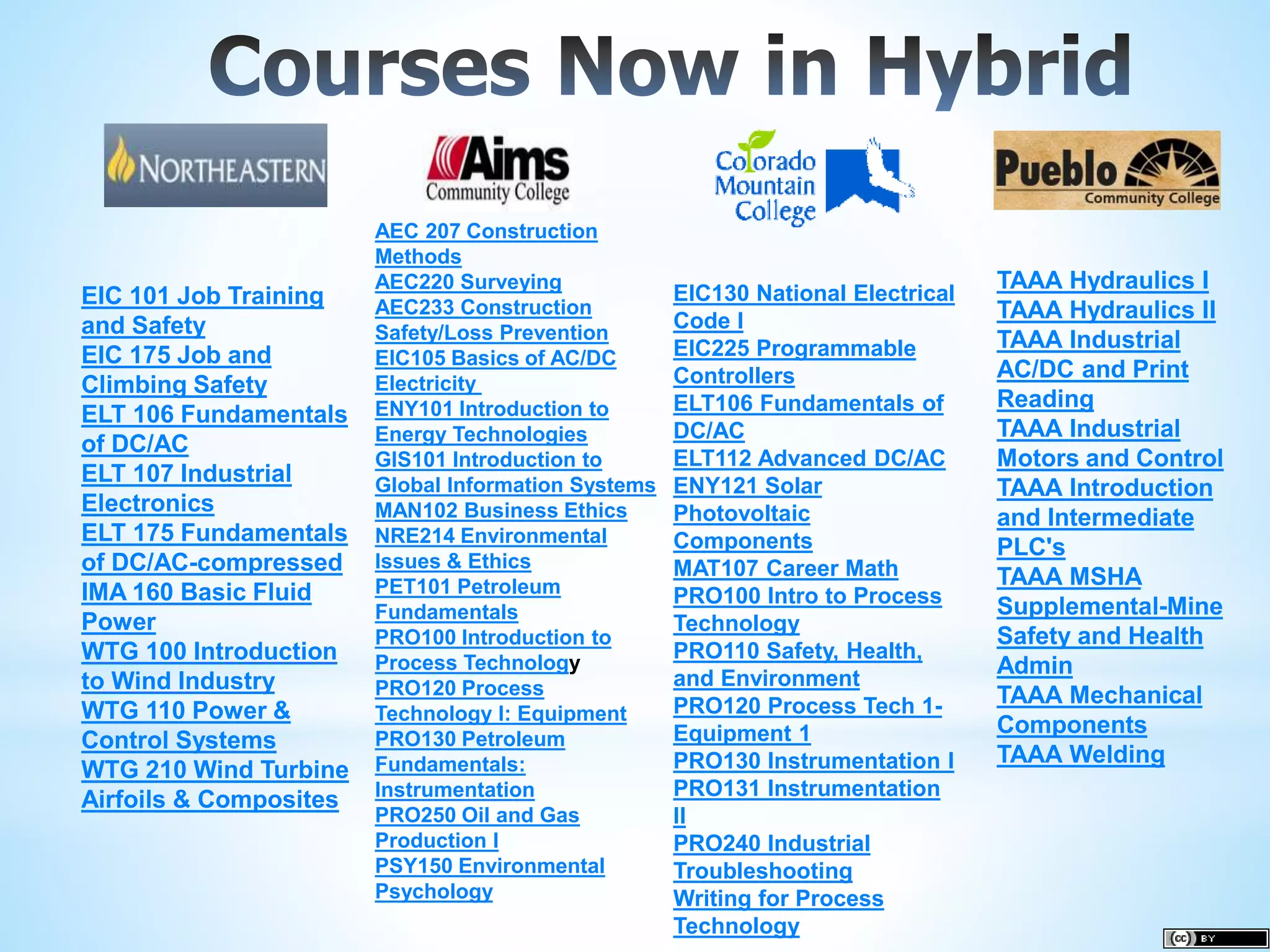
EIC130 National Electrical
Code I
EIC225 Programmable
Controllers
ELT106 Fundamentals of
DC/AC
ELT112 Advanced DC/AC
ENY121 Solar Photovoltaic
Components
PRO120 Process Tech 1-
Equipment 1
PRO130 Instrumentation I
PRO131 Instrumentation II
PRO240 Industrial
Troubleshooting
Hydraulics I
Hydraulics II
Industrial Motors and
Control
Introduction and
Intermediate PLC's
MSHA Supplemental-
Mine Safety and Health
Admin
Mechanical Components
Welding
ENY101 Introduction to Energy
Technologies
GIS101 Introduction to Global
Information Systems
MAN102 Business Ethics
NRE214 Environmental Issues &
Ethics
PET101 Petroleum Fundamentals
PRO120 Process Technology I:
Equipment
PRO130 Petroleum
Fundamentals: Instrumentation
PRO250 Oil and Gas Production I
PSY150 Environmental
Psychology
EIC 101 Job Training and
Safety
EIC 175 Job and Climbing
Safety
ELT 106 Fundamentals of
DC/AC
ELT 107 Industrial
Electronics
IMA 160 Basic Fluid
Power
WTG 100 Introduction to
Wind Industry
WTG 110 Power & Control
Systems
WTG 210 Wind Turbine
Airfoils & Composites
 Only 15 out of 122
course had been
converted to hybrid
format
 Due date for all 122
courses to be in
hybrid format Dec
2013
 We didn’t know what needed to be done before full
scale adoption
 Asking faculty to commit to a different teaching style
 At first, provided no training or resources to provide
pedagogy or help for converting courses
 There was NO detailed plan to convert a F2F
course to hybrid.
Analyzed Certificates and courses
Identified courses in currently in hybrid status
Selected:
Courses in certificates with high enrollment
F2F courses which could be “flipped”, delivered online, used
simulations, and where authentic assessment was needed for
certifications
Courses that could be shared between colleges to maximize
use of faculty time and reduce duplication of effort.
Created a course development plan with
benchmarks and deadlines
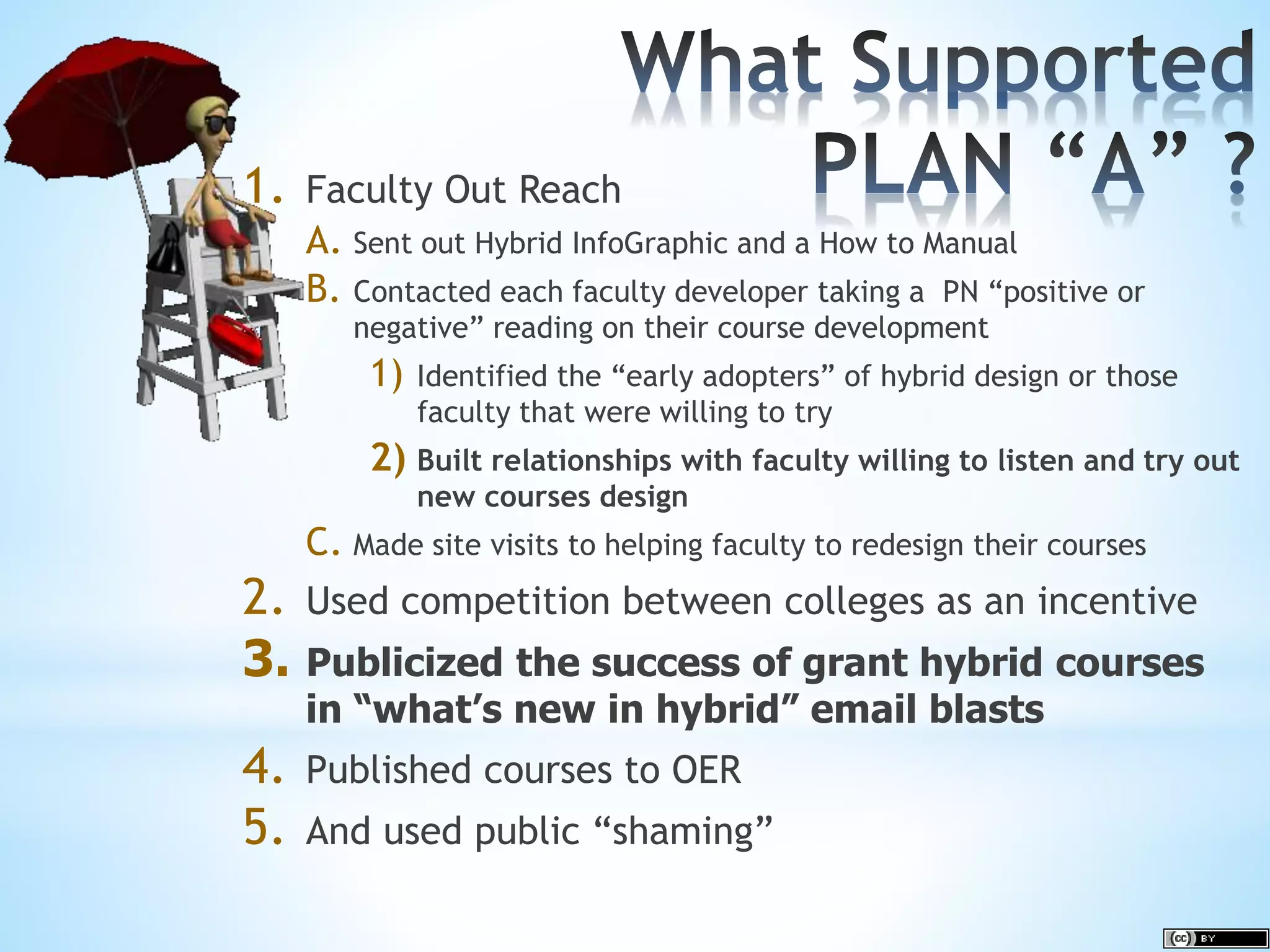
1. Faculty Out Reach
2. Course Mapping
3. “Chunking” the content
4. Used competition between colleges as an
incentive
5. Publicized the success of grant hybrid
courses in “what’s new in hybrid” email
blasts
6. Published courses to OER
7. And used public “shaming” within the
consortium
*When building the content:
*Create “snack-sized”
appetizers of Content
delivery
*Content
*Challenges and Activities
*Assessments
*Feedback
*Stack the appetizers into
full sized modules
19
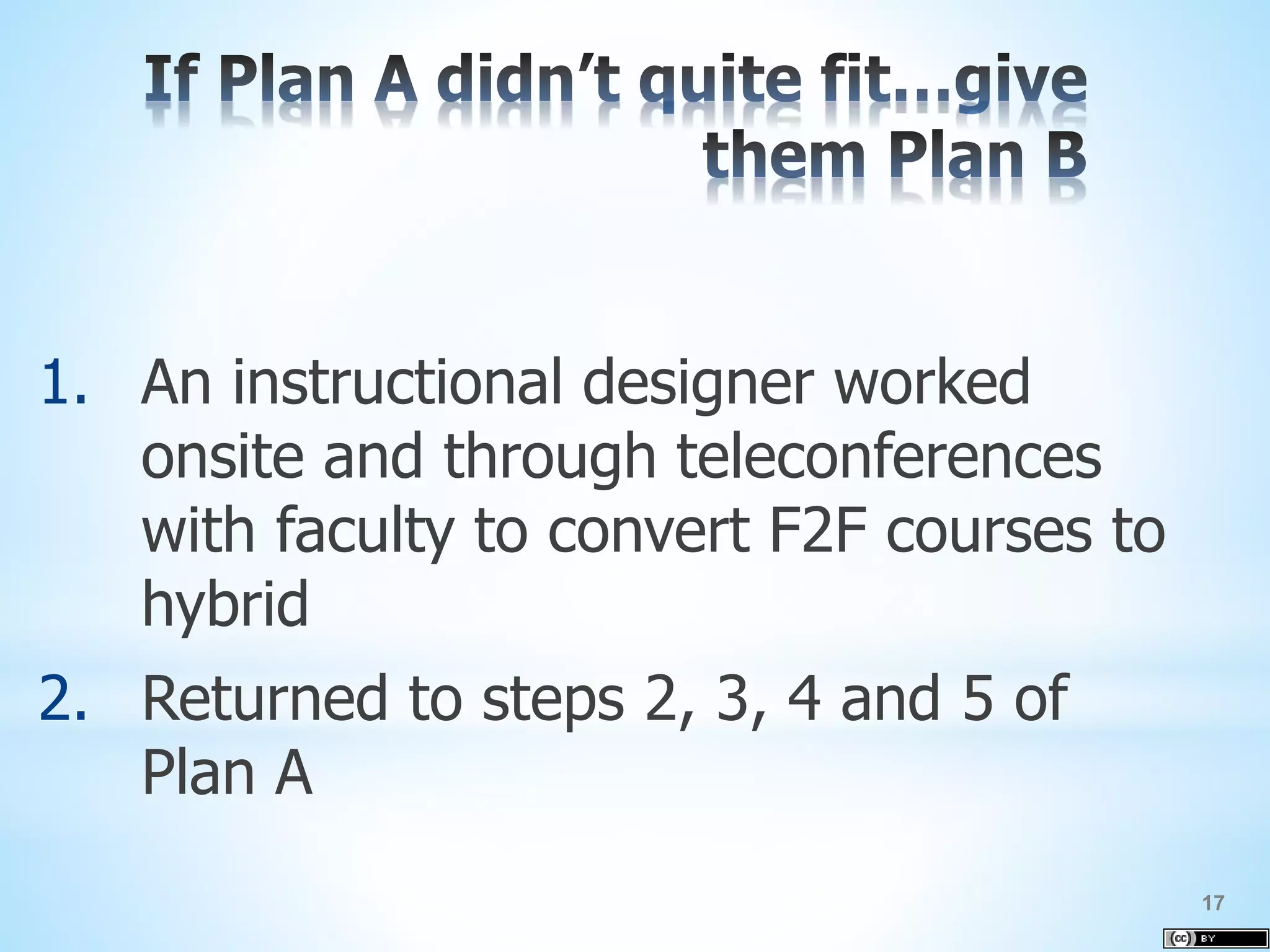
1. An instructional designer
worked onsite and through
teleconferences with faculty
to convert F2F courses to
hybrid
2. Returned to steps 2, 3, 4, 5,
6 and 7 of Plan A
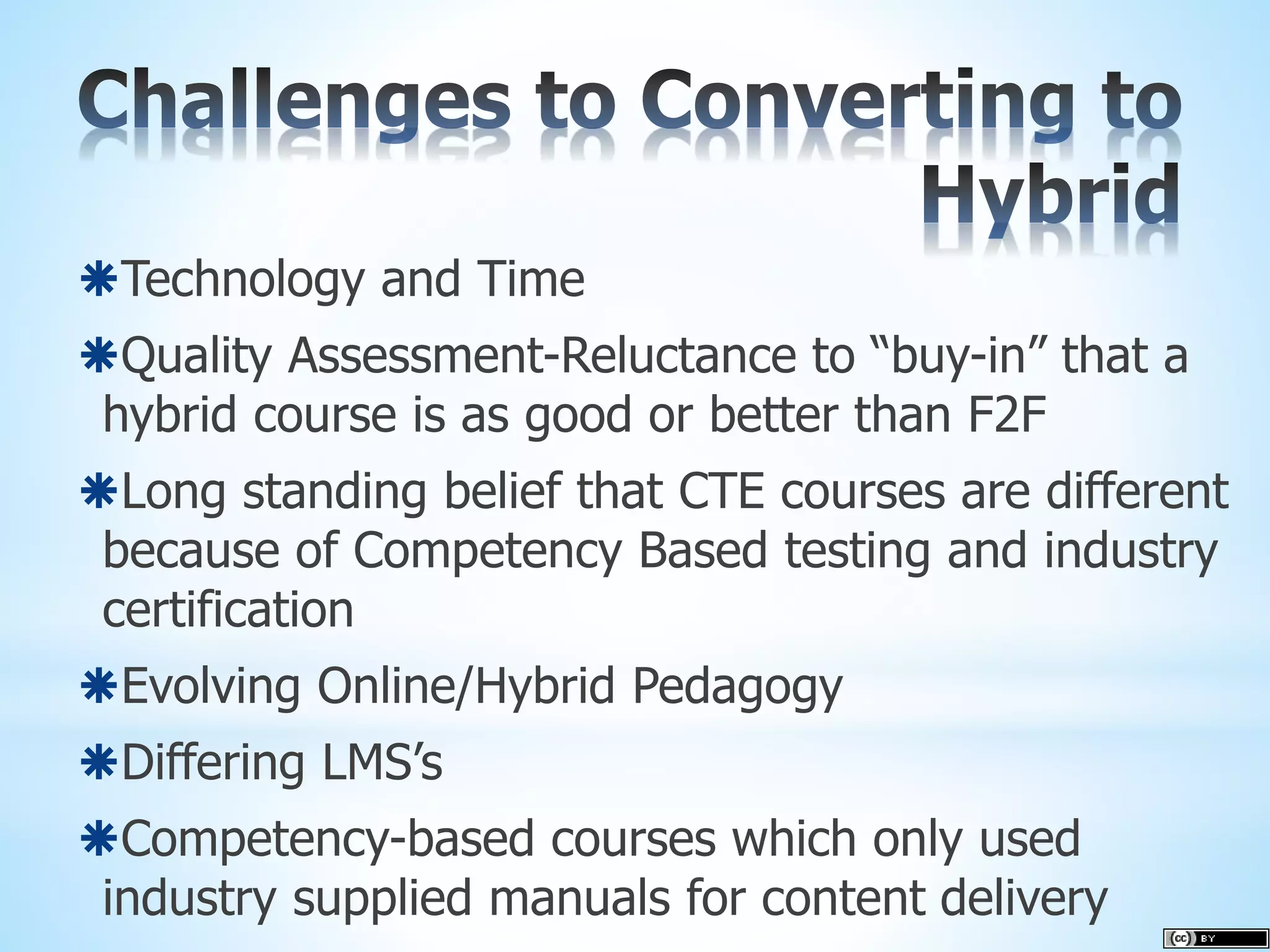
Technology and Time
Quality Assessment-Reluctance to “buy-in” that a hybrid
course is as good or better than F2F
Long standing belief that CTE courses are different
because of Competency Based testing and industry
certification
Evolving Online/Hybrid Pedagogy
Differing LMS’s
23
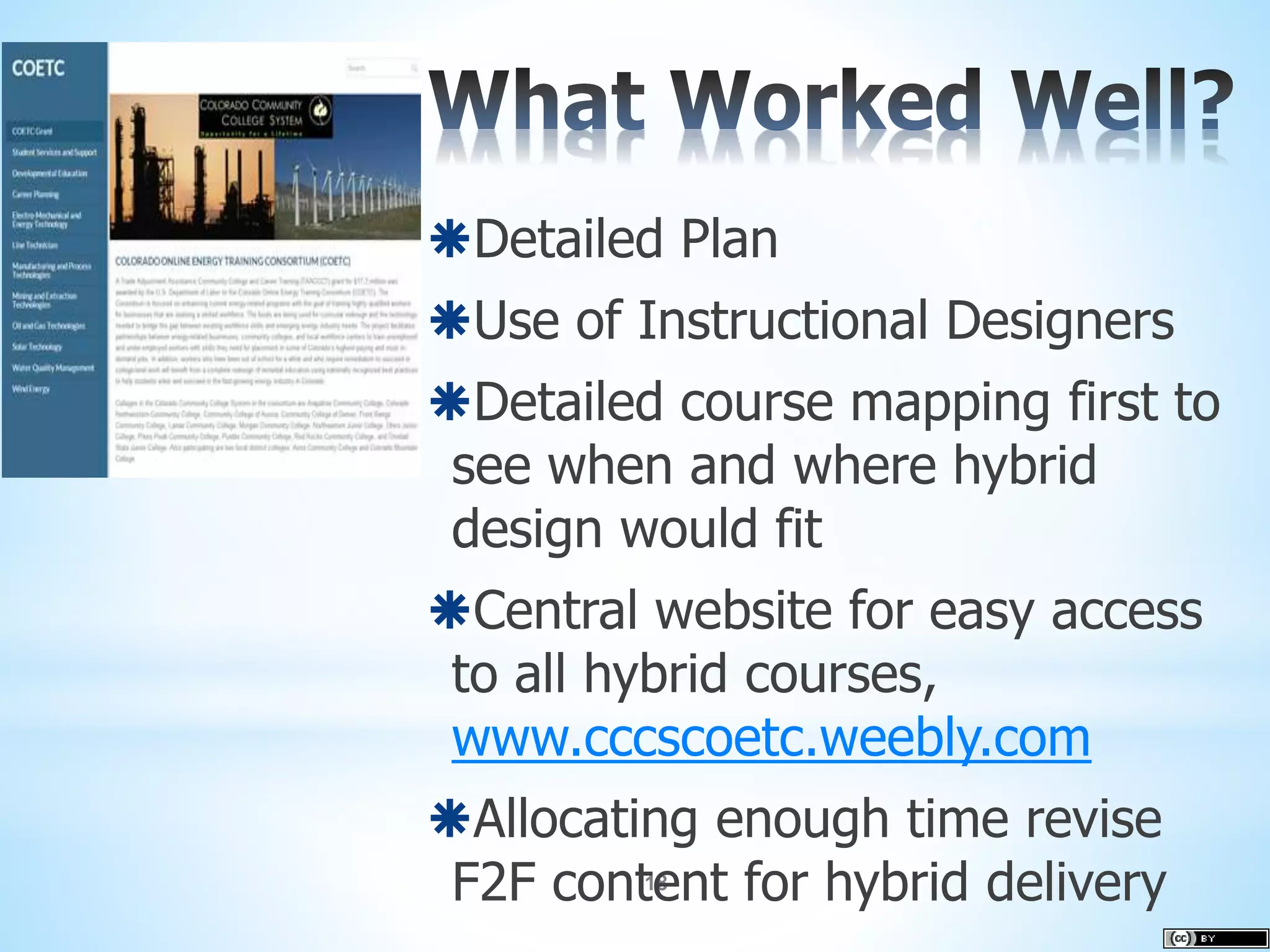
Detailed Plan
Use of Instructional Designers
Detailed course mapping first to see when
and where hybrid design would fit
Central website for easy access to all
hybrid courses, www.cccscoetc.weebly.com
Allocating enough time revise F2F content
for hybrid delivery
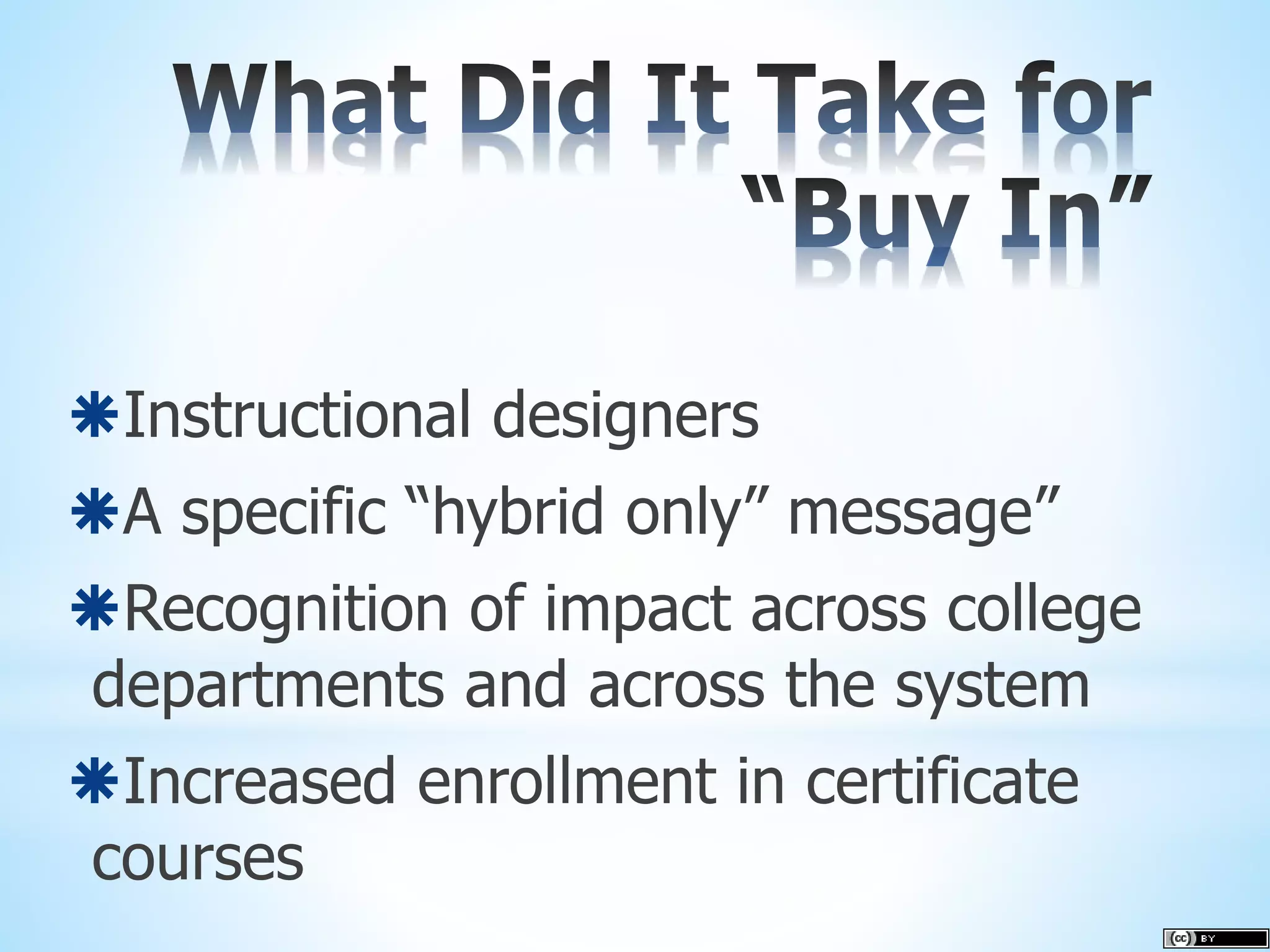
Instructional designers
A specific “hybrid only” message”
Recognition of impact across college
departments and across the system
Increased enrollment in certificate courses
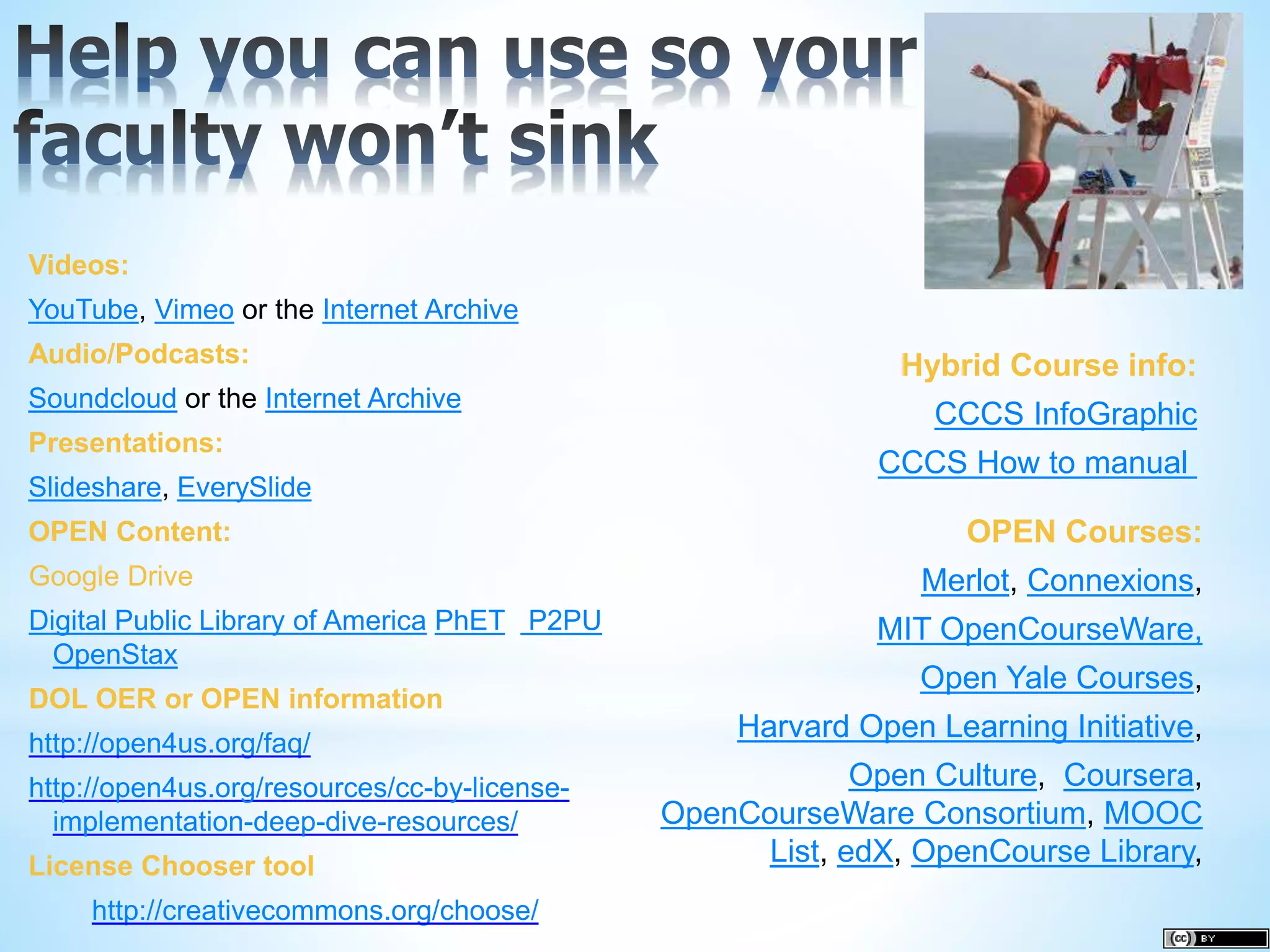
Videos:
YouTube, Vimeo or the Internet Archive
Audio/Podcasts:
Soundcloud or the Internet Archive
Presentations:
Slideshare, EverySlide
OPEN Content:
Google Drive
Digital Public Library of America PhET P2PU OpenStax
DOL OER or OPEN information
http://open4us.org/faq/
http://open4us.org/resources/cc-by-license-implementation-
deep-dive-resources/
OPEN Courses:
Merlot, Connexions,
MIT OpenCourseWare,
Open Yale Courses,
Harvard Open Learning Initiative,
Open Culture, Coursera, OpenCourseWare
Consortium, MOOC List, edX, OpenCourse Library,
Hybrid Course info:
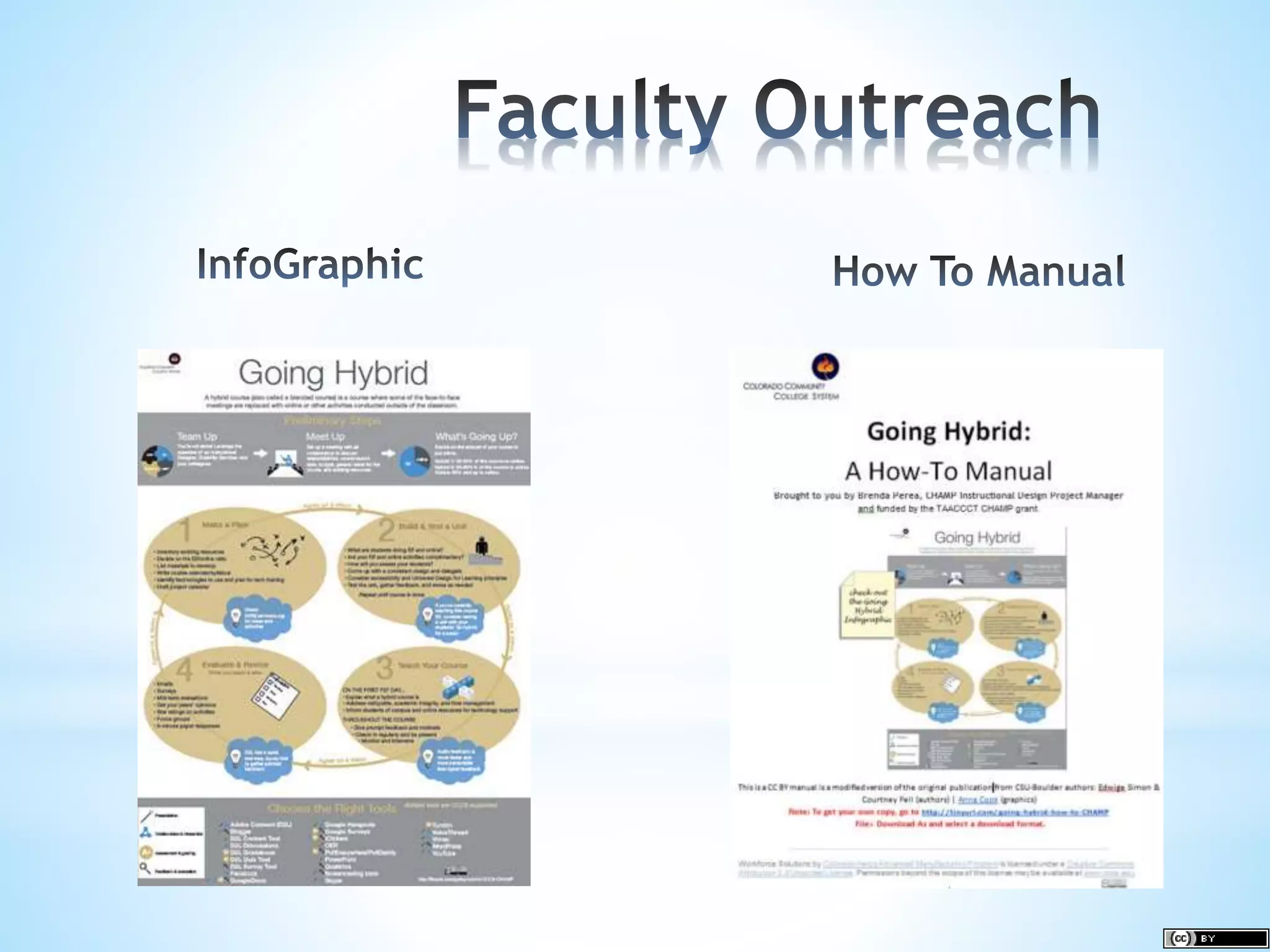
CCCS InfoGraphic
CCCS How to manual
► Open Educational Resources and Practices
► The Adoption of OER by One Community College Math Department
► OER Videos http://www.youtube.com/watch?v=1wgqQdYKjIM
http://www.iskme.org/category/tags/oer-research
► http://oer13.wordpress.com/2013/03/26/the-ecology-of-sharing-synthesizing-oer-research-rob-farrow/
► http://www.slideshare.net/robertfarrow/the-ecology-of-sharing-synthesizing-oer-research
► http://www.irrodl.org/index.php/irrodl/article/view/1523/2652
► http://www-jime.open.ac.uk/jime/article/viewArticle/2013-04/html
This Workforce Solution presentation created by Brenda M. Perea of the Colorado
Community College System COETC Grant is licensed under a Creative Commons
Attribution 3.0 Unported License. The material was created with funds from the
Trade Adjustment Assistance Community College and Career Training (TAACCCT)
Grant awarded to the Colorado Online Energy Training Consortium (COETC).Based
on a work at www.cccs.edu.Permissions beyond the scope of this license may be
available at www.cccs.edu.
27

Jumping Into the Deep End: CCCS' Success At Moving CTE Courses to Blended Courses

  • 1.
    CCCS’s Success atMoving CTE Courses to Blended Courses July 9, 2014 Presented by Brenda Perea Instructional Design Project Manager
  • 2.
    Provide more opportunityfor students to complete a certificate or degree Industry demands The TAACCCT1 grant required all COETC consortium members courses touched by the grant to be in online or hybrid format
  • 5.
    EIC130 National Electrical CodeI EIC225 Programmable Controllers ELT106 Fundamentals of DC/AC ELT112 Advanced DC/AC ENY121 Solar Photovoltaic Components PRO120 Process Tech 1- Equipment 1 PRO130 Instrumentation I PRO131 Instrumentation II PRO240 Industrial Troubleshooting Hydraulics I Hydraulics II Industrial Motors and Control Introduction and Intermediate PLC's MSHA Supplemental- Mine Safety and Health Admin Mechanical Components Welding ENY101 Introduction to Energy Technologies GIS101 Introduction to Global Information Systems MAN102 Business Ethics NRE214 Environmental Issues & Ethics PET101 Petroleum Fundamentals PRO120 Process Technology I: Equipment PRO130 Petroleum Fundamentals: Instrumentation PRO250 Oil and Gas Production I PSY150 Environmental Psychology EIC 101 Job Training and Safety EIC 175 Job and Climbing Safety ELT 106 Fundamentals of DC/AC ELT 107 Industrial Electronics IMA 160 Basic Fluid Power WTG 100 Introduction to Wind Industry WTG 110 Power & Control Systems WTG 210 Wind Turbine Airfoils & Composites
  • 11.
     Only 15out of 122 course had been converted to hybrid format  Due date for all 122 courses to be in hybrid format Dec 2013
  • 12.
     We didn’tknow what needed to be done before full scale adoption  Asking faculty to commit to a different teaching style  At first, provided no training or resources to provide pedagogy or help for converting courses  There was NO detailed plan to convert a F2F course to hybrid.
  • 14.
    Analyzed Certificates andcourses Identified courses in currently in hybrid status Selected: Courses in certificates with high enrollment F2F courses which could be “flipped”, delivered online, used simulations, and where authentic assessment was needed for certifications Courses that could be shared between colleges to maximize use of faculty time and reduce duplication of effort. Created a course development plan with benchmarks and deadlines
  • 15.
    1. Faculty OutReach 2. Course Mapping 3. “Chunking” the content 4. Used competition between colleges as an incentive 5. Publicized the success of grant hybrid courses in “what’s new in hybrid” email blasts 6. Published courses to OER 7. And used public “shaming” within the consortium
  • 18.
    *When building thecontent: *Create “snack-sized” appetizers of Content delivery *Content *Challenges and Activities *Assessments *Feedback *Stack the appetizers into full sized modules
  • 19.
    19 1. An instructionaldesigner worked onsite and through teleconferences with faculty to convert F2F courses to hybrid 2. Returned to steps 2, 3, 4, 5, 6 and 7 of Plan A
  • 22.
    Technology and Time QualityAssessment-Reluctance to “buy-in” that a hybrid course is as good or better than F2F Long standing belief that CTE courses are different because of Competency Based testing and industry certification Evolving Online/Hybrid Pedagogy Differing LMS’s
  • 23.
    23 Detailed Plan Use ofInstructional Designers Detailed course mapping first to see when and where hybrid design would fit Central website for easy access to all hybrid courses, www.cccscoetc.weebly.com Allocating enough time revise F2F content for hybrid delivery
  • 24.
    Instructional designers A specific“hybrid only” message” Recognition of impact across college departments and across the system Increased enrollment in certificate courses
  • 25.
    Videos: YouTube, Vimeo orthe Internet Archive Audio/Podcasts: Soundcloud or the Internet Archive Presentations: Slideshare, EverySlide OPEN Content: Google Drive Digital Public Library of America PhET P2PU OpenStax DOL OER or OPEN information http://open4us.org/faq/ http://open4us.org/resources/cc-by-license-implementation- deep-dive-resources/ OPEN Courses: Merlot, Connexions, MIT OpenCourseWare, Open Yale Courses, Harvard Open Learning Initiative, Open Culture, Coursera, OpenCourseWare Consortium, MOOC List, edX, OpenCourse Library, Hybrid Course info: CCCS InfoGraphic CCCS How to manual
  • 26.
    ► Open EducationalResources and Practices ► The Adoption of OER by One Community College Math Department ► OER Videos http://www.youtube.com/watch?v=1wgqQdYKjIM http://www.iskme.org/category/tags/oer-research ► http://oer13.wordpress.com/2013/03/26/the-ecology-of-sharing-synthesizing-oer-research-rob-farrow/ ► http://www.slideshare.net/robertfarrow/the-ecology-of-sharing-synthesizing-oer-research ► http://www.irrodl.org/index.php/irrodl/article/view/1523/2652 ► http://www-jime.open.ac.uk/jime/article/viewArticle/2013-04/html
  • 27.
    This Workforce Solutionpresentation created by Brenda M. Perea of the Colorado Community College System COETC Grant is licensed under a Creative Commons Attribution 3.0 Unported License. The material was created with funds from the Trade Adjustment Assistance Community College and Career Training (TAACCCT) Grant awarded to the Colorado Online Energy Training Consortium (COETC).Based on a work at www.cccs.edu.Permissions beyond the scope of this license may be available at www.cccs.edu. 27

Editor's Notes

  • #2 Opening the Gate: A Fast and Easy Way to Create, Collaborate, and Share Courses!
  • #3 Why did CCCS decided to convert CTE energy courses to hybrid? Provide more opportunity for students to complete a certificate or degree Industry demands The TAACCCT1 grant required all COETC consortium members courses touched by the grant to be in online or hybrid format
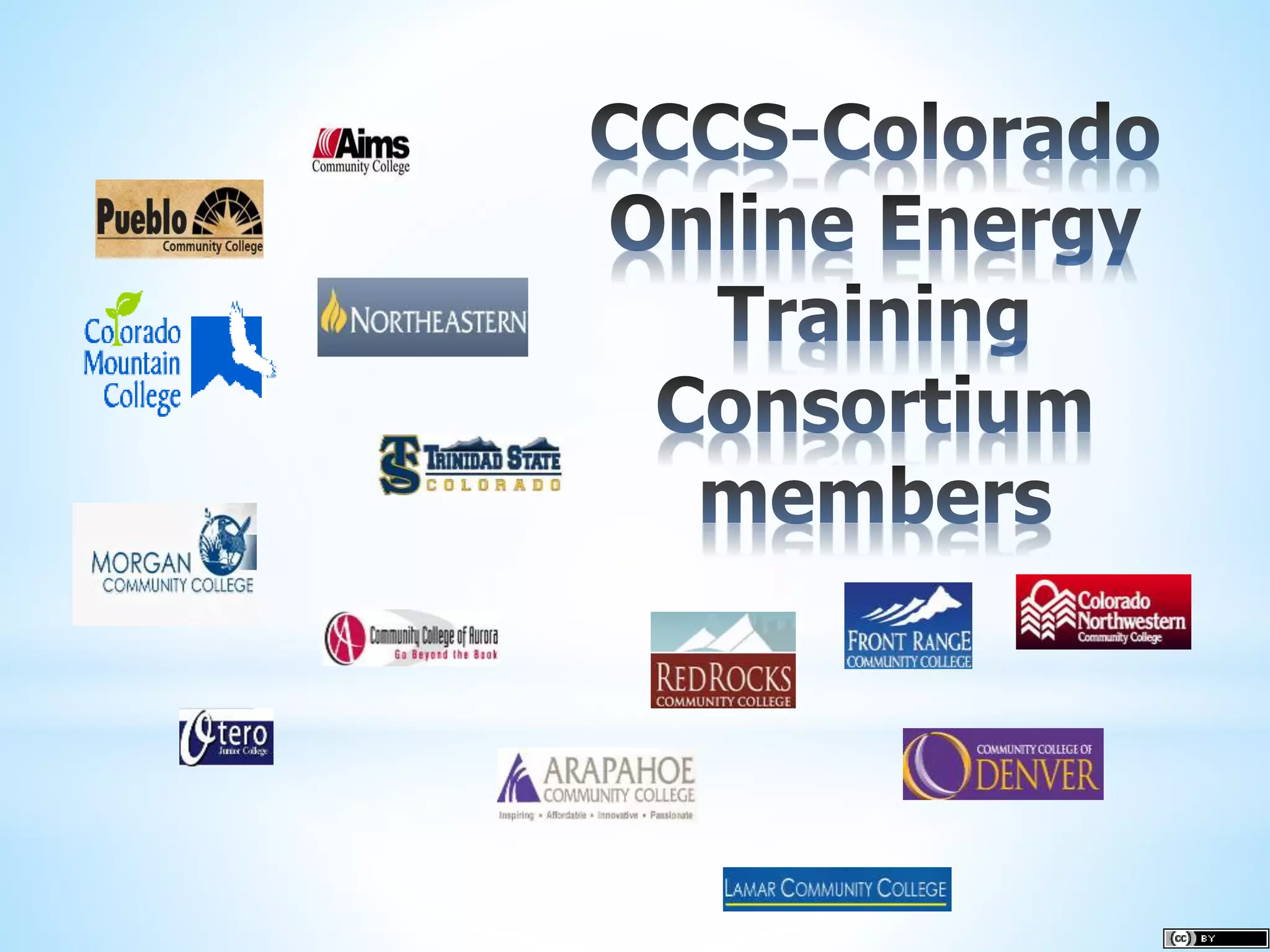
  • #4 CCCS-Colorado Online Energy Training Consortium members Our consortium had 16 colleges and we needed an cost efficient way to develop or revise 270 courses. Converting course to hybrid design had the same “bell curve” of the technology adoption curve: the early adopters eagerly submitted their courses whether they were “final editions” or rough drafts. As the website was built, more and more colleges, were peeking and willing to share. Instructors and institutions began to see similarities and differences and began contacting each other/other institutions for resources. That contact started a intrastate collaboration on course development, leading to several exemplary courses that are now being used system wide.
  • #5 Success to Date Aug 2012- 15 courses in hybrid Dec 2014- approximately 270
  • #6 Courses Now in Hybrid a sampling Aims Community College—Oil and Gas Technologies Pueblo Community College—Workforce Development in Mining and Extractive Technologies Colorado Mountain College—Solar Technology and Manufacturing Process Technologies Northeastern Junior College—Wind Energy Red Rocks Community College—Water Quality Management
  • #7 Line Person
  • #8 Solar and Process Technology
  • #9 Water Quality Management
  • #10 Oil and Gas Technology
  • #11 Wind Energy
  • #12 Situation Report Aug. 1 2013 Only 15 out of 122 course had been converted to hybrid format Due date for all 122 courses to be in hybrid format Dec 2013
  • #13 Why were we like a giraffe in a pool”? We didn’t know what needed to be done before full scale adoption Asking faculty to commit to a different teaching style At first, provided no training or resources to provide pedagogy or help for converting courses There was NO detailed plan to convert a F2F course to hybrid.
  • #14 How Did WE Avoid “Drowning” Analyzed Certificates and Courses And Created Plan A
  • #15 Plan A Analyzed Certificates and courses Identified courses in currently in hybrid status Selected: Courses in certificates with high enrollment F2F courses which could be “flipped”, delivered online, used simulations, and where authentic assessment was needed for certifications Courses that could be shared between colleges to maximize use of faculty time and reduce duplication of effort. Created a course development plan with benchmarks and deadlines
  • #16 What supported Plan A? Faculty Out Reach Course Mapping “Chunking” the content Used competition between colleges as an incentive Publicized the success of grant hybrid courses in “what’s new in hybrid” email blasts Published courses to OER And used public “shaming” within the consortium
  • #17 Faculty Outreach Info Graphic Sent out Hybrid InfoGraphic and a How to Manual Contacted each faculty developer taking a PN “positive or negative” reading on their course development Identified the “early adopters” of hybrid design or those faculty that were willing to try Built relationships with faculty willing to listen and try out new courses design Made site visits to helping faculty to redesign their courses
  • #18 Course Mapping Course Competencies Module topics Measurable Objectives Content, Activities, Challenges Assessment, Rubrics Feedback Publish to OER
  • #19 Chunk the Content When building the content: Create “snack-sized” appetizers of Content delivery Content Challenges and Activities Assessments Feedback Stack the appetizers into full sized modules
  • #20 If Plan A wasn’t quite right for a college…gave them plan B An instructional designer worked onsite and through teleconferences with faculty to convert F2F courses to hybrid Returned to steps 2, 3, 4 and 5 of Plan A
  • #21 Just when you thought it was safe in blended learning
  • #22 Was OER a “Hard Sell” Yes Instructors who taught by the textbook didn’t want to change. Instructors who were willing to move to hybrid were reluctant to then “share” their courses
  • #23 Challenges to Converting to Hybrid Technology Time Quality Assessment-Reluctance to “buy-in” that a hybrid course is as good or better than F2F Long standing belief that CTE courses are different because of Competency Based testing and industry certification Evolving Online/Hybrid Pedagogy Differing LMS’s Competency-based courses which only used industry supplied manuals for content delivery
  • #24 What Worked Well? Detailed Plan Use of Instructional Designers Central website for easy access to all hybrid courses, www.cccscoetc.weebly.com Allocating enough time revise F2F content for hybrid delivery Detailed course mapping first to see when and where OER fits into an existing course Course mapping new courses to ensure all competencies are list to find appropriate OER Central URL repository for easy access to OER sites Central website for OER index Multimedia hosted on an institution channel or institutional account Allocating enough time to search & revise content
  • #25 What did it Take for Buy in Instructional designers A specific “hybrid only” message” Recognition of impact across college departments and across the system Increased enrollment in certificate courses
  • #26 Tools an OER Superhero Uses in this Grant CHAMP Dashboard http://www.symbaloo.com/shared/AAAACMSNVS0AA42Agd4JvQ== OPEN Courses: Merlot, Connexions, MIT OpenCourseWare, Open Yale Courses, Harvard Open Learning Initiative, Open Culture, Coursera, OpenCourseWare Consortium, MOOC List, edX, OpenCourse Library, Videos: YouTube, Vimeo or the Internet Archive Audio/Podcasts: Soundcloud or the Internet Archive Presentations: Slideshare OPEN Content: Google Drive Digital Public Library of America PhET P2PU OpenStax DOL OER or OPEN information http://open4us.org/faq/ http://open4us.org/resources/cc-by-license-implementation-deep-dive-resources/
  • #27 Open Educational Resources and Practices The Adoption of OER by One Community College Math Department OER Video   http://www.youtube.com/watch?v=1wgqQdYKjIM http://www.iskme.org/category/tags/oer-research http://oer13.wordpress.com/2013/03/26/the-ecology-of-sharing-synthesizing-oer-research-rob-farrow/ http://www.slideshare.net/robertfarrow/the-ecology-of-sharing-synthesizing-oer-research http://www.irrodl.org/index.php/irrodl/article/view/1523/2652 http://www-jime.open.ac.uk/jime/article/viewArticle/2013-04/html
  • #28  Creative Commons Attribution This Workforce Solution created by Colorado Community College System COETC Grant is licensed under a Creative Commons Attribution 3.0 Unported License. The material was created with funds from the Trade Adjustment Assistance Community College and Career Training (TAACCCT) Grant awarded to the Colorado Online Energy Training Consortium (COETC).Based on a work at www.cccs.edu.Permissions