Redesign
Decision
Making
Implementation Planning
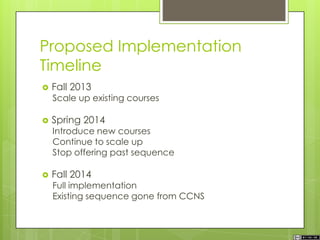
Proposed Implementation
Timeline
 Fall 2013
Scale up existing courses
 Spring 2014
Introduce new courses
Continue to scale up
Stop offering past sequence
 Fall 2014
Full implementation
Existing sequence gone from CCNS
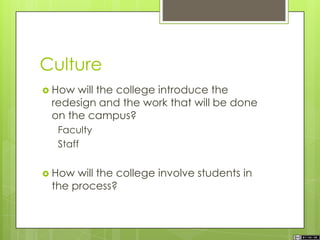
Culture
 How will the college introduce the
redesign and the work that will be done
on the campus?
Faculty
Staff
 How will the college involve students in
the process?
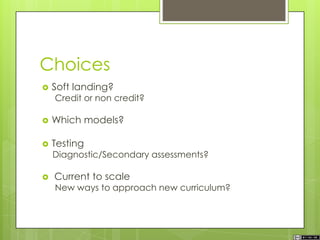
Choices
 Soft landing?
Credit or non credit?
 Which models?
 Testing
Diagnostic/Secondary assessments?
 Current to scale
New ways to approach new curriculum?
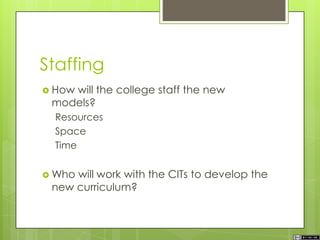
Staffing
 How will the college staff the new
models?
Resources
Space
Time
 Who will work with the CITs to develop the
new curriculum?
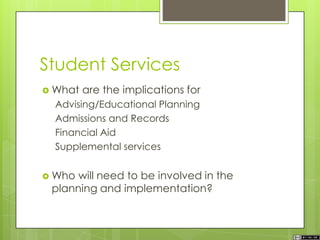
Student Services
 What are the implications for
Advising/Educational Planning
Admissions and Records
Financial Aid
Supplemental services
 Who will need to be involved in the
planning and implementation?
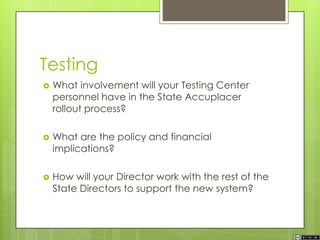
Testing
 What involvement will your Testing Center
personnel have in the State Accuplacer
rollout process?
 What are the policy and financial
implications?
 How will your Director work with the rest of the
State Directors to support the new system?
What is your timeline?
Introduction to the campus
Catalog and schedule changes
Curricular development
Training
Steps to full implementation
What are the barriers?
 Identify roadblocks
State statute
CCCS
Institution
 Banner issues and planning
Faculty
 How will Developmental Education
faculty be involved in the planning and
implementation?
 How will the college involve transfer
faculty?
 Are there any credentialing issues?
Institutional decision making
Resources
 What resources does the college need to
allocate for implementation?
 How will TAA funds be used for the
process?
 How will the college plan for the fiscal
changes in the first three years of
implementation?
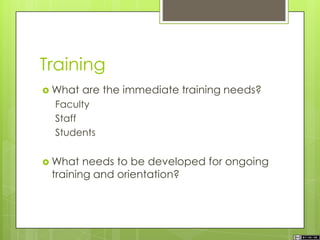
Training
 What are the immediate training needs?
Faculty
Staff
Students
 What needs to be developed for ongoing
training and orientation?
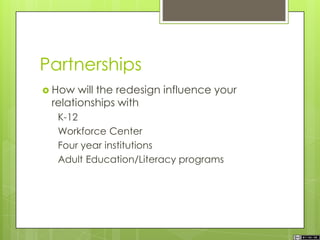
Partnerships
 How will the redesign influence your
relationships with
K-12
Workforce Center
Four year institutions
Adult Education/Literacy programs
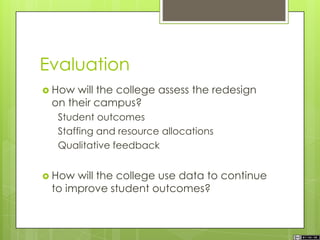
Evaluation
 How will the college assess the redesign
on their campus?
Student outcomes
Staffing and resource allocations
Qualitative feedback
 How will the college use data to continue
to improve student outcomes?
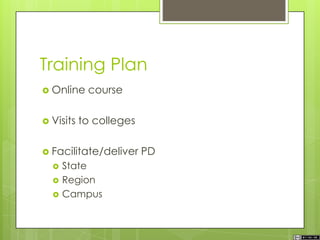
Training Plan
 Online course
 Visits to colleges
 Facilitate/deliver PD
 State
 Region
 Campus
Creative Commons
Attribution
Unless otherwise specified, this work by the Colorado Community College System http://www.cccs.edu is licensed
under a Creative Commons Attribution-NonCommercial-ShareAlike 3.0 United States License. The material was
created with funds from the Trade Adjustment Assistance Community College and Career Training (TAACCCT)
Grant awarded to the Colorado Online Energy Training Consortium (COETC).

DETF presentation 1 4 13

  • 1.
  • 2.
    Proposed Implementation Timeline  Fall2013 Scale up existing courses  Spring 2014 Introduce new courses Continue to scale up Stop offering past sequence  Fall 2014 Full implementation Existing sequence gone from CCNS
  • 3.
    Culture  How willthe college introduce the redesign and the work that will be done on the campus? Faculty Staff  How will the college involve students in the process?
  • 4.
    Choices  Soft landing? Creditor non credit?  Which models?  Testing Diagnostic/Secondary assessments?  Current to scale New ways to approach new curriculum?
  • 5.
    Staffing  How willthe college staff the new models? Resources Space Time  Who will work with the CITs to develop the new curriculum?
  • 6.
    Student Services  Whatare the implications for Advising/Educational Planning Admissions and Records Financial Aid Supplemental services  Who will need to be involved in the planning and implementation?
  • 7.
    Testing  What involvementwill your Testing Center personnel have in the State Accuplacer rollout process?  What are the policy and financial implications?  How will your Director work with the rest of the State Directors to support the new system?
  • 8.
    What is yourtimeline? Introduction to the campus Catalog and schedule changes Curricular development Training Steps to full implementation
  • 9.
    What are thebarriers?  Identify roadblocks State statute CCCS Institution  Banner issues and planning
  • 10.
    Faculty  How willDevelopmental Education faculty be involved in the planning and implementation?  How will the college involve transfer faculty?  Are there any credentialing issues? Institutional decision making
  • 11.
    Resources  What resourcesdoes the college need to allocate for implementation?  How will TAA funds be used for the process?  How will the college plan for the fiscal changes in the first three years of implementation?
  • 12.
    Training  What arethe immediate training needs? Faculty Staff Students  What needs to be developed for ongoing training and orientation?
  • 13.
    Partnerships  How willthe redesign influence your relationships with K-12 Workforce Center Four year institutions Adult Education/Literacy programs
  • 14.
    Evaluation  How willthe college assess the redesign on their campus? Student outcomes Staffing and resource allocations Qualitative feedback  How will the college use data to continue to improve student outcomes?
  • 15.
    Training Plan  Onlinecourse  Visits to colleges  Facilitate/deliver PD  State  Region  Campus
  • 16.
    Creative Commons Attribution Unless otherwisespecified, this work by the Colorado Community College System http://www.cccs.edu is licensed under a Creative Commons Attribution-NonCommercial-ShareAlike 3.0 United States License. The material was created with funds from the Trade Adjustment Assistance Community College and Career Training (TAACCCT) Grant awarded to the Colorado Online Energy Training Consortium (COETC).