Garrett Morris
Director – Client Services Group
Sageworks
Date of Last Revision: 9/18/2015
Date of Last Review: 9/18/2015
• Important data collection elements
• Information technology and security
• Data storage
• Loan portfolio information
• Data for ASC 310-10-35 calculations
• Data for ASC 450-20 calculations
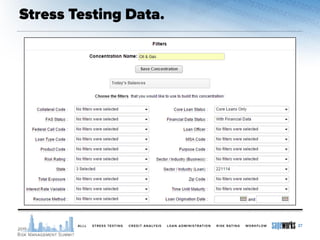
• Stress testing data
• Preparing for FASB’s CECL model
• Utilizing data, knowing your clients, knowing your loan portfolio
2
• The 2006 Interagency Policy Statement articulates:
“The ALLL represents one of the most significant estimates in an institution’s
financial statements and regulatory reports… each institution has a responsibility
for developing, maintaining, and documenting a comprehensive, systematic, and
consistently applied process for determining the amounts of the ALLL and the
provision for loan and lease losses.”
3
• Data access
• Data availability – redundancy and backups
• Disaster recovery and business continuity strategy
• Data security – Internal
• Strong security awareness program
• Data security outside your organization
4
U
5
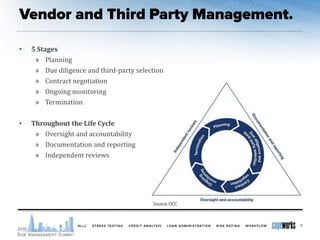
• 5 Stages
» Planning
» Due diligence and third-party selection
» Contract negotiation
» Ongoing monitoring
» Termination
• Throughout the Life Cycle
» Oversight and accountability
» Documentation and reporting
» Independent reviews
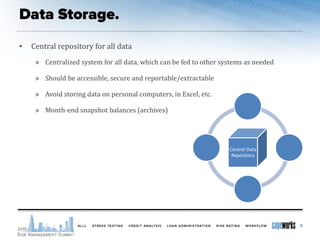
• Central repository for all data
» Centralized system for all data, which can be fed to other systems as needed
» Should be accessible, secure and reportable/extractable
» Avoid storing data on personal computers, in Excel, etc.
» Month-end snapshot balances (archives)
6
Central Data
Repository
• Types of data for the ALLL
» Detailed loan data
• ASC 450-20 / FAS 5 segment
• Risk rating, GL balance, etc. ~30-40 fields
» Basic collateral data (collateral type, appraisal date, appraisal value)
» Basic customer data (name, total checking/savings balance, industry, etc.)
7
• Antiquated or otherwise limited bank core
» Pursue core systems with flexible data and reporting features
• Internal bank issues
» Disjointed or conflicting operations, policies and processes
» Lack of uniformity with information
• Collateral data gathering and storage
• ASC 310-10-35 (formerly known as FAS 114)
» Proper training of staff
» Data integrity
8
9
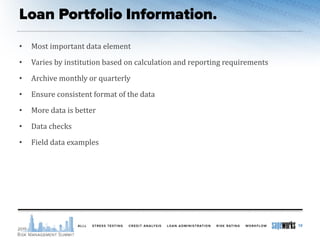
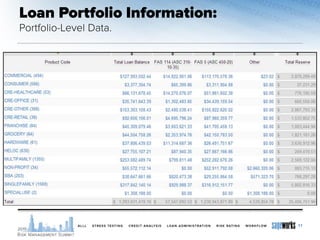
• Most important data element
• Varies by institution based on calculation and reporting requirements
• Archive monthly or quarterly
• Ensure consistent format of the data
• More data is better
• Data checks
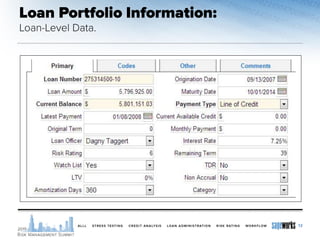
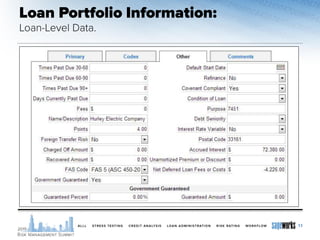
• Field data examples
10
11
12
13
14
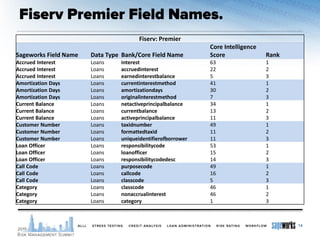
Fiserv: Premier
Sageworks Field Name Data Type Bank/Core Field Name
Core Intelligence
Score Rank
Accrued Interest Loans interest 63 1
Accrued Interest Loans accruedinterest 22 2
Accrued Interest Loans earnedinterestbalance 5 3
Amortization Days Loans currentinterestmethod 41 1
Amortization Days Loans amortizationdays 30 2
Amortization Days Loans originalinterestmethod 7 3
Current Balance Loans netactiveprincipalbalance 34 1
Current Balance Loans currentbalance 13 2
Current Balance Loans activeprincipalbalance 11 3
Customer Number Loans taxidnumber 49 1
Customer Number Loans formattedtaxid 11 2
Customer Number Loans uniqueidentifierofborrower 11 3
Loan Officer Loans responsibilitycode 53 1
Loan Officer Loans loanofficer 15 2
Loan Officer Loans responsibilitycodedesc 14 3
Call Code Loans purposecode 49 1
Call Code Loans callcode 16 2
Call Code Loans classcode 5 3
Category Loans classcode 46 1
Category Loans nonaccrualinterest 46 2
Category Loans category 1 3
15
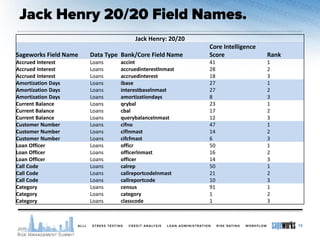
Jack Henry: 20/20
Sageworks Field Name Data Type Bank/Core Field Name
Core Intelligence
Score Rank
Accrued Interest Loans accint 41 1
Accrued Interest Loans accruedinterestlnmast 28 2
Accrued Interest Loans accruedinterest 18 3
Amortization Days Loans ibase 27 1
Amortization Days Loans interestbaselnmast 27 2
Amortization Days Loans amortizationdays 8 3
Current Balance Loans qrybal 23 1
Current Balance Loans cbal 17 2
Current Balance Loans querybalancelnmast 12 3
Customer Number Loans cifno 47 1
Customer Number Loans ciflnmast 14 2
Customer Number Loans cifcfmast 6 3
Loan Officer Loans officr 50 1
Loan Officer Loans officerlnmast 16 2
Loan Officer Loans officer 14 3
Call Code Loans calrep 50 1
Call Code Loans callreportcodelnmast 21 2
Call Code Loans callreportcode 10 3
Category Loans census 91 1
Category Loans category 1 2
Category Loans classcode 1 3
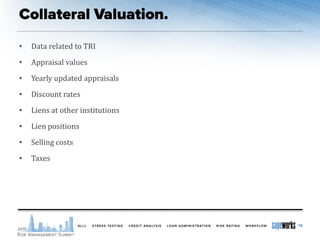
• Data related to TRI
• Appraisal values
• Yearly updated appraisals
• Discount rates
• Liens at other institutions
• Lien positions
• Selling costs
• Taxes
16
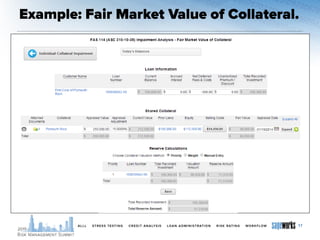
17
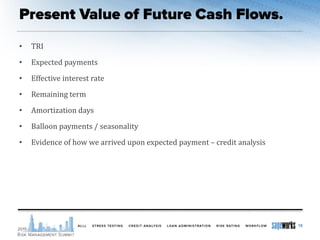
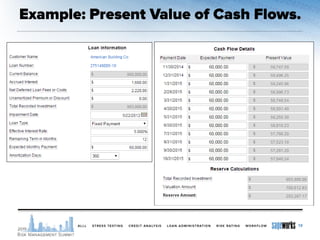
• TRI
• Expected payments
• Effective interest rate
• Remaining term
• Amortization days
• Balloon payments / seasonality
• Evidence of how we arrived upon expected payment – credit analysis
18
19
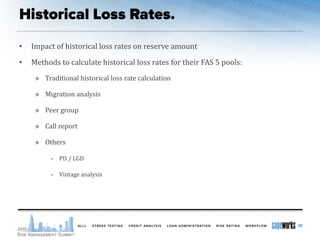
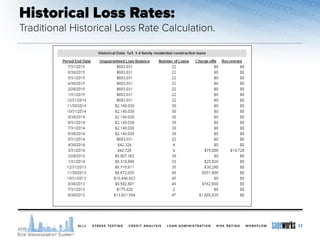
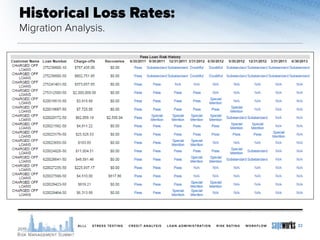
• Impact of historical loss rates on reserve amount
• Methods to calculate historical loss rates for their FAS 5 pools:
» Traditional historical loss rate calculation
» Migration analysis
» Peer group
» Call report
» Others
• PD / LGD
• Vintage analysis
20
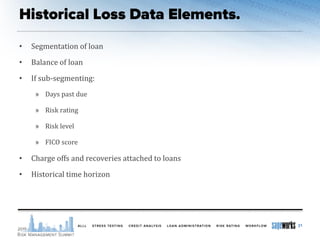
• Segmentation of loan
• Balance of loan
• If sub-segmenting:
» Days past due
» Risk rating
» Risk level
» FICO score
• Charge offs and recoveries attached to loans
• Historical time horizon
21
22
23
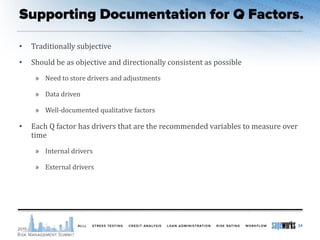
• Traditionally subjective
• Should be as objective and directionally consistent as possible
» Need to store drivers and adjustments
» Data driven
» Well-documented qualitative factors
• Each Q factor has drivers that are the recommended variables to measure over
time
» Internal drivers
» External drivers
24
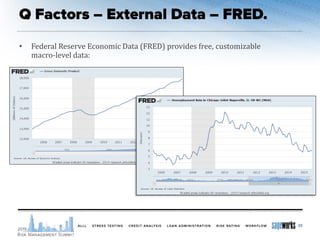
• Federal Reserve Economic Data (FRED) provides free, customizable
macro-level data:
25
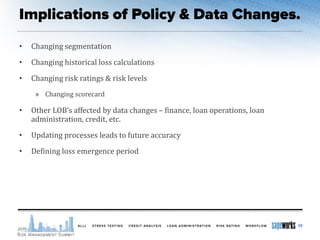
• Changing segmentation
• Changing historical loss calculations
• Changing risk ratings & risk levels
» Changing scorecard
• Other LOB’s affected by data changes – finance, loan operations, loan
administration, credit, etc.
• Updating processes leads to future accuracy
• Defining loss emergence period
26
27
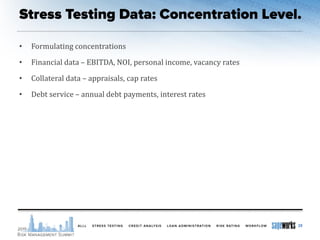
• Formulating concentrations
• Financial data – EBITDA, NOI, personal income, vacancy rates
• Collateral data – appraisals, cap rates
• Debt service – annual debt payments, interest rates
28
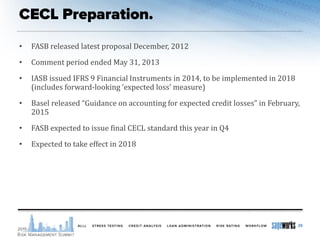
• FASB released latest proposal December, 2012
• Comment period ended May 31, 2013
• IASB issued IFRS 9 Financial Instruments in 2014, to be implemented in 2018
(includes forward-looking ‘expected loss’ measure)
• Basel released “Guidance on accounting for expected credit losses” in February,
2015
• FASB expected to issue final CECL standard this year in Q4
• Expected to take effect in 2018
29
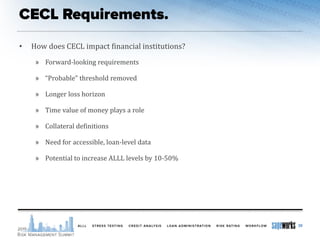
• How does CECL impact financial institutions?
» Forward-looking requirements
» “Probable” threshold removed
» Longer loss horizon
» Time value of money plays a role
» Collateral definitions
» Need for accessible, loan-level data
» Potential to increase ALLL levels by 10-50%
30
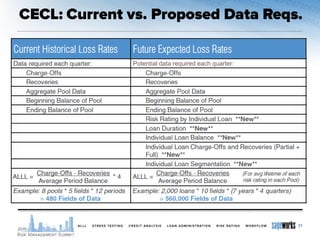
31
Potential data required each quarter:
32
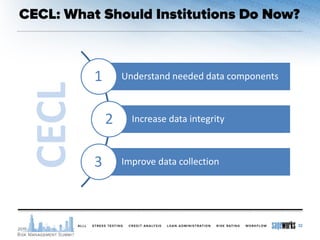
Understand needed data components
Increase data integrity
Improve data collection
CECL 1
2
3
• More defensible, documented calculations
• Enhanced reconciliation capabilities
• Perform more robust data analysis
» Stress Testing / Scenario Building
» Migration analysis
» PD / LGD
» Backtesting
• Reduce future subjectivity
• Enhanced reporting capability
• Advising on risk strategy
33
Director – Client Services Group
garrett.morris@Sageworks.com
984.242.2568
34
• ALLL Forum for Bankers
• Commercial Credit Risk Professionals
• www.sageworksanalyst.com
• www.alll.com
• Whitepapers, webinars,
thought leadership

ALLL Data Management - 2015 Risk Management Summit

  • 1.
    Garrett Morris Director –Client Services Group Sageworks Date of Last Revision: 9/18/2015 Date of Last Review: 9/18/2015
  • 2.
    • Important datacollection elements • Information technology and security • Data storage • Loan portfolio information • Data for ASC 310-10-35 calculations • Data for ASC 450-20 calculations • Stress testing data • Preparing for FASB’s CECL model • Utilizing data, knowing your clients, knowing your loan portfolio 2
  • 3.
    • The 2006Interagency Policy Statement articulates: “The ALLL represents one of the most significant estimates in an institution’s financial statements and regulatory reports… each institution has a responsibility for developing, maintaining, and documenting a comprehensive, systematic, and consistently applied process for determining the amounts of the ALLL and the provision for loan and lease losses.” 3
  • 4.
    • Data access •Data availability – redundancy and backups • Disaster recovery and business continuity strategy • Data security – Internal • Strong security awareness program • Data security outside your organization 4 U
  • 5.
    5 • 5 Stages »Planning » Due diligence and third-party selection » Contract negotiation » Ongoing monitoring » Termination • Throughout the Life Cycle » Oversight and accountability » Documentation and reporting » Independent reviews
  • 6.
    • Central repositoryfor all data » Centralized system for all data, which can be fed to other systems as needed » Should be accessible, secure and reportable/extractable » Avoid storing data on personal computers, in Excel, etc. » Month-end snapshot balances (archives) 6 Central Data Repository
  • 7.
    • Types ofdata for the ALLL » Detailed loan data • ASC 450-20 / FAS 5 segment • Risk rating, GL balance, etc. ~30-40 fields » Basic collateral data (collateral type, appraisal date, appraisal value) » Basic customer data (name, total checking/savings balance, industry, etc.) 7
  • 8.
    • Antiquated orotherwise limited bank core » Pursue core systems with flexible data and reporting features • Internal bank issues » Disjointed or conflicting operations, policies and processes » Lack of uniformity with information • Collateral data gathering and storage • ASC 310-10-35 (formerly known as FAS 114) » Proper training of staff » Data integrity 8
  • 9.
  • 10.
    • Most importantdata element • Varies by institution based on calculation and reporting requirements • Archive monthly or quarterly • Ensure consistent format of the data • More data is better • Data checks • Field data examples 10
  • 11.
  • 12.
  • 13.
  • 14.
    14 Fiserv: Premier Sageworks FieldName Data Type Bank/Core Field Name Core Intelligence Score Rank Accrued Interest Loans interest 63 1 Accrued Interest Loans accruedinterest 22 2 Accrued Interest Loans earnedinterestbalance 5 3 Amortization Days Loans currentinterestmethod 41 1 Amortization Days Loans amortizationdays 30 2 Amortization Days Loans originalinterestmethod 7 3 Current Balance Loans netactiveprincipalbalance 34 1 Current Balance Loans currentbalance 13 2 Current Balance Loans activeprincipalbalance 11 3 Customer Number Loans taxidnumber 49 1 Customer Number Loans formattedtaxid 11 2 Customer Number Loans uniqueidentifierofborrower 11 3 Loan Officer Loans responsibilitycode 53 1 Loan Officer Loans loanofficer 15 2 Loan Officer Loans responsibilitycodedesc 14 3 Call Code Loans purposecode 49 1 Call Code Loans callcode 16 2 Call Code Loans classcode 5 3 Category Loans classcode 46 1 Category Loans nonaccrualinterest 46 2 Category Loans category 1 3
  • 15.
    15 Jack Henry: 20/20 SageworksField Name Data Type Bank/Core Field Name Core Intelligence Score Rank Accrued Interest Loans accint 41 1 Accrued Interest Loans accruedinterestlnmast 28 2 Accrued Interest Loans accruedinterest 18 3 Amortization Days Loans ibase 27 1 Amortization Days Loans interestbaselnmast 27 2 Amortization Days Loans amortizationdays 8 3 Current Balance Loans qrybal 23 1 Current Balance Loans cbal 17 2 Current Balance Loans querybalancelnmast 12 3 Customer Number Loans cifno 47 1 Customer Number Loans ciflnmast 14 2 Customer Number Loans cifcfmast 6 3 Loan Officer Loans officr 50 1 Loan Officer Loans officerlnmast 16 2 Loan Officer Loans officer 14 3 Call Code Loans calrep 50 1 Call Code Loans callreportcodelnmast 21 2 Call Code Loans callreportcode 10 3 Category Loans census 91 1 Category Loans category 1 2 Category Loans classcode 1 3
  • 16.
    • Data relatedto TRI • Appraisal values • Yearly updated appraisals • Discount rates • Liens at other institutions • Lien positions • Selling costs • Taxes 16
  • 17.
  • 18.
    • TRI • Expectedpayments • Effective interest rate • Remaining term • Amortization days • Balloon payments / seasonality • Evidence of how we arrived upon expected payment – credit analysis 18
  • 19.
  • 20.
    • Impact ofhistorical loss rates on reserve amount • Methods to calculate historical loss rates for their FAS 5 pools: » Traditional historical loss rate calculation » Migration analysis » Peer group » Call report » Others • PD / LGD • Vintage analysis 20
  • 21.
    • Segmentation ofloan • Balance of loan • If sub-segmenting: » Days past due » Risk rating » Risk level » FICO score • Charge offs and recoveries attached to loans • Historical time horizon 21
  • 22.
  • 23.
  • 24.
    • Traditionally subjective •Should be as objective and directionally consistent as possible » Need to store drivers and adjustments » Data driven » Well-documented qualitative factors • Each Q factor has drivers that are the recommended variables to measure over time » Internal drivers » External drivers 24
  • 25.
    • Federal ReserveEconomic Data (FRED) provides free, customizable macro-level data: 25
  • 26.
    • Changing segmentation •Changing historical loss calculations • Changing risk ratings & risk levels » Changing scorecard • Other LOB’s affected by data changes – finance, loan operations, loan administration, credit, etc. • Updating processes leads to future accuracy • Defining loss emergence period 26
  • 27.
  • 28.
    • Formulating concentrations •Financial data – EBITDA, NOI, personal income, vacancy rates • Collateral data – appraisals, cap rates • Debt service – annual debt payments, interest rates 28
  • 29.
    • FASB releasedlatest proposal December, 2012 • Comment period ended May 31, 2013 • IASB issued IFRS 9 Financial Instruments in 2014, to be implemented in 2018 (includes forward-looking ‘expected loss’ measure) • Basel released “Guidance on accounting for expected credit losses” in February, 2015 • FASB expected to issue final CECL standard this year in Q4 • Expected to take effect in 2018 29
  • 30.
    • How doesCECL impact financial institutions? » Forward-looking requirements » “Probable” threshold removed » Longer loss horizon » Time value of money plays a role » Collateral definitions » Need for accessible, loan-level data » Potential to increase ALLL levels by 10-50% 30
  • 31.
  • 32.
    32 Understand needed datacomponents Increase data integrity Improve data collection CECL 1 2 3
  • 33.
    • More defensible,documented calculations • Enhanced reconciliation capabilities • Perform more robust data analysis » Stress Testing / Scenario Building » Migration analysis » PD / LGD » Backtesting • Reduce future subjectivity • Enhanced reporting capability • Advising on risk strategy 33
  • 34.
    Director – ClientServices Group garrett.morris@Sageworks.com 984.242.2568 34 • ALLL Forum for Bankers • Commercial Credit Risk Professionals • www.sageworksanalyst.com • www.alll.com • Whitepapers, webinars, thought leadership