Regulatory & Compliance
Case studies and samples of groundbreaking work being done by Axis for top US financial institutions
May, 2012
A BUSINESS MANAGEMENT SERIES CASE STUDY By TED POWELL | Axis Senior Project Manager
The expansion of products and services and complex financial relationships
in the last ten years has given rise to more creative money laundering
methods. Advances in technology, and the increased velocity of money
flows worldwide continue to intensify the problem.
www.axistechnologyllc.com Boston | Dallas | Charlotte | New York
The project, undertaken for the high net worth division of a Fortune 500 financial services
firm, focused on Know Your Customer (KYC) and Anti-Money Laundering (AML) risk rating
analysis.
Primary Objectives:
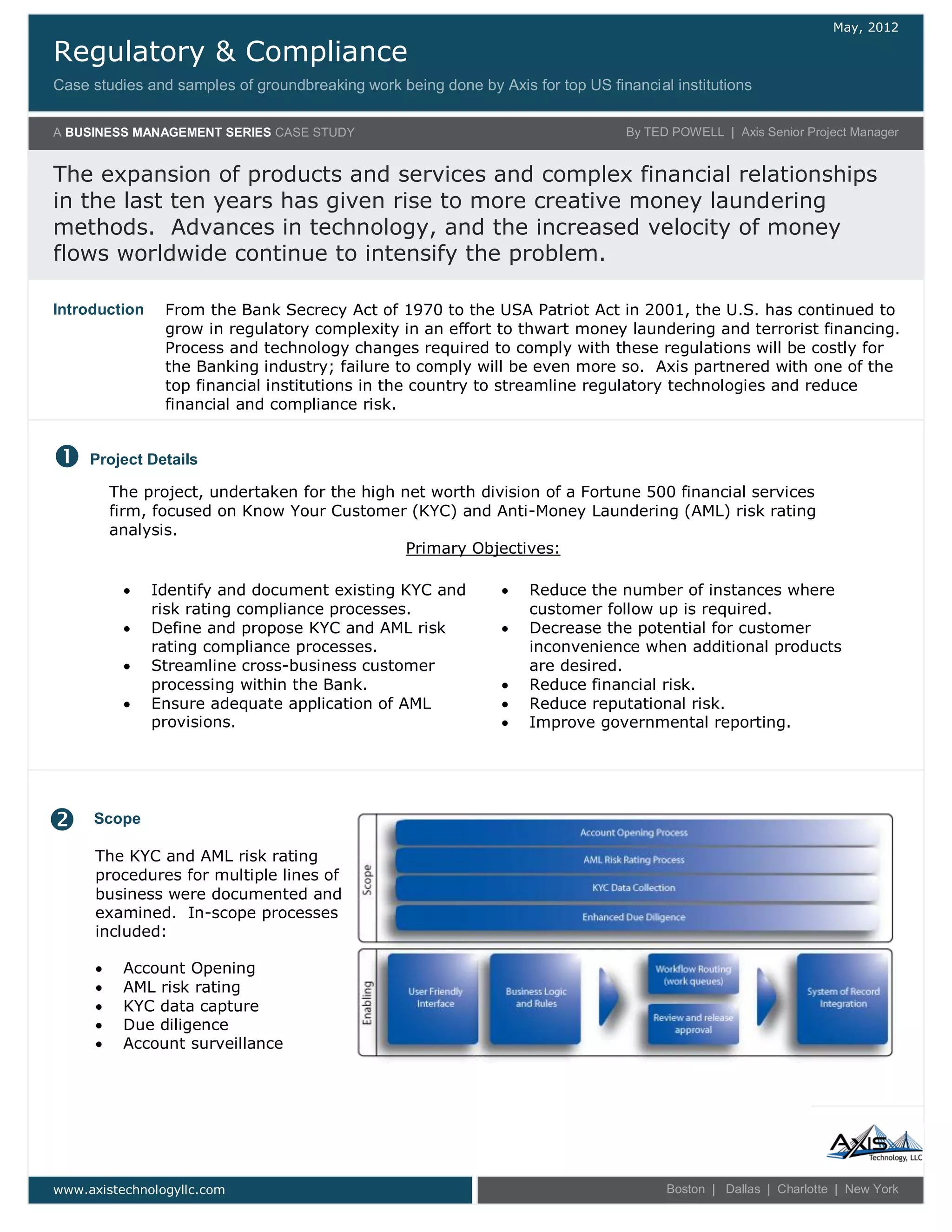
The KYC and AML risk rating
procedures for multiple lines of
business were documented and
examined. In-scope processes
included:


From the Bank Secrecy Act of 1970 to the USA Patriot Act in 2001, the U.S. has continued to
grow in regulatory complexity in an effort to thwart money laundering and terrorist financing.
Process and technology changes required to comply with these regulations will be costly for
the Banking industry; failure to comply will be even more so. Axis partnered with one of the
top financial institutions in the country to streamline regulatory technologies and reduce
financial and compliance risk.
Introduction
 Identify and document existing KYC and
risk rating compliance processes.
 Define and propose KYC and AML risk
rating compliance processes.
 Streamline cross-business customer
processing within the Bank.
 Ensure adequate application of AML
provisions.
 Reduce the number of instances where
customer follow up is required.
 Decrease the potential for customer
inconvenience when additional products
are desired.
 Reduce financial risk.
 Reduce reputational risk.
 Improve governmental reporting.
 Account Opening
 AML risk rating
 KYC data capture
 Due diligence
 Account surveillance
Scope
Project Details
Regulatory & Compliance
A BUSINESS MANAGEMENT SERIES CASE STUDY By TED POWELL | Axis Senior Project Manager
…groundbreaking work for top US financial institutions
www.axistechnologyllc.com Boston | Dallas | Charlotte | New York

Banks must develop, administer, and maintain a program that ensures and monitors
compliance with the BSA – including record keeping and reporting. Banks must also create
and maintain an effective due diligence program starting at the beginning of a business
relationship, several aspects of which are addressed in the Patriot Act. Once a relationship
has been established, Banks must be able to report unusual activity or transactions that
In Closing
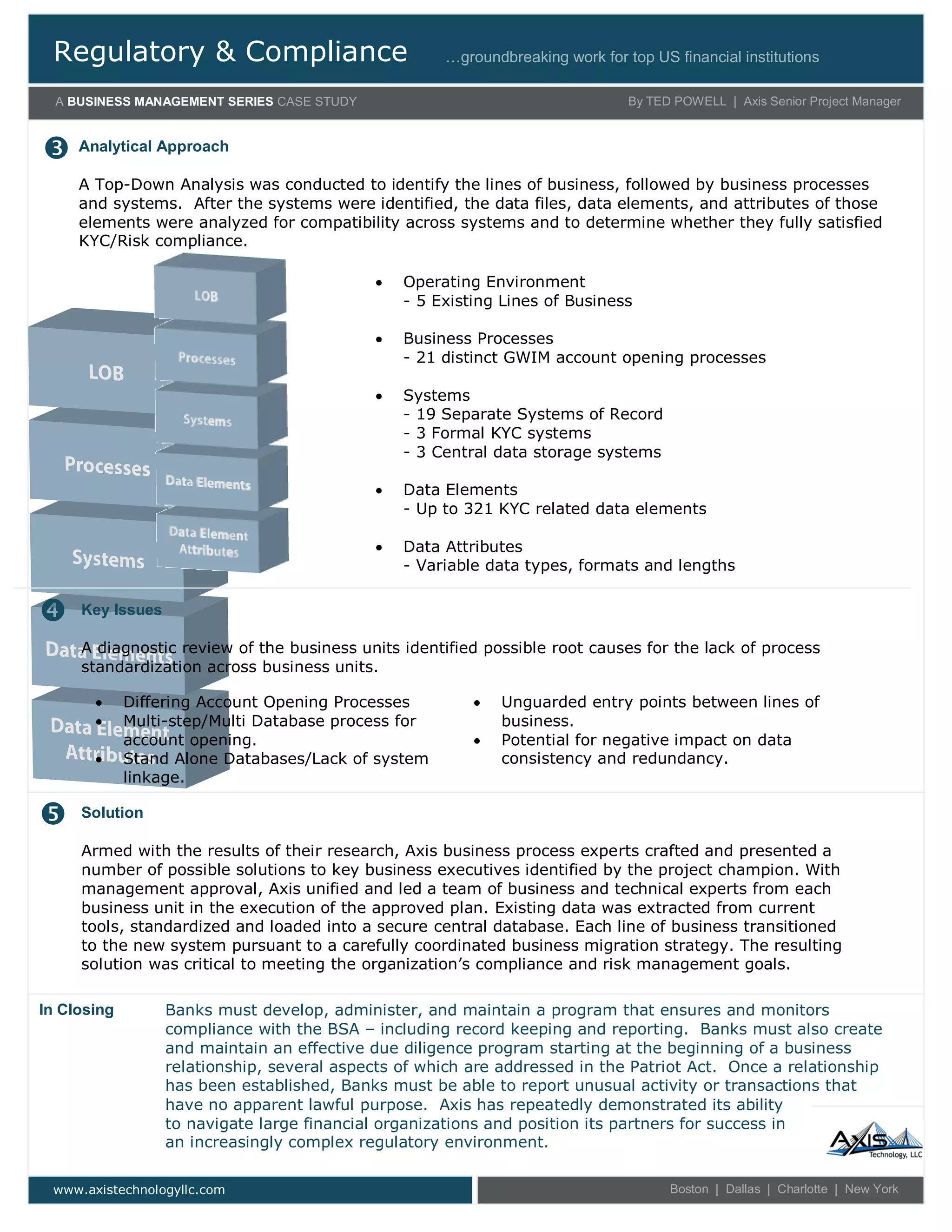
 Operating Environment
- 5 Existing Lines of Business
 Business Processes
- 21 distinct GWIM account opening processes
 Systems
- 19 Separate Systems of Record
- 3 Formal KYC systems
- 3 Central data storage systems
 Data Elements
- Up to 321 KYC related data elements
 Data Attributes
- Variable data types, formats and lengths
Analytical Approach
A Top-Down Analysis was conducted to identify the lines of business, followed by business processes
and systems. After the systems were identified, the data files, data elements, and attributes of those
elements were analyzed for compatibility across systems and to determine whether they fully satisfied
KYC/Risk compliance.
 Solution
Armed with the results of their research, Axis business process experts crafted and presented a
number of possible solutions to key business executives identified by the project champion. With
management approval, Axis unified and led a team of business and technical experts from each
business unit in the execution of the approved plan. Existing data was extracted from current
tools, standardized and loaded into a secure central database. Each line of business transitioned
to the new system pursuant to a carefully coordinated business migration strategy. The resulting
solution was critical to meeting the organization’s compliance and risk management goals.
have no apparent lawful purpose. Axis has repeatedly demonstrated its ability
to navigate large financial organizations and position its partners for success in
an increasingly complex regulatory environment.
 Key Issues
A diagnostic review of the business units identified possible root causes for the lack of process
standardization across business units.
 Differing Account Opening Processes
 Multi-step/Multi Database process for
account opening.
 Stand Alone Databases/Lack of system
linkage.
 Unguarded entry points between lines of
business.
 Potential for negative impact on data
consistency and redundancy.

Regulatory & Compliance Account Opening

  • 1.
    Regulatory & Compliance Casestudies and samples of groundbreaking work being done by Axis for top US financial institutions May, 2012 A BUSINESS MANAGEMENT SERIES CASE STUDY By TED POWELL | Axis Senior Project Manager The expansion of products and services and complex financial relationships in the last ten years has given rise to more creative money laundering methods. Advances in technology, and the increased velocity of money flows worldwide continue to intensify the problem. www.axistechnologyllc.com Boston | Dallas | Charlotte | New York The project, undertaken for the high net worth division of a Fortune 500 financial services firm, focused on Know Your Customer (KYC) and Anti-Money Laundering (AML) risk rating analysis. Primary Objectives: The KYC and AML risk rating procedures for multiple lines of business were documented and examined. In-scope processes included:   From the Bank Secrecy Act of 1970 to the USA Patriot Act in 2001, the U.S. has continued to grow in regulatory complexity in an effort to thwart money laundering and terrorist financing. Process and technology changes required to comply with these regulations will be costly for the Banking industry; failure to comply will be even more so. Axis partnered with one of the top financial institutions in the country to streamline regulatory technologies and reduce financial and compliance risk. Introduction  Identify and document existing KYC and risk rating compliance processes.  Define and propose KYC and AML risk rating compliance processes.  Streamline cross-business customer processing within the Bank.  Ensure adequate application of AML provisions.  Reduce the number of instances where customer follow up is required.  Decrease the potential for customer inconvenience when additional products are desired.  Reduce financial risk.  Reduce reputational risk.  Improve governmental reporting.  Account Opening  AML risk rating  KYC data capture  Due diligence  Account surveillance Scope Project Details
  • 2.
    Regulatory & Compliance ABUSINESS MANAGEMENT SERIES CASE STUDY By TED POWELL | Axis Senior Project Manager …groundbreaking work for top US financial institutions www.axistechnologyllc.com Boston | Dallas | Charlotte | New York  Banks must develop, administer, and maintain a program that ensures and monitors compliance with the BSA – including record keeping and reporting. Banks must also create and maintain an effective due diligence program starting at the beginning of a business relationship, several aspects of which are addressed in the Patriot Act. Once a relationship has been established, Banks must be able to report unusual activity or transactions that In Closing  Operating Environment - 5 Existing Lines of Business  Business Processes - 21 distinct GWIM account opening processes  Systems - 19 Separate Systems of Record - 3 Formal KYC systems - 3 Central data storage systems  Data Elements - Up to 321 KYC related data elements  Data Attributes - Variable data types, formats and lengths Analytical Approach A Top-Down Analysis was conducted to identify the lines of business, followed by business processes and systems. After the systems were identified, the data files, data elements, and attributes of those elements were analyzed for compatibility across systems and to determine whether they fully satisfied KYC/Risk compliance.  Solution Armed with the results of their research, Axis business process experts crafted and presented a number of possible solutions to key business executives identified by the project champion. With management approval, Axis unified and led a team of business and technical experts from each business unit in the execution of the approved plan. Existing data was extracted from current tools, standardized and loaded into a secure central database. Each line of business transitioned to the new system pursuant to a carefully coordinated business migration strategy. The resulting solution was critical to meeting the organization’s compliance and risk management goals. have no apparent lawful purpose. Axis has repeatedly demonstrated its ability to navigate large financial organizations and position its partners for success in an increasingly complex regulatory environment.  Key Issues A diagnostic review of the business units identified possible root causes for the lack of process standardization across business units.  Differing Account Opening Processes  Multi-step/Multi Database process for account opening.  Stand Alone Databases/Lack of system linkage.  Unguarded entry points between lines of business.  Potential for negative impact on data consistency and redundancy.