Presented By:
Ed Bayer, Sageworks, Inc.
Ancin Cooley, Synergy Bank Consulting, Inc.
Moderated By:
Regan Camp, Sageworks, Inc.






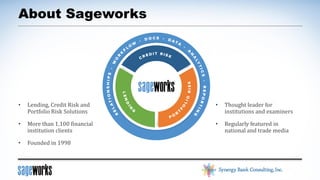
Financial information company that provides
credit and risk management solutions to
financial institutions
Data and applications used by thousands of
financial institutions and accounting firms
across North America
Awards
◦ Named to Inc. 500 list of fastest growing privately
held companies in the U.S.
◦ Named to Deloitte’s Technology Fast 500






Ancin Cooley, CIA, CISA, is the Founder and Managing Principal of Synergy Bank
Consulting, Inc., the risk management advisory firm dedicated to helping financial
institutions optimize their security, compliance and business performance.
He brings deep, first-hand experience gained from working for the Office of the
Comptroller of the Currency (OCC) as an examiner. During his tenure at the OCC,
he performed safety and soundness examinations at community and mid-size
banks that ranged from $100 million to $4 billion dollars in total assets located in
Georgia, South Carolina, North Carolina, and Florida. After leaving the OCC, Ancin
worked for a regional accounting firm where he led loan reviews and internal
audits.
Ancin specializes in preparing financial institutions for regulatory exams, process
improvement, and project management. When not advising clients, training for
triathlons, or hanging out with his young son, Ancin designs and conducts
targeted professional development trainings for the banking industry.


Ed Bayer
◦ Ed Bayer is a senior risk management consultant at Sageworks,
where he serves as a specialist in assisting financial institutions
with accurately interpreting and applying federal accounting
guidance.



Ancin Cooley, CIA, CISA
◦ Ancin Cooley is a former OCC regulator and the Principal of
Synergy Bank Consulting. He specializes in preparing financial
institutions for regulatory exams, ALLL consulting, loan review
and credit training.


Accounting Standards Update (ASU) 2010-20
◦ Disclosures about the credit quality of financial
receivables and the allowance for credit losses





Required for submission to the
10-K and 10-Q
Currently not required for call report*






Released July 2010
Required for public banks: December 15,
2010
Non-public: December 15, 2011


“ASU 2010-20 now applies to all banks that
have audited financial statements” – Tom
Danielson, Partner at CliftonLarsonAllen


“The global financial crisis highlighted the need
for additional information about a company’s
financial instruments, including loans and other
financing receivables…this update provides
greater transparency for investors and other
users of financial statements by requiring more
information from companies about credit risk
exposures for financing receivables and the
related credit reserves.”

– FASB Chairman Robert H. Herz


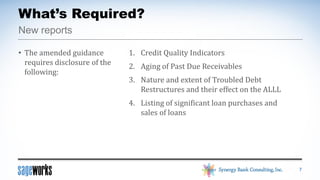
The amended guidance requires disclosure of
the following:
◦ Credit quality indicators
◦ Aging of past due receivables
◦ Nature and extent of troubled debt restructures and
their affect on the allowance for credit losses.
◦ Listing of significant loan purchases and sales of
loans


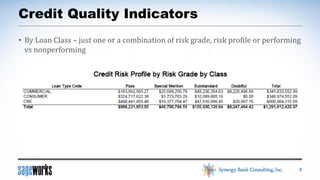
Credit quality indicators by loan class
◦ Just one or a combination of risk grade, risk profile
or performing vs. nonperforming


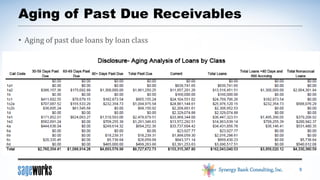
Aging of past due loans by loan class


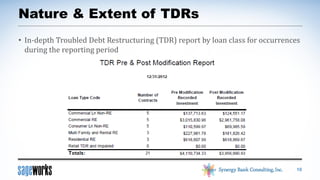
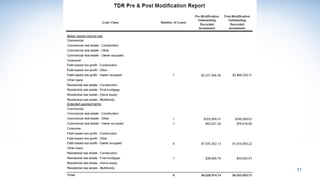
In-depth Troubled Debt Restructuring (TDR)
report by loan class for occurrences during
the reporting period


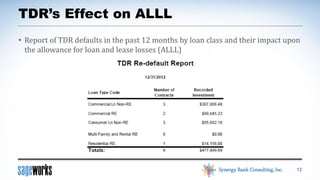
Report of TDR defaults in the past 12 months
by loan class and their impact upon the
allowance for loan and lease losses (ALLL).


Roll forward schedule for allowance for credit
losses
◦ Broken out by disaggregated basis of loan class
◦ Each corresponding loan’s total recorded
investment listed out




Non accrual status of loans by loan class
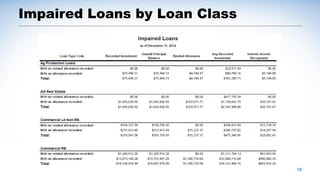
Impaired loans by loan class, with and
without reserve required
◦ Must also disclose interest income recognized
◦ Disclosure average recorded investment


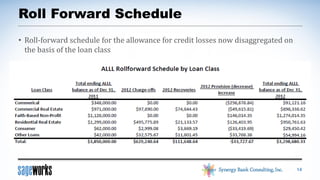
Roll-forward schedule for the allowance for
credit losses now disaggregated on the basis
of the loan class.

"ALLL" About Disclosure Reports: Key Issues to Know

  • 1.
    Presented By: Ed Bayer,Sageworks, Inc. Ancin Cooley, Synergy Bank Consulting, Inc. Moderated By: Regan Camp, Sageworks, Inc.
  • 2.
       Financial information companythat provides credit and risk management solutions to financial institutions Data and applications used by thousands of financial institutions and accounting firms across North America Awards ◦ Named to Inc. 500 list of fastest growing privately held companies in the U.S. ◦ Named to Deloitte’s Technology Fast 500
  • 3.
       Ancin Cooley, CIA,CISA, is the Founder and Managing Principal of Synergy Bank Consulting, Inc., the risk management advisory firm dedicated to helping financial institutions optimize their security, compliance and business performance. He brings deep, first-hand experience gained from working for the Office of the Comptroller of the Currency (OCC) as an examiner. During his tenure at the OCC, he performed safety and soundness examinations at community and mid-size banks that ranged from $100 million to $4 billion dollars in total assets located in Georgia, South Carolina, North Carolina, and Florida. After leaving the OCC, Ancin worked for a regional accounting firm where he led loan reviews and internal audits. Ancin specializes in preparing financial institutions for regulatory exams, process improvement, and project management. When not advising clients, training for triathlons, or hanging out with his young son, Ancin designs and conducts targeted professional development trainings for the banking industry.
  • 4.
     Ed Bayer ◦ EdBayer is a senior risk management consultant at Sageworks, where he serves as a specialist in assisting financial institutions with accurately interpreting and applying federal accounting guidance.  Ancin Cooley, CIA, CISA ◦ Ancin Cooley is a former OCC regulator and the Principal of Synergy Bank Consulting. He specializes in preparing financial institutions for regulatory exams, ALLL consulting, loan review and credit training.
  • 5.
     Accounting Standards Update(ASU) 2010-20 ◦ Disclosures about the credit quality of financial receivables and the allowance for credit losses   Required for submission to the 10-K and 10-Q Currently not required for call report*
  • 6.
       Released July 2010 Requiredfor public banks: December 15, 2010 Non-public: December 15, 2011
  • 7.
     “ASU 2010-20 nowapplies to all banks that have audited financial statements” – Tom Danielson, Partner at CliftonLarsonAllen
  • 8.
     “The global financialcrisis highlighted the need for additional information about a company’s financial instruments, including loans and other financing receivables…this update provides greater transparency for investors and other users of financial statements by requiring more information from companies about credit risk exposures for financing receivables and the related credit reserves.” – FASB Chairman Robert H. Herz
  • 9.
     The amended guidancerequires disclosure of the following: ◦ Credit quality indicators ◦ Aging of past due receivables ◦ Nature and extent of troubled debt restructures and their affect on the allowance for credit losses. ◦ Listing of significant loan purchases and sales of loans
  • 10.
     Credit quality indicatorsby loan class ◦ Just one or a combination of risk grade, risk profile or performing vs. nonperforming
  • 11.
     Aging of pastdue loans by loan class
  • 12.
     In-depth Troubled DebtRestructuring (TDR) report by loan class for occurrences during the reporting period
  • 14.
     Report of TDRdefaults in the past 12 months by loan class and their impact upon the allowance for loan and lease losses (ALLL).
  • 15.
     Roll forward schedulefor allowance for credit losses ◦ Broken out by disaggregated basis of loan class ◦ Each corresponding loan’s total recorded investment listed out   Non accrual status of loans by loan class Impaired loans by loan class, with and without reserve required ◦ Must also disclose interest income recognized ◦ Disclosure average recorded investment
  • 16.
     Roll-forward schedule forthe allowance for credit losses now disaggregated on the basis of the loan class.