© Hee Xin Wei (Copyrighted)
Topic18:
Inheritance
ChapterAnalysis
FOCUS
EXAM
WEIGHTAGE
• Constitute to around 9.5% in Paper 2 in
the past 5 years
• commonly tested in MCQ and structured
questions
• tested twice in section B in the past 5
years
• may be an abstract topic
• application questions
Inheritance
Inheritance is the process by which genetic information is passed on from parent to child
Hereditary traits that can be passed down to you by your parents:
ability to roll tongue
dimples right or left handed attached or free earlobe
ability to taste PTC (bitter compound)
allergy
variation
Variations are differences in traits between individuals of the same species.
Discontinuous variation Continuous variation
Phenotype
Few clear-cut phenotypes with no
intermediate
Range of phenotypes.
Environment
influence
Rarely affected by environmental
conditions
Greatly affected by environmental
conditions.
Genes Controlled by one or few genes Controlled by many genes
Additive effect Not present
The effect of many genes add together and contribute the
phenotype
Graph
Discrete groups Normal distribution
Examples
Blood groups, eyelid, flower colour in pea
plant
Height, skin colour, weight, intelligence
© Hee Xin Wei (Copyrighted)
monohybridhesitance
codominance
sexdetermination
Key Concept
© Hee Xin Wei (Copyrighted)
terms
definitions
Gene Gene is sequence of DNA nucleotides that stores information used to make a polypeptide, therefore gene is a unit of
inheritance passed from parents to offspring
Chromosome • Chromosome is a compact structure visible in the nucleus during cell division and it is made up of DNA
• The place on the chromosome where the gene is located is called the gene locus.
Allele • Alleles are different forms of a gene.
• Alleles of a gene occupy the same locus on a pair of homologous chromosomes.
• For example, eye colour gene has brown allele and blue allele
Dominant A dominant allele is the allele that is always expressed in the phenotype, no matter under homozygous or heterozygous
condition.
Recessive A recessive allele is the allele that is only expressed under homozygous recessive condition.
Codominant • When both alleles have an equal effect on the phenotype of the offspring.
• Both alleles are expressed in the phenotype.
Homozygous Organisms having two identical alleles of a particular gene. Allele can be either both dominant or both recessive.
Heterozygous Organisms having two different alleles of a particular gene.
Phenotype • Phenotype refers to the expressed trait in an organism.
• The phenotype of an organism is the result of its genes and the effects of its environment.
Genotype • A genotype is the genetic makeup of an organism.
• An organism’s genotype is homozygous for a trait if the two alleles controlling the trait are identical, heterozygous for a trait if
the alleles controlling the trait are different.
© Hee Xin Wei (Copyrighted)
MonohybridInheritance
• The gene for flower colour of pea plant has two alleles: dominant
purple allele (P) and recessive white allele (p’)
• When a homozygous purple plants (PP) is crossed with a
homozygous white plant (p’p’), each organism inherits one allele
from the mother and one allele from the father during sexual
reproduction
• The offspring generation consisted of all purple-flowered plants
even though their genotype is heterozygous (Pp’) as the
dominant purple allele (P) is expressed over recessive white allele
• Self-pollination in the F1 generation produced a F2 generation
where the phenotypic ratio of purple-flowered to white-flowered
plants is 3:1
© Hee Xin Wei (Copyrighted)
x
Parental
Generation
F1 Generation
F2 Generation
GeneticDiagram
3 purple flower: 1 white flower is the
expected ratios, but the actual
observed ratio can be different
especially when there are small
numbers of progeny, because
• Fertilisation of the ova and sperms
is a random event.
• Therefore the expected ratios are
only based on chance and
probabilities.
With small number of offspring, the
observed ratios often differ from
expected ratios. But, with large
number of offspring (large sample
size), the observed ratios will be
closer to expected ratios.
codominance
Complete dominance is when the heterozygote has the same
phenotype as the dominant homozygote. In pea plant flower example,
Pp has the same phenotype as pp. The recessive allele present in the
heterozygote is masked by the dominant allele.
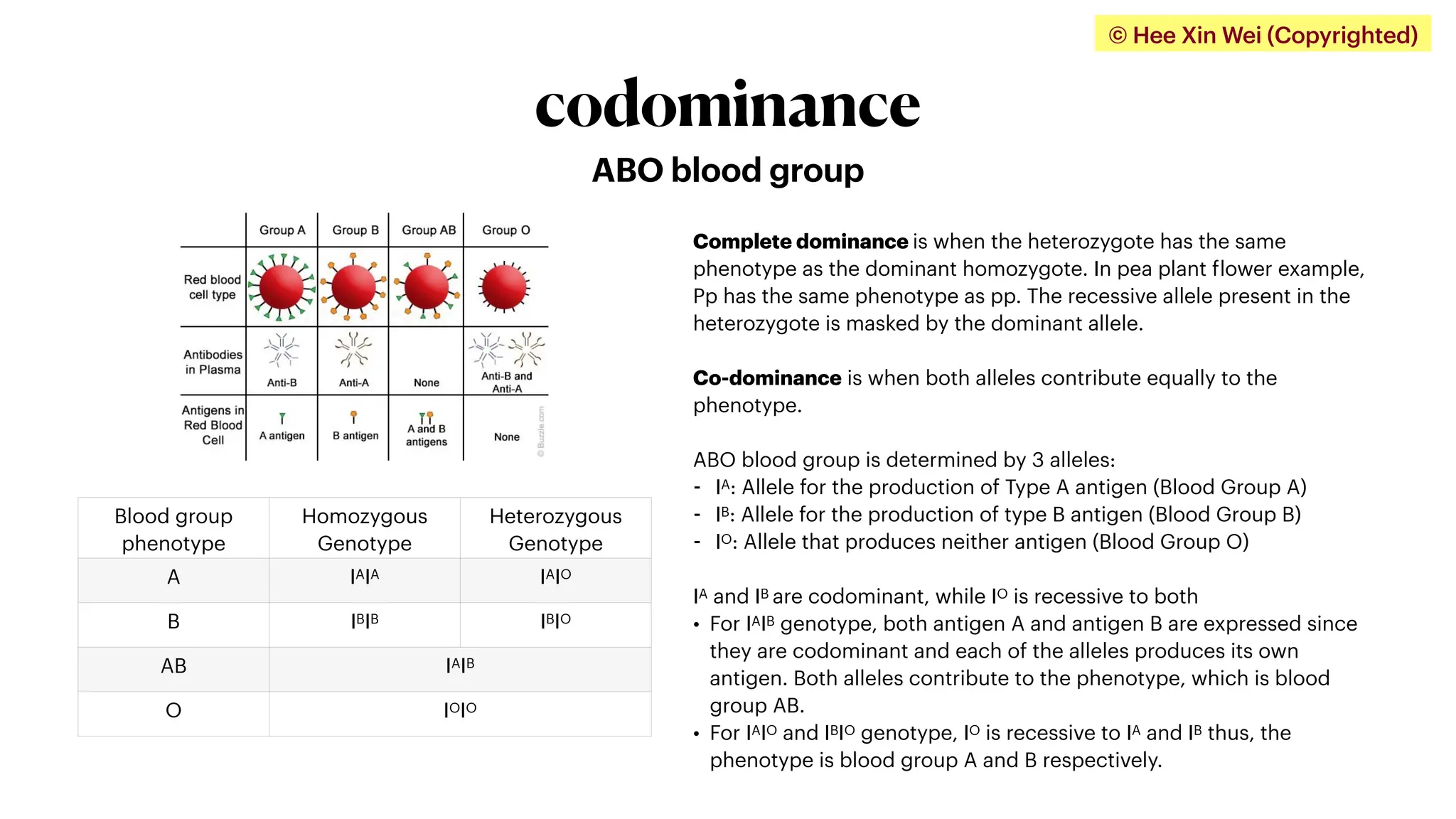
Co-dominance is when both alleles contribute equally to the
phenotype.
ABO blood group is determined by 3 alleles:
- IA: Allele for the production of Type A antigen (Blood Group A)
- IB: Allele for the production of type B antigen (Blood Group B)
- IO: Allele that produces neither antigen (Blood Group O)
IA and IB are codominant, while IO is recessive to both
• For IAIB genotype, both antigen A and antigen B are expressed since
they are codominant and each of the alleles produces its own
antigen. Both alleles contribute to the phenotype, which is blood
group AB.
• For IAIO and IBIO genotype, IO is recessive to IA and IB thus, the
phenotype is blood group A and B respectively.
ABO blood group
Blood group
phenotype
Homozygous
Genotype
Heterozygous
Genotype
A IAIA IAIO
B IBIB IBIO
AB IAIB
O IOIO
© Hee Xin Wei (Copyrighted)
codominance
abo blood group example
parents with blood group B can produce
offsprings with blood group O
© Hee Xin Wei (Copyrighted)
sexdetermination
• A human cell has 23 pairs of chromosomes and the last pair is the sex
chromosomes
• In humans, sex is determined by sex chromosomes. Human sex
chromosomes are the X chromosome and the Y chromosome.
• X chromosome is much larger than the Y chromosome.
• Human males have one X chromosome and one Y chromosome (XY
genotype) while human females have two X chromosomes (XX genotype)
Example of sex determination cross:
equal probability of a male or female offspring
© Hee Xin Wei (Copyrighted)
mutation
variation
naturalselection
artificialselection
Key Concept
© Hee Xin Wei (Copyrighted)
mutation
Mutation
• Mutation is a random change in the structure of a gene or in the
chromosome number
• Mutations that take place in body cells other than gametes are called
somatic mutations, which will not be passed on to the next generation
• Mutation is spontaneous and can occur during replication of DNA
• Mutagen increase the rate of mutation
Ultraviolet radiation, x rays, gamma rays
Chemicals such as benzene, ethidium bromide
© Hee Xin Wei (Copyrighted)
genemutation
• Sickle-cell anaemia is caused by a change in the sequence of
nucleotides coding for haemoglobin
• It is a recessive condition, which means mutated allele only expresses in
homozygous recessive condition
• Heterozygous individual with one normal allele, one mutated allele are
healthy but are carrier
• Normal red blood cells are flexible and can change their shape in order
to pass through capillaries.
• Mutated gene produces Haemoglobin S (HbS) that tend to clump
together, which result in sickle-shaped red blood cells that can block
capillaries
• When oxygen concentration in the blood drops, the red blood cells
become sickled-shaped and this lowers their surface area to volume
ratio for diffusion of oxygen. Hence, they cannot transport oxygen as
effectively as the normal red blood cells.
© Hee Xin Wei (Copyrighted)
chromosomalmutation
• Down syndrome is a condition caused by a chromosome mutation
during meiosis (gamete production)
• The gamete has 2 copies of chromosome 21, thus upon fertilisation,
the zygote inherits 3 copies of chromosome 21 and a total of 47
chromosomes
• This mutation is present in all body cells due to mitosis during zygote
development.
• This chromosome mutation is far more likely to occur during ovum
production than during sperm production.
• Women above 30 have a higher risk of carrying babies with Down
syndrome.
© Hee Xin Wei (Copyrighted)
down syndrome is also known as trisomy 21
normal number of
chromosomes 21
naturalselection
Natural selection
1. There are variation among individuals within the population such
as giraffe with short and long neck
• Factors that contribute to variation includes mutation, crossing over
of homologous chromosomes and independent assortment during
meiosis and random fusion of gametes during fertilisation
2. There is limited resources eg limited food, water resulting in
competition for scarce resources
3. Only individuals with favourable characteristics that are best
adapted to the environment can survive
4. They have a higher chance of reproducing and passing down their
favourable alleles to their offspring
5. Their offspring increase in proportion in the population thus the
proportion of favourable allele also increases
6. This is known as natural selection which is the survival of fittest
7. Evolution is the change in allele frequency in a population. Natural
selection occurs over many generations and over a long period of
time, it can produce major changes of allele frequency in a
population that could give rise to a new species.
© Hee Xin Wei (Copyrighted)
artificialselection
Artificial selection
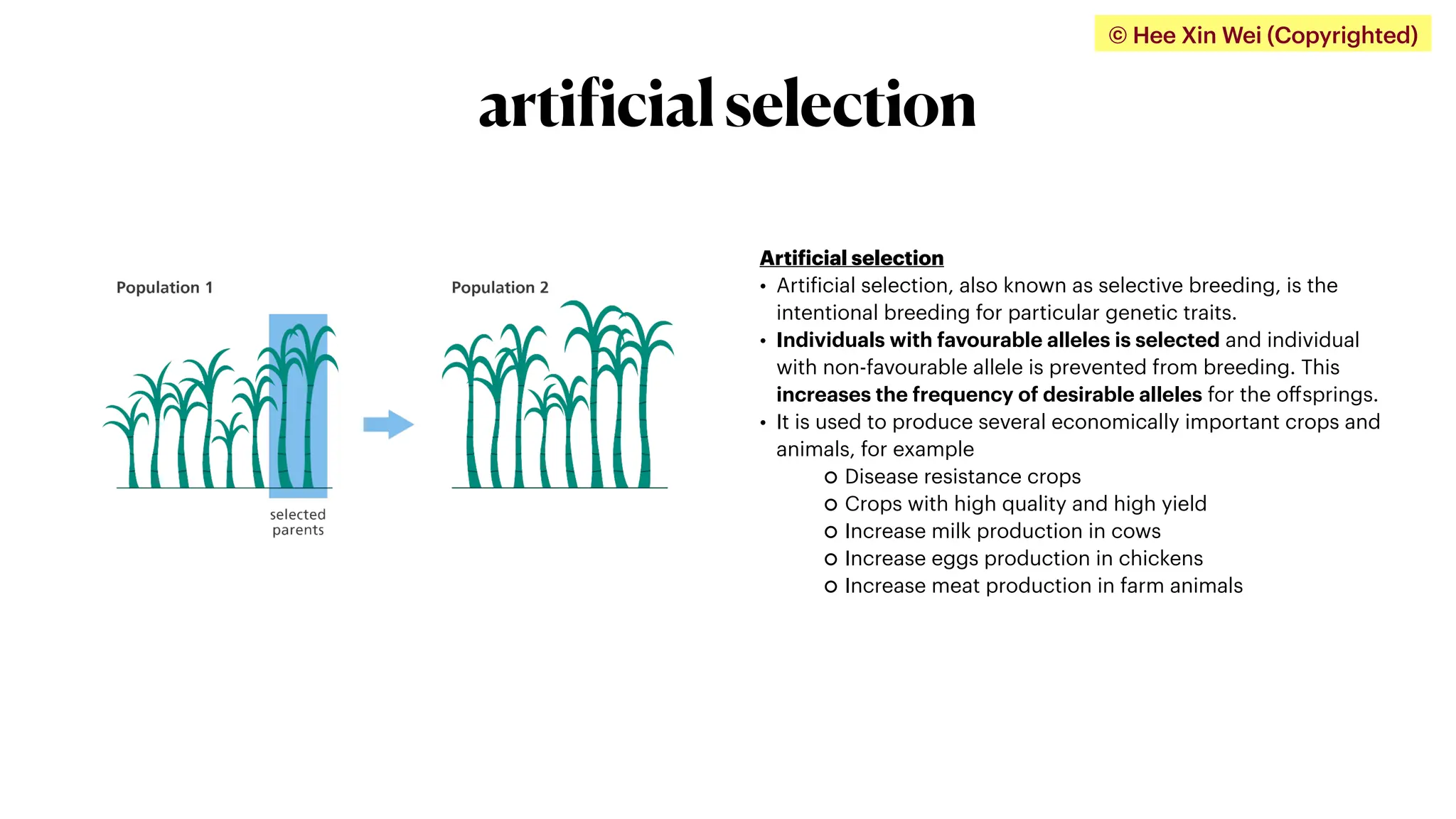
• Artificial selection, also known as selective breeding, is the
intentional breeding for particular genetic traits.
• Individuals with favourable alleles is selected and individual
with non-favourable allele is prevented from breeding. This
increases the frequency of desirable alleles for the offsprings.
• It is used to produce several economically important crops and
animals, for example
Disease resistance crops
Crops with high quality and high yield
Increase milk production in cows
Increase eggs production in chickens
Increase meat production in farm animals
© Hee Xin Wei (Copyrighted)
comparing
natural selection, artificial selection and genetic engineering
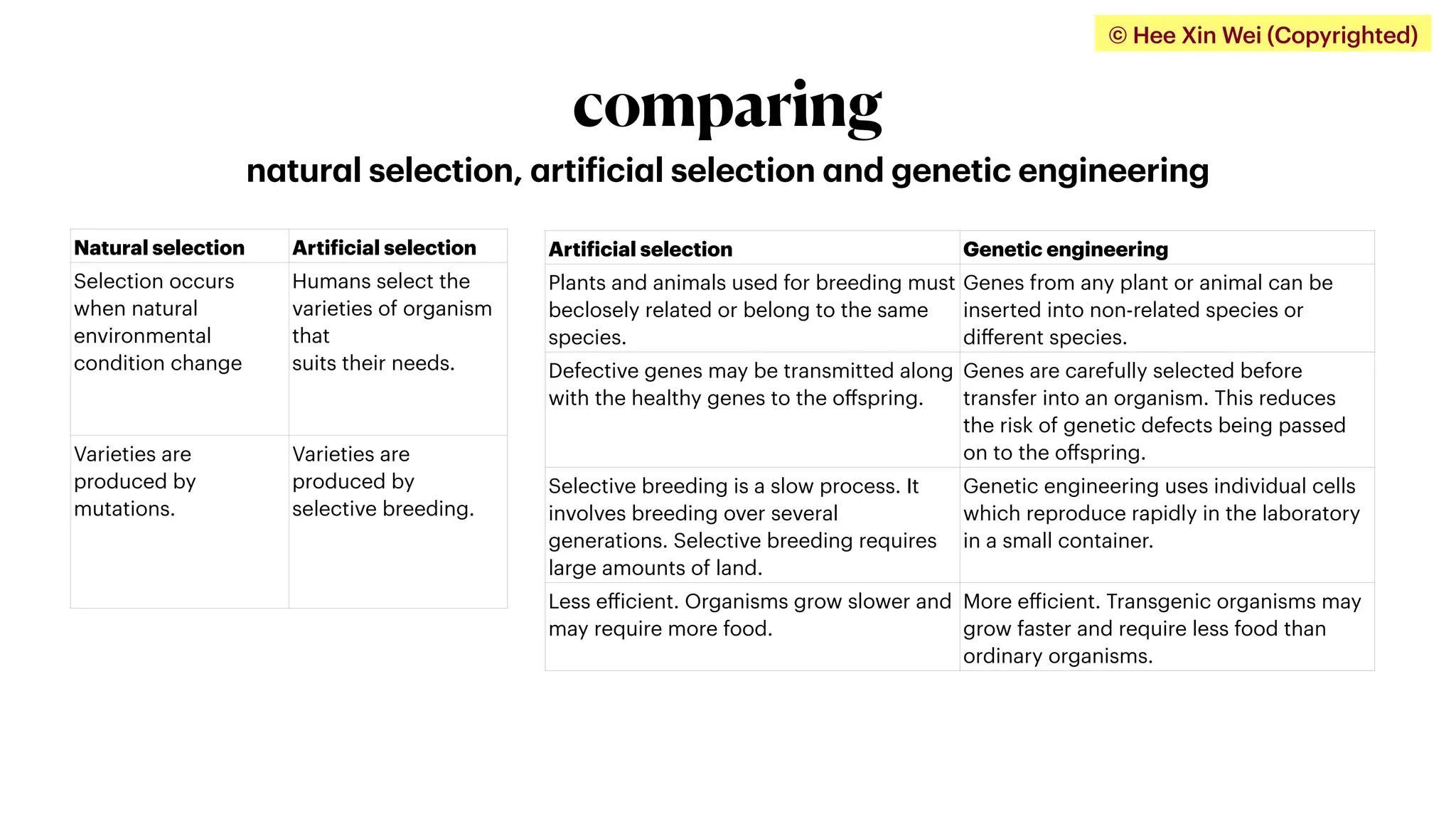
Natural selection Artificial selection
Selection occurs
when natural
environmental
condition change
Humans select the
varieties of organism
that
suits their needs.
Varieties are
produced by
mutations.
Varieties are
produced by
selective breeding.
Artificial selection Genetic engineering
Plants and animals used for breeding must
beclosely related or belong to the same
species.
Genes from any plant or animal can be
inserted into non-related species or
different species.
Defective genes may be transmitted along
with the healthy genes to the offspring.
Genes are carefully selected before
transfer into an organism. This reduces
the risk of genetic defects being passed
on to the offspring.
Selective breeding is a slow process. It
involves breeding over several
generations. Selective breeding requires
large amounts of land.
Genetic engineering uses individual cells
which reproduce rapidly in the laboratory
in a small container.
Less efficient. Organisms grow slower and
may require more food.
More efficient. Transgenic organisms may
grow faster and require less food than
ordinary organisms.
© Hee Xin Wei (Copyrighted)
19
For more notes & learning materials, visit:
www.overmugged.com
‘O’ levels crash course program
IG handle:
@overmugged
Join our telegram
channel:
@overmugged
Need help?
Hee Xin Wei
(Private tutor with 5
years of experience)
90721842 (Whatsapp)
@xinweihee
(telegram username)
Professionally designed crash course to help you get a condensed revision before your ‘O’ Levels!
The 4 hour session focuses on going through key concepts and identifying commonly tested
questions!
Our specialist tutors will also impart valuable exam pointers and tips to help you maximise your
preparation and ace your upcoming national exam!
The crash courses will begin in June 2021 and last till Oct 2021.
Pre-register now on our website and secure your slots!

[BIO] Chapter 18 - Inheritance notes.pdf

  • 1.
    © Hee XinWei (Copyrighted) Topic18: Inheritance
  • 2.
    ChapterAnalysis FOCUS EXAM WEIGHTAGE • Constitute toaround 9.5% in Paper 2 in the past 5 years • commonly tested in MCQ and structured questions • tested twice in section B in the past 5 years • may be an abstract topic • application questions
  • 3.
    Inheritance Inheritance is theprocess by which genetic information is passed on from parent to child Hereditary traits that can be passed down to you by your parents: ability to roll tongue dimples right or left handed attached or free earlobe ability to taste PTC (bitter compound) allergy
  • 4.
    variation Variations are differencesin traits between individuals of the same species. Discontinuous variation Continuous variation Phenotype Few clear-cut phenotypes with no intermediate Range of phenotypes. Environment influence Rarely affected by environmental conditions Greatly affected by environmental conditions. Genes Controlled by one or few genes Controlled by many genes Additive effect Not present The effect of many genes add together and contribute the phenotype Graph Discrete groups Normal distribution Examples Blood groups, eyelid, flower colour in pea plant Height, skin colour, weight, intelligence © Hee Xin Wei (Copyrighted)
  • 5.
  • 6.
    terms definitions Gene Gene issequence of DNA nucleotides that stores information used to make a polypeptide, therefore gene is a unit of inheritance passed from parents to offspring Chromosome • Chromosome is a compact structure visible in the nucleus during cell division and it is made up of DNA • The place on the chromosome where the gene is located is called the gene locus. Allele • Alleles are different forms of a gene. • Alleles of a gene occupy the same locus on a pair of homologous chromosomes. • For example, eye colour gene has brown allele and blue allele Dominant A dominant allele is the allele that is always expressed in the phenotype, no matter under homozygous or heterozygous condition. Recessive A recessive allele is the allele that is only expressed under homozygous recessive condition. Codominant • When both alleles have an equal effect on the phenotype of the offspring. • Both alleles are expressed in the phenotype. Homozygous Organisms having two identical alleles of a particular gene. Allele can be either both dominant or both recessive. Heterozygous Organisms having two different alleles of a particular gene. Phenotype • Phenotype refers to the expressed trait in an organism. • The phenotype of an organism is the result of its genes and the effects of its environment. Genotype • A genotype is the genetic makeup of an organism. • An organism’s genotype is homozygous for a trait if the two alleles controlling the trait are identical, heterozygous for a trait if the alleles controlling the trait are different. © Hee Xin Wei (Copyrighted)
  • 7.
    MonohybridInheritance • The genefor flower colour of pea plant has two alleles: dominant purple allele (P) and recessive white allele (p’) • When a homozygous purple plants (PP) is crossed with a homozygous white plant (p’p’), each organism inherits one allele from the mother and one allele from the father during sexual reproduction • The offspring generation consisted of all purple-flowered plants even though their genotype is heterozygous (Pp’) as the dominant purple allele (P) is expressed over recessive white allele • Self-pollination in the F1 generation produced a F2 generation where the phenotypic ratio of purple-flowered to white-flowered plants is 3:1 © Hee Xin Wei (Copyrighted) x Parental Generation F1 Generation F2 Generation
  • 8.
    GeneticDiagram 3 purple flower:1 white flower is the expected ratios, but the actual observed ratio can be different especially when there are small numbers of progeny, because • Fertilisation of the ova and sperms is a random event. • Therefore the expected ratios are only based on chance and probabilities. With small number of offspring, the observed ratios often differ from expected ratios. But, with large number of offspring (large sample size), the observed ratios will be closer to expected ratios.
  • 9.
    codominance Complete dominance iswhen the heterozygote has the same phenotype as the dominant homozygote. In pea plant flower example, Pp has the same phenotype as pp. The recessive allele present in the heterozygote is masked by the dominant allele. Co-dominance is when both alleles contribute equally to the phenotype. ABO blood group is determined by 3 alleles: - IA: Allele for the production of Type A antigen (Blood Group A) - IB: Allele for the production of type B antigen (Blood Group B) - IO: Allele that produces neither antigen (Blood Group O) IA and IB are codominant, while IO is recessive to both • For IAIB genotype, both antigen A and antigen B are expressed since they are codominant and each of the alleles produces its own antigen. Both alleles contribute to the phenotype, which is blood group AB. • For IAIO and IBIO genotype, IO is recessive to IA and IB thus, the phenotype is blood group A and B respectively. ABO blood group Blood group phenotype Homozygous Genotype Heterozygous Genotype A IAIA IAIO B IBIB IBIO AB IAIB O IOIO © Hee Xin Wei (Copyrighted)
  • 10.
    codominance abo blood groupexample parents with blood group B can produce offsprings with blood group O © Hee Xin Wei (Copyrighted)
  • 11.
    sexdetermination • A humancell has 23 pairs of chromosomes and the last pair is the sex chromosomes • In humans, sex is determined by sex chromosomes. Human sex chromosomes are the X chromosome and the Y chromosome. • X chromosome is much larger than the Y chromosome. • Human males have one X chromosome and one Y chromosome (XY genotype) while human females have two X chromosomes (XX genotype) Example of sex determination cross: equal probability of a male or female offspring © Hee Xin Wei (Copyrighted)
  • 12.
  • 13.
    mutation Mutation • Mutation isa random change in the structure of a gene or in the chromosome number • Mutations that take place in body cells other than gametes are called somatic mutations, which will not be passed on to the next generation • Mutation is spontaneous and can occur during replication of DNA • Mutagen increase the rate of mutation Ultraviolet radiation, x rays, gamma rays Chemicals such as benzene, ethidium bromide © Hee Xin Wei (Copyrighted)
  • 14.
    genemutation • Sickle-cell anaemiais caused by a change in the sequence of nucleotides coding for haemoglobin • It is a recessive condition, which means mutated allele only expresses in homozygous recessive condition • Heterozygous individual with one normal allele, one mutated allele are healthy but are carrier • Normal red blood cells are flexible and can change their shape in order to pass through capillaries. • Mutated gene produces Haemoglobin S (HbS) that tend to clump together, which result in sickle-shaped red blood cells that can block capillaries • When oxygen concentration in the blood drops, the red blood cells become sickled-shaped and this lowers their surface area to volume ratio for diffusion of oxygen. Hence, they cannot transport oxygen as effectively as the normal red blood cells. © Hee Xin Wei (Copyrighted)
  • 15.
    chromosomalmutation • Down syndromeis a condition caused by a chromosome mutation during meiosis (gamete production) • The gamete has 2 copies of chromosome 21, thus upon fertilisation, the zygote inherits 3 copies of chromosome 21 and a total of 47 chromosomes • This mutation is present in all body cells due to mitosis during zygote development. • This chromosome mutation is far more likely to occur during ovum production than during sperm production. • Women above 30 have a higher risk of carrying babies with Down syndrome. © Hee Xin Wei (Copyrighted) down syndrome is also known as trisomy 21 normal number of chromosomes 21
  • 16.
    naturalselection Natural selection 1. Thereare variation among individuals within the population such as giraffe with short and long neck • Factors that contribute to variation includes mutation, crossing over of homologous chromosomes and independent assortment during meiosis and random fusion of gametes during fertilisation 2. There is limited resources eg limited food, water resulting in competition for scarce resources 3. Only individuals with favourable characteristics that are best adapted to the environment can survive 4. They have a higher chance of reproducing and passing down their favourable alleles to their offspring 5. Their offspring increase in proportion in the population thus the proportion of favourable allele also increases 6. This is known as natural selection which is the survival of fittest 7. Evolution is the change in allele frequency in a population. Natural selection occurs over many generations and over a long period of time, it can produce major changes of allele frequency in a population that could give rise to a new species. © Hee Xin Wei (Copyrighted)
  • 17.
    artificialselection Artificial selection • Artificialselection, also known as selective breeding, is the intentional breeding for particular genetic traits. • Individuals with favourable alleles is selected and individual with non-favourable allele is prevented from breeding. This increases the frequency of desirable alleles for the offsprings. • It is used to produce several economically important crops and animals, for example Disease resistance crops Crops with high quality and high yield Increase milk production in cows Increase eggs production in chickens Increase meat production in farm animals © Hee Xin Wei (Copyrighted)
  • 18.
    comparing natural selection, artificialselection and genetic engineering Natural selection Artificial selection Selection occurs when natural environmental condition change Humans select the varieties of organism that suits their needs. Varieties are produced by mutations. Varieties are produced by selective breeding. Artificial selection Genetic engineering Plants and animals used for breeding must beclosely related or belong to the same species. Genes from any plant or animal can be inserted into non-related species or different species. Defective genes may be transmitted along with the healthy genes to the offspring. Genes are carefully selected before transfer into an organism. This reduces the risk of genetic defects being passed on to the offspring. Selective breeding is a slow process. It involves breeding over several generations. Selective breeding requires large amounts of land. Genetic engineering uses individual cells which reproduce rapidly in the laboratory in a small container. Less efficient. Organisms grow slower and may require more food. More efficient. Transgenic organisms may grow faster and require less food than ordinary organisms. © Hee Xin Wei (Copyrighted)
  • 19.
    19 For more notes& learning materials, visit: www.overmugged.com ‘O’ levels crash course program IG handle: @overmugged Join our telegram channel: @overmugged Need help? Hee Xin Wei (Private tutor with 5 years of experience) 90721842 (Whatsapp) @xinweihee (telegram username) Professionally designed crash course to help you get a condensed revision before your ‘O’ Levels! The 4 hour session focuses on going through key concepts and identifying commonly tested questions! Our specialist tutors will also impart valuable exam pointers and tips to help you maximise your preparation and ace your upcoming national exam! The crash courses will begin in June 2021 and last till Oct 2021. Pre-register now on our website and secure your slots!