Demand Forecasting
Prepared By:
Mohammed Jasir PV
Asst. Professor
MIIMS, Puthanangadi
Demand Forecasting - Techniques
Demand Forecasting
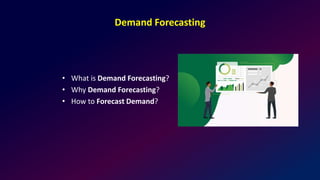
• What is Demand Forecasting?
• Why Demand Forecasting?
• How to Forecast Demand?
Demand Forecasting
• It is a technique for estimation of probable demand for a product or
services in the future.
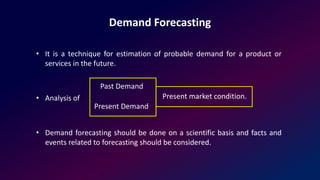
• Analysis of
• Demand forecasting should be done on a scientific basis and facts and
events related to forecasting should be considered.
Past Demand
Present Demand
Present market condition.
Demand Forecasting
• It is the process in which historical sales data is used to develop an
estimate of an expected forecast of customer demand.
• To businesses, Demand Forecasting provides an estimate of the
amount of goods and services that its customers will purchase in the
foreseeable future.
• Critical business assumptions like turnover, profit margins, cash flow,
capital expenditure, risk assessment and mitigation plans, capacity
planning, etc. are dependent on Demand
Definitions
• According to Evan J. Douglas, “Demand estimation (forecasting) may be
defined as a process of finding values for demand in future time periods.”
• In the words of Cundiff and Still, “Demand forecasting is an estimate of
sales during a specified future period based on proposed marketing plan
and a set of particular uncontrollable and competitive forces.”
Demand Forecasting Objectives
• Financial planning
• Pricing policy
• Manufacturing policy
• Sales and Marketing planning
• Capacity planning and expansion
• Manpower planning
• Capital expenditure
Why DF? / DF Using for
• Strategic and long-range plans
– Budgeting
– Financial planning
– Sales and marketing plans
– Capacity planning
– Risk assessment
• Short to medium term tactical plans
– Pre-building
– Make-to-stock, Make-to-order
– Contract manufacturing
– Supply planning
– Network balancing
Other purposes: Decision making, performance evaluation, allocation of
resources in a constrained environment and business expansion planning
Steps In Demand Forecasting
1. Specifying the Objective
2. Determining the Time Perspective
3. Choice of method for Demand Forecasting
4. Collection of Data and Data Adjustment
5. Estimation and Interpretation of Results
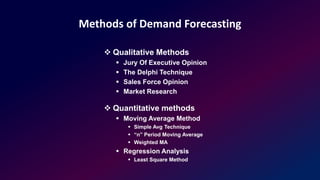
Methods of Demand Forecasting
 Qualitative Methods
 Jury Of Executive Opinion
 The Delphi Technique
 Sales Force Opinion
 Market Research
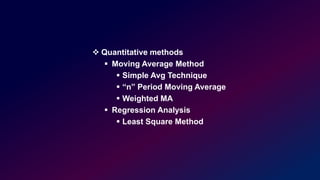
 Quantitative methods
 Moving Average Method
 Simple Avg Technique
 “n” Period Moving Average
 Weighted MA
 Regression Analysis
 Least Square Method
Jury of Executive Opinion
• Collecting the view of experts from sales, marketing, production,
finance etc… after explaining the current situation of company and
market.
• Estimating by their experiences
• Quick and cheap method
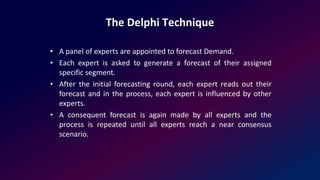
The Delphi Technique
• A panel of experts are appointed to forecast Demand.
• Each expert is asked to generate a forecast of their assigned
specific segment.
• After the initial forecasting round, each expert reads out their
forecast and in the process, each expert is influenced by other
experts.
• A consequent forecast is again made by all experts and the
process is repeated until all experts reach a near consensus
scenario.
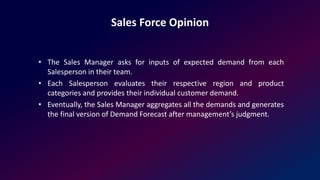
Sales Force Opinion
• The Sales Manager asks for inputs of expected demand from each
Salesperson in their team.
• Each Salesperson evaluates their respective region and product
categories and provides their individual customer demand.
• Eventually, the Sales Manager aggregates all the demands and generates
the final version of Demand Forecast after management’s judgment.
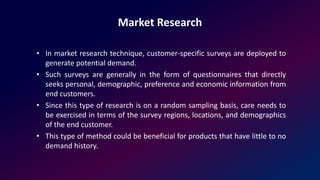
Market Research
• In market research technique, customer-specific surveys are deployed to
generate potential demand.
• Such surveys are generally in the form of questionnaires that directly
seeks personal, demographic, preference and economic information from
end customers.
• Since this type of research is on a random sampling basis, care needs to
be exercised in terms of the survey regions, locations, and demographics
of the end customer.
• This type of method could be beneficial for products that have little to no
demand history.
 Quantitative methods
 Moving Average Method
 Simple Avg Technique
 “n” Period Moving Average
 Weighted MA
 Regression Analysis
 Least Square Method
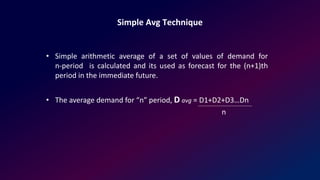
Simple Avg Technique
• Simple arithmetic average of a set of values of demand for
n-period is calculated and its used as forecast for the (n+1)th
period in the immediate future.
• The average demand for “n” period, D avg = D1+D2+D3…Dn
n
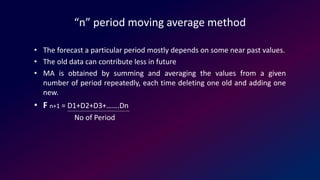
“n” period moving average method
• The forecast a particular period mostly depends on some near past values.
• The old data can contribute less in future
• MA is obtained by summing and averaging the values from a given
number of period repeatedly, each time deleting one old and adding one
new.
• F n+1 = D1+D2+D3+…….Dn
No of Period
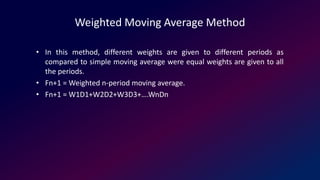
Weighted Moving Average Method
• In this method, different weights are given to different periods as
compared to simple moving average were equal weights are given to all
the periods.
• Fn+1 = Weighted n-period moving average.
• Fn+1 = W1D1+W2D2+W3D3+….WnDn
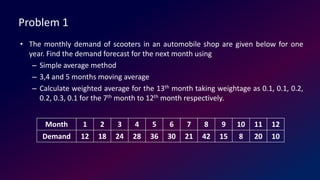
Problem 1
• The monthly demand of scooters in an automobile shop are given below for one
year. Find the demand forecast for the next month using
– Simple average method
– 3,4 and 5 months moving average
– Calculate weighted average for the 13th month taking weightage as 0.1, 0.1, 0.2,
0.2, 0.3, 0.1 for the 7th month to 12th month respectively.
Month 1 2 3 4 5 6 7 8 9 10 11 12
Demand 12 18 24 28 36 30 21 42 15 8 20 10
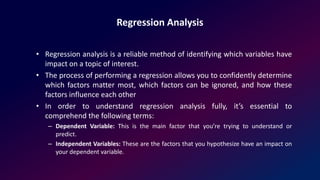
Regression Analysis
• Regression analysis is a reliable method of identifying which variables have
impact on a topic of interest.
• The process of performing a regression allows you to confidently determine
which factors matter most, which factors can be ignored, and how these
factors influence each other
• In order to understand regression analysis fully, it’s essential to
comprehend the following terms:
– Dependent Variable: This is the main factor that you’re trying to understand or
predict.
– Independent Variables: These are the factors that you hypothesize have an impact on
your dependent variable.
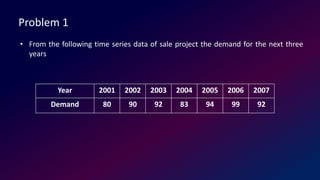
Problem 1
• From the following time series data of sale project the demand for the next three
years
Year 2001 2002 2003 2004 2005 2006 2007
Demand 80 90 92 83 94 99 92
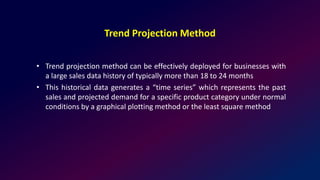
Trend Projection Method
• Trend projection method can be effectively deployed for businesses with
a large sales data history of typically more than 18 to 24 months
• This historical data generates a “time series” which represents the past
sales and projected demand for a specific product category under normal
conditions by a graphical plotting method or the least square method
All about dd forecasting

All about dd forecasting

  • 1.
    Demand Forecasting Prepared By: MohammedJasir PV Asst. Professor MIIMS, Puthanangadi
  • 2.
  • 3.
    Demand Forecasting • Whatis Demand Forecasting? • Why Demand Forecasting? • How to Forecast Demand?
  • 4.
    Demand Forecasting • Itis a technique for estimation of probable demand for a product or services in the future. • Analysis of • Demand forecasting should be done on a scientific basis and facts and events related to forecasting should be considered. Past Demand Present Demand Present market condition.
  • 5.
    Demand Forecasting • Itis the process in which historical sales data is used to develop an estimate of an expected forecast of customer demand. • To businesses, Demand Forecasting provides an estimate of the amount of goods and services that its customers will purchase in the foreseeable future. • Critical business assumptions like turnover, profit margins, cash flow, capital expenditure, risk assessment and mitigation plans, capacity planning, etc. are dependent on Demand
  • 6.
    Definitions • According toEvan J. Douglas, “Demand estimation (forecasting) may be defined as a process of finding values for demand in future time periods.” • In the words of Cundiff and Still, “Demand forecasting is an estimate of sales during a specified future period based on proposed marketing plan and a set of particular uncontrollable and competitive forces.”
  • 7.
    Demand Forecasting Objectives •Financial planning • Pricing policy • Manufacturing policy • Sales and Marketing planning • Capacity planning and expansion • Manpower planning • Capital expenditure
  • 8.
    Why DF? /DF Using for • Strategic and long-range plans – Budgeting – Financial planning – Sales and marketing plans – Capacity planning – Risk assessment • Short to medium term tactical plans – Pre-building – Make-to-stock, Make-to-order – Contract manufacturing – Supply planning – Network balancing Other purposes: Decision making, performance evaluation, allocation of resources in a constrained environment and business expansion planning
  • 9.
    Steps In DemandForecasting 1. Specifying the Objective 2. Determining the Time Perspective 3. Choice of method for Demand Forecasting 4. Collection of Data and Data Adjustment 5. Estimation and Interpretation of Results
  • 10.
    Methods of DemandForecasting  Qualitative Methods  Jury Of Executive Opinion  The Delphi Technique  Sales Force Opinion  Market Research  Quantitative methods  Moving Average Method  Simple Avg Technique  “n” Period Moving Average  Weighted MA  Regression Analysis  Least Square Method
  • 11.
    Jury of ExecutiveOpinion • Collecting the view of experts from sales, marketing, production, finance etc… after explaining the current situation of company and market. • Estimating by their experiences • Quick and cheap method
  • 12.
    The Delphi Technique •A panel of experts are appointed to forecast Demand. • Each expert is asked to generate a forecast of their assigned specific segment. • After the initial forecasting round, each expert reads out their forecast and in the process, each expert is influenced by other experts. • A consequent forecast is again made by all experts and the process is repeated until all experts reach a near consensus scenario.
  • 13.
    Sales Force Opinion •The Sales Manager asks for inputs of expected demand from each Salesperson in their team. • Each Salesperson evaluates their respective region and product categories and provides their individual customer demand. • Eventually, the Sales Manager aggregates all the demands and generates the final version of Demand Forecast after management’s judgment.
  • 14.
    Market Research • Inmarket research technique, customer-specific surveys are deployed to generate potential demand. • Such surveys are generally in the form of questionnaires that directly seeks personal, demographic, preference and economic information from end customers. • Since this type of research is on a random sampling basis, care needs to be exercised in terms of the survey regions, locations, and demographics of the end customer. • This type of method could be beneficial for products that have little to no demand history.
  • 15.
     Quantitative methods Moving Average Method  Simple Avg Technique  “n” Period Moving Average  Weighted MA  Regression Analysis  Least Square Method
  • 16.
    Simple Avg Technique •Simple arithmetic average of a set of values of demand for n-period is calculated and its used as forecast for the (n+1)th period in the immediate future. • The average demand for “n” period, D avg = D1+D2+D3…Dn n
  • 17.
    “n” period movingaverage method • The forecast a particular period mostly depends on some near past values. • The old data can contribute less in future • MA is obtained by summing and averaging the values from a given number of period repeatedly, each time deleting one old and adding one new. • F n+1 = D1+D2+D3+…….Dn No of Period
  • 18.
    Weighted Moving AverageMethod • In this method, different weights are given to different periods as compared to simple moving average were equal weights are given to all the periods. • Fn+1 = Weighted n-period moving average. • Fn+1 = W1D1+W2D2+W3D3+….WnDn
  • 19.
    Problem 1 • Themonthly demand of scooters in an automobile shop are given below for one year. Find the demand forecast for the next month using – Simple average method – 3,4 and 5 months moving average – Calculate weighted average for the 13th month taking weightage as 0.1, 0.1, 0.2, 0.2, 0.3, 0.1 for the 7th month to 12th month respectively. Month 1 2 3 4 5 6 7 8 9 10 11 12 Demand 12 18 24 28 36 30 21 42 15 8 20 10
  • 20.
    Regression Analysis • Regressionanalysis is a reliable method of identifying which variables have impact on a topic of interest. • The process of performing a regression allows you to confidently determine which factors matter most, which factors can be ignored, and how these factors influence each other • In order to understand regression analysis fully, it’s essential to comprehend the following terms: – Dependent Variable: This is the main factor that you’re trying to understand or predict. – Independent Variables: These are the factors that you hypothesize have an impact on your dependent variable.
  • 21.
    Problem 1 • Fromthe following time series data of sale project the demand for the next three years Year 2001 2002 2003 2004 2005 2006 2007 Demand 80 90 92 83 94 99 92
  • 22.
    Trend Projection Method •Trend projection method can be effectively deployed for businesses with a large sales data history of typically more than 18 to 24 months • This historical data generates a “time series” which represents the past sales and projected demand for a specific product category under normal conditions by a graphical plotting method or the least square method