Dr.M_T The 3rd Vision Academy 01156281369
I
Alkanelecture,
IUPAC Nomenclature of Organic Compounds
*Introduction
The purpose of the IUPAC system of nomenclature is to establish an international
standard of naming compounds to facilitate communication. The goal of the system
is to give each structure
a unique and unambiguous name, and to correlate each name with a unique and
unambiguous structure.
I. Fundamental Principle
IUPAC nomenclature is based on naming a molecule’s longest chain of carbons
connected by single bonds, whether in a continuous chain or in a ring. All
deviations, either multiple bonds or atoms other than carbon and hydrogen, are
indicated by prefixes or suffixes accordin0g to a specific set of priorities.
II. Rules of Alkanes Nomenclature
Alkanes are the family of saturated hydrocarbons, that is, molecules containing carbon and
hydrogen connected by single bonds only. These molecules can be in continuous chains
(called linear or acyclic), or in rings (called cyclic or alicyclic).
The names of alkanes and cycloalkanes are the root names of organic compounds.
Dr.M_T The 3rd Vision Academy 01156281369
II
1. Find the longest continuous carbon chain. Determine the root name for this parent
chain.
2. Number the chain in the direction such that the position number of the first substituent
is the smaller number. If the first substituents from either end have the same number, then
number so that the second substituent has the smaller number, etc.
3. Determine the name and position number of each substituent.
4. Indicate the number of identical groups by the prefixes di, tri, tetra, etc.
5. Place the position numbers and names of the substituent groups, in alphabetical order,
before the root name. In alphabetizing, ignore prefixes like sec-, tert-, di, tri, etc., but
include iso and cyclo. Always include a position number for each substituent, regardless of
redundancies.
-Example;
- Common branched substituents;
Dr.M_T The 3rd Vision Academy 01156281369
III
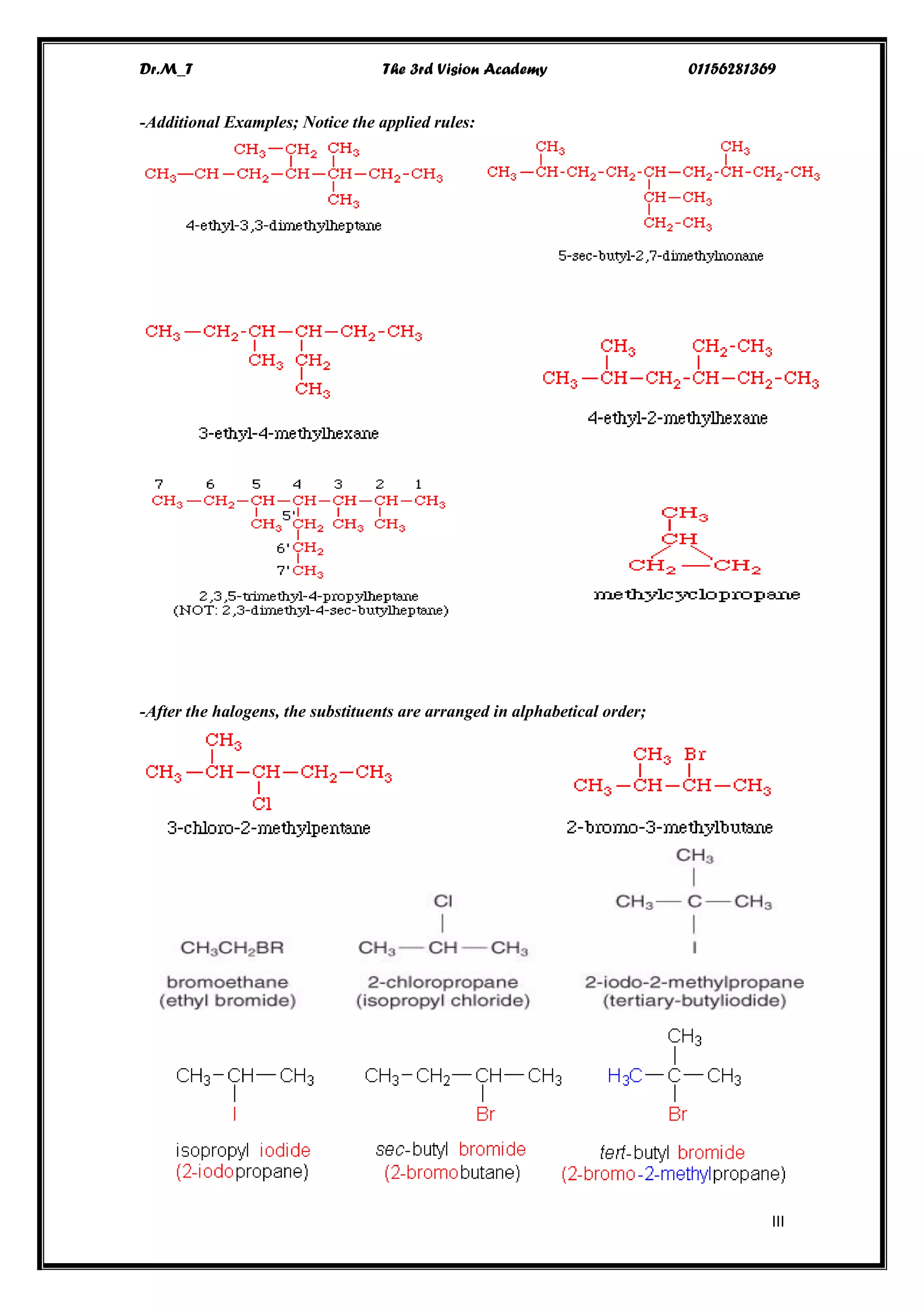
-Additional Examples; Notice the applied rules:
-After the halogens, the substituents are arranged in alphabetical order;
Dr.M_T The 3rd Vision Academy 01156281369
IV
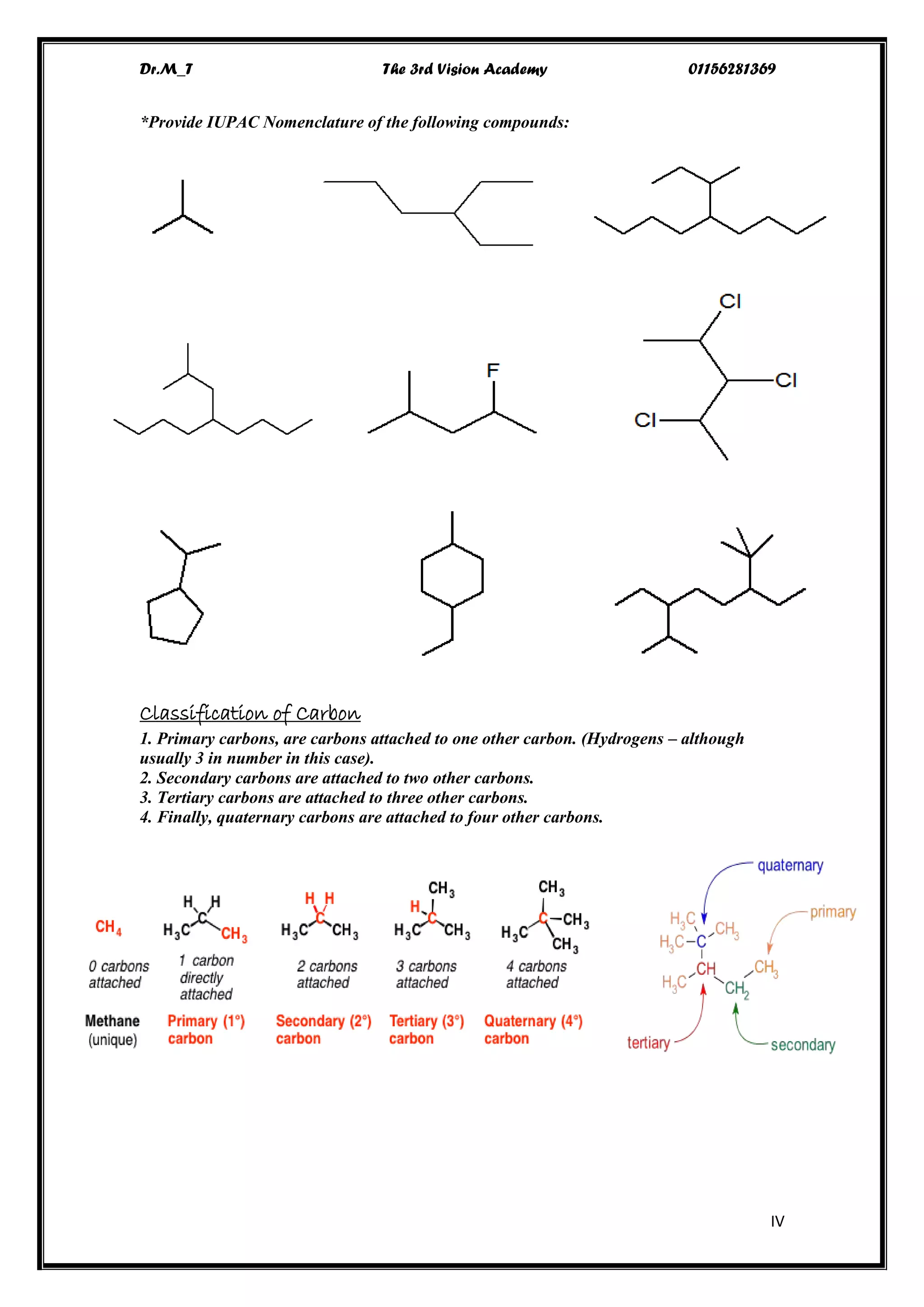
*Provide IUPAC Nomenclature of the following compounds:
Classification of Carbon
1. Primary carbons, are carbons attached to one other carbon. (Hydrogens – although
usually 3 in number in this case).
2. Secondary carbons are attached to two other carbons.
3. Tertiary carbons are attached to three other carbons.
4. Finally, quaternary carbons are attached to four other carbons.
Dr.M_T The 3rd Vision Academy 01156281369
V
Physical Properties of Alkanes
* 1c to 5c are gases.
* 6c to 10c are liquids.
* more than 11c are semisolid.
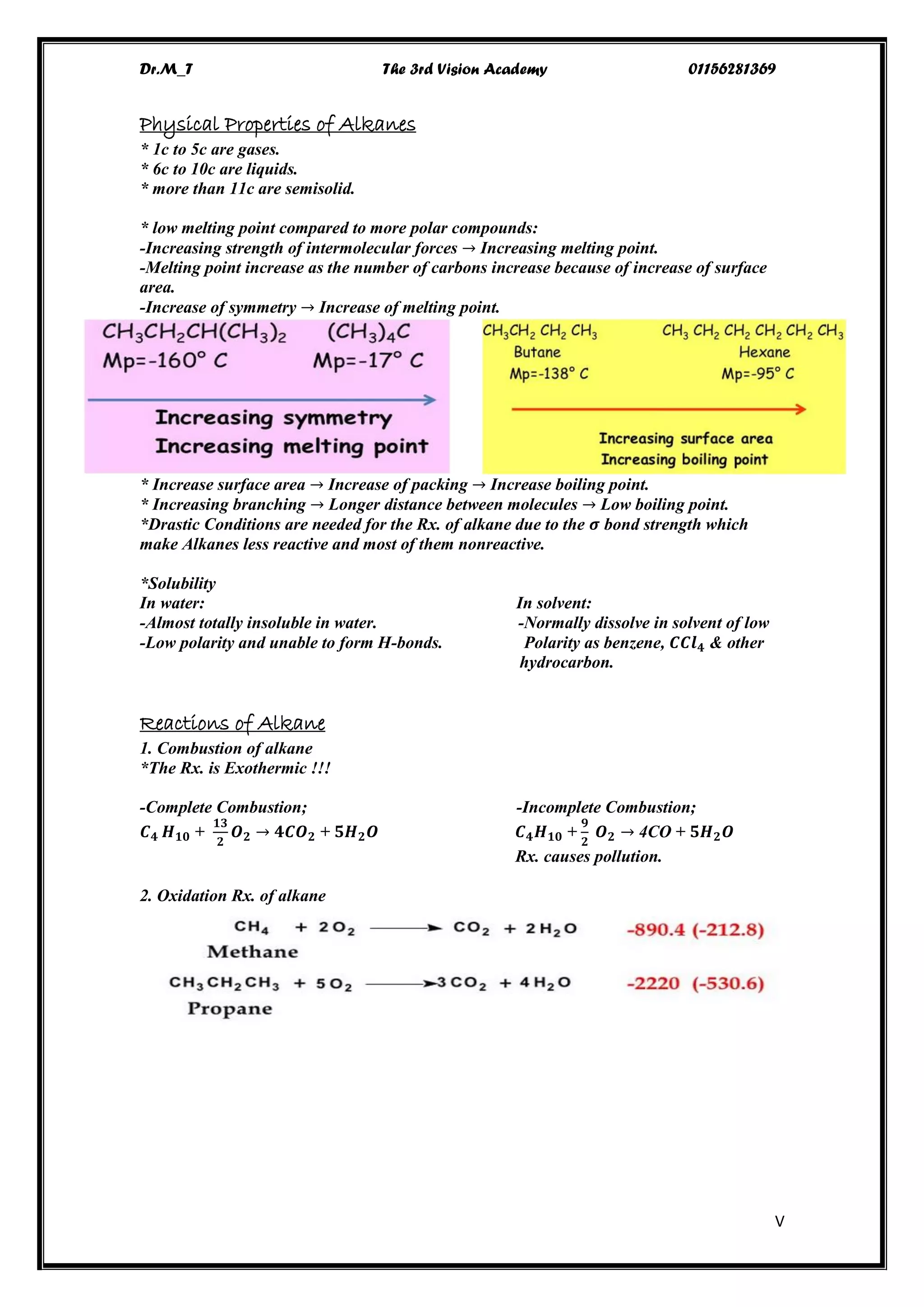
* low melting point compared to more polar compounds:
-Increasing strength of intermolecular forces → Increasing melting point.
-Melting point increase as the number of carbons increase because of increase of surface
area.
-Increase of symmetry → Increase of melting point.
* Increase surface area → Increase of packing → Increase boiling point.
* Increasing branching → Longer distance between molecules → Low boiling point.
*Drastic Conditions are needed for the Rx. of alkane due to the 𝝈 bond strength which
make Alkanes less reactive and most of them nonreactive.
*Solubility
In water: In solvent:
-Almost totally insoluble in water. -Normally dissolve in solvent of low
-Low polarity and unable to form H-bonds. Polarity as benzene, 𝑪𝑪𝒍 𝟒 & other
hydrocarbon.
Reactions of Alkane
1. Combustion of alkane
*The Rx. is Exothermic !!!
-Complete Combustion; -Incomplete Combustion;
𝑪 𝟒 𝑯 𝟏𝟎 +
𝟏𝟑
𝟐
𝑶 𝟐 → 𝟒𝑪𝑶 𝟐 + 𝟓𝑯 𝟐 𝑶 𝑪 𝟒 𝑯 𝟏𝟎 +
𝟗
𝟐
𝑶 𝟐 → 4CO + 𝟓𝑯 𝟐 𝑶
Rx. causes pollution.
2. Oxidation Rx. of alkane
Dr.M_T The 3rd Vision Academy 01156281369
VI
3. Halogenation of alkane
*Chain Radical Rx.-a substitution Rx.
Chlorination of Methane Mechanism;
Bromination of Ethane Mechanism;
The same sequence:
Dr.M_T The 3rd Vision Academy 01156281369
VII
*Regeoselectivity:
𝑭 𝟐 > 𝑪𝒍 𝟐 > 𝑩𝒓 𝟐 > 𝑰 𝟐
𝑻𝒉𝒆 𝒎𝒐𝒔𝒕 𝑹𝒆𝒂𝒄𝒕𝒊𝒗𝒆 𝑹𝒆𝒂𝒄𝒕𝒊𝒗𝒆 𝒘𝒊𝒕𝒉 ONLY 𝑹 𝑰𝒏𝒆𝒓𝒕
(𝑬𝒙𝒑𝒍𝒐𝒔𝒊𝒗𝒆) 𝟑 𝒐
. 𝟐 𝒐
&𝟏 𝒐
𝒘𝒊𝒕𝒉 ↑ 𝒔𝒕𝒂𝒃𝒍 Rx. indirect
𝑹𝒙 𝒊𝒏𝒅𝒊𝒓𝒆𝒄𝒕 Radical R-Br(𝑲𝑰)𝑹 − 𝑰
𝑹 − 𝒄𝒍 (
𝑯𝑭
𝑺𝒃𝑭 𝟓
) 𝑹 − 𝑭
-Radical Stability;
Radicals are stabilized by conjugating, electron-withdrawing, and electron-donating groups
-Chlorination of Alkane:
Dr.M_T The 3rd Vision Academy 01156281369
VIII
- Bromination of alkanes is more selective
The following reaction yields tert-butyl bromide with less than 1% of the primary isomer.
*Preparation of Alkene
1. Reduction of Alkene& Alkyne; Catalytic Reduction
2. From Alkyl halide
a. Via Reduc. Rx.
b. Via Grignard Reagent
*Grignard Reagent: (RMGX)
Dr.M_T The 3rd Vision Academy 01156281369
IX
c. Via Corey-House (Gilman reagent)
*C-C Coupling Rx.
d. Via Wurtz Rx.
*C-C Coupling Rx.
*Ascending Rx.
3. From Carboxylic acid
a. Using reducing agent
b. Via Decarboxylation (Using Sodalime)
c. Via Kolb's electrolytes
4. From Aldehydes& Ketones
a. Clemmensen's Reduction; for Ketones or aldehydes
Dr.M_T The 3rd Vision Academy 01156281369
X

Alkane

  • 1.
    Dr.M_T The 3rdVision Academy 01156281369 I Alkanelecture, IUPAC Nomenclature of Organic Compounds *Introduction The purpose of the IUPAC system of nomenclature is to establish an international standard of naming compounds to facilitate communication. The goal of the system is to give each structure a unique and unambiguous name, and to correlate each name with a unique and unambiguous structure. I. Fundamental Principle IUPAC nomenclature is based on naming a molecule’s longest chain of carbons connected by single bonds, whether in a continuous chain or in a ring. All deviations, either multiple bonds or atoms other than carbon and hydrogen, are indicated by prefixes or suffixes accordin0g to a specific set of priorities. II. Rules of Alkanes Nomenclature Alkanes are the family of saturated hydrocarbons, that is, molecules containing carbon and hydrogen connected by single bonds only. These molecules can be in continuous chains (called linear or acyclic), or in rings (called cyclic or alicyclic). The names of alkanes and cycloalkanes are the root names of organic compounds.
  • 2.
    Dr.M_T The 3rdVision Academy 01156281369 II 1. Find the longest continuous carbon chain. Determine the root name for this parent chain. 2. Number the chain in the direction such that the position number of the first substituent is the smaller number. If the first substituents from either end have the same number, then number so that the second substituent has the smaller number, etc. 3. Determine the name and position number of each substituent. 4. Indicate the number of identical groups by the prefixes di, tri, tetra, etc. 5. Place the position numbers and names of the substituent groups, in alphabetical order, before the root name. In alphabetizing, ignore prefixes like sec-, tert-, di, tri, etc., but include iso and cyclo. Always include a position number for each substituent, regardless of redundancies. -Example; - Common branched substituents;
  • 3.
    Dr.M_T The 3rdVision Academy 01156281369 III -Additional Examples; Notice the applied rules: -After the halogens, the substituents are arranged in alphabetical order;
  • 4.
    Dr.M_T The 3rdVision Academy 01156281369 IV *Provide IUPAC Nomenclature of the following compounds: Classification of Carbon 1. Primary carbons, are carbons attached to one other carbon. (Hydrogens – although usually 3 in number in this case). 2. Secondary carbons are attached to two other carbons. 3. Tertiary carbons are attached to three other carbons. 4. Finally, quaternary carbons are attached to four other carbons.
  • 5.
    Dr.M_T The 3rdVision Academy 01156281369 V Physical Properties of Alkanes * 1c to 5c are gases. * 6c to 10c are liquids. * more than 11c are semisolid. * low melting point compared to more polar compounds: -Increasing strength of intermolecular forces → Increasing melting point. -Melting point increase as the number of carbons increase because of increase of surface area. -Increase of symmetry → Increase of melting point. * Increase surface area → Increase of packing → Increase boiling point. * Increasing branching → Longer distance between molecules → Low boiling point. *Drastic Conditions are needed for the Rx. of alkane due to the 𝝈 bond strength which make Alkanes less reactive and most of them nonreactive. *Solubility In water: In solvent: -Almost totally insoluble in water. -Normally dissolve in solvent of low -Low polarity and unable to form H-bonds. Polarity as benzene, 𝑪𝑪𝒍 𝟒 & other hydrocarbon. Reactions of Alkane 1. Combustion of alkane *The Rx. is Exothermic !!! -Complete Combustion; -Incomplete Combustion; 𝑪 𝟒 𝑯 𝟏𝟎 + 𝟏𝟑 𝟐 𝑶 𝟐 → 𝟒𝑪𝑶 𝟐 + 𝟓𝑯 𝟐 𝑶 𝑪 𝟒 𝑯 𝟏𝟎 + 𝟗 𝟐 𝑶 𝟐 → 4CO + 𝟓𝑯 𝟐 𝑶 Rx. causes pollution. 2. Oxidation Rx. of alkane
  • 6.
    Dr.M_T The 3rdVision Academy 01156281369 VI 3. Halogenation of alkane *Chain Radical Rx.-a substitution Rx. Chlorination of Methane Mechanism; Bromination of Ethane Mechanism; The same sequence:
  • 7.
    Dr.M_T The 3rdVision Academy 01156281369 VII *Regeoselectivity: 𝑭 𝟐 > 𝑪𝒍 𝟐 > 𝑩𝒓 𝟐 > 𝑰 𝟐 𝑻𝒉𝒆 𝒎𝒐𝒔𝒕 𝑹𝒆𝒂𝒄𝒕𝒊𝒗𝒆 𝑹𝒆𝒂𝒄𝒕𝒊𝒗𝒆 𝒘𝒊𝒕𝒉 ONLY 𝑹 𝑰𝒏𝒆𝒓𝒕 (𝑬𝒙𝒑𝒍𝒐𝒔𝒊𝒗𝒆) 𝟑 𝒐 . 𝟐 𝒐 &𝟏 𝒐 𝒘𝒊𝒕𝒉 ↑ 𝒔𝒕𝒂𝒃𝒍 Rx. indirect 𝑹𝒙 𝒊𝒏𝒅𝒊𝒓𝒆𝒄𝒕 Radical R-Br(𝑲𝑰)𝑹 − 𝑰 𝑹 − 𝒄𝒍 ( 𝑯𝑭 𝑺𝒃𝑭 𝟓 ) 𝑹 − 𝑭 -Radical Stability; Radicals are stabilized by conjugating, electron-withdrawing, and electron-donating groups -Chlorination of Alkane:
  • 8.
    Dr.M_T The 3rdVision Academy 01156281369 VIII - Bromination of alkanes is more selective The following reaction yields tert-butyl bromide with less than 1% of the primary isomer. *Preparation of Alkene 1. Reduction of Alkene& Alkyne; Catalytic Reduction 2. From Alkyl halide a. Via Reduc. Rx. b. Via Grignard Reagent *Grignard Reagent: (RMGX)
  • 9.
    Dr.M_T The 3rdVision Academy 01156281369 IX c. Via Corey-House (Gilman reagent) *C-C Coupling Rx. d. Via Wurtz Rx. *C-C Coupling Rx. *Ascending Rx. 3. From Carboxylic acid a. Using reducing agent b. Via Decarboxylation (Using Sodalime) c. Via Kolb's electrolytes 4. From Aldehydes& Ketones a. Clemmensen's Reduction; for Ketones or aldehydes
  • 10.
    Dr.M_T The 3rdVision Academy 01156281369 X