Dr.M_T The 3rd Vision Academy 01156281369
I
Aromatic Compound
Classes of Aromatic comp.,,,
I. Annulens
-Def;
"completely conjugated monocyclic polyenes."
"cyclic hydrocarbon with continuous alternating of single and double
bond."
Cyclobutadiene, benzene, and cyclooctatetraene are the first members
of a family of annulenes.
-Nomenclature;
[ no. of C-atoms ] + annulene
-Note;
*Aromaticity in the larger annulenes depends on whether the molecule
can adopt the necessary planar conformation.
# carbon atoms must be EVEN (4,6,8 …) to be AROMATIC.
*Geometry of the structure control hybridization concept not vice vesra.
*Polyenes;
" poly-unsaturated organic compounds that contain at least three al-
ternating double and single carbon–carbon bonds, and have conjugated
system."
*The generality and limits of the Hückel rule can be tested by consider-
ing the properties of the annulene series.
e.g.
cyclobutadiene Benzene cyclooctatetraiene
[4]annulene [ 6]annulene [ 8]annulene
n=0.5 n=1 n=1.5
antiaromatic aromatic antiaromatic
Dr.M_T The 3rd Vision Academy 01156281369
II
[10]annulene [12]annulene [14]annulene
n=2 n=2.5 n=3
aromatic antiaromatic aromatic
[16]annulene [18]annulene
n=3.5 n=4
antiaromatic aromatic
N.B.
-The [10]annulene isomer with two trans double bonds cannot adopt a
planar conformation either, because two hydrogen atoms interfere with
each other. Neither of these [10]annulene isomers is aromatic, even
though each has pi electrons, with If the interfering hydrogen atoms in
the partially trans isomer are removed, the molecule can be planar.
[10]annulene [10]annulene [10]annulene
all CIS two trans remved interfering H
n=2 n=2 n=2
nonaromatic nonaromatic aromatic
-Naphthalene is the result when the interfering
hydrogen atoms of [10]annulene are replaced
with a bond.
Dr.M_T The 3rd Vision Academy 01156281369
III
-[18]Annulene offers a particularly significant test of
the Hückel rule. The internal cavity in [18]annulene is
large enough to minimize steric interaction between
the internal hydrogens in a geometry that is free of
angle strain.
[18]annulene
-Hückel’s rule also applies to systems having odd numbers of carbon
atoms and bearing positive or negative charges
II. Aromatic Ions
1. The Cyclopentadienyl Ions
With four 𝝅electrons (a cation), Hückel’s rule predicts this system to be
antiaromatic.
With six 𝝅electrons (an anion), Hückel’s rule predicts aromaticity.
Because the cyclopentadienyl anion (six 𝝅electrons) is aromatic, it is
unusually stable compared with other carbanions. It can be formed by
abstracting a proton from cyclopentadiene, which is unusually acidic
for an alkene.
Dr.M_T The 3rd Vision Academy 01156281369
IV
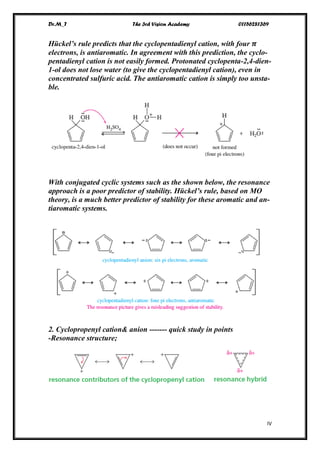
Hückel’s rule predicts that the cyclopentadienyl cation, with four 𝝅
electrons, is antiaromatic. In agreement with this prediction, the cyclo-
pentadienyl cation is not easily formed. Protonated cyclopenta-2,4-dien-
1-ol does not lose water (to give the cyclopentadienyl cation), even in
concentrated sulfuric acid. The antiaromatic cation is simply too unsta-
ble.
With conjugated cyclic systems such as the shown below, the resonance
approach is a poor predictor of stability. Hückel’s rule, based on MO
theory, is a much better predictor of stability for these aromatic and an-
tiaromatic systems.
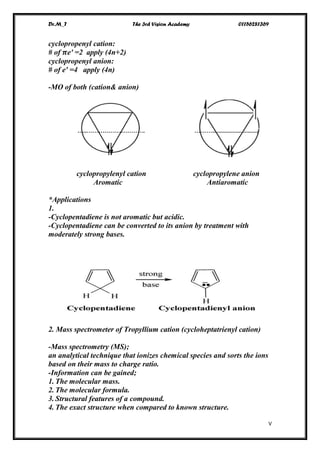
2. Cyclopropenyl cation& anion ------- quick study in points
-Resonance structure;
Dr.M_T The 3rd Vision Academy 01156281369
V
cyclopropenyl cation:
# of 𝝅e' =2 apply (4n+2)
cyclopropenyl anion:
# of e' =4 apply (4n)
-MO of both (cation& anion)
cyclopropylenyl cation cyclopropylene anion
Aromatic Antiaromatic
*Applications
1.
-Cyclopentadiene is not aromatic but acidic.
-Cyclopentadiene can be converted to its anion by treatment with
moderately strong bases.
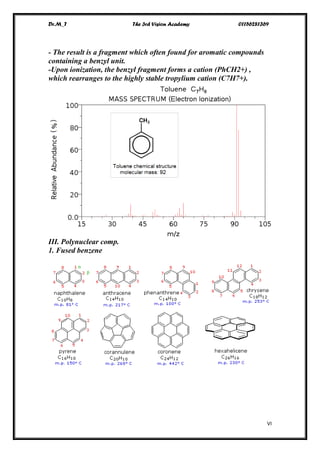
2. Mass spectrometer of Tropyllium cation (cycloheptatrienyl cation)
-Mass spectrometry (MS);
an analytical technique that ionizes chemical species and sorts the ions
based on their mass to charge ratio.
-Information can be gained;
1. The molecular mass.
2. The molecular formula.
3. Structural features of a compound.
4. The exact structure when compared to known structure.
Dr.M_T The 3rd Vision Academy 01156281369
VI
- The result is a fragment which often found for aromatic compounds
containing a benzyl unit.
-Upon ionization, the benzyl fragment forms a cation (PhCH2+) ,
which rearranges to the highly stable tropylium cation (C7H7+).
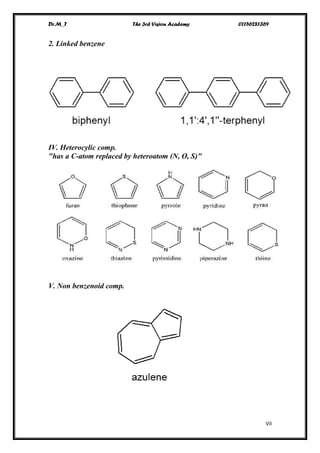
III. Polynuclear comp.
1. Fused benzene
Dr.M_T The 3rd Vision Academy 01156281369
VII
2. Linked benzene
IV. Heterocylic comp.
"has a C-atom replaced by heteroatom (N, O, S)"
V. Non benzenoid comp.
Dr.M_T The 3rd Vision Academy 01156281369
VIII
*Application
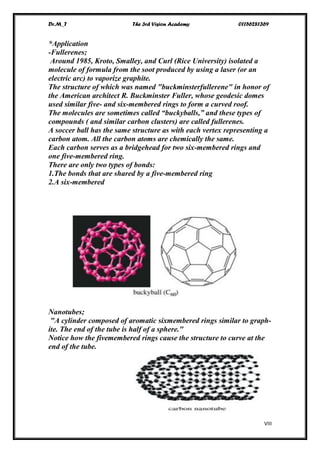
-Fullerenes;
Around 1985, Kroto, Smalley, and Curl (Rice University) isolated a
molecule of formula from the soot produced by using a laser (or an
electric arc) to vaporize graphite.
The structure of which was named "buckminsterfullerene" in honor of
the American architect R. Buckminster Fuller, whose geodesic domes
used similar five- and six-membered rings to form a curved roof.
The molecules are sometimes called “buckyballs,” and these types of
compounds ( and similar carbon clusters) are called fullerenes.
A soccer ball has the same structure as with each vertex representing a
carbon atom. All the carbon atoms are chemically the same.
Each carbon serves as a bridgehead for two six-membered rings and
one five-membered ring.
There are only two types of bonds:
1.The bonds that are shared by a five-membered ring
2.A six-membered
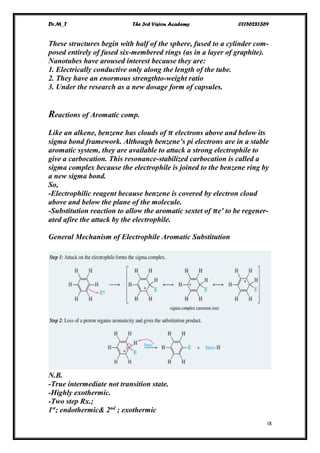
Nanotubes;
"A cylinder composed of aromatic sixmembered rings similar to graph-
ite. The end of the tube is half of a sphere."
Notice how the fivemembered rings cause the structure to curve at the
end of the tube.
Dr.M_T The 3rd Vision Academy 01156281369
IX
These structures begin with half of the sphere, fused to a cylinder com-
posed entirely of fused six-membered rings (as in a layer of graphite).
Nanotubes have aroused interest because they are:
1. Electrically conductive only along the length of the tube.
2. They have an enormous strengthto-weight ratio
3. Under the research as a new dosage form of capsules.
Reactions of Aromatic comp.
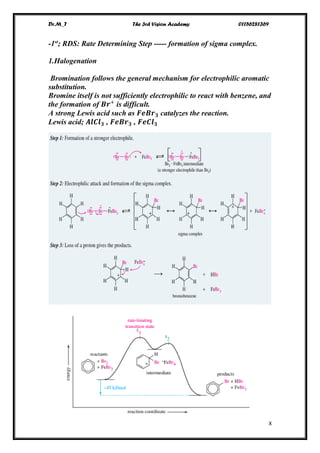
Like an alkene, benzene has clouds of 𝝅 electrons above and below its
sigma bond framework. Although benzene’s pi electrons are in a stable
aromatic system, they are available to attack a strong electrophile to
give a carbocation. This resonance-stabilized carbocation is called a
sigma complex because the electrophile is joined to the benzene ring by
a new sigma bond.
So,
-Electrophilic reagent because benzene is covered by electron cloud
above and below the plane of the molecule.
-Substitution reaction to allow the aromatic sextet of 𝝅e' to be regener-
ated afire the attack by the electrophile.
General Mechanism of Electrophile Aromatic Substitution
N.B.
-True intermediate not transition state.
-Highly exothermic.
-Two step Rx.;
1st
; endothermic& 2nd
; exothermic
Dr.M_T The 3rd Vision Academy 01156281369
X
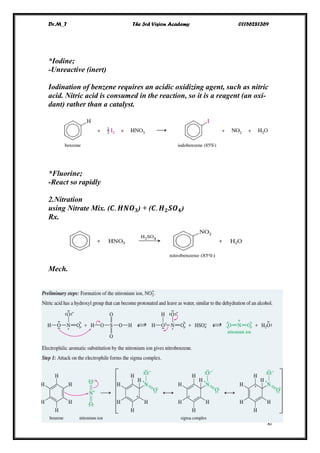
-1st
; RDS: Rate Determining Step ----- formation of sigma complex.
1.Halogenation
Bromination follows the general mechanism for electrophilic aromatic
substitution.
Bromine itself is not sufficiently electrophilic to react with benzene, and
the formation of 𝑩𝒓+
is difficult.
A strong Lewis acid such as 𝑭𝒆𝑩𝒓 𝟑 catalyzes the reaction.
Lewis acid; 𝑨𝒍𝑪𝒍 𝟑 , 𝑭𝒆𝑩𝒓 𝟑 , 𝑭𝒆𝑪𝒍 𝟑
Type equation here.
Dr.M_T The 3rd Vision Academy 01156281369
XI
*Iodine;
-Unreactive (inert)
Iodination of benzene requires an acidic oxidizing agent, such as nitric
acid. Nitric acid is consumed in the reaction, so it is a reagent (an oxi-
dant) rather than a catalyst.
*Fluorine;
-React so rapidly
2.Nitration
using Nitrate Mix. (𝑪. 𝑯𝑵𝑶 𝟑) + (𝑪. 𝑯 𝟐 𝑺𝑶 𝟒)
Rx.
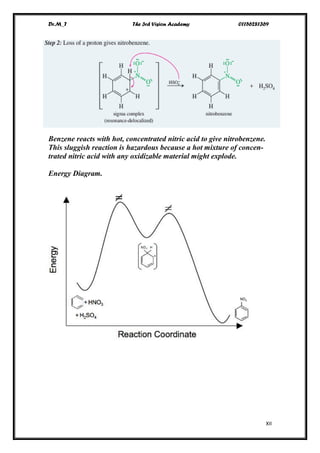
Mech.
Dr.M_T The 3rd Vision Academy 01156281369
XII
Benzene reacts with hot, concentrated nitric acid to give nitrobenzene.
This sluggish reaction is hazardous because a hot mixture of concen-
trated nitric acid with any oxidizable material might explode.
Energy Diagram.
Dr.M_T The 3rd Vision Academy 01156281369
XIII
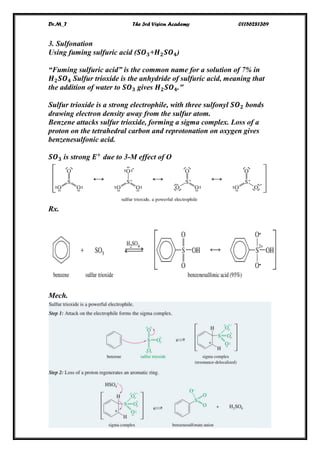
3. Sulfonation
Using fuming sulfuric acid (𝑺𝑶 𝟑+𝑯 𝟐 𝑺𝑶 𝟒)
“Fuming sulfuric acid” is the common name for a solution of 7% in
𝑯 𝟐 𝑺𝑶 𝟒 Sulfur trioxide is the anhydride of sulfuric acid, meaning that
the addition of water to 𝑺𝑶 𝟑 gives 𝑯 𝟐 𝑺𝑶 𝟒."
Sulfur trioxide is a strong electrophile, with three sulfonyl 𝑺𝑶 𝟐 bonds
drawing electron density away from the sulfur atom.
Benzene attacks sulfur trioxide, forming a sigma complex. Loss of a
proton on the tetrahedral carbon and reprotonation on oxygen gives
benzenesulfonic acid.
𝑺𝑶 𝟑 is strong 𝑬+
due to 3-M effect of O
Rx.
Mech.
Dr.M_T The 3rd Vision Academy 01156281369
XIV
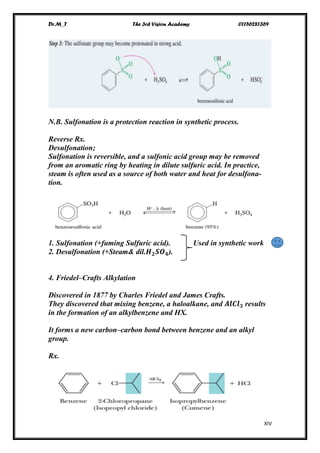
N.B. Sulfonation is a protection reaction in synthetic process.
Reverse Rx.
Desulfonation;
Sulfonation is reversible, and a sulfonic acid group may be removed
from an aromatic ring by heating in dilute sulfuric acid. In practice,
steam is often used as a source of both water and heat for desulfona-
tion.
1. Sulfonation (+fuming Sulfuric acid). Used in synthetic work
2. Desulfonation (+Steam& dil.𝑯 𝟐 𝑺𝑶 𝟒).
4. Friedel–Crafts Alkylation
Discovered in 1877 by Charles Friedel and James Crafts.
They discovered that mixing benzene, a haloalkane, and 𝑨𝒍𝑪𝒍 𝟑 results
in the formation of an alkylbenzene and HX.
It forms a new carbon–carbon bond between benzene and an alkyl
group.
Rx.
Dr.M_T The 3rd Vision Academy 01156281369
XV
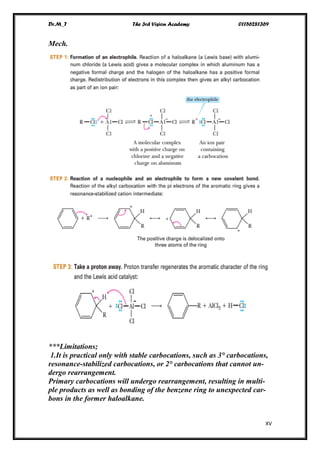
Mech.
***Limitations;
1.It is practical only with stable carbocations, such as 3° carbocations,
resonance-stabilized carbocations, or 2° carbocations that cannot un-
dergo rearrangement.
Primary carbocations will undergo rearrangement, resulting in multi-
ple products as well as bonding of the benzene ring to unexpected car-
bons in the former haloalkane.
Dr.M_T The 3rd Vision Academy 01156281369
XVI
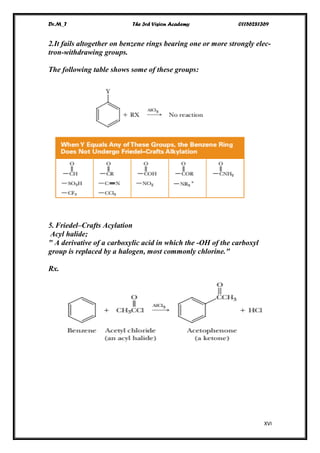
2.It fails altogether on benzene rings bearing one or more strongly elec-
tron-withdrawing groups.
The following table shows some of these groups:
5. Friedel–Crafts Acylation
Acyl halide;
" A derivative of a carboxylic acid in which the -OH of the carboxyl
group is replaced by a halogen, most commonly chlorine."
Rx.
Dr.M_T The 3rd Vision Academy 01156281369
XVII
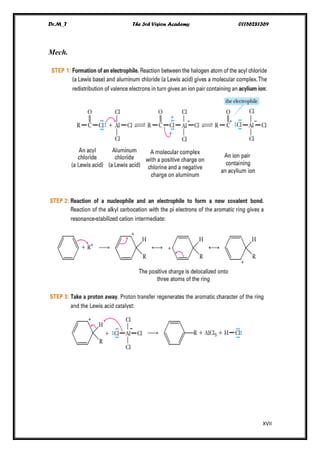
Mech.
Dr.M_T The 3rd Vision Academy 01156281369
XVIII
N.B.
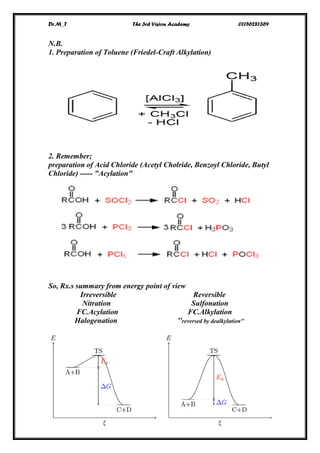
1. Preparation of Toluene (Friedel-Craft Alkylation)
2. Remember;
preparation of Acid Chloride (Acetyl Cholride, Benzoyl Chloride, Butyl
Chloride) ----- "Acylation"
So, Rx.s summary from energy point of view
Irreversible Reversible
Nitration Sulfonation
FC.Acylation FC.Alkylation
Halogenation ''reversed by dealkylation''
Dr.M_T The 3rd Vision Academy 01156281369
XIX

Aromatic Comp. Lec.2

  • 1.
    Dr.M_T The 3rdVision Academy 01156281369 I Aromatic Compound Classes of Aromatic comp.,,, I. Annulens -Def; "completely conjugated monocyclic polyenes." "cyclic hydrocarbon with continuous alternating of single and double bond." Cyclobutadiene, benzene, and cyclooctatetraene are the first members of a family of annulenes. -Nomenclature; [ no. of C-atoms ] + annulene -Note; *Aromaticity in the larger annulenes depends on whether the molecule can adopt the necessary planar conformation. # carbon atoms must be EVEN (4,6,8 …) to be AROMATIC. *Geometry of the structure control hybridization concept not vice vesra. *Polyenes; " poly-unsaturated organic compounds that contain at least three al- ternating double and single carbon–carbon bonds, and have conjugated system." *The generality and limits of the Hückel rule can be tested by consider- ing the properties of the annulene series. e.g. cyclobutadiene Benzene cyclooctatetraiene [4]annulene [ 6]annulene [ 8]annulene n=0.5 n=1 n=1.5 antiaromatic aromatic antiaromatic
  • 2.
    Dr.M_T The 3rdVision Academy 01156281369 II [10]annulene [12]annulene [14]annulene n=2 n=2.5 n=3 aromatic antiaromatic aromatic [16]annulene [18]annulene n=3.5 n=4 antiaromatic aromatic N.B. -The [10]annulene isomer with two trans double bonds cannot adopt a planar conformation either, because two hydrogen atoms interfere with each other. Neither of these [10]annulene isomers is aromatic, even though each has pi electrons, with If the interfering hydrogen atoms in the partially trans isomer are removed, the molecule can be planar. [10]annulene [10]annulene [10]annulene all CIS two trans remved interfering H n=2 n=2 n=2 nonaromatic nonaromatic aromatic -Naphthalene is the result when the interfering hydrogen atoms of [10]annulene are replaced with a bond.
  • 3.
    Dr.M_T The 3rdVision Academy 01156281369 III -[18]Annulene offers a particularly significant test of the Hückel rule. The internal cavity in [18]annulene is large enough to minimize steric interaction between the internal hydrogens in a geometry that is free of angle strain. [18]annulene -Hückel’s rule also applies to systems having odd numbers of carbon atoms and bearing positive or negative charges II. Aromatic Ions 1. The Cyclopentadienyl Ions With four 𝝅electrons (a cation), Hückel’s rule predicts this system to be antiaromatic. With six 𝝅electrons (an anion), Hückel’s rule predicts aromaticity. Because the cyclopentadienyl anion (six 𝝅electrons) is aromatic, it is unusually stable compared with other carbanions. It can be formed by abstracting a proton from cyclopentadiene, which is unusually acidic for an alkene.
  • 4.
    Dr.M_T The 3rdVision Academy 01156281369 IV Hückel’s rule predicts that the cyclopentadienyl cation, with four 𝝅 electrons, is antiaromatic. In agreement with this prediction, the cyclo- pentadienyl cation is not easily formed. Protonated cyclopenta-2,4-dien- 1-ol does not lose water (to give the cyclopentadienyl cation), even in concentrated sulfuric acid. The antiaromatic cation is simply too unsta- ble. With conjugated cyclic systems such as the shown below, the resonance approach is a poor predictor of stability. Hückel’s rule, based on MO theory, is a much better predictor of stability for these aromatic and an- tiaromatic systems. 2. Cyclopropenyl cation& anion ------- quick study in points -Resonance structure;
  • 5.
    Dr.M_T The 3rdVision Academy 01156281369 V cyclopropenyl cation: # of 𝝅e' =2 apply (4n+2) cyclopropenyl anion: # of e' =4 apply (4n) -MO of both (cation& anion) cyclopropylenyl cation cyclopropylene anion Aromatic Antiaromatic *Applications 1. -Cyclopentadiene is not aromatic but acidic. -Cyclopentadiene can be converted to its anion by treatment with moderately strong bases. 2. Mass spectrometer of Tropyllium cation (cycloheptatrienyl cation) -Mass spectrometry (MS); an analytical technique that ionizes chemical species and sorts the ions based on their mass to charge ratio. -Information can be gained; 1. The molecular mass. 2. The molecular formula. 3. Structural features of a compound. 4. The exact structure when compared to known structure.
  • 6.
    Dr.M_T The 3rdVision Academy 01156281369 VI - The result is a fragment which often found for aromatic compounds containing a benzyl unit. -Upon ionization, the benzyl fragment forms a cation (PhCH2+) , which rearranges to the highly stable tropylium cation (C7H7+). III. Polynuclear comp. 1. Fused benzene
  • 7.
    Dr.M_T The 3rdVision Academy 01156281369 VII 2. Linked benzene IV. Heterocylic comp. "has a C-atom replaced by heteroatom (N, O, S)" V. Non benzenoid comp.
  • 8.
    Dr.M_T The 3rdVision Academy 01156281369 VIII *Application -Fullerenes; Around 1985, Kroto, Smalley, and Curl (Rice University) isolated a molecule of formula from the soot produced by using a laser (or an electric arc) to vaporize graphite. The structure of which was named "buckminsterfullerene" in honor of the American architect R. Buckminster Fuller, whose geodesic domes used similar five- and six-membered rings to form a curved roof. The molecules are sometimes called “buckyballs,” and these types of compounds ( and similar carbon clusters) are called fullerenes. A soccer ball has the same structure as with each vertex representing a carbon atom. All the carbon atoms are chemically the same. Each carbon serves as a bridgehead for two six-membered rings and one five-membered ring. There are only two types of bonds: 1.The bonds that are shared by a five-membered ring 2.A six-membered Nanotubes; "A cylinder composed of aromatic sixmembered rings similar to graph- ite. The end of the tube is half of a sphere." Notice how the fivemembered rings cause the structure to curve at the end of the tube.
  • 9.
    Dr.M_T The 3rdVision Academy 01156281369 IX These structures begin with half of the sphere, fused to a cylinder com- posed entirely of fused six-membered rings (as in a layer of graphite). Nanotubes have aroused interest because they are: 1. Electrically conductive only along the length of the tube. 2. They have an enormous strengthto-weight ratio 3. Under the research as a new dosage form of capsules. Reactions of Aromatic comp. Like an alkene, benzene has clouds of 𝝅 electrons above and below its sigma bond framework. Although benzene’s pi electrons are in a stable aromatic system, they are available to attack a strong electrophile to give a carbocation. This resonance-stabilized carbocation is called a sigma complex because the electrophile is joined to the benzene ring by a new sigma bond. So, -Electrophilic reagent because benzene is covered by electron cloud above and below the plane of the molecule. -Substitution reaction to allow the aromatic sextet of 𝝅e' to be regener- ated afire the attack by the electrophile. General Mechanism of Electrophile Aromatic Substitution N.B. -True intermediate not transition state. -Highly exothermic. -Two step Rx.; 1st ; endothermic& 2nd ; exothermic
  • 10.
    Dr.M_T The 3rdVision Academy 01156281369 X -1st ; RDS: Rate Determining Step ----- formation of sigma complex. 1.Halogenation Bromination follows the general mechanism for electrophilic aromatic substitution. Bromine itself is not sufficiently electrophilic to react with benzene, and the formation of 𝑩𝒓+ is difficult. A strong Lewis acid such as 𝑭𝒆𝑩𝒓 𝟑 catalyzes the reaction. Lewis acid; 𝑨𝒍𝑪𝒍 𝟑 , 𝑭𝒆𝑩𝒓 𝟑 , 𝑭𝒆𝑪𝒍 𝟑 Type equation here.
  • 11.
    Dr.M_T The 3rdVision Academy 01156281369 XI *Iodine; -Unreactive (inert) Iodination of benzene requires an acidic oxidizing agent, such as nitric acid. Nitric acid is consumed in the reaction, so it is a reagent (an oxi- dant) rather than a catalyst. *Fluorine; -React so rapidly 2.Nitration using Nitrate Mix. (𝑪. 𝑯𝑵𝑶 𝟑) + (𝑪. 𝑯 𝟐 𝑺𝑶 𝟒) Rx. Mech.
  • 12.
    Dr.M_T The 3rdVision Academy 01156281369 XII Benzene reacts with hot, concentrated nitric acid to give nitrobenzene. This sluggish reaction is hazardous because a hot mixture of concen- trated nitric acid with any oxidizable material might explode. Energy Diagram.
  • 13.
    Dr.M_T The 3rdVision Academy 01156281369 XIII 3. Sulfonation Using fuming sulfuric acid (𝑺𝑶 𝟑+𝑯 𝟐 𝑺𝑶 𝟒) “Fuming sulfuric acid” is the common name for a solution of 7% in 𝑯 𝟐 𝑺𝑶 𝟒 Sulfur trioxide is the anhydride of sulfuric acid, meaning that the addition of water to 𝑺𝑶 𝟑 gives 𝑯 𝟐 𝑺𝑶 𝟒." Sulfur trioxide is a strong electrophile, with three sulfonyl 𝑺𝑶 𝟐 bonds drawing electron density away from the sulfur atom. Benzene attacks sulfur trioxide, forming a sigma complex. Loss of a proton on the tetrahedral carbon and reprotonation on oxygen gives benzenesulfonic acid. 𝑺𝑶 𝟑 is strong 𝑬+ due to 3-M effect of O Rx. Mech.
  • 14.
    Dr.M_T The 3rdVision Academy 01156281369 XIV N.B. Sulfonation is a protection reaction in synthetic process. Reverse Rx. Desulfonation; Sulfonation is reversible, and a sulfonic acid group may be removed from an aromatic ring by heating in dilute sulfuric acid. In practice, steam is often used as a source of both water and heat for desulfona- tion. 1. Sulfonation (+fuming Sulfuric acid). Used in synthetic work 2. Desulfonation (+Steam& dil.𝑯 𝟐 𝑺𝑶 𝟒). 4. Friedel–Crafts Alkylation Discovered in 1877 by Charles Friedel and James Crafts. They discovered that mixing benzene, a haloalkane, and 𝑨𝒍𝑪𝒍 𝟑 results in the formation of an alkylbenzene and HX. It forms a new carbon–carbon bond between benzene and an alkyl group. Rx.
  • 15.
    Dr.M_T The 3rdVision Academy 01156281369 XV Mech. ***Limitations; 1.It is practical only with stable carbocations, such as 3° carbocations, resonance-stabilized carbocations, or 2° carbocations that cannot un- dergo rearrangement. Primary carbocations will undergo rearrangement, resulting in multi- ple products as well as bonding of the benzene ring to unexpected car- bons in the former haloalkane.
  • 16.
    Dr.M_T The 3rdVision Academy 01156281369 XVI 2.It fails altogether on benzene rings bearing one or more strongly elec- tron-withdrawing groups. The following table shows some of these groups: 5. Friedel–Crafts Acylation Acyl halide; " A derivative of a carboxylic acid in which the -OH of the carboxyl group is replaced by a halogen, most commonly chlorine." Rx.
  • 17.
    Dr.M_T The 3rdVision Academy 01156281369 XVII Mech.
  • 18.
    Dr.M_T The 3rdVision Academy 01156281369 XVIII N.B. 1. Preparation of Toluene (Friedel-Craft Alkylation) 2. Remember; preparation of Acid Chloride (Acetyl Cholride, Benzoyl Chloride, Butyl Chloride) ----- "Acylation" So, Rx.s summary from energy point of view Irreversible Reversible Nitration Sulfonation FC.Acylation FC.Alkylation Halogenation ''reversed by dealkylation''
  • 19.
    Dr.M_T The 3rdVision Academy 01156281369 XIX