Dr.M_T The 3rd Vision Academy 01156281369
I
Aromatic Compound
I. Topics of to understand& handle the following pathways of
CONVERSION& Pre-steps Rx.
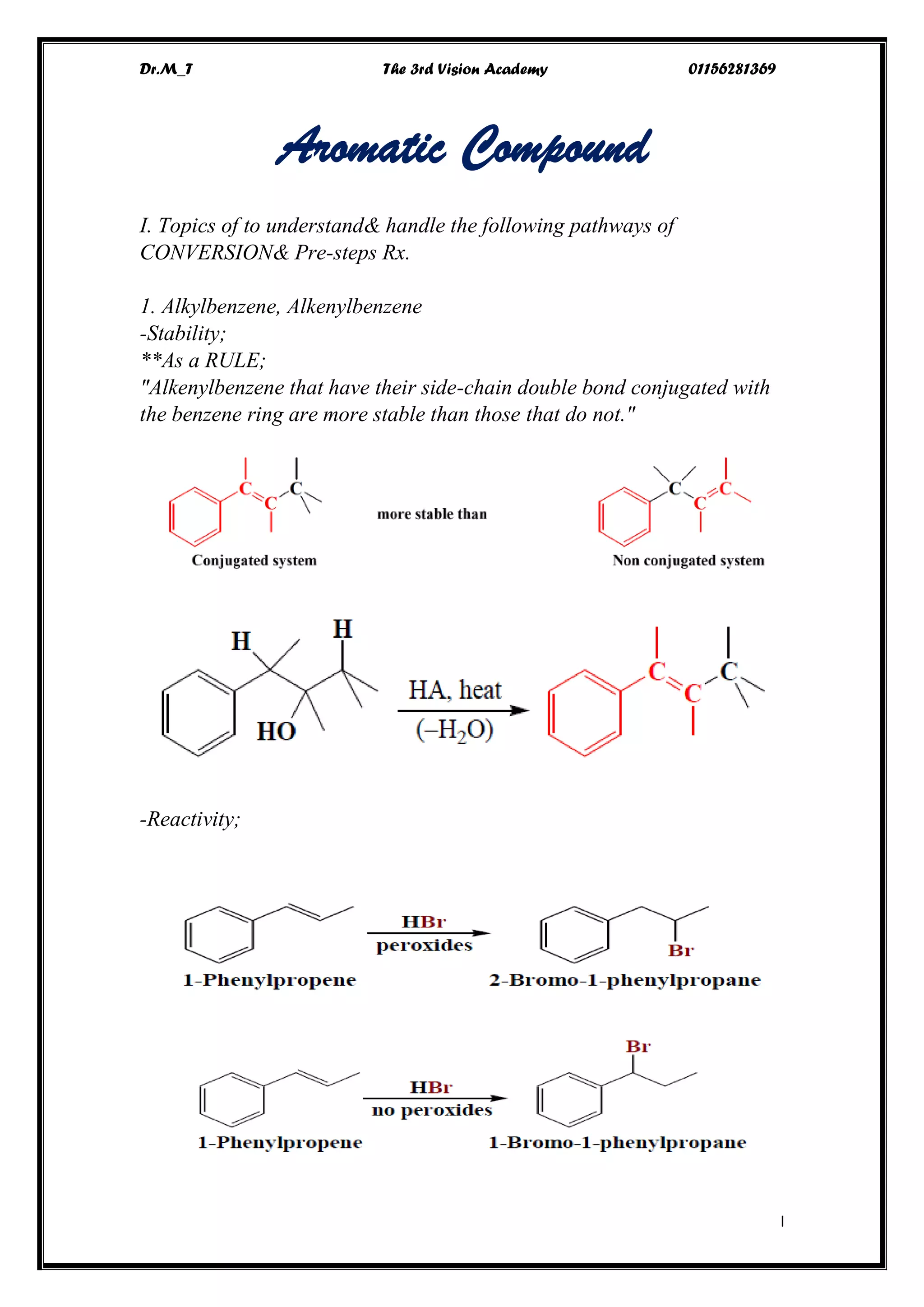
1. Alkylbenzene, Alkenylbenzene
-Stability;
**As a RULE;
"Alkenylbenzene that have their side-chain double bond conjugated with
the benzene ring are more stable than those that do not."
-Reactivity;
Dr.M_T The 3rd Vision Academy 01156281369
II
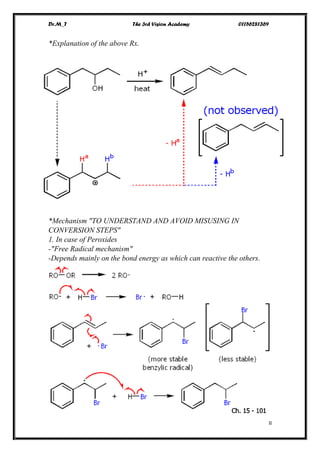
*Explanation of the above Rx.
*Mechanism "TO UNDERSTAND AND AVOID MISUSING IN
CONVERSION STEPS"
1. In case of Peroxides
-"Free Radical mechanism"
-Depends mainly on the bond energy as which can reactive the others.
Dr.M_T The 3rd Vision Academy 01156281369
III
2. In case of NO Peroxides
-"Ionic mechanism"
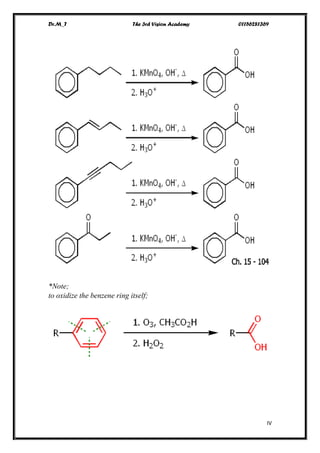
2. Oxidation of the side chain
-Using hot alkaline 𝐾𝑀𝑁𝑂4, alkyl, alkenyl, alkynyl and acyl grp.s all
oxidized to -COOH grp.
-For alkylbenzene, 3°alkyl grp. can resist oxidation. GIVE REASON!
---Answer; Need to benzylic hydrogen for alkyl grp. oxidation.
Dr.M_T The 3rd Vision Academy 01156281369
IV
*Note;
to oxidize the benzene ring itself;
Dr.M_T The 3rd Vision Academy 01156281369
V
**Application;
Chemistry of Industrial Styrene
Styrene is one of the most important industrial chemicals—more than
11billion pounds (5billionKg=5millionton) is produced each year.
-How to prepare it ?!
II. Aralkylhalides; Side-Halogen Comp.
Hint; memorize the mentioned comp. in their common names, please!
1. examples;
Dr.M_T The 3rd Vision Academy 01156281369
VI
2. Synthesis;
- Free radical halogenations of alkylbenzene.
- Addition of HX to alkenylbenzene.
- Reaction of HX with aromatic alcohols.
3. Reactions
Remember the general points of 𝑆 𝑁1& 𝑆 𝑁2.
Dr.M_T The 3rd Vision Academy 01156281369
VII
-Nucleophilic substitution reactions either 𝑆 𝑁1 or 𝑆 𝑁2.
-1°& 2° benzylic halide typically react via an 𝑆 𝑛2.(NO Elimination)
-3° benzylic halide typically react via an 𝑆 𝑁1. GIVE REASON!
---Answer; due to the resonance stabilized carbocation& steric effect.
-Unlike allylic systems, NO benzylic rearrangement.
GIVE REASON!
---Answer; I would result in loss of aromaticity.
-We can shift from one mechanism to the other by changing reaction
conditions.
1. 𝑆 𝑁2 Rx Mechanism.
1°& 2° benzylic halides typically react via an 𝑆 𝑁2 pathway.
Allylic and benzylic halides exhibit enhanced 𝑆 𝑁2 reactivity thanks to
conjugation of the newly formed and breaking bonds with the adjacent π-
electron system.
2. 𝑆 𝑁1 Rx Mechanism.
3° benzylic halides typically react via an 𝑆 𝑁1 pathway,
A carbocation is formed as a high-energy intermediate, and this species
bonds immediately to nearby nucleophiles.
If the nucleophile is a neutral molecule, the initial product is an "onium"
cation.
Dr.M_T The 3rd Vision Academy 01156281369
VIII
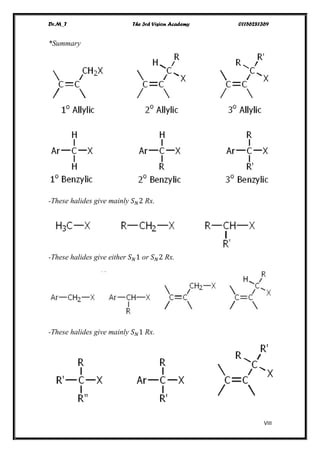
*Summary
-These halides give mainly 𝑆 𝑁2 Rx.
-These halides give either 𝑆 𝑁1 or 𝑆 𝑁2 Rx.
-These halides give mainly 𝑆 𝑁1 Rx.
Dr.M_T The 3rd Vision Academy 01156281369
IX
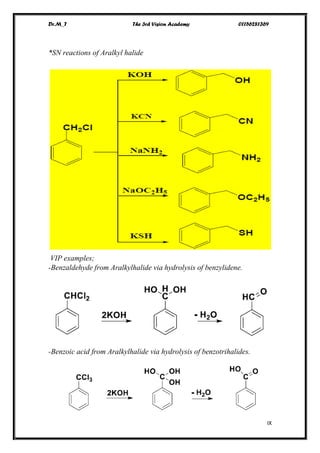
*SN reactions of Aralkyl halide
VIP examples;
-Benzaldehyde from Aralkylhalide via hydrolysis of benzylidene.
-Benzoic acid from Aralkylhalide via hydrolysis of benzotrihalides.
Dr.M_T The 3rd Vision Academy 01156281369
X
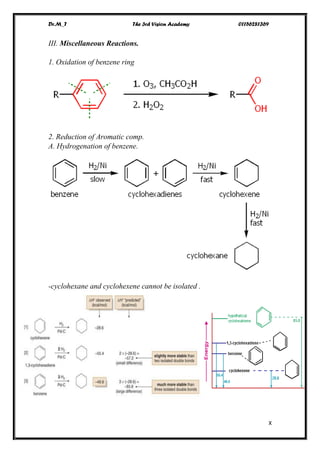
III. Miscellaneous Reactions.
1. Oxidation of benzene ring
2. Reduction of Aromatic comp.
A. Hydrogenation of benzene.
-cyclohexane and cyclohexene cannot be isolated .
Dr.M_T The 3rd Vision Academy 01156281369
XI
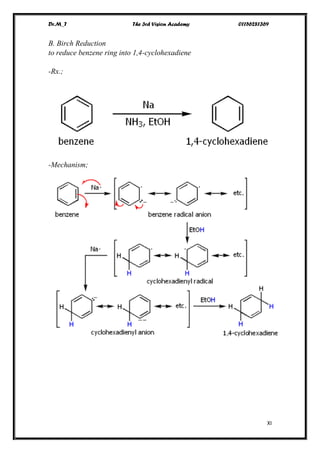
B. Birch Reduction
to reduce benzene ring into 1,4-cyclohexadiene
-Rx.;
-Mechanism;
Dr.M_T The 3rd Vision Academy 01156281369
XII
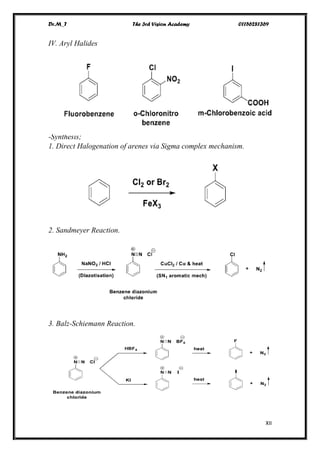
IV. Aryl Halides
-Synthesis;
1. Direct Halogenation of arenes via Sigma complex mechanism.
2. Sandmeyer Reaction.
3. Balz-Schiemann Reaction.
Dr.M_T The 3rd Vision Academy 01156281369
XIII
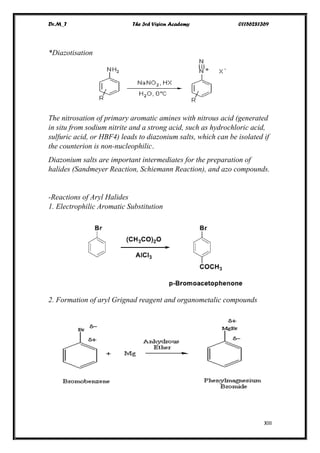
*Diazotisation
The nitrosation of primary aromatic amines with nitrous acid (generated
in situ from sodium nitrite and a strong acid, such as hydrochloric acid,
sulfuric acid, or HBF4) leads to diazonium salts, which can be isolated if
the counterion is non-nucleophilic.
Diazonium salts are important intermediates for the preparation of
halides (Sandmeyer Reaction, Schiemann Reaction), and azo compounds.
-Reactions of Aryl Halides
1. Electrophilic Aromatic Substitution
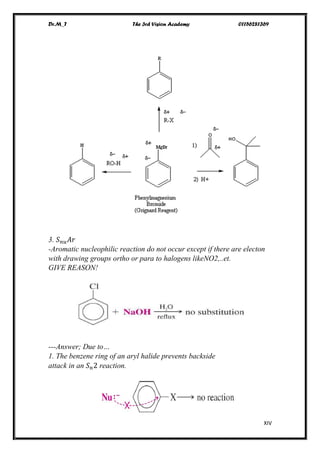
2. Formation of aryl Grignad reagent and organometalic compounds
Dr.M_T The 3rd Vision Academy 01156281369
XIV
3. 𝑆 𝑛𝑢 𝐴𝑟
-Aromatic nucleophilic reaction do not occur except if there are electon
with drawing groups ortho or para to halogens likeNO2,..et.
GIVE REASON!
---Answer; Due to…
1. The benzene ring of an aryl halide prevents backside
attack in an 𝑆 𝑛2 reaction.
Dr.M_T The 3rd Vision Academy 01156281369
XV
2. Phenyl cations are very unstable; thus 𝑆 𝑛1 reactions do
not occur.
3. Due to stability of benzene ring and its electron cloud, the carbon-
halogen bonds of aryl and vinylic halides are shorter and stronger than
those of alkyl, allylic, and benzylic halides.
Stronger carbon-halogen bonds mean that bond breaking by either an
𝑆 𝑛1 or 𝑆 𝑛2 mechanism will require more energy.
4.More two points can affect the strength of carbon-hydrogen bond;
A. The carbon of either type of halide is 𝑆𝑝2
hybridized, and there for the
electrons of the carbon orbital are closer to the nucleus than those of an
𝑆𝑝3
-hybridized carbon.
B. Resonance can strengthen the carbon-halogen bond by giving it
double-bond character.
3.1. Activated 𝑆 𝑛𝑢 𝐴𝑟 "Addition-Elimination" mechanism
Dr.M_T The 3rd Vision Academy 01156281369
XVI
Explanation;
Example;
Why EWG?!
Dr.M_T The 3rd Vision Academy 01156281369
XVII
**Activator OR Deactivator**
-We should say activator (ordeactivator ) for either erlectophilic or
nucleophilc reactions.
-Activating and deactivating functions are applied to substituents effects.
"𝑁𝑂2"
-A strong deactivating substituent in electrophilic aromatic substitution.
-A strong activating substituent in nucleophilic aromatic substitution.
3.2. Factors affect 𝑆 𝑛𝑢 𝐴𝑟
1. # and the power of activating groups present at the o-and p-positions
of the leaving group.
-More EWG, less energy used.
Dr.M_T The 3rd Vision Academy 01156281369
XVIII
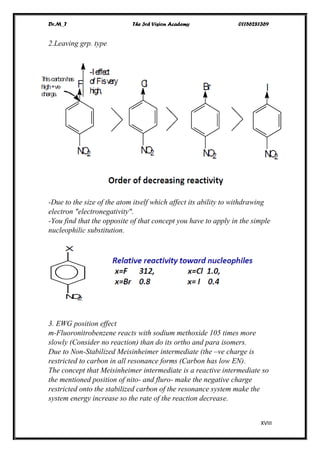
2.Leaving grp. type
-Due to the size of the atom itself which affect its ability to withdrawing
electron "electronegativity".
-You find that the opposite of that concept you have to apply in the simple
nucleophilic substitution.
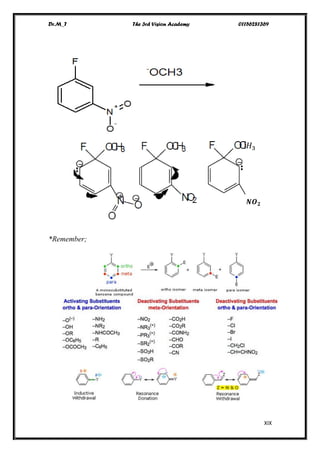
3. EWG position effect
m-Fluoronitrobenzene reacts with sodium methoxide 105 times more
slowly (Consider no reaction) than do its ortho and para isomers.
Due to Non-Stabilized Meisinheimer intermediate (the –ve charge is
restricted to carbon in all resonance forms (Carbon has low EN).
The concept that Meisinheimer intermediate is a reactive intermediate so
the mentioned position of nito- and fluro- make the negative charge
restricted onto the stabilized carbon of the resonance system make the
system energy increase so the rate of the reaction decrease.
Dr.M_T The 3rd Vision Academy 01156281369
XIX
𝐻3
𝑵𝑶 𝟐
*Remember;

Aromatic Comp. Lec.5

  • 1.
    Dr.M_T The 3rdVision Academy 01156281369 I Aromatic Compound I. Topics of to understand& handle the following pathways of CONVERSION& Pre-steps Rx. 1. Alkylbenzene, Alkenylbenzene -Stability; **As a RULE; "Alkenylbenzene that have their side-chain double bond conjugated with the benzene ring are more stable than those that do not." -Reactivity;
  • 2.
    Dr.M_T The 3rdVision Academy 01156281369 II *Explanation of the above Rx. *Mechanism "TO UNDERSTAND AND AVOID MISUSING IN CONVERSION STEPS" 1. In case of Peroxides -"Free Radical mechanism" -Depends mainly on the bond energy as which can reactive the others.
  • 3.
    Dr.M_T The 3rdVision Academy 01156281369 III 2. In case of NO Peroxides -"Ionic mechanism" 2. Oxidation of the side chain -Using hot alkaline 𝐾𝑀𝑁𝑂4, alkyl, alkenyl, alkynyl and acyl grp.s all oxidized to -COOH grp. -For alkylbenzene, 3°alkyl grp. can resist oxidation. GIVE REASON! ---Answer; Need to benzylic hydrogen for alkyl grp. oxidation.
  • 4.
    Dr.M_T The 3rdVision Academy 01156281369 IV *Note; to oxidize the benzene ring itself;
  • 5.
    Dr.M_T The 3rdVision Academy 01156281369 V **Application; Chemistry of Industrial Styrene Styrene is one of the most important industrial chemicals—more than 11billion pounds (5billionKg=5millionton) is produced each year. -How to prepare it ?! II. Aralkylhalides; Side-Halogen Comp. Hint; memorize the mentioned comp. in their common names, please! 1. examples;
  • 6.
    Dr.M_T The 3rdVision Academy 01156281369 VI 2. Synthesis; - Free radical halogenations of alkylbenzene. - Addition of HX to alkenylbenzene. - Reaction of HX with aromatic alcohols. 3. Reactions Remember the general points of 𝑆 𝑁1& 𝑆 𝑁2.
  • 7.
    Dr.M_T The 3rdVision Academy 01156281369 VII -Nucleophilic substitution reactions either 𝑆 𝑁1 or 𝑆 𝑁2. -1°& 2° benzylic halide typically react via an 𝑆 𝑛2.(NO Elimination) -3° benzylic halide typically react via an 𝑆 𝑁1. GIVE REASON! ---Answer; due to the resonance stabilized carbocation& steric effect. -Unlike allylic systems, NO benzylic rearrangement. GIVE REASON! ---Answer; I would result in loss of aromaticity. -We can shift from one mechanism to the other by changing reaction conditions. 1. 𝑆 𝑁2 Rx Mechanism. 1°& 2° benzylic halides typically react via an 𝑆 𝑁2 pathway. Allylic and benzylic halides exhibit enhanced 𝑆 𝑁2 reactivity thanks to conjugation of the newly formed and breaking bonds with the adjacent π- electron system. 2. 𝑆 𝑁1 Rx Mechanism. 3° benzylic halides typically react via an 𝑆 𝑁1 pathway, A carbocation is formed as a high-energy intermediate, and this species bonds immediately to nearby nucleophiles. If the nucleophile is a neutral molecule, the initial product is an "onium" cation.
  • 8.
    Dr.M_T The 3rdVision Academy 01156281369 VIII *Summary -These halides give mainly 𝑆 𝑁2 Rx. -These halides give either 𝑆 𝑁1 or 𝑆 𝑁2 Rx. -These halides give mainly 𝑆 𝑁1 Rx.
  • 9.
    Dr.M_T The 3rdVision Academy 01156281369 IX *SN reactions of Aralkyl halide VIP examples; -Benzaldehyde from Aralkylhalide via hydrolysis of benzylidene. -Benzoic acid from Aralkylhalide via hydrolysis of benzotrihalides.
  • 10.
    Dr.M_T The 3rdVision Academy 01156281369 X III. Miscellaneous Reactions. 1. Oxidation of benzene ring 2. Reduction of Aromatic comp. A. Hydrogenation of benzene. -cyclohexane and cyclohexene cannot be isolated .
  • 11.
    Dr.M_T The 3rdVision Academy 01156281369 XI B. Birch Reduction to reduce benzene ring into 1,4-cyclohexadiene -Rx.; -Mechanism;
  • 12.
    Dr.M_T The 3rdVision Academy 01156281369 XII IV. Aryl Halides -Synthesis; 1. Direct Halogenation of arenes via Sigma complex mechanism. 2. Sandmeyer Reaction. 3. Balz-Schiemann Reaction.
  • 13.
    Dr.M_T The 3rdVision Academy 01156281369 XIII *Diazotisation The nitrosation of primary aromatic amines with nitrous acid (generated in situ from sodium nitrite and a strong acid, such as hydrochloric acid, sulfuric acid, or HBF4) leads to diazonium salts, which can be isolated if the counterion is non-nucleophilic. Diazonium salts are important intermediates for the preparation of halides (Sandmeyer Reaction, Schiemann Reaction), and azo compounds. -Reactions of Aryl Halides 1. Electrophilic Aromatic Substitution 2. Formation of aryl Grignad reagent and organometalic compounds
  • 14.
    Dr.M_T The 3rdVision Academy 01156281369 XIV 3. 𝑆 𝑛𝑢 𝐴𝑟 -Aromatic nucleophilic reaction do not occur except if there are electon with drawing groups ortho or para to halogens likeNO2,..et. GIVE REASON! ---Answer; Due to… 1. The benzene ring of an aryl halide prevents backside attack in an 𝑆 𝑛2 reaction.
  • 15.
    Dr.M_T The 3rdVision Academy 01156281369 XV 2. Phenyl cations are very unstable; thus 𝑆 𝑛1 reactions do not occur. 3. Due to stability of benzene ring and its electron cloud, the carbon- halogen bonds of aryl and vinylic halides are shorter and stronger than those of alkyl, allylic, and benzylic halides. Stronger carbon-halogen bonds mean that bond breaking by either an 𝑆 𝑛1 or 𝑆 𝑛2 mechanism will require more energy. 4.More two points can affect the strength of carbon-hydrogen bond; A. The carbon of either type of halide is 𝑆𝑝2 hybridized, and there for the electrons of the carbon orbital are closer to the nucleus than those of an 𝑆𝑝3 -hybridized carbon. B. Resonance can strengthen the carbon-halogen bond by giving it double-bond character. 3.1. Activated 𝑆 𝑛𝑢 𝐴𝑟 "Addition-Elimination" mechanism
  • 16.
    Dr.M_T The 3rdVision Academy 01156281369 XVI Explanation; Example; Why EWG?!
  • 17.
    Dr.M_T The 3rdVision Academy 01156281369 XVII **Activator OR Deactivator** -We should say activator (ordeactivator ) for either erlectophilic or nucleophilc reactions. -Activating and deactivating functions are applied to substituents effects. "𝑁𝑂2" -A strong deactivating substituent in electrophilic aromatic substitution. -A strong activating substituent in nucleophilic aromatic substitution. 3.2. Factors affect 𝑆 𝑛𝑢 𝐴𝑟 1. # and the power of activating groups present at the o-and p-positions of the leaving group. -More EWG, less energy used.
  • 18.
    Dr.M_T The 3rdVision Academy 01156281369 XVIII 2.Leaving grp. type -Due to the size of the atom itself which affect its ability to withdrawing electron "electronegativity". -You find that the opposite of that concept you have to apply in the simple nucleophilic substitution. 3. EWG position effect m-Fluoronitrobenzene reacts with sodium methoxide 105 times more slowly (Consider no reaction) than do its ortho and para isomers. Due to Non-Stabilized Meisinheimer intermediate (the –ve charge is restricted to carbon in all resonance forms (Carbon has low EN). The concept that Meisinheimer intermediate is a reactive intermediate so the mentioned position of nito- and fluro- make the negative charge restricted onto the stabilized carbon of the resonance system make the system energy increase so the rate of the reaction decrease.
  • 19.
    Dr.M_T The 3rdVision Academy 01156281369 XIX 𝐻3 𝑵𝑶 𝟐 *Remember;