Alkaloids
Introduction of Alkaloids
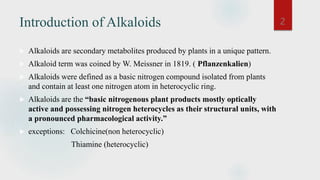
 Alkaloids are secondary metabolites produced by plants in a unique pattern.
 Alkaloid term was coined by W. Meissner in 1819. ( Pflanzenkalien)
 Alkaloids were defined as a basic nitrogen compound isolated from plants
and contain at least one nitrogen atom in heterocyclic ring.
 Alkaloids are the “basic nitrogenous plant products mostly optically
active and possessing nitrogen heterocycles as their structural units, with
a pronounced pharmacological activity.”
 exceptions: Colchicine(non heterocyclic)
Thiamine (heterocyclic)
2
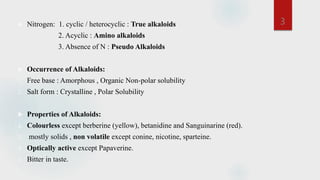
 Nitrogen: 1. cyclic / heterocyclic : True alkaloids
2. Acyclic : Amino alkaloids
3. Absence of N : Pseudo Alkaloids
 Occurrence of Alkaloids:
1. Free base : Amorphous , Organic Non-polar solubility
2. Salt form : Crystalline , Polar Solubility
 Properties of Alkaloids:
1. Colourless except berberine (yellow), betanidine and Sanguinarine (red).
2. mostly solids , non volatile except conine, nicotine, sparteine.
3. Optically active except Papaverine.
4. Bitter in taste.
3
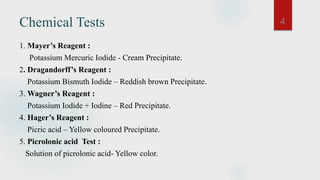
Chemical Tests
1. Mayer’s Reagent :
Potassium Mercuric Iodide - Cream Precipitate.
2. Dragandorff’s Reagent :
Potassium Bismuth Iodide – Reddish brown Precipitate.
3. Wagner’s Reagent :
Potassium Iodide + Iodine – Red Precipitate.
4. Hager’s Reagent :
Picric acid – Yellow coloured Precipitate.
5. Picrolonic acid Test :
Solution of picrolonic acid- Yellow color.
4
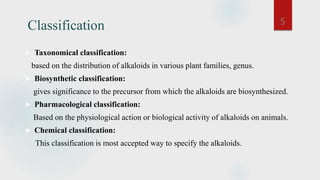
Classification
 Taxonomical classification:
based on the distribution of alkaloids in various plant families, genus.
 Biosynthetic classification:
gives significance to the precursor from which the alkaloids are biosynthesized.
 Pharmacological classification:
Based on the physiological action or biological activity of alkaloids on animals.
 Chemical classification:
This classification is most accepted way to specify the alkaloids.
5
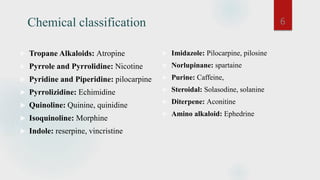
Chemical classification
 Tropane Alkaloids: Atropine
 Pyrrole and Pyrrolidine: Nicotine
 Pyridine and Piperidine: pilocarpine
 Pyrrolizidine: Echimidine
 Quinoline: Quinine, quinidine
 Isoquinoline: Morphine
 Indole: reserpine, vincristine
 Imidazole: Pilocarpine, pilosine
 Norlupinane: spartaine
 Purine: Caffeine,
 Steroidal: Solasodine, solanine
 Diterpene: Aconitine
 Amino alkaloid: Ephedrine
6
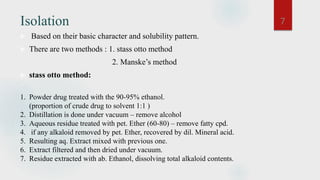
Isolation
 Based on their basic character and solubility pattern.
 There are two methods : 1. stass otto method
2. Manske’s method
 stass otto method:
1. Powder drug treated with the 90-95% ethanol.
(proportion of crude drug to solvent 1:1 )
2. Distillation is done under vacuum – remove alcohol
3. Aqueous residue treated with pet. Ether (60-80) – remove fatty cpd.
4. if any alkaloid removed by pet. Ether, recovered by dil. Mineral acid.
5. Resulting aq. Extract mixed with previous one.
6. Extract filtered and then dried under vacuum.
7. Residue extracted with ab. Ethanol, dissolving total alkaloid contents.
7
Purification
1. Direct crystallization from solvent:
It is a simple method of isolation in which the alkaloids crystallize
directly by fractionation process.
May not be useful in case of complex mixtures.
2. Steam distillation:
Used for volatile liquid alkaloids like coniine, sparteine and nicotine.
Not suitable for alkaloids of high molecular weights.
In this method, the aqueous extract is made alkaline with caustic soda or
sodium carbonate and then alkaloids are distilled off in steam.
8
3. Gradient pH technique:
The crude alkaloid mixture is dissolved in 2% tartaric acid, extracted with benzene.
first fraction very weakly basic alkaloids.
The pH value of the aqueous solution is increased gradually by 0.5 increments to
pH 9 and extraction is carried out at each pH.
By this way, the alkaloids of different basicity are extracted and strongly basic
alkaloids extracted at the end.
4. Chromatographic techniques:
The separation of alkaloids carried out by using stationary and mobile phase of
different organic solvents.
The different techniques of chromatography used for separation of individual alkaloid
from complex mixture.
9
Biological activity of Alkaloids
 In Plants
1. They may act as protective against insects and herbivorous due to
their taste and toxicity.
2. They are in certain cases the final products of detoxification.
3. Source of nitrogen in case of nitrogen deficiency.
4. They may be utilized as a source of energy in case of deficiency
in carbon dioxide assimilation.
10
 In humans
1. Shows high biological activity.
2. Produce various degrees of physiological and psychological
responses by interfering neurotransmitter,.
3. Large dose shows highly toxic fatal
4. Small dose may have therapeutic value.
5. Muscle relaxant, pain killers, tranquillizers, mind altering drugs,
chemotherapy.
11
General methods of structural
determination of alkaloids
1. Molecular formula Determination
2. Functional group analysis
3. Functional Nature of oxygen
4. Nature of Nitrogen
5. Estimation of C- methyl group
6. Degradation of alkaloids
7. Physical methods
12
Molecular Formula :
 The first step in structural elucidation is the determination of molecular
formula and optical rotatory power.
 Elemental composition and hence the empirical formula is found by
combustion analysis.
Determination of Unsaturation:
 The unsaturation can be determined by adding bromine, halogen acids or
by hydroxylation with KMnO4 or by reduction (using either LiAlH4 or
NaBH4 ).
Functional Group Determination:
 By using the usual standard chemical tests or by infrared (IR)
spectroscopy.
13
Hydroxyl group:
 By determining the amount of Acetic anhydride /Acetyl chloride or benzoate that
reacted with alcohol to form an ester, the number of hydroxyl groups can be
determined.
Nature of Nitrogen:
 General reactions of alkaloids with acetic acid, methyl iodide and nitrous acid
indicates the nature of nitrogen.
 If all reactions are negative – N2 probably tertiary Majority of nitrogen presence
in alkaloids are secondary and tertiary: If tertiary when treated with H2O2 (30%)
form amine oxide.
 Herzig- Mayer method: presence and number of N- methyl group
Nature and No. alkyl group attached to Nitrogen:
 Distillation with Aq. KOH, formation of methylamine, dimethylamine and
trimethylamine.
14
Degradation of alkaloids:
 Study of degradation of alkaloids gives rise to some identifiable
products of known structure. Knowing structure of the degraded products
and the changes occurred during the degradation, it is convenient to
know the structure of the original molecule.
Different degradation reactions
1. Hoffman exhaustive methylation method
2. Emde’s method
3. Von Braun’s (VB) method for 3° cyclic amines
4. Reductive degradation
5. Oxidation
6. Zinc distillation
7. Alkali fusion Dehydrogenation
15
 Physical method:
 Development of physical method has revolutionized the structural
elucidation of complex alkaloids.
 It has advantage over time consuming methods like degradation.
 Extensive methods are replaced by spectral analysis of compound
 Important physical techniques for determination are:
1.NMR spectroscopy
2. Mass spectrometry
3. UV-Vis spectroscopy
4. I.R. spectroscopy
16
Reference
 Chemistry of Natural products,VOLUME-1.,O.P.AGARWAL
17
Thank you !
18

Alkaloids.pptx

  • 1.
  • 2.
    Introduction of Alkaloids Alkaloids are secondary metabolites produced by plants in a unique pattern.  Alkaloid term was coined by W. Meissner in 1819. ( Pflanzenkalien)  Alkaloids were defined as a basic nitrogen compound isolated from plants and contain at least one nitrogen atom in heterocyclic ring.  Alkaloids are the “basic nitrogenous plant products mostly optically active and possessing nitrogen heterocycles as their structural units, with a pronounced pharmacological activity.”  exceptions: Colchicine(non heterocyclic) Thiamine (heterocyclic) 2
  • 3.
     Nitrogen: 1.cyclic / heterocyclic : True alkaloids 2. Acyclic : Amino alkaloids 3. Absence of N : Pseudo Alkaloids  Occurrence of Alkaloids: 1. Free base : Amorphous , Organic Non-polar solubility 2. Salt form : Crystalline , Polar Solubility  Properties of Alkaloids: 1. Colourless except berberine (yellow), betanidine and Sanguinarine (red). 2. mostly solids , non volatile except conine, nicotine, sparteine. 3. Optically active except Papaverine. 4. Bitter in taste. 3
  • 4.
    Chemical Tests 1. Mayer’sReagent : Potassium Mercuric Iodide - Cream Precipitate. 2. Dragandorff’s Reagent : Potassium Bismuth Iodide – Reddish brown Precipitate. 3. Wagner’s Reagent : Potassium Iodide + Iodine – Red Precipitate. 4. Hager’s Reagent : Picric acid – Yellow coloured Precipitate. 5. Picrolonic acid Test : Solution of picrolonic acid- Yellow color. 4
  • 5.
    Classification  Taxonomical classification: basedon the distribution of alkaloids in various plant families, genus.  Biosynthetic classification: gives significance to the precursor from which the alkaloids are biosynthesized.  Pharmacological classification: Based on the physiological action or biological activity of alkaloids on animals.  Chemical classification: This classification is most accepted way to specify the alkaloids. 5
  • 6.
    Chemical classification  TropaneAlkaloids: Atropine  Pyrrole and Pyrrolidine: Nicotine  Pyridine and Piperidine: pilocarpine  Pyrrolizidine: Echimidine  Quinoline: Quinine, quinidine  Isoquinoline: Morphine  Indole: reserpine, vincristine  Imidazole: Pilocarpine, pilosine  Norlupinane: spartaine  Purine: Caffeine,  Steroidal: Solasodine, solanine  Diterpene: Aconitine  Amino alkaloid: Ephedrine 6
  • 7.
    Isolation  Based ontheir basic character and solubility pattern.  There are two methods : 1. stass otto method 2. Manske’s method  stass otto method: 1. Powder drug treated with the 90-95% ethanol. (proportion of crude drug to solvent 1:1 ) 2. Distillation is done under vacuum – remove alcohol 3. Aqueous residue treated with pet. Ether (60-80) – remove fatty cpd. 4. if any alkaloid removed by pet. Ether, recovered by dil. Mineral acid. 5. Resulting aq. Extract mixed with previous one. 6. Extract filtered and then dried under vacuum. 7. Residue extracted with ab. Ethanol, dissolving total alkaloid contents. 7
  • 8.
    Purification 1. Direct crystallizationfrom solvent: It is a simple method of isolation in which the alkaloids crystallize directly by fractionation process. May not be useful in case of complex mixtures. 2. Steam distillation: Used for volatile liquid alkaloids like coniine, sparteine and nicotine. Not suitable for alkaloids of high molecular weights. In this method, the aqueous extract is made alkaline with caustic soda or sodium carbonate and then alkaloids are distilled off in steam. 8
  • 9.
    3. Gradient pHtechnique: The crude alkaloid mixture is dissolved in 2% tartaric acid, extracted with benzene. first fraction very weakly basic alkaloids. The pH value of the aqueous solution is increased gradually by 0.5 increments to pH 9 and extraction is carried out at each pH. By this way, the alkaloids of different basicity are extracted and strongly basic alkaloids extracted at the end. 4. Chromatographic techniques: The separation of alkaloids carried out by using stationary and mobile phase of different organic solvents. The different techniques of chromatography used for separation of individual alkaloid from complex mixture. 9
  • 10.
    Biological activity ofAlkaloids  In Plants 1. They may act as protective against insects and herbivorous due to their taste and toxicity. 2. They are in certain cases the final products of detoxification. 3. Source of nitrogen in case of nitrogen deficiency. 4. They may be utilized as a source of energy in case of deficiency in carbon dioxide assimilation. 10
  • 11.
     In humans 1.Shows high biological activity. 2. Produce various degrees of physiological and psychological responses by interfering neurotransmitter,. 3. Large dose shows highly toxic fatal 4. Small dose may have therapeutic value. 5. Muscle relaxant, pain killers, tranquillizers, mind altering drugs, chemotherapy. 11
  • 12.
    General methods ofstructural determination of alkaloids 1. Molecular formula Determination 2. Functional group analysis 3. Functional Nature of oxygen 4. Nature of Nitrogen 5. Estimation of C- methyl group 6. Degradation of alkaloids 7. Physical methods 12
  • 13.
    Molecular Formula : The first step in structural elucidation is the determination of molecular formula and optical rotatory power.  Elemental composition and hence the empirical formula is found by combustion analysis. Determination of Unsaturation:  The unsaturation can be determined by adding bromine, halogen acids or by hydroxylation with KMnO4 or by reduction (using either LiAlH4 or NaBH4 ). Functional Group Determination:  By using the usual standard chemical tests or by infrared (IR) spectroscopy. 13
  • 14.
    Hydroxyl group:  Bydetermining the amount of Acetic anhydride /Acetyl chloride or benzoate that reacted with alcohol to form an ester, the number of hydroxyl groups can be determined. Nature of Nitrogen:  General reactions of alkaloids with acetic acid, methyl iodide and nitrous acid indicates the nature of nitrogen.  If all reactions are negative – N2 probably tertiary Majority of nitrogen presence in alkaloids are secondary and tertiary: If tertiary when treated with H2O2 (30%) form amine oxide.  Herzig- Mayer method: presence and number of N- methyl group Nature and No. alkyl group attached to Nitrogen:  Distillation with Aq. KOH, formation of methylamine, dimethylamine and trimethylamine. 14
  • 15.
    Degradation of alkaloids: Study of degradation of alkaloids gives rise to some identifiable products of known structure. Knowing structure of the degraded products and the changes occurred during the degradation, it is convenient to know the structure of the original molecule. Different degradation reactions 1. Hoffman exhaustive methylation method 2. Emde’s method 3. Von Braun’s (VB) method for 3° cyclic amines 4. Reductive degradation 5. Oxidation 6. Zinc distillation 7. Alkali fusion Dehydrogenation 15
  • 16.
     Physical method: Development of physical method has revolutionized the structural elucidation of complex alkaloids.  It has advantage over time consuming methods like degradation.  Extensive methods are replaced by spectral analysis of compound  Important physical techniques for determination are: 1.NMR spectroscopy 2. Mass spectrometry 3. UV-Vis spectroscopy 4. I.R. spectroscopy 16
  • 17.
    Reference  Chemistry ofNatural products,VOLUME-1.,O.P.AGARWAL 17
  • 18.