ALGORITHMS &
FLOWCHARTING II
LOOPS
 Computers are particularly well suited to
  applications in which operations are
  repeated many times.
 If the same task is repeated over and over
  again a loop can be used to reduce
  program size and complexity
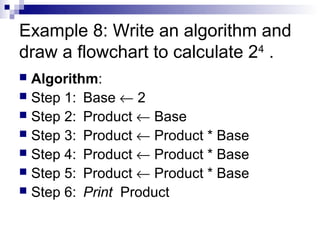
Example 8: Write an algorithm and
draw a flowchart to calculate 24 .
 Algorithm:
 Step 1: Base ← 2
 Step 2: Product ← Base
 Step 3: Product ← Product * Base
 Step 4: Product ← Product * Base
 Step 5: Product ← Product * Base
 Step 6: Print Product
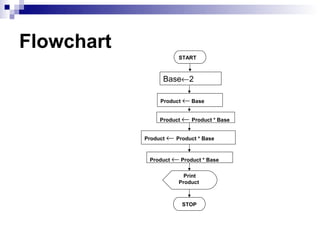
Flowchart
                       START


                  Base←2

                 Product ← Base


                 Product ← Product * Base


            Product ← Product * Base


             Product ← Product * Base


                         Print
                       Product


                        STOP
 Question: What happens if you want to
  calculate 2 to the power of 1000?
 Answer: Use a LOOP (repeated
  execution of the same set of instructions)
   Example 9: Write an algorithm and draw a
    flowchart to calculate 24 using a loop
    approach? Verify your result by a trace
    table.
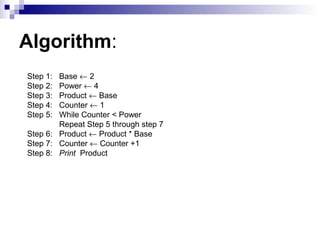
Algorithm:
Step 1: Base ← 2
Step 2: Power ← 4
Step 3: Product ← Base
Step 4: Counter ← 1
Step 5: While Counter < Power
        Repeat Step 5 through step 7
Step 6: Product ← Product * Base
Step 7: Counter ← Counter +1
Step 8: Print Product
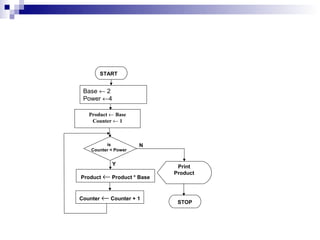
START


 Base ← 2
 Power ←4

   Product ← Base
    Counter ← 1


          is          N
    Counter < Power


            Y               Print
                           Product
Product ← Product * Base


Counter ← Counter + 1
                            STOP
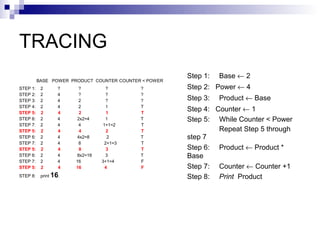
TRACING
                                                       Step 1:   Base ← 2
          BASE POWER PRODUCT COUNTER COUNTER < POWER
STEP 1:    2         ?    ?         ?       ?          Step 2: Power ← 4
STEP 2:    2         4    ?         ?       ?
STEP 3:    2         4    2         ?       ?          Step 3:   Product ← Base
STEP 4:    2         4    2         1       T
STEP 5:    2         4    2          1      T
                                                       Step 4: Counter ← 1
STEP 6:    2         4   2x2=4      1       T          Step 5: While Counter < Power
STEP 7:    2         4    4        1+1=2    T
STEP 5:    2         4    4          2      T                   Repeat Step 5 through
STEP 6:    2         4   4x2=8       2      T          step 7
STEP 7:    2         4    8        2+1=3    T
STEP 5:    2         4    8          3      T          Step 6: Product ← Product *
STEP 6:    2         4   8x2=16     3       T          Base
STEP 7:    2         4   16       3+1=4     F
STEP 5:    2         4   16         4       F          Step 7: Counter ← Counter +1
STEP 8:    print   16.                                 Step 8: Print Product
   Example 10: Write down an algorithm and
    draw a flowchart to find and print the
    largest of three numbers. Read numbers
    one by one. Verify your result by a trace
    table. (Use 5, 7, 3 as the numbers read)
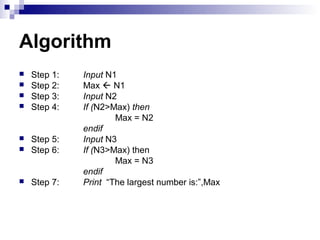
Algorithm
   Step 1:   Input N1
   Step 2:   Max  N1
   Step 3:   Input N2
   Step 4:   If (N2>Max) then
                      Max = N2
              endif
   Step 5:   Input N3
   Step 6:   If (N3>Max) then
                      Max = N3
              endif
   Step 7:   Print “The largest number is:”,Max
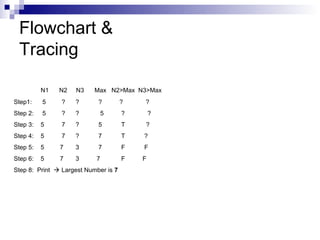
Flowchart &
 Tracing

          N1   N2   N3     Max N2>Max N3>Max
Step1:    5     ?   ?       ?         ?   ?
Step 2:   5     ?   ?          5      ?       ?
Step 3:   5     7   ?       5         T   ?
Step 4:   5     7   ?       7         T   ?
Step 5:   5    7    3       7         F   F
Step 6:   5    7    3      7          F   F
Step 8: Print  Largest Number is 7
   Example 11: Write down an algorithm and
    draw a flowchart to find and print the
    largest of N (N can be any number)
    numbers. Read numbers one by one.
    Verify your result by a trace table.
    (Assume N to be 5 and the following set to
    be the numbers {1 4 2 6 8 })
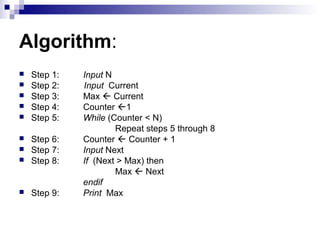
Algorithm:
   Step 1:   Input N
   Step 2:   Input Current
   Step 3:   Max  Current
   Step 4:   Counter 1
   Step 5:   While (Counter < N)
                      Repeat steps 5 through 8
   Step 6:   Counter  Counter + 1
   Step 7:   Input Next
   Step 8:   If (Next > Max) then
                      Max  Next
              endif
   Step 9:   Print Max
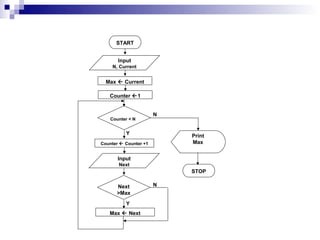
START


       Input
    N, Current


  Max  Current

   Counter 1


                       N
    Counter < N


          Y                Print
Counter  Counter +1       Max


       Input
       Next
                           STOP

      Next             N
      >Max
          Y
   Max  Next
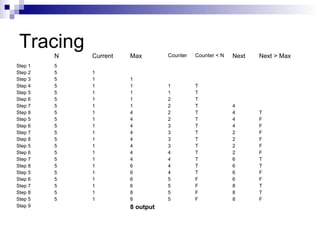
Tracing
         N   Current   Max        Counter   Counter < N   Next   Next > Max
Step 1   5
Step 2   5   1
Step 3   5   1         1
Step 4   5   1         1          1         T
Step 5   5   1         1          1         T
Step 6   5   1         1          2         T
Step 7   5   1         1          2         T             4
Step 8   5   1         4          2         T             4      T
Step 5   5   1         4          2         T             4      F
Step 6   5   1         4          3         T             4      F
Step 7   5   1         4          3         T             2      F
Step 8   5   1         4          3         T             2      F
Step 5   5   1         4          3         T             2      F
Step 6   5   1         4          4         T             2      F
Step 7   5   1         4          4         T             6      T
Step 8   5   1         6          4         T             6      T
Step 5   5   1         6          4         T             6      F
Step 6   5   1         6          5         F             6      F
Step 7   5   1         6          5         F             8      T
Step 8   5   1         8          5         F             8      T
Step 5   5   1         8          5         F             8      F
Step 9                 8 output
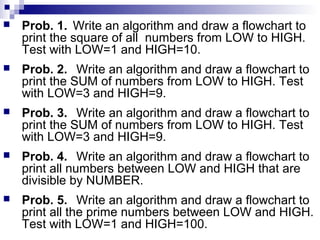
   Prob. 1. Write an algorithm and draw a flowchart to
    print the square of all numbers from LOW to HIGH.
    Test with LOW=1 and HIGH=10.
   Prob. 2. Write an algorithm and draw a flowchart to
    print the SUM of numbers from LOW to HIGH. Test
    with LOW=3 and HIGH=9.
   Prob. 3. Write an algorithm and draw a flowchart to
    print the SUM of numbers from LOW to HIGH. Test
    with LOW=3 and HIGH=9.
   Prob. 4. Write an algorithm and draw a flowchart to
    print all numbers between LOW and HIGH that are
    divisible by NUMBER.
   Prob. 5. Write an algorithm and draw a flowchart to
    print all the prime numbers between LOW and HIGH.
    Test with LOW=1 and HIGH=100.
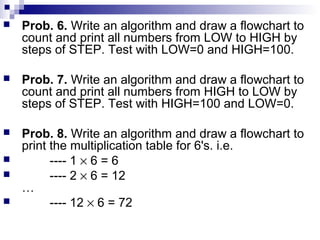
   Prob. 6. Write an algorithm and draw a flowchart to
    count and print all numbers from LOW to HIGH by
    steps of STEP. Test with LOW=0 and HIGH=100.

   Prob. 7. Write an algorithm and draw a flowchart to
    count and print all numbers from HIGH to LOW by
    steps of STEP. Test with HIGH=100 and LOW=0.

   Prob. 8. Write an algorithm and draw a flowchart to
    print the multiplication table for 6's. i.e.
         ---- 1 × 6 = 6
         ---- 2 × 6 = 12
    …
         ---- 12 × 6 = 72
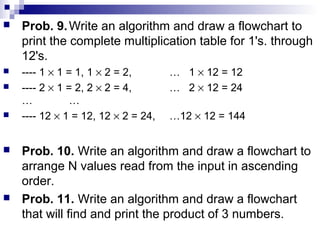
   Prob. 9. Write an algorithm and draw a flowchart to
    print the complete multiplication table for 1's. through
    12's.
   ---- 1 × 1 = 1, 1 × 2 = 2,       … 1 × 12 = 12
   ---- 2 × 1 = 2, 2 × 2 = 4,       … 2 × 12 = 24
    …           …
   ---- 12 × 1 = 12, 12 × 2 = 24,   …12 × 12 = 144


   Prob. 10. Write an algorithm and draw a flowchart to
    arrange N values read from the input in ascending
    order.
   Prob. 11. Write an algorithm and draw a flowchart
    that will find and print the product of 3 numbers.

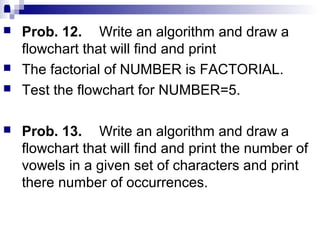
   Prob. 12. Write an algorithm and draw a
    flowchart that will find and print
   The factorial of NUMBER is FACTORIAL.
   Test the flowchart for NUMBER=5.

   Prob. 13. Write an algorithm and draw a
    flowchart that will find and print the number of
    vowels in a given set of characters and print
    there number of occurrences.

Algorithmsandflowcharts2

  • 1.
  • 2.
    LOOPS  Computers areparticularly well suited to applications in which operations are repeated many times.  If the same task is repeated over and over again a loop can be used to reduce program size and complexity
  • 3.
    Example 8: Writean algorithm and draw a flowchart to calculate 24 .  Algorithm:  Step 1: Base ← 2  Step 2: Product ← Base  Step 3: Product ← Product * Base  Step 4: Product ← Product * Base  Step 5: Product ← Product * Base  Step 6: Print Product
  • 4.
    Flowchart START Base←2 Product ← Base Product ← Product * Base Product ← Product * Base Product ← Product * Base Print Product STOP
  • 5.
     Question: Whathappens if you want to calculate 2 to the power of 1000?  Answer: Use a LOOP (repeated execution of the same set of instructions)
  • 6.
    Example 9: Write an algorithm and draw a flowchart to calculate 24 using a loop approach? Verify your result by a trace table.
  • 7.
    Algorithm: Step 1: Base← 2 Step 2: Power ← 4 Step 3: Product ← Base Step 4: Counter ← 1 Step 5: While Counter < Power Repeat Step 5 through step 7 Step 6: Product ← Product * Base Step 7: Counter ← Counter +1 Step 8: Print Product
  • 8.
    START Base ←2 Power ←4 Product ← Base Counter ← 1 is N Counter < Power Y Print Product Product ← Product * Base Counter ← Counter + 1 STOP
  • 9.
    TRACING Step 1: Base ← 2 BASE POWER PRODUCT COUNTER COUNTER < POWER STEP 1: 2 ? ? ? ? Step 2: Power ← 4 STEP 2: 2 4 ? ? ? STEP 3: 2 4 2 ? ? Step 3: Product ← Base STEP 4: 2 4 2 1 T STEP 5: 2 4 2 1 T Step 4: Counter ← 1 STEP 6: 2 4 2x2=4 1 T Step 5: While Counter < Power STEP 7: 2 4 4 1+1=2 T STEP 5: 2 4 4 2 T Repeat Step 5 through STEP 6: 2 4 4x2=8 2 T step 7 STEP 7: 2 4 8 2+1=3 T STEP 5: 2 4 8 3 T Step 6: Product ← Product * STEP 6: 2 4 8x2=16 3 T Base STEP 7: 2 4 16 3+1=4 F STEP 5: 2 4 16 4 F Step 7: Counter ← Counter +1 STEP 8: print 16. Step 8: Print Product
  • 10.
    Example 10: Write down an algorithm and draw a flowchart to find and print the largest of three numbers. Read numbers one by one. Verify your result by a trace table. (Use 5, 7, 3 as the numbers read)
  • 11.
    Algorithm  Step 1: Input N1  Step 2: Max  N1  Step 3: Input N2  Step 4: If (N2>Max) then Max = N2 endif  Step 5: Input N3  Step 6: If (N3>Max) then Max = N3 endif  Step 7: Print “The largest number is:”,Max
  • 12.
    Flowchart & Tracing N1 N2 N3 Max N2>Max N3>Max Step1: 5 ? ? ? ? ? Step 2: 5 ? ? 5 ? ? Step 3: 5 7 ? 5 T ? Step 4: 5 7 ? 7 T ? Step 5: 5 7 3 7 F F Step 6: 5 7 3 7 F F Step 8: Print  Largest Number is 7
  • 13.
    Example 11: Write down an algorithm and draw a flowchart to find and print the largest of N (N can be any number) numbers. Read numbers one by one. Verify your result by a trace table. (Assume N to be 5 and the following set to be the numbers {1 4 2 6 8 })
  • 14.
    Algorithm:  Step 1: Input N  Step 2: Input Current  Step 3: Max  Current  Step 4: Counter 1  Step 5: While (Counter < N) Repeat steps 5 through 8  Step 6: Counter  Counter + 1  Step 7: Input Next  Step 8: If (Next > Max) then Max  Next endif  Step 9: Print Max
  • 15.
    START Input N, Current Max  Current Counter 1 N Counter < N Y Print Counter  Counter +1 Max Input Next STOP Next N >Max Y Max  Next
  • 16.
    Tracing N Current Max Counter Counter < N Next Next > Max Step 1 5 Step 2 5 1 Step 3 5 1 1 Step 4 5 1 1 1 T Step 5 5 1 1 1 T Step 6 5 1 1 2 T Step 7 5 1 1 2 T 4 Step 8 5 1 4 2 T 4 T Step 5 5 1 4 2 T 4 F Step 6 5 1 4 3 T 4 F Step 7 5 1 4 3 T 2 F Step 8 5 1 4 3 T 2 F Step 5 5 1 4 3 T 2 F Step 6 5 1 4 4 T 2 F Step 7 5 1 4 4 T 6 T Step 8 5 1 6 4 T 6 T Step 5 5 1 6 4 T 6 F Step 6 5 1 6 5 F 6 F Step 7 5 1 6 5 F 8 T Step 8 5 1 8 5 F 8 T Step 5 5 1 8 5 F 8 F Step 9 8 output
  • 17.
    Prob. 1. Write an algorithm and draw a flowchart to print the square of all numbers from LOW to HIGH. Test with LOW=1 and HIGH=10.  Prob. 2. Write an algorithm and draw a flowchart to print the SUM of numbers from LOW to HIGH. Test with LOW=3 and HIGH=9.  Prob. 3. Write an algorithm and draw a flowchart to print the SUM of numbers from LOW to HIGH. Test with LOW=3 and HIGH=9.  Prob. 4. Write an algorithm and draw a flowchart to print all numbers between LOW and HIGH that are divisible by NUMBER.  Prob. 5. Write an algorithm and draw a flowchart to print all the prime numbers between LOW and HIGH. Test with LOW=1 and HIGH=100.
  • 18.
    Prob. 6. Write an algorithm and draw a flowchart to count and print all numbers from LOW to HIGH by steps of STEP. Test with LOW=0 and HIGH=100.  Prob. 7. Write an algorithm and draw a flowchart to count and print all numbers from HIGH to LOW by steps of STEP. Test with HIGH=100 and LOW=0.  Prob. 8. Write an algorithm and draw a flowchart to print the multiplication table for 6's. i.e.  ---- 1 × 6 = 6  ---- 2 × 6 = 12 …  ---- 12 × 6 = 72
  • 19.
    Prob. 9. Write an algorithm and draw a flowchart to print the complete multiplication table for 1's. through 12's.  ---- 1 × 1 = 1, 1 × 2 = 2, … 1 × 12 = 12  ---- 2 × 1 = 2, 2 × 2 = 4, … 2 × 12 = 24 … …  ---- 12 × 1 = 12, 12 × 2 = 24, …12 × 12 = 144  Prob. 10. Write an algorithm and draw a flowchart to arrange N values read from the input in ascending order.  Prob. 11. Write an algorithm and draw a flowchart that will find and print the product of 3 numbers.
  • 20.
      Prob. 12. Write an algorithm and draw a flowchart that will find and print  The factorial of NUMBER is FACTORIAL.  Test the flowchart for NUMBER=5.  Prob. 13. Write an algorithm and draw a flowchart that will find and print the number of vowels in a given set of characters and print there number of occurrences.