Boolean Logic 
 Basics 
 Combinational Circuits 
 Sequential Circuits 
Inam Ul-Haq 
Senior Lecturer in Computer Science 
University of Education Okara Campus 
Inam.bth@gmail.com 
Member at IEEE & ACM 
Thanks to Adapted from the slides prepared by S. Dandamudi for the book, 
Fundamentals of Computer Organization and Design.
Introduction to Digital Logic Basics 
 Hardware consists of a few simple building blocks 
 These are called logic gates 
 AND, OR, NOT, … 
 NAND, NOR, XOR, … 
 Logic gates are built using transistors 
 NOT gate can be implemented by a single transistor 
 AND gate requires 3 transistors 
 Transistors are the fundamental devices 
 Pentium consists of 3 million transistors 
 Compaq Alpha consists of 9 million transistors 
 Now we can build chips with more than 100 million transistors
Basic Concepts 
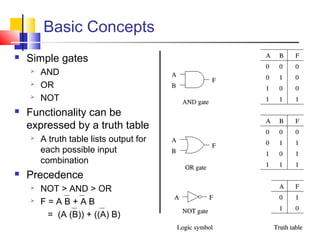
 Simple gates 
 AND 
 OR 
 NOT 
 Functionality can be 
expressed by a truth table 
 A truth table lists output for 
each possible input 
combination 
 Precedence 
 NOT > AND > OR 
 F = A B + A B 
= (A (B)) + ((A) B)
Basic Concepts (cont.) 
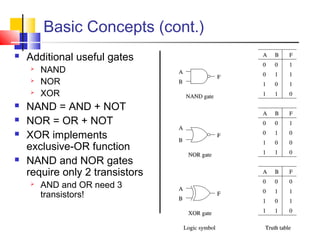
 Additional useful gates 
 NAND 
 NOR 
 XOR 
 NAND = AND + NOT 
 NOR = OR + NOT 
 XOR implements 
exclusive-OR function 
 NAND and NOR gates 
require only 2 transistors 
 AND and OR need 3 
transistors!
Basic Concepts (cont.) 
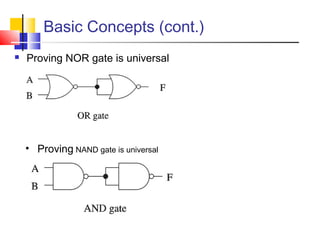
 Proving NOR gate is universal 
• Proving NAND gate is universal
Logic Chips (cont.) 
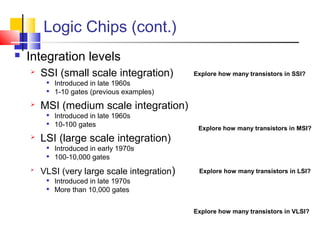
 Integration levels 
 SSI (small scale integration) 
 Introduced in late 1960s 
 1-10 gates (previous examples) 
 MSI (medium scale integration) 
 Introduced in late 1960s 
 10-100 gates 
 LSI (large scale integration) 
 Introduced in early 1970s 
 100-10,000 gates 
 VLSI (very large scale integration) 
 Introduced in late 1970s 
 More than 10,000 gates 
Explore how many transistors in SSI? 
Explore how many transistors in MSI? 
Explore how many transistors in LSI? 
Explore how many transistors in VLSI?
Logic Functions 
 Logical functions can be expressed in several 
ways: 
 Truth table 
 Logical expressions 
 Graphical form
Logic Functions (cont.) 
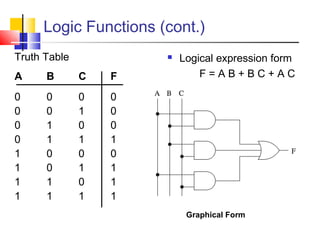
Truth Table 
A B C F 
0 0 0 0 
0 0 1 0 
0 1 0 0 
0 1 1 1 
1 0 0 0 
1 0 1 1 
1 1 0 1 
1 1 1 1 
 Logical expression form 
F = A B + B C + A C 
Graphical Form
Logical Equivalence 
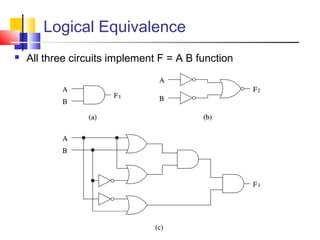
 All three circuits implement F = A B function
Logical Equivalence 
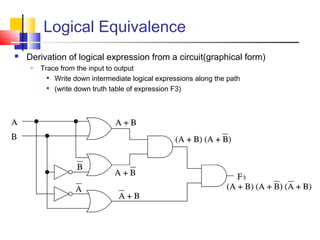
 Derivation of logical expression from a circuit(graphical form) 
 Trace from the input to output 
 Write down intermediate logical expressions along the path 
 (write down truth table of expression F3)
Logical Equivalence (cont.) 
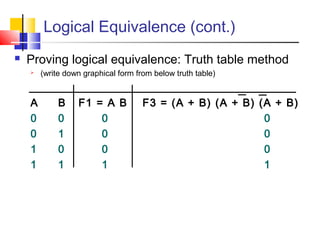
 Proving logical equivalence: Truth table method 
 (write down graphical form from below truth table) 
A B F1 = A B F3 = (A + B) (A + B) (A + B) 
0 0 0 0 
0 1 0 0 
1 0 0 0 
1 1 1 1
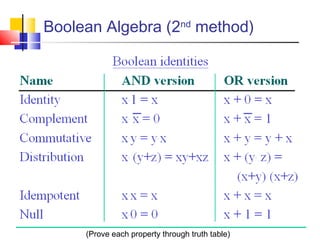
Boolean Algebra (2nd method) 
(Prove each property through truth table)
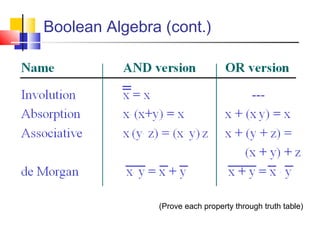
Boolean Algebra (cont.) 
(Prove each property through truth table)

Boolean Logic

  • 1.
    Boolean Logic Basics  Combinational Circuits  Sequential Circuits Inam Ul-Haq Senior Lecturer in Computer Science University of Education Okara Campus Inam.bth@gmail.com Member at IEEE & ACM Thanks to Adapted from the slides prepared by S. Dandamudi for the book, Fundamentals of Computer Organization and Design.
  • 2.
    Introduction to DigitalLogic Basics  Hardware consists of a few simple building blocks  These are called logic gates  AND, OR, NOT, …  NAND, NOR, XOR, …  Logic gates are built using transistors  NOT gate can be implemented by a single transistor  AND gate requires 3 transistors  Transistors are the fundamental devices  Pentium consists of 3 million transistors  Compaq Alpha consists of 9 million transistors  Now we can build chips with more than 100 million transistors
  • 3.
    Basic Concepts Simple gates  AND  OR  NOT  Functionality can be expressed by a truth table  A truth table lists output for each possible input combination  Precedence  NOT > AND > OR  F = A B + A B = (A (B)) + ((A) B)
  • 4.
    Basic Concepts (cont.)  Additional useful gates  NAND  NOR  XOR  NAND = AND + NOT  NOR = OR + NOT  XOR implements exclusive-OR function  NAND and NOR gates require only 2 transistors  AND and OR need 3 transistors!
  • 5.
    Basic Concepts (cont.)  Proving NOR gate is universal • Proving NAND gate is universal
  • 6.
    Logic Chips (cont.)  Integration levels  SSI (small scale integration)  Introduced in late 1960s  1-10 gates (previous examples)  MSI (medium scale integration)  Introduced in late 1960s  10-100 gates  LSI (large scale integration)  Introduced in early 1970s  100-10,000 gates  VLSI (very large scale integration)  Introduced in late 1970s  More than 10,000 gates Explore how many transistors in SSI? Explore how many transistors in MSI? Explore how many transistors in LSI? Explore how many transistors in VLSI?
  • 7.
    Logic Functions Logical functions can be expressed in several ways:  Truth table  Logical expressions  Graphical form
  • 8.
    Logic Functions (cont.) Truth Table A B C F 0 0 0 0 0 0 1 0 0 1 0 0 0 1 1 1 1 0 0 0 1 0 1 1 1 1 0 1 1 1 1 1  Logical expression form F = A B + B C + A C Graphical Form
  • 9.
    Logical Equivalence All three circuits implement F = A B function
  • 10.
    Logical Equivalence Derivation of logical expression from a circuit(graphical form)  Trace from the input to output  Write down intermediate logical expressions along the path  (write down truth table of expression F3)
  • 11.
    Logical Equivalence (cont.)  Proving logical equivalence: Truth table method  (write down graphical form from below truth table) A B F1 = A B F3 = (A + B) (A + B) (A + B) 0 0 0 0 0 1 0 0 1 0 0 0 1 1 1 1
  • 12.
    Boolean Algebra (2ndmethod) (Prove each property through truth table)
  • 13.
    Boolean Algebra (cont.) (Prove each property through truth table)