ALGORITHM
AND
FLOWCHART
PROBLEM ANALYSIS
INTRODUCTION
 Algorithm and flowchart are the powerful tools for learning
programming.
 An algorithm is a Step-by-step analysis of the process, while a flowchart
explains the steps of a program in a Graphical way.
 Algorithm and flowcharts helps to clarify all the steps for solving the
problem.
 For beginners, it is always recommended to first write algorithm and
draw flowchart forSolving a problem and then only write the program
ALGORITHM
 An algorithm is a sequence of steps to solve a particular problem
or algorithm is an ordered set of unambiguous steps that produces a result
and terminates in a finite time.
Algorithm has the following characteristics
• Input: An algorithm may or may not require input
• Output: Each algorithm is expected to produce at least one result
• Definiteness: Each instruction must be clear and unambiguous.
• Finiteness: If the instructions of an algorithm are executed, the algorithm
should terminate after finite number of steps
ALGORTITHM
Advantages of algorithm:
• It is a step-wise representation of a solution to a given problem,
which makes it easy to understand.
• An algorithm uses a definite procedure.
• It is not dependent on any programming language, so it is easy to
understand for anyone even without programming knowledge.
• Every step in an algorithm has its own logical sequence so it is easy
to debug.
FLOWCHART
 The first design of flowchart goes back to 1945 which was designed by
John Von Neumann.
 Unlike an algorithm, Flowchart uses different symbols to design a
solution to a problem.
 It is another commonly used programming tool. By looking at a Flowchart
one can understand the operations and sequence of operations
performed in a system.
 Flowchart is often considered as a blueprint of a design used for
solving a specific problem.
FLOWCHART
 Advantages of flowchart:
• Flowchart is an excellent way of communicating the logic of a program.
• Easy and efficient to analyze problem using flowchart.
• During program development cycle, the flowchart plays the role of a
blueprint, which makes program development process easier.
• After successful development of a program, it needs continuous timely
maintenance during the course of its operation. The flowchart makes
program or system maintenance easier.
• It is easy to convert the flowchart into any programming language code.
FLOWCHART
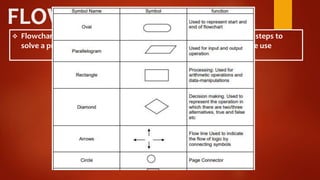
 Flowchart is diagrammatic /Graphical representation of sequence of steps to
solve a problem. To draw a flowchart following standard symbols are use
ASSIGNMENT
Assignment Symbol ( =) is used to assign value to the variable.
e.g. to assign value 5 to the variable HEIGHT, statement is
HEIGHT = 5
 The symbol ‘=’ is used in most of the programming language as an
assignment symbol, the same has been used in all the algorithms and
flowcharts in the manual.
 The statement C = A + B means that add the value stored in variable A and
variable B then assign/store the value in variable C.
 The statement R = R + 1 means that add I to the value stored in variable R and
then assign/store the new value in variable R, in other words increase the
value of variable R by 1
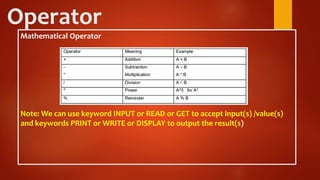
Operator
Mathematical Operator
Note: We can use keyword INPUT or READ or GET to accept input(s) /value(s)
and keywords PRINT or WRITE or DISPLAY to output the result(s)
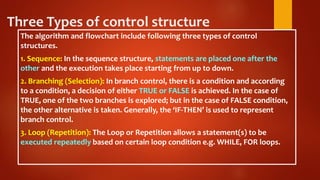
Three Types of control structure
The algorithm and flowchart include following three types of control
structures.
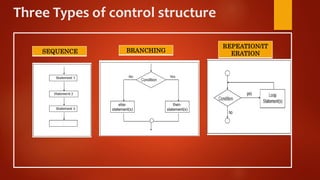
1. Sequence: In the sequence structure, statements are placed one after the
other and the execution takes place starting from up to down.
2. Branching (Selection): In branch control, there is a condition and according
to a condition, a decision of either TRUE or FALSE is achieved. In the case of
TRUE, one of the two branches is explored; but in the case of FALSE condition,
the other alternative is taken. Generally, the ‘IF-THEN’ is used to represent
branch control.
3. Loop (Repetition): The Loop or Repetition allows a statement(s) to be
executed repeatedly based on certain loop condition e.g. WHILE, FOR loops.
Three Types of control structure
SEQUENCE BRANCHING
REPEATION/IT
ERATION
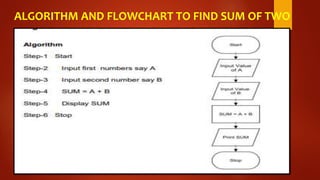
ALGORITHM AND FLOWCHART TO FIND SUM OF TWO
NUMBERS
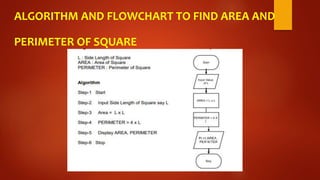
ALGORITHM AND FLOWCHART TO FIND AREA AND
PERIMETER OF SQUARE
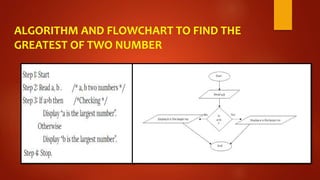
ALGORITHM AND FLOWCHART TO FIND THE
GREATEST OF TWO NUMBER
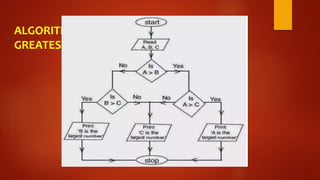
ALGORITHM AND FLOWCHART TO FIND THE
GREATEST OF THREE NUMBER
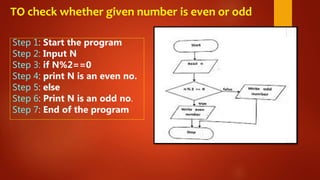
TO check whether given number is even or odd
Step 1: Start the program
Step 2: Input N
Step 3: if N%2==0
Step 4: print N is an even no.
Step 5: else
Step 6: Print N is an odd no.
Step 7: End of the program
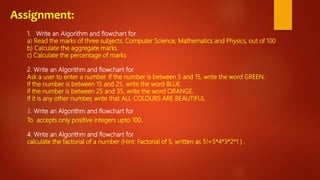
Assignment:
1. Write an Algorithm and flowchart for
a) Read the marks of three subjects: Computer Science, Mathematics and Physics, out of 100
b) Calculate the aggregate marks
c) Calculate the percentage of marks
2. Write an Algorithm and flowchart for
Ask a user to enter a number. If the number is between 5 and 15, write the word GREEN.
If the number is between 15 and 25, write the word BLUE.
if the number is between 25 and 35, write the word ORANGE.
If it is any other number, write that ALL COLOURS ARE BEAUTIFUL
3. Write an Algorithm and flowchart for
To accepts only positive integers upto 100.
4. Write an Algorithm and flowchart for
calculate the factorial of a number (Hint: Factorial of 5, written as 5!=5*4*3*2*1 ) .
RECAP
1. What is Algorithm?
2. Why we need Algorithm?
3. What is difference between algorithm and program.
4.Define Flowchart

Algorithm and flowchart.pptx

  • 1.
  • 2.
    INTRODUCTION  Algorithm andflowchart are the powerful tools for learning programming.  An algorithm is a Step-by-step analysis of the process, while a flowchart explains the steps of a program in a Graphical way.  Algorithm and flowcharts helps to clarify all the steps for solving the problem.  For beginners, it is always recommended to first write algorithm and draw flowchart forSolving a problem and then only write the program
  • 3.
    ALGORITHM  An algorithmis a sequence of steps to solve a particular problem or algorithm is an ordered set of unambiguous steps that produces a result and terminates in a finite time. Algorithm has the following characteristics • Input: An algorithm may or may not require input • Output: Each algorithm is expected to produce at least one result • Definiteness: Each instruction must be clear and unambiguous. • Finiteness: If the instructions of an algorithm are executed, the algorithm should terminate after finite number of steps
  • 4.
    ALGORTITHM Advantages of algorithm: •It is a step-wise representation of a solution to a given problem, which makes it easy to understand. • An algorithm uses a definite procedure. • It is not dependent on any programming language, so it is easy to understand for anyone even without programming knowledge. • Every step in an algorithm has its own logical sequence so it is easy to debug.
  • 5.
    FLOWCHART  The firstdesign of flowchart goes back to 1945 which was designed by John Von Neumann.  Unlike an algorithm, Flowchart uses different symbols to design a solution to a problem.  It is another commonly used programming tool. By looking at a Flowchart one can understand the operations and sequence of operations performed in a system.  Flowchart is often considered as a blueprint of a design used for solving a specific problem.
  • 6.
    FLOWCHART  Advantages offlowchart: • Flowchart is an excellent way of communicating the logic of a program. • Easy and efficient to analyze problem using flowchart. • During program development cycle, the flowchart plays the role of a blueprint, which makes program development process easier. • After successful development of a program, it needs continuous timely maintenance during the course of its operation. The flowchart makes program or system maintenance easier. • It is easy to convert the flowchart into any programming language code.
  • 7.
    FLOWCHART  Flowchart isdiagrammatic /Graphical representation of sequence of steps to solve a problem. To draw a flowchart following standard symbols are use
  • 8.
    ASSIGNMENT Assignment Symbol (=) is used to assign value to the variable. e.g. to assign value 5 to the variable HEIGHT, statement is HEIGHT = 5  The symbol ‘=’ is used in most of the programming language as an assignment symbol, the same has been used in all the algorithms and flowcharts in the manual.  The statement C = A + B means that add the value stored in variable A and variable B then assign/store the value in variable C.  The statement R = R + 1 means that add I to the value stored in variable R and then assign/store the new value in variable R, in other words increase the value of variable R by 1
  • 9.
    Operator Mathematical Operator Note: Wecan use keyword INPUT or READ or GET to accept input(s) /value(s) and keywords PRINT or WRITE or DISPLAY to output the result(s)
  • 10.
    Three Types ofcontrol structure The algorithm and flowchart include following three types of control structures. 1. Sequence: In the sequence structure, statements are placed one after the other and the execution takes place starting from up to down. 2. Branching (Selection): In branch control, there is a condition and according to a condition, a decision of either TRUE or FALSE is achieved. In the case of TRUE, one of the two branches is explored; but in the case of FALSE condition, the other alternative is taken. Generally, the ‘IF-THEN’ is used to represent branch control. 3. Loop (Repetition): The Loop or Repetition allows a statement(s) to be executed repeatedly based on certain loop condition e.g. WHILE, FOR loops.
  • 11.
    Three Types ofcontrol structure SEQUENCE BRANCHING REPEATION/IT ERATION
  • 12.
    ALGORITHM AND FLOWCHARTTO FIND SUM OF TWO NUMBERS
  • 13.
    ALGORITHM AND FLOWCHARTTO FIND AREA AND PERIMETER OF SQUARE
  • 14.
    ALGORITHM AND FLOWCHARTTO FIND THE GREATEST OF TWO NUMBER
  • 15.
    ALGORITHM AND FLOWCHARTTO FIND THE GREATEST OF THREE NUMBER
  • 16.
    TO check whethergiven number is even or odd Step 1: Start the program Step 2: Input N Step 3: if N%2==0 Step 4: print N is an even no. Step 5: else Step 6: Print N is an odd no. Step 7: End of the program
  • 17.
    Assignment: 1. Write anAlgorithm and flowchart for a) Read the marks of three subjects: Computer Science, Mathematics and Physics, out of 100 b) Calculate the aggregate marks c) Calculate the percentage of marks 2. Write an Algorithm and flowchart for Ask a user to enter a number. If the number is between 5 and 15, write the word GREEN. If the number is between 15 and 25, write the word BLUE. if the number is between 25 and 35, write the word ORANGE. If it is any other number, write that ALL COLOURS ARE BEAUTIFUL 3. Write an Algorithm and flowchart for To accepts only positive integers upto 100. 4. Write an Algorithm and flowchart for calculate the factorial of a number (Hint: Factorial of 5, written as 5!=5*4*3*2*1 ) .
  • 18.
    RECAP 1. What isAlgorithm? 2. Why we need Algorithm? 3. What is difference between algorithm and program. 4.Define Flowchart