By: Akash Chauhan
In the development of computer hardware, a decision was made to use binary circuits because it greatly simplified the electronic circuit design . In order to work with binary circuits, it is helpful to have a conceptual framework to manipulate the circuits algebraically, building only the final “most simple” result. George Boole  (1813-1864) developed a mathematical structure to deal with binary operations with just two values.  Today, we call these structures  Boolean Algebras .
Boolean algebra provides the operations and the rules for working with the set  {0, 1}. These are the rules that underlie  electronic circuits , and the methods we will discuss are fundamental to  VLSI design . We are going to focus on three operations : Boolean complementation, Boolean sum, and Boolean product
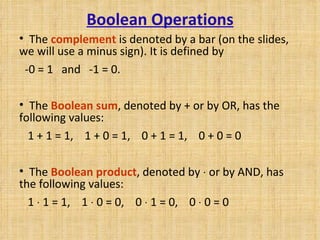
Boolean Operations The  complement   is denoted by a bar (on the slides, we will use a minus sign). It is defined by -0 = 1  and  -1 = 0. The  Boolean sum , denoted by + or by OR, has the following values: 1 + 1 = 1,  1 + 0 = 1,  0 + 1 = 1,  0 + 0 = 0 The  Boolean product , denoted by    or by AND, has the following values: 1    1 = 1,  1    0 = 0,  0    1 = 0,  0    0 = 0
NOW WE  ARE GOING TO FOCUS ON TOPICS Terminology AXIOMS LOGIC GATES
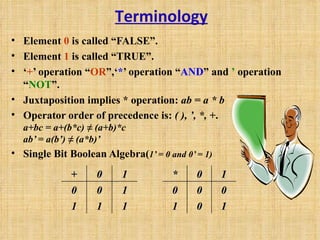
Terminology Element  0  is called “FALSE”. Element  1  is called “TRUE”. ‘ + ’ operation “ OR ”,‘ * ’ operation “ AND ” and  ’  operation “ NOT ”.  Juxtaposition implies * operation:  ab = a * b Operator order of precedence is:  ( ),  ’, *, + . a+bc = a+(b*c)  ≠ (a+b)*c ab’ = a(b’) ≠ (a*b)’ Single Bit Boolean Algebra( 1’ = 0 and 0’ = 1) + 0 1 0 0 1 1 1 1 * 0 1 0 0 0 1 0 1
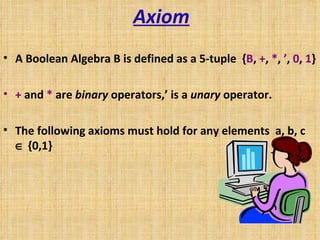
Axiom A Boolean Algebra B is defined as a 5-tuple  { B ,  + ,  * ,   ’ ,  0 ,  1 } +  and  *  are  binary  operators,’ is a  unary  operator. The following axioms must hold for any elements  a, b, c    {0,1}
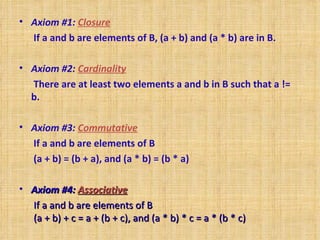
Axiom #1:  Closure If a and b are elements of B, (a + b) and (a * b) are in B. Axiom #2:  Cardinality There are at least two elements a and b in B such that a != b. Axiom #3:  Commutative If a and b are elements of B  (a + b) = (b + a), and (a * b) = (b * a) Axiom #4:  Associative If a and b are elements of B  (a + b) + c = a + (b + c), and (a * b) * c = a * (b * c)
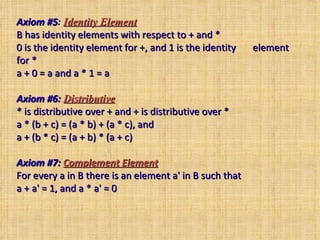
Axiom #5 :   Identity Element B has identity elements with respect to + and * 0 is the identity element for +, and 1 is the identity  element for * a + 0 = a and a * 1 = a Axiom #6:   Distributive * is distributive over + and + is distributive over * a * (b + c) = (a * b) + (a * c), and  a + (b * c) = (a + b) * (a + c) Axiom #7:   Complement Element For every a in B there is an element a' in B such that a + a' = 1, and a * a' = 0
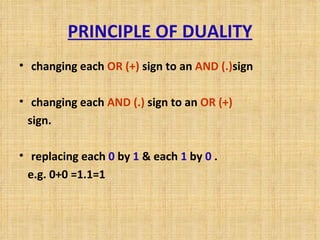
PRINCIPLE OF DUALITY changing each  OR (+)  sign to an  AND (.) sign changing each  AND (.)  sign to an  OR (+)   sign. replacing each  0  by  1  & each  1  by  0  . e.g. 0+0 =1.1=1
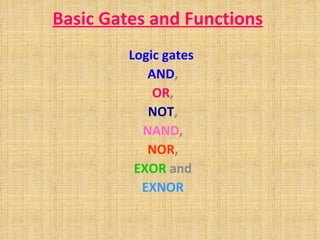
Basic Gates and Functions   Logic gates AND , OR , NOT , NAND , NOR , EXOR  and EXNOR
AND  gate
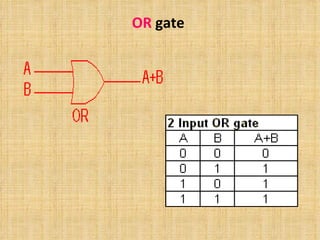
OR  gate
NOT  gate
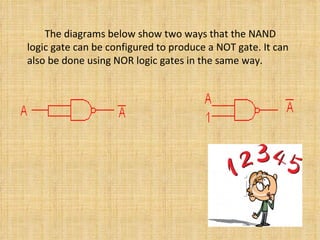
  The diagrams below show two ways that the NAND logic gate can be configured to produce a NOT gate .  It can also be done using NOR logic gates in the same way .
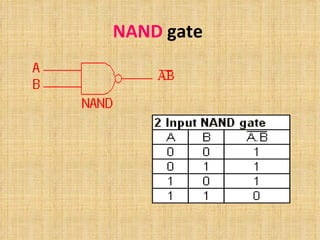
NAND  gate
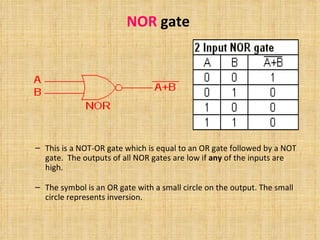
NOR  gate   This is a NOT - OR gate which is equal to an OR gate followed by a NOT gate .   The outputs of all NOR gates are low if  any  of the inputs are high .  The symbol is an OR gate with a small circle on the output. The small circle represents inversion.
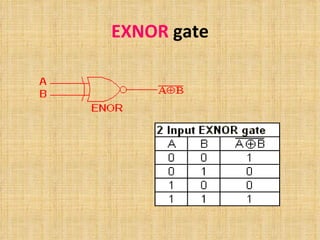
EXNOR  gate
The NAND and NOR gates are called  universal functions  since with either one the AND and OR functions and NOT can be generated . Note : A function in  sum of products  form can be implemented using NAND gates by replacing all AND and OR gates by NAND gates . A function in  product of sums  form can be implemented using NOR gates by replacing all AND and OR gates by NOR gates .  UNIVERSAL FUNCTIONS
Logic gates representation using the truth  table TRUTH  TABLE
THANK YOU

Boolean algebra akash

  • 1.
  • 2.
    In the developmentof computer hardware, a decision was made to use binary circuits because it greatly simplified the electronic circuit design . In order to work with binary circuits, it is helpful to have a conceptual framework to manipulate the circuits algebraically, building only the final “most simple” result. George Boole (1813-1864) developed a mathematical structure to deal with binary operations with just two values. Today, we call these structures Boolean Algebras .
  • 3.
    Boolean algebra providesthe operations and the rules for working with the set {0, 1}. These are the rules that underlie electronic circuits , and the methods we will discuss are fundamental to VLSI design . We are going to focus on three operations : Boolean complementation, Boolean sum, and Boolean product
  • 4.
    Boolean Operations The complement is denoted by a bar (on the slides, we will use a minus sign). It is defined by -0 = 1 and -1 = 0. The Boolean sum , denoted by + or by OR, has the following values: 1 + 1 = 1, 1 + 0 = 1, 0 + 1 = 1, 0 + 0 = 0 The Boolean product , denoted by  or by AND, has the following values: 1  1 = 1, 1  0 = 0, 0  1 = 0, 0  0 = 0
  • 5.
    NOW WE ARE GOING TO FOCUS ON TOPICS Terminology AXIOMS LOGIC GATES
  • 6.
    Terminology Element 0 is called “FALSE”. Element 1 is called “TRUE”. ‘ + ’ operation “ OR ”,‘ * ’ operation “ AND ” and ’ operation “ NOT ”. Juxtaposition implies * operation: ab = a * b Operator order of precedence is: ( ), ’, *, + . a+bc = a+(b*c) ≠ (a+b)*c ab’ = a(b’) ≠ (a*b)’ Single Bit Boolean Algebra( 1’ = 0 and 0’ = 1) + 0 1 0 0 1 1 1 1 * 0 1 0 0 0 1 0 1
  • 7.
    Axiom A BooleanAlgebra B is defined as a 5-tuple { B , + , * , ’ , 0 , 1 } + and * are binary operators,’ is a unary operator. The following axioms must hold for any elements a, b, c  {0,1}
  • 8.
    Axiom #1: Closure If a and b are elements of B, (a + b) and (a * b) are in B. Axiom #2: Cardinality There are at least two elements a and b in B such that a != b. Axiom #3: Commutative If a and b are elements of B (a + b) = (b + a), and (a * b) = (b * a) Axiom #4: Associative If a and b are elements of B (a + b) + c = a + (b + c), and (a * b) * c = a * (b * c)
  • 9.
    Axiom #5 : Identity Element B has identity elements with respect to + and * 0 is the identity element for +, and 1 is the identity element for * a + 0 = a and a * 1 = a Axiom #6: Distributive * is distributive over + and + is distributive over * a * (b + c) = (a * b) + (a * c), and a + (b * c) = (a + b) * (a + c) Axiom #7: Complement Element For every a in B there is an element a' in B such that a + a' = 1, and a * a' = 0
  • 10.
    PRINCIPLE OF DUALITYchanging each  OR (+)  sign to an  AND (.) sign changing each  AND (.)  sign to an  OR (+)   sign. replacing each  0  by  1  & each  1  by  0  . e.g. 0+0 =1.1=1
  • 11.
    Basic Gates andFunctions Logic gates AND , OR , NOT , NAND , NOR , EXOR and EXNOR
  • 12.
  • 13.
  • 14.
  • 15.
    Thediagrams below show two ways that the NAND logic gate can be configured to produce a NOT gate . It can also be done using NOR logic gates in the same way .
  • 16.
  • 17.
    NOR gate This is a NOT - OR gate which is equal to an OR gate followed by a NOT gate .   The outputs of all NOR gates are low if any of the inputs are high . The symbol is an OR gate with a small circle on the output. The small circle represents inversion.
  • 18.
  • 19.
    The NAND andNOR gates are called universal functions since with either one the AND and OR functions and NOT can be generated . Note : A function in sum of products form can be implemented using NAND gates by replacing all AND and OR gates by NAND gates . A function in product of sums form can be implemented using NOR gates by replacing all AND and OR gates by NOR gates . UNIVERSAL FUNCTIONS
  • 20.
    Logic gates representationusing the truth table TRUTH TABLE
  • 21.