Acute Kidney injury 

Pathophysiology

and Novel biomarker
CHAKEN MANIYAN M.D.

Nephrology fellow ,
Phramongkutklao hospital
 19 Aug 2016
Scope : Part I
• Pathophysiology
• Pre-renal AKI
• Post-renal AKI
• Renal (focus on acute tubular necrosis) AKI
• Hemodynamic / endothelium injury
• Inflammatory response
• Tubular injury
• Cell death and regeneration
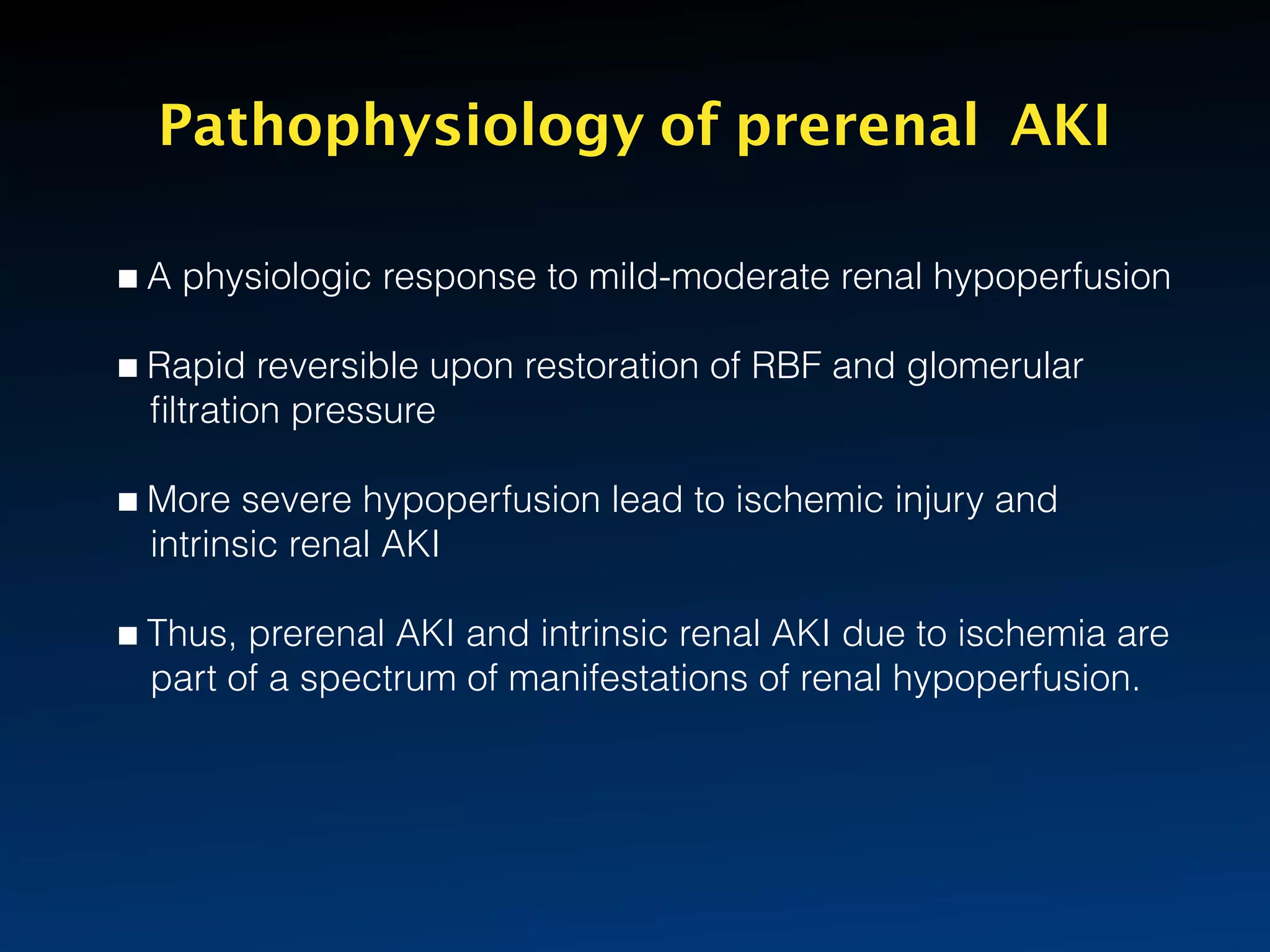
Pathophysiology of prerenal AKI
A physiologic response to mild-moderate renal hypoperfusion
Rapid reversible upon restoration of RBF and glomerular
filtration pressure
More severe hypoperfusion lead to ischemic injury and
intrinsic renal AKI
Thus, prerenal AKI and intrinsic renal AKI due to ischemia are
part of a spectrum of manifestations of renal hypoperfusion.
Compensatory mechanisms
A physiologic response to mild-moderate renal hypoperfusion
EXTRINSIC:
Neurohormonal mechanisms
Pituitary response
INTRINSIC:
RAAS activation
Tubuloglomerular feedback
Afferent arteriolar dilatation
Efferent arteriolar constriction
Homeostasis to maintain RBF
Critical Care Medicine: Principles of Diagnosis and Management in the Adult .4th edition
RAAS
activation
Regulation of renal perfusion pressure
J. Gary Abuelo,N Engl J Med 2007; 357:797-805
Pathophysiology of Post renal AKI
Obstruction can affect
hemodynamic variables and GFR
GFR = Kf x (PGC-PT- ΠGC)
Kf - glomerular ultrafiltration coeffecient (related to surface area and
permeability of capillary membrane)
PGC- glomerular capillary pressure (influenced by RBF and resistance of
afferent and efferent arterioles)
PT - hydraulic pressure of fluid in tubule
ΠGC- oncotic pressure of proteins in glomerular capillary
RBF = (aortic pressure - renal venous pressure)
renal vascular resistance
Influences PGC constriction of afferent arteriole will result in a decrease of
PGC and GFR
An increase in efferent arteriolar resistance will increase PGC
Campbell-Walsh Urology, 11th Edition, 2016 Elsevier Inc.
Summary of renal hemodynamic change UUO and BUO
Campbell-Walsh Urology, 11th Edition, 2016 Elsevier Inc.
Triphasic pattern of UUO
Smith's Textbook of endourology 3rd edition vol I
Pre-glomerular
vasodilatation
Post-glomerular
vasoconstriction
Pre and Post-glomerular
vasoconstriction
Regulation of GFR in Response to Obstruction
• After release of obstruction
• RBF is increased
• GFR remains low because of nonperfusion or
underperfusion of many glomeruli
• Intense afferent vasoconstriction reduces PGC, so that
even though PT also falls with release of the obstruction
• Macula densa likely senses dramatic change in rate of
flow, and this may lead to intense vasoconstriction
Nevo A, et al. Urology. 2014 Dec. 84 (6):1475-9
Recovery of Glomerular Function
after Relief of Obstruction
• Depends on several factors,
• Duration and extent of obstruction
• Presence of functioning contralateral kidney
• Presence of associated infection
• Level of pre obstruction RBF
Nevo A, et al. Urology. 2014 Dec. 84 (6):1475-9
Pathophysiology of ATN
Morphologic changes
• Classical hallmark of ATN is loss of apical
brush border of proximal tubular cell
• Detached tubular cell , denuded tubular
basement and focal proximal tubular dilatation
• Sloughed tubule cells, brush border vesicle
remnants, and cellular debris in combination
with Tamm-Horsfall protein form classical
muddy-brown granular casts
J Am Soc Nephrol. 2011 Mar;22(3):416-25
Major biochemical change
• Intracellular calcium accumulation
• ROS
• Activation of phospholipases and proteases
• ATP depletion
• The net effect result in
• Cell death
• Sloughing of viable cells into tubule lumen by impairment of
normal cell-to-basement membrane adhesion
• Activation of inflammatory response
J Am Soc Nephrol. 2011 Mar;22(3):416-25
Destiny of injury
Insult Injured
NECRO
SIS
APOP
TOSIS
REGENERATE
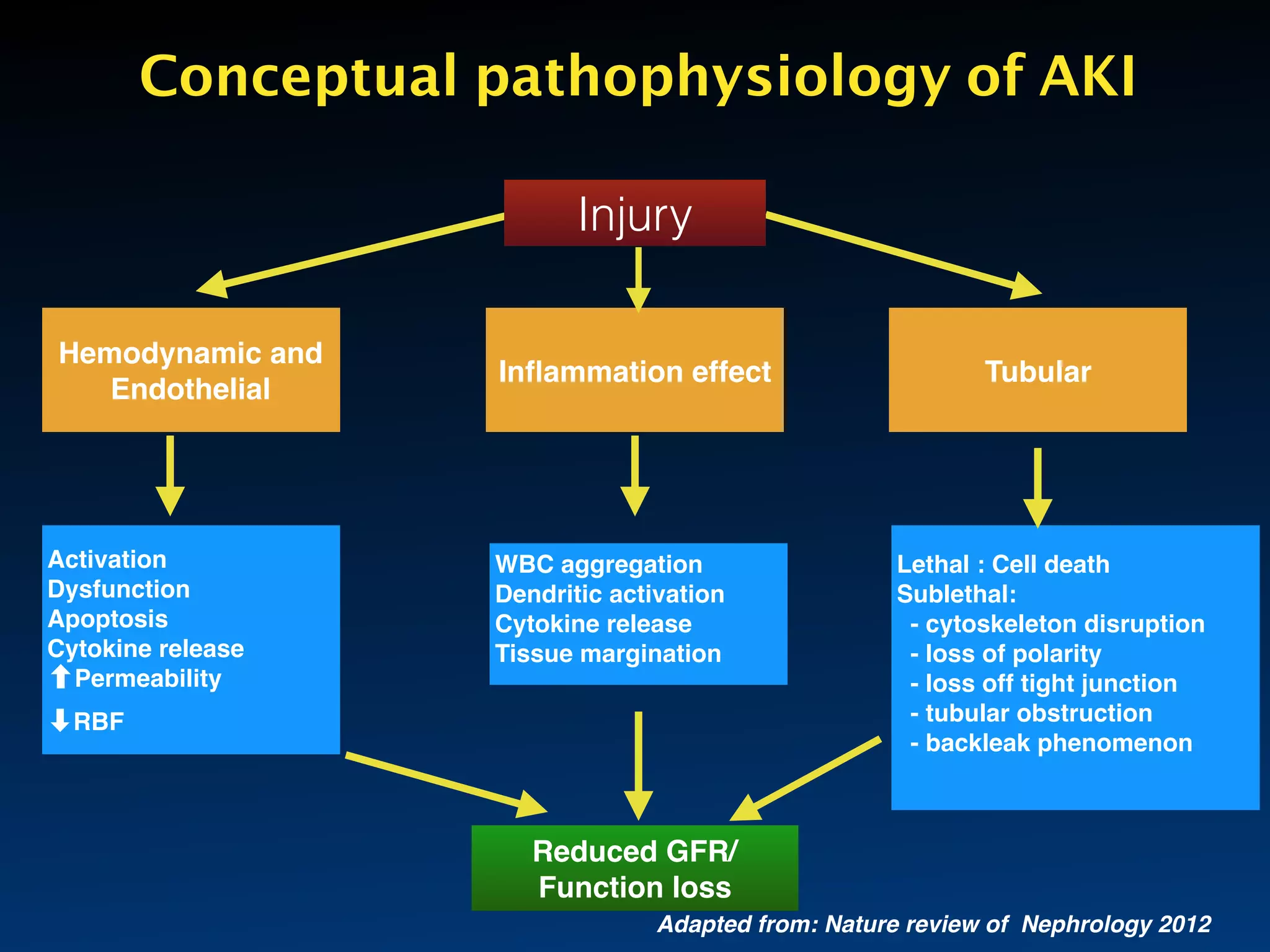
Conceptual pathophysiology of AKI
Hemodynamic and
Endothelial
TubularInflammation effect
Activation
Dysfunction
Apoptosis
Cytokine release
Permeability
➡RBF
Lethal : Cell death
Sublethal:
- cytoskeleton disruption
- loss of polarity
- loss off tight junction
- tubular obstruction
- backleak phenomenon
WBC aggregation
Dendritic activation
Cytokine release
Tissue margination
Reduced GFR/
Function loss
Adapted from: Nature review of Nephrology 2012
Injury
Conceptual pathophysiology of AKI
Hemodynamic and
Endothelial
TubularInflammation effect
Activation
Dysfunction
Apoptosis
Cytokine release
Permeability
➡RBF
Lethal : Cell death
Sublethal:
- cytoskeleton disruption
- loss of polarity
- loss off tight junction
- tubular obstruction
- backleak phenomenon
WBC aggregation
Dendritic activation
Cytokine release
Tissue margination
Reduced GFR/
Function loss
Adapted from: Nature review of Nephrology 2012
Injury
Hemodynamic factor in development
of ATN
Comprehensive clinical nephrology 5th edition : Section XIV Acute Kidney Injury
Effect of endothelial disruption
• ↑vascular permeability
• Leukocyte recruitment and activation.
• Activated endothelium ➪ up regulation of
intracellular adhesion molecule 1 (ICAM-1) and P-
selectin
K J Kelly. J Clin Invest. 1996 Feb 15; 97(4): 1056–1063
Model of leukocyte extravasation
Robbins and Cotran Pathologic Basis of Disease. 7th ed. Philadelphia: Elsevier Saunders
Effects of renal ischemia on histopathology
in ICAM-1–deficient and control mice
K J Kelly. J Clin Invest. 1996 Feb 15; 97(4): 1056–1063
ICAM-1–deficientICAM-1–present
Coagulation
• Injured endothelial cell interact with protein C through
endothelial cell protein C receptor (EPCR) and thrombomodulin
• Activated protein C
• antithrombotic actions
• antiinflammatory
• cytoprotective pathways to restore normal homeostasis
• During inflammatory response, protein C, are consumed along
with downregulation EPCR and thrombomodulin expression
Bernard GR, et al.. N Engl J Med. 2001;344:699–709.
Multiple protective effect of
activated protein C
Adapted from Bernard GR, et al.. N Engl J Med. 2001;344:699–709.
Activation of protein C
Faust el al. NEJM 2001; 345:408-16 27
Endothelial cell activation and injury
Sharfuddin, A.Nat. Rev. Nephrol. doi:10.1038/nrneph.2011.16
Conceptual pathophysiology of AKI
Hemodynamic and
Endothelial
TubularInflammation effect
Activation
Dysfunction
Apoptosis
Cytokine release
Permeability
➡RBF
Lethal : Cell death
Sublethal:
- cytoskeleton disruption
- loss of polarity
- loss off tight junction
- tubular obstruction
- backleak phenomenon
WBC aggregation
Dendritic activation
Cytokine release
Tissue margination
Reduced GFR/
Function loss
Adapted from: Nature review of Nephrology 2012
Injury
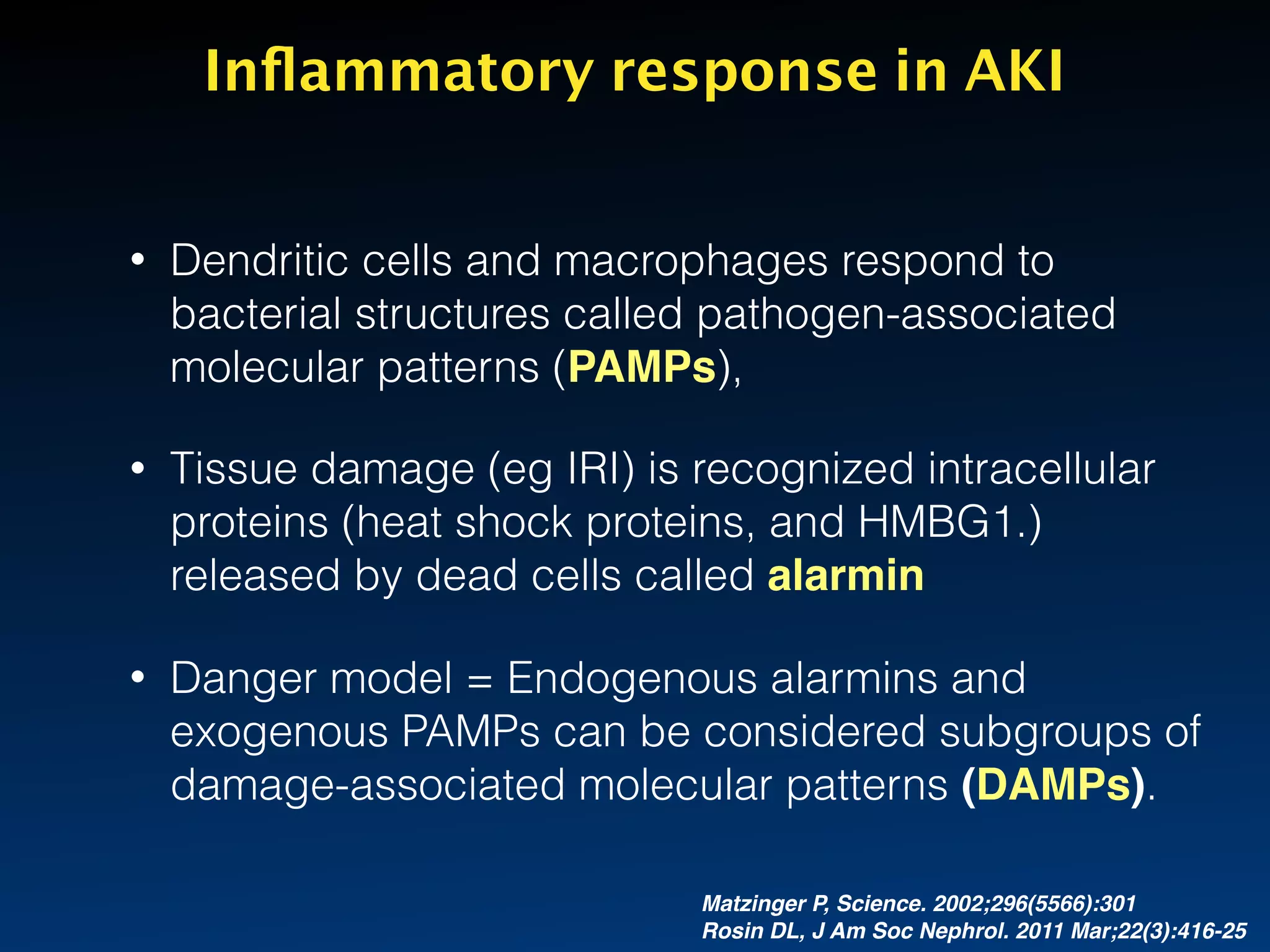
Inflammatory response in AKI
• Dendritic cells and macrophages respond to
bacterial structures called pathogen-associated
molecular patterns (PAMPs),
• Tissue damage (eg IRI) is recognized intracellular
proteins (heat shock proteins, and HMBG1.)
released by dead cells called alarmin
• Danger model = Endogenous alarmins and
exogenous PAMPs can be considered subgroups of
damage-associated molecular patterns (DAMPs).
Matzinger P, Science. 2002;296(5566):301
Rosin DL, J Am Soc Nephrol. 2011 Mar;22(3):416-25
Danger & Stranger model
J Am Soc Nephrol. 2011 Mar;22(3):416-25
Key Inflammatory response after IRI
• Initiated by endothelial dysfunction with
leukocyte extravasation
• Macrophage release of proinflammatory
cytokines (TNF- 𝛼, IL-8,IL-1)
• Chemotactic cytokines (e.g., monocyte
chemoattractant protein-1 [MCP-1] IL-8, RANTES)
• Powerful recruits other inflammatory cells and
complement activation
Alterations in microvasculature and
inflammation in ischemic AKI
P.Devarajan et al ; J Am Soc Nephrol 17: 1503–1520, 2006
Complement activation
• Complement system generates number of
inflammatory signals that lead to ongoing injury
• Induce recruitment of neutrophils and directly
damages endothelium and surrounding cells.
• Activation of alternative and lectin pathway
(forms membrane attack complex (C5-C9) may
contribute to renal injury
Thurman JM, Kidney Int. 2005;67(2):524.
B.Vries,Am J Pathol. 2004 Nov; 165(5): 1677–1688.
Three pathways of complement
activation
B.Vries,Am J Pathol. 2004 Nov; 165(5): 1677–1688.
Ischemia followed by reperfusion leads to
renal deposition of
MBL(mannose binding lectin)
B.Vries,Am J Pathol. 2004 Nov; 165(5): 1677–1688.
Complement activation in kidneys with ATN
occurs via the alternative complement
pathway.
P.Devarajan et al ,Kidney Int. 2005;67(2):524.
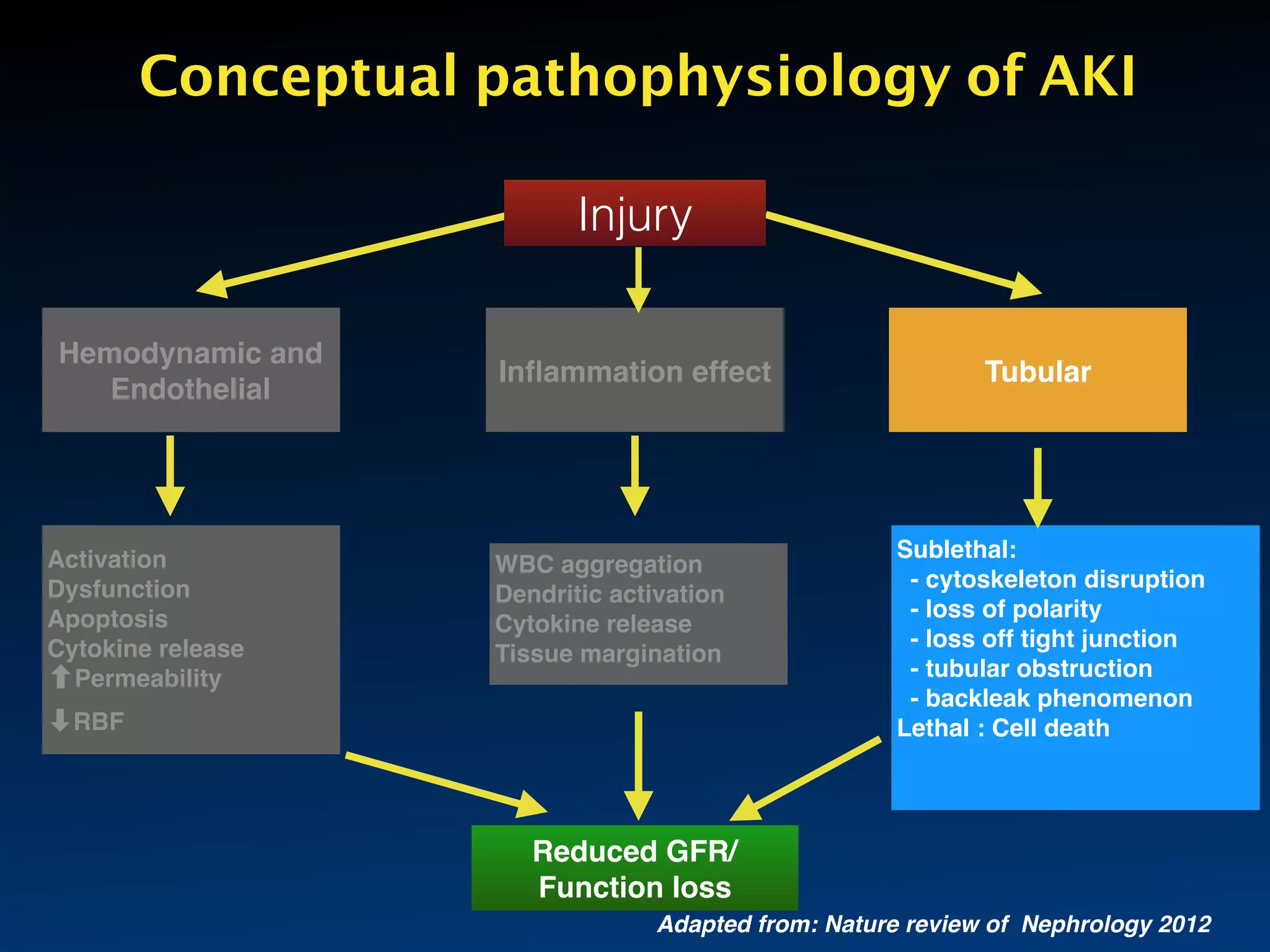
Conceptual pathophysiology of AKI
Hemodynamic and
Endothelial
TubularInflammation effect
Activation
Dysfunction
Apoptosis
Cytokine release
Permeability
➡RBF
Sublethal:
- cytoskeleton disruption
- loss of polarity
- loss off tight junction
- tubular obstruction
- backleak phenomenon
Lethal : Cell death
WBC aggregation
Dendritic activation
Cytokine release
Tissue margination
Reduced GFR/
Function loss
Adapted from: Nature review of Nephrology 2012
Injury
Sites of tubular injury
in acute tubular necrosis
• S3 segment and medullary TAL
is most damaged area during ischemic injury
• Limited anaerobic glycolysis
• Marked hypoperfusion and congestion area
• Highly metabolised due to reabsorption
Comprehensive clinical nephrology 5th edition : Section XIV Acute Kidney Injury
Regional blood flow is altered
following injury in ischemic AKI
Karlberg L. Acta Physiologica Scandinavica. 1983;118:11–17.
IRI leads to loss of polarity
• Ischemia-induced redistribution of membrane
proteins
• Disrupts beta-1 integrins protein which regulate
actin–spectrin cytoskeleton cytoskeleton that
anchors the Na-K-ATPase pump lead to
redistribution
• This redistribution of pump results in loss of
bidirectional transport of Na and water resulting
high FeNa in ATN
Schrier RW et al , J Clin Invest. 2006;116(2):357.
Tubular Epithelial Cell Injury and the
Development of Acute Tubular Necrosis
Adapted from Schrier RW. J Clin Invest. 2004;114:5-14.
Backleak Phenomenon
• ATP depletion induces rapid disruption of actin
cytoskeleton result in loss of tight junctions

• Increased paracellular permeability producing backleak of
the glomerular filtrate into interstitial
• Interstitial edema play major role in decreased blood flow
and exacerbating tubular injury during extension phase
Asif A et al, Nature Reviews Nephrology 7, 189-200 April 2011
CYTOSKELETAL AND INTRACELLULAR
STRUCTURAL CHANGES
Sharfuddin A: Encyclopedia of intensive care medicine, New York, 2012, Springer
Loss of filamentous F-actin
(Proximal tubule microvilli)
Loss of tight junction
paracellular transport
(Backleak Phenomenon)
Loss of polarity
Disruption
of integrins with ECM
Intratubular obstruction
• Tubular cells bind to beta1-integrin ligands on
basement membrane
• minimize tubule cell detachment and intratubular
obstruction
• Intraluminal casts and Tamm-Horsfall protein,
converted to gel-like polymer in high local luminal
sodium concentrations
J Am Soc Nephrol. 2005;16(2):374
Kidney Int. 2001;59(3):932
J Am Soc Nephrol. 2005;16(2):374
Classical muddy brown granular casts.
Endothelial-tubular interaction in
ATN
J. Gary Abuelo,N Engl J Med 2007; 357:797-805
Cell death and regeneration
Alterations in tubule cell structure
after Ischemic reperfusion injury
initiation phase
P.Devarajan et al. J Am Soc Nephrol 17: 1503–1520, 2012
extension phase
initiation phase
sublethal injury
maintenance phase
stem cells and progenitor cells?
Inhibition of apoptosis and inflammation at extension stage
may represent a powerful therapeutic approach
recovery phase
Apoptotic pathway
A. Linkermann, J Am Soc Nephrol. 2014 Dec; 25(12): 2689–2701.
Four-phase model of necrosis
A. Linkermann, J Am Soc Nephrol. 2006 Dec; 25(12): 2689–2701.
Necrosis : is it really unprogrammed?
• Necrosis
• cytoplasmic and organelle swelling
• loss of cell membrane integrity
• release of cellular contents into extracellular space
• inflammatory response within the tissue
• Believed form of accidental uncontrolled cell death w/o signal
• Nowadays general agreement that necrosis can occur in a regulated
manner
• Two special forms of regulated necrosis are necroptosis and parthanatos.
Sandra M., Clinical Kidney Journal, 2015, vol. 8, no. 5, 548–559
Necroptosis : New pathway of death
Signalling pathways of different cell
death modes
Sandra M., Clinical Kidney Journal, 2015, vol. 8, no. 5, 548–559
Programmed Cell Death ≠ Apoptosis
A.Linkermann, N Engl J Med 2014;370:455-65.
Necroptosis
• Consequence of death receptor
• Signal 1 : signalling upon formation of RIPK1
• Regulated necrosis, started by TNFR1 ligation (inhibited by RIP1-targeting
chemical necrostatin-1)
• Triggers: FAS/CD95, TRAILR (TNF-related apoptosis-inducing ligand
receptor), TLR3/4 (Toll-like receptor), etoposide and IRI (ischaemia-
reperfusion injury)
• RIPK3/mixed lineage kinase domain-like protein (MLKL) containing
necroptosome
• Signal 2 : Opening mitochondria permeability transition (MPT) pore
• Upon MPT pore opening and apoptosome-forming proteins
• Induce apoptotic phenotype in a caspase-independent mannere
Allam R, J Am Soc Nephrol 2012; 23: 1375–1388
Sandra M., Clinical Kidney Journal, 2015, vol. 8, no. 5, 548–559
Major signal in Necroptosis
A.Linkermann, Kidney International (2016) 89, 46–57
Difference between apoptosis,
necroptosis and necrosis
Apoptosis Necroptosis Necrosis
Type of cell death Controlled Controlled Uncontrolled
Trigger
Trauma, toxic stress, self-renew,
aging, development.
Trauma, toxic stress, infection
Trauma, toxic stress,
infection
Morphology
Extensive membrane blebbing,
condensation and fragmentation
of the nucleus
Cytoplasmic swelling, rupture of the
plasma membrane and spilling of
the intracellular content
Extensive organelle and cell
swelling, loss of membrane
integrity, release of extracellular
contents
Signalling pathway
Specific, intrinsic or extrinsic
pathways
Specific, e.g TNFR1 pathway Unspecific
Executioner
Caspase, (caspase-3, -6, -7, -8
and -9)
RIP kinase (RIPK1 and RIPK3) -
Inhibitor Z-VAD fmk Necrostatin-1 -
Adapted from A. Linkermann et al. Cell Death Dis. 2015 Nov; 6(11): e1975.
Promising intervention to control
regulated necrosis
A.Linkermann, Kidney International (2016) 89, 46–57
Take home
Thank you for your attention

AKI pathophysiology chaken maniyan

  • 1.
    Acute Kidney injury Pathophysiology and Novel biomarker CHAKEN MANIYAN M.D. Nephrology fellow , Phramongkutklao hospital 19 Aug 2016
  • 2.
    Scope : PartI • Pathophysiology • Pre-renal AKI • Post-renal AKI • Renal (focus on acute tubular necrosis) AKI • Hemodynamic / endothelium injury • Inflammatory response • Tubular injury • Cell death and regeneration
  • 3.
    Pathophysiology of prerenalAKI A physiologic response to mild-moderate renal hypoperfusion Rapid reversible upon restoration of RBF and glomerular filtration pressure More severe hypoperfusion lead to ischemic injury and intrinsic renal AKI Thus, prerenal AKI and intrinsic renal AKI due to ischemia are part of a spectrum of manifestations of renal hypoperfusion.
  • 4.
    Compensatory mechanisms A physiologicresponse to mild-moderate renal hypoperfusion EXTRINSIC: Neurohormonal mechanisms Pituitary response INTRINSIC: RAAS activation Tubuloglomerular feedback Afferent arteriolar dilatation Efferent arteriolar constriction
  • 5.
    Homeostasis to maintainRBF Critical Care Medicine: Principles of Diagnosis and Management in the Adult .4th edition RAAS activation
  • 6.
    Regulation of renalperfusion pressure J. Gary Abuelo,N Engl J Med 2007; 357:797-805
  • 7.
  • 8.
    Obstruction can affect hemodynamicvariables and GFR GFR = Kf x (PGC-PT- ΠGC) Kf - glomerular ultrafiltration coeffecient (related to surface area and permeability of capillary membrane) PGC- glomerular capillary pressure (influenced by RBF and resistance of afferent and efferent arterioles) PT - hydraulic pressure of fluid in tubule ΠGC- oncotic pressure of proteins in glomerular capillary RBF = (aortic pressure - renal venous pressure) renal vascular resistance Influences PGC constriction of afferent arteriole will result in a decrease of PGC and GFR An increase in efferent arteriolar resistance will increase PGC Campbell-Walsh Urology, 11th Edition, 2016 Elsevier Inc.
  • 9.
    Summary of renalhemodynamic change UUO and BUO Campbell-Walsh Urology, 11th Edition, 2016 Elsevier Inc.
  • 10.
    Triphasic pattern ofUUO Smith's Textbook of endourology 3rd edition vol I Pre-glomerular vasodilatation Post-glomerular vasoconstriction Pre and Post-glomerular vasoconstriction
  • 11.
    Regulation of GFRin Response to Obstruction • After release of obstruction • RBF is increased • GFR remains low because of nonperfusion or underperfusion of many glomeruli • Intense afferent vasoconstriction reduces PGC, so that even though PT also falls with release of the obstruction • Macula densa likely senses dramatic change in rate of flow, and this may lead to intense vasoconstriction Nevo A, et al. Urology. 2014 Dec. 84 (6):1475-9
  • 12.
    Recovery of GlomerularFunction after Relief of Obstruction • Depends on several factors, • Duration and extent of obstruction • Presence of functioning contralateral kidney • Presence of associated infection • Level of pre obstruction RBF Nevo A, et al. Urology. 2014 Dec. 84 (6):1475-9
  • 13.
  • 14.
    Morphologic changes • Classicalhallmark of ATN is loss of apical brush border of proximal tubular cell • Detached tubular cell , denuded tubular basement and focal proximal tubular dilatation • Sloughed tubule cells, brush border vesicle remnants, and cellular debris in combination with Tamm-Horsfall protein form classical muddy-brown granular casts J Am Soc Nephrol. 2011 Mar;22(3):416-25
  • 15.
    Major biochemical change •Intracellular calcium accumulation • ROS • Activation of phospholipases and proteases • ATP depletion • The net effect result in • Cell death • Sloughing of viable cells into tubule lumen by impairment of normal cell-to-basement membrane adhesion • Activation of inflammatory response J Am Soc Nephrol. 2011 Mar;22(3):416-25
  • 16.
    Destiny of injury InsultInjured NECRO SIS APOP TOSIS REGENERATE
  • 17.
    Conceptual pathophysiology ofAKI Hemodynamic and Endothelial TubularInflammation effect Activation Dysfunction Apoptosis Cytokine release Permeability ➡RBF Lethal : Cell death Sublethal: - cytoskeleton disruption - loss of polarity - loss off tight junction - tubular obstruction - backleak phenomenon WBC aggregation Dendritic activation Cytokine release Tissue margination Reduced GFR/ Function loss Adapted from: Nature review of Nephrology 2012 Injury
  • 18.
    Conceptual pathophysiology ofAKI Hemodynamic and Endothelial TubularInflammation effect Activation Dysfunction Apoptosis Cytokine release Permeability ➡RBF Lethal : Cell death Sublethal: - cytoskeleton disruption - loss of polarity - loss off tight junction - tubular obstruction - backleak phenomenon WBC aggregation Dendritic activation Cytokine release Tissue margination Reduced GFR/ Function loss Adapted from: Nature review of Nephrology 2012 Injury
  • 19.
    Hemodynamic factor indevelopment of ATN Comprehensive clinical nephrology 5th edition : Section XIV Acute Kidney Injury
  • 20.
    Effect of endothelialdisruption • ↑vascular permeability • Leukocyte recruitment and activation. • Activated endothelium ➪ up regulation of intracellular adhesion molecule 1 (ICAM-1) and P- selectin K J Kelly. J Clin Invest. 1996 Feb 15; 97(4): 1056–1063
  • 21.
    Model of leukocyteextravasation Robbins and Cotran Pathologic Basis of Disease. 7th ed. Philadelphia: Elsevier Saunders
  • 22.
    Effects of renalischemia on histopathology in ICAM-1–deficient and control mice K J Kelly. J Clin Invest. 1996 Feb 15; 97(4): 1056–1063 ICAM-1–deficientICAM-1–present
  • 23.
    Coagulation • Injured endothelialcell interact with protein C through endothelial cell protein C receptor (EPCR) and thrombomodulin • Activated protein C • antithrombotic actions • antiinflammatory • cytoprotective pathways to restore normal homeostasis • During inflammatory response, protein C, are consumed along with downregulation EPCR and thrombomodulin expression Bernard GR, et al.. N Engl J Med. 2001;344:699–709.
  • 24.
    Multiple protective effectof activated protein C Adapted from Bernard GR, et al.. N Engl J Med. 2001;344:699–709.
  • 25.
    Activation of proteinC Faust el al. NEJM 2001; 345:408-16 27
  • 26.
    Endothelial cell activationand injury Sharfuddin, A.Nat. Rev. Nephrol. doi:10.1038/nrneph.2011.16
  • 27.
    Conceptual pathophysiology ofAKI Hemodynamic and Endothelial TubularInflammation effect Activation Dysfunction Apoptosis Cytokine release Permeability ➡RBF Lethal : Cell death Sublethal: - cytoskeleton disruption - loss of polarity - loss off tight junction - tubular obstruction - backleak phenomenon WBC aggregation Dendritic activation Cytokine release Tissue margination Reduced GFR/ Function loss Adapted from: Nature review of Nephrology 2012 Injury
  • 28.
    Inflammatory response inAKI • Dendritic cells and macrophages respond to bacterial structures called pathogen-associated molecular patterns (PAMPs), • Tissue damage (eg IRI) is recognized intracellular proteins (heat shock proteins, and HMBG1.) released by dead cells called alarmin • Danger model = Endogenous alarmins and exogenous PAMPs can be considered subgroups of damage-associated molecular patterns (DAMPs). Matzinger P, Science. 2002;296(5566):301 Rosin DL, J Am Soc Nephrol. 2011 Mar;22(3):416-25
  • 29.
    Danger & Strangermodel J Am Soc Nephrol. 2011 Mar;22(3):416-25
  • 30.
    Key Inflammatory responseafter IRI • Initiated by endothelial dysfunction with leukocyte extravasation • Macrophage release of proinflammatory cytokines (TNF- 𝛼, IL-8,IL-1) • Chemotactic cytokines (e.g., monocyte chemoattractant protein-1 [MCP-1] IL-8, RANTES) • Powerful recruits other inflammatory cells and complement activation
  • 31.
    Alterations in microvasculatureand inflammation in ischemic AKI P.Devarajan et al ; J Am Soc Nephrol 17: 1503–1520, 2006
  • 32.
    Complement activation • Complementsystem generates number of inflammatory signals that lead to ongoing injury • Induce recruitment of neutrophils and directly damages endothelium and surrounding cells. • Activation of alternative and lectin pathway (forms membrane attack complex (C5-C9) may contribute to renal injury Thurman JM, Kidney Int. 2005;67(2):524. B.Vries,Am J Pathol. 2004 Nov; 165(5): 1677–1688.
  • 33.
    Three pathways ofcomplement activation B.Vries,Am J Pathol. 2004 Nov; 165(5): 1677–1688.
  • 34.
    Ischemia followed byreperfusion leads to renal deposition of MBL(mannose binding lectin) B.Vries,Am J Pathol. 2004 Nov; 165(5): 1677–1688.
  • 35.
    Complement activation inkidneys with ATN occurs via the alternative complement pathway. P.Devarajan et al ,Kidney Int. 2005;67(2):524.
  • 37.
    Conceptual pathophysiology ofAKI Hemodynamic and Endothelial TubularInflammation effect Activation Dysfunction Apoptosis Cytokine release Permeability ➡RBF Sublethal: - cytoskeleton disruption - loss of polarity - loss off tight junction - tubular obstruction - backleak phenomenon Lethal : Cell death WBC aggregation Dendritic activation Cytokine release Tissue margination Reduced GFR/ Function loss Adapted from: Nature review of Nephrology 2012 Injury
  • 38.
    Sites of tubularinjury in acute tubular necrosis • S3 segment and medullary TAL is most damaged area during ischemic injury • Limited anaerobic glycolysis • Marked hypoperfusion and congestion area • Highly metabolised due to reabsorption Comprehensive clinical nephrology 5th edition : Section XIV Acute Kidney Injury
  • 39.
    Regional blood flowis altered following injury in ischemic AKI Karlberg L. Acta Physiologica Scandinavica. 1983;118:11–17.
  • 40.
    IRI leads toloss of polarity • Ischemia-induced redistribution of membrane proteins • Disrupts beta-1 integrins protein which regulate actin–spectrin cytoskeleton cytoskeleton that anchors the Na-K-ATPase pump lead to redistribution • This redistribution of pump results in loss of bidirectional transport of Na and water resulting high FeNa in ATN Schrier RW et al , J Clin Invest. 2006;116(2):357.
  • 41.
    Tubular Epithelial CellInjury and the Development of Acute Tubular Necrosis Adapted from Schrier RW. J Clin Invest. 2004;114:5-14.
  • 42.
    Backleak Phenomenon • ATPdepletion induces rapid disruption of actin cytoskeleton result in loss of tight junctions • Increased paracellular permeability producing backleak of the glomerular filtrate into interstitial • Interstitial edema play major role in decreased blood flow and exacerbating tubular injury during extension phase Asif A et al, Nature Reviews Nephrology 7, 189-200 April 2011
  • 43.
    CYTOSKELETAL AND INTRACELLULAR STRUCTURALCHANGES Sharfuddin A: Encyclopedia of intensive care medicine, New York, 2012, Springer Loss of filamentous F-actin (Proximal tubule microvilli) Loss of tight junction paracellular transport (Backleak Phenomenon) Loss of polarity Disruption of integrins with ECM
  • 44.
    Intratubular obstruction • Tubularcells bind to beta1-integrin ligands on basement membrane • minimize tubule cell detachment and intratubular obstruction • Intraluminal casts and Tamm-Horsfall protein, converted to gel-like polymer in high local luminal sodium concentrations J Am Soc Nephrol. 2005;16(2):374
  • 45.
    Kidney Int. 2001;59(3):932 JAm Soc Nephrol. 2005;16(2):374 Classical muddy brown granular casts.
  • 46.
    Endothelial-tubular interaction in ATN J.Gary Abuelo,N Engl J Med 2007; 357:797-805
  • 47.
    Cell death andregeneration
  • 48.
    Alterations in tubulecell structure after Ischemic reperfusion injury initiation phase P.Devarajan et al. J Am Soc Nephrol 17: 1503–1520, 2012 extension phase initiation phase sublethal injury maintenance phase stem cells and progenitor cells? Inhibition of apoptosis and inflammation at extension stage may represent a powerful therapeutic approach recovery phase
  • 49.
    Apoptotic pathway A. Linkermann,J Am Soc Nephrol. 2014 Dec; 25(12): 2689–2701.
  • 50.
    Four-phase model ofnecrosis A. Linkermann, J Am Soc Nephrol. 2006 Dec; 25(12): 2689–2701.
  • 51.
    Necrosis : isit really unprogrammed? • Necrosis • cytoplasmic and organelle swelling • loss of cell membrane integrity • release of cellular contents into extracellular space • inflammatory response within the tissue • Believed form of accidental uncontrolled cell death w/o signal • Nowadays general agreement that necrosis can occur in a regulated manner • Two special forms of regulated necrosis are necroptosis and parthanatos. Sandra M., Clinical Kidney Journal, 2015, vol. 8, no. 5, 548–559
  • 52.
    Necroptosis : Newpathway of death
  • 53.
    Signalling pathways ofdifferent cell death modes Sandra M., Clinical Kidney Journal, 2015, vol. 8, no. 5, 548–559
  • 54.
    Programmed Cell Death≠ Apoptosis A.Linkermann, N Engl J Med 2014;370:455-65.
  • 55.
    Necroptosis • Consequence ofdeath receptor • Signal 1 : signalling upon formation of RIPK1 • Regulated necrosis, started by TNFR1 ligation (inhibited by RIP1-targeting chemical necrostatin-1) • Triggers: FAS/CD95, TRAILR (TNF-related apoptosis-inducing ligand receptor), TLR3/4 (Toll-like receptor), etoposide and IRI (ischaemia- reperfusion injury) • RIPK3/mixed lineage kinase domain-like protein (MLKL) containing necroptosome • Signal 2 : Opening mitochondria permeability transition (MPT) pore • Upon MPT pore opening and apoptosome-forming proteins • Induce apoptotic phenotype in a caspase-independent mannere Allam R, J Am Soc Nephrol 2012; 23: 1375–1388 Sandra M., Clinical Kidney Journal, 2015, vol. 8, no. 5, 548–559
  • 56.
    Major signal inNecroptosis A.Linkermann, Kidney International (2016) 89, 46–57
  • 57.
    Difference between apoptosis, necroptosisand necrosis Apoptosis Necroptosis Necrosis Type of cell death Controlled Controlled Uncontrolled Trigger Trauma, toxic stress, self-renew, aging, development. Trauma, toxic stress, infection Trauma, toxic stress, infection Morphology Extensive membrane blebbing, condensation and fragmentation of the nucleus Cytoplasmic swelling, rupture of the plasma membrane and spilling of the intracellular content Extensive organelle and cell swelling, loss of membrane integrity, release of extracellular contents Signalling pathway Specific, intrinsic or extrinsic pathways Specific, e.g TNFR1 pathway Unspecific Executioner Caspase, (caspase-3, -6, -7, -8 and -9) RIP kinase (RIPK1 and RIPK3) - Inhibitor Z-VAD fmk Necrostatin-1 - Adapted from A. Linkermann et al. Cell Death Dis. 2015 Nov; 6(11): e1975.
  • 58.
    Promising intervention tocontrol regulated necrosis A.Linkermann, Kidney International (2016) 89, 46–57
  • 59.
  • 60.
    Thank you foryour attention