DR.GORDHAN DAS
MBBS,FCPS,Dip Diabetes(UK)
ASSOCIATE PROFESSOR
 The most common intrinsic cause of acute kidney injury is acute tubular necrosis.
Acute tubular necrosis is most common in hospitalized patients and can occur
following ischemia, exposure to toxins, or sepsis. Acute tubular necrosis is
associated with high morbidity and mortality. This activity reviews the evaluation,
diagnosis, and treatment of acute tubular necrosis, and highlights the role of the
inter professional team in caring for patients with this condition
Objectives:
 Describe the four clinical phases of acute tubular necrosis.
 Explain how to evaluate a patient for acute tubular necrosis.
 Explain how to manage a patient with acute tubular necrosis.
 Explain the importance of well-coordinated inter professional teamwork in
managing patients with acute tubular necrosis.
Introduction
 The most common cause of acute kidney injury (AKI) is acute tubular necrosis
(ATN) when the pattern of injury lies within the kidney (intrinsic disease). The term
tubular necrosis is a misnomer, as true cellular necrosis is usually minimal, and the
alteration is not limited to the tubular structures. Acute tubular necrosis is most
common in hospitalized patients and is associated with high morbidity and
mortality. The pattern of injury that defines acute tubular necrosis includes renal
tubular cell damage and death. Intrarenal vasoconstriction or a direct effect of
drug toxicity is caused by an ischemic event, nephrotoxic mechanism, or a mixture
of both
Etiology
 Acute tubular necrosis is precipitated by an acute ischemic or toxic event or sepsis.
 Ischemic-Induced Acute Tubular Necrosis
 Prerenal azotemia and ischemic acute tubular necrosis have the same spectrum of
causes. Any factor that leads to prerenal azotemia can lead to ischemic acute tubular
necrosis. Some common causes include hypovolemic states such as diarrhea, vomiting,
bleeding, dehydration, burns, renal losses via diuretics or osmotic diuresis, and third
fluid sequestration. Edematous states such as heart failure and cirrhosis cause reduced
kidney perfusion. Sepsis or anaphylaxis leads to systemic vasodilation. Coagulopathy,
such as disseminated intravascular coagulation, can also cause acute tubular necrosis
 Nephrotoxic-Induced Acute Tubular Necrosis
 The kidney clears and metabolizes many drugs. Some of these drugs behave as
exogenous toxins and can cause direct renal tubular injury or crystal-induced
acute kidney injury (AKI), leading to acute tubular necrosis. Drugs such as
aminoglycoside, amphotericin B, radiocontrast media, sulfa drugs, acyclovir,
cisplatin, calcineurin inhibitors (tacrolimus, cyclosporine), mammalian target of
rapamycin mTOR inhibitors (everolimus, temsirolimus), foscarnet, ifosfamide,
cidofovir, and intravenous immunoglobulin containing sucrose all can
tubular necrosis.
 Heme pigment-containing proteins such as hemoglobin and myoglobin can
behave as endotoxins in 3 ways:
 Causing direct proximal tubular injury, tubular obstruction, or renal
vasoconstriction.
 Crystal-induced nephropathy due to high cell turnover such as uric acid, calcium
phosphate crystals in the setting of ongoing malignancy treatment.
 Light chain accumulation in multiple myeloma is directly toxic to the renal
proximal and distal tubules.
 Sepsis-Induced Acute Tubular Necrosis
 Sepsis also plays a role in causing acute tubular necrosis because of systemic
hypotension and renal hypoperfusion. Other mechanisms that are incompletely
understood include endotoxemia leading to AKI by renal vasoconstriction and
release of inflammatory cytokines causing enhanced secretion of reactive
species and leading to renal injury
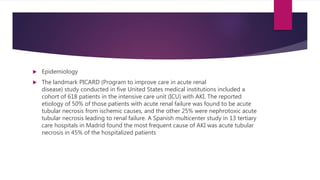
 Epidemiology
 The landmark PICARD (Program to improve care in acute renal
disease) study conducted in five United States medical institutions included a
cohort of 618 patients in the intensive care unit (ICU) with AKI. The reported
etiology of 50% of those patients with acute renal failure was found to be acute
tubular necrosis from ischemic causes, and the other 25% were nephrotoxic acute
tubular necrosis leading to renal failure. A Spanish multicenter study in 13 tertiary
care hospitals in Madrid found the most frequent cause of AKI was acute tubular
necrosis in 45% of the hospitalized patients
Pathophysiology
 Decreased glomerular filtration rate (GFR) is associated with acute tubular
necrosis, leading to 3 possible mechanisms of injury to the renal tubular epithelial
cells:
 Afferent arteriolar vasoconstriction in response to tubuloglomerular feedback
 Backleak of glomerular filtrate
 Tubular obstruction
 Clinical Phases
 These injury patterns lead to the following 4 phases clinically:
 Initiation
 The initiation phase is characterized by an acute decrease in GFR and a sudden
increase in serum creatinine and BUN concentrations.
 Extension
 The extension phase consists of 2 major events:
 Ongoing hypoxia following the ischemic event
 An inflammatory response
 These events are more pronounced in the corticomedullary junction of the kidney.
In this phase, damage to the renal vascular endothelial cell is responsible for the
ischemia of the renal tubular epithelial cell. The cells in the outer medulla continue
to undergo injury and death with the combination of both necrosis and apoptosis.
While in the outer cortex, the blood flow returns to near normal, leading to cellular
repair. As the injury worsens in the cortico-medullary junction (CMJ), the GFR falls
due to the continuous release of cytokines and chemokines enhancing the
inflammatory cascade.
Maintenance
 The maintenance phase is established by cellular repair, apoptosis, migration,
and proliferation to maintain cellular and tubule integrity. The cellular function
improves slowly as the cells repair and reorganize. The blood flow returns to the
normal range, and the cells establish intracellular homeostasis.
Recovery
 The recovery phase is the continuation of the maintenance phase in which
differentiation continues, and epithelial polarity is reestablished, improving the
renal function
Histopathology
 Because it is a histological finding, acute tubular necrosis is diagnosed on a clinical
basis. A biopsy is only performed when there is suspicion of an entity other than
acute tubular necrosis causing AKI. Histopathological findings include
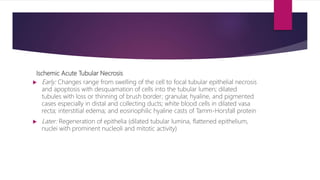
Ischemic Acute Tubular Necrosis
 Early: Changes range from swelling of the cell to focal tubular epithelial necrosis
and apoptosis with desquamation of cells into the tubular lumen; dilated
tubules with loss or thinning of brush border; granular, hyaline, and pigmented
cases especially in distal and collecting ducts; white blood cells in dilated vasa
recta; interstitial edema; and eosinophilic hyaline casts of Tamm-Horsfall protein
 Later: Regeneration of epithelia (dilated tubular lumina, flattened epithelium,
nuclei with prominent nucleoli and mitotic activity)
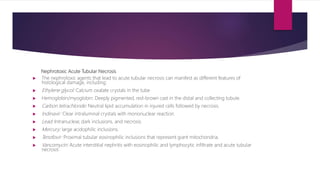
Nephrotoxic Acute Tubular Necrosis
 The nephrotoxic agents that lead to acute tubular necrosis can manifest as different features of
histological damage, including:
 Ethylene glycol: Calcium oxalate crystals in the tube
 Hemoglobin/myoglobin: Deeply pigmented, red-brown cast in the distal and collecting tubule.
 Carbon tetrachloride: Neutral lipid accumulation in injured cells followed by necrosis.
 Indinavir: Clear intraluminal crystals with mononuclear reaction.
 Lead: Intranuclear, dark inclusions, and necrosis.
 Mercury: large acidophilic inclusions.
 Tenofovir: Proximal tubular eosinophilic inclusions that represent giant mitochondria.
 Vancomycin: Acute interstitial nephritis with eosinophilic and lymphocytic infiltrate and acute tubular
necrosis
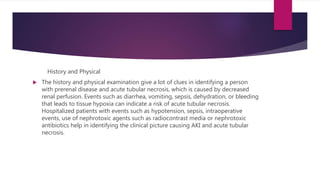
History and Physical
 The history and physical examination give a lot of clues in identifying a person
with prerenal disease and acute tubular necrosis, which is caused by decreased
renal perfusion. Events such as diarrhea, vomiting, sepsis, dehydration, or bleeding
that leads to tissue hypoxia can indicate a risk of acute tubular necrosis.
Hospitalized patients with events such as hypotension, sepsis, intraoperative
events, use of nephrotoxic agents such as radiocontrast media or nephrotoxic
antibiotics help in identifying the clinical picture causing AKI and acute tubular
necrosis.
 Physical findings such as tachycardia, dry mucous membrane, decreased skin
turgor, and cool extremities are findings that can be present in patients with
volume depletion and hypotension. Fever and hypotension are common
manifestations of sepsis. Muscle tenderness is present in the setting of
rhabdomyolysis. Intraabdominal hypertension that causes abdominal distension
due to abdominal compartment syndrome also impedes renal perfusion and raises
the concern for acute tubular necrosis.
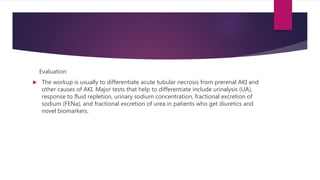
Evaluation
 The workup is usually to differentiate acute tubular necrosis from prerenal AKI and
other causes of AKI. Major tests that help to differentiate include urinalysis (UA),
response to fluid repletion, urinary sodium concentration, fractional excretion of
sodium (FENa), and fractional excretion of urea in patients who get diuretics and
novel biomarkers.
sUrinalysis (UA)
 In prerenal disease, the UA microscopy is normal or may contain hyaline casts.
the other hand, the UA of acute tubular necrosis shows muddy brown casts or
renal tubular epithelial cells secondary to the sloughing of tubular cells into the
lumen due to ischemia or toxic injury
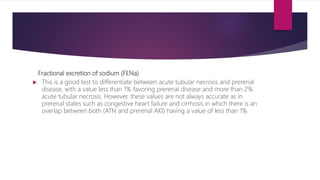
Fractional excretion of sodium (FENa)
 This is a good test to differentiate between acute tubular necrosis and prerenal
disease, with a value less than 1% favoring prerenal disease and more than 2%
acute tubular necrosis. However, these values are not always accurate as in
prerenal states such as congestive heart failure and cirrhosis in which there is an
overlap between both (ATN and prerenal AKI) having a value of less than 1%
Urine sodium concentration
 This test determines that the kidney is sodium avid in hypovolemic states
(prerenal) where kidneys try to conserve sodium or lose sodium due to tubular
injury with values more than 40 to 50 mEq/L indicating acute tubular necrosis
less than 20 mEq/L suggestive of prerenal disease.
Novel Biomarkers
 Numerous biomarkers have evolved to detect AKI/acute tubular necrosis early
compared to serum creatinine. These biomarkers include serum cystatin C to be
an early and reliable marker of renal injury as compared to serum creatinine
is often witnessed 48 to 72 hours after the initial insult. Other markers include
urinary alpha one microglobulin, beta-2 microglobulin, urinary liver-type fatty
acid-binding protein (L-FABP), and kidney injury molecule 1 (KIM-1) for the
detection of proximal tubular damage, urinary interleukin-18 (IL-18) is known to
differentiate ATN from CKD, urinary tract infection (UTI), and prerenal azotemia.
Urinary biomarker neutrophil gelatinase-associated lipocalin (NGAL) is
upregulated in renal ischemia after distal tubular injury.
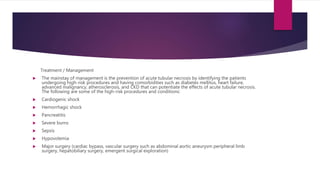
Treatment / Management
 The mainstay of management is the prevention of acute tubular necrosis by identifying the patients
undergoing high-risk procedures and having comorbidities such as diabetes mellitus, heart failure,
advanced malignancy, atherosclerosis, and CKD that can potentiate the effects of acute tubular necrosis.
The following are some of the high-risk procedures and conditions:
 Cardiogenic shock
 Hemorrhagic shock
 Pancreatitis
 Severe burns
 Sepsis
 Hypovolemia
 Major surgery (cardiac bypass, vascular surgery such as abdominal aortic aneurysm peripheral limb
surgery, hepatobiliary surgery, emergent surgical exploration)
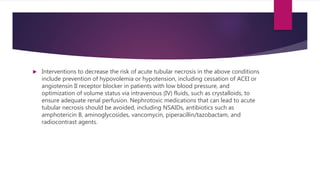
 Interventions to decrease the risk of acute tubular necrosis in the above conditions
include prevention of hypovolemia or hypotension, including cessation of ACEI or
angiotensin II receptor blocker in patients with low blood pressure, and
optimization of volume status via intravenous (IV) fluids, such as crystalloids, to
ensure adequate renal perfusion. Nephrotoxic medications that can lead to acute
tubular necrosis should be avoided, including NSAIDs, antibiotics such as
amphotericin B, aminoglycosides, vancomycin, piperacillin/tazobactam, and
radiocontrast agents.
 Diuretics are used only to manage the volume status but are not recommended
for the treatment of acute tubular necrosis in the Kidney Disease: Improving
Global Outcomes (KDIGO) 2012 guidelines. Other pharmacological agents such as
dopamine, fenoldopam, and atrial natriuretic peptide do not provide any survival
benefit in patients with acute tubular necrosis.
 Renal replacement therapy (RRT) has the same indications and is used in volume
overload refractory to diuretics, hyperkalemia, signs of uremia, and metabolic
acidosis. In critically ill hemodynamically unstable patients, the use of
continuous renal replacement therapy (CRRT) is the preferred option
 Differential Diagnosis
 Acute kidney injury
 Acute glomerulonephritis
 Azotemia
 Tubulointerstitial nephritis
 Chronic kidney disease
 Drug-induced nephrotoxicity
Prognosis
 The mortality in patients with acute tubular necrosis depends on the underlying
condition that leads to acute tubular necrosis. Some factors that lead to poor
survival in such patients include oliguria, poor nutritional status, male gender,
the need for mechanical ventilation, stroke, seizures, and acute myocardial
infarction. The mortality rate is higher in oliguric patients than in non-oliguric
patients signifying the amount of damage done leading to necrosis. Mortality is
high (about 60%) in sepsis and surgical patients, causing multiple organ failure.
 Complications
 Complications related to acute tubular necrosis are the same as related to AKI,
which include acid-base and electrolyte disturbances such as hypocalcemia,
hyperkalemia related to metabolic acidosis, and hyperphosphatemia. Volume
overload is related to anuria or oliguria. Uremic complications lead to pericarditis,
bleeding diathesis, and altered mental status.
Approach Considerations
 The first step in the management of acute tubular necrosis (ATN) is identification
of patients at risk for it. Patients undergoing major surgery or presenting with
shock or other conditions associated with development of ATN should be
proactively followed and monitored. Measurement of fluid balances and urine
output and daily measurement of creatinine and electrolytes will permit rapid
diagnosis of acute kidney injury (AKI).
 Another vulnerable group of patients are those with significant co-morbidities,
who are likely to develop ATN with relatively minor injury and thus need more
frequent and close follow up. This group includes patients with diabetes mellitus,
significant coronary or peripheral vascular disease, multiple myeloma, or
dehydration, as well as those receiving nephrotoxic medications or undergoing
contrast-enhanced imaging studies. Prevention of ATN in these patients is group
includes maintaining euvolemia, avoiding nephrotoxic medications, and
supporting blood pressure with vasopressors if necessary.
 Kidney Disease: Improving Global Outcomes (KDIGO) guidelines suggest using a
stage-based approach to management of AKI/ATN. [25] The guidelines suggest
that the following measures have no role in the prevention of AKI [25] :
 Diuretics to prevent AKI
 Diuretics to treat AKI, except in the management of volume overload
 Low-dose dopamine to prevent or treat AKI
 Fenoldopam to prevent or treat AKI
 Atrial natriuretic peptide (ANP) to prevent or treat AKI
 Enhancing Healthcare Team Outcomes
 The diagnosis and management of ATN are best done with an interprofessional
team that includes a nephrologist, pharmacist, internist, cardiologist, and
intensivist. The mainstay of management is the prevention of acute tubular
necrosis by identifying the patients undergoing high-risk procedures and having
comorbidities such as diabetes mellitus, heart failure, advanced malignancy,
atherosclerosis, and CKD that can potentiate the effects of acute tubular necrosis.
 ATN is not a benign disorder, and the outcomes depend on the cause. Factors that
lead to poor survival in such patients include oliguria, poor nutritional status, male
gender, the need for mechanical ventilation, stroke, seizures, and acute myocardial
infarction. The mortality rate is higher in oliguric patients than in non-oliguric
patients signifying the amount of damage done leading to necrosis. Mortality is
high (about 60%) in sepsis and surgical patients, causing multiple organ failure.
Despite aggressive treatment, some patients may end up with end-stage renal
disease requiring dialysis.
THE END

Atn

  • 1.
  • 2.
     The mostcommon intrinsic cause of acute kidney injury is acute tubular necrosis. Acute tubular necrosis is most common in hospitalized patients and can occur following ischemia, exposure to toxins, or sepsis. Acute tubular necrosis is associated with high morbidity and mortality. This activity reviews the evaluation, diagnosis, and treatment of acute tubular necrosis, and highlights the role of the inter professional team in caring for patients with this condition
  • 3.
    Objectives:  Describe thefour clinical phases of acute tubular necrosis.  Explain how to evaluate a patient for acute tubular necrosis.  Explain how to manage a patient with acute tubular necrosis.  Explain the importance of well-coordinated inter professional teamwork in managing patients with acute tubular necrosis.
  • 4.
    Introduction  The mostcommon cause of acute kidney injury (AKI) is acute tubular necrosis (ATN) when the pattern of injury lies within the kidney (intrinsic disease). The term tubular necrosis is a misnomer, as true cellular necrosis is usually minimal, and the alteration is not limited to the tubular structures. Acute tubular necrosis is most common in hospitalized patients and is associated with high morbidity and mortality. The pattern of injury that defines acute tubular necrosis includes renal tubular cell damage and death. Intrarenal vasoconstriction or a direct effect of drug toxicity is caused by an ischemic event, nephrotoxic mechanism, or a mixture of both
  • 5.
    Etiology  Acute tubularnecrosis is precipitated by an acute ischemic or toxic event or sepsis.  Ischemic-Induced Acute Tubular Necrosis  Prerenal azotemia and ischemic acute tubular necrosis have the same spectrum of causes. Any factor that leads to prerenal azotemia can lead to ischemic acute tubular necrosis. Some common causes include hypovolemic states such as diarrhea, vomiting, bleeding, dehydration, burns, renal losses via diuretics or osmotic diuresis, and third fluid sequestration. Edematous states such as heart failure and cirrhosis cause reduced kidney perfusion. Sepsis or anaphylaxis leads to systemic vasodilation. Coagulopathy, such as disseminated intravascular coagulation, can also cause acute tubular necrosis
  • 6.
     Nephrotoxic-Induced AcuteTubular Necrosis  The kidney clears and metabolizes many drugs. Some of these drugs behave as exogenous toxins and can cause direct renal tubular injury or crystal-induced acute kidney injury (AKI), leading to acute tubular necrosis. Drugs such as aminoglycoside, amphotericin B, radiocontrast media, sulfa drugs, acyclovir, cisplatin, calcineurin inhibitors (tacrolimus, cyclosporine), mammalian target of rapamycin mTOR inhibitors (everolimus, temsirolimus), foscarnet, ifosfamide, cidofovir, and intravenous immunoglobulin containing sucrose all can tubular necrosis.
  • 7.
     Heme pigment-containingproteins such as hemoglobin and myoglobin can behave as endotoxins in 3 ways:  Causing direct proximal tubular injury, tubular obstruction, or renal vasoconstriction.  Crystal-induced nephropathy due to high cell turnover such as uric acid, calcium phosphate crystals in the setting of ongoing malignancy treatment.  Light chain accumulation in multiple myeloma is directly toxic to the renal proximal and distal tubules.
  • 8.
     Sepsis-Induced AcuteTubular Necrosis  Sepsis also plays a role in causing acute tubular necrosis because of systemic hypotension and renal hypoperfusion. Other mechanisms that are incompletely understood include endotoxemia leading to AKI by renal vasoconstriction and release of inflammatory cytokines causing enhanced secretion of reactive species and leading to renal injury
  • 9.
     Epidemiology  Thelandmark PICARD (Program to improve care in acute renal disease) study conducted in five United States medical institutions included a cohort of 618 patients in the intensive care unit (ICU) with AKI. The reported etiology of 50% of those patients with acute renal failure was found to be acute tubular necrosis from ischemic causes, and the other 25% were nephrotoxic acute tubular necrosis leading to renal failure. A Spanish multicenter study in 13 tertiary care hospitals in Madrid found the most frequent cause of AKI was acute tubular necrosis in 45% of the hospitalized patients
  • 10.
    Pathophysiology  Decreased glomerularfiltration rate (GFR) is associated with acute tubular necrosis, leading to 3 possible mechanisms of injury to the renal tubular epithelial cells:  Afferent arteriolar vasoconstriction in response to tubuloglomerular feedback  Backleak of glomerular filtrate  Tubular obstruction
  • 11.
     Clinical Phases These injury patterns lead to the following 4 phases clinically:  Initiation  The initiation phase is characterized by an acute decrease in GFR and a sudden increase in serum creatinine and BUN concentrations.  Extension  The extension phase consists of 2 major events:  Ongoing hypoxia following the ischemic event  An inflammatory response
  • 12.
     These eventsare more pronounced in the corticomedullary junction of the kidney. In this phase, damage to the renal vascular endothelial cell is responsible for the ischemia of the renal tubular epithelial cell. The cells in the outer medulla continue to undergo injury and death with the combination of both necrosis and apoptosis. While in the outer cortex, the blood flow returns to near normal, leading to cellular repair. As the injury worsens in the cortico-medullary junction (CMJ), the GFR falls due to the continuous release of cytokines and chemokines enhancing the inflammatory cascade.
  • 13.
    Maintenance  The maintenancephase is established by cellular repair, apoptosis, migration, and proliferation to maintain cellular and tubule integrity. The cellular function improves slowly as the cells repair and reorganize. The blood flow returns to the normal range, and the cells establish intracellular homeostasis. Recovery  The recovery phase is the continuation of the maintenance phase in which differentiation continues, and epithelial polarity is reestablished, improving the renal function
  • 14.
    Histopathology  Because itis a histological finding, acute tubular necrosis is diagnosed on a clinical basis. A biopsy is only performed when there is suspicion of an entity other than acute tubular necrosis causing AKI. Histopathological findings include
  • 15.
    Ischemic Acute TubularNecrosis  Early: Changes range from swelling of the cell to focal tubular epithelial necrosis and apoptosis with desquamation of cells into the tubular lumen; dilated tubules with loss or thinning of brush border; granular, hyaline, and pigmented cases especially in distal and collecting ducts; white blood cells in dilated vasa recta; interstitial edema; and eosinophilic hyaline casts of Tamm-Horsfall protein  Later: Regeneration of epithelia (dilated tubular lumina, flattened epithelium, nuclei with prominent nucleoli and mitotic activity)
  • 16.
    Nephrotoxic Acute TubularNecrosis  The nephrotoxic agents that lead to acute tubular necrosis can manifest as different features of histological damage, including:  Ethylene glycol: Calcium oxalate crystals in the tube  Hemoglobin/myoglobin: Deeply pigmented, red-brown cast in the distal and collecting tubule.  Carbon tetrachloride: Neutral lipid accumulation in injured cells followed by necrosis.  Indinavir: Clear intraluminal crystals with mononuclear reaction.  Lead: Intranuclear, dark inclusions, and necrosis.  Mercury: large acidophilic inclusions.  Tenofovir: Proximal tubular eosinophilic inclusions that represent giant mitochondria.  Vancomycin: Acute interstitial nephritis with eosinophilic and lymphocytic infiltrate and acute tubular necrosis
  • 17.
    History and Physical The history and physical examination give a lot of clues in identifying a person with prerenal disease and acute tubular necrosis, which is caused by decreased renal perfusion. Events such as diarrhea, vomiting, sepsis, dehydration, or bleeding that leads to tissue hypoxia can indicate a risk of acute tubular necrosis. Hospitalized patients with events such as hypotension, sepsis, intraoperative events, use of nephrotoxic agents such as radiocontrast media or nephrotoxic antibiotics help in identifying the clinical picture causing AKI and acute tubular necrosis.
  • 18.
     Physical findingssuch as tachycardia, dry mucous membrane, decreased skin turgor, and cool extremities are findings that can be present in patients with volume depletion and hypotension. Fever and hypotension are common manifestations of sepsis. Muscle tenderness is present in the setting of rhabdomyolysis. Intraabdominal hypertension that causes abdominal distension due to abdominal compartment syndrome also impedes renal perfusion and raises the concern for acute tubular necrosis.
  • 19.
    Evaluation  The workupis usually to differentiate acute tubular necrosis from prerenal AKI and other causes of AKI. Major tests that help to differentiate include urinalysis (UA), response to fluid repletion, urinary sodium concentration, fractional excretion of sodium (FENa), and fractional excretion of urea in patients who get diuretics and novel biomarkers.
  • 20.
    sUrinalysis (UA)  Inprerenal disease, the UA microscopy is normal or may contain hyaline casts. the other hand, the UA of acute tubular necrosis shows muddy brown casts or renal tubular epithelial cells secondary to the sloughing of tubular cells into the lumen due to ischemia or toxic injury
  • 21.
    Fractional excretion ofsodium (FENa)  This is a good test to differentiate between acute tubular necrosis and prerenal disease, with a value less than 1% favoring prerenal disease and more than 2% acute tubular necrosis. However, these values are not always accurate as in prerenal states such as congestive heart failure and cirrhosis in which there is an overlap between both (ATN and prerenal AKI) having a value of less than 1%
  • 22.
    Urine sodium concentration This test determines that the kidney is sodium avid in hypovolemic states (prerenal) where kidneys try to conserve sodium or lose sodium due to tubular injury with values more than 40 to 50 mEq/L indicating acute tubular necrosis less than 20 mEq/L suggestive of prerenal disease.
  • 23.
    Novel Biomarkers  Numerousbiomarkers have evolved to detect AKI/acute tubular necrosis early compared to serum creatinine. These biomarkers include serum cystatin C to be an early and reliable marker of renal injury as compared to serum creatinine is often witnessed 48 to 72 hours after the initial insult. Other markers include urinary alpha one microglobulin, beta-2 microglobulin, urinary liver-type fatty acid-binding protein (L-FABP), and kidney injury molecule 1 (KIM-1) for the detection of proximal tubular damage, urinary interleukin-18 (IL-18) is known to differentiate ATN from CKD, urinary tract infection (UTI), and prerenal azotemia. Urinary biomarker neutrophil gelatinase-associated lipocalin (NGAL) is upregulated in renal ischemia after distal tubular injury.
  • 24.
    Treatment / Management The mainstay of management is the prevention of acute tubular necrosis by identifying the patients undergoing high-risk procedures and having comorbidities such as diabetes mellitus, heart failure, advanced malignancy, atherosclerosis, and CKD that can potentiate the effects of acute tubular necrosis. The following are some of the high-risk procedures and conditions:  Cardiogenic shock  Hemorrhagic shock  Pancreatitis  Severe burns  Sepsis  Hypovolemia  Major surgery (cardiac bypass, vascular surgery such as abdominal aortic aneurysm peripheral limb surgery, hepatobiliary surgery, emergent surgical exploration)
  • 25.
     Interventions todecrease the risk of acute tubular necrosis in the above conditions include prevention of hypovolemia or hypotension, including cessation of ACEI or angiotensin II receptor blocker in patients with low blood pressure, and optimization of volume status via intravenous (IV) fluids, such as crystalloids, to ensure adequate renal perfusion. Nephrotoxic medications that can lead to acute tubular necrosis should be avoided, including NSAIDs, antibiotics such as amphotericin B, aminoglycosides, vancomycin, piperacillin/tazobactam, and radiocontrast agents.
  • 26.
     Diuretics areused only to manage the volume status but are not recommended for the treatment of acute tubular necrosis in the Kidney Disease: Improving Global Outcomes (KDIGO) 2012 guidelines. Other pharmacological agents such as dopamine, fenoldopam, and atrial natriuretic peptide do not provide any survival benefit in patients with acute tubular necrosis.  Renal replacement therapy (RRT) has the same indications and is used in volume overload refractory to diuretics, hyperkalemia, signs of uremia, and metabolic acidosis. In critically ill hemodynamically unstable patients, the use of continuous renal replacement therapy (CRRT) is the preferred option
  • 27.
     Differential Diagnosis Acute kidney injury  Acute glomerulonephritis  Azotemia  Tubulointerstitial nephritis  Chronic kidney disease  Drug-induced nephrotoxicity
  • 28.
    Prognosis  The mortalityin patients with acute tubular necrosis depends on the underlying condition that leads to acute tubular necrosis. Some factors that lead to poor survival in such patients include oliguria, poor nutritional status, male gender, the need for mechanical ventilation, stroke, seizures, and acute myocardial infarction. The mortality rate is higher in oliguric patients than in non-oliguric patients signifying the amount of damage done leading to necrosis. Mortality is high (about 60%) in sepsis and surgical patients, causing multiple organ failure.
  • 29.
     Complications  Complicationsrelated to acute tubular necrosis are the same as related to AKI, which include acid-base and electrolyte disturbances such as hypocalcemia, hyperkalemia related to metabolic acidosis, and hyperphosphatemia. Volume overload is related to anuria or oliguria. Uremic complications lead to pericarditis, bleeding diathesis, and altered mental status.
  • 30.
    Approach Considerations  Thefirst step in the management of acute tubular necrosis (ATN) is identification of patients at risk for it. Patients undergoing major surgery or presenting with shock or other conditions associated with development of ATN should be proactively followed and monitored. Measurement of fluid balances and urine output and daily measurement of creatinine and electrolytes will permit rapid diagnosis of acute kidney injury (AKI).
  • 31.
     Another vulnerablegroup of patients are those with significant co-morbidities, who are likely to develop ATN with relatively minor injury and thus need more frequent and close follow up. This group includes patients with diabetes mellitus, significant coronary or peripheral vascular disease, multiple myeloma, or dehydration, as well as those receiving nephrotoxic medications or undergoing contrast-enhanced imaging studies. Prevention of ATN in these patients is group includes maintaining euvolemia, avoiding nephrotoxic medications, and supporting blood pressure with vasopressors if necessary.
  • 32.
     Kidney Disease:Improving Global Outcomes (KDIGO) guidelines suggest using a stage-based approach to management of AKI/ATN. [25] The guidelines suggest that the following measures have no role in the prevention of AKI [25] :  Diuretics to prevent AKI  Diuretics to treat AKI, except in the management of volume overload  Low-dose dopamine to prevent or treat AKI  Fenoldopam to prevent or treat AKI  Atrial natriuretic peptide (ANP) to prevent or treat AKI
  • 33.
     Enhancing HealthcareTeam Outcomes  The diagnosis and management of ATN are best done with an interprofessional team that includes a nephrologist, pharmacist, internist, cardiologist, and intensivist. The mainstay of management is the prevention of acute tubular necrosis by identifying the patients undergoing high-risk procedures and having comorbidities such as diabetes mellitus, heart failure, advanced malignancy, atherosclerosis, and CKD that can potentiate the effects of acute tubular necrosis.
  • 34.
     ATN isnot a benign disorder, and the outcomes depend on the cause. Factors that lead to poor survival in such patients include oliguria, poor nutritional status, male gender, the need for mechanical ventilation, stroke, seizures, and acute myocardial infarction. The mortality rate is higher in oliguric patients than in non-oliguric patients signifying the amount of damage done leading to necrosis. Mortality is high (about 60%) in sepsis and surgical patients, causing multiple organ failure. Despite aggressive treatment, some patients may end up with end-stage renal disease requiring dialysis.
  • 35.