AIRWAY CLEARANCE
TECHNIQUES
Hafsa imtiaz DPT
University of Balochistan
AIRWAY CLEARANCE TECHNIQUES
 Airway clearance techniques (ACTs) are ways to loosen
thick, sticky mucus so it can be coughed up and cleared
out of the lungs.
 ACT is indicated for individuals whose function of the
mucociliary escalator and/or cough mechanics are altered
and whose ability to mobilize and expectorate airways
secretions is compromised.
 Early diagnosis and implementation of ACT, coupled with
medical management of infections and airways
inflammation, can reduce morbidity and mortality
associated with chronic pulmonary and neurorespiratory
disease.
 Today a variety of interventions may be used to enhance
airway clearance, with the goal of improving lung
mechanics and gas exchange and preventing atelectasis
and infection.
CONT
 Techniques include:
 ACBT
 Breathing control
 Thoracic expansion exercises
 Forced expiratory techniques
 PERCUSSION
 Manual Percussion ( cupping)
 Mechanical percussion
 Chest shaking ,Vibrations, Compression
 Gravity assisted positions
 Autogenic Drainage
 SPIROMETRY
 AIRWAY SUCTION
ACBT
 Stands for active cycle of breathing technique.
 The active cycle of breathing techniques (ACBT) is used
to
 mobilize and clear excess bronchial secretions.
 Improve ventilation in the lungs.
 Improve the effectiveness of a cough
 The ACBT is a flexible method of treatment which can
be adapted for use in any patient, young or old, medical
or surgical, where there is a problem of excess bronchial
secretions.
Phases of ACBT
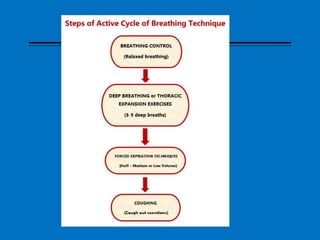
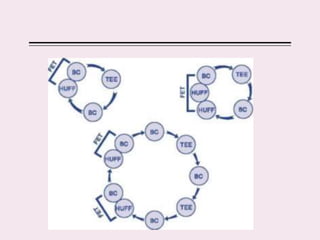
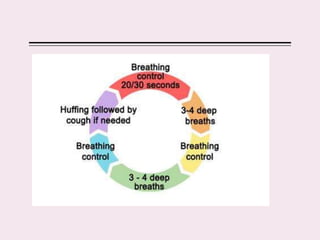
 ACBT consists of three main phases:
 Breathing Control
 Deep Breathing Exercises or Thoracic Expansion Exercises
 Huffing or Forced Expiratory Technique (FET)
 Expiratory vibrations or percussion can be used along
with ACBT
Breathing control
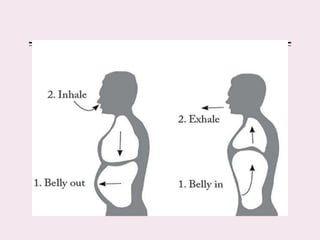
 Breathing control is normal breathing using the lower
chest with relaxation of the upper chest and shoulders.
 Breathing techniques can be divided into two
I. normal breathing, known as 'breathing control', where minimal
effort is expended, and
II. breathing exercises where either inspiration is emphasized as
in thoracic expansion exercises or expiration is emphasized as in
the huff of the forced expiration technique.
Procedure
 The patient should be in a comfortable well-supported
position either sitting or in high side lying.
 The patient is encouraged to relax his upper chest
shoulders and arms while using the lower chest.
 One hand of patient or physiotherapist should be placed
on upper abdomen.
 As the patient breathes in, the hand should be felt to
rise up and out; as the patient breathes out, the hand
sinks down and in.
 Breath through nose, but if patient is breathless can use
mouth to breath.
 Inspiration is the active phase, expiration should be
relaxed and passive.
 Gradually try to make the breaths slower.
 Try closing your eyes to help you to focus on your
breathing and to relax.
 If one breathe out through mouth, it's best to use
breathing control with ‘pursed lips breathing’.
 https://www.youtube.com/watch?time_continue=80&v=0Ua9bOs
ZTYg&feature=emb_logo
Thoracic expansion exercises
 Deep breaths are like little love notes to your body
 Thoracic expansion exercises are deep breathing
exercises emphasizing inspiration.
 Inspiration is active and may be combined with a 3-
second hold before the passive relaxed expiration.
 Helps to loosen secretions on the lungs.
 The postoperative maneuver of a 3-second hold at full
inspiration has been said to decrease collapse of lung
tissue.
Rationale
 In the normal lung the resistance to airflow via the collateral ventilatory
system is high, but with increasing lung volume and in the presence of
lung pathology the resistance decreases,
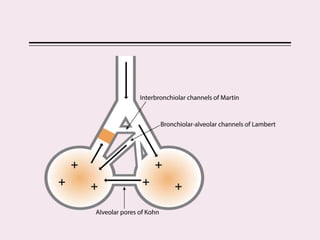
 allowing air to flow via the collateral channels the pores of Kohn, channels
of Lambert and channels of Martin.
 Air behind secretions may assist in mobilizing them
 The effectiveness of thoracic expansion exercises in re-expanding lung
tissue and in mobilizing and clearing excess bronchial secretions can also
be explained by the phenomenon of interdependence.
 This is the effect of the expanding forces exerted between adjacent alveoli.
 At high lung volumes the expanding forces between alveoli are greater
than at tidal volume and assist in re-expansion of lung tissue.
 Breath-hold(inspiratory hold) used at the end of deep breathing to
compensate asynchronous ventilation that may happen due to sputum
retention or atelectasis in some respiratory conditions
Procedure
 Try to keep your chest and shoulders relaxed.
 Take a long, slow and deep breath in, through your nose if you
can.
 At the end of the breath in, hold the air in your lungs for 2-3
seconds before breathing out (this is known as an inspiratory
hold)
 Breathe out gently and relaxed, like a sigh. Don’t force the air
out.
 Three or four expansion exercises are usually appropriate before
pausing for a few seconds to a period of breathing control.
 Any more deep breaths could produce the effects of
hyperventilation or could tire the patient.
 Thoracic expansion exercises can be encouraged with
proprioceptive stimulation by placing a hand, either the patient's
or the physiotherapist's, over the part of the chest wall where
movement of the chest is to be encouraged.
Forced expiratory technique
 A huff (also called the forced expiration technique [FET]
when combined with breathing control) is a maneuver
used to move secretions, mobilized by thoracic
expansion exercises, downstream towards the mouth.
 Huffing helps moves sputum from the small airways to
the larger airways, from where they are removed by
coughing.
Types
 Medium volume Huff:
 This helps to move secretions that are lower down in your
airways. From small airways to larger airways
 Take a normal-sized breath in and then an active, long breath out
until your lungs feel quite empty.
 High volume Huff:
 This helps to move secretions in your upper airways.
 Take a deep breath in, open your mouth wide and huff out
quickly.
Rationale
 With any forced expiratory maneuver there is dynamic
compression and collapse of the airways downstream
(towards the mouth) of the equal pressure point .
 This is an important part of the clearance mechanism of
either a huff or a cough.
 The rationale behind a huff is based on the equal pressure
point (EPP) – the point at which pressure within the
bronchi equals peri-bronchial pressure (outside the
airway).
 During normal respiration, the EPP occurs in airways
protected by cartilaginous rings which help to prevent
airway collapse.
 During a forced expiration, the pressure outside the airway
remains relatively constant, whilst the pressure inside the
airway decreases from the peripheral airways to the
mouth, resulting in airway compression.
Coughing
 Coughing should be incorporated if huffing alone does
not clear your sputum.
 However, if it does clear your sputum, then you may not
need to cough.
 It is very important to avoid long bouts of coughing as
these can be very tiring and may make you feel
breathless, or make your throat or chest sore or tight.
 You should only cough if the sputum can be cleared
easily, if not, return to the beginning of the cycle
INDICATIONS
 Post surgical /pain (rib
fracture/ICC).
 Chronic increased sputum
production e.g in Chronic
bronchitis, cystic fibrosis.
 Acute increase sputum
production.
 Poor expansion.
 Sputum Retention.
 SOBAR/SOBOE.
 SOB at rest/ SOB at exertion
 Cystic Fibrosis.
 Bronchiectasis.
 Atelectasis.
 Respiratory muscle
weakness.
 Mechanical ventilation.
 Asthma.
 Increased breathing
rate/effort
 Audible rattling in airways
 Palpable secretions
precautions
 It is important to constantly assess for dizziness or
increased shortness of breath throughout ACBT. If a
patient feels dizzy during deep breathing, decrease the
number of deep breaths taken during each cycle and
return to breathing control to reduce dizziness.
 Inadequate pain control where needed
 Bronchospasm
 Acute, unstable head, neck or spinal surgery
Contraindications
 Patients not spontaneously breathing
 Unconscious patient
 Patients who are unable to follow instructions
 Agitated or confused
Percussion
 Chest percussion is a type of chest physical therapy that
essentially involves tapping or clapping on your chest
with your hand.
 Percussion over an affected area produces an energy
wave, which is transmitted to the lungs and airways,
loosening thick, sticky secretions from the chest wall
making it easier to cough up out sputum.
 Chest percussion can also be used in combination
with active cycle breathing techniques or coupled
with positioning in those who are unable to actively
participate in active controlled breathing exercises.
 Combining this technique with gravity-assisted
positioning can improve the drainage process in patients
with abnormalities in cilia that inhibit effective airway
clearance
 Chest clapping should never be uncomfortable and
should be done over a layer of doming to avoid sensory
stimulation of the skin.
 Chest clapping has been shown to cause an increase in
hypoxaemia, but when short periods of chest clapping
(less than 30 seconds) have been combined with three
to four thoracic expansion exercises no fall was seen in
oxygen saturation.
 Do NOT perform percussions on any of these
areas:
 Avoid the stomach
 Avoid the breastbone
 Avoid the spine
 Avoid the lower ribs and lower back (to prevent injuring
organs
Indications
 Patients with pulmonary disease that are associated
with increased production or viscosity of mucus, such as
chronic bronchitis and cystic fibrosis.
 Patients who are on prolonged bed rest.
 Patients who have received general anesthesia and who
have painful incisions that restrict deep breathing and
coughing postoperatively.
 Any patient who is on ventilator if he or she is stable
enough to tolerate the treatment.
 Patients with acute or chronic lung disease, e.g. COPD.
 Patients who are generally weak or elderly.
 Patients with artificial airways
Contraindication
 Over fractures, spinal fusion, or osteoporotic bone.
 Over tumor area.
 If a patient has a pulmonary embolus.
 If a patient has a condition in which hemorrhage could
easily occur.
 If the patient has an unstable angina.
 If the patient has a chest wall pain.
 In recent neurosurgery, head down position is
contraindicated.
 If patients has a hyper-reactive airways and severe
bronchospasm; though, not an absolute contraindication.
Types
 Manual percussion
 Mechanical percussion
Manual Percussion
 also known as cupping, clapping, and tapotement
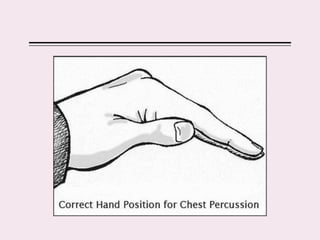
 Chest percussion is performed with cupped hands
which strike's the patient chest wall in an alternating
rhythmic manner over the lung segments being drained.
Procedure
 Chest percussion is performed with cupped hands which strike's
the patient chest wall in an alternating rhythmic manner over the
lung segments being drained.
 This loosens the thick, sticky secretions from the walls of the lung
allowing them to move more freely into the larger airways,
especially when used with associated gravity positioning.
 To improve the efficacy of treatment the following guidelines are
recommended[5]:
 Patient should be in a comfortable or painless position.
 The technique is applied over a towel to ensure it does not feel
uncomfortable.
 Therapist should try to keep shoulders, elbows and wrist loose and mobile
during the manoeuvre.
 Duration: Several minutes or until the patient needs to alter the position to
cough
 https://www.youtube.com/watch?v=1ZRk55sHJ1I
 https://www.youtube.com/watch?v=vxFUPdFc1eM
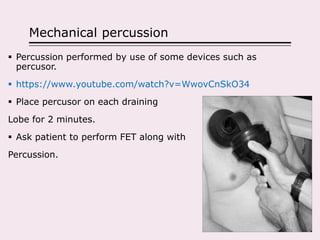
Mechanical percussion
 Percussion performed by use of some devices such as
percusor.
 https://www.youtube.com/watch?v=WwovCnSkO34
 Place percusor on each draining
Lobe for 2 minutes.
 Ask patient to perform FET along with
Percussion.
Vibrations shaking and compression
 Vibration/shaking is a movement used to move loose
secretions to larger airways so that they can be coughed
up or removed by suctioning.
 The vibratory action may be either a coarse movement
(chest shaking) or a fine movement (chest vibrations)
 Vibration involves the rapid shaking of the chest
wall during exhalation.
 Chest physiotherapy techniques should be used every
2–4 h for patients with retained secretions.
 In infants, vibrations are performed using two fingers in
contact with the chest wall
 The physiotherapist or other care giver may give
compression during huffing or coughing.
 Postoperative patients usually find that supporting the
wound facilitates both huffing and coughing.
 With fractured ribs and other chest injuries shaking of
the chest wall would be inappropriate, but compressive
support may assist the clearance of secretions.
 https://www.youtube.com/watch?v=t6pL-BzZBTY
procedure
 The caregiver places a firm hand on the chest wall over the
part of the lung being drained
 tenses the muscles of the arm and shoulder to create a
fine shaking motion.
 Then, the caregiver applies a light pressure over the area
being vibrated.
 The caregiver may also place one hand over the other, then
press the top and bottom hand into each other to vibrate.
 Vibration is done with the flattened hand, not the cupped
hand.
 Exhalation should be as slow and as complete as possible.
 Use ACBT along with vibration
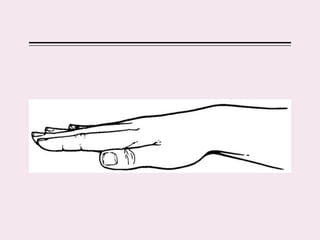
 With the hands in a similar position chest compression
throughout expiration is often helpful to augment the
forced expiratory manoeuvre of the huff.
 When in side lying self-compression can be given over
the side of the chest with the upper arm and elbow and
the hand of the other arm.
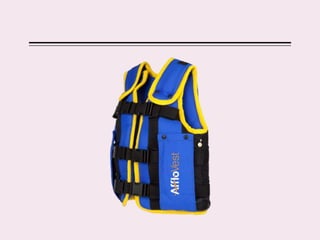
 there's an inflatable vest called a high-frequency chest
wall oscillator that uses air pressure to deliver high
frequency vibrations to the chest and back.
 one usually use a high-frequency chest wall oscillator for
about five minutes at a time with breaks to allow to
cough and clear out the loosened mucus between
sessions.
 Mechanical vibrations have been reported to be clinically
effective.
 Gentle mechanical vibration may be indicated for
patients who cannot tolerate manual percussion
Indications
 Patients with pulmonary disease that are associated
with increased production or viscosity of mucus, such as
chronic bronchitis and cystic fibrosis.
 Patients who are on prolonged bed rest.
 Patients who have received general anesthesia and who
have painful incisions that restrict deep breathing and
coughing postoperatively.
 Any patient who is on ventilator if he or she is stable
enough to tolerate the treatment.
 Patients with acute or chronic lung disease, e.g. COPD.
 Patients who are generally weak or elderly.
 Patients with artificial airways
Contraindications
 Osteoporosis
 ribs fracture / rib pathology
 Thoracic / cardiac surgery
 Pain
 Frank haemoptysis
 Bronchospasm
 Liver disease, coagulopathies, BMD deficiency
 Metastatic deposits
 Clotting disorders
 Loss of skin integrity (surgery, burns, wounds)
 Subcutaneous emphysema
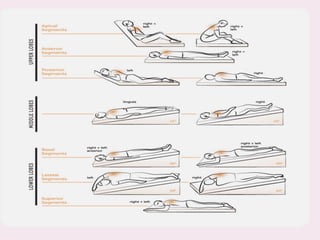
Gravity Assisted positioning
 Gravity assisted drainage positions (also known as GAD
or postural drainage) can be used to assist the clearance
of excess bronchial secretions from the lungs
 Postural drainage uses gravity to help move mucus from
the lungs up to the throat.
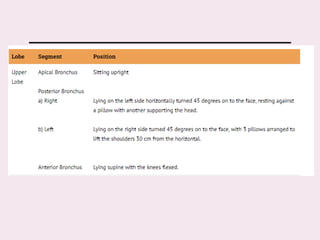
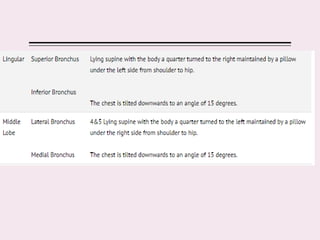
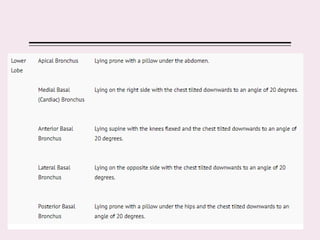
 The person lies or sits in various positions so the part of
the lung to be drained is as high as possible.
 That part of the lung is then drained using percussion,
vibration and gravity.
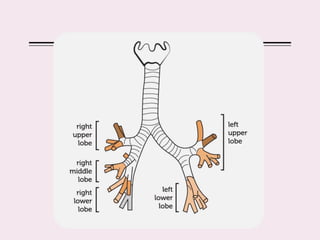
Lobes and segments
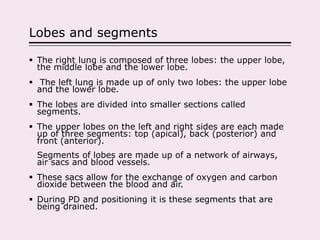
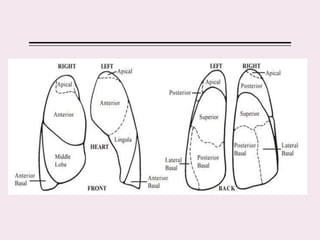
 The right lung is composed of three lobes: the upper lobe,
the middle lobe and the lower lobe.
 The left lung is made up of only two lobes: the upper lobe
and the lower lobe.
 The lobes are divided into smaller sections called
segments.
 The upper lobes on the left and right sides are each made
up of three segments: top (apical), back (posterior) and
front (anterior).
Segments of lobes are made up of a network of airways,
air sacs and blood vessels.
 These sacs allow for the exchange of oxygen and carbon
dioxide between the blood and air.
 During PD and positioning it is these segments that are
being drained.
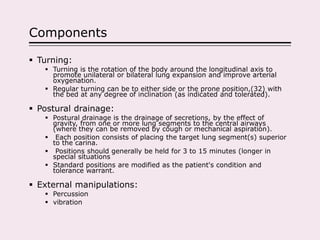
Components
 Turning:
 Turning is the rotation of the body around the longitudinal axis to
promote unilateral or bilateral lung expansion and improve arterial
oxygenation.
 Regular turning can be to either side or the prone position,(32) with
the bed at any degree of inclination (as indicated and tolerated).
 Postural drainage:
 Postural drainage is the drainage of secretions, by the effect of
gravity, from one or more lung segments to the central airways
(where they can be removed by cough or mechanical aspiration).
 Each position consists of placing the target lung segment(s) superior
to the carina.
 Positions should generally be held for 3 to 15 minutes (longer in
special situations
 Standard positions are modified as the patient's condition and
tolerance warrant.
 External manipulations:
 Percussion
 vibration
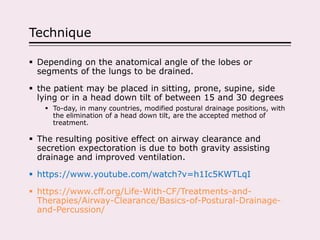
Technique
 Depending on the anatomical angle of the lobes or
segments of the lungs to be drained.
 the patient may be placed in sitting, prone, supine, side
lying or in a head down tilt of between 15 and 30 degrees
 To-day, in many countries, modified postural drainage positions, with
the elimination of a head down tilt, are the accepted method of
treatment.
 The resulting positive effect on airway clearance and
secretion expectoration is due to both gravity assisting
drainage and improved ventilation.
 https://www.youtube.com/watch?v=h1Ic5KWTLqI
 https://www.cff.org/Life-With-CF/Treatments-and-
Therapies/Airway-Clearance/Basics-of-Postural-Drainage-
and-Percussion/
Contraindication
 Cardiac failure
 Severe hypertension
 Cerebral edema
 Aortic and cerebral
aneurysms
 Abdominal distension
 Frank haemoptysis
 Cardiovascular instability
 Existing gastro-
oesophageal reflux /
gastro-oesophageal
surgery
 Recent surgery or trauma
to the head or neck
 Post-op abdominal /
thoracic surgery
 Extremely short of breath
 Sinus pain / severe
headaches
Indications
 cystic fibrosis
 bronchiectasis
 as well as temporary infections, such as pneumonia
 Artificial airways.
 Atelactasis
 To mobilize retained secretions so that they can be
suctioned or expectorated
 Foreign body obstruction
Autogenic Drainage
 Autogenic drainage (AD) aims to maximize airflow within the airways to
improve the clearance of mucus and ventilation
 AD is breathing at different lung volumes and an active expiration is used
to mobilize the mucus
 Autogenic drainage was developed in Belgium in the late 1960's by
Chevaillier
 The overall aim of AD is to reach the highest possible expiratory airflow in
different generations of the bronchi simultaneously with an active, but not
forced expiration.
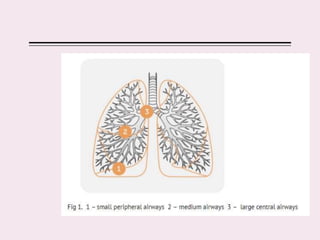
 secretions are systematically transported from peripheral to more central
airways by breathing at lower lung volumes , through progressively higher
lung volumes.
 The rationale for the technique is the generation of shearing forces induced
by airflow.
 shear stress, which is due to the frictional action of the air rubbing against the
surface, acts tangentially to the surface at that point.
 The speed of the expiratory flow may mobilize secretions by shearing them
from the bronchial walls and transporting them from the peripheral to the
central airways
phases
 Chevaillier described three phrases:
 'unstick',
 'collect' and ‘
 evacuate'
 Breathing at low lung volumes is said to mobilize peripheral
mucus. This is the first or 'unstick' phase. It is followed by a
period of tidal breathing which is said to 'collect' mucus in
the middle airways. Then, by breathing at higher lung
volumes, the 'evacuate' phase, expectoration of secretions
from the central airways is promoted.
 A huff from high lung volume is now encouraged to clear
the secretions from the trachea.
 Coughing is discouraged
 Nowadays, these phases are not seen as separate, rather
that they blend into one another.
 Unstick secretions -
 breathe as much air out of your chest as you can then take a
small breath in, using your tummy, feeling your breath at the
bottom of your chest. You may hear secretions start to crackle.
 Resist any desire to cough.
 Loosening peripheral secretions by breathing at low lung volumes
(slow, deep air movement)
 Repeat for at least 3 breaths.
 Collect secretions -
 As the crackle of secretions starts to get louder change to
medium sized breaths in.
 Feel the breaths more in the middle of your chest.
 Repeat for at least 3 breaths.
 Collecting secretions from central airways by breathing at low to
middle lung volumes (slow, mid-range air movement)
 Evacuate secretions -
 when the crackles are louder still, take long, slow, full breaths in
to your absolute maximum.
 Repeat for at least 3 breaths.
 Expelling secretions from the central airways by breathing at mid
to high lung volumes (shallow air movements
Spirometry
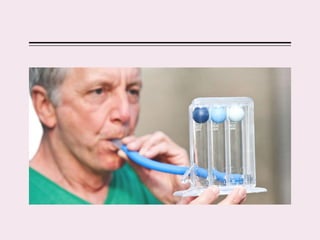
 Incentive spirometers are mechanical devices
introduced in an attempt to reduce postoperative
pulmonary complications.
 The patient takes a slow deep breath in, with his lips
sealed around the mouthpiece
 patient is motivated by visual feedback, for example a
ball rising to a preset marker.
 The patient aims to generate a predetermined flow or to
achieve a preset volume and he is encouraged to hold
his breath for 2-3 seconds at full inspiration.
 The pattern of breathing while using an incentive
spirometer is important.
 Expansion of the lower chest should be emphasized rather man
the use of the accessory muscles of respiration
 Diaphragmatic movement is thought to be an important factor in
the prevention of postoperative pulmonary complications.
 Incentive spirometry has been shown to increase
abdominal movement in normal subjects, but not in
subjects following abdominal surgery.
 https://www.youtube.com/watch?v=-O-
Zawtb32o&feature=emb_logo
Indications
 Pre-operative screening of patients at risk of postoperative
complications to obtain a baseline of their inspiratory flow
and volume
 Presence of pulmonary atelectasis
 Conditions predisposing to atelectasis such as:
 Abdominal or thoracic surgery[4]
 Prolonged bed rest
 Surgery in patients with COPD
 Presence thoracic or Abdominal binders.
 Lack of pain control
 Restrictive lung disease associated with a
dysfunctional diaphragm or involving respiratory
musculature
 Patients with inspiratory capacity less than 2.5 litres
 Patients with neuromuscular disease or spinal cord injury
Contraindications
 Patients who cannot use the device appropriately or
require supervision at all times
 Patients who are noncompliant or do not understand or
demonstrate proper use of the device
 Very young patients or pediatrics with developmental delay
 Hyperventilation
 Hypoxaemia secondary to interruption of oxygen therapy
 Fatigue
 Patients unable to take deep breath effectively due to pain,
diaphragmatic dysfunction, or opiate analgesia.
 Patients who are heavily sedated or comatose
 The device is not suitable for people with severe dyspnea
Suctioning
 Airway suction is usually necessary to clear secretions
from the intubated patient with an endotracheal tube,
tracheostomy, minitracheostomy or the patient with an
'airway condition.
 https://www.youtube.com/watch?v=pk9ZB9jovGQ
Airway clearance techniques

Airway clearance techniques

  • 1.
    AIRWAY CLEARANCE TECHNIQUES Hafsa imtiazDPT University of Balochistan
  • 2.
    AIRWAY CLEARANCE TECHNIQUES Airway clearance techniques (ACTs) are ways to loosen thick, sticky mucus so it can be coughed up and cleared out of the lungs.  ACT is indicated for individuals whose function of the mucociliary escalator and/or cough mechanics are altered and whose ability to mobilize and expectorate airways secretions is compromised.  Early diagnosis and implementation of ACT, coupled with medical management of infections and airways inflammation, can reduce morbidity and mortality associated with chronic pulmonary and neurorespiratory disease.  Today a variety of interventions may be used to enhance airway clearance, with the goal of improving lung mechanics and gas exchange and preventing atelectasis and infection.
  • 3.
    CONT  Techniques include: ACBT  Breathing control  Thoracic expansion exercises  Forced expiratory techniques  PERCUSSION  Manual Percussion ( cupping)  Mechanical percussion  Chest shaking ,Vibrations, Compression  Gravity assisted positions  Autogenic Drainage  SPIROMETRY  AIRWAY SUCTION
  • 4.
    ACBT  Stands foractive cycle of breathing technique.  The active cycle of breathing techniques (ACBT) is used to  mobilize and clear excess bronchial secretions.  Improve ventilation in the lungs.  Improve the effectiveness of a cough  The ACBT is a flexible method of treatment which can be adapted for use in any patient, young or old, medical or surgical, where there is a problem of excess bronchial secretions.
  • 5.
    Phases of ACBT ACBT consists of three main phases:  Breathing Control  Deep Breathing Exercises or Thoracic Expansion Exercises  Huffing or Forced Expiratory Technique (FET)  Expiratory vibrations or percussion can be used along with ACBT
  • 7.
    Breathing control  Breathingcontrol is normal breathing using the lower chest with relaxation of the upper chest and shoulders.  Breathing techniques can be divided into two I. normal breathing, known as 'breathing control', where minimal effort is expended, and II. breathing exercises where either inspiration is emphasized as in thoracic expansion exercises or expiration is emphasized as in the huff of the forced expiration technique.
  • 8.
    Procedure  The patientshould be in a comfortable well-supported position either sitting or in high side lying.  The patient is encouraged to relax his upper chest shoulders and arms while using the lower chest.  One hand of patient or physiotherapist should be placed on upper abdomen.  As the patient breathes in, the hand should be felt to rise up and out; as the patient breathes out, the hand sinks down and in.  Breath through nose, but if patient is breathless can use mouth to breath.  Inspiration is the active phase, expiration should be relaxed and passive.
  • 9.
     Gradually tryto make the breaths slower.  Try closing your eyes to help you to focus on your breathing and to relax.  If one breathe out through mouth, it's best to use breathing control with ‘pursed lips breathing’.  https://www.youtube.com/watch?time_continue=80&v=0Ua9bOs ZTYg&feature=emb_logo
  • 11.
    Thoracic expansion exercises Deep breaths are like little love notes to your body  Thoracic expansion exercises are deep breathing exercises emphasizing inspiration.  Inspiration is active and may be combined with a 3- second hold before the passive relaxed expiration.  Helps to loosen secretions on the lungs.  The postoperative maneuver of a 3-second hold at full inspiration has been said to decrease collapse of lung tissue.
  • 12.
    Rationale  In thenormal lung the resistance to airflow via the collateral ventilatory system is high, but with increasing lung volume and in the presence of lung pathology the resistance decreases,  allowing air to flow via the collateral channels the pores of Kohn, channels of Lambert and channels of Martin.  Air behind secretions may assist in mobilizing them  The effectiveness of thoracic expansion exercises in re-expanding lung tissue and in mobilizing and clearing excess bronchial secretions can also be explained by the phenomenon of interdependence.  This is the effect of the expanding forces exerted between adjacent alveoli.  At high lung volumes the expanding forces between alveoli are greater than at tidal volume and assist in re-expansion of lung tissue.  Breath-hold(inspiratory hold) used at the end of deep breathing to compensate asynchronous ventilation that may happen due to sputum retention or atelectasis in some respiratory conditions
  • 14.
    Procedure  Try tokeep your chest and shoulders relaxed.  Take a long, slow and deep breath in, through your nose if you can.  At the end of the breath in, hold the air in your lungs for 2-3 seconds before breathing out (this is known as an inspiratory hold)  Breathe out gently and relaxed, like a sigh. Don’t force the air out.  Three or four expansion exercises are usually appropriate before pausing for a few seconds to a period of breathing control.  Any more deep breaths could produce the effects of hyperventilation or could tire the patient.  Thoracic expansion exercises can be encouraged with proprioceptive stimulation by placing a hand, either the patient's or the physiotherapist's, over the part of the chest wall where movement of the chest is to be encouraged.
  • 15.
    Forced expiratory technique A huff (also called the forced expiration technique [FET] when combined with breathing control) is a maneuver used to move secretions, mobilized by thoracic expansion exercises, downstream towards the mouth.  Huffing helps moves sputum from the small airways to the larger airways, from where they are removed by coughing.
  • 16.
    Types  Medium volumeHuff:  This helps to move secretions that are lower down in your airways. From small airways to larger airways  Take a normal-sized breath in and then an active, long breath out until your lungs feel quite empty.  High volume Huff:  This helps to move secretions in your upper airways.  Take a deep breath in, open your mouth wide and huff out quickly.
  • 17.
    Rationale  With anyforced expiratory maneuver there is dynamic compression and collapse of the airways downstream (towards the mouth) of the equal pressure point .  This is an important part of the clearance mechanism of either a huff or a cough.  The rationale behind a huff is based on the equal pressure point (EPP) – the point at which pressure within the bronchi equals peri-bronchial pressure (outside the airway).  During normal respiration, the EPP occurs in airways protected by cartilaginous rings which help to prevent airway collapse.  During a forced expiration, the pressure outside the airway remains relatively constant, whilst the pressure inside the airway decreases from the peripheral airways to the mouth, resulting in airway compression.
  • 18.
    Coughing  Coughing shouldbe incorporated if huffing alone does not clear your sputum.  However, if it does clear your sputum, then you may not need to cough.  It is very important to avoid long bouts of coughing as these can be very tiring and may make you feel breathless, or make your throat or chest sore or tight.  You should only cough if the sputum can be cleared easily, if not, return to the beginning of the cycle
  • 19.
    INDICATIONS  Post surgical/pain (rib fracture/ICC).  Chronic increased sputum production e.g in Chronic bronchitis, cystic fibrosis.  Acute increase sputum production.  Poor expansion.  Sputum Retention.  SOBAR/SOBOE.  SOB at rest/ SOB at exertion  Cystic Fibrosis.  Bronchiectasis.  Atelectasis.  Respiratory muscle weakness.  Mechanical ventilation.  Asthma.  Increased breathing rate/effort  Audible rattling in airways  Palpable secretions
  • 20.
    precautions  It isimportant to constantly assess for dizziness or increased shortness of breath throughout ACBT. If a patient feels dizzy during deep breathing, decrease the number of deep breaths taken during each cycle and return to breathing control to reduce dizziness.  Inadequate pain control where needed  Bronchospasm  Acute, unstable head, neck or spinal surgery
  • 21.
    Contraindications  Patients notspontaneously breathing  Unconscious patient  Patients who are unable to follow instructions  Agitated or confused
  • 25.
    Percussion  Chest percussionis a type of chest physical therapy that essentially involves tapping or clapping on your chest with your hand.  Percussion over an affected area produces an energy wave, which is transmitted to the lungs and airways, loosening thick, sticky secretions from the chest wall making it easier to cough up out sputum.  Chest percussion can also be used in combination with active cycle breathing techniques or coupled with positioning in those who are unable to actively participate in active controlled breathing exercises.  Combining this technique with gravity-assisted positioning can improve the drainage process in patients with abnormalities in cilia that inhibit effective airway clearance
  • 26.
     Chest clappingshould never be uncomfortable and should be done over a layer of doming to avoid sensory stimulation of the skin.  Chest clapping has been shown to cause an increase in hypoxaemia, but when short periods of chest clapping (less than 30 seconds) have been combined with three to four thoracic expansion exercises no fall was seen in oxygen saturation.  Do NOT perform percussions on any of these areas:  Avoid the stomach  Avoid the breastbone  Avoid the spine  Avoid the lower ribs and lower back (to prevent injuring organs
  • 27.
    Indications  Patients withpulmonary disease that are associated with increased production or viscosity of mucus, such as chronic bronchitis and cystic fibrosis.  Patients who are on prolonged bed rest.  Patients who have received general anesthesia and who have painful incisions that restrict deep breathing and coughing postoperatively.  Any patient who is on ventilator if he or she is stable enough to tolerate the treatment.  Patients with acute or chronic lung disease, e.g. COPD.  Patients who are generally weak or elderly.  Patients with artificial airways
  • 28.
    Contraindication  Over fractures,spinal fusion, or osteoporotic bone.  Over tumor area.  If a patient has a pulmonary embolus.  If a patient has a condition in which hemorrhage could easily occur.  If the patient has an unstable angina.  If the patient has a chest wall pain.  In recent neurosurgery, head down position is contraindicated.  If patients has a hyper-reactive airways and severe bronchospasm; though, not an absolute contraindication.
  • 29.
    Types  Manual percussion Mechanical percussion
  • 30.
    Manual Percussion  alsoknown as cupping, clapping, and tapotement  Chest percussion is performed with cupped hands which strike's the patient chest wall in an alternating rhythmic manner over the lung segments being drained.
  • 31.
    Procedure  Chest percussionis performed with cupped hands which strike's the patient chest wall in an alternating rhythmic manner over the lung segments being drained.  This loosens the thick, sticky secretions from the walls of the lung allowing them to move more freely into the larger airways, especially when used with associated gravity positioning.  To improve the efficacy of treatment the following guidelines are recommended[5]:  Patient should be in a comfortable or painless position.  The technique is applied over a towel to ensure it does not feel uncomfortable.  Therapist should try to keep shoulders, elbows and wrist loose and mobile during the manoeuvre.  Duration: Several minutes or until the patient needs to alter the position to cough  https://www.youtube.com/watch?v=1ZRk55sHJ1I  https://www.youtube.com/watch?v=vxFUPdFc1eM
  • 34.
    Mechanical percussion  Percussionperformed by use of some devices such as percusor.  https://www.youtube.com/watch?v=WwovCnSkO34  Place percusor on each draining Lobe for 2 minutes.  Ask patient to perform FET along with Percussion.
  • 35.
    Vibrations shaking andcompression  Vibration/shaking is a movement used to move loose secretions to larger airways so that they can be coughed up or removed by suctioning.  The vibratory action may be either a coarse movement (chest shaking) or a fine movement (chest vibrations)  Vibration involves the rapid shaking of the chest wall during exhalation.  Chest physiotherapy techniques should be used every 2–4 h for patients with retained secretions.  In infants, vibrations are performed using two fingers in contact with the chest wall
  • 36.
     The physiotherapistor other care giver may give compression during huffing or coughing.  Postoperative patients usually find that supporting the wound facilitates both huffing and coughing.  With fractured ribs and other chest injuries shaking of the chest wall would be inappropriate, but compressive support may assist the clearance of secretions.  https://www.youtube.com/watch?v=t6pL-BzZBTY
  • 37.
    procedure  The caregiverplaces a firm hand on the chest wall over the part of the lung being drained  tenses the muscles of the arm and shoulder to create a fine shaking motion.  Then, the caregiver applies a light pressure over the area being vibrated.  The caregiver may also place one hand over the other, then press the top and bottom hand into each other to vibrate.  Vibration is done with the flattened hand, not the cupped hand.  Exhalation should be as slow and as complete as possible.  Use ACBT along with vibration
  • 38.
     With thehands in a similar position chest compression throughout expiration is often helpful to augment the forced expiratory manoeuvre of the huff.  When in side lying self-compression can be given over the side of the chest with the upper arm and elbow and the hand of the other arm.
  • 40.
     there's aninflatable vest called a high-frequency chest wall oscillator that uses air pressure to deliver high frequency vibrations to the chest and back.  one usually use a high-frequency chest wall oscillator for about five minutes at a time with breaks to allow to cough and clear out the loosened mucus between sessions.  Mechanical vibrations have been reported to be clinically effective.  Gentle mechanical vibration may be indicated for patients who cannot tolerate manual percussion
  • 42.
    Indications  Patients withpulmonary disease that are associated with increased production or viscosity of mucus, such as chronic bronchitis and cystic fibrosis.  Patients who are on prolonged bed rest.  Patients who have received general anesthesia and who have painful incisions that restrict deep breathing and coughing postoperatively.  Any patient who is on ventilator if he or she is stable enough to tolerate the treatment.  Patients with acute or chronic lung disease, e.g. COPD.  Patients who are generally weak or elderly.  Patients with artificial airways
  • 43.
    Contraindications  Osteoporosis  ribsfracture / rib pathology  Thoracic / cardiac surgery  Pain  Frank haemoptysis  Bronchospasm  Liver disease, coagulopathies, BMD deficiency  Metastatic deposits  Clotting disorders  Loss of skin integrity (surgery, burns, wounds)  Subcutaneous emphysema
  • 44.
    Gravity Assisted positioning Gravity assisted drainage positions (also known as GAD or postural drainage) can be used to assist the clearance of excess bronchial secretions from the lungs  Postural drainage uses gravity to help move mucus from the lungs up to the throat.  The person lies or sits in various positions so the part of the lung to be drained is as high as possible.  That part of the lung is then drained using percussion, vibration and gravity.
  • 46.
    Lobes and segments The right lung is composed of three lobes: the upper lobe, the middle lobe and the lower lobe.  The left lung is made up of only two lobes: the upper lobe and the lower lobe.  The lobes are divided into smaller sections called segments.  The upper lobes on the left and right sides are each made up of three segments: top (apical), back (posterior) and front (anterior). Segments of lobes are made up of a network of airways, air sacs and blood vessels.  These sacs allow for the exchange of oxygen and carbon dioxide between the blood and air.  During PD and positioning it is these segments that are being drained.
  • 48.
    Components  Turning:  Turningis the rotation of the body around the longitudinal axis to promote unilateral or bilateral lung expansion and improve arterial oxygenation.  Regular turning can be to either side or the prone position,(32) with the bed at any degree of inclination (as indicated and tolerated).  Postural drainage:  Postural drainage is the drainage of secretions, by the effect of gravity, from one or more lung segments to the central airways (where they can be removed by cough or mechanical aspiration).  Each position consists of placing the target lung segment(s) superior to the carina.  Positions should generally be held for 3 to 15 minutes (longer in special situations  Standard positions are modified as the patient's condition and tolerance warrant.  External manipulations:  Percussion  vibration
  • 49.
    Technique  Depending onthe anatomical angle of the lobes or segments of the lungs to be drained.  the patient may be placed in sitting, prone, supine, side lying or in a head down tilt of between 15 and 30 degrees  To-day, in many countries, modified postural drainage positions, with the elimination of a head down tilt, are the accepted method of treatment.  The resulting positive effect on airway clearance and secretion expectoration is due to both gravity assisting drainage and improved ventilation.  https://www.youtube.com/watch?v=h1Ic5KWTLqI  https://www.cff.org/Life-With-CF/Treatments-and- Therapies/Airway-Clearance/Basics-of-Postural-Drainage- and-Percussion/
  • 55.
    Contraindication  Cardiac failure Severe hypertension  Cerebral edema  Aortic and cerebral aneurysms  Abdominal distension  Frank haemoptysis  Cardiovascular instability  Existing gastro- oesophageal reflux / gastro-oesophageal surgery  Recent surgery or trauma to the head or neck  Post-op abdominal / thoracic surgery  Extremely short of breath  Sinus pain / severe headaches
  • 56.
    Indications  cystic fibrosis bronchiectasis  as well as temporary infections, such as pneumonia  Artificial airways.  Atelactasis  To mobilize retained secretions so that they can be suctioned or expectorated  Foreign body obstruction
  • 57.
    Autogenic Drainage  Autogenicdrainage (AD) aims to maximize airflow within the airways to improve the clearance of mucus and ventilation  AD is breathing at different lung volumes and an active expiration is used to mobilize the mucus  Autogenic drainage was developed in Belgium in the late 1960's by Chevaillier  The overall aim of AD is to reach the highest possible expiratory airflow in different generations of the bronchi simultaneously with an active, but not forced expiration.  secretions are systematically transported from peripheral to more central airways by breathing at lower lung volumes , through progressively higher lung volumes.  The rationale for the technique is the generation of shearing forces induced by airflow.  shear stress, which is due to the frictional action of the air rubbing against the surface, acts tangentially to the surface at that point.  The speed of the expiratory flow may mobilize secretions by shearing them from the bronchial walls and transporting them from the peripheral to the central airways
  • 59.
    phases  Chevaillier describedthree phrases:  'unstick',  'collect' and ‘  evacuate'  Breathing at low lung volumes is said to mobilize peripheral mucus. This is the first or 'unstick' phase. It is followed by a period of tidal breathing which is said to 'collect' mucus in the middle airways. Then, by breathing at higher lung volumes, the 'evacuate' phase, expectoration of secretions from the central airways is promoted.  A huff from high lung volume is now encouraged to clear the secretions from the trachea.  Coughing is discouraged  Nowadays, these phases are not seen as separate, rather that they blend into one another.
  • 60.
     Unstick secretions-  breathe as much air out of your chest as you can then take a small breath in, using your tummy, feeling your breath at the bottom of your chest. You may hear secretions start to crackle.  Resist any desire to cough.  Loosening peripheral secretions by breathing at low lung volumes (slow, deep air movement)  Repeat for at least 3 breaths.  Collect secretions -  As the crackle of secretions starts to get louder change to medium sized breaths in.  Feel the breaths more in the middle of your chest.  Repeat for at least 3 breaths.  Collecting secretions from central airways by breathing at low to middle lung volumes (slow, mid-range air movement)
  • 61.
     Evacuate secretions-  when the crackles are louder still, take long, slow, full breaths in to your absolute maximum.  Repeat for at least 3 breaths.  Expelling secretions from the central airways by breathing at mid to high lung volumes (shallow air movements
  • 63.
    Spirometry  Incentive spirometersare mechanical devices introduced in an attempt to reduce postoperative pulmonary complications.  The patient takes a slow deep breath in, with his lips sealed around the mouthpiece  patient is motivated by visual feedback, for example a ball rising to a preset marker.  The patient aims to generate a predetermined flow or to achieve a preset volume and he is encouraged to hold his breath for 2-3 seconds at full inspiration.
  • 64.
     The patternof breathing while using an incentive spirometer is important.  Expansion of the lower chest should be emphasized rather man the use of the accessory muscles of respiration  Diaphragmatic movement is thought to be an important factor in the prevention of postoperative pulmonary complications.  Incentive spirometry has been shown to increase abdominal movement in normal subjects, but not in subjects following abdominal surgery.  https://www.youtube.com/watch?v=-O- Zawtb32o&feature=emb_logo
  • 66.
    Indications  Pre-operative screeningof patients at risk of postoperative complications to obtain a baseline of their inspiratory flow and volume  Presence of pulmonary atelectasis  Conditions predisposing to atelectasis such as:  Abdominal or thoracic surgery[4]  Prolonged bed rest  Surgery in patients with COPD  Presence thoracic or Abdominal binders.  Lack of pain control  Restrictive lung disease associated with a dysfunctional diaphragm or involving respiratory musculature  Patients with inspiratory capacity less than 2.5 litres  Patients with neuromuscular disease or spinal cord injury
  • 67.
    Contraindications  Patients whocannot use the device appropriately or require supervision at all times  Patients who are noncompliant or do not understand or demonstrate proper use of the device  Very young patients or pediatrics with developmental delay  Hyperventilation  Hypoxaemia secondary to interruption of oxygen therapy  Fatigue  Patients unable to take deep breath effectively due to pain, diaphragmatic dysfunction, or opiate analgesia.  Patients who are heavily sedated or comatose  The device is not suitable for people with severe dyspnea
  • 68.
    Suctioning  Airway suctionis usually necessary to clear secretions from the intubated patient with an endotracheal tube, tracheostomy, minitracheostomy or the patient with an 'airway condition.  https://www.youtube.com/watch?v=pk9ZB9jovGQ