Chest Physiotherapy
Dr/ Mousa Abdelfatah Group (D1)
Pediatric Nursing Department
2024/2025
Student names
Eslam Ahmed Mohamed
1.
Said Mohamed Hamdy
2.
Abdelrahman Hamed Mahmoud
3.
Abdelrahman Reda Abdelbasset
4.
Abdelrahman Ateeq Abdelnaby
5.
Afaf Mohamed Hassan
6.
Ghada Ismail Ali
7.
Fatema Ali SAyed
8.
Fatema Abdelnasser Farahat
9.
Fatema Farag Tawfik
10.
Fatema Mahmoud Lotfy
11.
Karim Maher Abdelrazek
12.
Latifa Mohamed Tarfaya
13.
Mohamed Ashraf Emam
14.
Mohamed Talaat Mohamed
15.
Mohamed Emad Aldein Elsayed
16.
At the end of the lecture the students sould be able to :
• Define chest physiotherapy (CPT) and its importance in improving respiratory function.
• Explain the indications and clinical applications for chest physiotherapy.
• Identify the equipment and tools required to perform CPT.
• Describe the different techniques used in chest physiotherapy.
• Highlight the contraindications and potential complications of the procedure.
• Emphasize the nursing role in implementing and monitoring CPT.
objectives
Outlines
Introduction
Definition
purpose of procedure
Indication
Type and Position
Equipments
Contraindications
Complication
Health Teaching
Nursing intervention for chest physiotherapy.
Nursing Role
Conclusion
Introduction :
Chest physiotherapy (CPT) are treatments generally
performed by physical therapists and respiratory
therapists, whereby breathing is improved by the
indirect removal of mucus from the breathing passages
of a patient. Other terms include respiratory or cardio-
thoracic physiotherapy.
Definition
CPT are treatments which are performed on people who
have mucus dysfunction in respiratory disease
conditions like asthma, chronic obstructive pulmonary
disease, bronchitis, bronchiectasis and cystic fibrosis.
These respiratory conditions all have a common
requirement of chest physiotherapy to assist the mucus
clearance due to defects with mucociliary clearance.
PURPOSE OF CPT
The purposes of chest physiotherapy can include :
1. Clear mucus from the airways to improve breathing
2. Improve lung ventilation and oxygenation.
3. Enhance respiratory function by promoting deep breathing.
4. Prevent lung infections by reducing mucus buildup.
5. Aid post-surgical recovery, particularly after chest or
abdominal surgery.
6. Relieve respiratory distress and improve airflow in conditions
like asthma and COPD.
7. Support patients with chronic respiratory conditions like cystic
fibrosis and bronchiectasis
Indication of chest physiotherapy :
Patient with excessive secretion in lungs.
1.
Pneumonia.
2.
Lung abscess.
3.
Atelectasis
4.
ASTHMA
5.
Cystic fibrosis.
6.
Immovability.
7.
COPD
8.
Neuromuscular disease ( spinal cord injury
,cerebral palsy)
9.
Types of chest physiotherapy
Deep breathing
Deep breathing helps expand the lungs and forces an
improved distribution of the air into all sections of the lungs.
The patient either sits in a chair or sits upright in bed and
inhales then pushes the abdomen out to force maximum
amounts of air into the lung. The abdomen is then
contracted, and the patient exhales. Deep breathing
exercises are done several times each day for short periods.
Types of chest physiotherapy
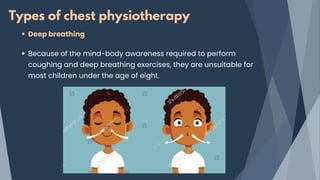
Deep breathing
Because of the mind-body awareness required to perform
coughing and deep breathing exercises, they are unsuitable for
most children under the age of eight.
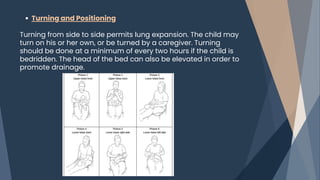
Turning and Positioning
Turning from side to side permits lung expansion. The child may
turn on his or her own, or be turned by a caregiver. Turning
should be done at a minimum of every two hours if the child is
bedridden. The head of the bed can also be elevated in order to
promote drainage.
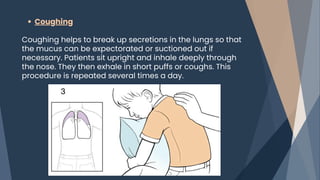
Coughing
Coughing helps to break up secretions in the lungs so that
the mucus can be expectorated or suctioned out if
necessary. Patients sit upright and inhale deeply through
the nose. They then exhale in short puffs or coughs. This
procedure is repeated several times a day.
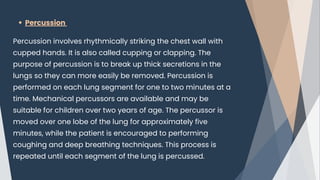
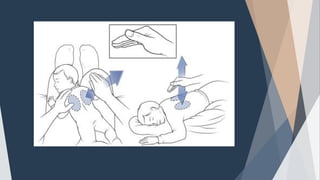
Percussion
Percussion involves rhythmically striking the chest wall with
cupped hands. It is also called cupping or clapping. The
purpose of percussion is to break up thick secretions in the
lungs so they can more easily be removed. Percussion is
performed on each lung segment for one to two minutes at a
time. Mechanical percussors are available and may be
suitable for children over two years of age. The percussor is
moved over one lobe of the lung for approximately five
minutes, while the patient is encouraged to performing
coughing and deep breathing techniques. This process is
repeated until each segment of the lung is percussed.
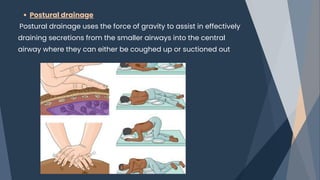
Postural drainage
Postural drainage uses the force of gravity to assist in effectively
draining secretions from the smaller airways into the central
airway where they can either be coughed up or suctioned out
Vibration
As with percussion, the purpose of vibration is to help
break up lung secretions. Vibration can be either
mechanical or manual. It is performed as the patient
breathes deeply. When done manually, the person
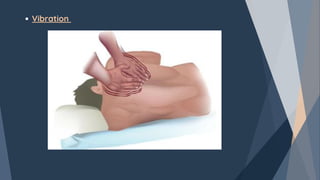
performing the vibration places his or her hands against
the patient's chest and creates vibrations by quickly
contracting and relaxing arm and shoulder muscles
while the patient exhales. The procedure is repeated
several times each day for about five exhalations
Vibration
Flutter
The flutter valve is a hand-held mucus clearance device
designed to combine positive expiratory pressure (PEP) with
high frequency airway oscillations. The device looks like a
pipe containing an inner cone that cradles a steel ball
sealed with a perforated cover. Exhalation through the
device results in a vibration of the airway walls, which in turn
loosens secretions. It may be a suitable technique for
children aged five years and over.
Flutter
Positive expiratory pressure ( pep)
PEP therapy has been extensively tested and is equivalent to
standard chest physical therapy. It is an airway clearance method
that is administered by applying a mechanical pressure device to
the mouth. By breathing out with a moderate force through the
resistance of the device, a positive pressure is created in the
airways that helps to keep them open. This positive pressure
permits airflow to reach beneath the areas of mucus obstruction
and to move the mucus toward the larger airways where it can be
expectorated. This technique may be suitable for alert, cooperative
children over the age of four.
Positive expiratory pressure ( pep)
Equipment
Stethoscope.
Pillows or folded towels for positioning.
Tilt or postural drainage table (if available) or adjustable hospital bed.
Gloves.
Emesis basin.
Facial tissues.
Suction equipment.
Equipment for oral care.
Trash bag.
Optional: sterile specimen container, mechanical ventilator,
supplemental oxygen.
Complications :
Complications of (CPT) can include :
Hypoxia
Increased metabolic demand
Oxygen consumption
Cardiac arrhythmias
Changes in blood pressure
Raised intracranial pressure
Decreased cerebral oxygenation
Gastroesophageal reflux
Pneumothoraces
Rib fractures
Periosteal reactions
Atelectasis
Death
Contraindications :
Pulmonary hemorrhage.
Pulmonary edema.
Coagulation defects
Rriased intracranial pressure.
Pulmonary hypertension and/or a history of hypertensive
crises.
Very premature or small for gestational age.
Health teaching :-
1. Explain to the patient why chest manipulation techniques are being
received. Relate it to disease or injury condition.
2.Tell the patient that everything will be done to make the procedure
as comfortable as possible.
3. Instruct the patient in proper breathing techniques such as
"huffing" and effective cough.
4. Explain any adjuncts to therapy.
5. If the patient is coherent, at the end of the patient teaching aspects
of this procedure, patient should be able to verbalize and
demonstrate understanding of the procedure
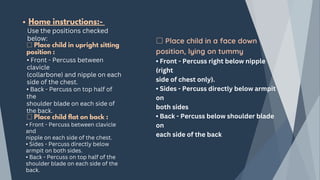
Home instructions:-
Use the positions checked
below:
□ Place child in upright sitting
position :
• Front - Percuss between
clavicle
(collarbone) and nipple on each
side of the chest.
• Back - Percuss on top half of
the
shoulder blade on each side of
the back.
□ Place child flat on back :
• Front - Percuss between clavicle
and
nipple on each side of the chest.
• Sides - Percuss directly below
armpit on both sides.
• Back - Percuss on top half of the
shoulder blade on each side of the
back.
□ Place child in a face down
position, lying on tummy
• Front - Percuss right below nipple
(right
side of chest only).
• Sides - Percuss directly below armpit
on
both sides
• Back - Percuss below shoulder blade
on
each side of the back
Nursing Interventions for Chest physiotherapy :
ASSESSMENT
• Observation of breathing: Assessing the rate, depth,
and use of accessory muscles.
• Auscultation of lungs: Listening to the lungs using a
stethoscope to detect abnormal sounds (e.g., crackles or
wheezing)
• Assessment of Secretions: Evaluating the
amount,color, and consistency of mucus to determine
congestion or infection.
• Assess of patient’s vital signs. Conditions
requiring CPT, such atelectasis, and pneumonia,
affects vital signs
• Assess the patient’s medications.
Certain medications, particularly diuretics
antihypertensive cause fluid and hemodynamic changes.
These decrease patient’s tolerance to positional changes
and postural drainage.
• Nursing intervention for chest physiotherapy:
Assessment
Nursing Interventions for Chest physiotherapy :
ASSESSMENT
•Assess the patient’s medical history; certain conditions
such as increased ICP, spinal cord injuries and
abdominal aneurysm resection, contra indicate the
positional change to postural drainage. Thoracic trauma
and chest surgeries also contraindicate percussion and
vibration.
•Assess the patient’s cognitive level of functioning.
Participating in controlled cough techniques requires the
patient to follow instructions.
Nursing Interventions for Chest physiotherapy :
Nursing Diagnosis
1. Ineffective Airway Clearance Related to Excessive mucus
production, weak cough effort, or retained secretions.
2. Impaired Gas Exchange Related to Mucus plugging,
alveolar hypoventilation, or atelectasis
3. Ineffective Breathing Pattern Related to Restricted chest
movement, pain, or fatigue.
Nursing Interventions for Chest physiotherapy :
Nursing Diagnosis
4. Risk for Aspiration Related to: Inability to manage
secretions or impaired swallowing during therapy.
5. Activity Intolerance Related to: Decreased oxygenation
and increased work of breathing.
6. Risk for Infection Related to: Retained secretions serving
as a medium for bacterial growth.
Nursing Interventions for Chest physiotherapy :
Planning
1. Facilitate Mobilization of Secretions
Reduce mucus plugging by breaking down and mobilizing
secretions to the central airways for easier expulsion
2. Enhance Lung Expansion
Prevent atelectasis by improving alveolar recruitment
through deep breathing and positioning techniques
3. Optimize Respiratory Mechanics
Strengthen respiratory muscles to improve tidal volume and
overall lung capacity.
Nursing Interventions for Chest physiotherapy :
Planning
4. Promote Efficient Ventilation-Perfusion (V/Q) Matching
Improve oxygen delivery to tissues by reducing areas of lung
collapse or congestion.
5. Reduce Work of Breathing
Minimize the child’s respiratory effort by clearing obstructions
and improving airflow.
6. Prevent Complications
Reduce the risk of pneumonia, chronic lung disease, and other
complications associated with retained secretions.
Nursing Interventions for Chest physiotherapy :
Implementation
Use auscultation to identify areas of retained secretions
(crackles or wheezing).
Monitor oxygen saturation and respiratory rate.
Position the child to allow gravity to aid mucus drainage from
specific lung lobes.
Observe for signs of fatigue, cyanosis, or respiratory distress.
Consider age and developmental level.
Nursing Interventions for Chest physiotherapy :
Implementation
Older children may participate in active techniques (e.g.,
deep breathing).
Suction excess secretions if the child cannot clear them
independently.
Use sterile technique and limit suctioning time to prevent
hypoxia.
Demonstrate techniques if caregivers are expected to assist
or continue therapy at home.
Nursing Interventions for Chest physiotherapy :
Evaluation
1. Respiratory Status
Improved breath sounds (e.g., reduction in crackles or
wheezes)
Improved oxygen saturation levels (e.g., ≥95% in most
cases).
Decreased respiratory rate to age-appropriate norms.
Reduced use of accessory muscles and work of breathing
Nursing Interventions for Chest physiotherapy :
Evaluation
2. Secretion Clearance
Observation of loosened or expelled secretions
Increased volume of sputum produced.
Thinner and clearer mucus consistency.
3. Symptoms
Reduction in coughing frequency or severity.
Improved ease of breathing and comfort level.
Relief from dyspnea or other respiratory distress signs.
Nursing Interventions for Chest physiotherapy :
Evaluation
4. Tolerance and Cooperation
Child’s ability to tolerate therapy without distress or fatigue.
Level of cooperation during procedures, especially in older
children.
Absence of adverse effects such as vomiting, hypoxia,
or cyanosis.
5. Physical and Functional Outcomes
Improved activity tolerance, such as the ability to play or
feed without respiratory distress.
Nursing Role:
• Administer bronchodilators, if ordered, before CPT to
enhance airway clearance.
• Instruct the patient use diaphragmatic breathing.
• Position the patient in prescribed postural drainage
positions. Spine should be straight to promote rib cage
expansion.
• Perform percussion over the ribs only; don't percuss over
the spine, the sternum, liver, spleen, breast, scapula, or
clavicle.
• Percuss or clap with cupped hands or chest wall for 5
minutes over each segment for 5 minutes for cystic fibrosis
and 1-2 minutes for other conditions.
• Encourage the child to cough (which may be easier while sitting
up) and give him a soft pillow or stuffed toy to hug while coughing
to provide support.
• Instruct the patient to inhale slowly and deeply.
• Encourage the child to perform deep breathing exercises; use
techniques to make this fun, such as having the child blow soap
bubbles, blow through a straw, or blow cotton balls or tissues
across a table.
• Listen with stethoscope for changes in breath sounds.
• Repeat the percussion and vibration cycle according to the
patient’s tolerance and clinical response: usually 15-30 minutes.
Nursing role :
Conclusion
Chest physiotherapy is an important treatment that helps
improve breathing and clear mucus from the airways. It uses
simple techniques like breathing exercises, postural
drainage, vibration and percussion.
This therapy is especially helpful for people with chronic lung
problems, such as cystic fibrosis or Chronic obstruction
pulmonary disease (COPD). Its success depends on using the
right techniques and individualized treatment plan.
By making breathing easier and preventing complications, chest
physiotherapy plays an important role in improving the health and
comfort of patients.
Refrences
https://www.childrensmn.org/educationmaterials/childrensmn/ar
ticle/15300/chest-physiotherapy-birth-to-2-years/
https://www.aurorahealthcare.org/services/heart-
vascular/services-treatments/diagnosis-treatment-chest-
lung/chest-physiotherapy
https://pmc.ncbi.nlm.nih.gov/articles/PMC6513290/
Chest Physiotherapy-1.pptx (3).pdf 2024j

Chest Physiotherapy-1.pptx (3).pdf 2024j

  • 1.
    Chest Physiotherapy Dr/ MousaAbdelfatah Group (D1) Pediatric Nursing Department 2024/2025
  • 2.
    Student names Eslam AhmedMohamed 1. Said Mohamed Hamdy 2. Abdelrahman Hamed Mahmoud 3. Abdelrahman Reda Abdelbasset 4. Abdelrahman Ateeq Abdelnaby 5. Afaf Mohamed Hassan 6. Ghada Ismail Ali 7. Fatema Ali SAyed 8. Fatema Abdelnasser Farahat 9. Fatema Farag Tawfik 10. Fatema Mahmoud Lotfy 11. Karim Maher Abdelrazek 12. Latifa Mohamed Tarfaya 13. Mohamed Ashraf Emam 14. Mohamed Talaat Mohamed 15. Mohamed Emad Aldein Elsayed 16.
  • 3.
    At the endof the lecture the students sould be able to : • Define chest physiotherapy (CPT) and its importance in improving respiratory function. • Explain the indications and clinical applications for chest physiotherapy. • Identify the equipment and tools required to perform CPT. • Describe the different techniques used in chest physiotherapy. • Highlight the contraindications and potential complications of the procedure. • Emphasize the nursing role in implementing and monitoring CPT. objectives
  • 4.
    Outlines Introduction Definition purpose of procedure Indication Typeand Position Equipments Contraindications Complication Health Teaching Nursing intervention for chest physiotherapy. Nursing Role Conclusion
  • 5.
    Introduction : Chest physiotherapy(CPT) are treatments generally performed by physical therapists and respiratory therapists, whereby breathing is improved by the indirect removal of mucus from the breathing passages of a patient. Other terms include respiratory or cardio- thoracic physiotherapy.
  • 6.
    Definition CPT are treatmentswhich are performed on people who have mucus dysfunction in respiratory disease conditions like asthma, chronic obstructive pulmonary disease, bronchitis, bronchiectasis and cystic fibrosis. These respiratory conditions all have a common requirement of chest physiotherapy to assist the mucus clearance due to defects with mucociliary clearance.
  • 7.
    PURPOSE OF CPT Thepurposes of chest physiotherapy can include : 1. Clear mucus from the airways to improve breathing 2. Improve lung ventilation and oxygenation. 3. Enhance respiratory function by promoting deep breathing. 4. Prevent lung infections by reducing mucus buildup. 5. Aid post-surgical recovery, particularly after chest or abdominal surgery. 6. Relieve respiratory distress and improve airflow in conditions like asthma and COPD. 7. Support patients with chronic respiratory conditions like cystic fibrosis and bronchiectasis
  • 8.
    Indication of chestphysiotherapy : Patient with excessive secretion in lungs. 1. Pneumonia. 2. Lung abscess. 3. Atelectasis 4. ASTHMA 5. Cystic fibrosis. 6. Immovability. 7. COPD 8. Neuromuscular disease ( spinal cord injury ,cerebral palsy) 9.
  • 9.
    Types of chestphysiotherapy Deep breathing Deep breathing helps expand the lungs and forces an improved distribution of the air into all sections of the lungs. The patient either sits in a chair or sits upright in bed and inhales then pushes the abdomen out to force maximum amounts of air into the lung. The abdomen is then contracted, and the patient exhales. Deep breathing exercises are done several times each day for short periods.
  • 10.
    Types of chestphysiotherapy Deep breathing Because of the mind-body awareness required to perform coughing and deep breathing exercises, they are unsuitable for most children under the age of eight.
  • 11.
    Turning and Positioning Turningfrom side to side permits lung expansion. The child may turn on his or her own, or be turned by a caregiver. Turning should be done at a minimum of every two hours if the child is bedridden. The head of the bed can also be elevated in order to promote drainage.
  • 12.
    Coughing Coughing helps tobreak up secretions in the lungs so that the mucus can be expectorated or suctioned out if necessary. Patients sit upright and inhale deeply through the nose. They then exhale in short puffs or coughs. This procedure is repeated several times a day.
  • 13.
    Percussion Percussion involves rhythmicallystriking the chest wall with cupped hands. It is also called cupping or clapping. The purpose of percussion is to break up thick secretions in the lungs so they can more easily be removed. Percussion is performed on each lung segment for one to two minutes at a time. Mechanical percussors are available and may be suitable for children over two years of age. The percussor is moved over one lobe of the lung for approximately five minutes, while the patient is encouraged to performing coughing and deep breathing techniques. This process is repeated until each segment of the lung is percussed.
  • 15.
    Postural drainage Postural drainageuses the force of gravity to assist in effectively draining secretions from the smaller airways into the central airway where they can either be coughed up or suctioned out
  • 16.
    Vibration As with percussion,the purpose of vibration is to help break up lung secretions. Vibration can be either mechanical or manual. It is performed as the patient breathes deeply. When done manually, the person performing the vibration places his or her hands against the patient's chest and creates vibrations by quickly contracting and relaxing arm and shoulder muscles while the patient exhales. The procedure is repeated several times each day for about five exhalations
  • 17.
  • 18.
    Flutter The flutter valveis a hand-held mucus clearance device designed to combine positive expiratory pressure (PEP) with high frequency airway oscillations. The device looks like a pipe containing an inner cone that cradles a steel ball sealed with a perforated cover. Exhalation through the device results in a vibration of the airway walls, which in turn loosens secretions. It may be a suitable technique for children aged five years and over.
  • 19.
  • 20.
    Positive expiratory pressure( pep) PEP therapy has been extensively tested and is equivalent to standard chest physical therapy. It is an airway clearance method that is administered by applying a mechanical pressure device to the mouth. By breathing out with a moderate force through the resistance of the device, a positive pressure is created in the airways that helps to keep them open. This positive pressure permits airflow to reach beneath the areas of mucus obstruction and to move the mucus toward the larger airways where it can be expectorated. This technique may be suitable for alert, cooperative children over the age of four.
  • 21.
  • 22.
    Equipment Stethoscope. Pillows or foldedtowels for positioning. Tilt or postural drainage table (if available) or adjustable hospital bed. Gloves. Emesis basin. Facial tissues. Suction equipment. Equipment for oral care. Trash bag. Optional: sterile specimen container, mechanical ventilator, supplemental oxygen.
  • 23.
    Complications : Complications of(CPT) can include : Hypoxia Increased metabolic demand Oxygen consumption Cardiac arrhythmias Changes in blood pressure Raised intracranial pressure Decreased cerebral oxygenation Gastroesophageal reflux Pneumothoraces Rib fractures Periosteal reactions Atelectasis Death
  • 24.
    Contraindications : Pulmonary hemorrhage. Pulmonaryedema. Coagulation defects Rriased intracranial pressure. Pulmonary hypertension and/or a history of hypertensive crises. Very premature or small for gestational age.
  • 25.
    Health teaching :- 1.Explain to the patient why chest manipulation techniques are being received. Relate it to disease or injury condition. 2.Tell the patient that everything will be done to make the procedure as comfortable as possible. 3. Instruct the patient in proper breathing techniques such as "huffing" and effective cough. 4. Explain any adjuncts to therapy. 5. If the patient is coherent, at the end of the patient teaching aspects of this procedure, patient should be able to verbalize and demonstrate understanding of the procedure
  • 26.
    Home instructions:- Use thepositions checked below: □ Place child in upright sitting position : • Front - Percuss between clavicle (collarbone) and nipple on each side of the chest. • Back - Percuss on top half of the shoulder blade on each side of the back. □ Place child flat on back : • Front - Percuss between clavicle and nipple on each side of the chest. • Sides - Percuss directly below armpit on both sides. • Back - Percuss on top half of the shoulder blade on each side of the back. □ Place child in a face down position, lying on tummy • Front - Percuss right below nipple (right side of chest only). • Sides - Percuss directly below armpit on both sides • Back - Percuss below shoulder blade on each side of the back
  • 27.
    Nursing Interventions forChest physiotherapy : ASSESSMENT • Observation of breathing: Assessing the rate, depth, and use of accessory muscles. • Auscultation of lungs: Listening to the lungs using a stethoscope to detect abnormal sounds (e.g., crackles or wheezing) • Assessment of Secretions: Evaluating the amount,color, and consistency of mucus to determine congestion or infection.
  • 28.
    • Assess ofpatient’s vital signs. Conditions requiring CPT, such atelectasis, and pneumonia, affects vital signs • Assess the patient’s medications. Certain medications, particularly diuretics antihypertensive cause fluid and hemodynamic changes. These decrease patient’s tolerance to positional changes and postural drainage. • Nursing intervention for chest physiotherapy: Assessment
  • 29.
    Nursing Interventions forChest physiotherapy : ASSESSMENT •Assess the patient’s medical history; certain conditions such as increased ICP, spinal cord injuries and abdominal aneurysm resection, contra indicate the positional change to postural drainage. Thoracic trauma and chest surgeries also contraindicate percussion and vibration. •Assess the patient’s cognitive level of functioning. Participating in controlled cough techniques requires the patient to follow instructions.
  • 30.
    Nursing Interventions forChest physiotherapy : Nursing Diagnosis 1. Ineffective Airway Clearance Related to Excessive mucus production, weak cough effort, or retained secretions. 2. Impaired Gas Exchange Related to Mucus plugging, alveolar hypoventilation, or atelectasis 3. Ineffective Breathing Pattern Related to Restricted chest movement, pain, or fatigue.
  • 31.
    Nursing Interventions forChest physiotherapy : Nursing Diagnosis 4. Risk for Aspiration Related to: Inability to manage secretions or impaired swallowing during therapy. 5. Activity Intolerance Related to: Decreased oxygenation and increased work of breathing. 6. Risk for Infection Related to: Retained secretions serving as a medium for bacterial growth.
  • 32.
    Nursing Interventions forChest physiotherapy : Planning 1. Facilitate Mobilization of Secretions Reduce mucus plugging by breaking down and mobilizing secretions to the central airways for easier expulsion 2. Enhance Lung Expansion Prevent atelectasis by improving alveolar recruitment through deep breathing and positioning techniques 3. Optimize Respiratory Mechanics Strengthen respiratory muscles to improve tidal volume and overall lung capacity.
  • 33.
    Nursing Interventions forChest physiotherapy : Planning 4. Promote Efficient Ventilation-Perfusion (V/Q) Matching Improve oxygen delivery to tissues by reducing areas of lung collapse or congestion. 5. Reduce Work of Breathing Minimize the child’s respiratory effort by clearing obstructions and improving airflow. 6. Prevent Complications Reduce the risk of pneumonia, chronic lung disease, and other complications associated with retained secretions.
  • 34.
    Nursing Interventions forChest physiotherapy : Implementation Use auscultation to identify areas of retained secretions (crackles or wheezing). Monitor oxygen saturation and respiratory rate. Position the child to allow gravity to aid mucus drainage from specific lung lobes. Observe for signs of fatigue, cyanosis, or respiratory distress. Consider age and developmental level.
  • 35.
    Nursing Interventions forChest physiotherapy : Implementation Older children may participate in active techniques (e.g., deep breathing). Suction excess secretions if the child cannot clear them independently. Use sterile technique and limit suctioning time to prevent hypoxia. Demonstrate techniques if caregivers are expected to assist or continue therapy at home.
  • 36.
    Nursing Interventions forChest physiotherapy : Evaluation 1. Respiratory Status Improved breath sounds (e.g., reduction in crackles or wheezes) Improved oxygen saturation levels (e.g., ≥95% in most cases). Decreased respiratory rate to age-appropriate norms. Reduced use of accessory muscles and work of breathing
  • 37.
    Nursing Interventions forChest physiotherapy : Evaluation 2. Secretion Clearance Observation of loosened or expelled secretions Increased volume of sputum produced. Thinner and clearer mucus consistency. 3. Symptoms Reduction in coughing frequency or severity. Improved ease of breathing and comfort level. Relief from dyspnea or other respiratory distress signs.
  • 38.
    Nursing Interventions forChest physiotherapy : Evaluation 4. Tolerance and Cooperation Child’s ability to tolerate therapy without distress or fatigue. Level of cooperation during procedures, especially in older children. Absence of adverse effects such as vomiting, hypoxia, or cyanosis. 5. Physical and Functional Outcomes Improved activity tolerance, such as the ability to play or feed without respiratory distress.
  • 39.
    Nursing Role: • Administerbronchodilators, if ordered, before CPT to enhance airway clearance. • Instruct the patient use diaphragmatic breathing. • Position the patient in prescribed postural drainage positions. Spine should be straight to promote rib cage expansion. • Perform percussion over the ribs only; don't percuss over the spine, the sternum, liver, spleen, breast, scapula, or clavicle. • Percuss or clap with cupped hands or chest wall for 5 minutes over each segment for 5 minutes for cystic fibrosis and 1-2 minutes for other conditions.
  • 40.
    • Encourage thechild to cough (which may be easier while sitting up) and give him a soft pillow or stuffed toy to hug while coughing to provide support. • Instruct the patient to inhale slowly and deeply. • Encourage the child to perform deep breathing exercises; use techniques to make this fun, such as having the child blow soap bubbles, blow through a straw, or blow cotton balls or tissues across a table. • Listen with stethoscope for changes in breath sounds. • Repeat the percussion and vibration cycle according to the patient’s tolerance and clinical response: usually 15-30 minutes. Nursing role :
  • 41.
    Conclusion Chest physiotherapy isan important treatment that helps improve breathing and clear mucus from the airways. It uses simple techniques like breathing exercises, postural drainage, vibration and percussion. This therapy is especially helpful for people with chronic lung problems, such as cystic fibrosis or Chronic obstruction pulmonary disease (COPD). Its success depends on using the right techniques and individualized treatment plan. By making breathing easier and preventing complications, chest physiotherapy plays an important role in improving the health and comfort of patients.
  • 42.