

Aircraft
manufacturing
Forming Technology Applications..
Group 4
Introduction
Types of Aircrafts According to
size and Usage
Military Civil Experimental Model
 Wright Brothers with their FLYER flied for a 39.5 Km Distance
 World War I 1st air force war
 Jet engine invention in Germany and UK between 1918 – 1939
 Commercial Aircrafts after World War II
Aircraft History
Introduction
In aircrafts industry forming technology plays a basic role in
manufacturing most of necessary and critical parts such bolts ,
rivets , body , wings.
in this presentation we will seek several applications of forming
technology in aircrafts industry.
Forming technology role
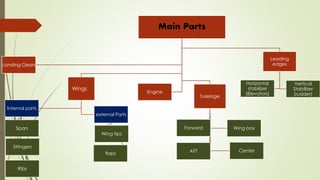
Main Parts
Wings
Internal parts
Spars
Ribs
Stringers
external Parts
Wing tips
flaps
fuselage
Center
Forward
AFT
Wing box
Leading
edges
Horizontal
stabilizer
(Elevators)
Vertical
Stabilizer
(rudder)Engine
Landing Gears
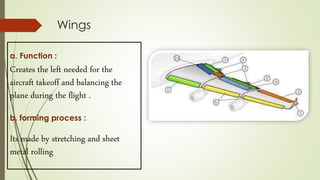
a. Function :
Creates the left needed for the
aircraft takeoff and balancing the
plane during the flight .
b. forming process :
Its made by stretching and sheet
metal rolling
Wings
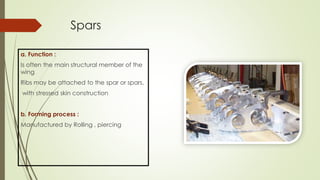
Spars
a. Function :
Is often the main structural member of the
wing
Ribs may be attached to the spar or spars,
with stressed skin construction
b. Forming process :
Manufactured by Rolling , piercing
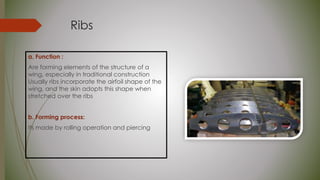
Ribs
a. Function :
Are forming elements of the structure of a
wing, especially in traditional construction
Usually ribs incorporate the airfoil shape of the
wing, and the skin adopts this shape when
stretched over the ribs
b. Forming process:
Its made by rolling operation and piercing
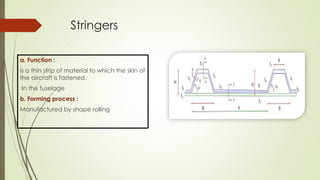
Stringers
a. Function :
is a thin strip of material to which the skin of
the aircraft is fastened.
In the fuselage
b. Forming process :
Manufactured by shape rolling
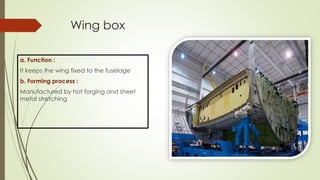
Wing box
a. Function :
It keeps the wing fixed to the fuselage
b. Forming process :
Manufactured by hot forging and sheet
metal stretching
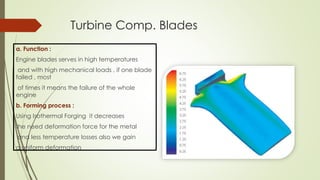
Turbine Comp. Blades
a. Function :
Engine blades serves in high temperatures
and with high mechanical loads , if one blade
failed , most
of times it means the failure of the whole
engine
b. Forming process :
Using Isothermal Forging it decreases
the need deformation force for the metal
and less temperature losses also we gain
a uniform deformation
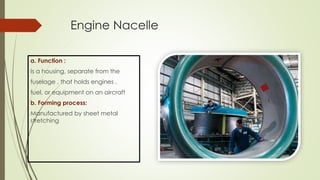
Engine Nacelle
a. Function :
Is a housing, separate from the
fuselage , that holds engines ,
fuel, or equipment on an aircraft
b. Forming process:
Manufactured by sheet metal
stretching
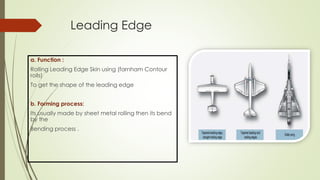
Leading Edge
a. Function :
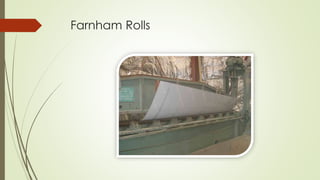
Rolling Leading Edge Skin using (farnham Contour
rolls)
To get the shape of the leading edge
b. Forming process:
Its usually made by sheet metal rolling then its bend
by the
Bending process .
Farnham Rolls
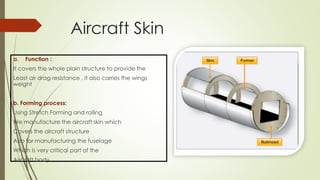
Aircraft Skin
a. Function :
It covers the whole plain structure to provide the
Least air drag resistance , it also carries the wings
weight
b. Forming process:
Using Stretch Forming and rolling
We manufacture the aircraft skin which
Covers the aircraft structure
Also for manufacturing the fuselage
Which is very critical part of the
Aircraft body
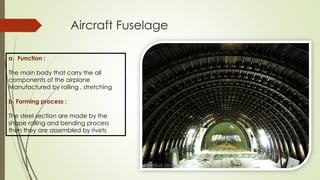
Aircraft Fuselage
a. Function :
The main body that carry the all
components of the airplane
Manufactured by rolling , stretching
b. Forming process :
The steel section are made by the
shape rolling and bending process
then they are assembled by rivets
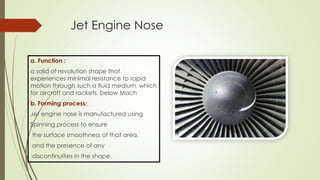
Jet Engine Nose
a. Function :
a solid of revolution shape that
experiences minimal resistance to rapid
motion through such a fluid medium, which
for aircraft and rockets, below Mach
b. Forming process:
Jet engine nose is manufactured using
Spinning process to ensure
the surface smoothness of that area,
and the presence of any
discontinuities in the shape.
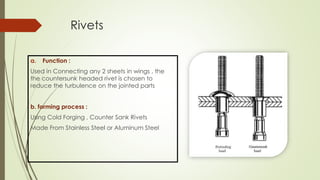
Rivets
a. Function :
Used in Connecting any 2 sheets in wings , the
the countersunk headed rivet is chosen to
reduce the turbulence on the jointed parts
b. forming process :
Using Cold Forging , Counter Sank Rivets
Made From Stainless Steel or Aluminum Steel
Aircraft cables
a. Function :
This is important for precise control Of the
rudder , elevator and flaps .
b. forming process :
Its made by wire drawing
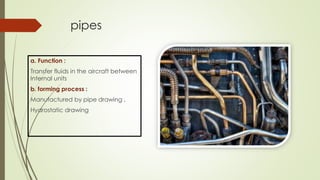
pipes
a. Function :
Transfer fluids in the aircraft between
Internal units
b. forming process :
Manufactured by pipe drawing ,
Hydrostatic drawing
General look
Group 4
 Aman Allah Ahmed
 Amr Helal
 Ahmed Taha
 Arsani Sami
 Asmaa el Biltagy
 Anas Moustafa
 Doaa Ahmed
 Dina el Malky
 Eslam el Badry
 Mohamed Magdy
 Yassmin Nabil
 Eslam Essam

Aircraft manufacturing

  • 1.
  • 2.
    Introduction Types of AircraftsAccording to size and Usage Military Civil Experimental Model  Wright Brothers with their FLYER flied for a 39.5 Km Distance  World War I 1st air force war  Jet engine invention in Germany and UK between 1918 – 1939  Commercial Aircrafts after World War II Aircraft History
  • 3.
    Introduction In aircrafts industryforming technology plays a basic role in manufacturing most of necessary and critical parts such bolts , rivets , body , wings. in this presentation we will seek several applications of forming technology in aircrafts industry. Forming technology role
  • 4.
    Main Parts Wings Internal parts Spars Ribs Stringers externalParts Wing tips flaps fuselage Center Forward AFT Wing box Leading edges Horizontal stabilizer (Elevators) Vertical Stabilizer (rudder)Engine Landing Gears
  • 5.
    a. Function : Createsthe left needed for the aircraft takeoff and balancing the plane during the flight . b. forming process : Its made by stretching and sheet metal rolling Wings
  • 6.
    Spars a. Function : Isoften the main structural member of the wing Ribs may be attached to the spar or spars, with stressed skin construction b. Forming process : Manufactured by Rolling , piercing
  • 7.
    Ribs a. Function : Areforming elements of the structure of a wing, especially in traditional construction Usually ribs incorporate the airfoil shape of the wing, and the skin adopts this shape when stretched over the ribs b. Forming process: Its made by rolling operation and piercing
  • 8.
    Stringers a. Function : isa thin strip of material to which the skin of the aircraft is fastened. In the fuselage b. Forming process : Manufactured by shape rolling
  • 9.
    Wing box a. Function: It keeps the wing fixed to the fuselage b. Forming process : Manufactured by hot forging and sheet metal stretching
  • 10.
    Turbine Comp. Blades a.Function : Engine blades serves in high temperatures and with high mechanical loads , if one blade failed , most of times it means the failure of the whole engine b. Forming process : Using Isothermal Forging it decreases the need deformation force for the metal and less temperature losses also we gain a uniform deformation
  • 11.
    Engine Nacelle a. Function: Is a housing, separate from the fuselage , that holds engines , fuel, or equipment on an aircraft b. Forming process: Manufactured by sheet metal stretching
  • 12.
    Leading Edge a. Function: Rolling Leading Edge Skin using (farnham Contour rolls) To get the shape of the leading edge b. Forming process: Its usually made by sheet metal rolling then its bend by the Bending process .
  • 13.
  • 14.
    Aircraft Skin a. Function: It covers the whole plain structure to provide the Least air drag resistance , it also carries the wings weight b. Forming process: Using Stretch Forming and rolling We manufacture the aircraft skin which Covers the aircraft structure Also for manufacturing the fuselage Which is very critical part of the Aircraft body
  • 15.
    Aircraft Fuselage a. Function: The main body that carry the all components of the airplane Manufactured by rolling , stretching b. Forming process : The steel section are made by the shape rolling and bending process then they are assembled by rivets
  • 16.
    Jet Engine Nose a.Function : a solid of revolution shape that experiences minimal resistance to rapid motion through such a fluid medium, which for aircraft and rockets, below Mach b. Forming process: Jet engine nose is manufactured using Spinning process to ensure the surface smoothness of that area, and the presence of any discontinuities in the shape.
  • 17.
    Rivets a. Function : Usedin Connecting any 2 sheets in wings , the the countersunk headed rivet is chosen to reduce the turbulence on the jointed parts b. forming process : Using Cold Forging , Counter Sank Rivets Made From Stainless Steel or Aluminum Steel
  • 18.
    Aircraft cables a. Function: This is important for precise control Of the rudder , elevator and flaps . b. forming process : Its made by wire drawing
  • 19.
    pipes a. Function : Transferfluids in the aircraft between Internal units b. forming process : Manufactured by pipe drawing , Hydrostatic drawing
  • 20.
  • 22.
    Group 4  AmanAllah Ahmed  Amr Helal  Ahmed Taha  Arsani Sami  Asmaa el Biltagy  Anas Moustafa  Doaa Ahmed  Dina el Malky  Eslam el Badry  Mohamed Magdy  Yassmin Nabil  Eslam Essam