NAME: MONICA MARTIN FERNANDES
USN: 10SU20AM013
TABLE OF CONTENT
SCREWDRIVERS
PLIERS AND PLIER-TYPE CUTTING TOOLS
General Purpose Tools
WRENCHES
MALLET AND HAMMER
SCRAPER
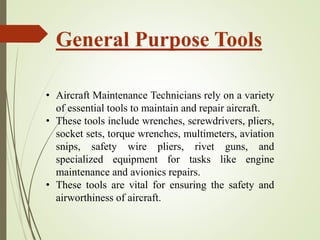
General Purpose Tools
• Aircraft Maintenance Technicians rely on a variety
of essential tools to maintain and repair aircraft.
• These tools include wrenches, screwdrivers, pliers,
socket sets, torque wrenches, multimeters, aviation
snips, safety wire pliers, rivet guns, and
specialized equipment for tasks like engine
maintenance and avionics repairs.
• These tools are vital for ensuring the safety and
airworthiness of aircraft.
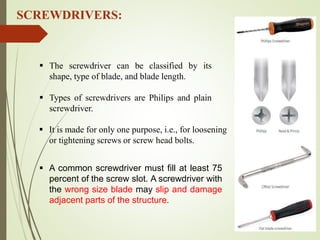
SCREWDRIVERS:
 A common screwdriver must fill at least 75
percent of the screw slot. A screwdriver with
the wrong size blade may slip and damage
adjacent parts of the structure.
 The screwdriver can be classified by its
shape, type of blade, and blade length.
 Types of screwdrivers are Philips and plain
screwdriver.
 It is made for only one purpose, i.e., for loosening
or tightening screws or screw head bolts.
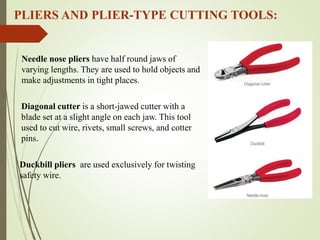
PLIERS AND PLIER-TYPE CUTTING TOOLS:
Needle nose pliers have half round jaws of
varying lengths. They are used to hold objects and
make adjustments in tight places.
Duckbill pliers are used exclusively for twisting
safety wire.
Diagonal cutter is a short-jawed cutter with a
blade set at a slight angle on each jaw. This tool
used to cut wire, rivets, small screws, and cotter
pins.
Round nose
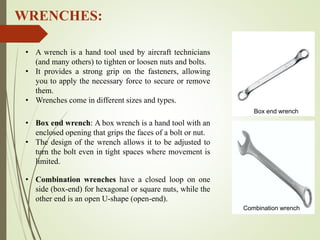
WRENCHES:
• Box end wrench: A box wrench is a hand tool with an
enclosed opening that grips the faces of a bolt or nut.
• The design of the wrench allows it to be adjusted to
turn the bolt even in tight spaces where movement is
limited.
• Combination wrenches have a closed loop on one
side (box-end) for hexagonal or square nuts, while the
other end is an open U-shape (open-end).
• A wrench is a hand tool used by aircraft technicians
(and many others) to tighten or loosen nuts and bolts.
• It provides a strong grip on the fasteners, allowing
you to apply the necessary force to secure or remove
them.
• Wrenches come in different sizes and types.
Combination wrench
Box end wrench
A socket wrench is made of two parts:
(1) the socket, which is placed over the top of a nut or bolt head, and
(2) a handle, which is attached to the socket to make it possible to use socket wrenches
in any location or position.
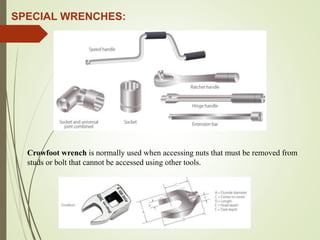
SOCKET WRENCH:
Speed Handle: Ease of rotation of a socket being used to loosen or tighten bolts and
nuts.
Ratchet: Mechanical device that allows continuous linear or rotary motion in only
one direction while preventing motion in the opposite direction.
SPECIAL WRENCHES:
Crowfoot wrench is normally used when accessing nuts that must be removed from
studs or bolt that cannot be accessed using other tools.
TORQUE WRENCH:
• The torque wrench is a precision tool consisting of a torque indicating handle and
appropriate adapter or attachments.
• A torque wrench is a tool used to tighten nuts and bolts to a predetermined torque value.
• This instrument allows fasteners to be tightened to the proper tension, helping avoid
damage from over tightening.
• Torque is measured in either lb·ft (pound-foot), lb·in (pound inch), or N·m (newton
meter)
Micrometer ”click type”
Torque wrench
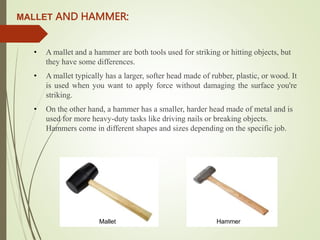
MALLET AND HAMMER:
• A mallet and a hammer are both tools used for striking or hitting objects, but
they have some differences.
• A mallet typically has a larger, softer head made of rubber, plastic, or wood. It
is used when you want to apply force without damaging the surface you're
striking.
• On the other hand, a hammer has a smaller, harder head made of metal and is
used for more heavy-duty tasks like driving nails or breaking objects.
Hammers come in different shapes and sizes depending on the specific job.
Mallet Hammer
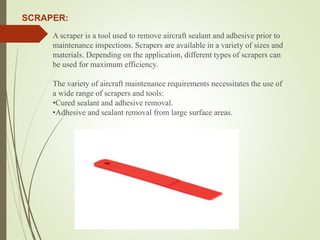
SCRAPER:
A scraper is a tool used to remove aircraft sealant and adhesive prior to
maintenance inspections. Scrapers are available in a variety of sizes and
materials. Depending on the application, different types of scrapers can
be used for maximum efficiency.
The variety of aircraft maintenance requirements necessitates the use of
a wide range of scrapers and tools:
•Cured sealant and adhesive removal.
•Adhesive and sealant removal from large surface areas.
CONCLUSION
In conclusion, the comprehensive overview of common tools for
aircraft maintenance technicians underscores the critical importance
of having the right equipment at their disposal.
These tools not only facilitate routine inspections and repairs but also
contribute significantly to ensuring the safety and airworthiness of
aircraft. By familiarizing themselves with these tools and honing their
skills in their usage, technicians can enhance operational efficiency,
minimize downtime, and uphold the highest standards of maintenance
excellence.
As aviation technology advances, it is essential for technicians to
remain adaptable and stay abreast of emerging tools and techniques.
Through continued training and professional development, they can
effectively navigate the complexities of aircraft maintenance,
ultimately safeguarding the integrity of the aviation industry and the
passengers it serves.
THANK YOU

aircraft Maintenace technician hand tools .pptx

  • 1.
    NAME: MONICA MARTINFERNANDES USN: 10SU20AM013
  • 2.
    TABLE OF CONTENT SCREWDRIVERS PLIERSAND PLIER-TYPE CUTTING TOOLS General Purpose Tools WRENCHES MALLET AND HAMMER SCRAPER
  • 3.
    General Purpose Tools •Aircraft Maintenance Technicians rely on a variety of essential tools to maintain and repair aircraft. • These tools include wrenches, screwdrivers, pliers, socket sets, torque wrenches, multimeters, aviation snips, safety wire pliers, rivet guns, and specialized equipment for tasks like engine maintenance and avionics repairs. • These tools are vital for ensuring the safety and airworthiness of aircraft.
  • 4.
    SCREWDRIVERS:  A commonscrewdriver must fill at least 75 percent of the screw slot. A screwdriver with the wrong size blade may slip and damage adjacent parts of the structure.  The screwdriver can be classified by its shape, type of blade, and blade length.  Types of screwdrivers are Philips and plain screwdriver.  It is made for only one purpose, i.e., for loosening or tightening screws or screw head bolts.
  • 5.
    PLIERS AND PLIER-TYPECUTTING TOOLS: Needle nose pliers have half round jaws of varying lengths. They are used to hold objects and make adjustments in tight places. Duckbill pliers are used exclusively for twisting safety wire. Diagonal cutter is a short-jawed cutter with a blade set at a slight angle on each jaw. This tool used to cut wire, rivets, small screws, and cotter pins. Round nose
  • 6.
    WRENCHES: • Box endwrench: A box wrench is a hand tool with an enclosed opening that grips the faces of a bolt or nut. • The design of the wrench allows it to be adjusted to turn the bolt even in tight spaces where movement is limited. • Combination wrenches have a closed loop on one side (box-end) for hexagonal or square nuts, while the other end is an open U-shape (open-end). • A wrench is a hand tool used by aircraft technicians (and many others) to tighten or loosen nuts and bolts. • It provides a strong grip on the fasteners, allowing you to apply the necessary force to secure or remove them. • Wrenches come in different sizes and types. Combination wrench Box end wrench
  • 7.
    A socket wrenchis made of two parts: (1) the socket, which is placed over the top of a nut or bolt head, and (2) a handle, which is attached to the socket to make it possible to use socket wrenches in any location or position. SOCKET WRENCH: Speed Handle: Ease of rotation of a socket being used to loosen or tighten bolts and nuts. Ratchet: Mechanical device that allows continuous linear or rotary motion in only one direction while preventing motion in the opposite direction.
  • 8.
    SPECIAL WRENCHES: Crowfoot wrenchis normally used when accessing nuts that must be removed from studs or bolt that cannot be accessed using other tools.
  • 9.
    TORQUE WRENCH: • Thetorque wrench is a precision tool consisting of a torque indicating handle and appropriate adapter or attachments. • A torque wrench is a tool used to tighten nuts and bolts to a predetermined torque value. • This instrument allows fasteners to be tightened to the proper tension, helping avoid damage from over tightening. • Torque is measured in either lb·ft (pound-foot), lb·in (pound inch), or N·m (newton meter) Micrometer ”click type” Torque wrench
  • 10.
    MALLET AND HAMMER: •A mallet and a hammer are both tools used for striking or hitting objects, but they have some differences. • A mallet typically has a larger, softer head made of rubber, plastic, or wood. It is used when you want to apply force without damaging the surface you're striking. • On the other hand, a hammer has a smaller, harder head made of metal and is used for more heavy-duty tasks like driving nails or breaking objects. Hammers come in different shapes and sizes depending on the specific job. Mallet Hammer
  • 11.
    SCRAPER: A scraper isa tool used to remove aircraft sealant and adhesive prior to maintenance inspections. Scrapers are available in a variety of sizes and materials. Depending on the application, different types of scrapers can be used for maximum efficiency. The variety of aircraft maintenance requirements necessitates the use of a wide range of scrapers and tools: •Cured sealant and adhesive removal. •Adhesive and sealant removal from large surface areas.
  • 12.
    CONCLUSION In conclusion, thecomprehensive overview of common tools for aircraft maintenance technicians underscores the critical importance of having the right equipment at their disposal. These tools not only facilitate routine inspections and repairs but also contribute significantly to ensuring the safety and airworthiness of aircraft. By familiarizing themselves with these tools and honing their skills in their usage, technicians can enhance operational efficiency, minimize downtime, and uphold the highest standards of maintenance excellence. As aviation technology advances, it is essential for technicians to remain adaptable and stay abreast of emerging tools and techniques. Through continued training and professional development, they can effectively navigate the complexities of aircraft maintenance, ultimately safeguarding the integrity of the aviation industry and the passengers it serves.
  • 13.

Editor's Notes

  • #7 The wrenches most often used in aircraft maintenance are classified as open-end, box-end, socket, adjustable, ratcheting and special wrenches.