AVIATION
ACCIDENTS
AND
INCIDENTS
ROSS APTED
KEGWORTH AIR DISASTER
Scene of the disaster – wreckage on M1 motorway near Kegworth
WHAT HAPPENED
On 8th January 1989 British midland flight 92 crashed while
undertaking an emergency landing.
Crashed site : M1 embankment near the village of Kegworth.
The Boeing 737 -400 aircraft was severely damaged 79 of the
of the 126 people aboard the plane survived.


An investigation was carried out by the Air Accidents
Investigation Branch (AAIB).
(Air Accidents Investigation Branch, 1989)
AAIB INVESTIGATION
Events of the crash
1. During the ascent of the aircraft to its cruising altitude of
   35,000 feet metal fatigue occurred on the fan blades in
   the left engine.


           Due to the engine
  design not being able to
  withstand vibrations caused
  by operation above 25, 000
  feet and a high power
  setting.


                                       Boeing 737–400 Engine
AAIB INVESTIGATION
2. Fan blade broke off causing decrease in power and
   increase in vibrations. This caused the left engine to
   produced a jet of flames.


3. Smoke flooded into the cabin. Captain shut down the
   engine on the right.


4. Smell of smoke and vibrations reduced.


5. Crew diverted to Midlands Airport. Left engine completely
   failed during the descent of the emergency landing
AAIB INVESTIGATION
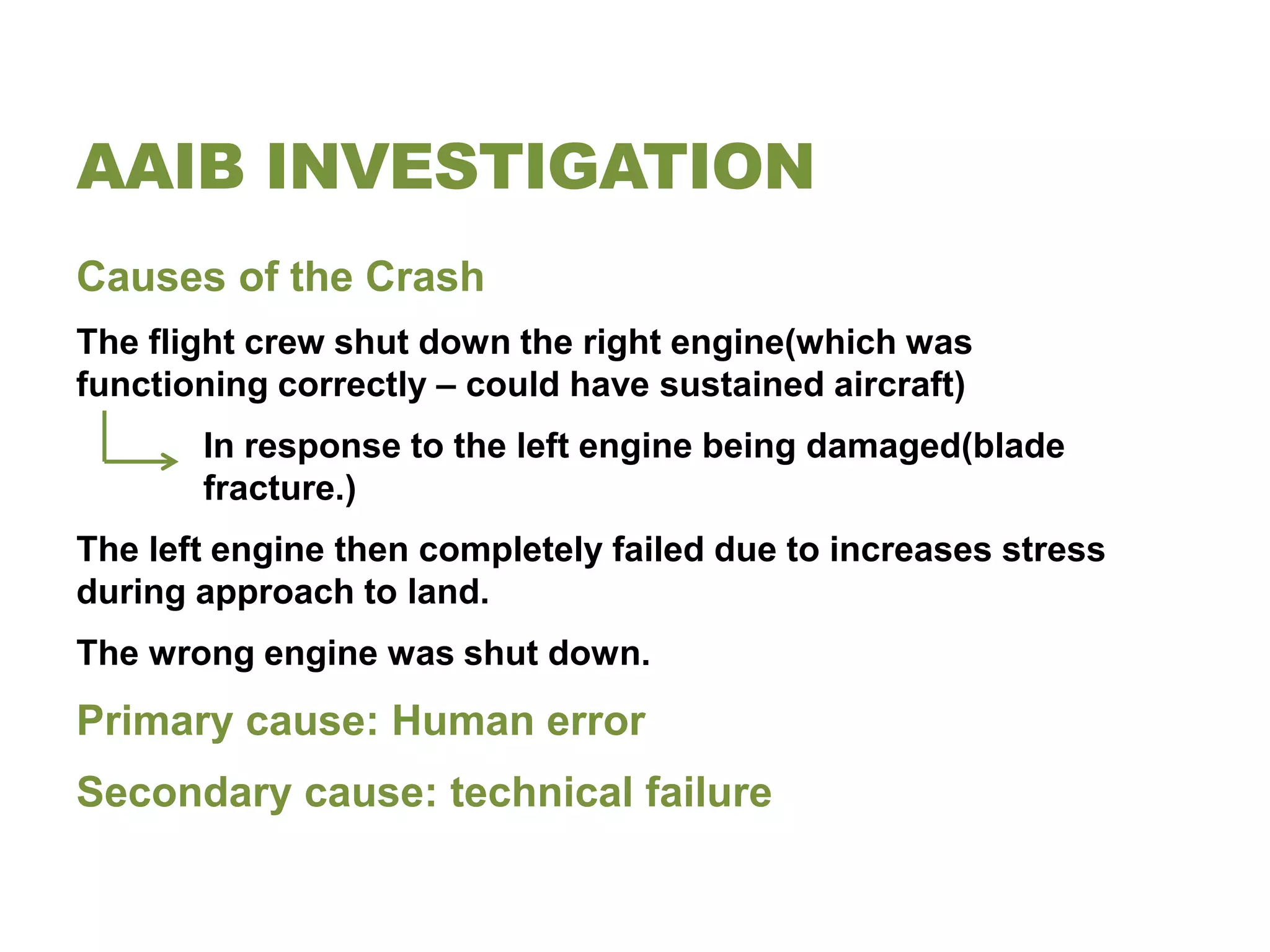
Causes of the Crash
The flight crew shut down the right engine(which was
functioning correctly – could have sustained aircraft)
       In response to the left engine being damaged(blade
       fracture.)
The left engine then completely failed due to increases stress
during approach to land.
The wrong engine was shut down.
Primary cause: Human error
Secondary cause: technical failure
CONTRIBUTING
FACTORS
Inadequate knowledge of the aircraft
Flight crew observed smoke in the cabin.
Believed they could not trust the Vibration sensors. Was true
of the old Boeing 737 but not the new 737-400.


   Indicates the state of the engines.
Fell back on general knowledge of aircraft which was wrong.
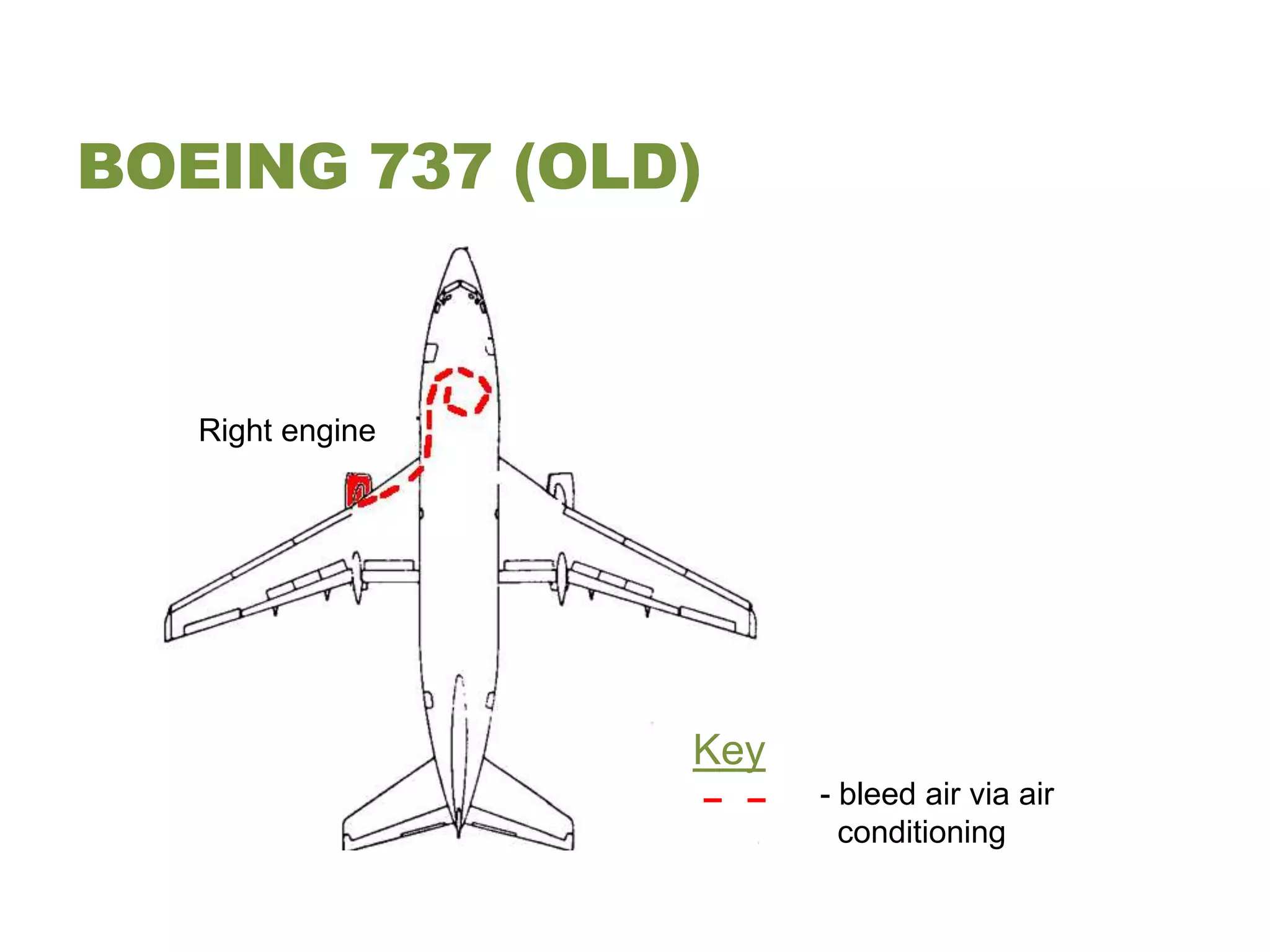
Thought that bleed air(pressure and heating) was taken from
the right engine.
In fact the air conditioning systems utilized both engines in
the new model.
BOEING 737 (OLD)


   Right engine


                  Key
                        - bleed air via air
                          conditioning
BOEING 737-400
(NEW)


 Right engine   Left engine


                          Key
                                - bleed air via air
                                  conditioning
CONTRIBUTING
FACTORS
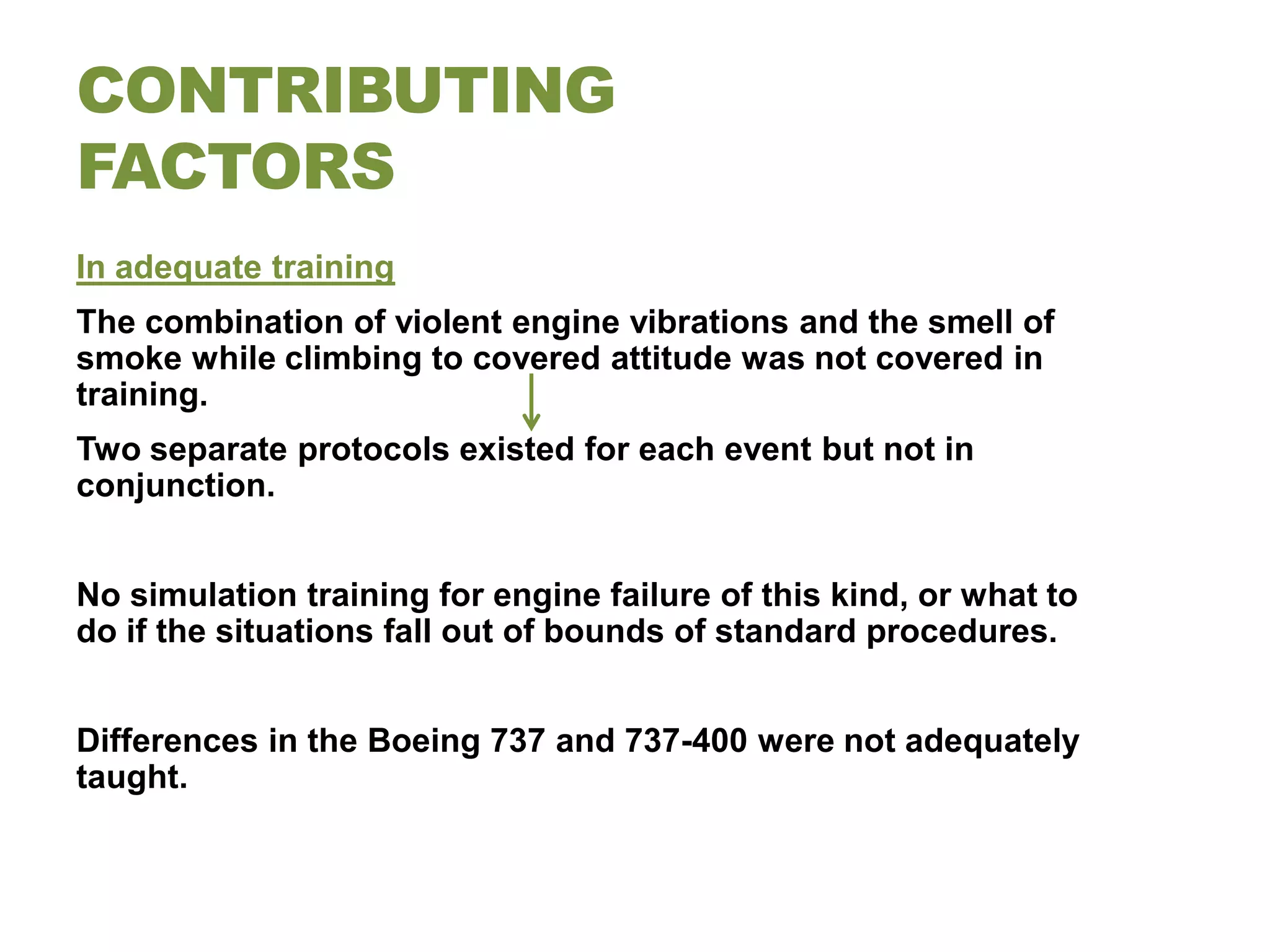
In adequate training
The combination of violent engine vibrations and the smell of
smoke while climbing to covered attitude was not covered in
training.
Two separate protocols existed for each event but not in
conjunction.


No simulation training for engine failure of this kind, or what to
do if the situations fall out of bounds of standard procedures.


Differences in the Boeing 737 and 737-400 were not adequately
taught.
WHY THE MISTAKE
WAS NOT FOUND
By chance the the smoke dissipated and the vibrations
reduced – this was actually due to standard procedure
reducing fuel flow to both the engines.


Pilots did not communicate with the cabin crew who had
visual confirmation of which engine was damaged.


Immediate division to Midlands airport create a high cabin
workload this resulted in incorrect review procedure after the
right engine was shut down.
Insufficient
                     knowledge
                      of aircraft


          Right          In
Crash
        engine was   adequate
        shut down     training


                                    Improper
                     Left engine     design
                        failed       testing
ACADEMIC
LITERATURE
On a Wing and a Prayer? Exploring the Human Components of
Technological Failure
(Smith, 2000)


Key points
Exploring the role of human error in complex technical systems.
Case study Kegworth
Thesis – Import to not only focus on individual but social and
managerial framework in which the exist.
Conclusion – With fly – by –wire system on the rise it is ever
more import to look at the organization as a
whole and not just focus on individual aspects.
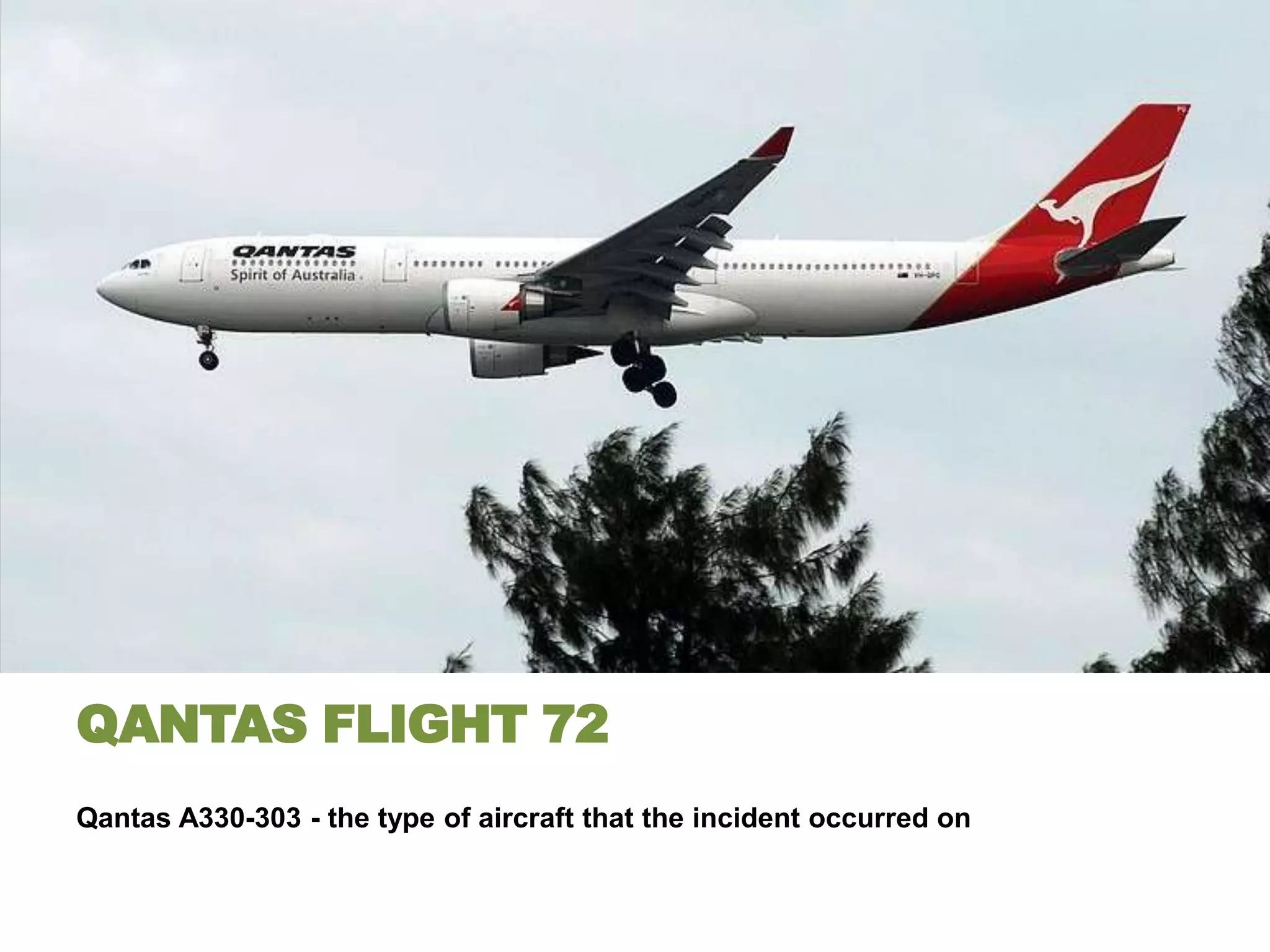
QANTAS FLIGHT 72
Qantas A330-303 - the type of aircraft that the incident occurred on
WHAT HAPPENED
On the 7th October 2008 Qantas Flight 72 made an
emergency landing due to in flight accident.
 A series of in uncommand pitch down maneuvers were
initiated resulting in crew and passenger injury.


An investigation was carried out by The Australian Transport
Safety Bureau (ATSB).
(Australian Transport Safety Bureau )
ATSB INVESTIGATION
Events of the accident
1. At cruising altitude one of the Air Data Inertial Reference
   Unit stated to providing incorrect values know as spikes
   to flight systems.


       Air Data Inertial Reference Unit(ADIRU) –provides air
data   such as air speed, altitude and angle of attack the
       pilots flight instruments.


2. The autopilot disconnect an warning were triggered.
3. Aircraft rapidly pitched down unprompted. Due to the
   flight control primary computer the angle of attack spike.
ATSB INVESTIGATION
4. Sudden forces cause severe injuries to the aircrafts
   occupants.
5. A second pitch down occurred moments later.
6. Pilots switch to manual operation a sent a Mayday
   distress.
7. Flight was diverted to Learmonth, Western Australia
ATSB INVESTIGATION
Cause of the accident
flight control primary computer
Is a “full-authority” flight control system. Get its flight data
from the ADIRU’s. 3 ADIRU for error resistance and
redundancy.
If all 3 ADIRU are consistent the and average of ADIRU1 and
ADIRU2 is used.
If ADIRU1 or ADIRU2 are not consistent then a memorized
value is used for 1.2s.
Fault occurred when there was multiple spikes 1.2s apart.
ATSB INVESTIGATION
ADIRU data-spike
ADIRU entered a failure mode in which it was sending invalid
data to flight system but marking it as being valid.


No warning that the unit had failed was trigged.


Hardware bug – the CPU module of the unit would inexpiably
combined the parameter for value with the label for another
parameter.
AIRBUS VS BOEING
Airbus philosophy - safety will be reduced by removing
human error
= giving the computer more control.


Boeing philosophy - safety will be reduced by removing the
complexities between the interactions of humans and
technology.
= give pilot unlimited control but make it easier to interact
with the computer.
AAIB BULLETIN- INCIDENT
Boeing 747- the type of aircraft that the incident occurred on
SERIOUS INCIDENT
Serious incident involving a Boeing 757-21B found in the
June 2012 bulletin.
(Air Accidents Investigation Branch, 2012)


AAIB Bulletin – A monthly notice of accidents and serous
                                    incident.


What happened:
The Aircraft lost power to its left AC electrical bus, causing
the failure many flight instruments.
BACKGROUND
1.    Mid-flight the “L AC BUS OFF” and “L GEN OFF” warning
      lights triggered indicating a power failure.
2.    Multiple flight instruments failed.
3.    Commander carried out the drill for power loss in the left
      generator.
4.    Bus reset and power temporally restored
5.    Power went off again this time accompanied with thin
      smoke on flight deck.
6.    MAYDAY was sent and aircraft was diverted to nearest
      airport.


     Only effect on passengers was that they had to
                    catch a new flight.
AAIB INVESTIGATION
Found that be a corroded crimp
terminal at the D1114J connector
which is part of the left power
generation system.


Procedure
Split into previous and post incident
maintenance actions
Still focuses on crew actions             Broken D1114j connector


Standardized format for bulletins – focus on primary sources of
information little root cause analysis.
REFERENCES
Air Accidents Investigation Branch. (2012). June 2012
Bulletin. Aldershot: Air Accidents Investigation Branch.
Air Accidents Investigation Branch. (1989). Report on the
Accident to Boeing 737-400 G-OBME near Kegworth,
Leicesterhire on 8 Janury 1989. Aldershot: Air Accidents
Investigation Branch.
Australian Transport Safety Bureau. (2008). In-flight upset
154 km west of Learmonth, WA 7 October 2008 VH-QPA
Airbus A330-303. Canberra: Australian Transport Safety
Bureau.
Smith, D. (2000). On a wing and a prayer? Exploring the
human components of technological failure. Syst. Res. , 543–
559.

Aviation accidents and incidents

  • 1.
  • 2.
    KEGWORTH AIR DISASTER Sceneof the disaster – wreckage on M1 motorway near Kegworth
  • 3.
    WHAT HAPPENED On 8thJanuary 1989 British midland flight 92 crashed while undertaking an emergency landing. Crashed site : M1 embankment near the village of Kegworth. The Boeing 737 -400 aircraft was severely damaged 79 of the of the 126 people aboard the plane survived. An investigation was carried out by the Air Accidents Investigation Branch (AAIB). (Air Accidents Investigation Branch, 1989)
  • 4.
    AAIB INVESTIGATION Events ofthe crash 1. During the ascent of the aircraft to its cruising altitude of 35,000 feet metal fatigue occurred on the fan blades in the left engine. Due to the engine design not being able to withstand vibrations caused by operation above 25, 000 feet and a high power setting. Boeing 737–400 Engine
  • 5.
    AAIB INVESTIGATION 2. Fanblade broke off causing decrease in power and increase in vibrations. This caused the left engine to produced a jet of flames. 3. Smoke flooded into the cabin. Captain shut down the engine on the right. 4. Smell of smoke and vibrations reduced. 5. Crew diverted to Midlands Airport. Left engine completely failed during the descent of the emergency landing
  • 6.
    AAIB INVESTIGATION Causes ofthe Crash The flight crew shut down the right engine(which was functioning correctly – could have sustained aircraft) In response to the left engine being damaged(blade fracture.) The left engine then completely failed due to increases stress during approach to land. The wrong engine was shut down. Primary cause: Human error Secondary cause: technical failure
  • 7.
    CONTRIBUTING FACTORS Inadequate knowledge ofthe aircraft Flight crew observed smoke in the cabin. Believed they could not trust the Vibration sensors. Was true of the old Boeing 737 but not the new 737-400. Indicates the state of the engines. Fell back on general knowledge of aircraft which was wrong. Thought that bleed air(pressure and heating) was taken from the right engine. In fact the air conditioning systems utilized both engines in the new model.
  • 8.
    BOEING 737 (OLD) Right engine Key - bleed air via air conditioning
  • 9.
    BOEING 737-400 (NEW) Rightengine Left engine Key - bleed air via air conditioning
  • 10.
    CONTRIBUTING FACTORS In adequate training Thecombination of violent engine vibrations and the smell of smoke while climbing to covered attitude was not covered in training. Two separate protocols existed for each event but not in conjunction. No simulation training for engine failure of this kind, or what to do if the situations fall out of bounds of standard procedures. Differences in the Boeing 737 and 737-400 were not adequately taught.
  • 11.
    WHY THE MISTAKE WASNOT FOUND By chance the the smoke dissipated and the vibrations reduced – this was actually due to standard procedure reducing fuel flow to both the engines. Pilots did not communicate with the cabin crew who had visual confirmation of which engine was damaged. Immediate division to Midlands airport create a high cabin workload this resulted in incorrect review procedure after the right engine was shut down.
  • 12.
    Insufficient knowledge of aircraft Right In Crash engine was adequate shut down training Improper Left engine design failed testing
  • 13.
    ACADEMIC LITERATURE On a Wingand a Prayer? Exploring the Human Components of Technological Failure (Smith, 2000) Key points Exploring the role of human error in complex technical systems. Case study Kegworth Thesis – Import to not only focus on individual but social and managerial framework in which the exist. Conclusion – With fly – by –wire system on the rise it is ever more import to look at the organization as a whole and not just focus on individual aspects.
  • 14.
    QANTAS FLIGHT 72 QantasA330-303 - the type of aircraft that the incident occurred on
  • 15.
    WHAT HAPPENED On the7th October 2008 Qantas Flight 72 made an emergency landing due to in flight accident. A series of in uncommand pitch down maneuvers were initiated resulting in crew and passenger injury. An investigation was carried out by The Australian Transport Safety Bureau (ATSB). (Australian Transport Safety Bureau )
  • 16.
    ATSB INVESTIGATION Events ofthe accident 1. At cruising altitude one of the Air Data Inertial Reference Unit stated to providing incorrect values know as spikes to flight systems. Air Data Inertial Reference Unit(ADIRU) –provides air data such as air speed, altitude and angle of attack the pilots flight instruments. 2. The autopilot disconnect an warning were triggered. 3. Aircraft rapidly pitched down unprompted. Due to the flight control primary computer the angle of attack spike.
  • 17.
    ATSB INVESTIGATION 4. Suddenforces cause severe injuries to the aircrafts occupants. 5. A second pitch down occurred moments later. 6. Pilots switch to manual operation a sent a Mayday distress. 7. Flight was diverted to Learmonth, Western Australia
  • 18.
    ATSB INVESTIGATION Cause ofthe accident flight control primary computer Is a “full-authority” flight control system. Get its flight data from the ADIRU’s. 3 ADIRU for error resistance and redundancy. If all 3 ADIRU are consistent the and average of ADIRU1 and ADIRU2 is used. If ADIRU1 or ADIRU2 are not consistent then a memorized value is used for 1.2s. Fault occurred when there was multiple spikes 1.2s apart.
  • 19.
    ATSB INVESTIGATION ADIRU data-spike ADIRUentered a failure mode in which it was sending invalid data to flight system but marking it as being valid. No warning that the unit had failed was trigged. Hardware bug – the CPU module of the unit would inexpiably combined the parameter for value with the label for another parameter.
  • 20.
    AIRBUS VS BOEING Airbusphilosophy - safety will be reduced by removing human error = giving the computer more control. Boeing philosophy - safety will be reduced by removing the complexities between the interactions of humans and technology. = give pilot unlimited control but make it easier to interact with the computer.
  • 21.
    AAIB BULLETIN- INCIDENT Boeing747- the type of aircraft that the incident occurred on
  • 22.
    SERIOUS INCIDENT Serious incidentinvolving a Boeing 757-21B found in the June 2012 bulletin. (Air Accidents Investigation Branch, 2012) AAIB Bulletin – A monthly notice of accidents and serous incident. What happened: The Aircraft lost power to its left AC electrical bus, causing the failure many flight instruments.
  • 23.
    BACKGROUND 1. Mid-flight the “L AC BUS OFF” and “L GEN OFF” warning lights triggered indicating a power failure. 2. Multiple flight instruments failed. 3. Commander carried out the drill for power loss in the left generator. 4. Bus reset and power temporally restored 5. Power went off again this time accompanied with thin smoke on flight deck. 6. MAYDAY was sent and aircraft was diverted to nearest airport. Only effect on passengers was that they had to catch a new flight.
  • 24.
    AAIB INVESTIGATION Found thatbe a corroded crimp terminal at the D1114J connector which is part of the left power generation system. Procedure Split into previous and post incident maintenance actions Still focuses on crew actions Broken D1114j connector Standardized format for bulletins – focus on primary sources of information little root cause analysis.
  • 25.
    REFERENCES Air Accidents InvestigationBranch. (2012). June 2012 Bulletin. Aldershot: Air Accidents Investigation Branch. Air Accidents Investigation Branch. (1989). Report on the Accident to Boeing 737-400 G-OBME near Kegworth, Leicesterhire on 8 Janury 1989. Aldershot: Air Accidents Investigation Branch. Australian Transport Safety Bureau. (2008). In-flight upset 154 km west of Learmonth, WA 7 October 2008 VH-QPA Airbus A330-303. Canberra: Australian Transport Safety Bureau. Smith, D. (2000). On a wing and a prayer? Exploring the human components of technological failure. Syst. Res. , 543– 559.