
SAM HIGGINBOTTOM UNIVERSITY
OF AGRICULTURE TECHNOLOGY
AND SCIENCES
ASSIGNMENT
ENVIRONMENTAL STUDIES
(ENVS 416)
TOPIC :- AIR POLLUTION
GROUP MEMBERS:-
 VIBHAW SHRIVASTAVA (16BSMBH018)
 MOUMITA GUHA (16BSMBH030)
 UTKARSH UPADHYAY (16BSMBH016)
 RUDRAKSHI MULLICK (16BSMBH014)
OVERVIEW
Atmosphere as a Resource
Types and Sources of Air Pollution
 Major Classes of Air Pollutants
 Sources of Outdoor Air Pollutants
 Urban Air Pollution
Effects of Air Pollution
Controlling Air Pollution
ATMOSPHERE AS A RESOURCE
Atmospheric Composition
 Nitrogen 78.08%
 Oxygen 20.95%
 Argon 0.93%
 Carbon dioxide 0.04%
Ecosystem services
 Blocks UV radiation
 Moderates the climate
 Redistributes water in the hydrological
cycle
TYPES AND SOURCES OF AIR POLLUTION
Air Pollution
 Chemicals added to the atmosphere by natural events or human
activities in high enough concentrations.
Two categories
 Primary Air Pollutant
 Harmful substance that is emitted directly into the atmosphere.
 Secondary Air Pollutant
 Harmful substance formed in the atmosphere when a primary air
pollutant reacts with substances normally found in the atmosphere or
with other air pollutants.
MAJOR AIR POLLUTANTS
MAJOR CLASSES OF AIR POLLUTANTS
Particulate Material
Nitrogen Oxides
Sulfur Oxides
Carbon Oxides
Hydrocarbons
Ozone
PARTICULATE MATERIAL
Thousands of different solid or liquid particles
suspended in air.
Includes: soil particles, soot, lead, asbestos, sea salt, and
sulfuric acid droplets.
Dangerous for 2 reasons -
May contain materials with toxic or carcinogenic effects.
Extremely small particles can become lodged in lungs.
NITROGEN AND SULFUR OXIDES
Nitrogen Oxides
 Gases produced by the chemical interactions between atmospheric
nitrogen and oxygen at high temperature.
 Problems
 Greenhouse gases
 Cause difficulty breathing
Sulfur Oxides
 Gases produced by the chemical interactions between sulfur and oxygen
 Causes acid precipitation.
CARBON OXIDES AND HYDROCARBONS
Carbon Oxides
 Gases carbon monoxide (CO) and carbon dioxide (CO2)
 Greenhouse gases
Hydrocarbons
 Diverse group of organic compounds that contain only hydrogen and
carbon (ex: CH4- methane)
 Some are related to photochemical smog and greenhouse gases
OZONE
Tropospheric Ozone
 Man- made pollutant in the lower atmosphere
 Secondary air pollutant
 Component of photochemical smog
Stratospheric Ozone
 Essential component that screens out UV radiation in the upper atmosphere
 Man- made pollutants (ex: CFCs) can destroy it
SOURCES OF OUTDOOR AIR POLLUTION
Two main sources
 Transportation
 Industry
Intentional forest fires is
also high
URBAN AIR POLLUTION
Photochemical Smog (ex: New Delhi below)
 Brownish-orange haze formed by chemical reactions involving
sunlight, nitrogen oxide, and hydrocarbons.
FORMATION OF PHOTOCHEMICAL SMOG
EFFECTS OF AIR POLLUTION
Low level exposure
Irritates eyes
Causes inflammation of respiratory tract
Can develop into chronic respiratory diseases
HEALTH EFFECTS OF AIR POLLUTION
Sulfur Dioxide and Particulate material
 Irritate respiratory tract and impair ability of lungs to exchange gases
Nitrogen Dioxides
 Causes airway restriction
Carbon monoxide
 Binds with iron in blood hemoglobin
 Causes headache, fatigue, drowsiness, death
Ozone
 Causes burning eyes, coughing, and chest discomfort
CHILDREN AND AIR POLLUTION
Greater health threat to children than adults
 Air pollution can restrict lung development
 Children breath more often than adults
Children who live in high ozone areas are more likely to
develop asthma.
CONTROLLING AIR
POLLUTION
Smokestacks with electrostatic
precipitator
WithoutWithout
ElectrostaticElectrostatic
precipitatorprecipitator
With ElectrostaticWith Electrostatic
precipitatorprecipitator
OTHER WAYS TO IMPROVE AIR QUALITY
Reduce sulfur content in gasoline from its current average of 330 ppm
30ppm
 Sulfur clogs catalytic converters
Require federal emission standards for all passenger vehicles
 Including SUVs, trucks and mini vans
Require emission testing for all vehicles
 Including diesel
OZONE DEPLETION IN STRATOSPHERE
Ozone Protects earth from UV radiation
 Part of the electromagnetic spectrum with wavelengths just shorter than
visible light
OZONE DEPLETION IN STRATOSPHERE
Ozone thinning/hole
 First identified in 1985 over Antarctica
Caused by
 human-produced bromine and chlorine
containing chemicals
 Ex: CFCs
OZONE DEPLETION IN STRATOSPHERE
Hole over Antarctica requires two conditions:
 Sunlight just returning to polar region
 Circumpolar vortex- a mass of cold air that circulates around the
southern polar region
 Isolates it from the warmer air in the rest of the planet
Polar stratospheric clouds form
 Enables Cl and Br to destroy ozone
EFFECTS OF OZONE DEPLETION
Higher levels of UV-radiation
hitting the earth
 Eye cataracts
 Skin cancer (right)
 Weakened immunity
May disrupt ecosystems
May damage crops and forests
RECOVERY OF OZONE LAYER
Montreal Protocol (1987)
 Reduction of CFCs
 Started using HCFCs (greenhouse gas)
Phase out of all ozone destroying chemicals is underway
globally
Satellite pictures in 2000 indicated that ozone layer was
recovering
Full recovery will not occur until 2050
ACID DEPOSITION
Sulfur dioxide and nitrogen dioxide emissions react with water vapor in the
atmosphere and form acids that return to the surface as either dry or wet
deposition.
pH scale:-
HOW ACID DEPOSITION DEVELOPS
EFFECTS OF ACID DEPOSITION
Declining Aquatic Animal Populations
Thin-shelled eggs prevent bird
reproduction
 Because calcium is unavailable in acidic soil
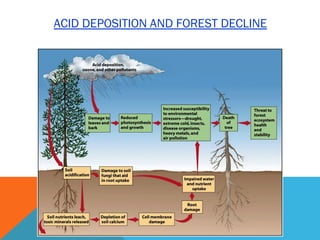
Forest decline
 Ex: Black forest in Germany (50% is
destroyed)
ACID DEPOSITION AND FOREST DECLINE
AIR POLLUTION AROUND THE WORLD
Air quality is deteriorating
rapidly in developing
countries
Shenyang, China
 Residents only see sunlight a few weeks
each year
Developing countries have older
cars
 Still use leaded gasoline
5 worst cities in world
 Beijing, China; Mexico City, Mexico;
Shanghai, China; Tehran, Iran; and Calcutta,
India
INDOOR AIR
POLLUTION
Pollutants can be
5-100X greater
than outdoors
Most common:-
 Radon, cigarette smoke,
carbon monoxide,
nitrogen dioxide,
formaldehyde pesticides,
lead, cleaning solvents,
ozone, and asbestos
INDOOR AIR POLLUTION - RADON
THANK YOU..

Air Pollution

  • 1.
    SAM HIGGINBOTTOM UNIVERSITY OFAGRICULTURE TECHNOLOGY AND SCIENCES
  • 2.
    ASSIGNMENT ENVIRONMENTAL STUDIES (ENVS 416) TOPIC:- AIR POLLUTION GROUP MEMBERS:-  VIBHAW SHRIVASTAVA (16BSMBH018)  MOUMITA GUHA (16BSMBH030)  UTKARSH UPADHYAY (16BSMBH016)  RUDRAKSHI MULLICK (16BSMBH014)
  • 3.
    OVERVIEW Atmosphere as aResource Types and Sources of Air Pollution  Major Classes of Air Pollutants  Sources of Outdoor Air Pollutants  Urban Air Pollution Effects of Air Pollution Controlling Air Pollution
  • 4.
    ATMOSPHERE AS ARESOURCE Atmospheric Composition  Nitrogen 78.08%  Oxygen 20.95%  Argon 0.93%  Carbon dioxide 0.04% Ecosystem services  Blocks UV radiation  Moderates the climate  Redistributes water in the hydrological cycle
  • 5.
    TYPES AND SOURCESOF AIR POLLUTION Air Pollution  Chemicals added to the atmosphere by natural events or human activities in high enough concentrations. Two categories  Primary Air Pollutant  Harmful substance that is emitted directly into the atmosphere.  Secondary Air Pollutant  Harmful substance formed in the atmosphere when a primary air pollutant reacts with substances normally found in the atmosphere or with other air pollutants.
  • 6.
  • 8.
    MAJOR CLASSES OFAIR POLLUTANTS Particulate Material Nitrogen Oxides Sulfur Oxides Carbon Oxides Hydrocarbons Ozone
  • 9.
    PARTICULATE MATERIAL Thousands ofdifferent solid or liquid particles suspended in air. Includes: soil particles, soot, lead, asbestos, sea salt, and sulfuric acid droplets. Dangerous for 2 reasons - May contain materials with toxic or carcinogenic effects. Extremely small particles can become lodged in lungs.
  • 10.
    NITROGEN AND SULFUROXIDES Nitrogen Oxides  Gases produced by the chemical interactions between atmospheric nitrogen and oxygen at high temperature.  Problems  Greenhouse gases  Cause difficulty breathing Sulfur Oxides  Gases produced by the chemical interactions between sulfur and oxygen  Causes acid precipitation.
  • 11.
    CARBON OXIDES ANDHYDROCARBONS Carbon Oxides  Gases carbon monoxide (CO) and carbon dioxide (CO2)  Greenhouse gases Hydrocarbons  Diverse group of organic compounds that contain only hydrogen and carbon (ex: CH4- methane)  Some are related to photochemical smog and greenhouse gases
  • 12.
    OZONE Tropospheric Ozone  Man-made pollutant in the lower atmosphere  Secondary air pollutant  Component of photochemical smog Stratospheric Ozone  Essential component that screens out UV radiation in the upper atmosphere  Man- made pollutants (ex: CFCs) can destroy it
  • 13.
    SOURCES OF OUTDOORAIR POLLUTION Two main sources  Transportation  Industry Intentional forest fires is also high
  • 14.
    URBAN AIR POLLUTION PhotochemicalSmog (ex: New Delhi below)  Brownish-orange haze formed by chemical reactions involving sunlight, nitrogen oxide, and hydrocarbons.
  • 15.
  • 16.
    EFFECTS OF AIRPOLLUTION Low level exposure Irritates eyes Causes inflammation of respiratory tract Can develop into chronic respiratory diseases
  • 17.
    HEALTH EFFECTS OFAIR POLLUTION Sulfur Dioxide and Particulate material  Irritate respiratory tract and impair ability of lungs to exchange gases Nitrogen Dioxides  Causes airway restriction Carbon monoxide  Binds with iron in blood hemoglobin  Causes headache, fatigue, drowsiness, death Ozone  Causes burning eyes, coughing, and chest discomfort
  • 18.
    CHILDREN AND AIRPOLLUTION Greater health threat to children than adults  Air pollution can restrict lung development  Children breath more often than adults Children who live in high ozone areas are more likely to develop asthma.
  • 19.
    CONTROLLING AIR POLLUTION Smokestacks withelectrostatic precipitator WithoutWithout ElectrostaticElectrostatic precipitatorprecipitator With ElectrostaticWith Electrostatic precipitatorprecipitator
  • 20.
    OTHER WAYS TOIMPROVE AIR QUALITY Reduce sulfur content in gasoline from its current average of 330 ppm 30ppm  Sulfur clogs catalytic converters Require federal emission standards for all passenger vehicles  Including SUVs, trucks and mini vans Require emission testing for all vehicles  Including diesel
  • 21.
    OZONE DEPLETION INSTRATOSPHERE Ozone Protects earth from UV radiation  Part of the electromagnetic spectrum with wavelengths just shorter than visible light
  • 22.
    OZONE DEPLETION INSTRATOSPHERE Ozone thinning/hole  First identified in 1985 over Antarctica Caused by  human-produced bromine and chlorine containing chemicals  Ex: CFCs
  • 23.
    OZONE DEPLETION INSTRATOSPHERE Hole over Antarctica requires two conditions:  Sunlight just returning to polar region  Circumpolar vortex- a mass of cold air that circulates around the southern polar region  Isolates it from the warmer air in the rest of the planet Polar stratospheric clouds form  Enables Cl and Br to destroy ozone
  • 24.
    EFFECTS OF OZONEDEPLETION Higher levels of UV-radiation hitting the earth  Eye cataracts  Skin cancer (right)  Weakened immunity May disrupt ecosystems May damage crops and forests
  • 25.
    RECOVERY OF OZONELAYER Montreal Protocol (1987)  Reduction of CFCs  Started using HCFCs (greenhouse gas) Phase out of all ozone destroying chemicals is underway globally Satellite pictures in 2000 indicated that ozone layer was recovering Full recovery will not occur until 2050
  • 26.
    ACID DEPOSITION Sulfur dioxideand nitrogen dioxide emissions react with water vapor in the atmosphere and form acids that return to the surface as either dry or wet deposition. pH scale:-
  • 27.
  • 28.
    EFFECTS OF ACIDDEPOSITION Declining Aquatic Animal Populations Thin-shelled eggs prevent bird reproduction  Because calcium is unavailable in acidic soil Forest decline  Ex: Black forest in Germany (50% is destroyed)
  • 29.
    ACID DEPOSITION ANDFOREST DECLINE
  • 30.
    AIR POLLUTION AROUNDTHE WORLD Air quality is deteriorating rapidly in developing countries Shenyang, China  Residents only see sunlight a few weeks each year Developing countries have older cars  Still use leaded gasoline 5 worst cities in world  Beijing, China; Mexico City, Mexico; Shanghai, China; Tehran, Iran; and Calcutta, India
  • 31.
    INDOOR AIR POLLUTION Pollutants canbe 5-100X greater than outdoors Most common:-  Radon, cigarette smoke, carbon monoxide, nitrogen dioxide, formaldehyde pesticides, lead, cleaning solvents, ozone, and asbestos
  • 32.
  • 33.