
ENVIRONMENTAL
CHEMISTRY.
AtmosphericPollution.
By AwaisBakshy
ABSTRACT
Airpollutionisone of the majorenvironmentalissues.It
can cause adverse healtheffectssuchascancer,
cardiovasculardiseasesandhighmortalityrates.High
populationdensityisahuge contributoryfactor
Of air pollution incitiesandurbanizedareas.
Course Content: Introduction to
Atmospheric Pollution,Components of Atmosphere,
Temperature and pressure profiles of different
components of atmosphere, Air pollutants and their
types, Effectsof air pollutants on atmosphere ( acid rain,
ozone depletion, greenhouse effect), Photochemical
Smog, Biogeochemical cycle,Importance of atmosphere.
Chapter No 2:
Atmospheric Pollution.
 Objectives.
1. Introduction to Atmospheric Pollution.
2. Components of Atmosphere.
3. Temperature and pressure profiles of different
components of atmosphere.
4. Air pollutants and their types.
5. Effects of air pollutants on atmosphere ( acid rain,
ozone depletion, green house effect )
6. Photochemical Smog.
7. Biogeochemical cycle.
8. Importance of atmosphere.
 Introduction To atmospheric Pollution.
The presence of substances in the atmosphere,
resulting from manmade activities and natural
processes causing adverse effects to man and
environment is known as atmospheric pollution. Air
Pollution is a term is used to define any unwanted
chemicals and other materials that contaminates the
air that we breath resulting in the degradation in
the air quality.
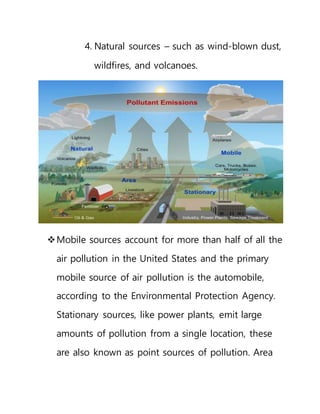
Types of Sources.
There Are Four Types of sources.
1. Mobile sources – such as cars, buses,
planes, trucks, and trains
2. Stationary sources – such as power plants,
oil refineries, industrial facilities, and
factories
3. Area sources – such as agricultural areas,
cities, and wood burning fireplaces
4. Natural sources – such as wind-blown dust,
wildfires, and volcanoes.
Mobile sources account for more than half of all the
air pollution in the United States and the primary
mobile source of air pollution is the automobile,
according to the Environmental Protection Agency.
Stationary sources, like power plants, emit large
amounts of pollution from a single location, these
are also known as point sources of pollution. Area
sources are made up of lots of smaller pollution
sources that aren't a big deal by themselves but
when considered as a group can be. Natural
sources can sometimes be significant but do not
usually create ongoing air pollution problems like
the other source types can.
Pollution from human-generated and natural
sources is often created in one place and
transported through the air. Sometimes chemical
reactions in the atmosphere change pollutants
before they are deposited. Pollutants in the air can
create haze, making it harder to see, and pollutant
deposition can have biological effects. NPS areas
experience these effects just like other places.
Location and even the time of year can determine
which pollution sources are most important to each
park. Parks downwind of power plants that lack
modern pollution controls can have increased
smog. Tailpipe emissions from cars and trucks, as
well as industrial processes such as oil and gas
development, give rise to elevated ozone
concentrations. Summertime wildfires can also
reduce visibility in NPS areas. There are even
examples of pollutants that originated from other
countries and were transported thousands of miles
arriving at parks. The effects of this pollution can be
seen as haze and through negative biological
effects.
 Components of Atmosphere.
Atmosphere.
The atmosphere of earth is the layer of
gases, commonly known as air, that
surrounds the planet earth and it is retained
by earth gravity.
Air.
The air is the earth’s atmosphere. It is the
clear gas in which human beings live and
take breath and it has indefinite shape and
volume. It has no color and smell. It has mass
and weight. It is a matter as it has mass and
weight and air creates atmospheric pressure.
Chemical Composition.
Nitrogen 78%
Oxygen 21%
Other gases 1%
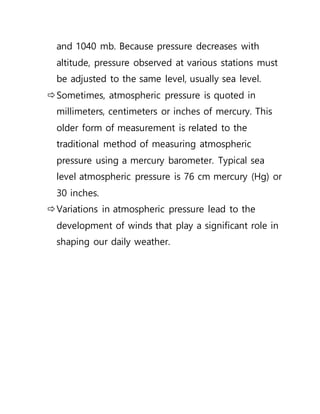
The atmosphere is divided in 5 layers.
Troposphere, Stratosphere, Mesosphere,
Thermosphere, Exosphere.
Troposphere.
The troposphere is the first layer above the surface
of earth and contains 75% of the atmosphere.
Weathers occur in this layer and its height is 6-10
km.
Tropopause.
The Tropopause is the layer between troposphere
and stratosphere. The troposphere is bounded
above by the Tropopause, a boundary marked by
stable temperature.
Stratosphere.
The layer of the earth’s atmosphere above the
troposphere and below the mesosphere, its height
is 10-50 km above the earth’s surface. Many jets air
craft’s fly in the stratosphere because it is very
stable.
Stratopause.
The Stratopause is the layer between stratosphere
and mesosphere.
Ozone Layer.
The ozone layer or ozone shield is a region of
earth’s stratosphere that absorbs sun’s UV radiation.
It contains high concentrations of ozone (O3) and it
is situated between troposphere and stratosphere.
The 90% of ozone layer is in stratosphere and its
height is 10-50 km. the ozone layer was discovered
by the French physicists Charles fabry and Henri
Buisson.
How oxygen formed and how the O3 Ozone
Formed.
The two processes are given below.
Photosynthesis.
Photo means light.
Synthesis means putting together.
One billion years ago, early aquatic organisms
called blue-green algae began using energy from
the Sun to split molecules of H2O and CO2 and
recombine them into organic compounds and
molecular oxygen (O2). This solar energy conversion
process is known as photosynthesis.
Photolysis.
Photo means light.
lysis means breaking or cutting
Ozone is created in the stratosphere when
highly energetic solar radiation strikes molecules
of oxygen (O2) and causes the two oxygen atoms
to split apart. If a freed atom bumps into another
O2, it joins up, forming ozone (O3). This process
known as photolysis
Mesosphere.
The region of the earth’s atmosphere above the
stratosphere and below the thermosphere and its
height is 50-80 km. Meteors or rock fragment burn
in the mesosphere.
Mesopause.
The Mesopause is the layer between mesosphere
and thermosphere.
Thermosphere.
The thermosphere is the layer in the Earth's
atmosphere directly above the mesosphere and
below the exosphere. Within this layer of the
atmosphere, ultraviolet
radiation causes photoionization of molecules,
creating ions in the ionosphere. Its height is 90 km
to about 500 km.
Ionosphere.
The ionosphere is located in the thermosphere. The
ionosphere is ionized by solar radiation. It plays an
important role in atmospheric electricity and forms
the inner edge of the magnetosphere. It has
practical importance because, among other
functions, it influences radio propagation to distant
places on the Earth.
Photoionization.
Photoionization is the physical process in which an
ion is formed from the interaction of a photon with
an atom or molecules.
Magnetosphere.
It is created by planets having active hot iron and
nickel or metallic cores, whose motion generated a
planetary magnetic field, but such fields can also
occur in stars by the interactions of plasma.
Exosphere.
The outermost region of a planet’s atmosphere.
And its height is 500-1000 km.
 Temperature and pressure profiles of different
components of atmosphere.
Temperature profile.
The hotness or coldness of a substance is called its
temperature. At the microscopic level, temperature
is a measurement of the kinetic energy, of a
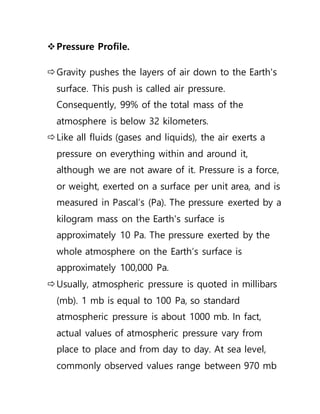
molecule. Air temperature changes with height.
Since the number of air molecules decreases with
height, it is sometimes assumed that temperature
also decreases with height. This, however, is not
always the case. Each layer in the atmosphere has
its own temperature profile. In
the troposphere and mesosphere, air temperature
usually decreases with increasing height, whilst in
the stratosphere, air temperature rises with
increasing altitude. In the outer atmosphere
or thermosphere, air temperature can rise to over
1000C. However because the air is so thin, Although
the measured temperature in the thermosphere is
very hot, the thermosphere would actually feel very
cold to us because the total energy of only a few
air molecules residing there would not be enough
to transfer any appreciable heat to our skin.
The temperature can be measured by the units of
temperature. There three units of temperature.
Celsius, Fahrenheit and Kelvin.
Celsius and Fahrenheit.
Degrees Fahrenheit, (developed in the early 1700's
by G. Daniel Fahrenheit), are used to record surface
temperature measurements by meteorologists in
the United States. However, since most of the rest
of the world uses degrees Celsius (developed in the
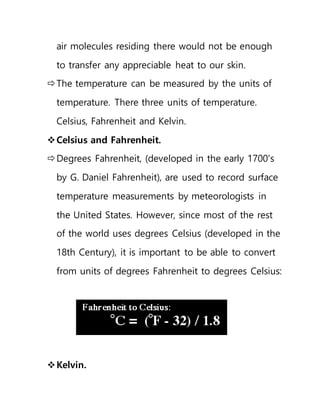
18th Century), it is important to be able to convert
from units of degrees Fahrenheit to degrees Celsius:
Kelvin.
Kelvin is another unit of temperature that is very
handy for many scientific calculations, since it
begins at absolute zero, meaning it has no negative
numbers. (Note...the word "degrees" is NOT used
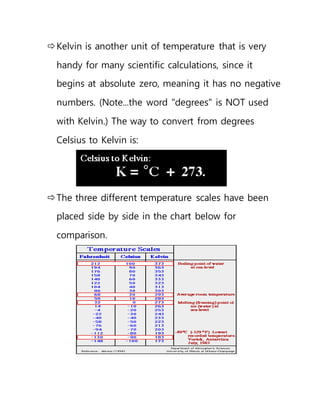
with Kelvin.) The way to convert from degrees
Celsius to Kelvin is:
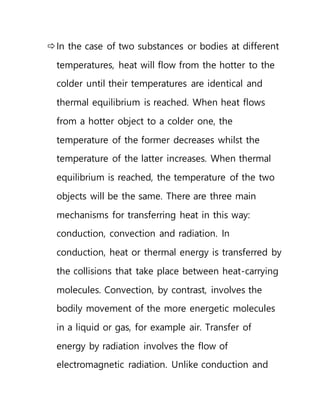
The three different temperature scales have been
placed side by side in the chart below for
comparison.
In the case of two substances or bodies at different
temperatures, heat will flow from the hotter to the
colder until their temperatures are identical and
thermal equilibrium is reached. When heat flows
from a hotter object to a colder one, the
temperature of the former decreases whilst the
temperature of the latter increases. When thermal
equilibrium is reached, the temperature of the two
objects will be the same. There are three main
mechanisms for transferring heat in this way:
conduction, convection and radiation. In
conduction, heat or thermal energy is transferred by
the collisions that take place between heat-carrying
molecules. Convection, by contrast, involves the
bodily movement of the more energetic molecules
in a liquid or gas, for example air. Transfer of
energy by radiation involves the flow of
electromagnetic radiation. Unlike conduction and
convection, radiation can take place across a
vacuum, like space.
Radiation is the principal means by which the Earth
receives energy from the Sun (in the form of light
and ultraviolet radiation). The Earth, too, emits
radiation, but because its temperature is much
lower than that of the Sun, it is much weaker in
intensity (in the form of infrared radiation). The
Earth has a flowing atmosphere, however, and
consequently much of its heat is redistributed
around the world by convection. Indeed convection
is the major process of energy transfer in the
atmosphere which causes weather phenomena.
Since the temperature of the Earth's surface is
usually higher nearer the equator than nearer the
poles, heat is transferred by the generation
of pressure differences and the accompanying
development of global wind patterns.
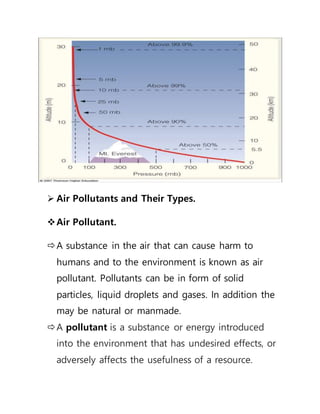
Pressure Profile.
Gravity pushes the layers of air down to the Earth's
surface. This push is called air pressure.
Consequently, 99% of the total mass of the
atmosphere is below 32 kilometers.
Like all fluids (gases and liquids), the air exerts a
pressure on everything within and around it,
although we are not aware of it. Pressure is a force,
or weight, exerted on a surface per unit area, and is
measured in Pascal’s (Pa). The pressure exerted by a
kilogram mass on the Earth's surface is
approximately 10 Pa. The pressure exerted by the
whole atmosphere on the Earth’s surface is
approximately 100,000 Pa.
Usually, atmospheric pressure is quoted in millibars
(mb). 1 mb is equal to 100 Pa, so standard
atmospheric pressure is about 1000 mb. In fact,
actual values of atmospheric pressure vary from
place to place and from day to day. At sea level,
commonly observed values range between 970 mb
and 1040 mb. Because pressure decreases with
altitude, pressure observed at various stations must
be adjusted to the same level, usually sea level.
Sometimes, atmospheric pressure is quoted in
millimeters, centimeters or inches of mercury. This
older form of measurement is related to the
traditional method of measuring atmospheric
pressure using a mercury barometer. Typical sea
level atmospheric pressure is 76 cm mercury (Hg) or
30 inches.
Variations in atmospheric pressure lead to the
development of winds that play a significant role in
shaping our daily weather.
 Air Pollutants and Their Types.
Air Pollutant.
A substance in the air that can cause harm to
humans and to the environment is known as air
pollutant. Pollutants can be in form of solid
particles, liquid droplets and gases. In addition the
may be natural or manmade.
A pollutant is a substance or energy introduced
into the environment that has undesired effects, or
adversely affects the usefulness of a resource.
Air pollutants can occur both outdoor air pollutant
and indoor air pollutant.
Indoor Air Pollutants or ambient air pollution.
The common sources of outdoor air pollution are
emissions caused by combustion processes from
motor vehicles, solid fuel burning and industry.
Other pollution sources include smoke from
bushfires, windblown dust, and biogenic emissions
from vegetation (pollen and mould spores).
The most common air pollutants of ambient air
include:
1. Particulate matter (PM10 and PM2.5)
2. Ozone (O3)
3. Nitrogen dioxide (NO2)
4. Carbon monoxide (CO)
5. Sulphur dioxide (SO2)
Indoor Air Pollutants.
We usually think of air pollution as being outdoors,
but the air in your house or office could also be
polluted. Sources of indoor pollution include
1. Mold and pollen.
2. Tobacco smoke.
3. Household products and pesticides.
4. Gases such as radon and carbon monoxide.
5. Materials used in the building such as asbestos,
formaldehyde and lead.
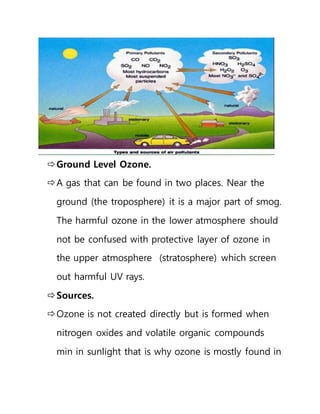
Types of air Pollutants.
There air pollutants can be classified into two types.
1. Primary Pollutants.
2. Secondary Pollutants.
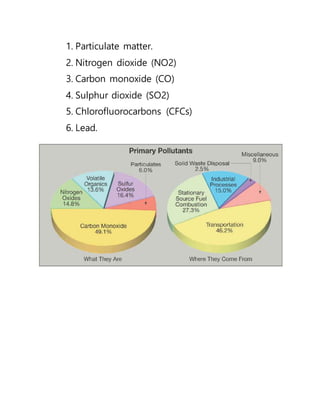
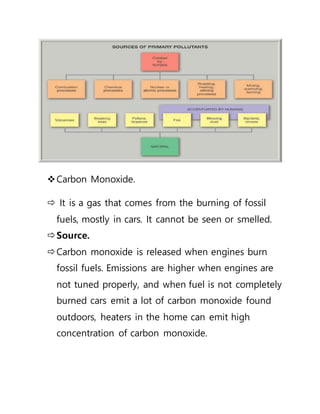
Primary Pollutants.
Which are emitted directly from identifiable sources,
Like emission of CO2 and NOX vehicles.
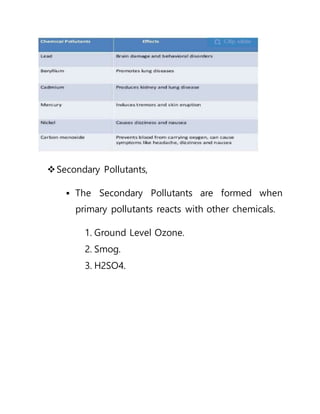
 Some Primary Pollutants are given below.
1. Particulate matter.
2. Nitrogen dioxide (NO2)
3. Carbon monoxide (CO)
4. Sulphur dioxide (SO2)
5. Chlorofluorocarbons (CFCs)
6. Lead.
Carbon Monoxide.
 It is a gas that comes from the burning of fossil
fuels, mostly in cars. It cannot be seen or smelled.
Source.
Carbon monoxide is released when engines burn
fossil fuels. Emissions are higher when engines are
not tuned properly, and when fuel is not completely
burned cars emit a lot of carbon monoxide found
outdoors, heaters in the home can emit high
concentration of carbon monoxide.
There is another source of carbon monoxide is
natural means volcanoes eruption, forest fire and
many other.
Effects.
carbon monoxide makes it hard for body parts to
get the oxygen they need to run correctly. Exposure
to carbon monoxide makes people feel dizzy and
tired and gives them headaches. In high
concentration it is fatal. Elderly people with heart
disease more often when they are exposed to
higher amount of carbon monoxide.
Carbon Dioxide.
Carbon dioxide (CO2) is a gas that is emitted from
combustion of fossil fuel.
Sources.
There are both natural and manmade sources of
carbon dioxide. Natural sources include
decomposition, ocean release, and respiration.
Human sources come from activities like burning of
fossil fuel, deforestation.
Effects.
There are many effects of carbon dioxide. These
effects depend on the concentration of carbon
dioxide.
The harmful effects are acid rain, climate change,
and greenhouse effect.
Nitrogen oxides (NOx).NO,NO2
Nitrogen dioxide and nitrogen monoxide are
referred together as oxides of nitrogen NOx.
Nitrogen Monoxide.
Nitrogen monoxide is a colorless gas with the
formula of NO.
The nitrogen monoxide has sources from both
natural and manmade. Natural source is that the
nitrogen and oxygen in the air at very high
temperature it reacts to form nitric oxide or
nitrogen monoxide.
N2 + 02 -------- NO
The nitric oxide very quickly reacts with more
oxygen to form nitrogen dioxide.
NO + O2 ----------NO2
At Normal temperature the oxygen and nitrogen
gases do not react together. In the presence of
very high temperatures nitrogen and oxygen do
react together to form nitric oxide. These
conditions are in the combustion of coal or oil at
electric power plants and also during combustion
of gasoline in automobiles.
The nitric oxide has small effect if the
concentration is small and if the concentration
large then it has huge effects. E.g. Acid rain,
Difficulty in respiration, Vomiting, skin effects.
Nitrogen Dioxide (NO2).
Is a reddish-brown gas that comes from the
burning of fossil fuels. It has a strong smell at high
levels.
Sources.
Nitrogen dioxide mostly comes from power plants
and cars. Nitrogen dioxide is formed in two ways.
When nitrogen in the fuel is burned or when
nitrogen in the air reacts with oxygen at very high
temperatures.
Effects.
High levels of nitrogen dioxide exposure can give
people coughs and can make them feel short
breath. People who are exposed to nitrogen dioxide
for a long time have a higher chance of getting
respiratory infections. Nitogren dioxide reacts in the
atmosphere to form acid rain, which can harm
plants and animals.
Sulfur oxides (SOx).
Sulphur oxides refer to many types of sulfur and
oxygen containing compounds such as SO, SO2.SO3
etc.
Sulphur Dioxide (SO2).
A corrosive gas that cannot be seen or smelled at
low levels but can have a rotten egg smell at high
levels.
Sources.
Sulphur dioxide mostly comes from burning of coal
or oil in power plants. It also comes from factories
that make chemicals, paper, or fuel. Like nitrogen
dioxide reacts in the atmosphere to form acid rain
and particles.
Effects.
Sulphur dioxide exposure can affects people who
have asthma by making it more difficult for them to
breath. It can also irritate people’s eyes, noses.
Sulphur dioxide can also harms the trees and crops,
damage buildings, and make it harder for people
see long distances.
Particulate Matter.
Solid or liquid matter that is suspended in the air
to remain in the air the particles usually must be
less than 0.1 mm wide and can be as small as
0.00005mm.
Sources.
Particulate matter can be divided into two types.
Coarse particles and fine particles are formed
from sources like road dust, sea spray, and
construction, fine particles are formed when fuel
is burned in automobiles and power plants.
Effects.
Particulate matter that is small enough can enter
lungs and cause health problems include more
frequent asthma attacks, respiratory problems
and premature death.
Chlorofluorocarbons (CFCs).
Stratospheric ozone depletes. Chemicals that
can destroy the ozone in the stratosphere these
chemicals include chlorofluorocarbons, halons
and other compound chorine or bromine.
Sources.
CFSc are used in air conditioners and
refrigerators, since they work well as coolants
they can also be found in aerosol cans and fire
extinguishers. The other stratospheric ozone
depleters are used as solvents in industry.
Effects.
If the ozone in the stratosphere is destroyed,
people are exposed to more radiation from the
sun UV radiation this can lead to skin cancer
and eye problems higher UV radiation can also
harm plants ans animals.
Secondary Pollutants,
 The Secondary Pollutants are formed when
primary pollutants reacts with other chemicals.
1. Ground Level Ozone.
2. Smog.
3. H2SO4.
Ground Level Ozone.
A gas that can be found in two places. Near the
ground (the troposphere) it is a major part of smog.
The harmful ozone in the lower atmosphere should
not be confused with protective layer of ozone in
the upper atmosphere (stratosphere) which screen
out harmful UV rays.
Sources.
Ozone is not created directly but is formed when
nitrogen oxides and volatile organic compounds
min in sunlight that is why ozone is mostly found in
the summer. Nitrogen oxides come from burning
gasoline, coal. Or other fossil fuels. There are many
types of volatile organic compounds and they come
from sources ranging from factories to trees.
Effects.
Ozone near the ground can cause a number of
health problems. Ozone can lead to more frequent
asthma attacks in people who have asthma and can
sore, throats, coughs, and breathing difficulty it may
even lead premature death. Ozone can also hurt
plants and crops
Smog.
Smog is another example of secondary pollutant.
Smog is a yellowish or blackish fog formed mainly
by a mixture of pollutants in the atmosphere which
consists of the particles and ground level ozone.
Smog which occurs mainly because of air pollution
can also be defined as a mixture of various gases
with dust and water vapors. Smog also refers to
hazy air that makes breathing difficulty.
Sources.
Smog is often caused by heavy traffic, high
temperature, sun shine, and calm winds. These are
few of the factors behind increasing level of air
pollution in atmosphere. During the winter months
when the wind speed are low it helps the smoke
and fog to become stagnate at a place forming
smog and increasing pollution levels near the
ground close where peoples repairing. It hampers
visibility and disturbs the environment. The
atmospheric pollutants or gases that form smog are
released in the air when fuels are burnt. When
sunlight and its heat react with these gases and fine
particles in the atmosphere.
Effects.
Smog affects plant life and the health of animals
and humans. It is a harmful to humans, animals,
plants, and to the nature as a whole. Smog leads to
bronchial diseases. Heavy smog results in a low
production of the crucial natural element vitamin D
leading to cases to rickets among people. Smog
can be responsible for any ailment from minor
pains to deadly pulmonary diseases such as lung
cancer. Smog is well known for causing irritation in
the eye. It may also result in inflammation in the
tissues of lungs, giving rise to pain in the chest.
Other issues are illnesses ETC.
Types of Smog.
Photochemical Smog.
Photochemical smog is produced when pollutants
from the combustion of fossil fuels react with
sunlight. The energy in the sunlight converts the
pollutants into other toxic chemicals. In order for
photochemical smog to form, there must be
other pollutants in the air, specifically nitrous
oxides and other volatile organic compounds
(VOCs).
Effects.
Photochemical smog’s effects cause damage to
the respiratory system and environmental system
with the release of nitrogen oxide (NO), ozone
and volatile organic compounds (VOCs). These
effects are worse when the sun is highest because
the pollutants react with it.
Health Hazards.
Irritation to the eye, nose, and throat are
common.
Respiratory problems are caused by the
pollutants being breath in, causing lung irritation
and complication from asthma to lung carcinoma.
Environmental Harm.
The pollutants in photochemical smog cause a
lack of productivity in vegetation because of
ground ozone.
In addition, animals have the same reposes to the
pollutants of photochemical smog as humans do.
Sulfurous Smog.
It is type of smog which is formed with fossil fuel
are burned in the power plants.
Effects of air pollutants on atmosphere ( acid
rain, ozone depletion, green house effect )
The air pollutants have a huge effects on
atmosphere through these many undesirable effects
can occur these effect can acid rain, ozone
depletion, smog, green house effect and many
other.
Acid Rain.
Acid rain occurs when sulfur dioxide and nitrogen
oxides are emitted into the atmosphere undergo
chemical transformation and are absorbed by water
droplets in the clouds. The droplets then fall to
earth as rain snow, mist, dry dust, hail, or sleet. This
can increase the acidity of the soil, and affect the
chemical balance of lacks and streams and it can kill
the fish in the rivers and acid rain can slow the
growth of forests, cause leaves. In extreme cases
trees or whole Ares of forest can die. Soil biology
can be seriously damage by acid.
Ozone Depletion.
Gradually thinning of earth’ ozone layer in the
upper atmosphere caused by releasing of chemical
compounds containing chlorine or bromine in the
atmosphere. This thinning of ozone layer is mainly
in polar region Antarctica. Ozone depletion is a big
problem in the world because it increase the
amount of ultraviolet radiation which reach the
earth surface which is increase in skin cancer eye
disease and mainly effect on our immune system.
Green House Effect.
It is the equilibrium of incoming and outgoing
radiation that warm the earth is referred as green
house effect. The earth is constantly bombarded
with enormous amount of the radiation from the
sun. These radiation strike the earth atmosphere in
the form of visible infrared and ultraviolet and other
types of radiation that are visible to the human
eyes. About the 30% of radiation striking
atmosphere is immediately reflected back to space,
by clouds, snow, sand, ice, and other reflective
surfaces. While rest of the 70% radiation is
absorbed by the land, ocean, and atmosphere .
These radiation heat up the ocean, land and
atmosphere releases heat in the form of infrared
radiations. Which passes out of the atmosphere into
the space .
Biogeochemical Cycles.
In ecology and Earth science, a biogeochemical
cycle or substance turnover or cycling of
substances is a pathway by which a chemical
substance moves through biotic (biosphere) and
abiotic (lithosphere, atmosphere,
and hydrosphere) compartments of Earth.
The important biogeochemical cycles are the
following.
1. Water Cycle.
2. Oxygen Cycle.
3. Photosynthesis.
4. Nitrogen Cycle.
5. Carbon Cycle
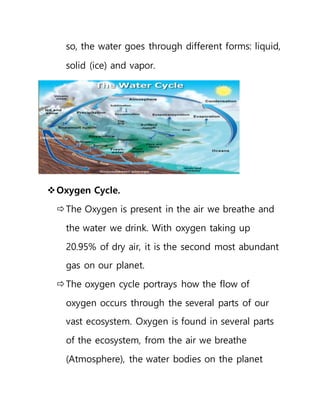
Water Cycle.
The water cycle, also known as the hydrologic
cycle or the hydrological cycle, describes the
continuous movement of water on, above and
below the surface of the Earth. The mass of water
on Earth remains fairly constant over time but the
partitioning of the water into the major reservoirs
of ice, fresh water, saline water and atmospheric
water is variable depending on a wide range
of climatic variables. The water moves from one
reservoir to another, such as from river to ocean,
or from the ocean to the atmosphere, by the
physical processes
of evaporation, condensation, precipitation, infiltra
tion, surface runoff, and subsurface flow. In doing
so, the water goes through different forms: liquid,
solid (ice) and vapor.
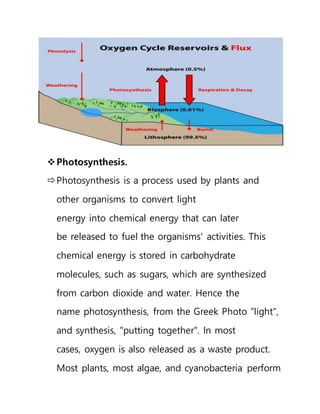
Oxygen Cycle.
The Oxygen is present in the air we breathe and
the water we drink. With oxygen taking up
20.95% of dry air, it is the second most abundant
gas on our planet.
The oxygen cycle portrays how the flow of
oxygen occurs through the several parts of our
vast ecosystem. Oxygen is found in several parts
of the ecosystem, from the air we breathe
(Atmosphere), the water bodies on the planet
(Hydrosphere), inside all the biological beings
(Biosphere) and inside the earth’s crust
(Lithosphere).
Oxygen Cycle Steps:
1. Atmosphere:
Only a small percentage of the world’s oxygen
is present in the atmosphere, only about 0.35
%. This exchange of gaseous oxygen happens
through Photolysis.
 Photolysis: This is the process by which
molecules like atmospheric water and nitrous
oxide are broken down by the ultraviolet
radiation coming from the sun and release free
oxygen.
2. Biosphere:
 The exchange of oxygen between the living
beings on the planet, between the animal
kingdom and the plant kingdom. The
exchange of oxygen in the biosphere is
codependent on the Carbon cycle and
hydrogen cycle as well.
 It mainly occurs through 2 processes.
 Photosynthesis:
The process by which plants make energy by
taking in carbon dioxide from the atmosphere
and give out oxygen.
 Respiration:
The process by which animals and humans take
in oxygen from the atmosphere and use it to
break down carbohydrates and give out carbon
dioxide.
3. Lithosphere:
 The part of the planet containing most of the
oxygen content through biomass, organic
content and mineral deposits. These deposits
are formed when free radical elements were
exposed to free oxygen and over time they
form silicates and oxides. This trapped oxygen
is released back due to several weathering
processes. Also, animals and plants draw
nutrient materials from the from the
lithosphere and free some of the trapped
oxygen.
4. Hydrosphere:
Oxygen dissolved in water is responsible for the
sustenance of the aquatic ecosystem present
beneath the surface. The hydrosphere is 33%
oxygen by volume present mainly as a
component of water molecules with dissolved
molecules including carbonic acids and free
oxygen.
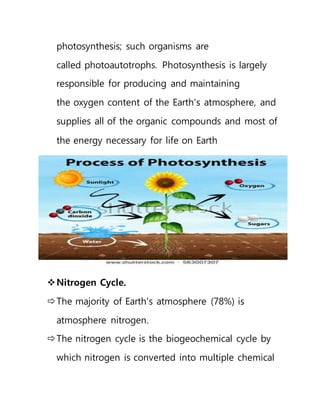
Photosynthesis.
Photosynthesis is a process used by plants and
other organisms to convert light
energy into chemical energy that can later
be released to fuel the organisms' activities. This
chemical energy is stored in carbohydrate
molecules, such as sugars, which are synthesized
from carbon dioxide and water. Hence the
name photosynthesis, from the Greek Photo "light",
and synthesis, "putting together". In most
cases, oxygen is also released as a waste product.
Most plants, most algae, and cyanobacteria perform
photosynthesis; such organisms are
called photoautotrophs. Photosynthesis is largely
responsible for producing and maintaining
the oxygen content of the Earth's atmosphere, and
supplies all of the organic compounds and most of
the energy necessary for life on Earth
Nitrogen Cycle.
The majority of Earth's atmosphere (78%) is
atmosphere nitrogen.
The nitrogen cycle is the biogeochemical cycle by
which nitrogen is converted into multiple chemical
forms as it circulates among atmosphere, terrestrial,
and marine ecosystems. The conversion of nitrogen
can be carried out through both biological and
physical processes.
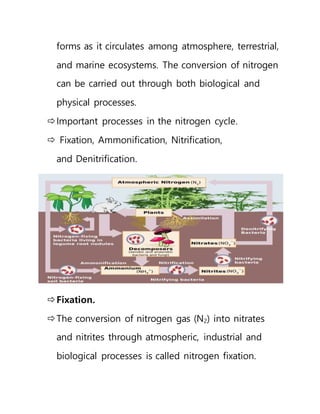
Important processes in the nitrogen cycle.
 Fixation, Ammonification, Nitrification,
and Denitrification.
Fixation.
The conversion of nitrogen gas (N2) into nitrates
and nitrites through atmospheric, industrial and
biological processes is called nitrogen fixation.
Atmospheric nitrogen must be processed, or "fixed",
into a usable form to be taken up by plants.
Between 5 and 10 billion kg per year are fixed
by lightning strikes, but most fixation is done by
free-living or symbioticbacteria known
as diazotrophs. These bacteria have
the nitrogenase enzyme that combines gaseous
nitrogen with hydrogento produce ammonia, which
is converted by the bacteria into other organic
compounds.
Ammnofication.
When a plant or animal dies or an animal expels
waste, the initial form of nitrogen is organic.
Bacteria or fungi convert the organic nitrogen
within the remains back into ammonium(NH+
4)a
process called ammonification or mineralization.
Nitrification.
The conversion of ammonium to nitrate is
performed primarily by soil-living bacteria and other
nitrifying bacteria. In the primary stage of
nitrification, the oxidation of ammonium (NH+4) is
performed by bacteria such as
the Nitrosomonas species, which converts ammonia
to nitrites (NH-2) other bacterial species such
as Nitrobacter, are responsible for the oxidation of
the nitrites (NO− 2) into nitrates (NO− 3). It is
important for the ammonia (NH3) to be converted
to nitrates or nitrites because ammonia gas is toxic
to plants.
Ditrification.
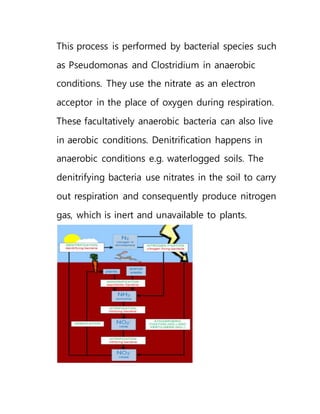
Denitrification is the reduction of nitrates back into
nitrogen gas (N2), completing the nitrogen cycle.
This process is performed by bacterial species such
as Pseudomonas and Clostridium in anaerobic
conditions. They use the nitrate as an electron
acceptor in the place of oxygen during respiration.
These facultatively anaerobic bacteria can also live
in aerobic conditions. Denitrification happens in
anaerobic conditions e.g. waterlogged soils. The
denitrifying bacteria use nitrates in the soil to carry
out respiration and consequently produce nitrogen
gas, which is inert and unavailable to plants.
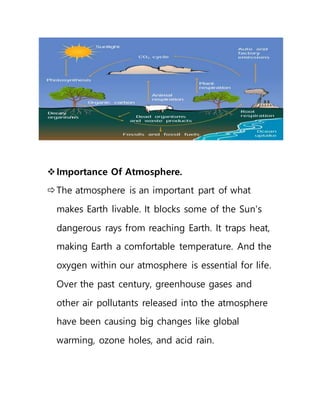
Carbon Cycle.
The carbon cycle is the biogeochemical cycle by
which carbon is exchanged among
the biosphere, pedosphere, geosphere, hydrosphere
, and atmosphere of the Earth. Carbon is the main
component of biological compounds as well as a
major component of many minerals such as
limestone. Along with the nitrogen cycle and
the water cycle, the carbon cycle comprises a
sequence of events that are key to make Earth
capable of sustaining life. It describes the
movement of carbon as it is recycled and reused
throughout the biosphere, as well as long-term
processes of carbon sequestration to and release
from carbon sinks.
The carbon cycle was discovered by Joseph
Priestley and Antoine Lavoisier, and popularized
by Humphry Davy.In the atmosphere, carbon is
attached to some oxygen in a gas called carbon
dioxide.
Plants use carbon dioxide and sunlight to make
their own food and grow. The carbon becomes part
of the plant. Plants that die and are buried may
turn into fossil fuels made of carbon like coal and
oil over millions of years. When humans burn fossil
fuels, most of the carbon quickly enters the
atmosphere as carbon dioxide.
Carbon dioxide is a greenhouse gas and traps heat
in the atmosphere. Without it and other
greenhouse gases, Earth would be a frozen world.
But humans have burned so much fuel that there is
about 30% more carbon dioxide in the air today
than there was about 150 years ago, and Earth is
becoming a warmer place. In fact, ice cores show us
that there is now more carbon dioxide in the
atmosphere than there has been in the last 420,000
years.
Importance Of Atmosphere.
The atmosphere is an important part of what
makes Earth livable. It blocks some of the Sun's
dangerous rays from reaching Earth. It traps heat,
making Earth a comfortable temperature. And the
oxygen within our atmosphere is essential for life.
Over the past century, greenhouse gases and
other air pollutants released into the atmosphere
have been causing big changes like global
warming, ozone holes, and acid rain.
The presence of the atmosphere plays a significant
role in the water cycle. It facilitates the formation of
clouds which remains suspended until they are
heavy enough to pour down on the earth as rain,
hail or snow.
Protects the life forms of the earth from the harmful
UV rays of the sun. The presence of the ozone layer
does this by reflecting the UV rays of the sun.
It keeps the temperature of the earth constant so
that it is suitable to support life.
 It protects the earth from smaller meteors.
Contains N2 ,O2 and other gases which are
necessary to support the life form on the earth.
The End.

Atmospheric pollution

  • 1.
    ENVIRONMENTAL CHEMISTRY. AtmosphericPollution. By AwaisBakshy ABSTRACT Airpollutionisone ofthe majorenvironmentalissues.It can cause adverse healtheffectssuchascancer, cardiovasculardiseasesandhighmortalityrates.High populationdensityisahuge contributoryfactor Of air pollution incitiesandurbanizedareas. Course Content: Introduction to Atmospheric Pollution,Components of Atmosphere, Temperature and pressure profiles of different components of atmosphere, Air pollutants and their types, Effectsof air pollutants on atmosphere ( acid rain, ozone depletion, greenhouse effect), Photochemical Smog, Biogeochemical cycle,Importance of atmosphere.
  • 2.
    Chapter No 2: AtmosphericPollution.  Objectives. 1. Introduction to Atmospheric Pollution. 2. Components of Atmosphere. 3. Temperature and pressure profiles of different components of atmosphere. 4. Air pollutants and their types. 5. Effects of air pollutants on atmosphere ( acid rain, ozone depletion, green house effect ) 6. Photochemical Smog. 7. Biogeochemical cycle. 8. Importance of atmosphere.  Introduction To atmospheric Pollution.
  • 3.
    The presence ofsubstances in the atmosphere, resulting from manmade activities and natural processes causing adverse effects to man and environment is known as atmospheric pollution. Air Pollution is a term is used to define any unwanted chemicals and other materials that contaminates the air that we breath resulting in the degradation in the air quality. Types of Sources. There Are Four Types of sources. 1. Mobile sources – such as cars, buses, planes, trucks, and trains 2. Stationary sources – such as power plants, oil refineries, industrial facilities, and factories 3. Area sources – such as agricultural areas, cities, and wood burning fireplaces
  • 4.
    4. Natural sources– such as wind-blown dust, wildfires, and volcanoes. Mobile sources account for more than half of all the air pollution in the United States and the primary mobile source of air pollution is the automobile, according to the Environmental Protection Agency. Stationary sources, like power plants, emit large amounts of pollution from a single location, these are also known as point sources of pollution. Area
  • 5.
    sources are madeup of lots of smaller pollution sources that aren't a big deal by themselves but when considered as a group can be. Natural sources can sometimes be significant but do not usually create ongoing air pollution problems like the other source types can. Pollution from human-generated and natural sources is often created in one place and transported through the air. Sometimes chemical reactions in the atmosphere change pollutants before they are deposited. Pollutants in the air can create haze, making it harder to see, and pollutant deposition can have biological effects. NPS areas experience these effects just like other places. Location and even the time of year can determine which pollution sources are most important to each park. Parks downwind of power plants that lack modern pollution controls can have increased
  • 6.
    smog. Tailpipe emissionsfrom cars and trucks, as well as industrial processes such as oil and gas development, give rise to elevated ozone concentrations. Summertime wildfires can also reduce visibility in NPS areas. There are even examples of pollutants that originated from other countries and were transported thousands of miles arriving at parks. The effects of this pollution can be seen as haze and through negative biological effects.
  • 7.
     Components ofAtmosphere. Atmosphere. The atmosphere of earth is the layer of gases, commonly known as air, that surrounds the planet earth and it is retained by earth gravity. Air. The air is the earth’s atmosphere. It is the clear gas in which human beings live and take breath and it has indefinite shape and volume. It has no color and smell. It has mass and weight. It is a matter as it has mass and weight and air creates atmospheric pressure. Chemical Composition. Nitrogen 78% Oxygen 21% Other gases 1% The atmosphere is divided in 5 layers.
  • 8.
    Troposphere, Stratosphere, Mesosphere, Thermosphere,Exosphere. Troposphere. The troposphere is the first layer above the surface of earth and contains 75% of the atmosphere. Weathers occur in this layer and its height is 6-10 km. Tropopause. The Tropopause is the layer between troposphere and stratosphere. The troposphere is bounded above by the Tropopause, a boundary marked by stable temperature. Stratosphere. The layer of the earth’s atmosphere above the troposphere and below the mesosphere, its height is 10-50 km above the earth’s surface. Many jets air craft’s fly in the stratosphere because it is very stable.
  • 9.
    Stratopause. The Stratopause isthe layer between stratosphere and mesosphere. Ozone Layer. The ozone layer or ozone shield is a region of earth’s stratosphere that absorbs sun’s UV radiation. It contains high concentrations of ozone (O3) and it is situated between troposphere and stratosphere. The 90% of ozone layer is in stratosphere and its height is 10-50 km. the ozone layer was discovered by the French physicists Charles fabry and Henri Buisson. How oxygen formed and how the O3 Ozone Formed. The two processes are given below. Photosynthesis. Photo means light. Synthesis means putting together.
  • 10.
    One billion yearsago, early aquatic organisms called blue-green algae began using energy from the Sun to split molecules of H2O and CO2 and recombine them into organic compounds and molecular oxygen (O2). This solar energy conversion process is known as photosynthesis. Photolysis. Photo means light. lysis means breaking or cutting Ozone is created in the stratosphere when highly energetic solar radiation strikes molecules of oxygen (O2) and causes the two oxygen atoms to split apart. If a freed atom bumps into another O2, it joins up, forming ozone (O3). This process known as photolysis Mesosphere. The region of the earth’s atmosphere above the stratosphere and below the thermosphere and its
  • 11.
    height is 50-80km. Meteors or rock fragment burn in the mesosphere. Mesopause. The Mesopause is the layer between mesosphere and thermosphere. Thermosphere. The thermosphere is the layer in the Earth's atmosphere directly above the mesosphere and below the exosphere. Within this layer of the atmosphere, ultraviolet radiation causes photoionization of molecules, creating ions in the ionosphere. Its height is 90 km to about 500 km. Ionosphere. The ionosphere is located in the thermosphere. The ionosphere is ionized by solar radiation. It plays an important role in atmospheric electricity and forms the inner edge of the magnetosphere. It has
  • 12.
    practical importance because,among other functions, it influences radio propagation to distant places on the Earth. Photoionization. Photoionization is the physical process in which an ion is formed from the interaction of a photon with an atom or molecules. Magnetosphere. It is created by planets having active hot iron and nickel or metallic cores, whose motion generated a planetary magnetic field, but such fields can also occur in stars by the interactions of plasma. Exosphere. The outermost region of a planet’s atmosphere. And its height is 500-1000 km.  Temperature and pressure profiles of different components of atmosphere. Temperature profile.
  • 13.
    The hotness orcoldness of a substance is called its temperature. At the microscopic level, temperature is a measurement of the kinetic energy, of a molecule. Air temperature changes with height. Since the number of air molecules decreases with height, it is sometimes assumed that temperature also decreases with height. This, however, is not always the case. Each layer in the atmosphere has its own temperature profile. In the troposphere and mesosphere, air temperature usually decreases with increasing height, whilst in the stratosphere, air temperature rises with increasing altitude. In the outer atmosphere or thermosphere, air temperature can rise to over 1000C. However because the air is so thin, Although the measured temperature in the thermosphere is very hot, the thermosphere would actually feel very cold to us because the total energy of only a few
  • 14.
    air molecules residingthere would not be enough to transfer any appreciable heat to our skin. The temperature can be measured by the units of temperature. There three units of temperature. Celsius, Fahrenheit and Kelvin. Celsius and Fahrenheit. Degrees Fahrenheit, (developed in the early 1700's by G. Daniel Fahrenheit), are used to record surface temperature measurements by meteorologists in the United States. However, since most of the rest of the world uses degrees Celsius (developed in the 18th Century), it is important to be able to convert from units of degrees Fahrenheit to degrees Celsius: Kelvin.
  • 15.
    Kelvin is anotherunit of temperature that is very handy for many scientific calculations, since it begins at absolute zero, meaning it has no negative numbers. (Note...the word "degrees" is NOT used with Kelvin.) The way to convert from degrees Celsius to Kelvin is: The three different temperature scales have been placed side by side in the chart below for comparison.
  • 16.
    In the caseof two substances or bodies at different temperatures, heat will flow from the hotter to the colder until their temperatures are identical and thermal equilibrium is reached. When heat flows from a hotter object to a colder one, the temperature of the former decreases whilst the temperature of the latter increases. When thermal equilibrium is reached, the temperature of the two objects will be the same. There are three main mechanisms for transferring heat in this way: conduction, convection and radiation. In conduction, heat or thermal energy is transferred by the collisions that take place between heat-carrying molecules. Convection, by contrast, involves the bodily movement of the more energetic molecules in a liquid or gas, for example air. Transfer of energy by radiation involves the flow of electromagnetic radiation. Unlike conduction and
  • 17.
    convection, radiation cantake place across a vacuum, like space. Radiation is the principal means by which the Earth receives energy from the Sun (in the form of light and ultraviolet radiation). The Earth, too, emits radiation, but because its temperature is much lower than that of the Sun, it is much weaker in intensity (in the form of infrared radiation). The Earth has a flowing atmosphere, however, and consequently much of its heat is redistributed around the world by convection. Indeed convection is the major process of energy transfer in the atmosphere which causes weather phenomena. Since the temperature of the Earth's surface is usually higher nearer the equator than nearer the poles, heat is transferred by the generation of pressure differences and the accompanying development of global wind patterns.
  • 19.
    Pressure Profile. Gravity pushesthe layers of air down to the Earth's surface. This push is called air pressure. Consequently, 99% of the total mass of the atmosphere is below 32 kilometers. Like all fluids (gases and liquids), the air exerts a pressure on everything within and around it, although we are not aware of it. Pressure is a force, or weight, exerted on a surface per unit area, and is measured in Pascal’s (Pa). The pressure exerted by a kilogram mass on the Earth's surface is approximately 10 Pa. The pressure exerted by the whole atmosphere on the Earth’s surface is approximately 100,000 Pa. Usually, atmospheric pressure is quoted in millibars (mb). 1 mb is equal to 100 Pa, so standard atmospheric pressure is about 1000 mb. In fact, actual values of atmospheric pressure vary from place to place and from day to day. At sea level, commonly observed values range between 970 mb
  • 20.
    and 1040 mb.Because pressure decreases with altitude, pressure observed at various stations must be adjusted to the same level, usually sea level. Sometimes, atmospheric pressure is quoted in millimeters, centimeters or inches of mercury. This older form of measurement is related to the traditional method of measuring atmospheric pressure using a mercury barometer. Typical sea level atmospheric pressure is 76 cm mercury (Hg) or 30 inches. Variations in atmospheric pressure lead to the development of winds that play a significant role in shaping our daily weather.
  • 21.
     Air Pollutantsand Their Types. Air Pollutant. A substance in the air that can cause harm to humans and to the environment is known as air pollutant. Pollutants can be in form of solid particles, liquid droplets and gases. In addition the may be natural or manmade. A pollutant is a substance or energy introduced into the environment that has undesired effects, or adversely affects the usefulness of a resource.
  • 22.
    Air pollutants canoccur both outdoor air pollutant and indoor air pollutant. Indoor Air Pollutants or ambient air pollution. The common sources of outdoor air pollution are emissions caused by combustion processes from motor vehicles, solid fuel burning and industry. Other pollution sources include smoke from bushfires, windblown dust, and biogenic emissions from vegetation (pollen and mould spores). The most common air pollutants of ambient air include: 1. Particulate matter (PM10 and PM2.5) 2. Ozone (O3) 3. Nitrogen dioxide (NO2) 4. Carbon monoxide (CO) 5. Sulphur dioxide (SO2) Indoor Air Pollutants.
  • 23.
    We usually thinkof air pollution as being outdoors, but the air in your house or office could also be polluted. Sources of indoor pollution include 1. Mold and pollen. 2. Tobacco smoke. 3. Household products and pesticides. 4. Gases such as radon and carbon monoxide. 5. Materials used in the building such as asbestos, formaldehyde and lead. Types of air Pollutants. There air pollutants can be classified into two types. 1. Primary Pollutants. 2. Secondary Pollutants. Primary Pollutants. Which are emitted directly from identifiable sources, Like emission of CO2 and NOX vehicles.  Some Primary Pollutants are given below.
  • 24.
    1. Particulate matter. 2.Nitrogen dioxide (NO2) 3. Carbon monoxide (CO) 4. Sulphur dioxide (SO2) 5. Chlorofluorocarbons (CFCs) 6. Lead.
  • 25.
    Carbon Monoxide.  Itis a gas that comes from the burning of fossil fuels, mostly in cars. It cannot be seen or smelled. Source. Carbon monoxide is released when engines burn fossil fuels. Emissions are higher when engines are not tuned properly, and when fuel is not completely burned cars emit a lot of carbon monoxide found outdoors, heaters in the home can emit high concentration of carbon monoxide.
  • 26.
    There is anothersource of carbon monoxide is natural means volcanoes eruption, forest fire and many other. Effects. carbon monoxide makes it hard for body parts to get the oxygen they need to run correctly. Exposure to carbon monoxide makes people feel dizzy and tired and gives them headaches. In high concentration it is fatal. Elderly people with heart disease more often when they are exposed to higher amount of carbon monoxide. Carbon Dioxide. Carbon dioxide (CO2) is a gas that is emitted from combustion of fossil fuel. Sources. There are both natural and manmade sources of carbon dioxide. Natural sources include decomposition, ocean release, and respiration.
  • 27.
    Human sources comefrom activities like burning of fossil fuel, deforestation. Effects. There are many effects of carbon dioxide. These effects depend on the concentration of carbon dioxide. The harmful effects are acid rain, climate change, and greenhouse effect. Nitrogen oxides (NOx).NO,NO2 Nitrogen dioxide and nitrogen monoxide are referred together as oxides of nitrogen NOx. Nitrogen Monoxide. Nitrogen monoxide is a colorless gas with the formula of NO. The nitrogen monoxide has sources from both natural and manmade. Natural source is that the nitrogen and oxygen in the air at very high
  • 28.
    temperature it reactsto form nitric oxide or nitrogen monoxide. N2 + 02 -------- NO The nitric oxide very quickly reacts with more oxygen to form nitrogen dioxide. NO + O2 ----------NO2 At Normal temperature the oxygen and nitrogen gases do not react together. In the presence of very high temperatures nitrogen and oxygen do react together to form nitric oxide. These conditions are in the combustion of coal or oil at electric power plants and also during combustion of gasoline in automobiles. The nitric oxide has small effect if the concentration is small and if the concentration large then it has huge effects. E.g. Acid rain, Difficulty in respiration, Vomiting, skin effects. Nitrogen Dioxide (NO2).
  • 29.
    Is a reddish-browngas that comes from the burning of fossil fuels. It has a strong smell at high levels. Sources. Nitrogen dioxide mostly comes from power plants and cars. Nitrogen dioxide is formed in two ways. When nitrogen in the fuel is burned or when nitrogen in the air reacts with oxygen at very high temperatures. Effects. High levels of nitrogen dioxide exposure can give people coughs and can make them feel short breath. People who are exposed to nitrogen dioxide for a long time have a higher chance of getting respiratory infections. Nitogren dioxide reacts in the atmosphere to form acid rain, which can harm plants and animals. Sulfur oxides (SOx).
  • 30.
    Sulphur oxides referto many types of sulfur and oxygen containing compounds such as SO, SO2.SO3 etc. Sulphur Dioxide (SO2). A corrosive gas that cannot be seen or smelled at low levels but can have a rotten egg smell at high levels. Sources. Sulphur dioxide mostly comes from burning of coal or oil in power plants. It also comes from factories that make chemicals, paper, or fuel. Like nitrogen dioxide reacts in the atmosphere to form acid rain and particles. Effects. Sulphur dioxide exposure can affects people who have asthma by making it more difficult for them to breath. It can also irritate people’s eyes, noses. Sulphur dioxide can also harms the trees and crops, damage buildings, and make it harder for people see long distances.
  • 31.
    Particulate Matter. Solid orliquid matter that is suspended in the air to remain in the air the particles usually must be less than 0.1 mm wide and can be as small as 0.00005mm. Sources. Particulate matter can be divided into two types. Coarse particles and fine particles are formed from sources like road dust, sea spray, and construction, fine particles are formed when fuel is burned in automobiles and power plants. Effects. Particulate matter that is small enough can enter lungs and cause health problems include more frequent asthma attacks, respiratory problems and premature death. Chlorofluorocarbons (CFCs). Stratospheric ozone depletes. Chemicals that can destroy the ozone in the stratosphere these
  • 32.
    chemicals include chlorofluorocarbons,halons and other compound chorine or bromine. Sources. CFSc are used in air conditioners and refrigerators, since they work well as coolants they can also be found in aerosol cans and fire extinguishers. The other stratospheric ozone depleters are used as solvents in industry. Effects. If the ozone in the stratosphere is destroyed, people are exposed to more radiation from the sun UV radiation this can lead to skin cancer and eye problems higher UV radiation can also harm plants ans animals.
  • 33.
    Secondary Pollutants,  TheSecondary Pollutants are formed when primary pollutants reacts with other chemicals. 1. Ground Level Ozone. 2. Smog. 3. H2SO4.
  • 34.
    Ground Level Ozone. Agas that can be found in two places. Near the ground (the troposphere) it is a major part of smog. The harmful ozone in the lower atmosphere should not be confused with protective layer of ozone in the upper atmosphere (stratosphere) which screen out harmful UV rays. Sources. Ozone is not created directly but is formed when nitrogen oxides and volatile organic compounds min in sunlight that is why ozone is mostly found in
  • 35.
    the summer. Nitrogenoxides come from burning gasoline, coal. Or other fossil fuels. There are many types of volatile organic compounds and they come from sources ranging from factories to trees. Effects. Ozone near the ground can cause a number of health problems. Ozone can lead to more frequent asthma attacks in people who have asthma and can sore, throats, coughs, and breathing difficulty it may even lead premature death. Ozone can also hurt plants and crops Smog. Smog is another example of secondary pollutant. Smog is a yellowish or blackish fog formed mainly by a mixture of pollutants in the atmosphere which consists of the particles and ground level ozone. Smog which occurs mainly because of air pollution can also be defined as a mixture of various gases
  • 36.
    with dust andwater vapors. Smog also refers to hazy air that makes breathing difficulty. Sources. Smog is often caused by heavy traffic, high temperature, sun shine, and calm winds. These are few of the factors behind increasing level of air pollution in atmosphere. During the winter months when the wind speed are low it helps the smoke and fog to become stagnate at a place forming smog and increasing pollution levels near the ground close where peoples repairing. It hampers visibility and disturbs the environment. The atmospheric pollutants or gases that form smog are released in the air when fuels are burnt. When sunlight and its heat react with these gases and fine particles in the atmosphere. Effects.
  • 37.
    Smog affects plantlife and the health of animals and humans. It is a harmful to humans, animals, plants, and to the nature as a whole. Smog leads to bronchial diseases. Heavy smog results in a low production of the crucial natural element vitamin D leading to cases to rickets among people. Smog can be responsible for any ailment from minor pains to deadly pulmonary diseases such as lung cancer. Smog is well known for causing irritation in the eye. It may also result in inflammation in the tissues of lungs, giving rise to pain in the chest. Other issues are illnesses ETC.
  • 38.
    Types of Smog. PhotochemicalSmog. Photochemical smog is produced when pollutants from the combustion of fossil fuels react with sunlight. The energy in the sunlight converts the pollutants into other toxic chemicals. In order for photochemical smog to form, there must be other pollutants in the air, specifically nitrous oxides and other volatile organic compounds (VOCs). Effects.
  • 39.
    Photochemical smog’s effectscause damage to the respiratory system and environmental system with the release of nitrogen oxide (NO), ozone and volatile organic compounds (VOCs). These effects are worse when the sun is highest because the pollutants react with it. Health Hazards. Irritation to the eye, nose, and throat are common. Respiratory problems are caused by the pollutants being breath in, causing lung irritation and complication from asthma to lung carcinoma. Environmental Harm. The pollutants in photochemical smog cause a lack of productivity in vegetation because of ground ozone. In addition, animals have the same reposes to the pollutants of photochemical smog as humans do.
  • 40.
    Sulfurous Smog. It istype of smog which is formed with fossil fuel are burned in the power plants. Effects of air pollutants on atmosphere ( acid rain, ozone depletion, green house effect ) The air pollutants have a huge effects on atmosphere through these many undesirable effects can occur these effect can acid rain, ozone depletion, smog, green house effect and many other. Acid Rain. Acid rain occurs when sulfur dioxide and nitrogen oxides are emitted into the atmosphere undergo chemical transformation and are absorbed by water droplets in the clouds. The droplets then fall to earth as rain snow, mist, dry dust, hail, or sleet. This can increase the acidity of the soil, and affect the chemical balance of lacks and streams and it can kill the fish in the rivers and acid rain can slow the growth of forests, cause leaves. In extreme cases
  • 41.
    trees or wholeAres of forest can die. Soil biology can be seriously damage by acid. Ozone Depletion. Gradually thinning of earth’ ozone layer in the upper atmosphere caused by releasing of chemical compounds containing chlorine or bromine in the atmosphere. This thinning of ozone layer is mainly in polar region Antarctica. Ozone depletion is a big problem in the world because it increase the amount of ultraviolet radiation which reach the earth surface which is increase in skin cancer eye disease and mainly effect on our immune system. Green House Effect. It is the equilibrium of incoming and outgoing radiation that warm the earth is referred as green house effect. The earth is constantly bombarded with enormous amount of the radiation from the sun. These radiation strike the earth atmosphere in the form of visible infrared and ultraviolet and other types of radiation that are visible to the human
  • 42.
    eyes. About the30% of radiation striking atmosphere is immediately reflected back to space, by clouds, snow, sand, ice, and other reflective surfaces. While rest of the 70% radiation is absorbed by the land, ocean, and atmosphere . These radiation heat up the ocean, land and atmosphere releases heat in the form of infrared radiations. Which passes out of the atmosphere into the space . Biogeochemical Cycles. In ecology and Earth science, a biogeochemical cycle or substance turnover or cycling of substances is a pathway by which a chemical substance moves through biotic (biosphere) and abiotic (lithosphere, atmosphere, and hydrosphere) compartments of Earth. The important biogeochemical cycles are the following. 1. Water Cycle. 2. Oxygen Cycle.
  • 43.
    3. Photosynthesis. 4. NitrogenCycle. 5. Carbon Cycle Water Cycle. The water cycle, also known as the hydrologic cycle or the hydrological cycle, describes the continuous movement of water on, above and below the surface of the Earth. The mass of water on Earth remains fairly constant over time but the partitioning of the water into the major reservoirs of ice, fresh water, saline water and atmospheric water is variable depending on a wide range of climatic variables. The water moves from one reservoir to another, such as from river to ocean, or from the ocean to the atmosphere, by the physical processes of evaporation, condensation, precipitation, infiltra tion, surface runoff, and subsurface flow. In doing
  • 44.
    so, the watergoes through different forms: liquid, solid (ice) and vapor. Oxygen Cycle. The Oxygen is present in the air we breathe and the water we drink. With oxygen taking up 20.95% of dry air, it is the second most abundant gas on our planet. The oxygen cycle portrays how the flow of oxygen occurs through the several parts of our vast ecosystem. Oxygen is found in several parts of the ecosystem, from the air we breathe (Atmosphere), the water bodies on the planet
  • 45.
    (Hydrosphere), inside allthe biological beings (Biosphere) and inside the earth’s crust (Lithosphere). Oxygen Cycle Steps: 1. Atmosphere: Only a small percentage of the world’s oxygen is present in the atmosphere, only about 0.35 %. This exchange of gaseous oxygen happens through Photolysis.  Photolysis: This is the process by which molecules like atmospheric water and nitrous oxide are broken down by the ultraviolet radiation coming from the sun and release free oxygen. 2. Biosphere:  The exchange of oxygen between the living beings on the planet, between the animal kingdom and the plant kingdom. The
  • 46.
    exchange of oxygenin the biosphere is codependent on the Carbon cycle and hydrogen cycle as well.  It mainly occurs through 2 processes.  Photosynthesis: The process by which plants make energy by taking in carbon dioxide from the atmosphere and give out oxygen.  Respiration: The process by which animals and humans take in oxygen from the atmosphere and use it to break down carbohydrates and give out carbon dioxide. 3. Lithosphere:  The part of the planet containing most of the oxygen content through biomass, organic content and mineral deposits. These deposits are formed when free radical elements were
  • 47.
    exposed to freeoxygen and over time they form silicates and oxides. This trapped oxygen is released back due to several weathering processes. Also, animals and plants draw nutrient materials from the from the lithosphere and free some of the trapped oxygen. 4. Hydrosphere: Oxygen dissolved in water is responsible for the sustenance of the aquatic ecosystem present beneath the surface. The hydrosphere is 33% oxygen by volume present mainly as a component of water molecules with dissolved molecules including carbonic acids and free oxygen.
  • 48.
    Photosynthesis. Photosynthesis is aprocess used by plants and other organisms to convert light energy into chemical energy that can later be released to fuel the organisms' activities. This chemical energy is stored in carbohydrate molecules, such as sugars, which are synthesized from carbon dioxide and water. Hence the name photosynthesis, from the Greek Photo "light", and synthesis, "putting together". In most cases, oxygen is also released as a waste product. Most plants, most algae, and cyanobacteria perform
  • 49.
    photosynthesis; such organismsare called photoautotrophs. Photosynthesis is largely responsible for producing and maintaining the oxygen content of the Earth's atmosphere, and supplies all of the organic compounds and most of the energy necessary for life on Earth Nitrogen Cycle. The majority of Earth's atmosphere (78%) is atmosphere nitrogen. The nitrogen cycle is the biogeochemical cycle by which nitrogen is converted into multiple chemical
  • 50.
    forms as itcirculates among atmosphere, terrestrial, and marine ecosystems. The conversion of nitrogen can be carried out through both biological and physical processes. Important processes in the nitrogen cycle.  Fixation, Ammonification, Nitrification, and Denitrification. Fixation. The conversion of nitrogen gas (N2) into nitrates and nitrites through atmospheric, industrial and biological processes is called nitrogen fixation.
  • 51.
    Atmospheric nitrogen mustbe processed, or "fixed", into a usable form to be taken up by plants. Between 5 and 10 billion kg per year are fixed by lightning strikes, but most fixation is done by free-living or symbioticbacteria known as diazotrophs. These bacteria have the nitrogenase enzyme that combines gaseous nitrogen with hydrogento produce ammonia, which is converted by the bacteria into other organic compounds. Ammnofication. When a plant or animal dies or an animal expels waste, the initial form of nitrogen is organic. Bacteria or fungi convert the organic nitrogen within the remains back into ammonium(NH+ 4)a process called ammonification or mineralization. Nitrification.
  • 52.
    The conversion ofammonium to nitrate is performed primarily by soil-living bacteria and other nitrifying bacteria. In the primary stage of nitrification, the oxidation of ammonium (NH+4) is performed by bacteria such as the Nitrosomonas species, which converts ammonia to nitrites (NH-2) other bacterial species such as Nitrobacter, are responsible for the oxidation of the nitrites (NO− 2) into nitrates (NO− 3). It is important for the ammonia (NH3) to be converted to nitrates or nitrites because ammonia gas is toxic to plants. Ditrification. Denitrification is the reduction of nitrates back into nitrogen gas (N2), completing the nitrogen cycle.
  • 53.
    This process isperformed by bacterial species such as Pseudomonas and Clostridium in anaerobic conditions. They use the nitrate as an electron acceptor in the place of oxygen during respiration. These facultatively anaerobic bacteria can also live in aerobic conditions. Denitrification happens in anaerobic conditions e.g. waterlogged soils. The denitrifying bacteria use nitrates in the soil to carry out respiration and consequently produce nitrogen gas, which is inert and unavailable to plants.
  • 54.
    Carbon Cycle. The carboncycle is the biogeochemical cycle by which carbon is exchanged among the biosphere, pedosphere, geosphere, hydrosphere , and atmosphere of the Earth. Carbon is the main component of biological compounds as well as a major component of many minerals such as limestone. Along with the nitrogen cycle and the water cycle, the carbon cycle comprises a sequence of events that are key to make Earth capable of sustaining life. It describes the movement of carbon as it is recycled and reused throughout the biosphere, as well as long-term processes of carbon sequestration to and release from carbon sinks. The carbon cycle was discovered by Joseph Priestley and Antoine Lavoisier, and popularized by Humphry Davy.In the atmosphere, carbon is attached to some oxygen in a gas called carbon dioxide.
  • 55.
    Plants use carbondioxide and sunlight to make their own food and grow. The carbon becomes part of the plant. Plants that die and are buried may turn into fossil fuels made of carbon like coal and oil over millions of years. When humans burn fossil fuels, most of the carbon quickly enters the atmosphere as carbon dioxide. Carbon dioxide is a greenhouse gas and traps heat in the atmosphere. Without it and other greenhouse gases, Earth would be a frozen world. But humans have burned so much fuel that there is about 30% more carbon dioxide in the air today than there was about 150 years ago, and Earth is becoming a warmer place. In fact, ice cores show us that there is now more carbon dioxide in the atmosphere than there has been in the last 420,000 years.
  • 56.
    Importance Of Atmosphere. Theatmosphere is an important part of what makes Earth livable. It blocks some of the Sun's dangerous rays from reaching Earth. It traps heat, making Earth a comfortable temperature. And the oxygen within our atmosphere is essential for life. Over the past century, greenhouse gases and other air pollutants released into the atmosphere have been causing big changes like global warming, ozone holes, and acid rain.
  • 57.
    The presence ofthe atmosphere plays a significant role in the water cycle. It facilitates the formation of clouds which remains suspended until they are heavy enough to pour down on the earth as rain, hail or snow. Protects the life forms of the earth from the harmful UV rays of the sun. The presence of the ozone layer does this by reflecting the UV rays of the sun. It keeps the temperature of the earth constant so that it is suitable to support life.  It protects the earth from smaller meteors. Contains N2 ,O2 and other gases which are necessary to support the life form on the earth.
  • 58.