1
AIR COMPRESSORS - INTRODUCTION
• The function of a compressor is to take a definite
quantity of fluid, compresses it and deliver it at a
required pressure and stores it in a vessel.
• Usually a gas, and most often air.
• To do this, mechanical work must be supplied to the
air compressor, by an electric motor.
• The air compressor does work on the air, called
indicated work.
• The compressed air is supplied through pipelines to
required locations.
2
• It is used for operating pneumatic tools, starting
internal combustion engines, and in jet engines
and gas turbines.
• In industries, compressed air powers lifts, pumps,
and blast furnaces.
AIR COMPRESSORS
3
TYPES OF AIR COMPRESSORS
4
TYPES OF AIR COMPRESSORS
5
AIR COMPRESSORS
https://youtu.be/oy6X6cZWx2Y
6
AIR COMPRESSORS
7
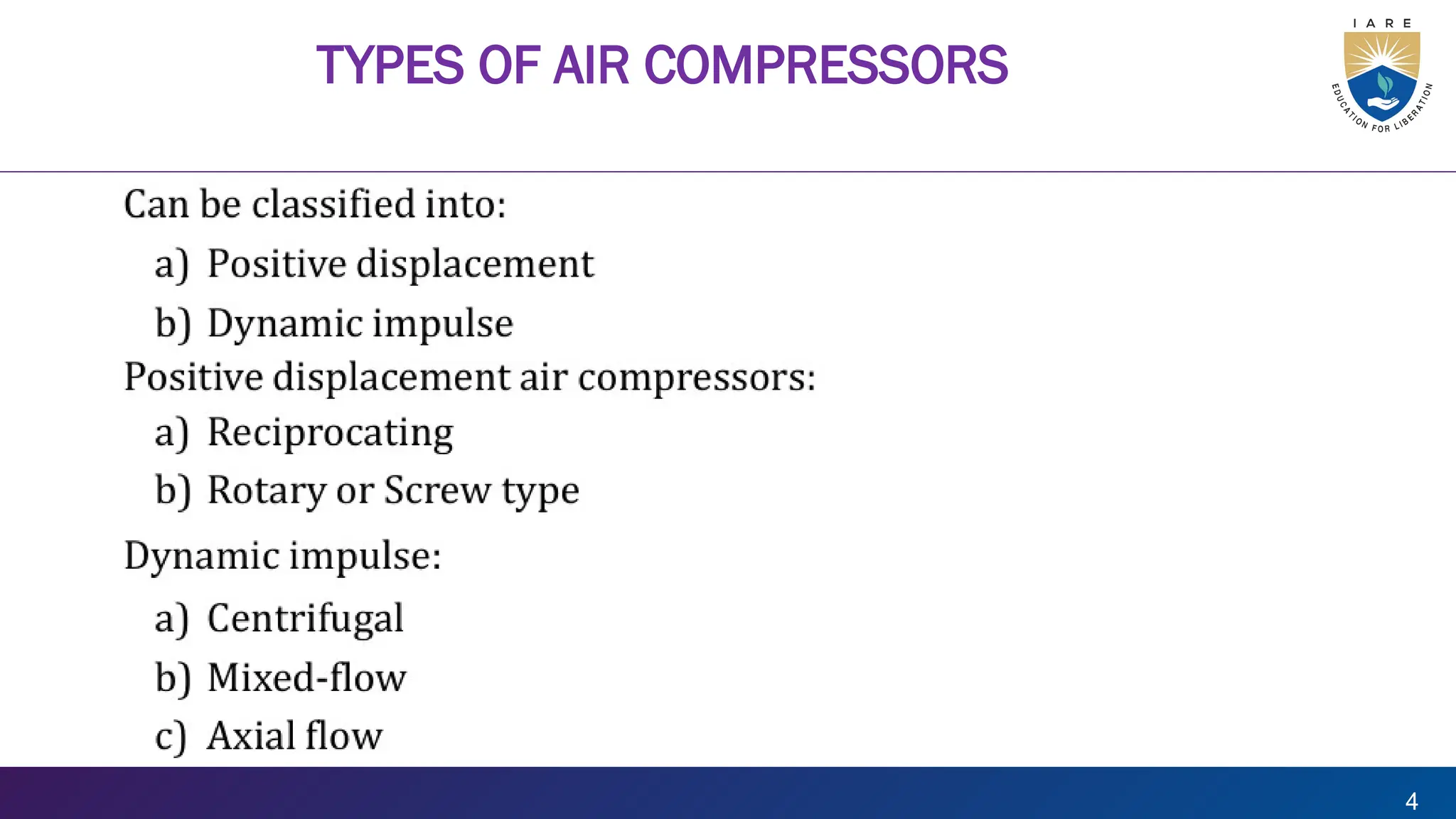
CLASSIFICATION OF AIR COMPRESSORS
The air compressors may be classified in many
ways, but the following are the important.
1. According to working
(a) Reciprocating Compressors, and
(b) Rotary compressors.
2. According to action
(a) Single acting compressors, and
(b) Double acting compressors.
3. According to number of stages
(b) Single stage compressors, and
(b) Multi-stage compressors.
8
TECHNICAL TERMS USED IN AIR COMPRESSORS.
The following technical terms are frequently used in
air compressors.
1. Inlet pressure: It is the absolute pressure of
air at the lnet of a compressor.
2. Discharge pressure: It is the absolute
pressure of air at the outlet of a compressor.
3. Compression ratio (or pressure ratio): It is
the ratio of discharge pressure to the inlet
pressure. The value of compression ratio is
more than unity.
9
TECHNICAL TERMS USED IN AIR COMPRESSORS
4. Compressor capacity: It is the volume of air
delivered by the compressor.
It is expressed in m3
/ min or m3
/s.
5. Free air delivery. It is the actual volume
delivered by a compressor when reduced to
the normal temperature and pressure
condition.
The capacity of a compressor is given in terms
of free air delivery.
10
TECHNICAL TERMS USED IN AIR COMPRESSORS
6. Swept volume:. ft is the volume of air sucked by the
compressor during its suction stroke.
For Single acting air compressor is given by
V = πD2
x L
where D = Diameter of cylinder bore, and
L = Length of piston stroke.
7. Mean effective pressure. The air pressure on the
compressor piston keeps on changing with the
movement of the piston in the cylinder.
The mean effective pressure of the compressor is the
ratio of work done per cycle to the stroke volume
11
ROTARY AIR COMPRESSORS
In rotary air compressors, air is compressed by
the squeezing action or backflow between two
engaging surfaces.
Types of Rotary Air Compressors:
Broadly classified as:
A. Positive displacement compressors
1. Roots blower compressor;
2. Vane blower compressor;
Note: These are not popular for engineering
applications.
12
ROTARY AIR COMPRESSORS
B. Non- Positive displacement compressors
1. Centrifugal blower compressor and
2. Axial flow compressor.
Note: Non- Positive displacement compressors are
popularly used for industrial applications..
Fig: Centrifugal
compressor
13
CENTRIFUGAL AIR COMPRESSORS
• A centrifugal blower compressor consists of a
rotor (impeller) with symmetrically tilted curved
vanes.
• The rotor rotates in an airtight volute casing,
converting the air's kinetic energy into
pressure energy.
• Mechanical energy is supplied to the rotor
from an external source.
• As the rotor rotates, it sucks air through its eye
(inlet), increases its pressure using centrifugal
force, and forces it over the diffuser.
14
ROTARY AIR COMPRESSORS
15
ROTARY AIR COMPRESSORS
16
PRINCIPLE OF OPERATION OF CENTRIFUGAL
AIR COMPRESSORS
• The air pressure further increases as it flows
over the diffuser and is then delivered to the
receiver at high pressure.
• Air enters the impeller radially and exits the
vanes axially.
• The curved vanes and diffuser are designed for
tangential, shock-free air entry and exit, with
smooth surfaces to minimize frictional losses.
• The power required to drive the compressor
can be calculated using velocity triangles or
other methods.
17
WORKDONE BY A CENTRIFUGAL AIR
COMPRESSOR
• In a centrifugal compressor, air is first sucked, then
compressed, and finally delivered.
• Work is done on the rotor during suction and by the rotor
during compression and delivery.
• The total work done by the compressor equals the work
done during compression.
• The compression process can be isothermal, polytropic, or
isentropic (reversible adiabatic).
• The work done depends on the type of compression
process.
Work done by a centrifugal Air Compressor:
18
AXIAL FLOW COMPRESSOR
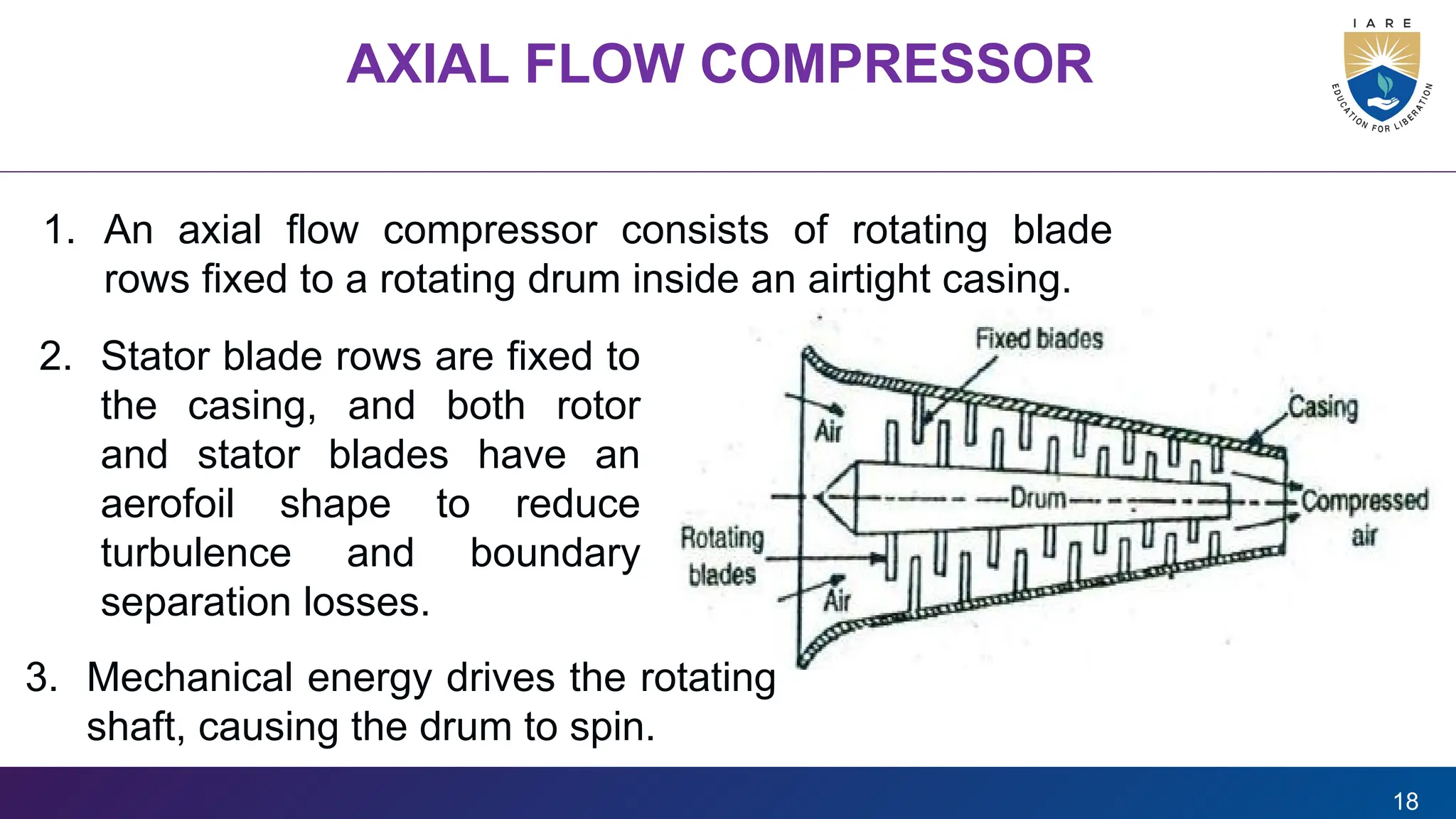
1. An axial flow compressor consists of rotating blade
rows fixed to a rotating drum inside an airtight casing.
2. Stator blade rows are fixed to
the casing, and both rotor
and stator blades have an
aerofoil shape to reduce
turbulence and boundary
separation losses.
3. Mechanical energy drives the rotating
shaft, causing the drum to spin.
19
5. After passing through
all the stator and rotor
sets, the air is
delivered at high
pressure at the outlet.
4. Air enters from the
left side and flows
through alternating
stator and rotor rows,
getting progressively
compressed.
AXIAL FLOW COMPRESSOR
20
AXIAL FLOW COMPRESSOR
21
COMPARISON OF CENTRIFUGAL AND
AXIAL FLOW AIR COMPRESSORS
The major comparison of the centrifugal and axial flow air
compressors are given below.
S.No. Centrifugal compressor Axial flow compressor
1 The flow of air is perpendicular to
the axis
The flow of air is parallel to the
axis of compressor.
2 It has low manufacturing and
running cost.
It has high manufacturing and
running cost.
3 It requires low starting torque. It requires high starting torque.
4 It is not suitable for multi-staging. It is suitable for multi-staging.
5 It requires large frontal area for a
given rate of flow.
It requires less frontal area for
a given rate of flow.
22

1. Principle of operation of centrifugal and axial compressors.pptx

  • 1.
    1 AIR COMPRESSORS -INTRODUCTION • The function of a compressor is to take a definite quantity of fluid, compresses it and deliver it at a required pressure and stores it in a vessel. • Usually a gas, and most often air. • To do this, mechanical work must be supplied to the air compressor, by an electric motor. • The air compressor does work on the air, called indicated work. • The compressed air is supplied through pipelines to required locations.
  • 2.
    2 • It isused for operating pneumatic tools, starting internal combustion engines, and in jet engines and gas turbines. • In industries, compressed air powers lifts, pumps, and blast furnaces. AIR COMPRESSORS
  • 3.
    3 TYPES OF AIRCOMPRESSORS
  • 4.
    4 TYPES OF AIRCOMPRESSORS
  • 5.
  • 6.
  • 7.
    7 CLASSIFICATION OF AIRCOMPRESSORS The air compressors may be classified in many ways, but the following are the important. 1. According to working (a) Reciprocating Compressors, and (b) Rotary compressors. 2. According to action (a) Single acting compressors, and (b) Double acting compressors. 3. According to number of stages (b) Single stage compressors, and (b) Multi-stage compressors.
  • 8.
    8 TECHNICAL TERMS USEDIN AIR COMPRESSORS. The following technical terms are frequently used in air compressors. 1. Inlet pressure: It is the absolute pressure of air at the lnet of a compressor. 2. Discharge pressure: It is the absolute pressure of air at the outlet of a compressor. 3. Compression ratio (or pressure ratio): It is the ratio of discharge pressure to the inlet pressure. The value of compression ratio is more than unity.
  • 9.
    9 TECHNICAL TERMS USEDIN AIR COMPRESSORS 4. Compressor capacity: It is the volume of air delivered by the compressor. It is expressed in m3 / min or m3 /s. 5. Free air delivery. It is the actual volume delivered by a compressor when reduced to the normal temperature and pressure condition. The capacity of a compressor is given in terms of free air delivery.
  • 10.
    10 TECHNICAL TERMS USEDIN AIR COMPRESSORS 6. Swept volume:. ft is the volume of air sucked by the compressor during its suction stroke. For Single acting air compressor is given by V = πD2 x L where D = Diameter of cylinder bore, and L = Length of piston stroke. 7. Mean effective pressure. The air pressure on the compressor piston keeps on changing with the movement of the piston in the cylinder. The mean effective pressure of the compressor is the ratio of work done per cycle to the stroke volume
  • 11.
    11 ROTARY AIR COMPRESSORS Inrotary air compressors, air is compressed by the squeezing action or backflow between two engaging surfaces. Types of Rotary Air Compressors: Broadly classified as: A. Positive displacement compressors 1. Roots blower compressor; 2. Vane blower compressor; Note: These are not popular for engineering applications.
  • 12.
    12 ROTARY AIR COMPRESSORS B.Non- Positive displacement compressors 1. Centrifugal blower compressor and 2. Axial flow compressor. Note: Non- Positive displacement compressors are popularly used for industrial applications.. Fig: Centrifugal compressor
  • 13.
    13 CENTRIFUGAL AIR COMPRESSORS •A centrifugal blower compressor consists of a rotor (impeller) with symmetrically tilted curved vanes. • The rotor rotates in an airtight volute casing, converting the air's kinetic energy into pressure energy. • Mechanical energy is supplied to the rotor from an external source. • As the rotor rotates, it sucks air through its eye (inlet), increases its pressure using centrifugal force, and forces it over the diffuser.
  • 14.
  • 15.
  • 16.
    16 PRINCIPLE OF OPERATIONOF CENTRIFUGAL AIR COMPRESSORS • The air pressure further increases as it flows over the diffuser and is then delivered to the receiver at high pressure. • Air enters the impeller radially and exits the vanes axially. • The curved vanes and diffuser are designed for tangential, shock-free air entry and exit, with smooth surfaces to minimize frictional losses. • The power required to drive the compressor can be calculated using velocity triangles or other methods.
  • 17.
    17 WORKDONE BY ACENTRIFUGAL AIR COMPRESSOR • In a centrifugal compressor, air is first sucked, then compressed, and finally delivered. • Work is done on the rotor during suction and by the rotor during compression and delivery. • The total work done by the compressor equals the work done during compression. • The compression process can be isothermal, polytropic, or isentropic (reversible adiabatic). • The work done depends on the type of compression process. Work done by a centrifugal Air Compressor:
  • 18.
    18 AXIAL FLOW COMPRESSOR 1.An axial flow compressor consists of rotating blade rows fixed to a rotating drum inside an airtight casing. 2. Stator blade rows are fixed to the casing, and both rotor and stator blades have an aerofoil shape to reduce turbulence and boundary separation losses. 3. Mechanical energy drives the rotating shaft, causing the drum to spin.
  • 19.
    19 5. After passingthrough all the stator and rotor sets, the air is delivered at high pressure at the outlet. 4. Air enters from the left side and flows through alternating stator and rotor rows, getting progressively compressed. AXIAL FLOW COMPRESSOR
  • 20.
  • 21.
    21 COMPARISON OF CENTRIFUGALAND AXIAL FLOW AIR COMPRESSORS The major comparison of the centrifugal and axial flow air compressors are given below. S.No. Centrifugal compressor Axial flow compressor 1 The flow of air is perpendicular to the axis The flow of air is parallel to the axis of compressor. 2 It has low manufacturing and running cost. It has high manufacturing and running cost. 3 It requires low starting torque. It requires high starting torque. 4 It is not suitable for multi-staging. It is suitable for multi-staging. 5 It requires large frontal area for a given rate of flow. It requires less frontal area for a given rate of flow.
  • 22.