AI@Wholi
Traian Rebedea, Ph.D.
traian@wholi.com
>> Bucharest.AI #5 << :: 05 Dec 17
What is Wholi?
• The right people find each other (at the right time)
• People search at first, company search now
• Aggregating signals from all public online sources
• Building a knowledge graph (e.g. People Graph, Company Graph)
• Use the graph to make informed decisions (e.g. contacting, selling)
• $5M+ total funding, last round in 2016
• Working with tens of companies for lead generation & scoring
>> Bucharest.AI #5 << :: 05 Dec 17
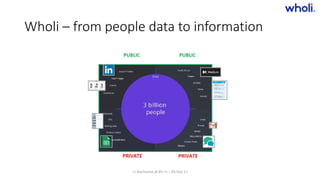
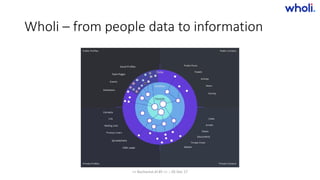
Wholi – from people data to information
>> Bucharest.AI #5 << :: 05 Dec 17
Wholi – from people data to information
>> Bucharest.AI #5 << :: 05 Dec 17
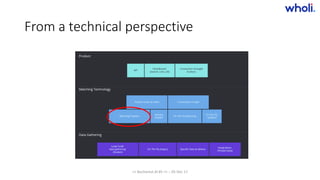
From a technical perspective
>> Bucharest.AI #5 << :: 05 Dec 17
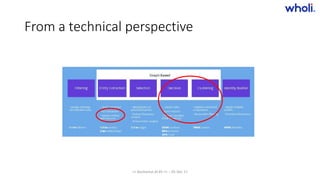
From a technical perspective
>> Bucharest.AI #5 << :: 05 Dec 17
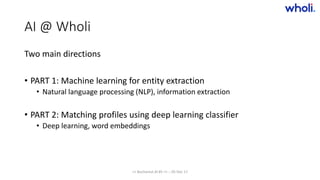
AI @ Wholi
Two main directions
• PART 1: Machine learning for entity extraction
• Natural language processing (NLP), information extraction
• PART 2: Matching profiles using deep learning classifier
• Deep learning, word embeddings
>> Bucharest.AI #5 << :: 05 Dec 17
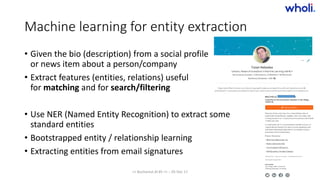
Machine learning for entity extraction
• Given the bio (description) from a social profile
or news item about a person/company
• Extract features (entities, relations) useful
for matching and for search/filtering
• Use NER (Named Entity Recognition) to extract some
standard entities
• Bootstrapped entity / relationship learning
• Extracting entities from email signatures
>> Bucharest.AI #5 << :: 05 Dec 17
CoreNLP for NER
• Out of the box, with some tuning for speed
• Used pretrained NER tagger in CoreNLP
• To enhance speed, we only kept the CRF classifier & got rid of regex for
time and money
• Detects three types of named entities: PERSON, ORGANISATION and
LOCATION
• Trained on news dataset, therefore performance/accuracy degrades on
social profiles
• Can improve performance by integrating new features (use gazetteer from
our index), new dataset with bio from social profiles
>> Bucharest.AI #5 << :: 05 Dec 17
Extracting topics from text
• Topic modelling (e.g. LDA – Latent Dirichlet Allocation) allows to extract a mix (distribution) of
topics from a given text
• Unfortunately topics are not automatically labeled, we only know the most important words in
each topic
• Given the text in a social profile, compute the most important topic(s)
• Uber Technologies Inc. is an American international transportation network company headquartered in San Francisco, California.
The company develops, markets and operates the Uber mobile app, which allows consumers with smartphones to submit a trip
request which is then routed to Uber drivers who use their own cars.[1][2] By May 28, 2015, the service was available in 58
countries and 300 cities worldwide => [taxi, transportation, ]
• Connectifier is a next-gen search platform specifically targeting hiring - one of the most fundamental pieces of our economy.
Discover, qualify, and connect with exceptional job candidates twice as effectively. => [hiring, career and jobs, recruitment,
marketplace, coaching]
• Dropbox is a free service that lets you bring your photos, docs, and videos anywhere and share them easily. Dropbox was founded
in 2007 by Drew Houston and Arash Ferdowsi, two MIT students tired of emailing files to themselves to work from more than one
computer. => [cloud, collaborative documents, collaboration, file sharing, storage, photo sharing, photo editing, ]
• PeopleGraph is building a people search engine. 3 billion searches a day are for people, yet there's no way to comprehensively
search someone's online footprint. We are well on the way to solving that problem. => [search, people, ]
>> Bucharest.AI #5 << :: 05 Dec 17
Bootstrapped entity / relationship learning
• I live in Bucharest<LOC>, working at Wholi<ORG>. Recently I’ve visited
Google<ORG>’s office in Zurich<LOC>.
• Wholi and Google have different semantics in the example
• Identify the relationship between the profile (person, company) and
each entity in the bio
• Also infer other types of entities / relations
• E.g. hobbies (likes, interests), software skills, roles, etc.
>> Bucharest.AI #5 << :: 05 Dec 17
Bootstrapped entity / relationship learning
• Work with Alex Tomescu, MSc @ Chalmers University of Technology
Software developer @ Google
• Started from SPIED in CoreNLP - Pattern-based entity extraction and visualization
• Similar works in other information extraction systems (e.g. NELL, Probase, Knowledge Vault)
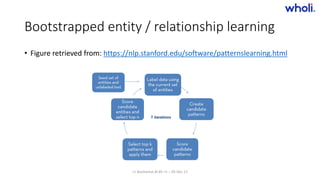
• Bootstrapping is a semi-supervised process which allows to iteratively discover
more and more examples (R ↗) with a pretty good precision (P↘)
1. Start with a (small) seed of correctly classified instances (P high, R low)
2. Using a huge unlabeled dataset, find patterns to discover these & new instances, keep only
high confidence patterns
3. Discover new instances (some may be incorrect, most should be correct => P decreases, R
increases) & repeat from 2 until… performance degrades too much
>> Bucharest.AI #5 << :: 05 Dec 17
Bootstrapped entity / relationship learning
• Figure retrieved from: https://nlp.stanford.edu/software/patternslearning.html
>> Bucharest.AI #5 << :: 05 Dec 17
Bootstrapped entity / relationship learning
• Seeds either initialized manually (e.g. hobbies), or from labeled data in our index (e.g. worksAt, livesIn)
• Seed hobbies:
• football, poker, martial arts, chess, swimming, jogging, hiking, fishing, archery, cooking
• Computes:
• baketball[0.0016682103969337127] baseball[0.0018129626504372067]
• dogs[0.0011119719042083742]
• drinks[1.4506528794721354E-4] beer[1.1687126552358244E-4] martini[2.4980405990967884E-4]
• husband[1.7630337419381701E-4]
• church[1.3872841379648836E-4] god[2.0515591306815217E-4]
• gadgets[2.67475711957433E-4]
• music[1.2155990349464713E-4]
• games[1.7018667163236963E-4]
• singing[1.5344948928898647E-4]
• birds[2.746465269584744E-4]
• facebook[1.5347921795982061E-4]
>> Bucharest.AI #5 << :: 05 Dec 17
Bootstrapped entity / relationship learning
• Patterns for role:
left 1.0000 : __company__ - [support=6891]
right 0.9802 : di __company__ [support=1879]
right 0.9442 : bei __company__ __end__ [support=5043]
right 0.5559 : @ __company__ __end__ [support=343]
left 1.0000 : __start__ __role__ at __company__ and [support=90]
>> Bucharest.AI #5 << :: 05 Dec 17
Bootstrapped entity / relationship learning - Conclusions
• Relationship learning can provide useful features for matching and for
search/filtering
• However, we have seen that in the best setting we obtain only a
minor boost in precision (not statistically relevant), with a more
relevant increase in recall (about 1%)
• It’s more useful for search in cases when this information can only be
inferred from text
>> Bucharest.AI #5 << :: 05 Dec 17
Matching profiles using deep learning
• Work with Vicentiu Ciorbaru, AI @ UPB MSc
Software developer @ MariaDB
• Dataset built by Dev team @ Wholi
• Used as one of the validation datasets for the different profile
matching methods developed for people search
• Main objective: cluster as many online profile pages of the same
person to build his online identity
>> Bucharest.AI #5 << :: 05 Dec 17
Introduction
• Online people search is a significant part of web search
• 11-17% of queries include a person name
• ~4% contain only a person name
• Name ambiguity makes people search a complex problem to solve
efficiently
• Huge overlap in person names worldwide
• The most popular 90,000 full names (first and last name) worldwide are shared by
100M+ individuals
• An important aspect in people search is to find most/all online sources of
information (e.g. web pages) related to the same person
• Recent shift from general web pages to specific ones, like social networking sites and
other professional communities
>> Bucharest.AI #5 << :: 05 Dec 17
Introduction
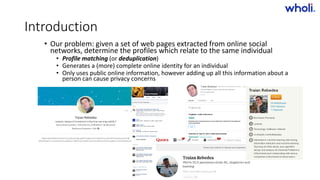
• Our problem: given a set of web pages extracted from online social
networks, determine the profiles which relate to the same individual
• Profile matching (or deduplication)
• Generates a (more) complete online identity for an individual
• Only uses public online information, however adding up all this information about a
person can cause privacy concerns
>> Bucharest.AI #5 << :: 05 Dec 17
Related work
• Two main directions
• Personal web pages deduplication
• Matching social networking profiles
• First problem is more generic and complex, as one also needs to
extract personal information (e.g. name, occupation, etc.) from a
wide range of different structured web pages
• Entity deduplication, in general, is a very complex field of study in
Databases, Natural Language Processing (NLP), and Information
Retrieval
>> Bucharest.AI #5 << :: 05 Dec 17
Related work
• Web People Search (WePS) datasets and competitions
• Given all web pages returned by a generic search engine for a popular name,
group pages such that each group corresponds to one specic person
• Most solutions employ clustering of the web pages using features extracted from
pages such as Wikipedia concepts, Named Entity Recognition (NER), bag of words
(BoW), and hyperlinks and different similarity measures
• A pairwise approach for solving this problem was also proposed
• Compute the probability that two pages refer to the same person
• Cluster pages by joining pairs that have a high probability to represent the same person
• WePS proposed B-cubed precision and recall for assessing performance
>> Bucharest.AI #5 << :: 05 Dec 17
Related work
• More recent research focused on linking social networking profiles
belonging to the same individual
• Zhang et al. (2015) proposed a binary classifier using a probabilistic
graphical model (factor graph)
• Features computed using BoW and TF-IDF for the text in each profile,
but also its social status (position of node in network) and
connections
• Our solution only uses textual features, since the dataset does not
contain connections (e.g. friends or followers)
• These additional features, or other like avatar/profile image, would only
improve the results
>> Bucharest.AI #5 << :: 05 Dec 17
Dataset
• Snapshot of multiple social networking profiles collected from 15
different online social networks and community websites
• Academia, Code-Project, Facebook, Github, Google+, Instagram, Lanyrd, Linkedin, Mashable, Medium, Moz, Quora,
Slideshare, Twitter, and Vimeo
• For each profile, we extracted some/all of the following information:
username, name (full name or distinct first and last names), gender,
bio (short description), interests, publications, jobs, etc.
• The average number of social profiles per individual is 2.04
and the maximum is 10
• Most profile pages feature a brief description (bio) of the owner
• Profiles do not contain connections, nor posts written by the owner
>> Bucharest.AI #5 << :: 05 Dec 17
Dataset
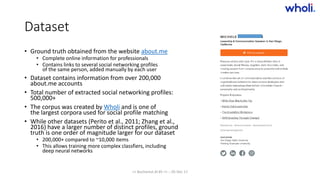
• Ground truth obtained from the website about.me
• Complete online information for professionals
• Contains links to several social networking profiles
of the same person, added manually by each user
• Dataset contains information from over 200,000
about.me accounts
• Total number of extracted social networking profiles:
500,000+
• The corpus was created by Wholi and is one of
the largest corpora used for social profile matching
• While other datasets (Perito et al., 2011; Zhang et al.,
2016) have a larger number of distinct profiles, ground
truth is one order of magnitude larger for our dataset
• 200,000+ compared to ~10,000 items
• This allows training more complex classfiers, including
deep neural networks
>> Bucharest.AI #5 << :: 05 Dec 17
Dataset
• Ground truth data has been manually entered by users
• It might be incorrect in some cases (entry errors, user misbehaviour)
• Resembles crowdsourced datasets, which are very popular lately to train complex models
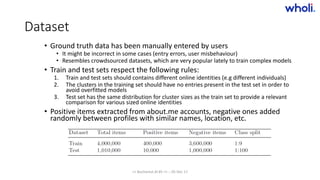
• Train and test sets respect the following rules:
1. Train and test sets should contains different online identities (e.g different individuals)
2. The clusters in the training set should have no entries present in the test set in order to
avoid overfitted models
3. Test set has the same distribution for cluster sizes as the train set to provide a relevant
comparison for various sized online identities
• Positive items extracted from about.me accounts, negative ones added
randomly between profiles with similar names, location, etc.
>> Bucharest.AI #5 << :: 05 Dec 17
Proposed solution
• Main contribution is using a deep neural network (NN) for matching online social
networking profiles
• NN is able to make use efficiently of both textual features and domain-specific
ones
• Also performed a comparison with other solutions used in previous studies,
employing both unsupervised and supervised methods
• For the unsupervised approach, we first generated the feature vector for each
profile, then applied Hierarchical Agglomerative Clustering (HAC) using cosine
distance
• For binary classification we have a twofold objective
1. Detect whether two profiles refer to the same person and should be matched (pairwise
matching)
2. For the graph of connected profiles discovered in phase 1, compute its connected
components
>> Bucharest.AI #5 << :: 05 Dec 17
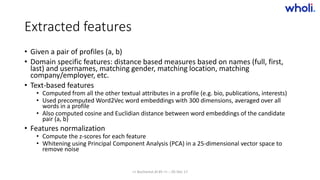
Extracted features
• Given a pair of profiles (a, b)
• Domain specific features: distance based measures based on names (full, first,
last) and usernames, matching gender, matching location, matching
company/employer, etc.
• Text-based features
• Computed from all the other textual attributes in a profile (e.g. bio, publications, interests)
• Used precomputed Word2Vec word embeddings with 300 dimensions, averaged over all
words in a profile
• Also computed cosine and Euclidian distance between word embeddings of the candidate
pair (a, b)
• Features normalization
• Compute the z-scores for each feature
• Whitening using Principal Component Analysis (PCA) in a 25-dimensional vector space to
remove noise
>> Bucharest.AI #5 << :: 05 Dec 17
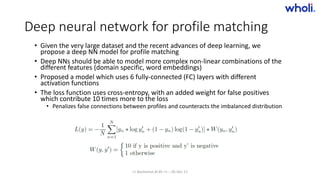
Deep neural network for profile matching
• Given the very large dataset and the recent advances of deep learning, we
propose a deep NN model for profile matching
• Deep NNs should be able to model more complex non-linear combinations of the
different features (domain specific, word embeddings)
• Proposed a model which uses 6 fully-connected (FC) layers with different
activation functions
• The loss function uses cross-entropy, with an added weight for false positives
which contribute 10 times more to the loss
• Penalizes false connections between profiles and counteracts the imbalanced distribution
>> Bucharest.AI #5 << :: 05 Dec 17
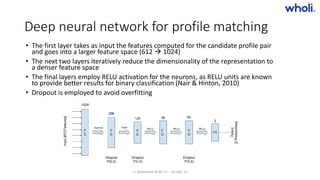
Deep neural network for profile matching
• The first layer takes as input the features computed for the candidate profile pair
and goes into a larger feature space (612  1024)
• The next two layers iteratively reduce the dimensionality of the representation to
a denser feature space
• The final layers employ RELU activation for the neurons, as RELU units are known
to provide better results for binary classification (Nair & Hinton, 2010)
• Dropout is employed to avoid overfitting
>> Bucharest.AI #5 << :: 05 Dec 17
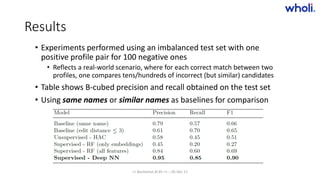
Results
• Experiments performed using an imbalanced test set with one
positive profile pair for 100 negative ones
• Reflects a real-world scenario, where for each correct match between two
profiles, one compares tens/hundreds of incorrect (but similar) candidates
• Table shows B-cubed precision and recall obtained on the test set
• Using same names or similar names as baselines for comparison
>> Bucharest.AI #5 << :: 05 Dec 17
Results
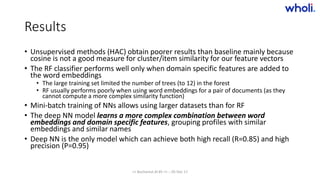
• Unsupervised methods (HAC) obtain poorer results than baseline mainly because
cosine is not a good measure for cluster/item similarity for our feature vectors
• The RF classifier performs well only when domain specific features are added to
the word embeddings
• The large training set limited the number of trees (to 12) in the forest
• RF usually performs poorly when using word embeddings for a pair of documents (as they
cannot compute a more complex similarity function)
• Mini-batch training of NNs allows using larger datasets than for RF
• The deep NN model learns a more complex combination between word
embeddings and domain specific features, grouping profiles with similar
embeddings and similar names
• Deep NN is the only model which can achieve both high recall (R=0.85) and high
precision (P=0.95)
>> Bucharest.AI #5 << :: 05 Dec 17
Results – examples
• Ground truth
• ['twitter/etniqminerals', 'instagram/etniqminerals', 'googleplus/106318957043871071183', 'facebook/etniqminerals',
'facebook/rockcityelitesalsa', 'facebook/1renaissancewoman', 'facebook/naturalblackgirlguide', 'linkedin/leahpatterson’]
• Computed
• [ 'facebook/1renaissancewoman’, 'linkedin/leahpatterson’, 'googleplus/106318957043871071183’]
• ['twitter/etniqminerals', 'instagram/etniqminerals', 'facebook/etniqminerals']
• [ 'facebook/naturalblackgirlguide']
• “Leah Patterson” is an individual who has two different companies “Etniq Minerals” and “Natural Black
Girl Guide”
• Ground truth
• 3 different individuals whose first name is “Tim” and all of them work in IT
• Computed
• ['googleplus/113375270405699485276', 'linkedin/timsmith78', 'googleplus/117829094399867770981',
'twitter/bbyxinnocenz', 'facebook/tim.tio.5', 'vimeo/user616297', 'linkedin/timtio', 'twitter/wbcsaint', 'twitter/turnitontim']
>> Bucharest.AI #5 << :: 05 Dec 17
Matching profiles using deep learning - Conclusions
• Proposed a large dataset for matching online social networking
profiles
• This allowed us to train a deep neural network for profile matching
using both domain-specific features and word embeddings generated
from textual descriptions from social profiles
• Experiments showed that the NN surpassed both unsupervised and
supervised models, achieving a high precision (P = 0.95) with a good
recall rate (R = 0.85)
• Further advancements can be made by training more complex deep
learning models, using recurrent or convolutional networks, and by
adding features extracted from profile pictures
>> Bucharest.AI #5 << :: 05 Dec 17
Summing up…
• Machine learning can be used to improve feature extraction and matching for people /
company search
• This requires a mix of NLP, ML, and information extraction techniques
• Also datasets for training / fitting parameters and testing / validation
• Improvements for matching were only marginally relevant using relationship extraction,
however filtering/search benefits more
• Deep learning is a solution for improving matching, especially for profiles that contain a
larger textul description
• We are moving from people data to company data, therefore we need to change / adapt
the proposed methods and datasets
>> Bucharest.AI #5 << :: 05 Dec 17
Thank you!
traian@wholi.com
_____
_____
>> Bucharest.AI #5 << :: 05 Dec 17
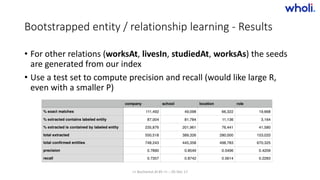
Bootstrapped entity / relationship learning - Results
• For other relations (worksAt, livesIn, studiedAt, worksAs) the seeds
are generated from our index
• Use a test set to compute precision and recall (would like large R,
even with a smaller P)
>> Bucharest.AI #5 << :: 05 Dec 17
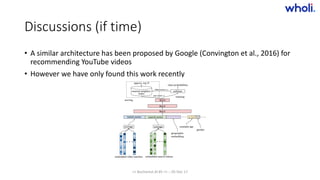
Discussions (if time)
• A similar architecture has been proposed by Google (Convington et al., 2016) for
recommending YouTube videos
• However we have only found this work recently
>> Bucharest.AI #5 << :: 05 Dec 17
About me
• Passionate of Machine Learning, Natural Language Processing and
algorithms, with solid experience as a ML scientist both in companies and
academia.
• Teaching & mentoring (A&C @ UPB) to transmit some of my passion and
interest to others.
• Linkedin profile: https://www.linkedin.com/in/trebedea/
• Google Scholar:
https://scholar.google.ro/citations?user=7NxaE1MAAAAJ&hl=en&oi=ao
• Deep learning meetup (more scientific, less business)
https://www.meetup.com/Bucharest-Deep-Learning/
>> Bucharest.AI #5 << :: 05 Dec 17

AI @ Wholi - Bucharest.AI Meetup #5

  • 1.
  • 2.
    What is Wholi? •The right people find each other (at the right time) • People search at first, company search now • Aggregating signals from all public online sources • Building a knowledge graph (e.g. People Graph, Company Graph) • Use the graph to make informed decisions (e.g. contacting, selling) • $5M+ total funding, last round in 2016 • Working with tens of companies for lead generation & scoring >> Bucharest.AI #5 << :: 05 Dec 17
  • 3.
    Wholi – frompeople data to information >> Bucharest.AI #5 << :: 05 Dec 17
  • 4.
    Wholi – frompeople data to information >> Bucharest.AI #5 << :: 05 Dec 17
  • 5.
    From a technicalperspective >> Bucharest.AI #5 << :: 05 Dec 17
  • 6.
    From a technicalperspective >> Bucharest.AI #5 << :: 05 Dec 17
  • 7.
    AI @ Wholi Twomain directions • PART 1: Machine learning for entity extraction • Natural language processing (NLP), information extraction • PART 2: Matching profiles using deep learning classifier • Deep learning, word embeddings >> Bucharest.AI #5 << :: 05 Dec 17
  • 8.
    Machine learning forentity extraction • Given the bio (description) from a social profile or news item about a person/company • Extract features (entities, relations) useful for matching and for search/filtering • Use NER (Named Entity Recognition) to extract some standard entities • Bootstrapped entity / relationship learning • Extracting entities from email signatures >> Bucharest.AI #5 << :: 05 Dec 17
  • 9.
    CoreNLP for NER •Out of the box, with some tuning for speed • Used pretrained NER tagger in CoreNLP • To enhance speed, we only kept the CRF classifier & got rid of regex for time and money • Detects three types of named entities: PERSON, ORGANISATION and LOCATION • Trained on news dataset, therefore performance/accuracy degrades on social profiles • Can improve performance by integrating new features (use gazetteer from our index), new dataset with bio from social profiles >> Bucharest.AI #5 << :: 05 Dec 17
  • 10.
    Extracting topics fromtext • Topic modelling (e.g. LDA – Latent Dirichlet Allocation) allows to extract a mix (distribution) of topics from a given text • Unfortunately topics are not automatically labeled, we only know the most important words in each topic • Given the text in a social profile, compute the most important topic(s) • Uber Technologies Inc. is an American international transportation network company headquartered in San Francisco, California. The company develops, markets and operates the Uber mobile app, which allows consumers with smartphones to submit a trip request which is then routed to Uber drivers who use their own cars.[1][2] By May 28, 2015, the service was available in 58 countries and 300 cities worldwide => [taxi, transportation, ] • Connectifier is a next-gen search platform specifically targeting hiring - one of the most fundamental pieces of our economy. Discover, qualify, and connect with exceptional job candidates twice as effectively. => [hiring, career and jobs, recruitment, marketplace, coaching] • Dropbox is a free service that lets you bring your photos, docs, and videos anywhere and share them easily. Dropbox was founded in 2007 by Drew Houston and Arash Ferdowsi, two MIT students tired of emailing files to themselves to work from more than one computer. => [cloud, collaborative documents, collaboration, file sharing, storage, photo sharing, photo editing, ] • PeopleGraph is building a people search engine. 3 billion searches a day are for people, yet there's no way to comprehensively search someone's online footprint. We are well on the way to solving that problem. => [search, people, ] >> Bucharest.AI #5 << :: 05 Dec 17
  • 11.
    Bootstrapped entity /relationship learning • I live in Bucharest<LOC>, working at Wholi<ORG>. Recently I’ve visited Google<ORG>’s office in Zurich<LOC>. • Wholi and Google have different semantics in the example • Identify the relationship between the profile (person, company) and each entity in the bio • Also infer other types of entities / relations • E.g. hobbies (likes, interests), software skills, roles, etc. >> Bucharest.AI #5 << :: 05 Dec 17
  • 12.
    Bootstrapped entity /relationship learning • Work with Alex Tomescu, MSc @ Chalmers University of Technology Software developer @ Google • Started from SPIED in CoreNLP - Pattern-based entity extraction and visualization • Similar works in other information extraction systems (e.g. NELL, Probase, Knowledge Vault) • Bootstrapping is a semi-supervised process which allows to iteratively discover more and more examples (R ↗) with a pretty good precision (P↘) 1. Start with a (small) seed of correctly classified instances (P high, R low) 2. Using a huge unlabeled dataset, find patterns to discover these & new instances, keep only high confidence patterns 3. Discover new instances (some may be incorrect, most should be correct => P decreases, R increases) & repeat from 2 until… performance degrades too much >> Bucharest.AI #5 << :: 05 Dec 17
  • 13.
    Bootstrapped entity /relationship learning • Figure retrieved from: https://nlp.stanford.edu/software/patternslearning.html >> Bucharest.AI #5 << :: 05 Dec 17
  • 14.
    Bootstrapped entity /relationship learning • Seeds either initialized manually (e.g. hobbies), or from labeled data in our index (e.g. worksAt, livesIn) • Seed hobbies: • football, poker, martial arts, chess, swimming, jogging, hiking, fishing, archery, cooking • Computes: • baketball[0.0016682103969337127] baseball[0.0018129626504372067] • dogs[0.0011119719042083742] • drinks[1.4506528794721354E-4] beer[1.1687126552358244E-4] martini[2.4980405990967884E-4] • husband[1.7630337419381701E-4] • church[1.3872841379648836E-4] god[2.0515591306815217E-4] • gadgets[2.67475711957433E-4] • music[1.2155990349464713E-4] • games[1.7018667163236963E-4] • singing[1.5344948928898647E-4] • birds[2.746465269584744E-4] • facebook[1.5347921795982061E-4] >> Bucharest.AI #5 << :: 05 Dec 17
  • 15.
    Bootstrapped entity /relationship learning • Patterns for role: left 1.0000 : __company__ - [support=6891] right 0.9802 : di __company__ [support=1879] right 0.9442 : bei __company__ __end__ [support=5043] right 0.5559 : @ __company__ __end__ [support=343] left 1.0000 : __start__ __role__ at __company__ and [support=90] >> Bucharest.AI #5 << :: 05 Dec 17
  • 16.
    Bootstrapped entity /relationship learning - Conclusions • Relationship learning can provide useful features for matching and for search/filtering • However, we have seen that in the best setting we obtain only a minor boost in precision (not statistically relevant), with a more relevant increase in recall (about 1%) • It’s more useful for search in cases when this information can only be inferred from text >> Bucharest.AI #5 << :: 05 Dec 17
  • 17.
    Matching profiles usingdeep learning • Work with Vicentiu Ciorbaru, AI @ UPB MSc Software developer @ MariaDB • Dataset built by Dev team @ Wholi • Used as one of the validation datasets for the different profile matching methods developed for people search • Main objective: cluster as many online profile pages of the same person to build his online identity >> Bucharest.AI #5 << :: 05 Dec 17
  • 18.
    Introduction • Online peoplesearch is a significant part of web search • 11-17% of queries include a person name • ~4% contain only a person name • Name ambiguity makes people search a complex problem to solve efficiently • Huge overlap in person names worldwide • The most popular 90,000 full names (first and last name) worldwide are shared by 100M+ individuals • An important aspect in people search is to find most/all online sources of information (e.g. web pages) related to the same person • Recent shift from general web pages to specific ones, like social networking sites and other professional communities >> Bucharest.AI #5 << :: 05 Dec 17
  • 19.
    Introduction • Our problem:given a set of web pages extracted from online social networks, determine the profiles which relate to the same individual • Profile matching (or deduplication) • Generates a (more) complete online identity for an individual • Only uses public online information, however adding up all this information about a person can cause privacy concerns >> Bucharest.AI #5 << :: 05 Dec 17
  • 20.
    Related work • Twomain directions • Personal web pages deduplication • Matching social networking profiles • First problem is more generic and complex, as one also needs to extract personal information (e.g. name, occupation, etc.) from a wide range of different structured web pages • Entity deduplication, in general, is a very complex field of study in Databases, Natural Language Processing (NLP), and Information Retrieval >> Bucharest.AI #5 << :: 05 Dec 17
  • 21.
    Related work • WebPeople Search (WePS) datasets and competitions • Given all web pages returned by a generic search engine for a popular name, group pages such that each group corresponds to one specic person • Most solutions employ clustering of the web pages using features extracted from pages such as Wikipedia concepts, Named Entity Recognition (NER), bag of words (BoW), and hyperlinks and different similarity measures • A pairwise approach for solving this problem was also proposed • Compute the probability that two pages refer to the same person • Cluster pages by joining pairs that have a high probability to represent the same person • WePS proposed B-cubed precision and recall for assessing performance >> Bucharest.AI #5 << :: 05 Dec 17
  • 22.
    Related work • Morerecent research focused on linking social networking profiles belonging to the same individual • Zhang et al. (2015) proposed a binary classifier using a probabilistic graphical model (factor graph) • Features computed using BoW and TF-IDF for the text in each profile, but also its social status (position of node in network) and connections • Our solution only uses textual features, since the dataset does not contain connections (e.g. friends or followers) • These additional features, or other like avatar/profile image, would only improve the results >> Bucharest.AI #5 << :: 05 Dec 17
  • 23.
    Dataset • Snapshot ofmultiple social networking profiles collected from 15 different online social networks and community websites • Academia, Code-Project, Facebook, Github, Google+, Instagram, Lanyrd, Linkedin, Mashable, Medium, Moz, Quora, Slideshare, Twitter, and Vimeo • For each profile, we extracted some/all of the following information: username, name (full name or distinct first and last names), gender, bio (short description), interests, publications, jobs, etc. • The average number of social profiles per individual is 2.04 and the maximum is 10 • Most profile pages feature a brief description (bio) of the owner • Profiles do not contain connections, nor posts written by the owner >> Bucharest.AI #5 << :: 05 Dec 17
  • 24.
    Dataset • Ground truthobtained from the website about.me • Complete online information for professionals • Contains links to several social networking profiles of the same person, added manually by each user • Dataset contains information from over 200,000 about.me accounts • Total number of extracted social networking profiles: 500,000+ • The corpus was created by Wholi and is one of the largest corpora used for social profile matching • While other datasets (Perito et al., 2011; Zhang et al., 2016) have a larger number of distinct profiles, ground truth is one order of magnitude larger for our dataset • 200,000+ compared to ~10,000 items • This allows training more complex classfiers, including deep neural networks >> Bucharest.AI #5 << :: 05 Dec 17
  • 25.
    Dataset • Ground truthdata has been manually entered by users • It might be incorrect in some cases (entry errors, user misbehaviour) • Resembles crowdsourced datasets, which are very popular lately to train complex models • Train and test sets respect the following rules: 1. Train and test sets should contains different online identities (e.g different individuals) 2. The clusters in the training set should have no entries present in the test set in order to avoid overfitted models 3. Test set has the same distribution for cluster sizes as the train set to provide a relevant comparison for various sized online identities • Positive items extracted from about.me accounts, negative ones added randomly between profiles with similar names, location, etc. >> Bucharest.AI #5 << :: 05 Dec 17
  • 26.
    Proposed solution • Maincontribution is using a deep neural network (NN) for matching online social networking profiles • NN is able to make use efficiently of both textual features and domain-specific ones • Also performed a comparison with other solutions used in previous studies, employing both unsupervised and supervised methods • For the unsupervised approach, we first generated the feature vector for each profile, then applied Hierarchical Agglomerative Clustering (HAC) using cosine distance • For binary classification we have a twofold objective 1. Detect whether two profiles refer to the same person and should be matched (pairwise matching) 2. For the graph of connected profiles discovered in phase 1, compute its connected components >> Bucharest.AI #5 << :: 05 Dec 17
  • 27.
    Extracted features • Givena pair of profiles (a, b) • Domain specific features: distance based measures based on names (full, first, last) and usernames, matching gender, matching location, matching company/employer, etc. • Text-based features • Computed from all the other textual attributes in a profile (e.g. bio, publications, interests) • Used precomputed Word2Vec word embeddings with 300 dimensions, averaged over all words in a profile • Also computed cosine and Euclidian distance between word embeddings of the candidate pair (a, b) • Features normalization • Compute the z-scores for each feature • Whitening using Principal Component Analysis (PCA) in a 25-dimensional vector space to remove noise >> Bucharest.AI #5 << :: 05 Dec 17
  • 28.
    Deep neural networkfor profile matching • Given the very large dataset and the recent advances of deep learning, we propose a deep NN model for profile matching • Deep NNs should be able to model more complex non-linear combinations of the different features (domain specific, word embeddings) • Proposed a model which uses 6 fully-connected (FC) layers with different activation functions • The loss function uses cross-entropy, with an added weight for false positives which contribute 10 times more to the loss • Penalizes false connections between profiles and counteracts the imbalanced distribution >> Bucharest.AI #5 << :: 05 Dec 17
  • 29.
    Deep neural networkfor profile matching • The first layer takes as input the features computed for the candidate profile pair and goes into a larger feature space (612  1024) • The next two layers iteratively reduce the dimensionality of the representation to a denser feature space • The final layers employ RELU activation for the neurons, as RELU units are known to provide better results for binary classification (Nair & Hinton, 2010) • Dropout is employed to avoid overfitting >> Bucharest.AI #5 << :: 05 Dec 17
  • 30.
    Results • Experiments performedusing an imbalanced test set with one positive profile pair for 100 negative ones • Reflects a real-world scenario, where for each correct match between two profiles, one compares tens/hundreds of incorrect (but similar) candidates • Table shows B-cubed precision and recall obtained on the test set • Using same names or similar names as baselines for comparison >> Bucharest.AI #5 << :: 05 Dec 17
  • 31.
    Results • Unsupervised methods(HAC) obtain poorer results than baseline mainly because cosine is not a good measure for cluster/item similarity for our feature vectors • The RF classifier performs well only when domain specific features are added to the word embeddings • The large training set limited the number of trees (to 12) in the forest • RF usually performs poorly when using word embeddings for a pair of documents (as they cannot compute a more complex similarity function) • Mini-batch training of NNs allows using larger datasets than for RF • The deep NN model learns a more complex combination between word embeddings and domain specific features, grouping profiles with similar embeddings and similar names • Deep NN is the only model which can achieve both high recall (R=0.85) and high precision (P=0.95) >> Bucharest.AI #5 << :: 05 Dec 17
  • 32.
    Results – examples •Ground truth • ['twitter/etniqminerals', 'instagram/etniqminerals', 'googleplus/106318957043871071183', 'facebook/etniqminerals', 'facebook/rockcityelitesalsa', 'facebook/1renaissancewoman', 'facebook/naturalblackgirlguide', 'linkedin/leahpatterson’] • Computed • [ 'facebook/1renaissancewoman’, 'linkedin/leahpatterson’, 'googleplus/106318957043871071183’] • ['twitter/etniqminerals', 'instagram/etniqminerals', 'facebook/etniqminerals'] • [ 'facebook/naturalblackgirlguide'] • “Leah Patterson” is an individual who has two different companies “Etniq Minerals” and “Natural Black Girl Guide” • Ground truth • 3 different individuals whose first name is “Tim” and all of them work in IT • Computed • ['googleplus/113375270405699485276', 'linkedin/timsmith78', 'googleplus/117829094399867770981', 'twitter/bbyxinnocenz', 'facebook/tim.tio.5', 'vimeo/user616297', 'linkedin/timtio', 'twitter/wbcsaint', 'twitter/turnitontim'] >> Bucharest.AI #5 << :: 05 Dec 17
  • 33.
    Matching profiles usingdeep learning - Conclusions • Proposed a large dataset for matching online social networking profiles • This allowed us to train a deep neural network for profile matching using both domain-specific features and word embeddings generated from textual descriptions from social profiles • Experiments showed that the NN surpassed both unsupervised and supervised models, achieving a high precision (P = 0.95) with a good recall rate (R = 0.85) • Further advancements can be made by training more complex deep learning models, using recurrent or convolutional networks, and by adding features extracted from profile pictures >> Bucharest.AI #5 << :: 05 Dec 17
  • 34.
    Summing up… • Machinelearning can be used to improve feature extraction and matching for people / company search • This requires a mix of NLP, ML, and information extraction techniques • Also datasets for training / fitting parameters and testing / validation • Improvements for matching were only marginally relevant using relationship extraction, however filtering/search benefits more • Deep learning is a solution for improving matching, especially for profiles that contain a larger textul description • We are moving from people data to company data, therefore we need to change / adapt the proposed methods and datasets >> Bucharest.AI #5 << :: 05 Dec 17
  • 35.
  • 36.
    Bootstrapped entity /relationship learning - Results • For other relations (worksAt, livesIn, studiedAt, worksAs) the seeds are generated from our index • Use a test set to compute precision and recall (would like large R, even with a smaller P) >> Bucharest.AI #5 << :: 05 Dec 17
  • 37.
    Discussions (if time) •A similar architecture has been proposed by Google (Convington et al., 2016) for recommending YouTube videos • However we have only found this work recently >> Bucharest.AI #5 << :: 05 Dec 17
  • 38.
    About me • Passionateof Machine Learning, Natural Language Processing and algorithms, with solid experience as a ML scientist both in companies and academia. • Teaching & mentoring (A&C @ UPB) to transmit some of my passion and interest to others. • Linkedin profile: https://www.linkedin.com/in/trebedea/ • Google Scholar: https://scholar.google.ro/citations?user=7NxaE1MAAAAJ&hl=en&oi=ao • Deep learning meetup (more scientific, less business) https://www.meetup.com/Bucharest-Deep-Learning/ >> Bucharest.AI #5 << :: 05 Dec 17