QALD
Question Answering
over
Linked Data
2
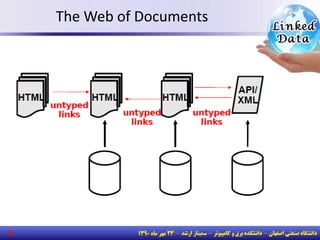
The Web of Documents
 Traditional Web, Hypertext Web
 Analogy
 A global file system
 Designed for
 Human consumption
 Primary objects
 Documents
 Links
 Untyped
 Between documents (or parts of documents)
 Degree of structure in object
 Fairy low
 Semantics of content and links
 implicit
3
The Web of Documents
4
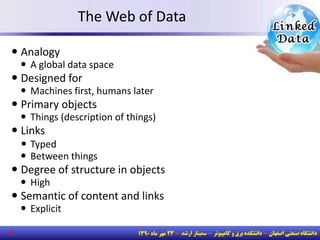
The Web of Data
 Analogy
 A global data space
 Designed for
 Machines first, humans later
 Primary objects
 Things (description of things)
 Links
 Typed
 Between things
 Degree of structure in objects
 High
 Semantic of content and links
 Explicit
5
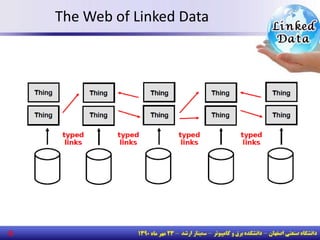
The Web of Linked Data
6
Linked Data
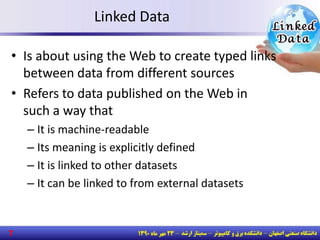
• Is about using the Web to create typed links
between data from different sources
• Refers to data published on the Web in
such a way that
– It is machine-readable
– Its meaning is explicitly defined
– It is linked to other datasets
– It can be linked to from external datasets
7
Properties of the Web of Data
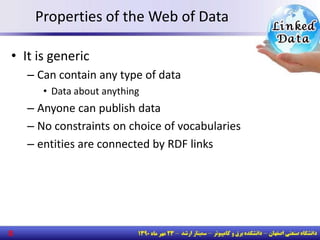
• It is generic
– Can contain any type of data
• Data about anything
– Anyone can publish data
– No constraints on choice of vocabularies
– entities are connected by RDF links
8
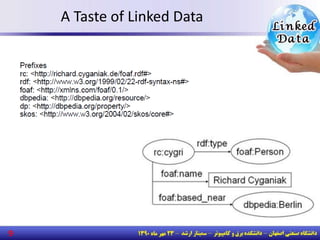
A Taste of Linked Data
9
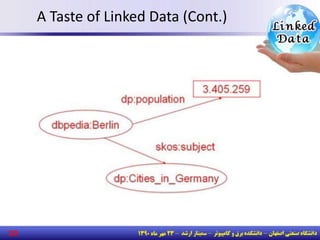
A Taste of Linked Data (Cont.)
10
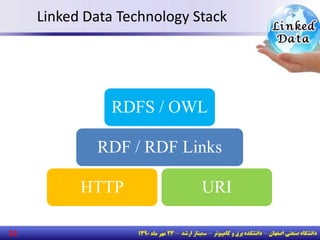
Linked Data Technology Stack
URIHTTP
RDFS / OWL
RDF / RDF Links
11
Ontology , RDF
• Ontology provides a means to vocabularies
and link’s semantics on linked data.
• RDF provides a generic, graph-based data
model to structure and link data that
describes things
• A triple [subject, predicate, object]
– Subject: a URI
– Predicate: a URI
– Object: a URI or a string literal
12
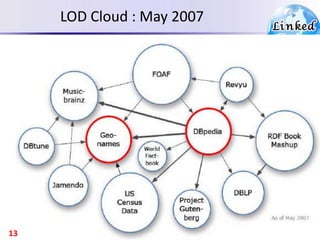
LOD Cloud : May 2007
13
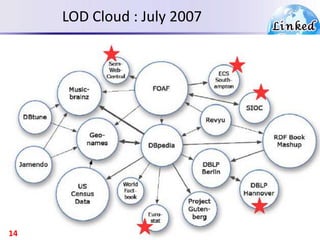
LOD Cloud : July 2007
14
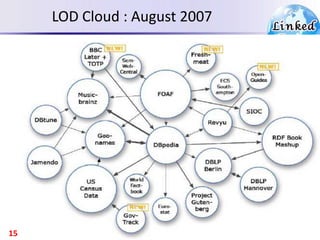
LOD Cloud : August 2007
15
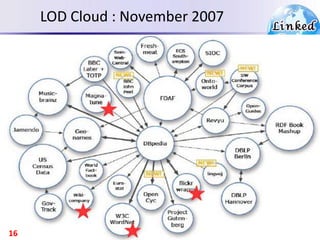
LOD Cloud : November 2007
16
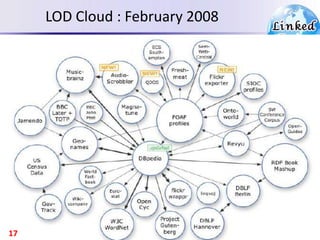
LOD Cloud : February 2008
17
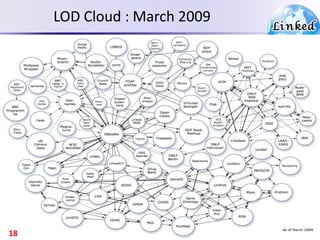
LOD Cloud : March 2009
18
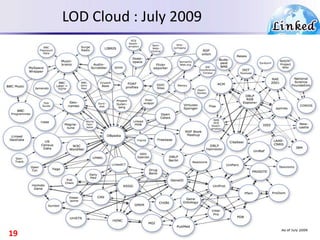
LOD Cloud : July 2009
19
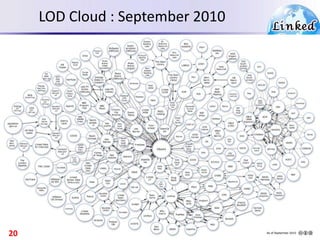
LOD Cloud : September 2010
20
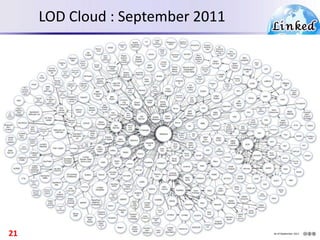
LOD Cloud : September 2011
21
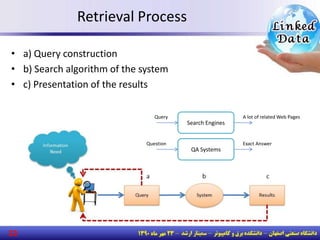
Retrieval Process
22
• a) Query construction
• b) Search algorithm of the system
• c) Presentation of the results
Search Engines
Query A lot of related Web Pages
QA Systems
Question Exact Answer
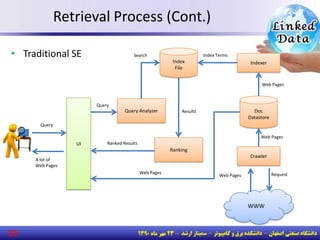
Retrieval Process (Cont.)
23
Query Analyzer
Query
A lot of
Web Pages
WWW
Crawler
RequestWeb Pages
Index
File
Indexer
Web Pages
Index TermsSearch
Ranking
Results Doc
Datastore
Web Pages
UI
Query
Ranked Results
Web Pages
• Traditional SE
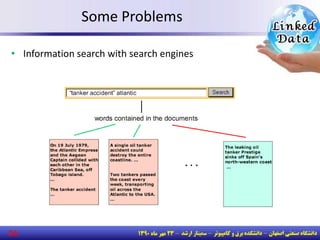
Some Problems
24
• Information search with search engines
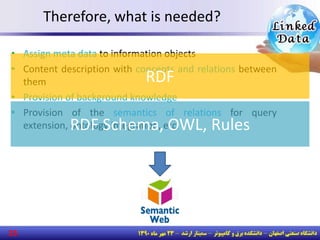
Therefore, what is needed?
25
• Assign meta data to information objects
• Content description with concepts and relations between
them
• Provision of background knowledge
• Provision of the semantics of relations for query
extension, ontology integration, etc.
RDF
RDF Schema, OWL, Rules
26
Question Answering
• Question answering (QA) systems take users’
natural language questions and automatically locate
answers from large collections of documents.
• Two types of QA systems
– Closed-Domain (or restricted domain) Question Answering
– Open-Domain Question Answering
27
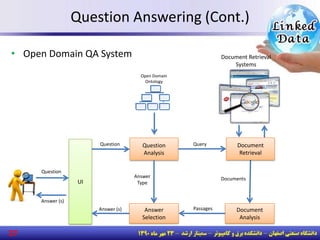
Question Answering (Cont.)
• Open Domain QA System
Question
Analysis
Answer
Selection
Question Query
Answer
Type
Documents
Answer (s)
Question
Answer (s)
UI
Document
Analysis
Passages
Document Retrieval
Systems
Document
Retrieval
Open Domain
Ontology
28
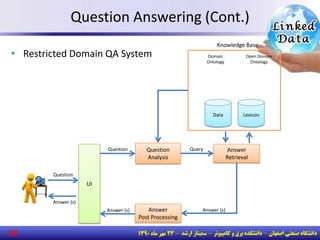
Question Answering (Cont.)
• Restricted Domain QA System
Question
Analysis
Answer
Post Processing
Question Query
Answer (s)
Question
Answer (s)
UI
Answer
Retrieval
Answer (s)
Data
Open Domain
Ontology
Lexicon
Domain
Ontology
Knowledge Base
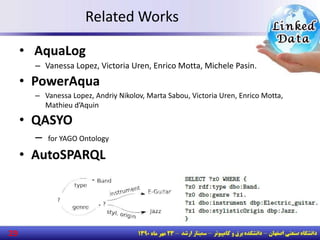
Related Works
• AquaLog
– Vanessa Lopez, Victoria Uren, Enrico Motta, Michele Pasin.
• PowerAqua
– Vanessa Lopez, Andriy Nikolov, Marta Sabou, Victoria Uren, Enrico Motta,
Mathieu d’Aquin
• QASYO
– for YAGO Ontology
• AutoSPARQL
29
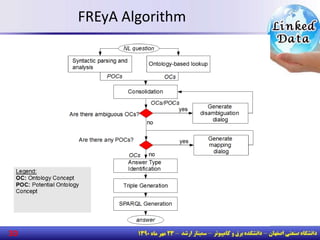
FREyA Algorithm
30
Questions?
31
Email: R.Ramezani@ec.iut.ac.ir

Question answering in linked data

  • 2.
  • 3.
    The Web ofDocuments  Traditional Web, Hypertext Web  Analogy  A global file system  Designed for  Human consumption  Primary objects  Documents  Links  Untyped  Between documents (or parts of documents)  Degree of structure in object  Fairy low  Semantics of content and links  implicit 3
  • 4.
    The Web ofDocuments 4
  • 5.
    The Web ofData  Analogy  A global data space  Designed for  Machines first, humans later  Primary objects  Things (description of things)  Links  Typed  Between things  Degree of structure in objects  High  Semantic of content and links  Explicit 5
  • 6.
    The Web ofLinked Data 6
  • 7.
    Linked Data • Isabout using the Web to create typed links between data from different sources • Refers to data published on the Web in such a way that – It is machine-readable – Its meaning is explicitly defined – It is linked to other datasets – It can be linked to from external datasets 7
  • 8.
    Properties of theWeb of Data • It is generic – Can contain any type of data • Data about anything – Anyone can publish data – No constraints on choice of vocabularies – entities are connected by RDF links 8
  • 9.
    A Taste ofLinked Data 9
  • 10.
    A Taste ofLinked Data (Cont.) 10
  • 11.
    Linked Data TechnologyStack URIHTTP RDFS / OWL RDF / RDF Links 11
  • 12.
    Ontology , RDF •Ontology provides a means to vocabularies and link’s semantics on linked data. • RDF provides a generic, graph-based data model to structure and link data that describes things • A triple [subject, predicate, object] – Subject: a URI – Predicate: a URI – Object: a URI or a string literal 12
  • 13.
    LOD Cloud :May 2007 13
  • 14.
    LOD Cloud :July 2007 14
  • 15.
    LOD Cloud :August 2007 15
  • 16.
    LOD Cloud :November 2007 16
  • 17.
    LOD Cloud :February 2008 17
  • 18.
    LOD Cloud :March 2009 18
  • 19.
    LOD Cloud :July 2009 19
  • 20.
    LOD Cloud :September 2010 20
  • 21.
    LOD Cloud :September 2011 21
  • 22.
    Retrieval Process 22 • a)Query construction • b) Search algorithm of the system • c) Presentation of the results Search Engines Query A lot of related Web Pages QA Systems Question Exact Answer
  • 23.
    Retrieval Process (Cont.) 23 QueryAnalyzer Query A lot of Web Pages WWW Crawler RequestWeb Pages Index File Indexer Web Pages Index TermsSearch Ranking Results Doc Datastore Web Pages UI Query Ranked Results Web Pages • Traditional SE
  • 24.
    Some Problems 24 • Informationsearch with search engines
  • 25.
    Therefore, what isneeded? 25 • Assign meta data to information objects • Content description with concepts and relations between them • Provision of background knowledge • Provision of the semantics of relations for query extension, ontology integration, etc. RDF RDF Schema, OWL, Rules
  • 26.
    26 Question Answering • Questionanswering (QA) systems take users’ natural language questions and automatically locate answers from large collections of documents. • Two types of QA systems – Closed-Domain (or restricted domain) Question Answering – Open-Domain Question Answering
  • 27.
    27 Question Answering (Cont.) •Open Domain QA System Question Analysis Answer Selection Question Query Answer Type Documents Answer (s) Question Answer (s) UI Document Analysis Passages Document Retrieval Systems Document Retrieval Open Domain Ontology
  • 28.
    28 Question Answering (Cont.) •Restricted Domain QA System Question Analysis Answer Post Processing Question Query Answer (s) Question Answer (s) UI Answer Retrieval Answer (s) Data Open Domain Ontology Lexicon Domain Ontology Knowledge Base
  • 29.
    Related Works • AquaLog –Vanessa Lopez, Victoria Uren, Enrico Motta, Michele Pasin. • PowerAqua – Vanessa Lopez, Andriy Nikolov, Marta Sabou, Victoria Uren, Enrico Motta, Mathieu d’Aquin • QASYO – for YAGO Ontology • AutoSPARQL 29
  • 30.
  • 31.