Motivating the Workforce
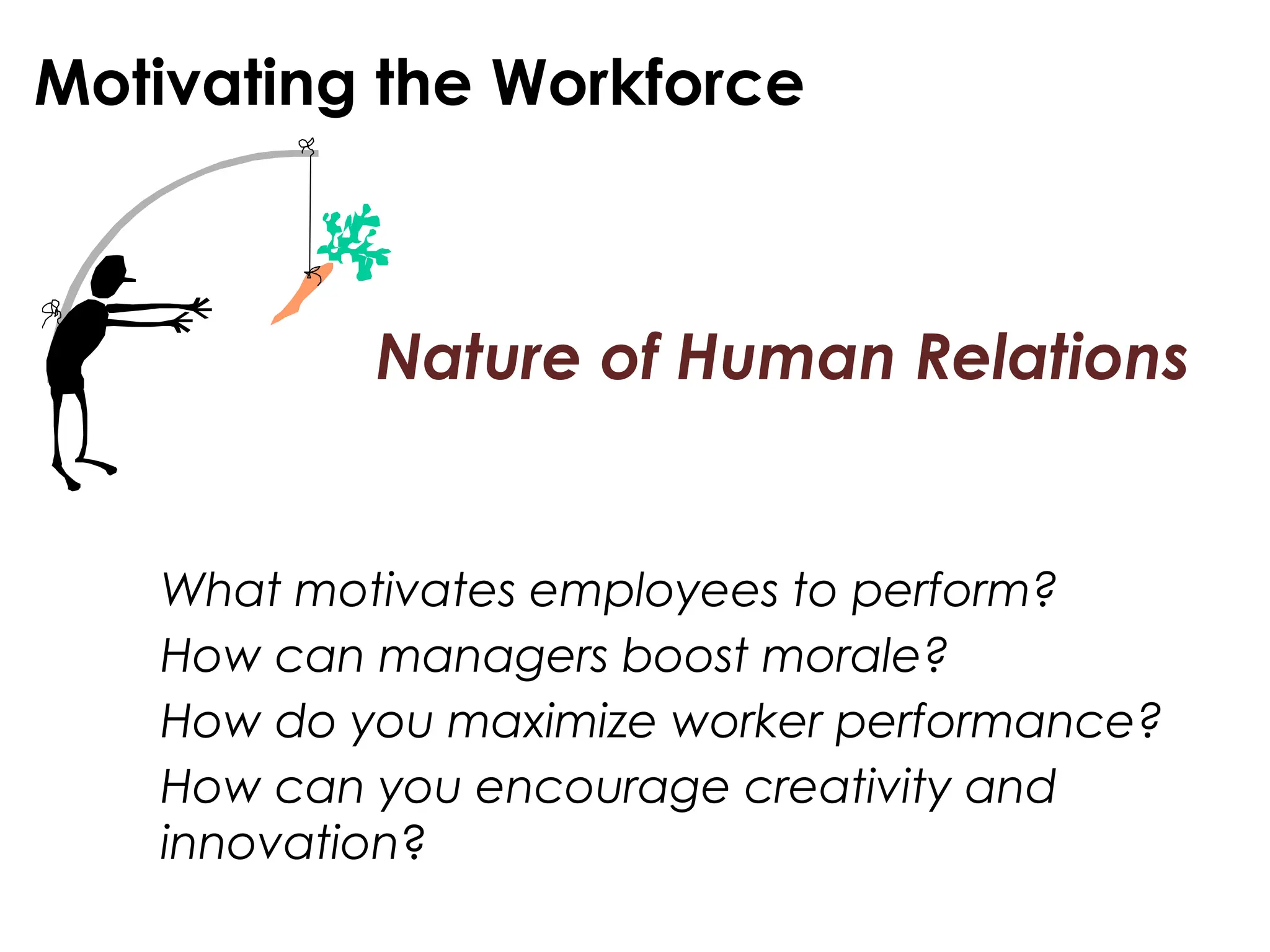
What motivates employees to perform?
How can managers boost morale?
How do you maximize worker performance?
How can you encourage creativity and
innovation?
Nature of Human Relations
Determining what motivates
employees to perform on the
job is the focus of human
relations.
Motivating the Workforce
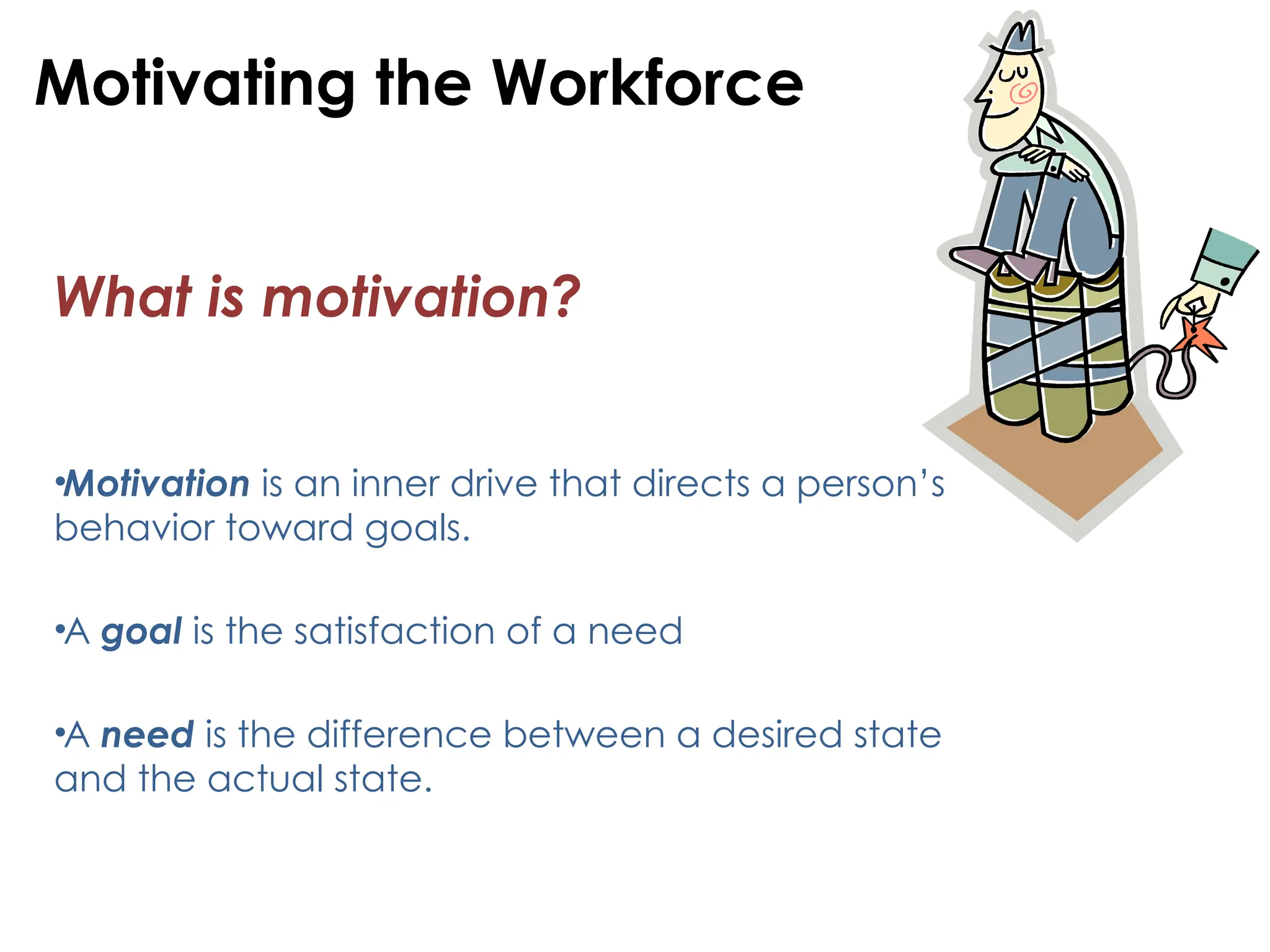
•Motivation is an inner drive that directs a person’s
behavior toward goals.
•A goal is the satisfaction of a need
•A need is the difference between a desired state
and the actual state.
What is motivation?
Motivating the Workforce
The basic model of
motivation shows that when
a need exists, an individual
engages in goal-directed
behavior designed to satisfy
that need.
Motivating the Workforce
Morale – an employee’s attitude
toward his or her job, employer,
and colleagues.
High Morale
•High levels of productivity
•High returns to stakeholders
•Employee loyalty
Motivating the Workforce
Low Morale
•Absenteeism
•Lack of commitment
•High turnover
Motivating the Workforce
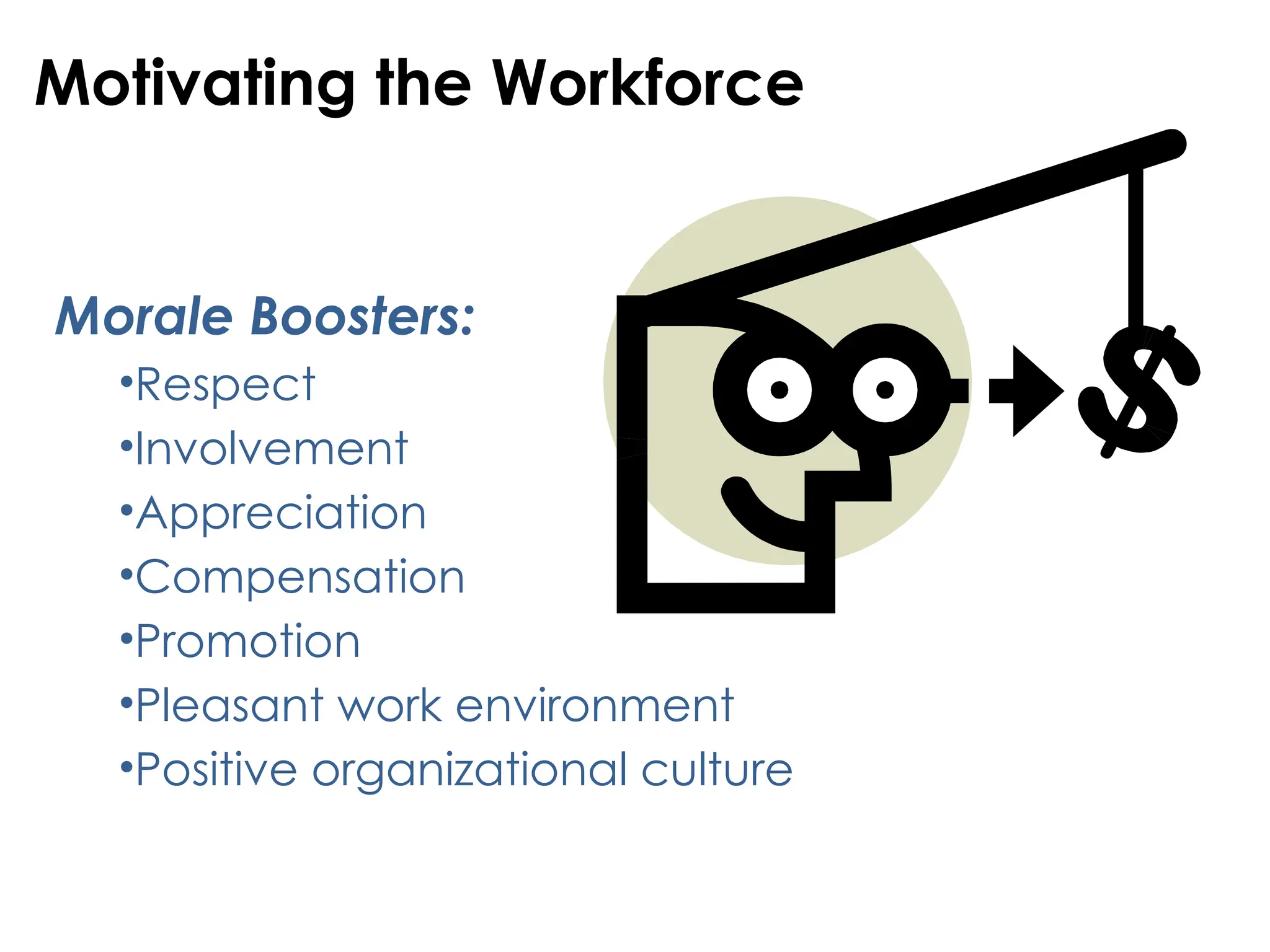
Morale Boosters:
•Respect
•Involvement
•Appreciation
•Compensation
•Promotion
•Pleasant work environment
•Positive organizational culture
Motivating the Workforce
Google’s focus on happy, committed
employees --
•Massage therapy
•Laundry service
•Gourmet meals & snacks
Motivating the Workforce
Intrinsic rewards – personal satisfaction
derived from goal attainment
Extrinsic rewards – benefits/recognition
received from someone else.
Perceptions of Rewards
Motivating the Workforce
Classical Theory of Motivation
Money – sole motivator for workers.
Taylor & Gilbreth – scientific focus on work
tasks & productivity.
Satisfactory pay & job security – motivate
employees to work hard.
Hawthorne Studies
Elton Mayo – postulated that physical conditions in
workplace stimulate productivity.
Productivity increased regardless of light levels
Hawthorne Effect – marks beginning of concern for
human relations in the workplace
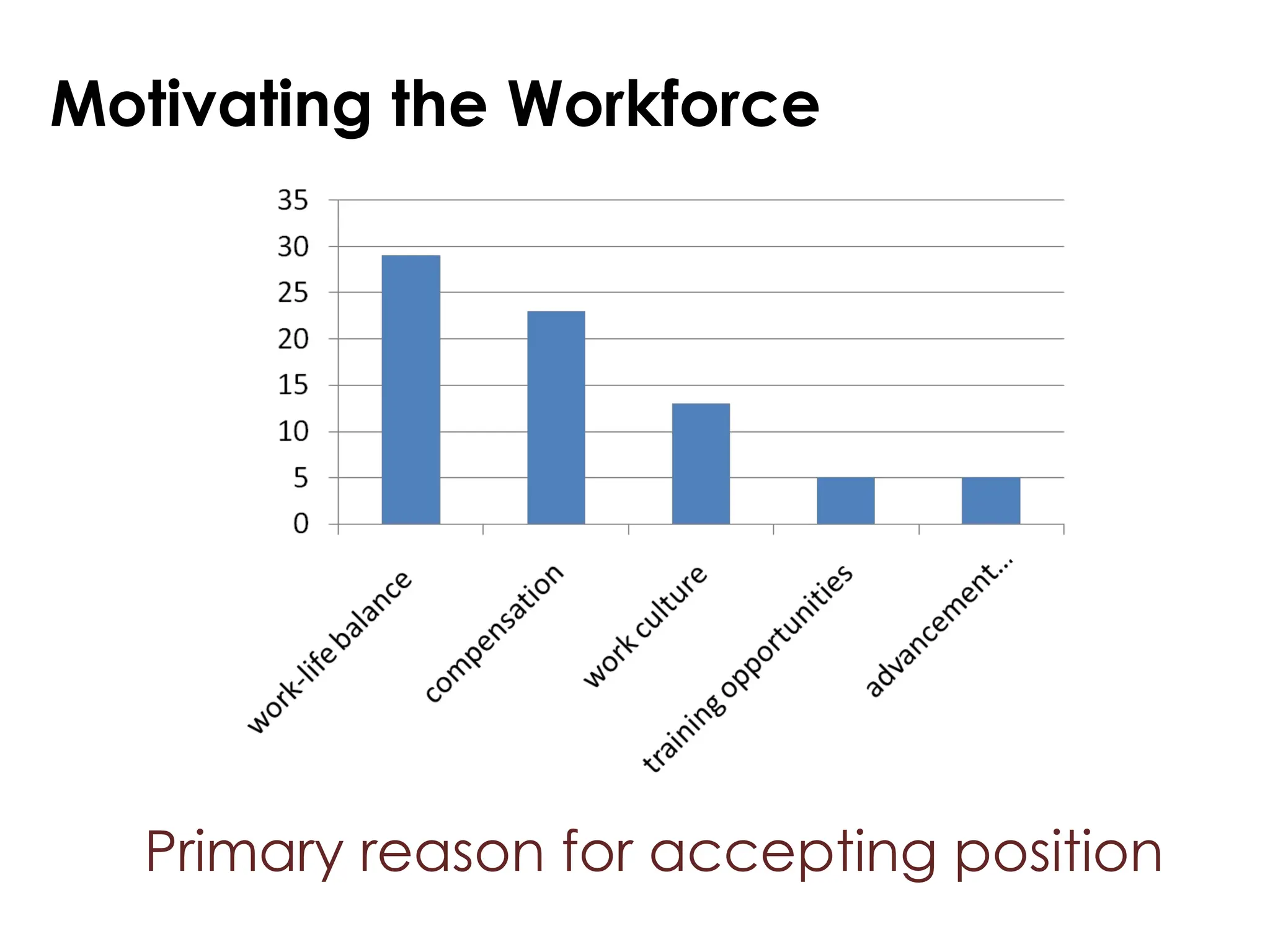
Primary reason for accepting position
Motivating the Workforce
Theories of Employee Motivation
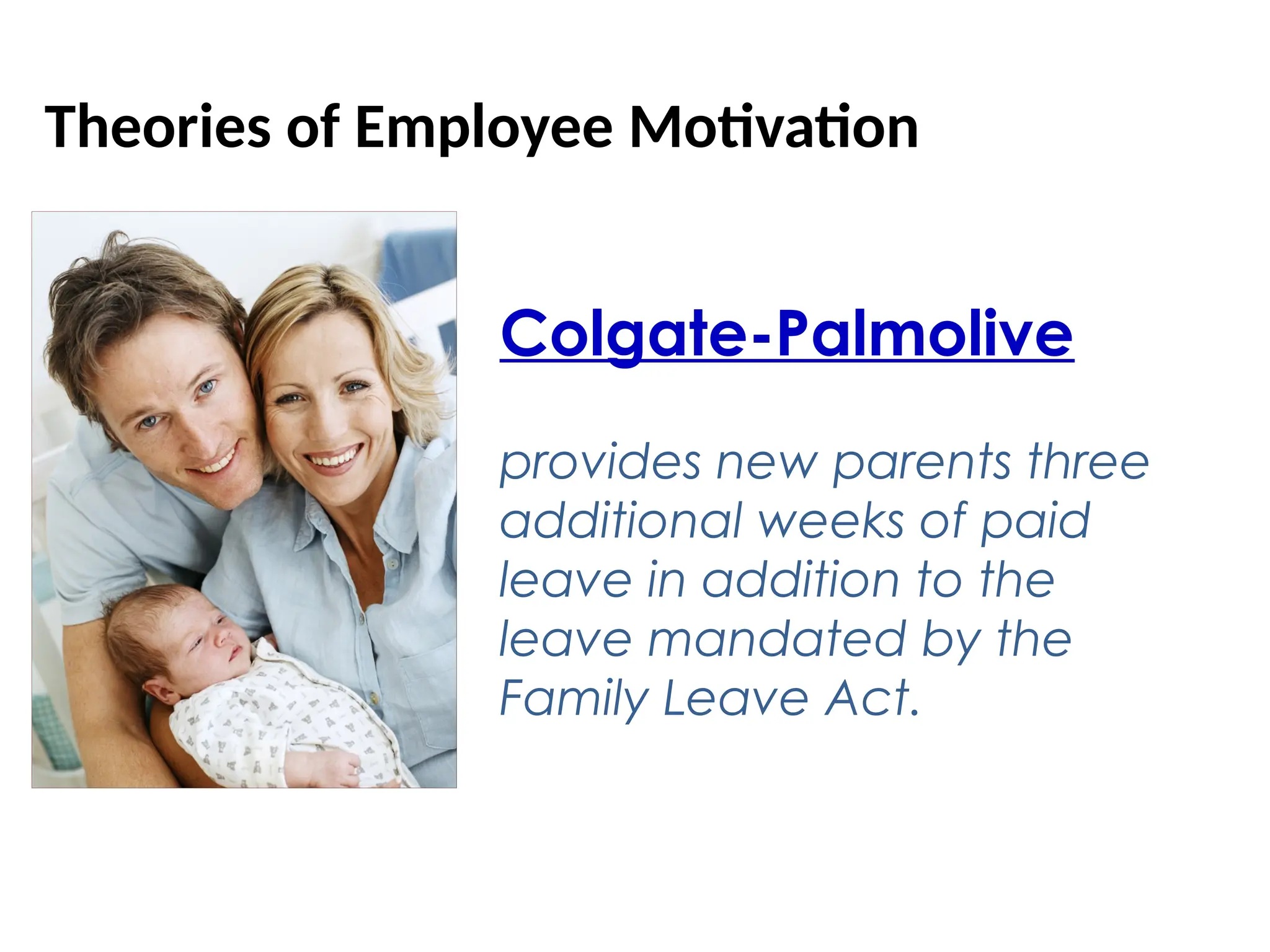
Colgate-Palmolive
provides new parents three
additional weeks of paid
leave in addition to the
leave mandated by the
Family Leave Act.
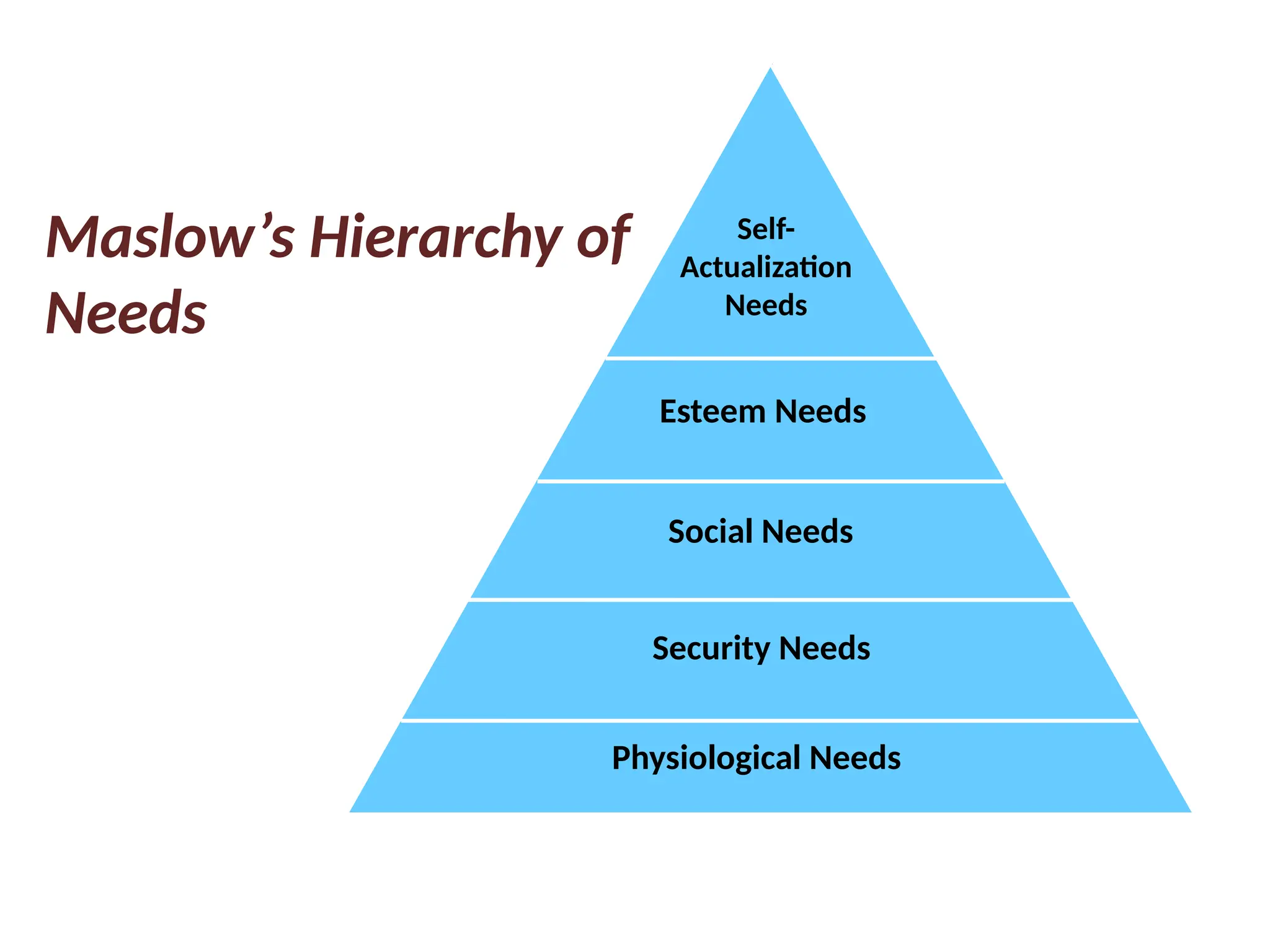
Maslow’s Hierarchy of
Needs
Self-
Actualization
Needs
Esteem Needs
Social Needs
Security Needs
Physiological Needs
Maslow’s Hierarchy of Needs
Physiological needs – basic needs for food, water,
shelter
Security needs– protection from physical &
economic harm
Social needs – need for love, companionship
Esteem needs – self-respect and respect from others
Self-actualization – maximizing one’s potential
Herzberg’s Two-Factor Theory
Hygiene factors – focus on the work
setting not the content of the work –
wages, working conditions, company
policies, job security.
Motivational factors – focus on content of
the work itself – achievement, recognition,
involvement, responsibility, advancement
Herzberg’s Two-Factor Theory
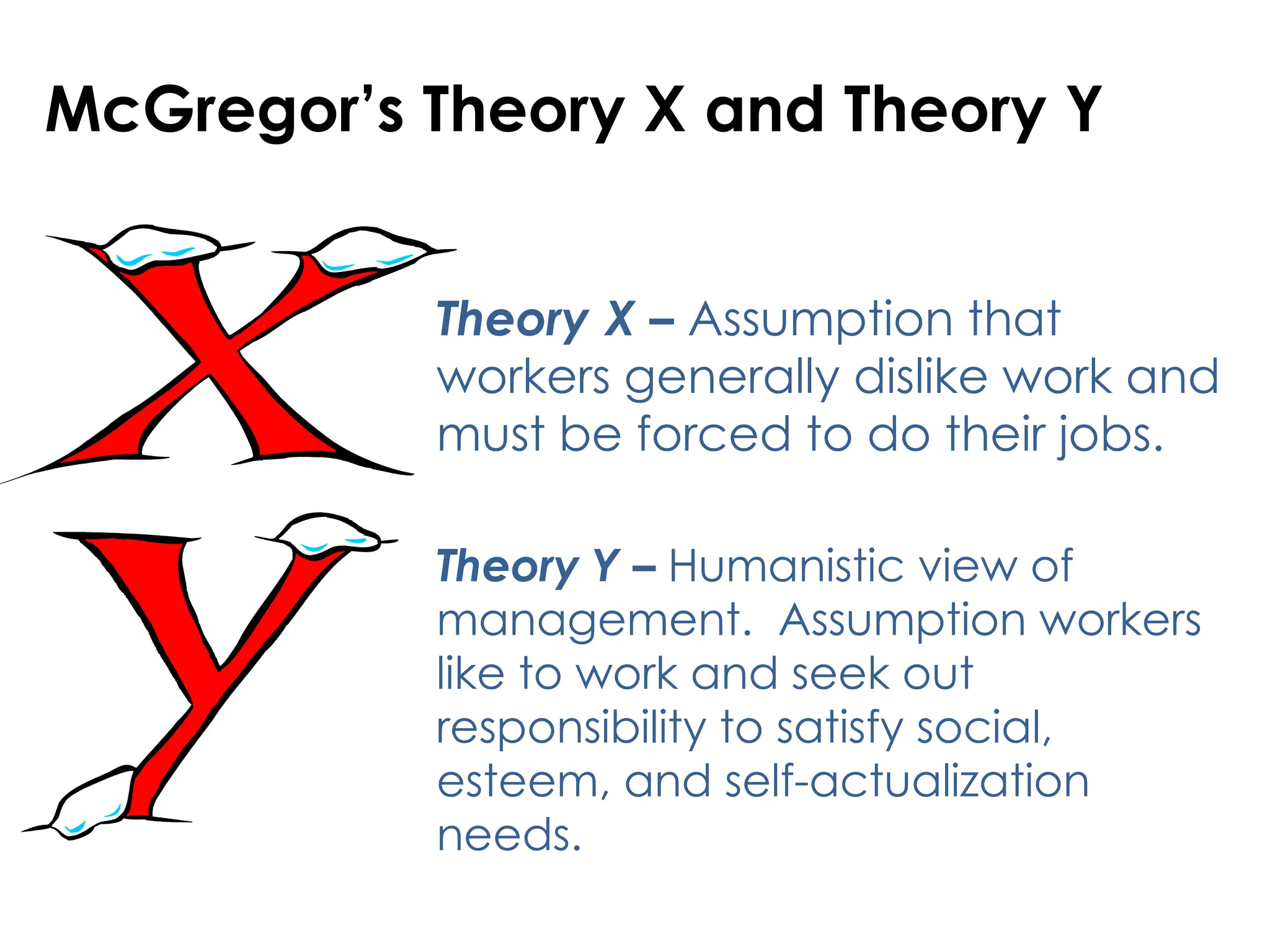
McGregor’s Theory X and Theory Y
Theory X – Assumption that
workers generally dislike work and
must be forced to do their jobs.
Theory Y – Humanistic view of
management. Assumption workers
like to work and seek out
responsibility to satisfy social,
esteem, and self-actualization
needs.
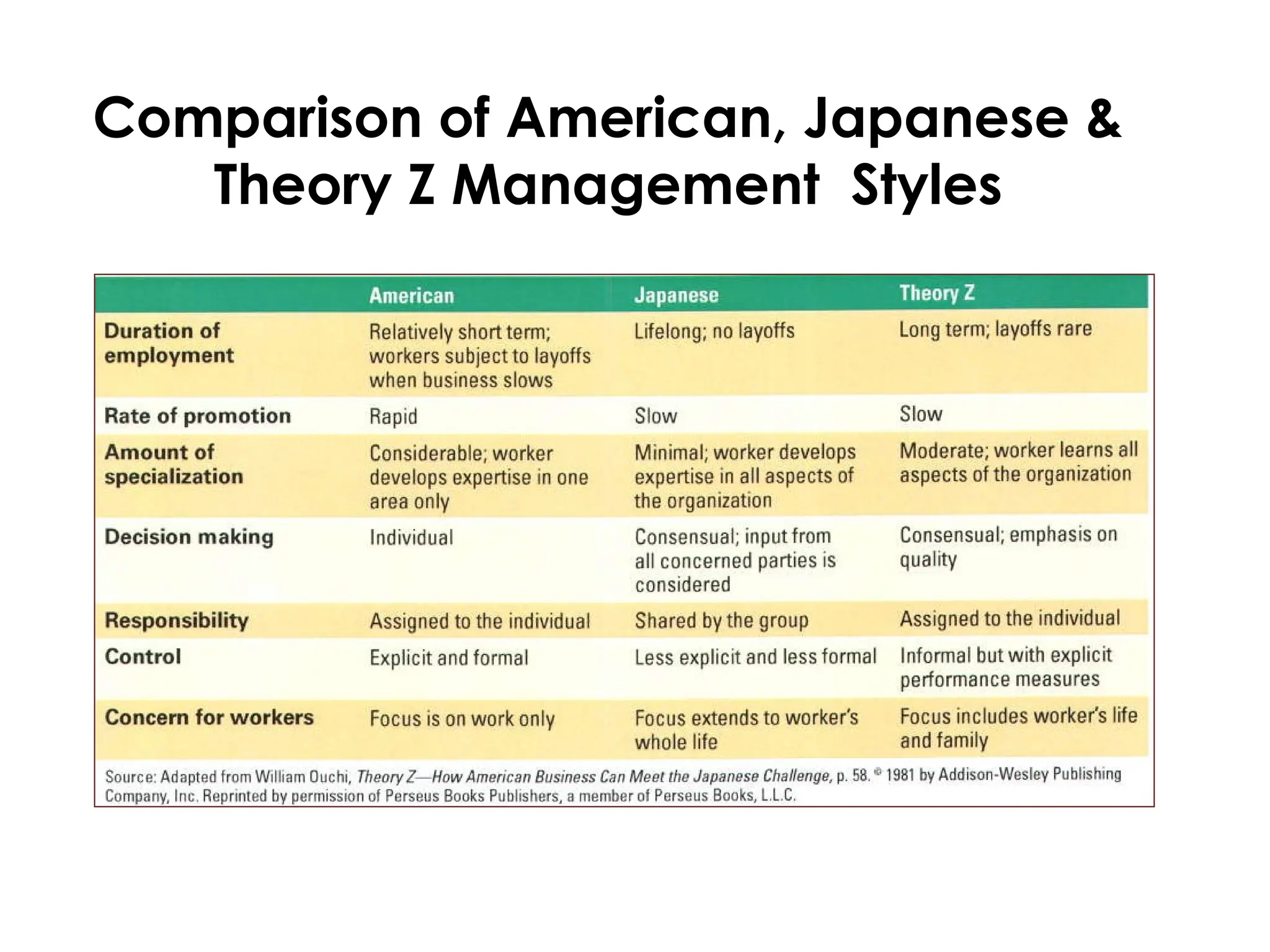
William Ouchi Theory Z
A management philosophy
that stresses employee
participation in all
aspects of company decision
making.
Comparison of American, Japanese &
Theory Z Management Styles
Equity Theory
Equity theory – the assumption
that how much people are
willing to contribute to an
organization depends on their
assessment of the fairness
(equity) of the rewards they will
receive in exchange.
Strategies for Motivating Employees
Behavior Modification – changing behavior and
encouraging appropriate actions by relating the
consequences of behavior to the behavior itself.
“Behavior is a function of its consequences.”
Job Design – strategies managers use to help
improve employee motivation:
•Job rotation
•Job enlargement
•Job enrichment
•Flexible scheduling
Strategies for Motivating Employees
Job Design Strategies
Job rotation – movement of employees
from one job to another to relieve the
boredom often associated with job
specialization.
Job enlargement – addition of more tasks
to a job instead of treating each task as
separate.
Job Design Strategies
Job enrichment – incorporating
motivational factors (achievement,
recognition, responsibility) into the job.
Job Design Strategies
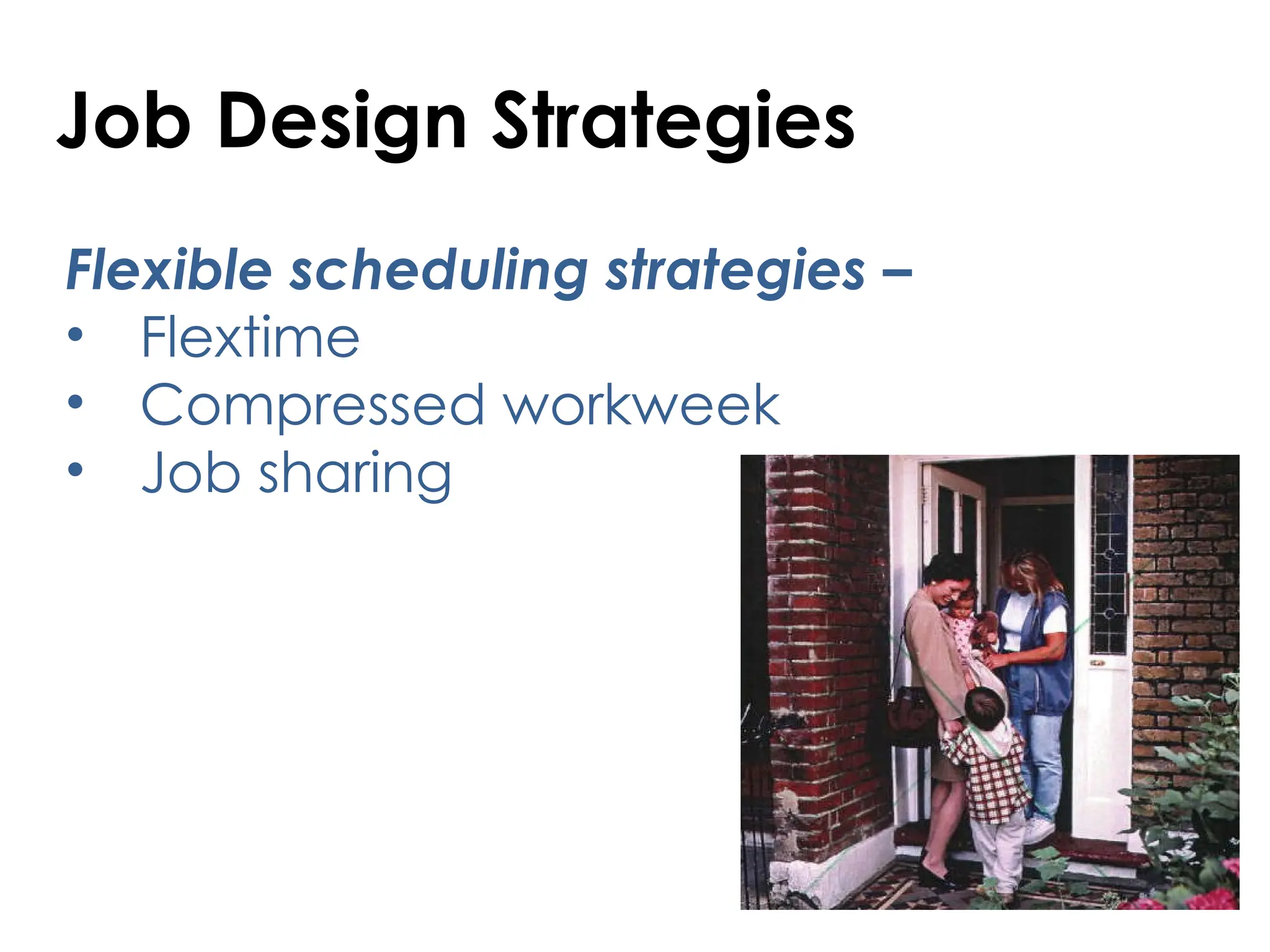
Flexible scheduling strategies –
• Flextime
• Compressed workweek
• Job sharing
Importance of Motivational Strategies
•Foster employee loyalty
•Boost productivity
•Influence on pay, promotion, job design
•Nature of relationships
•Nature of the job itself
•Characteristics of the organization
The Six P’s – Motivational Teaching
Strategies
• Projects – motivate the autonomous or inquisitive child
• People – motivate the gregarious or affiliation-driven
child
• Praise – motivates the status-driven or recognition-
driven or affiliation-driven child
• Prizes – motivates the status-driven or recognition-
driven or affiliation-driven or power-driven child
• Prestige – motivates the autonomous or status-driven or
aggressive or power-driven child
• Power – motivates the power-driven or autonomous or
aggressive-driven child
Remember…
If the child cannot learn the
way that we teach, we
must teach the way that he
learns.
-Richard Lavoie
Human Resource and
Motivation in the Work
Place
REPORTER:
JOANNA MARIE B. CERVANTES
MAED-ADMIN AND SUPERVISION

Human_Relations_and_Motivation_CERVANTESJM.pptXXXXX

  • 3.
    Motivating the Workforce Whatmotivates employees to perform? How can managers boost morale? How do you maximize worker performance? How can you encourage creativity and innovation? Nature of Human Relations
  • 4.
    Determining what motivates employeesto perform on the job is the focus of human relations. Motivating the Workforce
  • 5.
    •Motivation is aninner drive that directs a person’s behavior toward goals. •A goal is the satisfaction of a need •A need is the difference between a desired state and the actual state. What is motivation? Motivating the Workforce
  • 6.
    The basic modelof motivation shows that when a need exists, an individual engages in goal-directed behavior designed to satisfy that need. Motivating the Workforce
  • 7.
    Morale – anemployee’s attitude toward his or her job, employer, and colleagues. High Morale •High levels of productivity •High returns to stakeholders •Employee loyalty Motivating the Workforce
  • 8.
    Low Morale •Absenteeism •Lack ofcommitment •High turnover Motivating the Workforce
  • 9.
    Morale Boosters: •Respect •Involvement •Appreciation •Compensation •Promotion •Pleasant workenvironment •Positive organizational culture Motivating the Workforce
  • 10.
    Google’s focus onhappy, committed employees -- •Massage therapy •Laundry service •Gourmet meals & snacks Motivating the Workforce
  • 11.
    Intrinsic rewards –personal satisfaction derived from goal attainment Extrinsic rewards – benefits/recognition received from someone else. Perceptions of Rewards Motivating the Workforce
  • 12.
    Classical Theory ofMotivation Money – sole motivator for workers. Taylor & Gilbreth – scientific focus on work tasks & productivity. Satisfactory pay & job security – motivate employees to work hard.
  • 13.
    Hawthorne Studies Elton Mayo– postulated that physical conditions in workplace stimulate productivity. Productivity increased regardless of light levels Hawthorne Effect – marks beginning of concern for human relations in the workplace
  • 14.
    Primary reason foraccepting position Motivating the Workforce
  • 15.
    Theories of EmployeeMotivation Colgate-Palmolive provides new parents three additional weeks of paid leave in addition to the leave mandated by the Family Leave Act.
  • 16.
    Maslow’s Hierarchy of Needs Self- Actualization Needs EsteemNeeds Social Needs Security Needs Physiological Needs
  • 17.
    Maslow’s Hierarchy ofNeeds Physiological needs – basic needs for food, water, shelter Security needs– protection from physical & economic harm Social needs – need for love, companionship Esteem needs – self-respect and respect from others Self-actualization – maximizing one’s potential
  • 18.
    Herzberg’s Two-Factor Theory Hygienefactors – focus on the work setting not the content of the work – wages, working conditions, company policies, job security. Motivational factors – focus on content of the work itself – achievement, recognition, involvement, responsibility, advancement
  • 19.
  • 20.
    McGregor’s Theory Xand Theory Y Theory X – Assumption that workers generally dislike work and must be forced to do their jobs. Theory Y – Humanistic view of management. Assumption workers like to work and seek out responsibility to satisfy social, esteem, and self-actualization needs.
  • 21.
    William Ouchi TheoryZ A management philosophy that stresses employee participation in all aspects of company decision making.
  • 22.
    Comparison of American,Japanese & Theory Z Management Styles
  • 23.
    Equity Theory Equity theory– the assumption that how much people are willing to contribute to an organization depends on their assessment of the fairness (equity) of the rewards they will receive in exchange.
  • 24.
    Strategies for MotivatingEmployees Behavior Modification – changing behavior and encouraging appropriate actions by relating the consequences of behavior to the behavior itself. “Behavior is a function of its consequences.”
  • 25.
    Job Design –strategies managers use to help improve employee motivation: •Job rotation •Job enlargement •Job enrichment •Flexible scheduling Strategies for Motivating Employees
  • 26.
    Job Design Strategies Jobrotation – movement of employees from one job to another to relieve the boredom often associated with job specialization.
  • 27.
    Job enlargement –addition of more tasks to a job instead of treating each task as separate. Job Design Strategies
  • 28.
    Job Design Strategies Jobenrichment – incorporating motivational factors (achievement, recognition, responsibility) into the job.
  • 29.
    Job Design Strategies Flexiblescheduling strategies – • Flextime • Compressed workweek • Job sharing
  • 30.
    Importance of MotivationalStrategies •Foster employee loyalty •Boost productivity •Influence on pay, promotion, job design •Nature of relationships •Nature of the job itself •Characteristics of the organization
  • 31.
    The Six P’s– Motivational Teaching Strategies • Projects – motivate the autonomous or inquisitive child • People – motivate the gregarious or affiliation-driven child • Praise – motivates the status-driven or recognition- driven or affiliation-driven child • Prizes – motivates the status-driven or recognition- driven or affiliation-driven or power-driven child • Prestige – motivates the autonomous or status-driven or aggressive or power-driven child • Power – motivates the power-driven or autonomous or aggressive-driven child
  • 32.
    Remember… If the childcannot learn the way that we teach, we must teach the way that he learns. -Richard Lavoie
  • 37.
    Human Resource and Motivationin the Work Place REPORTER: JOANNA MARIE B. CERVANTES MAED-ADMIN AND SUPERVISION

Editor's Notes