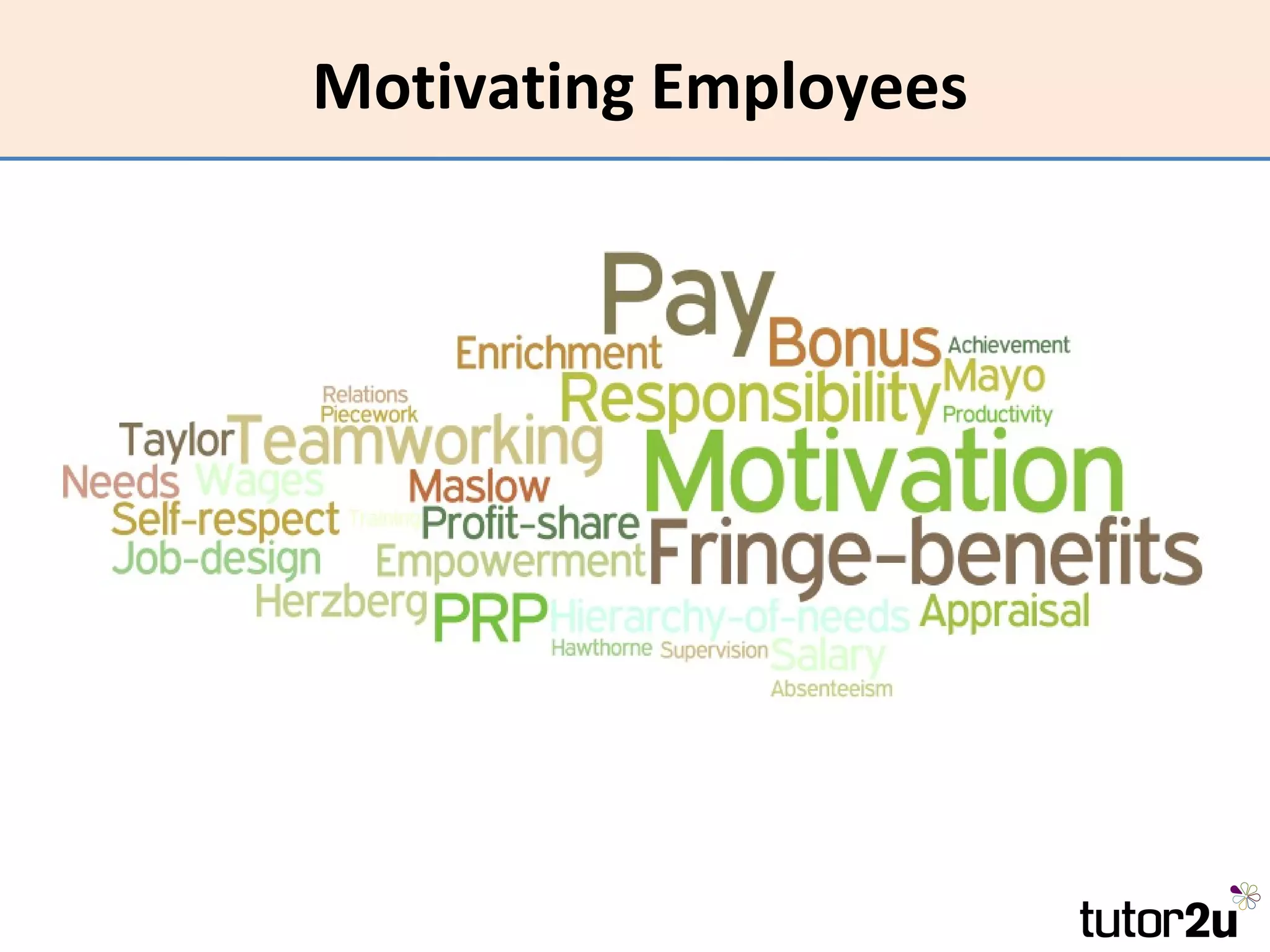
Motivating Employees
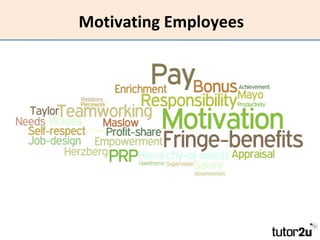
What this topic is all about Overview of the theories that support motivational techniques at work Practical approaches to motivation in the workplace (financial & non-financial) How motivation links to: Organisational structure Improving profit and quality
Motivation What is it? Motivation is  will to work Comes from enjoyment of work itself and/or from desire to achieve certain goals e.g. earn more money or achieve promotion Methods available to motivate employees Financial methods (e.g. salary, bonus)  Non-financial methods (passing on responsibility or praise)
Advantages of a Well Motivated Workforce Better productivity (amount produced per employee) Better quality Lower levels of absenteeism Lower levels of staff turnover (number of employees leaving business) Lower training and recruitment costs
The Theory of Motivation
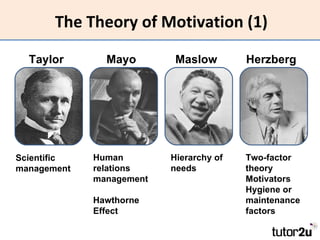
The Theory of Motivation (1) Taylor Mayo Maslow Herzberg Scientific management Human relations management Hawthorne Effect Two-factor theory Motivators Hygiene or maintenance factors Hierarchy of needs
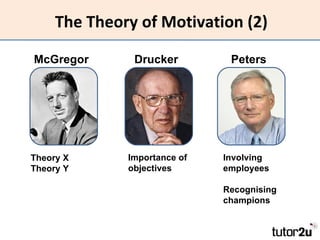
The Theory of Motivation (2) McGregor Drucker Peters Theory X Theory Y Importance of objectives Involving employees Recognising champions
Taylor’s Theory of Motivation Managers should maintain  close control and supervision  over their employees. Autocratic style of management- managers make all decisions themselves Theory X approach to workers- believe workers are lazy and are only motivated by money Motivate workers using piece-rate payment (pay based on how much they produce)
Mayo’s Theory of Motivation Workers are not just motivated by money but also by having their human/social needs met Increase motivation by: Better communication between managers and workers Greater manager involvement in employees working lives Working in groups In practice, therefore, businesses should introduce team working and personnel departments to look after employees interests
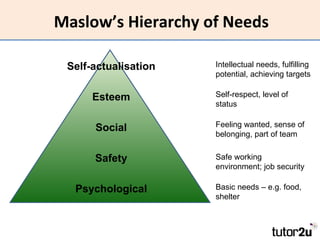
Maslow’s Theory of Motivation Five levels of human needs which employees need to have fulfilled at work  Only once a lower level of need has been fully met, would a worker be motivated by the opportunity of having the next need up in the hierarchy satisfied A business should therefore offer different incentives to workers in order to help them fulfill each need in turn and progress up the hierarchy
Maslow’s Hierarchy of Needs Psychological Basic needs – e.g. food, shelter Safety Social Esteem Self-actualisation Safe working environment; job security Feeling wanted, sense of belonging, part of team Self-respect, level of status Intellectual needs, fulfilling potential, achieving targets
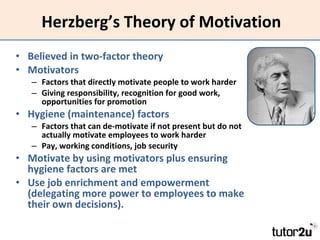
Herzberg’s Theory of Motivation Believed in two-factor theory Motivators Factors that directly motivate people to work harder Giving responsibility, recognition for good work, opportunities for promotion Hygiene (maintenance) factors Factors that can de-motivate if not present but do not actually motivate employees to work harder Pay, working conditions, job security Motivate by using motivators plus ensuring hygiene factors are met Use job enrichment and empowerment (delegating more power to employees to make their own decisions).
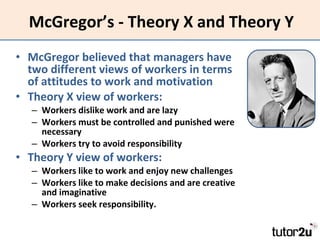
McGregor’s - Theory X and Theory Y McGregor believed that managers have two different views of workers in terms of attitudes to work and motivation Theory X view of workers: Workers dislike work and are lazy Workers must be controlled and punished were necessary Workers try to avoid responsibility Theory Y view of workers: Workers like to work and enjoy new challenges Workers like to make decisions and are creative and imaginative Workers seek responsibility.
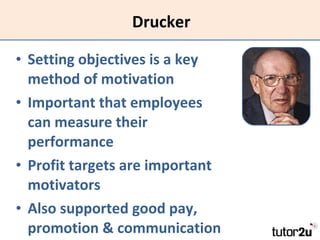
Drucker Setting objectives is a key method of motivation Important that employees can measure their performance Profit targets are important motivators Also supported good pay, promotion & communication
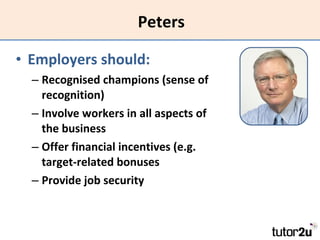
Peters Employers should: Recognised champions (sense of recognition) Involve workers in all aspects of the business Offer financial incentives (e.g. target-related bonuses Provide job security
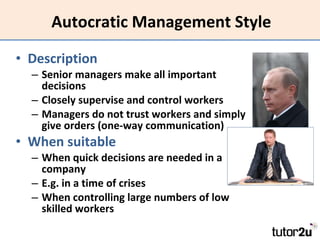
Autocratic Management Style Description Senior managers make all important decisions Closely supervise and control workers Managers do not trust workers and simply give orders (one-way communication) When suitable When quick decisions are needed in a company E.g. in a time of crises When controlling large numbers of low skilled workers
Democratic Management Style Managers trust employees Encourage employees to make decisions Delegate authority/power to employees and listen to their advice
Implications of theory for management styles? A distinction is often made between: Autocratic management Democratic management Which is best or most suitable?
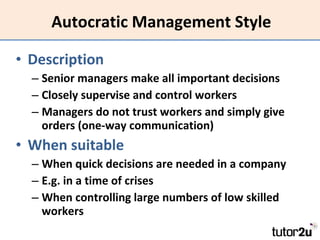
Autocratic Management Style Description Senior managers make all important decisions Closely supervise and control workers Managers do not trust workers and simply give orders (one-way communication) When suitable When quick decisions are needed in a company E.g. in a time of crises When controlling large numbers of low skilled workers
Democratic Management Style Managers trust employees Encourage employees to make decisions Delegate authority/power to employees and listen to their advice
Best Approach/Style for Management? Depends on circumstances Whether workers are skilled or experienced Level of genuine motivation Whether quick decisions are needed etc Best managers are those that are versatile and can call upon right style at right time
Motivation in Practice
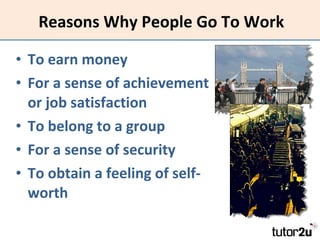
Reasons Why People Go To Work To earn money For a sense of achievement or job satisfaction To belong to a group For a sense of security To obtain a feeling of self-worth
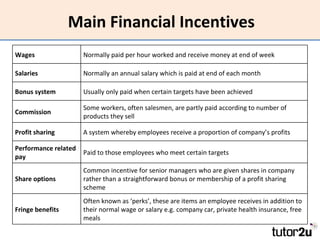
Main Financial Incentives Wages  Normally paid per hour worked and receive money at end of week Salaries Normally an annual salary which is paid at end of each month Bonus system Usually only paid when certain targets have been achieved Commission Some workers, often salesmen, are partly paid according to number of products they sell Profit sharing A system whereby employees receive a proportion of company’s profits Performance related pay Paid to those employees who meet certain targets Share options Common incentive for senior managers who are given shares in company rather than a straightforward bonus or membership of a profit sharing scheme Fringe benefits Often known as ‘perks’, these are items an employee receives in addition to their normal wage or salary e.g. company car, private health insurance, free meals
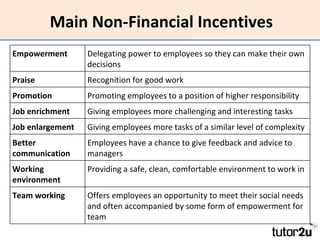
Main Non-Financial Incentives Empowerment Delegating power to employees so they can make their own decisions Praise  Recognition for good work Promotion Promoting employees to a position of higher responsibility Job enrichment Giving employees more challenging and interesting tasks Job enlargement Giving employees more tasks of a similar level of complexity Better communication Employees have a chance to give feedback and advice to managers Working environment  Providing a safe, clean, comfortable environment to work in Team working Offers employees an opportunity to meet their social needs and often accompanied by some form of empowerment for team
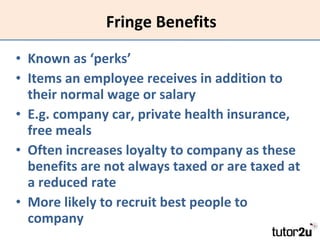
Fringe Benefits Known as ‘perks’ Items an employee receives in addition to their normal wage or salary E.g. company car, private health insurance, free meals Often increases loyalty to company as these benefits are not always taxed or are taxed at a reduced rate More likely to recruit best people to company
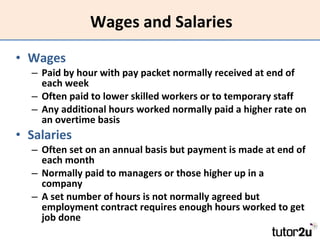
Wages and Salaries Wages Paid by hour with pay packet normally received at end of each week Often paid to lower skilled workers or to temporary staff  Any additional hours worked normally paid a higher rate on an overtime basis Salaries Often set on an annual basis but payment is made at end of each month Normally paid to managers or those higher up in a company A set number of hours is not normally agreed but employment contract requires enough hours worked to get job done
Gross and Net Pay Gross pay: Pay each month or week before any deductions have been removed E.g. before income tax, national insurance contributions Net pay: Pay after deductions have been taken off Sometimes known as take-home pay
Overtime and Bonus Pay Overtime Additional hours worked over and above normal working hours E.g. at weekends or on bank holidays Paid at a higher rate - often 1.5 or 2 times normal hourly wage Bonus pay Given out when certain performance targets have been met Normally applicable at manager level in a company How bonuses are used: By motivating employees to work harder in order to meet a realistic yet challenging target and therefore achieve a bonus payment Would only be effective if bonus payments were a significant sum
Profit Sharing What it is: A system whereby employees receive a proportion of business profits Advantages Creates a direct link between pay and performance Creates a sense of team spirit- helps remove ‘them and us’ barrier between managers and workers if all employees involved May improve employee’s loyalty to company Employees more likely to accept changes in working practices if can see that profits will increase overall
Performance Related Pay Increasingly popular method of paying people Paid to those employees who meet certain targets Advantages Senior managers can easily monitor and assess individual employee performance during appraisal process Setting of targets for employees can ensure they are all closely focused to company objectives Disadvantages Discourages a team based approach- can create unhealthy rivalry between managers Can be difficult to accurately measure performance of some workers e.g. in service sector firms Incentives may not be larger enough to motivate employees
Motivational Theorist Views on Pay Taylor was only theorist to emphasis pay, in particular piece-rate, as best way of motivating employees Mayo, Maslow and Herzberg all felt that non-financial rewards, such as teamworking, empowerment or job enrichment, acted as a better incentive for employees to work harder
Job Enrichment and Job Enlargement Job enrichment Giving workers more interesting and challenging tasks Seen as more motivating as it gives workers chance to further themselves Herzberg in particular recommended this approach Job enlargement Giving workers more tasks to do of a similar nature or complexity Job rotation is a part of this
Piece Rate Payment Relatively unusual and old-fashioned way of payment Pay per item produced in a certain period of time Advantages Requires low levels of manager supervision Encourages high speed production Provides good incentive for workers who are mainly motivated by pay Disadvantages Workers are focused on quantity not quality It is repetitive for workers and can be de-motivating Workers are only used to one set method of production and may resistant change
Commission A financial incentive linked to achievement of sales Typical set-up % commission for £value of sale achieved Basis commission rate set at low rate Higher rate offered once sales targets are achieved Main advantage – clear link between sales and remuneration Main disadvantages – sales may be influence by factors outside of employee control (e.g. mature product, customer service)
Reasons for Pay Differentials Mainly due to supply and demand People with skills that are in demand, but are in short supply, get paid more Cost of living varies between regions Some jobs require qualifications (e.g. accountants, lawyers)
Working in Teams
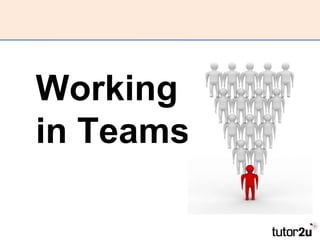
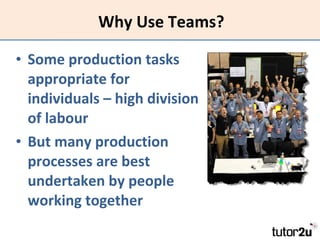
Why Use Teams? Some production tasks appropriate for individuals – high division of labour But many production processes are best undertaken by people working together
Benefits of Teamworking Higher productivity More flexible workforce (team members tend to be multi-skilled) Improved quality Reduced wastage More job satisfaction = better motivation Higher customer service
Test Your Understanding http://www.tutor2u.net/business/quiz/motivation/quiz.html
Motivating Employees

Aqa bus2-peoplemotivation

  • 1.
  • 2.
    What this topicis all about Overview of the theories that support motivational techniques at work Practical approaches to motivation in the workplace (financial & non-financial) How motivation links to: Organisational structure Improving profit and quality
  • 3.
    Motivation What isit? Motivation is will to work Comes from enjoyment of work itself and/or from desire to achieve certain goals e.g. earn more money or achieve promotion Methods available to motivate employees Financial methods (e.g. salary, bonus) Non-financial methods (passing on responsibility or praise)
  • 4.
    Advantages of aWell Motivated Workforce Better productivity (amount produced per employee) Better quality Lower levels of absenteeism Lower levels of staff turnover (number of employees leaving business) Lower training and recruitment costs
  • 5.
    The Theory ofMotivation
  • 6.
    The Theory ofMotivation (1) Taylor Mayo Maslow Herzberg Scientific management Human relations management Hawthorne Effect Two-factor theory Motivators Hygiene or maintenance factors Hierarchy of needs
  • 7.
    The Theory ofMotivation (2) McGregor Drucker Peters Theory X Theory Y Importance of objectives Involving employees Recognising champions
  • 8.
    Taylor’s Theory ofMotivation Managers should maintain close control and supervision over their employees. Autocratic style of management- managers make all decisions themselves Theory X approach to workers- believe workers are lazy and are only motivated by money Motivate workers using piece-rate payment (pay based on how much they produce)
  • 9.
    Mayo’s Theory ofMotivation Workers are not just motivated by money but also by having their human/social needs met Increase motivation by: Better communication between managers and workers Greater manager involvement in employees working lives Working in groups In practice, therefore, businesses should introduce team working and personnel departments to look after employees interests
  • 10.
    Maslow’s Theory ofMotivation Five levels of human needs which employees need to have fulfilled at work Only once a lower level of need has been fully met, would a worker be motivated by the opportunity of having the next need up in the hierarchy satisfied A business should therefore offer different incentives to workers in order to help them fulfill each need in turn and progress up the hierarchy
  • 11.
    Maslow’s Hierarchy ofNeeds Psychological Basic needs – e.g. food, shelter Safety Social Esteem Self-actualisation Safe working environment; job security Feeling wanted, sense of belonging, part of team Self-respect, level of status Intellectual needs, fulfilling potential, achieving targets
  • 12.
    Herzberg’s Theory ofMotivation Believed in two-factor theory Motivators Factors that directly motivate people to work harder Giving responsibility, recognition for good work, opportunities for promotion Hygiene (maintenance) factors Factors that can de-motivate if not present but do not actually motivate employees to work harder Pay, working conditions, job security Motivate by using motivators plus ensuring hygiene factors are met Use job enrichment and empowerment (delegating more power to employees to make their own decisions).
  • 13.
    McGregor’s - TheoryX and Theory Y McGregor believed that managers have two different views of workers in terms of attitudes to work and motivation Theory X view of workers: Workers dislike work and are lazy Workers must be controlled and punished were necessary Workers try to avoid responsibility Theory Y view of workers: Workers like to work and enjoy new challenges Workers like to make decisions and are creative and imaginative Workers seek responsibility.
  • 14.
    Drucker Setting objectivesis a key method of motivation Important that employees can measure their performance Profit targets are important motivators Also supported good pay, promotion & communication
  • 15.
    Peters Employers should:Recognised champions (sense of recognition) Involve workers in all aspects of the business Offer financial incentives (e.g. target-related bonuses Provide job security
  • 16.
    Autocratic Management StyleDescription Senior managers make all important decisions Closely supervise and control workers Managers do not trust workers and simply give orders (one-way communication) When suitable When quick decisions are needed in a company E.g. in a time of crises When controlling large numbers of low skilled workers
  • 17.
    Democratic Management StyleManagers trust employees Encourage employees to make decisions Delegate authority/power to employees and listen to their advice
  • 18.
    Implications of theoryfor management styles? A distinction is often made between: Autocratic management Democratic management Which is best or most suitable?
  • 19.
    Autocratic Management StyleDescription Senior managers make all important decisions Closely supervise and control workers Managers do not trust workers and simply give orders (one-way communication) When suitable When quick decisions are needed in a company E.g. in a time of crises When controlling large numbers of low skilled workers
  • 20.
    Democratic Management StyleManagers trust employees Encourage employees to make decisions Delegate authority/power to employees and listen to their advice
  • 21.
    Best Approach/Style forManagement? Depends on circumstances Whether workers are skilled or experienced Level of genuine motivation Whether quick decisions are needed etc Best managers are those that are versatile and can call upon right style at right time
  • 22.
  • 23.
    Reasons Why PeopleGo To Work To earn money For a sense of achievement or job satisfaction To belong to a group For a sense of security To obtain a feeling of self-worth
  • 24.
    Main Financial IncentivesWages Normally paid per hour worked and receive money at end of week Salaries Normally an annual salary which is paid at end of each month Bonus system Usually only paid when certain targets have been achieved Commission Some workers, often salesmen, are partly paid according to number of products they sell Profit sharing A system whereby employees receive a proportion of company’s profits Performance related pay Paid to those employees who meet certain targets Share options Common incentive for senior managers who are given shares in company rather than a straightforward bonus or membership of a profit sharing scheme Fringe benefits Often known as ‘perks’, these are items an employee receives in addition to their normal wage or salary e.g. company car, private health insurance, free meals
  • 25.
    Main Non-Financial IncentivesEmpowerment Delegating power to employees so they can make their own decisions Praise Recognition for good work Promotion Promoting employees to a position of higher responsibility Job enrichment Giving employees more challenging and interesting tasks Job enlargement Giving employees more tasks of a similar level of complexity Better communication Employees have a chance to give feedback and advice to managers Working environment Providing a safe, clean, comfortable environment to work in Team working Offers employees an opportunity to meet their social needs and often accompanied by some form of empowerment for team
  • 26.
    Fringe Benefits Knownas ‘perks’ Items an employee receives in addition to their normal wage or salary E.g. company car, private health insurance, free meals Often increases loyalty to company as these benefits are not always taxed or are taxed at a reduced rate More likely to recruit best people to company
  • 27.
    Wages and SalariesWages Paid by hour with pay packet normally received at end of each week Often paid to lower skilled workers or to temporary staff Any additional hours worked normally paid a higher rate on an overtime basis Salaries Often set on an annual basis but payment is made at end of each month Normally paid to managers or those higher up in a company A set number of hours is not normally agreed but employment contract requires enough hours worked to get job done
  • 28.
    Gross and NetPay Gross pay: Pay each month or week before any deductions have been removed E.g. before income tax, national insurance contributions Net pay: Pay after deductions have been taken off Sometimes known as take-home pay
  • 29.
    Overtime and BonusPay Overtime Additional hours worked over and above normal working hours E.g. at weekends or on bank holidays Paid at a higher rate - often 1.5 or 2 times normal hourly wage Bonus pay Given out when certain performance targets have been met Normally applicable at manager level in a company How bonuses are used: By motivating employees to work harder in order to meet a realistic yet challenging target and therefore achieve a bonus payment Would only be effective if bonus payments were a significant sum
  • 30.
    Profit Sharing Whatit is: A system whereby employees receive a proportion of business profits Advantages Creates a direct link between pay and performance Creates a sense of team spirit- helps remove ‘them and us’ barrier between managers and workers if all employees involved May improve employee’s loyalty to company Employees more likely to accept changes in working practices if can see that profits will increase overall
  • 31.
    Performance Related PayIncreasingly popular method of paying people Paid to those employees who meet certain targets Advantages Senior managers can easily monitor and assess individual employee performance during appraisal process Setting of targets for employees can ensure they are all closely focused to company objectives Disadvantages Discourages a team based approach- can create unhealthy rivalry between managers Can be difficult to accurately measure performance of some workers e.g. in service sector firms Incentives may not be larger enough to motivate employees
  • 32.
    Motivational Theorist Viewson Pay Taylor was only theorist to emphasis pay, in particular piece-rate, as best way of motivating employees Mayo, Maslow and Herzberg all felt that non-financial rewards, such as teamworking, empowerment or job enrichment, acted as a better incentive for employees to work harder
  • 33.
    Job Enrichment andJob Enlargement Job enrichment Giving workers more interesting and challenging tasks Seen as more motivating as it gives workers chance to further themselves Herzberg in particular recommended this approach Job enlargement Giving workers more tasks to do of a similar nature or complexity Job rotation is a part of this
  • 34.
    Piece Rate PaymentRelatively unusual and old-fashioned way of payment Pay per item produced in a certain period of time Advantages Requires low levels of manager supervision Encourages high speed production Provides good incentive for workers who are mainly motivated by pay Disadvantages Workers are focused on quantity not quality It is repetitive for workers and can be de-motivating Workers are only used to one set method of production and may resistant change
  • 35.
    Commission A financialincentive linked to achievement of sales Typical set-up % commission for £value of sale achieved Basis commission rate set at low rate Higher rate offered once sales targets are achieved Main advantage – clear link between sales and remuneration Main disadvantages – sales may be influence by factors outside of employee control (e.g. mature product, customer service)
  • 36.
    Reasons for PayDifferentials Mainly due to supply and demand People with skills that are in demand, but are in short supply, get paid more Cost of living varies between regions Some jobs require qualifications (e.g. accountants, lawyers)
  • 37.
  • 38.
    Why Use Teams?Some production tasks appropriate for individuals – high division of labour But many production processes are best undertaken by people working together
  • 39.
    Benefits of TeamworkingHigher productivity More flexible workforce (team members tend to be multi-skilled) Improved quality Reduced wastage More job satisfaction = better motivation Higher customer service
  • 40.
    Test Your Understandinghttp://www.tutor2u.net/business/quiz/motivation/quiz.html
  • 41.