Empowerment
Dr. Chamaru De Alwis
Learning Objectives
End of the lecture sessions Students should be
able to
 Explain Why important Empowerment
 Define Empowerment
 Explain the perspectives of the empowerment
 Explain the Employee Empowerment and Sustainable
Competitive Advantage: A Relational Approach
Employee Empowerment – Concept
and Definition
Employee empowerment is the
process of shifting authority and
responsibility to employees at lower
level in the organizational hierarchy.
It is a transfer of power from the managers to
their subordinates.
It occurs
When ? when a person works for some years he
develops a thorough idea, knowledge, skill, ability
over the job and gets everything into his grip.
If such person is given overall charge
of the work he does, with adequate
authority and responsibility
Then he can take decision on his own
and can effectively and efficiently
accomplish the job
Empowerment enhance
Status
Recognition of empowered employees
Employees try their best to go ahead to achieve
individual goals, team goals and organizational
goals.
Natural
 It is the expectation of most human beings that they
should have power, authority, recognition, status,
responsibility; and when they get all these,
 they exert drives to utilize their full
potential, energy, abilities and
competences in an attempt to excel
their performance.
Definitions
 Randolph (1995) - Employee empowerment is a transfer of power
from the employer to the employees.
 Newstrom and Davis (1998) - Empowerment as any process that
provides
greater autonomy through the sharing of relevant
information and
 the provision of control over factors affecting job
performance.
 Burke (1986) _ Empower implies the granting of power,
delegation of authority.
 Sewell and Wilkinson (1992) - To make the empowerment
process meaningful there must be a genuine shift in the
locus of power away from management and to the
shop floor.
Empowerment is a planned and
systematic process of transferring
power, authority with responsibility
and accountability, to the
employees by the managers.
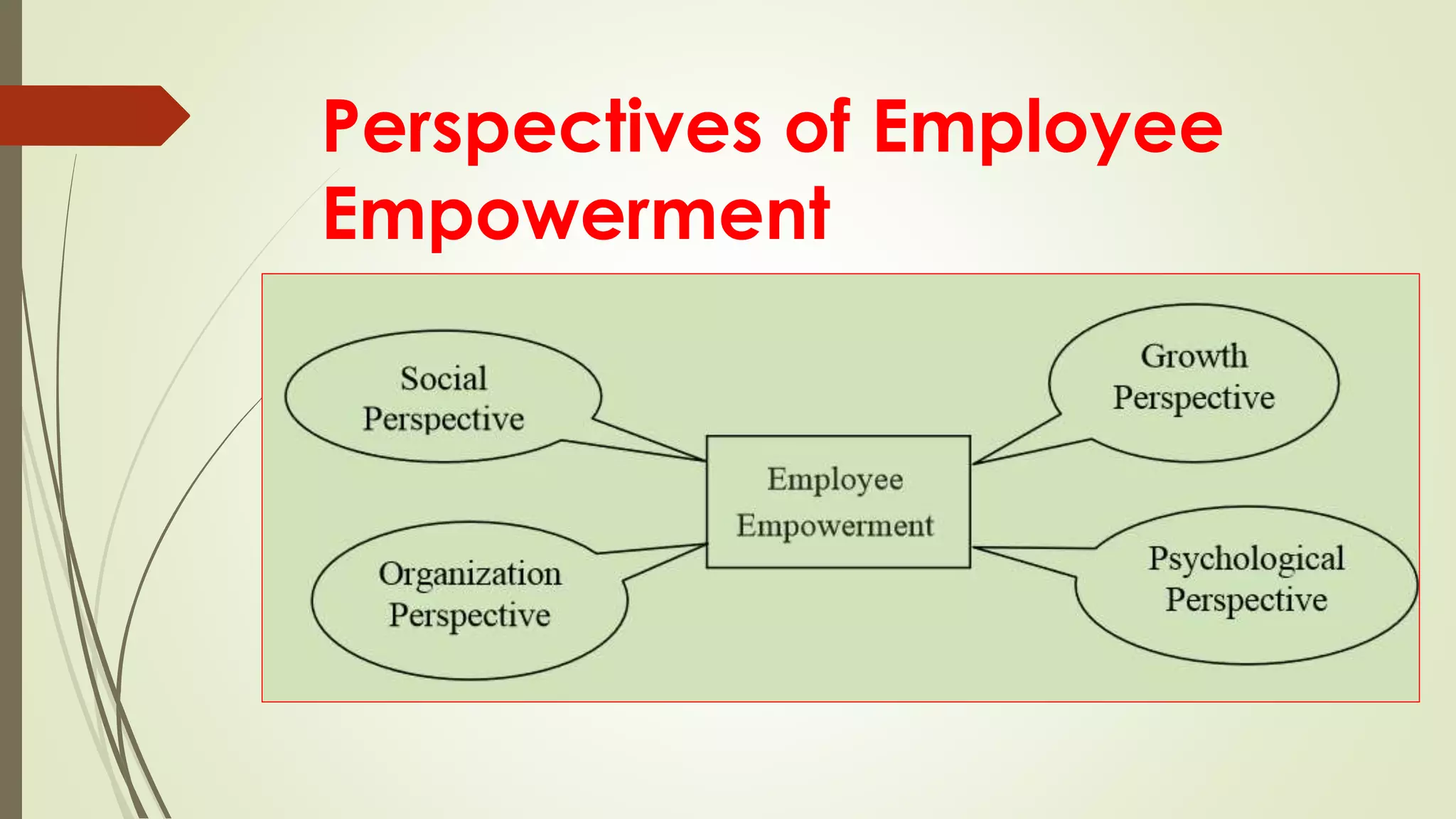
Perspectives of Employee
Empowerment
Social Perspective
Psychological Perspective
In general, human beings desire for status,
recognition, authority, responsibility, challenging
job that come from promotion to the next
cadre.
So, employees are no exception to the need
hierarchical activity. They can give their best,
contribute to the achievement of organizational
goal if their esteem needs are satisfied.
This can be possible through employee
empowerment. .
Growth Perspective
Peak employee performance is a requirement
for a excellence performance of the
organization.
It happens that people can not give their best
performance even when they are exceptionally
strong in technical activities of their work. They
need power, authority,
Organizational Perspective
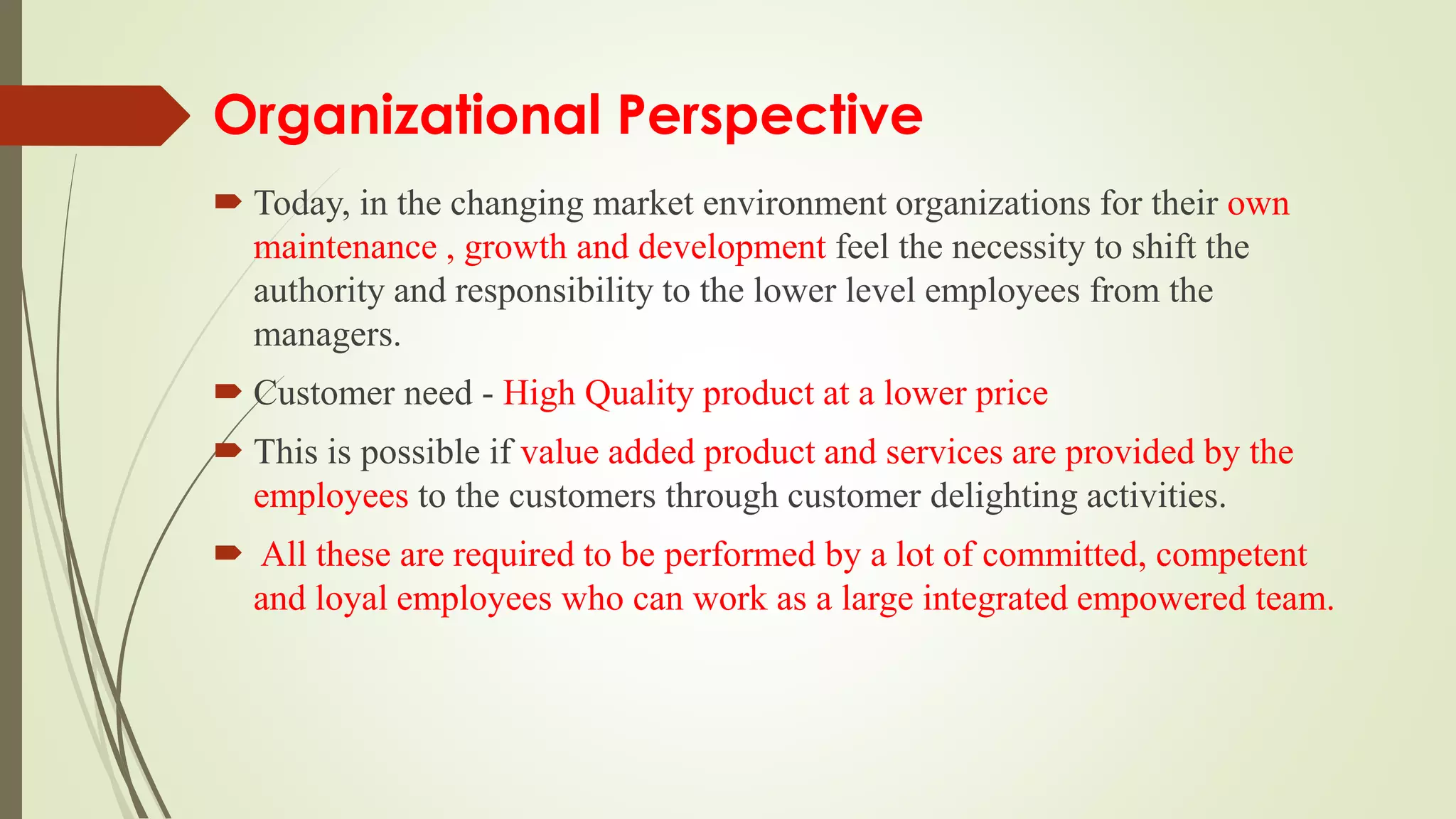
 Today, in the changing market environment organizations for their own
maintenance , growth and development feel the necessity to shift the
authority and responsibility to the lower level employees from the
managers.
 Customer need - High Quality product at a lower price
 This is possible if value added product and services are provided by the
employees to the customers through customer delighting activities.
 All these are required to be performed by a lot of committed, competent
and loyal employees who can work as a large integrated empowered team.
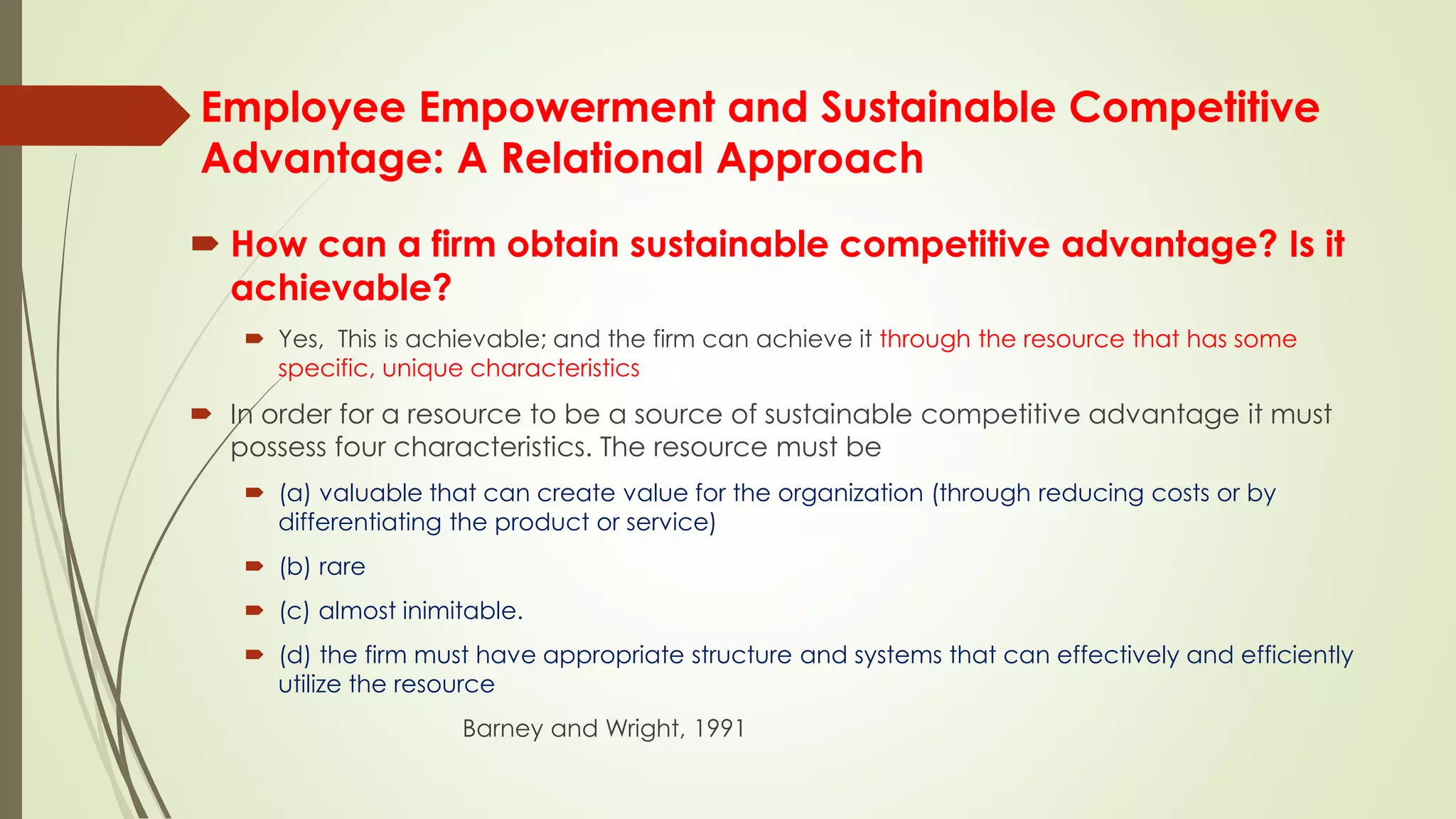
Employee Empowerment and Sustainable Competitive
Advantage: A Relational Approach
 How can a firm obtain sustainable competitive advantage? Is it
achievable?
 Yes, This is achievable; and the firm can achieve it through the resource that has some
specific, unique characteristics
 In order for a resource to be a source of sustainable competitive advantage it must
possess four characteristics. The resource must be
 (a) valuable that can create value for the organization (through reducing costs or by
differentiating the product or service)
 (b) rare
 (c) almost inimitable.
 (d) the firm must have appropriate structure and systems that can effectively and efficiently
utilize the resource
Barney and Wright, 1991
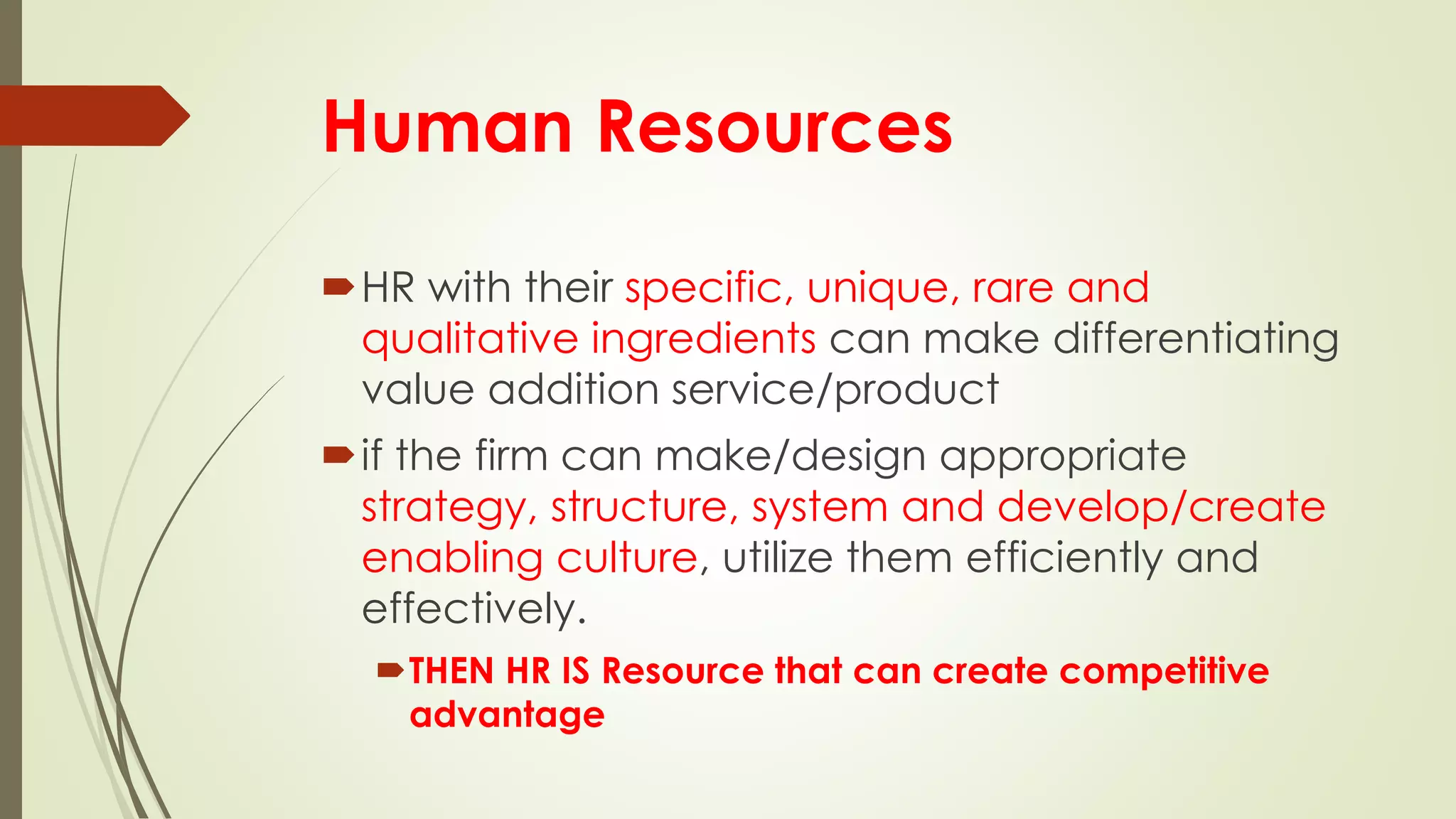
Human Resources
HR with their specific, unique, rare and
qualitative ingredients can make differentiating
value addition service/product
if the firm can make/design appropriate
strategy, structure, system and develop/create
enabling culture, utilize them efficiently and
effectively.
THEN HR IS Resource that can create competitive
advantage
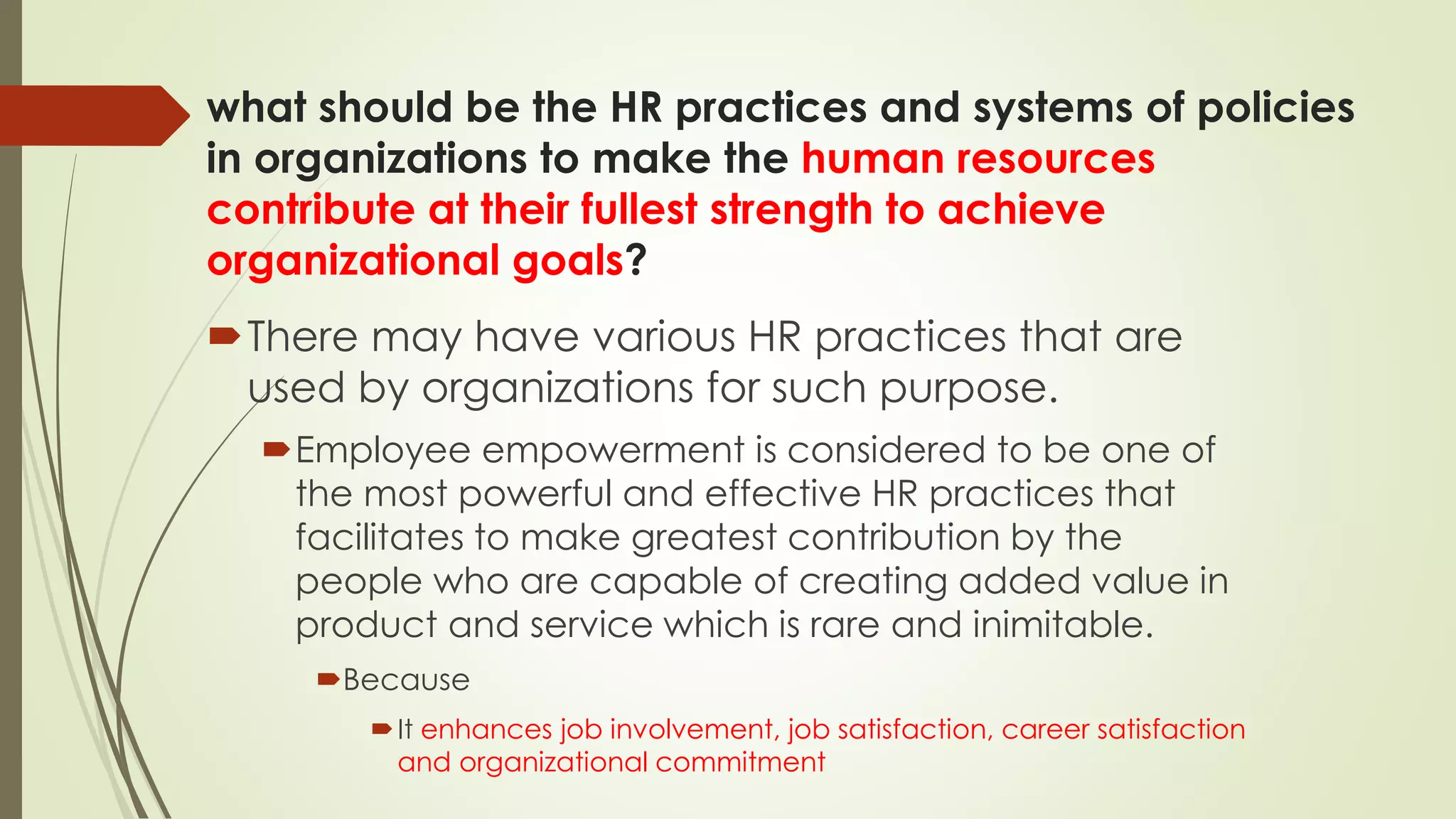
what should be the HR practices and systems of policies
in organizations to make the human resources
contribute at their fullest strength to achieve
organizational goals?
There may have various HR practices that are
used by organizations for such purpose.
Employee empowerment is considered to be one of
the most powerful and effective HR practices that
facilitates to make greatest contribution by the
people who are capable of creating added value in
product and service which is rare and inimitable.
Because
It enhances job involvement, job satisfaction, career satisfaction
and organizational commitment
Ingredients that require for
effective empowerment
 Desire and accepting of empowerment programme both by
empowered subordinate and empowering boss
 A strong confidence of empowered employee in the matter that
higher responsibility assigned to him be efficiently and effectively
discharged
 A healthy dyadic relationship between boss and subordinate
established on the foundation of openness, trust and mutuality
 Attitudinal explanation of boss towards subordinate by
 sharing information
 Responsibility
 offering help
 Assistance
 suggestion for successfully completion of task
 A high degree of employee commitment towards work
and organization
 Honest efforts of firm to enhance level of competence of
 Management support and encouragement to
empowered employee for innovative efforts
Benefits
 Empowerment makes systems of working smooth, easy,
 Helping to develop new ideas in work setting in cost
effective manner,
 Giving an ample scope to boss to search for a creative,
 Innovative work process through release of stress of
overwork, responsibility that can enhance efficiency and
efficacy of the managerial personnel.
relationship between employee empowerment
and sustainable competitive advantage
 This shows how an empowerment programme can be effective to make
a firm gain sustainable competitive advantage in a changing market
economy.
 It becomes clear that employee empowerment makes
 the people feel that they have crucial role to contribute to the organization for
achievement of its goals.
 Employees get involved, motivated and committed to work
 A strong desire from both subordinate and boss to make the empowerment
programme implemented generates a new environment to help the team
move forward for its success.
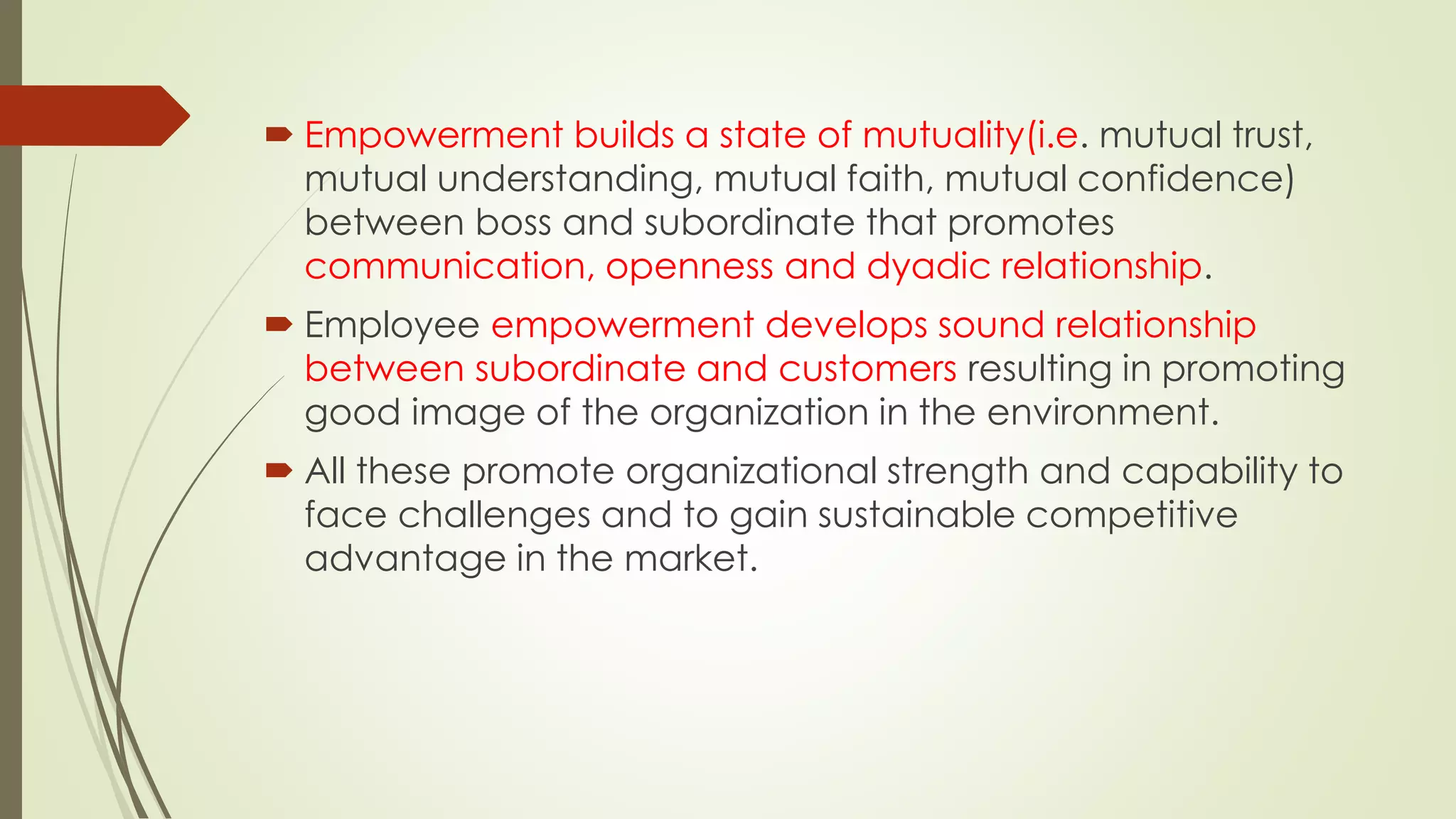
 Empowerment builds a state of mutuality(i.e. mutual trust,
mutual understanding, mutual faith, mutual confidence)
between boss and subordinate that promotes
communication, openness and dyadic relationship.
 Employee empowerment develops sound relationship
between subordinate and customers resulting in promoting
good image of the organization in the environment.
 All these promote organizational strength and capability to
face challenges and to gain sustainable competitive
advantage in the market.
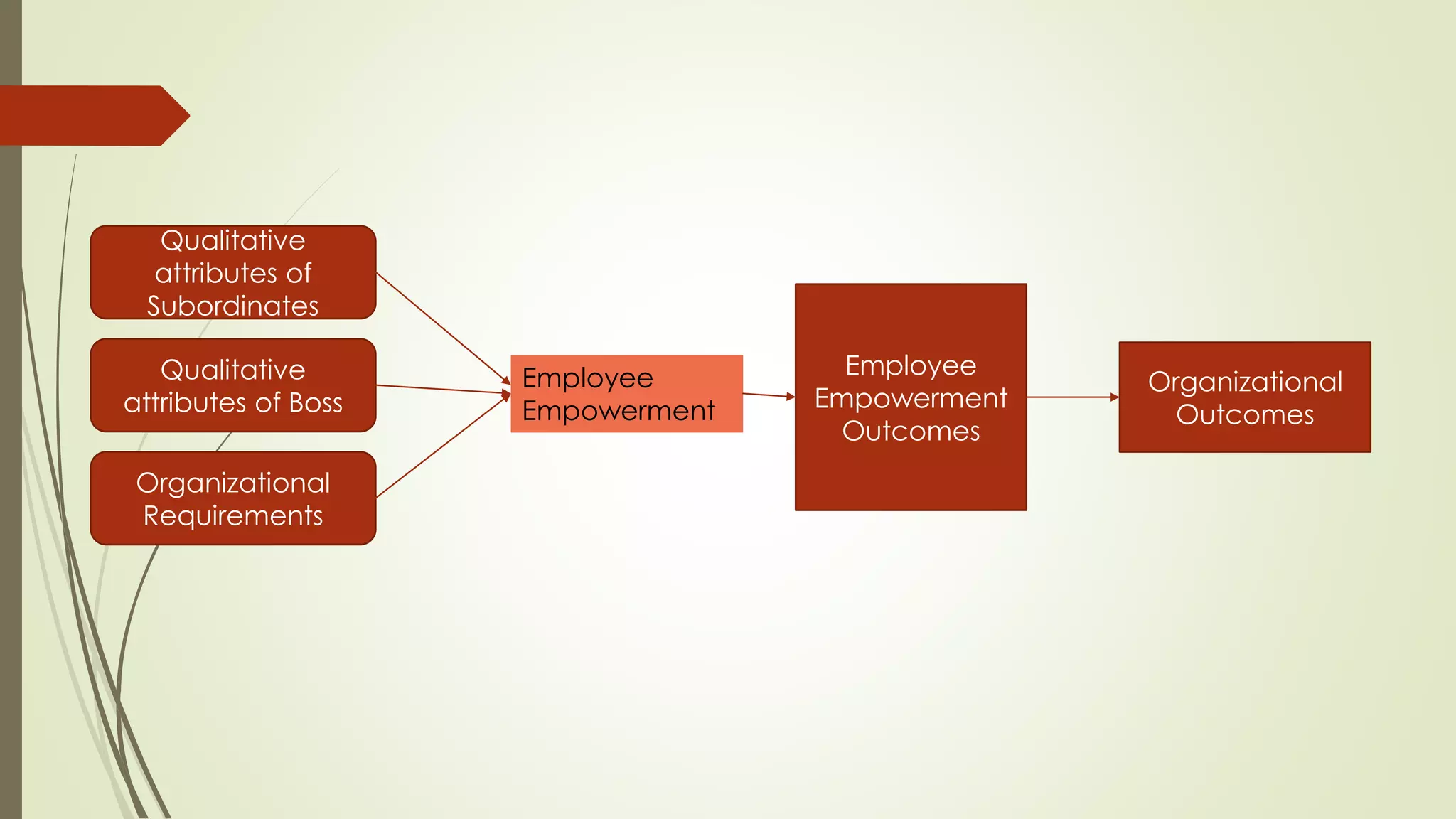
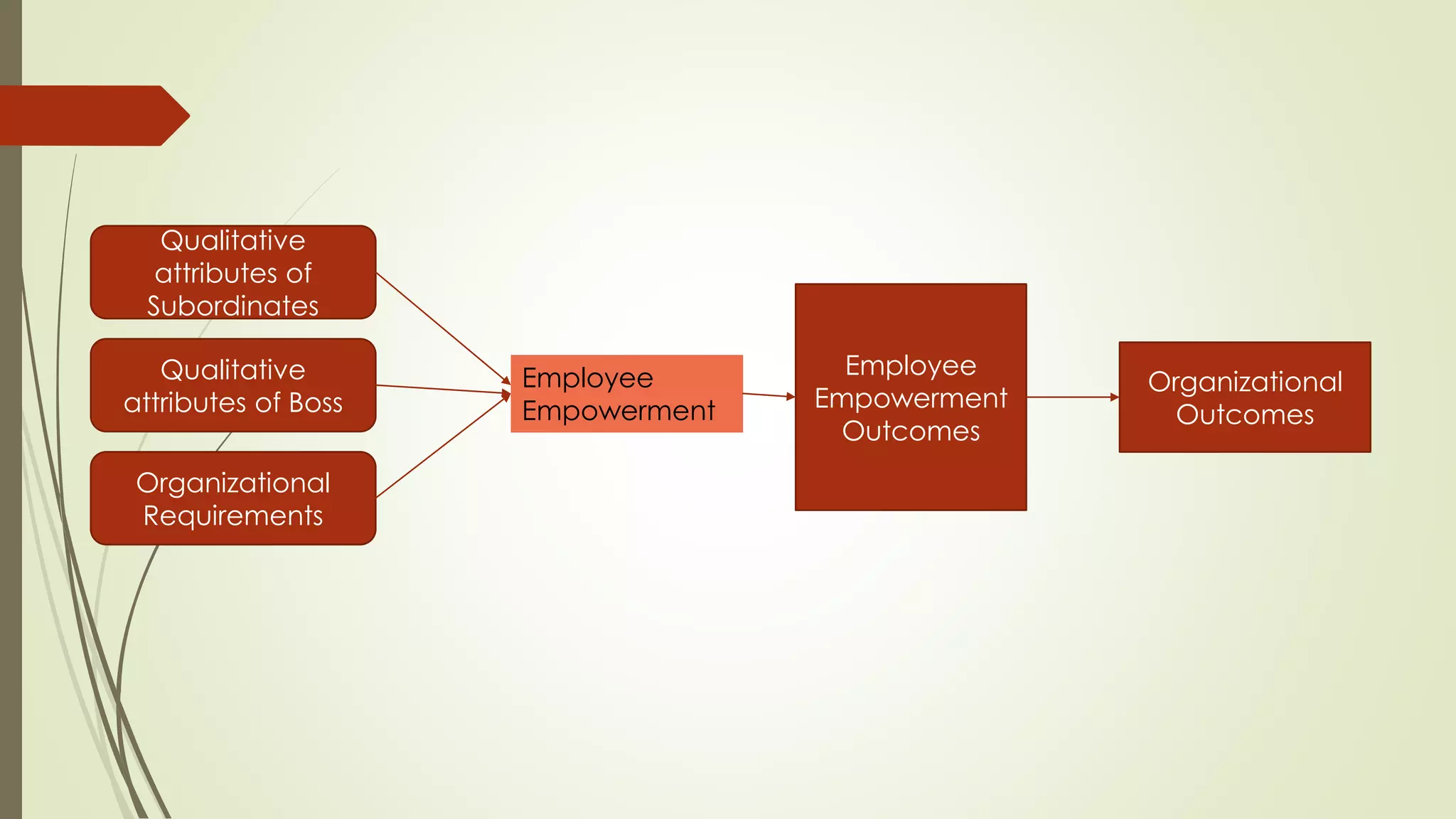
Organizational
Requirements
Qualitative
attributes of Boss
Qualitative
attributes of
Subordinates
Employee
Empowerment
Employee
Empowerment
Outcomes
Organizational
Outcomes
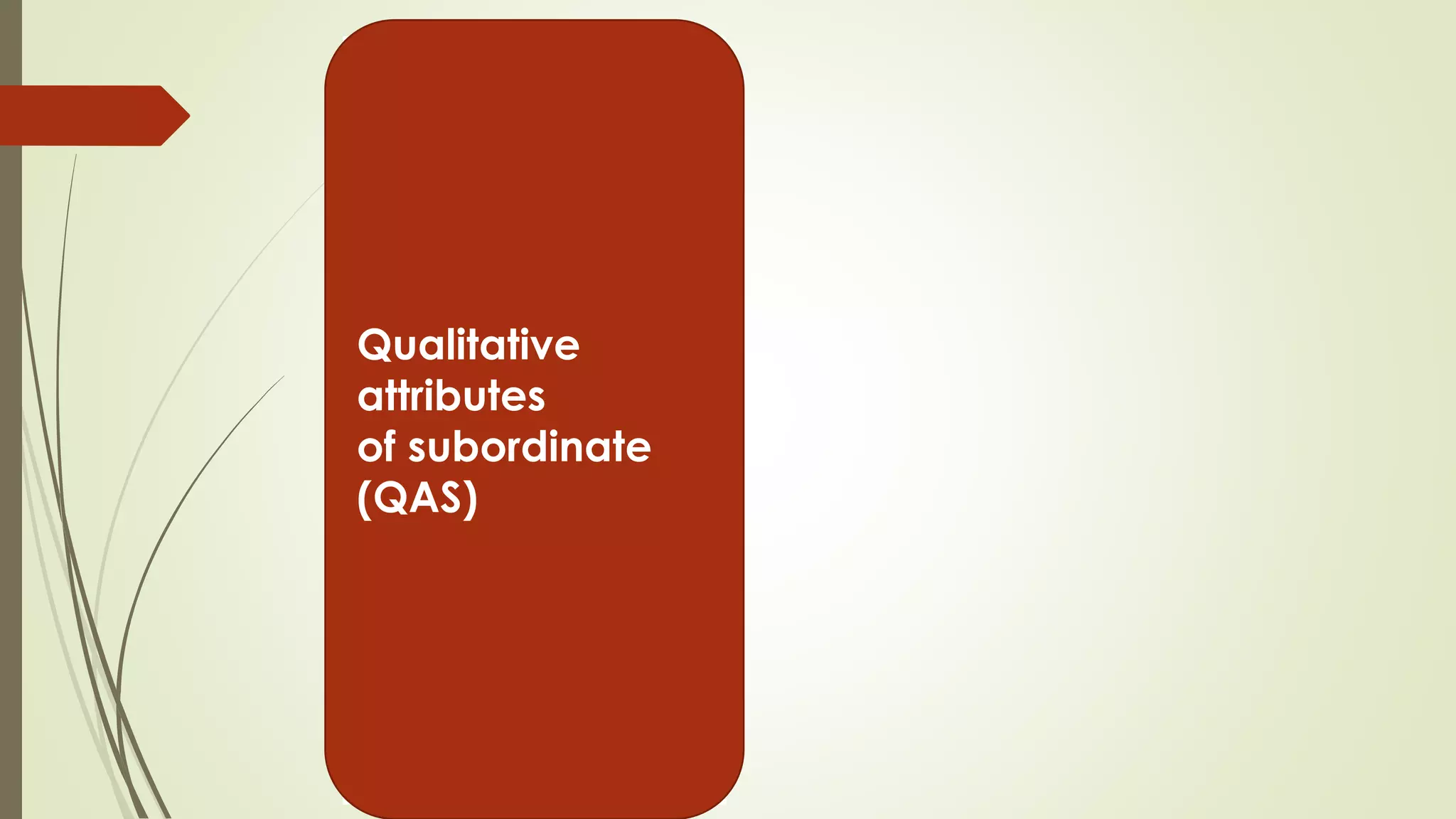
Qualitative
attributes
of subordinate
(QAS)
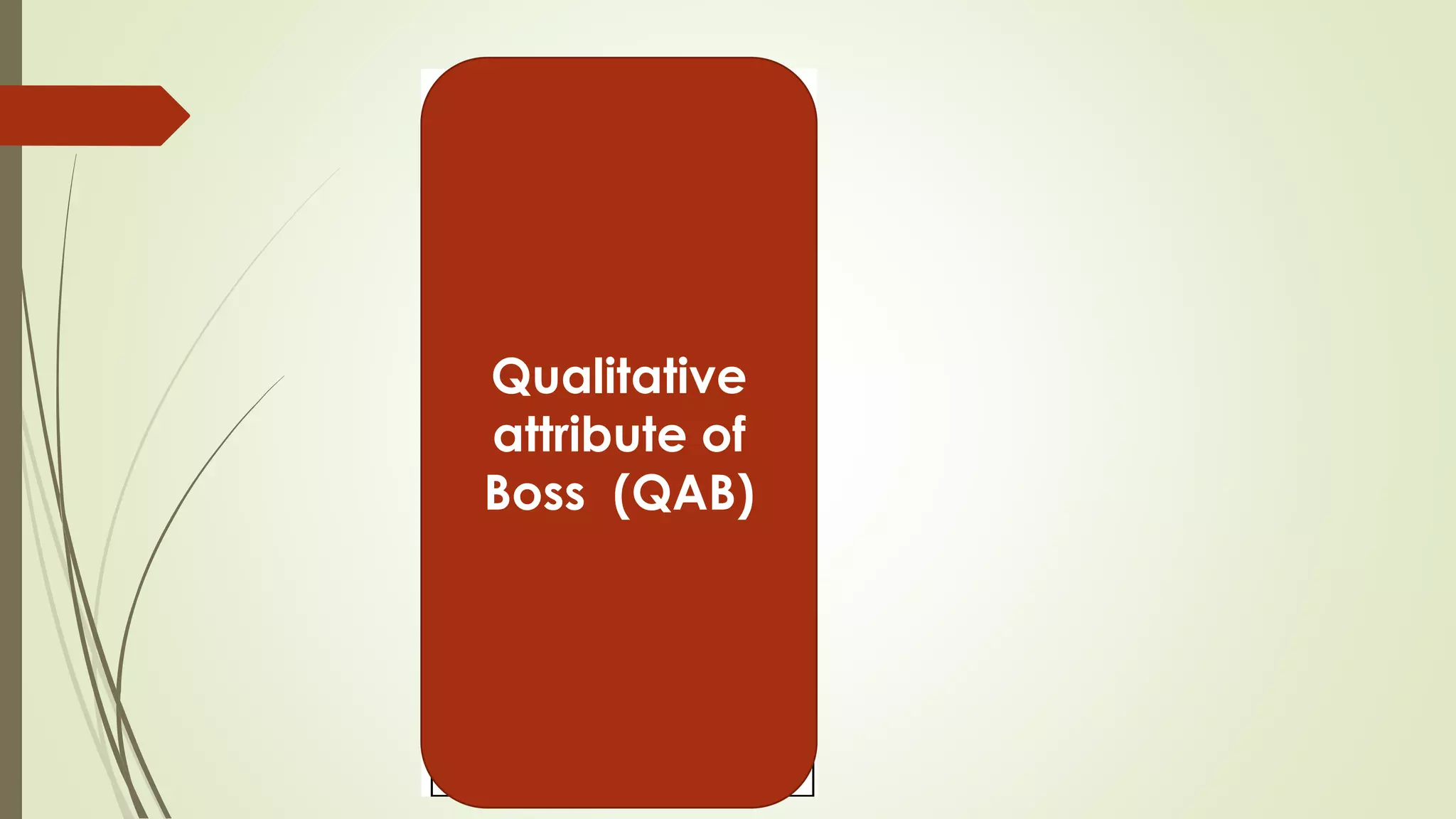
Qualitative
attribute of
Boss (QAB)
Organization
requirements
(OR)
Organizational
Requirements
Qualitative
attributes of Boss
Qualitative
attributes of
Subordinates
Employee
Empowerment
Employee
Empowerment
Outcomes
Organizational
Outcomes
Employee Empowerment Outcomes
Organizational Effectiveness
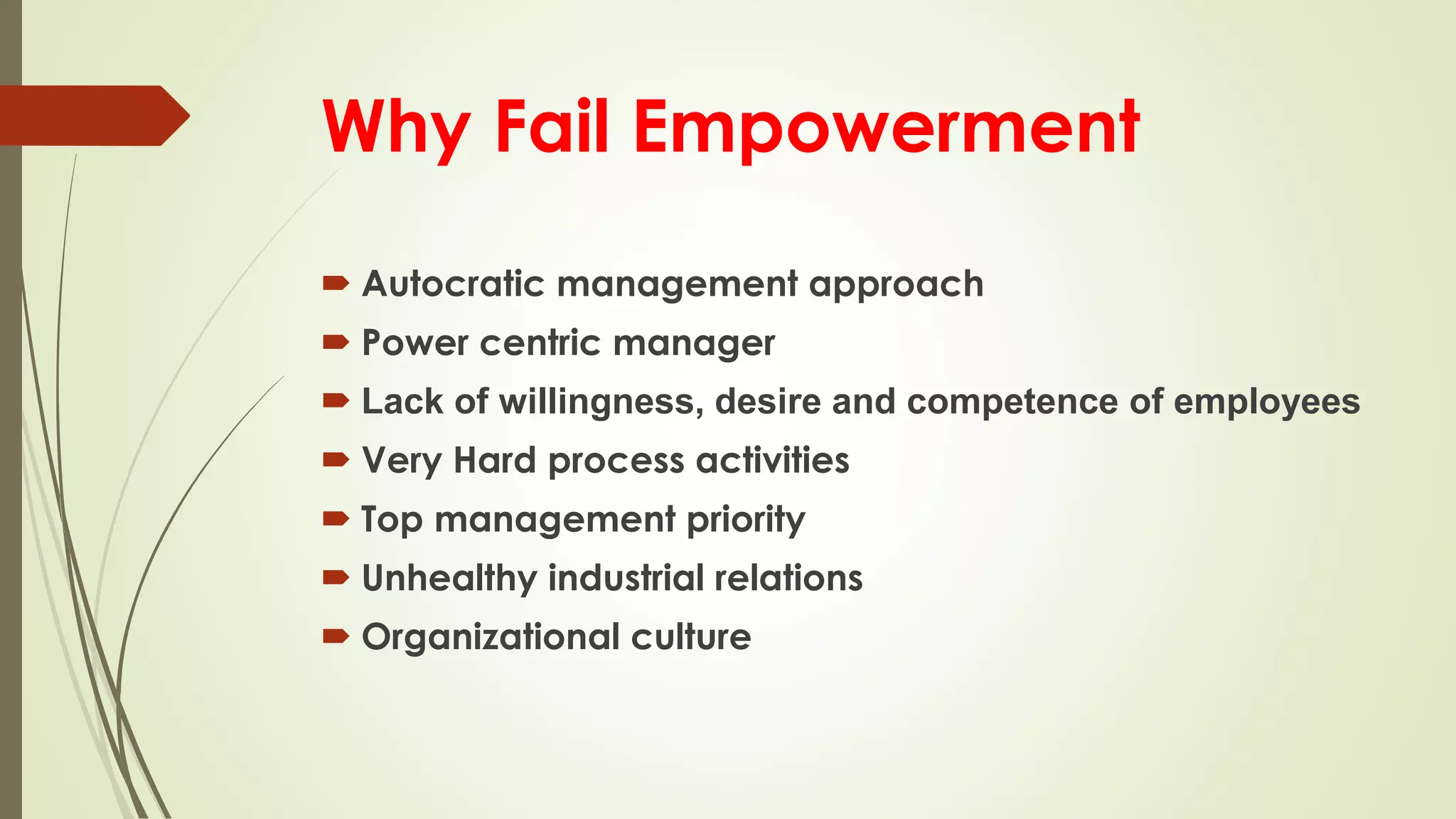
Why Fail Empowerment
 Autocratic management approach
 Power centric manager
 Lack of willingness, desire and competence of employees
 Very Hard process activities
 Top management priority
 Unhealthy industrial relations
 Organizational culture

Lecture 2 employee empowerment

  • 1.
  • 2.
    Learning Objectives End ofthe lecture sessions Students should be able to  Explain Why important Empowerment  Define Empowerment  Explain the perspectives of the empowerment  Explain the Employee Empowerment and Sustainable Competitive Advantage: A Relational Approach
  • 3.
    Employee Empowerment –Concept and Definition Employee empowerment is the process of shifting authority and responsibility to employees at lower level in the organizational hierarchy.
  • 4.
    It is atransfer of power from the managers to their subordinates. It occurs When ? when a person works for some years he develops a thorough idea, knowledge, skill, ability over the job and gets everything into his grip.
  • 5.
    If such personis given overall charge of the work he does, with adequate authority and responsibility Then he can take decision on his own and can effectively and efficiently accomplish the job
  • 6.
    Empowerment enhance Status Recognition ofempowered employees Employees try their best to go ahead to achieve individual goals, team goals and organizational goals.
  • 7.
    Natural  It isthe expectation of most human beings that they should have power, authority, recognition, status, responsibility; and when they get all these,  they exert drives to utilize their full potential, energy, abilities and competences in an attempt to excel their performance.
  • 8.
    Definitions  Randolph (1995)- Employee empowerment is a transfer of power from the employer to the employees.  Newstrom and Davis (1998) - Empowerment as any process that provides greater autonomy through the sharing of relevant information and  the provision of control over factors affecting job performance.
  • 9.
     Burke (1986)_ Empower implies the granting of power, delegation of authority.  Sewell and Wilkinson (1992) - To make the empowerment process meaningful there must be a genuine shift in the locus of power away from management and to the shop floor. Empowerment is a planned and systematic process of transferring power, authority with responsibility and accountability, to the employees by the managers.
  • 10.
  • 11.
  • 13.
    Psychological Perspective In general,human beings desire for status, recognition, authority, responsibility, challenging job that come from promotion to the next cadre. So, employees are no exception to the need hierarchical activity. They can give their best, contribute to the achievement of organizational goal if their esteem needs are satisfied. This can be possible through employee empowerment. .
  • 14.
    Growth Perspective Peak employeeperformance is a requirement for a excellence performance of the organization. It happens that people can not give their best performance even when they are exceptionally strong in technical activities of their work. They need power, authority,
  • 15.
    Organizational Perspective  Today,in the changing market environment organizations for their own maintenance , growth and development feel the necessity to shift the authority and responsibility to the lower level employees from the managers.  Customer need - High Quality product at a lower price  This is possible if value added product and services are provided by the employees to the customers through customer delighting activities.  All these are required to be performed by a lot of committed, competent and loyal employees who can work as a large integrated empowered team.
  • 16.
    Employee Empowerment andSustainable Competitive Advantage: A Relational Approach  How can a firm obtain sustainable competitive advantage? Is it achievable?  Yes, This is achievable; and the firm can achieve it through the resource that has some specific, unique characteristics  In order for a resource to be a source of sustainable competitive advantage it must possess four characteristics. The resource must be  (a) valuable that can create value for the organization (through reducing costs or by differentiating the product or service)  (b) rare  (c) almost inimitable.  (d) the firm must have appropriate structure and systems that can effectively and efficiently utilize the resource Barney and Wright, 1991
  • 17.
    Human Resources HR withtheir specific, unique, rare and qualitative ingredients can make differentiating value addition service/product if the firm can make/design appropriate strategy, structure, system and develop/create enabling culture, utilize them efficiently and effectively. THEN HR IS Resource that can create competitive advantage
  • 18.
    what should bethe HR practices and systems of policies in organizations to make the human resources contribute at their fullest strength to achieve organizational goals? There may have various HR practices that are used by organizations for such purpose. Employee empowerment is considered to be one of the most powerful and effective HR practices that facilitates to make greatest contribution by the people who are capable of creating added value in product and service which is rare and inimitable. Because It enhances job involvement, job satisfaction, career satisfaction and organizational commitment
  • 19.
    Ingredients that requirefor effective empowerment  Desire and accepting of empowerment programme both by empowered subordinate and empowering boss  A strong confidence of empowered employee in the matter that higher responsibility assigned to him be efficiently and effectively discharged  A healthy dyadic relationship between boss and subordinate established on the foundation of openness, trust and mutuality  Attitudinal explanation of boss towards subordinate by  sharing information  Responsibility  offering help  Assistance  suggestion for successfully completion of task
  • 20.
     A highdegree of employee commitment towards work and organization  Honest efforts of firm to enhance level of competence of  Management support and encouragement to empowered employee for innovative efforts
  • 21.
    Benefits  Empowerment makessystems of working smooth, easy,  Helping to develop new ideas in work setting in cost effective manner,  Giving an ample scope to boss to search for a creative,  Innovative work process through release of stress of overwork, responsibility that can enhance efficiency and efficacy of the managerial personnel.
  • 22.
    relationship between employeeempowerment and sustainable competitive advantage  This shows how an empowerment programme can be effective to make a firm gain sustainable competitive advantage in a changing market economy.  It becomes clear that employee empowerment makes  the people feel that they have crucial role to contribute to the organization for achievement of its goals.  Employees get involved, motivated and committed to work  A strong desire from both subordinate and boss to make the empowerment programme implemented generates a new environment to help the team move forward for its success.
  • 23.
     Empowerment buildsa state of mutuality(i.e. mutual trust, mutual understanding, mutual faith, mutual confidence) between boss and subordinate that promotes communication, openness and dyadic relationship.  Employee empowerment develops sound relationship between subordinate and customers resulting in promoting good image of the organization in the environment.  All these promote organizational strength and capability to face challenges and to gain sustainable competitive advantage in the market.
  • 24.
    Organizational Requirements Qualitative attributes of Boss Qualitative attributesof Subordinates Employee Empowerment Employee Empowerment Outcomes Organizational Outcomes
  • 25.
  • 26.
  • 27.
  • 28.
    Organizational Requirements Qualitative attributes of Boss Qualitative attributesof Subordinates Employee Empowerment Employee Empowerment Outcomes Organizational Outcomes
  • 29.
  • 30.
  • 31.
    Why Fail Empowerment Autocratic management approach  Power centric manager  Lack of willingness, desire and competence of employees  Very Hard process activities  Top management priority  Unhealthy industrial relations  Organizational culture