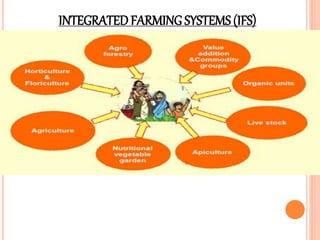
INTEGRATEDFARMING SYSTEMS (IFS)
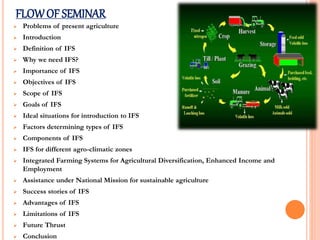
FLOWOF SEMINAR
 Problems of present agriculture
 Introduction
 Definition of IFS
 Why we need IFS?
 Importance of IFS
 Objectives of IFS
 Scope of IFS
 Goals of IFS
 Ideal situations for introduction to IFS
 Factors determining types of IFS
 Components of IFS
 IFS for different agro-climatic zones
 Integrated Farming Systems for Agricultural Diversification, Enhanced Income and
Employment
 Assistance under National Mission for sustainable agriculture
 Success stories of IFS
 Advantages of IFS
 Limitations of IFS
 Future Thrust
 Conclusion
 Decline in agricultural productivity rate
 Static or decline in food production
 Increasing malnutrition
 Shrinkage in net cultivable area
 Increasing environmental pollution
 Depleting ground water table
 Increasing cost of production
 Low farm income
WHATS THE SOLUTION ?
“INTEGRATEDFARMINGSYSTEM”
PROBLEMS OF PRESENTAGRICULTURE
INTRODUCTION
 “Farming” is a process of harnessing solar energy in form of economic
plant and animal products. “System” an arrangement of components or
parts that are interrelated and interact according to some process and
transforms inputs into output.
 “Farming system” → A farming system is the result of complex
interactions among a number of inter-dependent enterprises/components,
where an individual farmer allocates certain quantities and qualities of
four factors of production, namely land, labour, capital and management
to which he has access.
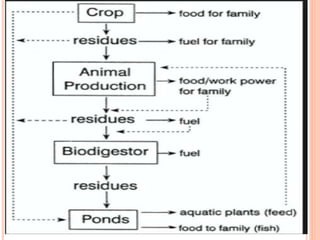
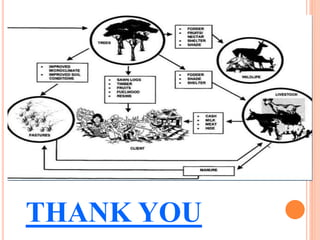
 The end products and wastes of one enterprise are used as inputs in
others. Eg: The wastes of dairy like dung, urine, refuse etc, are used for
the preparation of farmyard manure, which is an input in cropping
systems. The straw obtained from the crop is used as fodder for cattle.
The cattle are used for different field operations for growing crops. Thus,
different enterprise of farming system are highly interrelated.
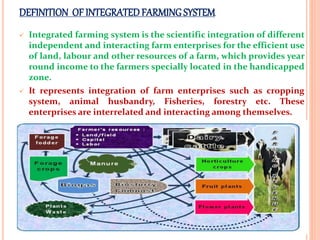
DEFINITION OF INTEGRATEDFARMINGSYSTEM
 Integrated farming system is the scientific integration of different
independent and interacting farm enterprises for the efficient use
of land, labour and other resources of a farm, which provides year
round income to the farmers specially located in the handicapped
zone.
 It represents integration of farm enterprises such as cropping
system, animal husbandry, Fisheries, forestry etc. These
enterprises are interrelated and interacting among themselves.
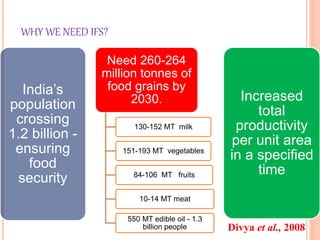
WHY WE NEED IFS?
India’s
population
crossing
1.2 billion -
ensuring
food
security
Need 260-264
million tonnes of
food grains by
2030.
130-152 MT milk
151-193 MT vegetables
84-106 MT fruits
10-14 MT meat
550 MT edible oil - 1.3
billion people
Increased
total
productivity
per unit area
in a specified
time
Divya et al., 2008
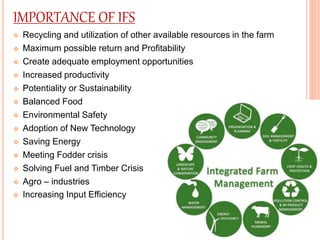
IMPORTANCE OF IFS
 Recycling and utilization of other available resources in the farm
 Maximum possible return and Profitability
 Create adequate employment opportunities
 Increased productivity
 Potentiality or Sustainability
 Balanced Food
 Environmental Safety
 Adoption of New Technology
 Saving Energy
 Meeting Fodder crisis
 Solving Fuel and Timber Crisis
 Agro – industries
 Increasing Input Efficiency
OBJECTIVES OF IFS
1. To identify existing farming systems in specific areas &
access their relative viability.
2. To formulate farming system model involving main & allied
enterprises for different farming situations.
3. To ensure optional utilization and conservation of available
resources.
4. Effective recycling of farm residues within system.
5. Maintain sustainable production without damaging
environment.
6. To raise overall profitability of farm house hold by
complementing main allied enterprises with each other.
SCOPE OF IFS
 Farming enterprises include crop, livestock, poultry, fish,
tree, sericulture etc.
 A combination of one or more enterprises with cropping
when carefully chosen, planned and executed gives greater
returns than a single enterprise, especially for small and
marginal farmers.
 Farm as a unit is to be considered and planned for
effective integration of the enterprises to be combined
with crop production activity.
GOALS OF IFS
1.
• Maximization of yield of all component enterprises to
provide steady & stable income.
2.
• Rejuvenation of systems productivity & achieve agro-
ecological equilibrium.
3.
• Avoid build up of insect pests, diseases & weed
population through natural cropping system & keep
them at low level of intensity.
4.
• Reducing use of chemicals, pesticides.
IDEAL SITUATIONS FOR INTRODUCTION OF IFS
 The farmer wishes to improve the soil quality.
 The farm household is struggling to buy food or below the poverty line.
 Water is stored on-far, in ponds or river-charged overflow areas.
 Soil salinity has increased as a result of inorganic fertilizer use.
 The farmer is seeking to maximize profits on existing holding.
 The farm is being eroded by wind or water.
 The farmer is looking to reduce chemical control methods.
 The farmer wants to reduce pollution or waste disposal costs.
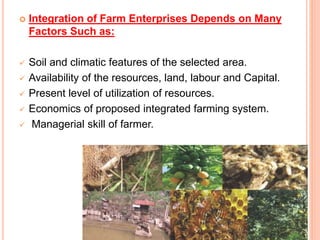
 Integration of Farm Enterprises Depends on Many
Factors Such as:
 Soil and climatic features of the selected area.
 Availability of the resources, land, labour and Capital.
 Present level of utilization of resources.
 Economics of proposed integrated farming system.
 Managerial skill of farmer.
FACTORS DETERMINING TYPE OF FARMING
 Physical factors (Climate, soil, topography)
 Economic factor
o Marketing cost
o Labour availability
o Consumer demand
o Prevalent pest and disease
 Social factor (type of community, easy transport,
marketing facilities)
 Environment (availability of resources and components)
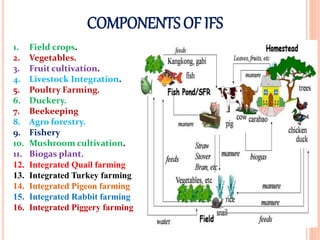
1. Field crops.
2. Vegetables.
3. Fruit cultivation.
4. Livestock Integration.
5. Poultry Farming.
6. Duckery.
7. Beekeeping
8. Agro forestry.
9. Fishery
10. Mushroom cultivation.
11. Biogas plant.
12. Integrated Quail farming
13. Integrated Turkey farming
14. Integrated Pigeon farming
15. Integrated Rabbit farming
16. Integrated Piggery farming
COMPONENTS OF IFS
 Field crops like rice, wheat, maize, sorghum; pulses and
cash crops like sugarcane, tobacco, jute, etc. are grown.
 Crop production constitutes a sizeable portion of farm
income followed by livestock and agro horticulture
system. A short duration legume such as mung bean and
bean or cowpea can be planted with minimum tillage
and irrigation to maximize the economic return and also
improves the nutrition of the farmer’s family.
 The income from this unit may be up to Rs. 1.80/ rupee
invested.
1. Crop Production
Vegetables form a very important component specially for
marginal Farmers to provide income at frequent short
intervals round the year. Cash crops like tomato, brinjal,
Cole crops, gourds, melons, pumpkin etc. could be grown.
The income from this unit may be Rs. 1.60/ rupee invested.
Fruit plants like coconut, banana, etc may be planted by
small farmers in a systematic manner. Multistoried
cropping by taking coconut, banana, pineapple and
ginger/turmeric can be practiced which also improves the
nutrition of the farmer’s family. . The returns per rupee
invested may go beyond Rs.2.50/ rupee invested.
2. Vegetables
3. Fruit Cultivation
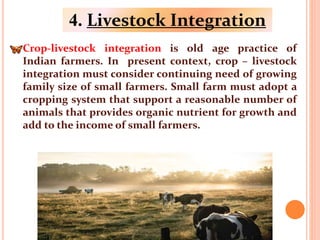
 Crop-livestock integration is old age practice of
Indian farmers. In present context, crop – livestock
integration must consider continuing need of growing
family size of small farmers. Small farm must adopt a
cropping system that support a reasonable number of
animals that provides organic nutrient for growth and
add to the income of small farmers.
4. Livestock Integration
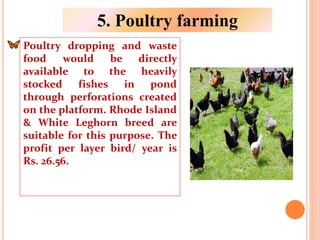
Poultry dropping and waste
food would be directly
available to the heavily
stocked fishes in pond
through perforations created
on the platform. Rhode Island
& White Leghorn breed are
suitable for this purpose. The
profit per layer bird/ year is
Rs. 26.56.
5. Poultry farming
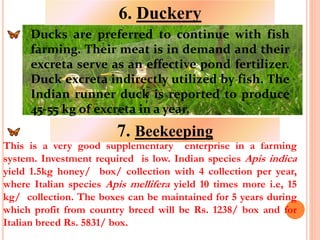
Ducks are preferred to continue with fish
farming. Their meat is in demand and their
excreta serve as an effective pond fertilizer.
Duck excreta indirectly utilized by fish. The
Indian runner duck is reported to produce
45-55 kg of excreta in a year.
This is a very good supplementary enterprise in a farming
system. Investment required is low. Indian species Apis indica
yield 1.5kg honey/ box/ collection with 4 collection per year,
where Italian species Apis mellifera yield 10 times more i.e, 15
kg/ collection. The boxes can be maintained for 5 years during
which profit from country breed will be Rs. 1238/ box and for
Italian breed Rs. 5831/ box.
6. Duckery
7. Beekeeping
8. Agroforestry
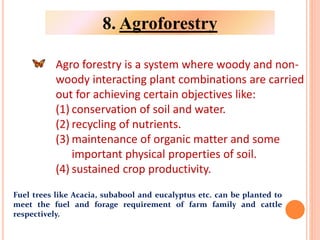
Agro forestry is a system where woody and non-
woody interacting plant combinations are carried
out for achieving certain objectives like:
(1) conservation of soil and water.
(2) recycling of nutrients.
(3) maintenance of organic matter and some
important physical properties of soil.
(4) sustained crop productivity.
Fuel trees like Acacia, subabool and eucalyptus etc. can be planted to
meet the fuel and forage requirement of farm family and cattle
respectively.
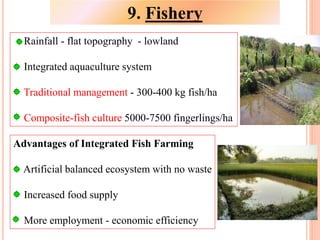
Rainfall - flat topography - lowland
Integrated aquaculture system
Traditional management - 300-400 kg fish/ha
Composite-fish culture 5000-7500 fingerlings/ha
Advantages of Integrated Fish Farming
Artificial balanced ecosystem with no waste
Increased food supply
More employment - economic efficiency
9. Fishery
10. Mushroom Cultivation
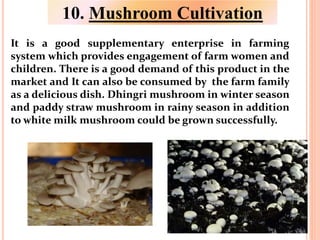
It is a good supplementary enterprise in farming
system which provides engagement of farm women and
children. There is a good demand of this product in the
market and It can also be consumed by the farm family
as a delicious dish. Dhingri mushroom in winter season
and paddy straw mushroom in rainy season in addition
to white milk mushroom could be grown successfully.
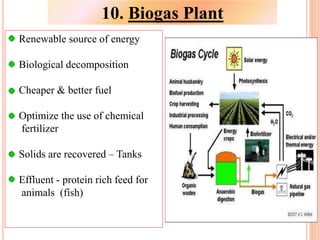
Renewable source of energy
Biological decomposition
Cheaper & better fuel
Optimize the use of chemical
fertilizer
Solids are recovered – Tanks
Effluent - protein rich feed for
animals (fish)
10. Biogas Plant
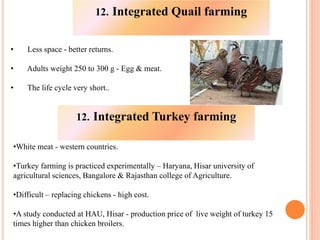
12. Integrated Quail farming
• Less space - better returns.
• Adults weight 250 to 300 g - Egg & meat.
• The life cycle very short..
12. Integrated Turkey farming
•White meat - western countries.
•Turkey farming is practiced experimentally – Haryana, Hisar university of
agricultural sciences, Bangalore & Rajasthan college of Agriculture.
•Difficult – replacing chickens - high cost.
•A study conducted at HAU, Hisar - production price of live weight of turkey 15
times higher than chicken broilers.
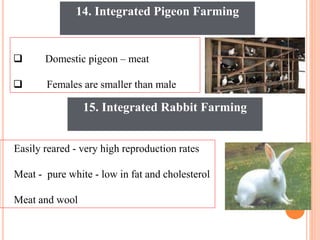
14. Integrated Pigeon Farming
 Domestic pigeon – meat
 Females are smaller than male
15. Integrated Rabbit Farming
Easily reared - very high reproduction rates
Meat - pure white - low in fat and cholesterol
Meat and wool
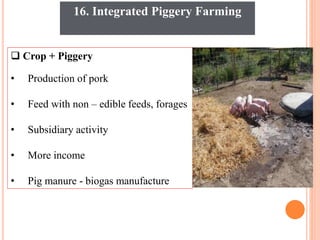
16. Integrated Piggery Farming
 Crop + Piggery
• Production of pork
• Feed with non – edible feeds, forages
• Subsidiary activity
• More income
• Pig manure - biogas manufacture
IFS FOR DIFFERENT AGRO-CLIMATIC ZONES
(INDIA)
1.High Altitude Cold Desert
Pasture + forestry + goats + rabbits + crops like
millets, wheat, barley, fodder crops
2. Arid & Desert Region
AH with camels + sheep + goat + crops like bajra,
wheat, pulses, gram, & fodder crops
3. Western & Central Himalayas
Horti crops+ agri on hill & slopes like maize, rice
pulses and fodder crops
4. Eastern Himalayas
Rice + millets + pulses + agroforestry system + piggery +
poultry
5. Indo-gangetic Plains
Crop husbandary + rice + wheat + maize + mustard
pulses + dairy + cattle + buffaloes
6. Central & Southern Highlands
Cotton-sorghum + millets pulses + dairy + cattle +
sheep + goats + poultry
7.Western Ghat
Plantation crops + rice + pulses + cattle + sheep + goats
8.Delta & Coastal Plains
Rice + fish culture + poultry + piggery
INTEGRATED FARMING SYSTEMS FOR
AGRICULTURAL DIVERSIFICATION, ENHANCED
INCOME AND EMPLOYMENT
 Realizing the importance of integrated farming systems, Indian Council of
Agricultural Research (ICAR) revised the mandate of Project Directorate
for Cropping Systems and All India Coordinated Research Project on
Cropping Systems to farming systems.
 Accordingly, ICAR-Indian Institute of Farming Systems Research,
Modipuram with component schemes of All India Coordinated Research
Project on Integrated Farming Systems (AICRP-IFS) and All India Network
Programme on Organic Farming (AI-NPOF) started research on Integrated
Farming Systems both at research farm and farmer’s field by partnering
with 25 SAUs, 6 ICAR institutes and 1 Central University. Common
methodology of area allocation for different components, with specific
purpose such as meeting the family and livestock nutrition, soil health and
income generation have been made at all locations. Initiation of National
Mission on Integrated Farming Systems by converging the schemes of
crops, horticulture, livestock and fisheries can give impetus in promoting
integrated farming systems among farmers.
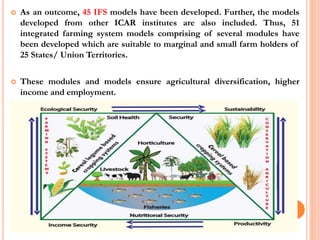
 As an outcome, 45 IFS models have been developed. Further, the models
developed from other ICAR institutes are also included. Thus, 51
integrated farming system models comprising of several modules have
been developed which are suitable to marginal and small farm holders of
25 States/ Union Territories.
 These modules and models ensure agricultural diversification, higher
income and employment.
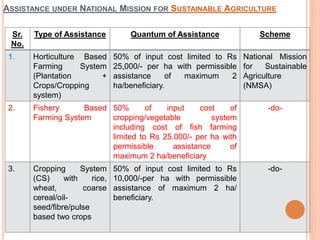
ASSISTANCE UNDER NATIONAL MISSION FOR SUSTAINABLE AGRICULTURE
Sr.
No.
Type of Assistance Quantum of Assistance Scheme
1. Horticulture Based
Farming System
(Plantation +
Crops/Cropping
system)
50% of input cost limited to Rs
25,000/- per ha with permissible
assistance of maximum 2
ha/beneficiary.
National Mission
for Sustainable
Agriculture
(NMSA)
2. Fishery Based
Farming System
50% of input cost of
cropping/vegetable system
including cost of fish farming
limited to Rs 25.000/- per ha with
permissible assistance of
maximum 2 ha/beneficiary
-do-
3. Cropping System
(CS) with rice,
wheat, coarse
cereal/oil-
seed/fibre/pulse
based two crops
50% of input cost limited to Rs
10,000/-per ha with permissible
assistance of maximum 2 ha/
beneficiary.
-do-
SUCCESS STORIES OF IFS
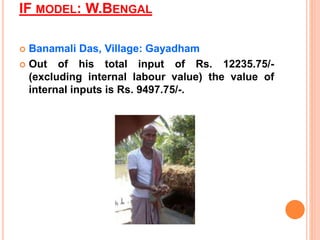
IF MODEL: W.BENGAL
 Banamali Das, Village: Gayadham
 Out of his total input of Rs. 12235.75/-
(excluding internal labour value) the value of
internal inputs is Rs. 9497.75/-.
 Outer border trees: eucalyptus, neem, subabul, bamboo etc.
 Homestead garden surrounded by perennial trees: banana,
guava, sapota, lemon, mango and coconut.
 Grows 25-30 types of vegetables today, using mixed cropping
techniques of various combinations.
 Has 5 cows, 8 ducklings 4 hens and 14 chicks and cultivates
fishes such as Rohu, Catla, Bata, Minor carp and catfishes in his
pond.
 Constructed a Biodigester to generate biogas and slurry and
prepares vermi-compost and compost by himself.
 Uses sesame cake and graded biogas slurry as organic manure
and prepares mixture of neem extract, garlic paste and kerosene
as pest repellent.
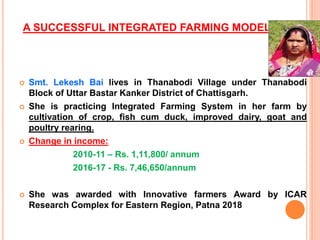
A SUCCESSFUL INTEGRATED FARMING MODEL
 Smt. Lekesh Bai lives in Thanabodi Village under Thanabodi
Block of Uttar Bastar Kanker District of Chattisgarh.
 She is practicing Integrated Farming System in her farm by
cultivation of crop, fish cum duck, improved dairy, goat and
poultry rearing.
 Change in income:
2010-11 – Rs. 1,11,800/ annum
2016-17 - Rs. 7,46,650/annum
 She was awarded with Innovative farmers Award by ICAR
Research Complex for Eastern Region, Patna 2018
IF MODEL: UTTAR PRADESH
AMAN LAKRA, 63, VILLAGE ABHAYPUR, BAREILLY
 Initially: 1.5 bigha land Now : 55 bigha
 He is rearing desi poultry bird (Aseel), duck, goat, pig, buffalo,
generating income from fish production, bee-keeping, cereal and
oilseed crop cultivation and fruit and vegetable cultivation.
 Milk production: 15-16 litres of milk/day
 Selling price @ Rs. 50/litre and (earning Rs. 750 per day)
 Most of the feed ingredients are procured from own farm.
Monthly expenditure on feeding was Rs. 5000
 Purchase wheat bran and straw only during the period of
scarcity
JOURNEY OF NURSE TO BECOME A FARMER
MS NABANITA DAS, DISTRICT: JORHAT, STATE: ASSAM
 At present her farm has become a small agri-hub with production of
flowers (Anthurium, Gerbera, Gladiolus, tuberose etc), rice, different
pulses, oilseeds, fruits and vegetables, fish (local type and carps),
eggs, milk, goatery and different poultry breeds viz. Silky Chicken ,
Rainbow Roaster, Bonroja, Kadaknath, Turkey, Guniea fowl; Pigeon
((Masokali); duck breeds (White Peikin), Indian Runner and
indigenous duck.
 The beauty of her farm is she has utilised every inch of the farm
land as a productive asset utilizing vertical space also. Recently she
has introduced vermicompost production and Azolla culture.
 Her earning from the land was merely Rs 4000/- before government
interventions. Now she earns Rs. 30,000/- net profit in first year
(2014), Rs. 56,000/- in 2nd year (2015), Rs. 96,000/- in 3rd year (2016),
Rs 1,10,000/- in 4th year (2017) and Rs 1,25,000/- in 2019.
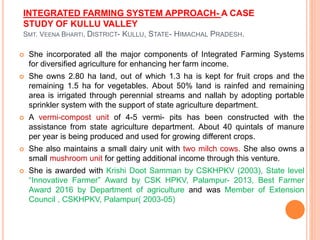
INTEGRATED FARMING SYSTEM APPROACH- A CASE
STUDY OF KULLU VALLEY
SMT. VEENA BHARTI, DISTRICT- KULLU, STATE- HIMACHAL PRADESH.
 She incorporated all the major components of Integrated Farming Systems
for diversified agriculture for enhancing her farm income.
 She owns 2.80 ha land, out of which 1.3 ha is kept for fruit crops and the
remaining 1.5 ha for vegetables. About 50% land is rainfed and remaining
area is irrigated through perennial streams and nallah by adopting portable
sprinkler system with the support of state agriculture department.
 A vermi-compost unit of 4-5 vermi- pits has been constructed with the
assistance from state agriculture department. About 40 quintals of manure
per year is being produced and used for growing different crops.
 She also maintains a small dairy unit with two milch cows. She also owns a
small mushroom unit for getting additional income through this venture.
 She is awarded with Krishi Doot Samman by CSKHPKV (2003), State level
“Innovative Farmer” Award by CSK HPKV, Palampur- 2013, Best Farmer
Award 2016 by Department of agriculture and was Member of Extension
Council , CSKHPKV, Palampur( 2003-05)
ALL IS WELL IN INTEGRATED FARMING
MR. MUTTAPPA PUJARI , GULBARGA DISTRICT OF KARNATAKA STATE
 He owns 8 acres of land, and he also owns two oxen and two goats. He
grows red gram, cotton, ginger, flowers and leafy vegetables in the Kharif
season. Immediately after harvest of the Kharif crops, he takes up wheat,
chilli, chickpea and sorghum for the Rabi .
 Mr. Pujari gets Rs. 4 to 5 lakh net profit from his 8 acres of land. He is
confident that if he has access to proper electricity and irrigation during the
summer season, he would be able to increase his income considerably. Apart
from agriculture, he purchased two goats worth Rs. 3,500/-, and within two
months, he sold them for Rs. 7,000/-, with a profit margin of Rs. 2,500/- after
deducting the expenditure. He draws parallels between farming and catching
fish through a net: you need to look over each and everything for effective
implementation at a farm level in order to increase production and
productivity.
 Every year, the cattle festival is conducted near his village during the festival
of Makar Sankranti. To make use of this opportunity, he purchased two oxen
and sold them within four months for Rs. 58,000/-, making a profit margin of
Rs. 21,000/- after deducting expenditure. In addition to that, he got two
tractors of cow dung as organic manure.
ADVANTAGES OF IFS
 Higher food production to equate the demand of the exploding population of our
nation
 Increased farm income through proper residue recycling and allied components
 Sustainable soil fertility and productivity through organic waste recycling
 Integration of allied activities will result in the availability of nutritious food
enriched with protein, carbohydrate, fat, minerals and vitamins.
 Integrated farming will help in environmental protection through effective
recycling of waste from animal activities like piggery, poultry and pigeon rearing.
 Regular stable income through the products like egg, milk, mushroom,
vegetables, honey and silkworm cocoons from the linked activities in integrated
farming
 Firewood and construction wood requirements could be met from the agro
forestry system without affecting the natural forest
 Avoidance of soil loss through erosion by agro-forestry and proper cultivation of
each part of land by integrated farming
 Generation of regular employment for the farm family members of small and
marginal farmers.
LIMITATIONS OF IFS
 Lack of awareness about sustainable farming systems.
 Lack of credit facilities at easy and reasonable interest rate.
 Non-availability of ensured marketing facilities specially for perishable
commodities.
 Lack of deep freezing and storage facilities.
 Lack of timely availability of inputs.
 Lack of knowledge among farming community specially in rural youth.
Future Thrust
 There is need to create a database on farming system in relation to type
of farming system, infrastructure, economics, sustainability, etc under
different farming situations.
 Need to develop more research modules of farming system under
different holding size with economically viable and socially acceptable
systems.
 The assessment and refinement of the technologies developed at research
station at cultivator’s field.
 Need to prepare a contingent planning to counteract the weather/climate
threats under different farming situation.
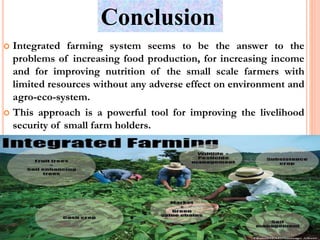
Conclusion
 Integrated farming system seems to be the answer to the
problems of increasing food production, for increasing income
and for improving nutrition of the small scale farmers with
limited resources without any adverse effect on environment and
agro-eco-system.
 This approach is a powerful tool for improving the livelihood
security of small farm holders.
THANK YOU

integrated farming system and its importnce.ppt

  • 1.
  • 2.
    FLOWOF SEMINAR  Problemsof present agriculture  Introduction  Definition of IFS  Why we need IFS?  Importance of IFS  Objectives of IFS  Scope of IFS  Goals of IFS  Ideal situations for introduction to IFS  Factors determining types of IFS  Components of IFS  IFS for different agro-climatic zones  Integrated Farming Systems for Agricultural Diversification, Enhanced Income and Employment  Assistance under National Mission for sustainable agriculture  Success stories of IFS  Advantages of IFS  Limitations of IFS  Future Thrust  Conclusion
  • 3.
     Decline inagricultural productivity rate  Static or decline in food production  Increasing malnutrition  Shrinkage in net cultivable area  Increasing environmental pollution  Depleting ground water table  Increasing cost of production  Low farm income WHATS THE SOLUTION ? “INTEGRATEDFARMINGSYSTEM” PROBLEMS OF PRESENTAGRICULTURE
  • 4.
    INTRODUCTION  “Farming” isa process of harnessing solar energy in form of economic plant and animal products. “System” an arrangement of components or parts that are interrelated and interact according to some process and transforms inputs into output.  “Farming system” → A farming system is the result of complex interactions among a number of inter-dependent enterprises/components, where an individual farmer allocates certain quantities and qualities of four factors of production, namely land, labour, capital and management to which he has access.  The end products and wastes of one enterprise are used as inputs in others. Eg: The wastes of dairy like dung, urine, refuse etc, are used for the preparation of farmyard manure, which is an input in cropping systems. The straw obtained from the crop is used as fodder for cattle. The cattle are used for different field operations for growing crops. Thus, different enterprise of farming system are highly interrelated.
  • 5.
    DEFINITION OF INTEGRATEDFARMINGSYSTEM Integrated farming system is the scientific integration of different independent and interacting farm enterprises for the efficient use of land, labour and other resources of a farm, which provides year round income to the farmers specially located in the handicapped zone.  It represents integration of farm enterprises such as cropping system, animal husbandry, Fisheries, forestry etc. These enterprises are interrelated and interacting among themselves.
  • 8.
    WHY WE NEEDIFS? India’s population crossing 1.2 billion - ensuring food security Need 260-264 million tonnes of food grains by 2030. 130-152 MT milk 151-193 MT vegetables 84-106 MT fruits 10-14 MT meat 550 MT edible oil - 1.3 billion people Increased total productivity per unit area in a specified time Divya et al., 2008
  • 9.
    IMPORTANCE OF IFS Recycling and utilization of other available resources in the farm  Maximum possible return and Profitability  Create adequate employment opportunities  Increased productivity  Potentiality or Sustainability  Balanced Food  Environmental Safety  Adoption of New Technology  Saving Energy  Meeting Fodder crisis  Solving Fuel and Timber Crisis  Agro – industries  Increasing Input Efficiency
  • 10.
    OBJECTIVES OF IFS 1.To identify existing farming systems in specific areas & access their relative viability. 2. To formulate farming system model involving main & allied enterprises for different farming situations. 3. To ensure optional utilization and conservation of available resources. 4. Effective recycling of farm residues within system. 5. Maintain sustainable production without damaging environment. 6. To raise overall profitability of farm house hold by complementing main allied enterprises with each other.
  • 11.
    SCOPE OF IFS Farming enterprises include crop, livestock, poultry, fish, tree, sericulture etc.  A combination of one or more enterprises with cropping when carefully chosen, planned and executed gives greater returns than a single enterprise, especially for small and marginal farmers.  Farm as a unit is to be considered and planned for effective integration of the enterprises to be combined with crop production activity.
  • 12.
    GOALS OF IFS 1. •Maximization of yield of all component enterprises to provide steady & stable income. 2. • Rejuvenation of systems productivity & achieve agro- ecological equilibrium. 3. • Avoid build up of insect pests, diseases & weed population through natural cropping system & keep them at low level of intensity. 4. • Reducing use of chemicals, pesticides.
  • 13.
    IDEAL SITUATIONS FORINTRODUCTION OF IFS  The farmer wishes to improve the soil quality.  The farm household is struggling to buy food or below the poverty line.  Water is stored on-far, in ponds or river-charged overflow areas.  Soil salinity has increased as a result of inorganic fertilizer use.  The farmer is seeking to maximize profits on existing holding.  The farm is being eroded by wind or water.  The farmer is looking to reduce chemical control methods.  The farmer wants to reduce pollution or waste disposal costs.
  • 14.
     Integration ofFarm Enterprises Depends on Many Factors Such as:  Soil and climatic features of the selected area.  Availability of the resources, land, labour and Capital.  Present level of utilization of resources.  Economics of proposed integrated farming system.  Managerial skill of farmer.
  • 15.
    FACTORS DETERMINING TYPEOF FARMING  Physical factors (Climate, soil, topography)  Economic factor o Marketing cost o Labour availability o Consumer demand o Prevalent pest and disease  Social factor (type of community, easy transport, marketing facilities)  Environment (availability of resources and components)
  • 16.
    1. Field crops. 2.Vegetables. 3. Fruit cultivation. 4. Livestock Integration. 5. Poultry Farming. 6. Duckery. 7. Beekeeping 8. Agro forestry. 9. Fishery 10. Mushroom cultivation. 11. Biogas plant. 12. Integrated Quail farming 13. Integrated Turkey farming 14. Integrated Pigeon farming 15. Integrated Rabbit farming 16. Integrated Piggery farming COMPONENTS OF IFS
  • 17.
     Field cropslike rice, wheat, maize, sorghum; pulses and cash crops like sugarcane, tobacco, jute, etc. are grown.  Crop production constitutes a sizeable portion of farm income followed by livestock and agro horticulture system. A short duration legume such as mung bean and bean or cowpea can be planted with minimum tillage and irrigation to maximize the economic return and also improves the nutrition of the farmer’s family.  The income from this unit may be up to Rs. 1.80/ rupee invested. 1. Crop Production
  • 18.
    Vegetables form avery important component specially for marginal Farmers to provide income at frequent short intervals round the year. Cash crops like tomato, brinjal, Cole crops, gourds, melons, pumpkin etc. could be grown. The income from this unit may be Rs. 1.60/ rupee invested. Fruit plants like coconut, banana, etc may be planted by small farmers in a systematic manner. Multistoried cropping by taking coconut, banana, pineapple and ginger/turmeric can be practiced which also improves the nutrition of the farmer’s family. . The returns per rupee invested may go beyond Rs.2.50/ rupee invested. 2. Vegetables 3. Fruit Cultivation
  • 19.
     Crop-livestock integrationis old age practice of Indian farmers. In present context, crop – livestock integration must consider continuing need of growing family size of small farmers. Small farm must adopt a cropping system that support a reasonable number of animals that provides organic nutrient for growth and add to the income of small farmers. 4. Livestock Integration
  • 20.
    Poultry dropping andwaste food would be directly available to the heavily stocked fishes in pond through perforations created on the platform. Rhode Island & White Leghorn breed are suitable for this purpose. The profit per layer bird/ year is Rs. 26.56. 5. Poultry farming
  • 21.
    Ducks are preferredto continue with fish farming. Their meat is in demand and their excreta serve as an effective pond fertilizer. Duck excreta indirectly utilized by fish. The Indian runner duck is reported to produce 45-55 kg of excreta in a year. This is a very good supplementary enterprise in a farming system. Investment required is low. Indian species Apis indica yield 1.5kg honey/ box/ collection with 4 collection per year, where Italian species Apis mellifera yield 10 times more i.e, 15 kg/ collection. The boxes can be maintained for 5 years during which profit from country breed will be Rs. 1238/ box and for Italian breed Rs. 5831/ box. 6. Duckery 7. Beekeeping
  • 22.
    8. Agroforestry Agro forestryis a system where woody and non- woody interacting plant combinations are carried out for achieving certain objectives like: (1) conservation of soil and water. (2) recycling of nutrients. (3) maintenance of organic matter and some important physical properties of soil. (4) sustained crop productivity. Fuel trees like Acacia, subabool and eucalyptus etc. can be planted to meet the fuel and forage requirement of farm family and cattle respectively.
  • 23.
    Rainfall - flattopography - lowland Integrated aquaculture system Traditional management - 300-400 kg fish/ha Composite-fish culture 5000-7500 fingerlings/ha Advantages of Integrated Fish Farming Artificial balanced ecosystem with no waste Increased food supply More employment - economic efficiency 9. Fishery
  • 24.
    10. Mushroom Cultivation Itis a good supplementary enterprise in farming system which provides engagement of farm women and children. There is a good demand of this product in the market and It can also be consumed by the farm family as a delicious dish. Dhingri mushroom in winter season and paddy straw mushroom in rainy season in addition to white milk mushroom could be grown successfully.
  • 25.
    Renewable source ofenergy Biological decomposition Cheaper & better fuel Optimize the use of chemical fertilizer Solids are recovered – Tanks Effluent - protein rich feed for animals (fish) 10. Biogas Plant
  • 26.
    12. Integrated Quailfarming • Less space - better returns. • Adults weight 250 to 300 g - Egg & meat. • The life cycle very short.. 12. Integrated Turkey farming •White meat - western countries. •Turkey farming is practiced experimentally – Haryana, Hisar university of agricultural sciences, Bangalore & Rajasthan college of Agriculture. •Difficult – replacing chickens - high cost. •A study conducted at HAU, Hisar - production price of live weight of turkey 15 times higher than chicken broilers.
  • 27.
    14. Integrated PigeonFarming  Domestic pigeon – meat  Females are smaller than male 15. Integrated Rabbit Farming Easily reared - very high reproduction rates Meat - pure white - low in fat and cholesterol Meat and wool
  • 28.
    16. Integrated PiggeryFarming  Crop + Piggery • Production of pork • Feed with non – edible feeds, forages • Subsidiary activity • More income • Pig manure - biogas manufacture
  • 29.
    IFS FOR DIFFERENTAGRO-CLIMATIC ZONES (INDIA) 1.High Altitude Cold Desert Pasture + forestry + goats + rabbits + crops like millets, wheat, barley, fodder crops 2. Arid & Desert Region AH with camels + sheep + goat + crops like bajra, wheat, pulses, gram, & fodder crops 3. Western & Central Himalayas Horti crops+ agri on hill & slopes like maize, rice pulses and fodder crops
  • 30.
    4. Eastern Himalayas Rice+ millets + pulses + agroforestry system + piggery + poultry 5. Indo-gangetic Plains Crop husbandary + rice + wheat + maize + mustard pulses + dairy + cattle + buffaloes 6. Central & Southern Highlands Cotton-sorghum + millets pulses + dairy + cattle + sheep + goats + poultry 7.Western Ghat Plantation crops + rice + pulses + cattle + sheep + goats 8.Delta & Coastal Plains Rice + fish culture + poultry + piggery
  • 31.
    INTEGRATED FARMING SYSTEMSFOR AGRICULTURAL DIVERSIFICATION, ENHANCED INCOME AND EMPLOYMENT  Realizing the importance of integrated farming systems, Indian Council of Agricultural Research (ICAR) revised the mandate of Project Directorate for Cropping Systems and All India Coordinated Research Project on Cropping Systems to farming systems.  Accordingly, ICAR-Indian Institute of Farming Systems Research, Modipuram with component schemes of All India Coordinated Research Project on Integrated Farming Systems (AICRP-IFS) and All India Network Programme on Organic Farming (AI-NPOF) started research on Integrated Farming Systems both at research farm and farmer’s field by partnering with 25 SAUs, 6 ICAR institutes and 1 Central University. Common methodology of area allocation for different components, with specific purpose such as meeting the family and livestock nutrition, soil health and income generation have been made at all locations. Initiation of National Mission on Integrated Farming Systems by converging the schemes of crops, horticulture, livestock and fisheries can give impetus in promoting integrated farming systems among farmers.
  • 32.
     As anoutcome, 45 IFS models have been developed. Further, the models developed from other ICAR institutes are also included. Thus, 51 integrated farming system models comprising of several modules have been developed which are suitable to marginal and small farm holders of 25 States/ Union Territories.  These modules and models ensure agricultural diversification, higher income and employment.
  • 33.
    ASSISTANCE UNDER NATIONALMISSION FOR SUSTAINABLE AGRICULTURE Sr. No. Type of Assistance Quantum of Assistance Scheme 1. Horticulture Based Farming System (Plantation + Crops/Cropping system) 50% of input cost limited to Rs 25,000/- per ha with permissible assistance of maximum 2 ha/beneficiary. National Mission for Sustainable Agriculture (NMSA) 2. Fishery Based Farming System 50% of input cost of cropping/vegetable system including cost of fish farming limited to Rs 25.000/- per ha with permissible assistance of maximum 2 ha/beneficiary -do- 3. Cropping System (CS) with rice, wheat, coarse cereal/oil- seed/fibre/pulse based two crops 50% of input cost limited to Rs 10,000/-per ha with permissible assistance of maximum 2 ha/ beneficiary. -do-
  • 34.
  • 35.
    IF MODEL: W.BENGAL Banamali Das, Village: Gayadham  Out of his total input of Rs. 12235.75/- (excluding internal labour value) the value of internal inputs is Rs. 9497.75/-.
  • 36.
     Outer bordertrees: eucalyptus, neem, subabul, bamboo etc.  Homestead garden surrounded by perennial trees: banana, guava, sapota, lemon, mango and coconut.  Grows 25-30 types of vegetables today, using mixed cropping techniques of various combinations.  Has 5 cows, 8 ducklings 4 hens and 14 chicks and cultivates fishes such as Rohu, Catla, Bata, Minor carp and catfishes in his pond.  Constructed a Biodigester to generate biogas and slurry and prepares vermi-compost and compost by himself.  Uses sesame cake and graded biogas slurry as organic manure and prepares mixture of neem extract, garlic paste and kerosene as pest repellent.
  • 37.
    A SUCCESSFUL INTEGRATEDFARMING MODEL  Smt. Lekesh Bai lives in Thanabodi Village under Thanabodi Block of Uttar Bastar Kanker District of Chattisgarh.  She is practicing Integrated Farming System in her farm by cultivation of crop, fish cum duck, improved dairy, goat and poultry rearing.  Change in income: 2010-11 – Rs. 1,11,800/ annum 2016-17 - Rs. 7,46,650/annum  She was awarded with Innovative farmers Award by ICAR Research Complex for Eastern Region, Patna 2018
  • 38.
    IF MODEL: UTTARPRADESH AMAN LAKRA, 63, VILLAGE ABHAYPUR, BAREILLY  Initially: 1.5 bigha land Now : 55 bigha  He is rearing desi poultry bird (Aseel), duck, goat, pig, buffalo, generating income from fish production, bee-keeping, cereal and oilseed crop cultivation and fruit and vegetable cultivation.  Milk production: 15-16 litres of milk/day  Selling price @ Rs. 50/litre and (earning Rs. 750 per day)  Most of the feed ingredients are procured from own farm. Monthly expenditure on feeding was Rs. 5000  Purchase wheat bran and straw only during the period of scarcity
  • 39.
    JOURNEY OF NURSETO BECOME A FARMER MS NABANITA DAS, DISTRICT: JORHAT, STATE: ASSAM  At present her farm has become a small agri-hub with production of flowers (Anthurium, Gerbera, Gladiolus, tuberose etc), rice, different pulses, oilseeds, fruits and vegetables, fish (local type and carps), eggs, milk, goatery and different poultry breeds viz. Silky Chicken , Rainbow Roaster, Bonroja, Kadaknath, Turkey, Guniea fowl; Pigeon ((Masokali); duck breeds (White Peikin), Indian Runner and indigenous duck.  The beauty of her farm is she has utilised every inch of the farm land as a productive asset utilizing vertical space also. Recently she has introduced vermicompost production and Azolla culture.  Her earning from the land was merely Rs 4000/- before government interventions. Now she earns Rs. 30,000/- net profit in first year (2014), Rs. 56,000/- in 2nd year (2015), Rs. 96,000/- in 3rd year (2016), Rs 1,10,000/- in 4th year (2017) and Rs 1,25,000/- in 2019.
  • 40.
    INTEGRATED FARMING SYSTEMAPPROACH- A CASE STUDY OF KULLU VALLEY SMT. VEENA BHARTI, DISTRICT- KULLU, STATE- HIMACHAL PRADESH.  She incorporated all the major components of Integrated Farming Systems for diversified agriculture for enhancing her farm income.  She owns 2.80 ha land, out of which 1.3 ha is kept for fruit crops and the remaining 1.5 ha for vegetables. About 50% land is rainfed and remaining area is irrigated through perennial streams and nallah by adopting portable sprinkler system with the support of state agriculture department.  A vermi-compost unit of 4-5 vermi- pits has been constructed with the assistance from state agriculture department. About 40 quintals of manure per year is being produced and used for growing different crops.  She also maintains a small dairy unit with two milch cows. She also owns a small mushroom unit for getting additional income through this venture.  She is awarded with Krishi Doot Samman by CSKHPKV (2003), State level “Innovative Farmer” Award by CSK HPKV, Palampur- 2013, Best Farmer Award 2016 by Department of agriculture and was Member of Extension Council , CSKHPKV, Palampur( 2003-05)
  • 41.
    ALL IS WELLIN INTEGRATED FARMING MR. MUTTAPPA PUJARI , GULBARGA DISTRICT OF KARNATAKA STATE  He owns 8 acres of land, and he also owns two oxen and two goats. He grows red gram, cotton, ginger, flowers and leafy vegetables in the Kharif season. Immediately after harvest of the Kharif crops, he takes up wheat, chilli, chickpea and sorghum for the Rabi .  Mr. Pujari gets Rs. 4 to 5 lakh net profit from his 8 acres of land. He is confident that if he has access to proper electricity and irrigation during the summer season, he would be able to increase his income considerably. Apart from agriculture, he purchased two goats worth Rs. 3,500/-, and within two months, he sold them for Rs. 7,000/-, with a profit margin of Rs. 2,500/- after deducting the expenditure. He draws parallels between farming and catching fish through a net: you need to look over each and everything for effective implementation at a farm level in order to increase production and productivity.  Every year, the cattle festival is conducted near his village during the festival of Makar Sankranti. To make use of this opportunity, he purchased two oxen and sold them within four months for Rs. 58,000/-, making a profit margin of Rs. 21,000/- after deducting expenditure. In addition to that, he got two tractors of cow dung as organic manure.
  • 42.
    ADVANTAGES OF IFS Higher food production to equate the demand of the exploding population of our nation  Increased farm income through proper residue recycling and allied components  Sustainable soil fertility and productivity through organic waste recycling  Integration of allied activities will result in the availability of nutritious food enriched with protein, carbohydrate, fat, minerals and vitamins.  Integrated farming will help in environmental protection through effective recycling of waste from animal activities like piggery, poultry and pigeon rearing.  Regular stable income through the products like egg, milk, mushroom, vegetables, honey and silkworm cocoons from the linked activities in integrated farming  Firewood and construction wood requirements could be met from the agro forestry system without affecting the natural forest  Avoidance of soil loss through erosion by agro-forestry and proper cultivation of each part of land by integrated farming  Generation of regular employment for the farm family members of small and marginal farmers.
  • 43.
    LIMITATIONS OF IFS Lack of awareness about sustainable farming systems.  Lack of credit facilities at easy and reasonable interest rate.  Non-availability of ensured marketing facilities specially for perishable commodities.  Lack of deep freezing and storage facilities.  Lack of timely availability of inputs.  Lack of knowledge among farming community specially in rural youth.
  • 44.
    Future Thrust  Thereis need to create a database on farming system in relation to type of farming system, infrastructure, economics, sustainability, etc under different farming situations.  Need to develop more research modules of farming system under different holding size with economically viable and socially acceptable systems.  The assessment and refinement of the technologies developed at research station at cultivator’s field.  Need to prepare a contingent planning to counteract the weather/climate threats under different farming situation.
  • 45.
    Conclusion  Integrated farmingsystem seems to be the answer to the problems of increasing food production, for increasing income and for improving nutrition of the small scale farmers with limited resources without any adverse effect on environment and agro-eco-system.  This approach is a powerful tool for improving the livelihood security of small farm holders.
  • 46.