International System for Agricultural
Science and Technology (AGRIS)
The International System for Agricultural Science and Technology (AGRIS) is an Information system which offers a
multilingual bibliographic database that connects global users directly to a rich collection of research and technical
information on food and agriculture.
AGRIS is managed centrally by the WAICENT/FAOINFO Dissemination Management Branch of the Library and
Documentation Systems Division (GIL) of FAO Food and Agriculture Organization of the United Nations.
AGRIS has been serving users through facilitating access to knowledge in agriculture, science and technology since 1975.
More than 400,000 agricultural and research professionals worldwide access AGRIS resources each month.
While AGRIS is predominantly a bibliographic database, it also provides full text links to about 2.5 million of its records.
AGRIS
To date It offers 9,466,760 bibliographic records produced from more than 400 data providers (research
centers, academic institutions, publishers, governmental bodies, development programmes, international and
national organizations) from 159 national, about 14,000 items per month.
For indexing the input documents (associating the appropriate descriptors) in order to be easily retrieved, a
structured and controlled thesaurus, AGROVOC, is used.
AGROVOC is widely used in specialized libraries as well as digital libraries and repositories to index content
and for the purpose of text mining.
AGRIS
AGRIS work process
AGRIS is a cooperative system in which participating countries input references to the literature/documents
produced within their boundaries and, in return, draw on the information provided by the other participants.
The bibliographic references forwarded by participating countries are collected and processed in the AGRIS
Processing Unit Vienna, which is hosted by the Division of Scientific and Technical Information of the IAEA.
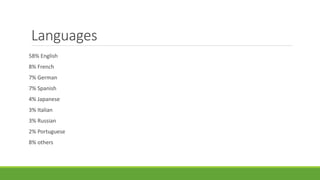
Languages
58% English
8% French
7% German
7% Spanish
4% Japanese
3% Italian
3% Russian
2% Portuguese
8% others
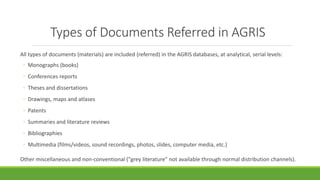
Types of Documents Referred in AGRIS
All types of documents (materials) are included (referred) in the AGRIS databases, at analytical, serial levels:
◦ Monographs (books)
◦ Conferences reports
◦ Theses and dissertations
◦ Drawings, maps and atlases
◦ Patents
◦ Summaries and literature reviews
◦ Bibliographies
◦ Multimedia (films/videos, sound recordings, photos, slides, computer media, etc.)
Other miscellaneous and non-conventional ("grey literature" not available through normal distribution channels).

AGRIS.pptx

  • 1.
    International System forAgricultural Science and Technology (AGRIS)
  • 2.
    The International Systemfor Agricultural Science and Technology (AGRIS) is an Information system which offers a multilingual bibliographic database that connects global users directly to a rich collection of research and technical information on food and agriculture. AGRIS is managed centrally by the WAICENT/FAOINFO Dissemination Management Branch of the Library and Documentation Systems Division (GIL) of FAO Food and Agriculture Organization of the United Nations. AGRIS has been serving users through facilitating access to knowledge in agriculture, science and technology since 1975. More than 400,000 agricultural and research professionals worldwide access AGRIS resources each month. While AGRIS is predominantly a bibliographic database, it also provides full text links to about 2.5 million of its records. AGRIS
  • 3.
    To date Itoffers 9,466,760 bibliographic records produced from more than 400 data providers (research centers, academic institutions, publishers, governmental bodies, development programmes, international and national organizations) from 159 national, about 14,000 items per month. For indexing the input documents (associating the appropriate descriptors) in order to be easily retrieved, a structured and controlled thesaurus, AGROVOC, is used. AGROVOC is widely used in specialized libraries as well as digital libraries and repositories to index content and for the purpose of text mining. AGRIS
  • 4.
    AGRIS work process AGRISis a cooperative system in which participating countries input references to the literature/documents produced within their boundaries and, in return, draw on the information provided by the other participants. The bibliographic references forwarded by participating countries are collected and processed in the AGRIS Processing Unit Vienna, which is hosted by the Division of Scientific and Technical Information of the IAEA.
  • 5.
    Languages 58% English 8% French 7%German 7% Spanish 4% Japanese 3% Italian 3% Russian 2% Portuguese 8% others
  • 6.
    Types of DocumentsReferred in AGRIS All types of documents (materials) are included (referred) in the AGRIS databases, at analytical, serial levels: ◦ Monographs (books) ◦ Conferences reports ◦ Theses and dissertations ◦ Drawings, maps and atlases ◦ Patents ◦ Summaries and literature reviews ◦ Bibliographies ◦ Multimedia (films/videos, sound recordings, photos, slides, computer media, etc.) Other miscellaneous and non-conventional ("grey literature" not available through normal distribution channels).