Issues , Experiences and a Project  Coherence and Interoperability in Agricultural Information Systems – Issues, Experiences and a Project Johannes Keizer FAO of the United Nations
World Food Summit 1996 Reducing Hunger and Poverty in the World by 50% in 2015 "The Rome Declaration calls upon us to reduce by half the number of chronically undernourished people on the Earth by the year 2015 .... If each of us gives his or her best I believe that we can meet and even exceed the target we have set for ourselves.""The Rome Declaration calls upon us to reduce by half the number of chronically undernourished people on the Earth by the year 2015 .... If each of us gives his or her best I believe that we can meet and even exceed the target we have set for ourselves.“ "We have the possibility to do it. We have the knowledge. We have the resources. And with the Rome Declaration and the Plan of Action, we've shown that we have the will." Our Division’s Goal: Combating Hunger with Information
Different Needs for Knowledge……  A library that wants to set up a new portal on sustainable fishery livelihoods let us imagine a researcher in Colombo, who working on the consequences of irrigation for land deterioration The Extension Worker in Tamil Nadu who every week needs to answer different questions of the farmers The Secretary  of the Ministry of Agriculture who needs Legal Information on Pesticide Regulations A researcher at IWMI who needs information on Irrigation and Land Deterioriation
And many sources……. ICAR NAL CABI DLML CAAS Libraries CGIAR Research DBs FAO WHO Websites GeoNW GIS Services USDA Gov.Archives University Resources University Resources University Resources Land Deterioriation Farmer questions Pesticide Regulations new web portal
And many sources……. There is nothing to resolve this  problem at the moment ICAR NAL CABI DLML CAAS Libraries CGIAR Research DBs FAO WHO Websites GeoNW GIS Services USDA Gov.Archives University Resources University Resources University Resources Land Deterioriation Farmer questions Pesticide Regulations new web portal
The problem has not been created by the Internet Revolution But the Internet Revolution has created the expectation that there are easy solutions
AGRIS: an example solution from the 70s  FAO program from 1975 More than 200 AGRIS centres all over the world collecting bibliographical references Nearly 3 million bibliographical references Standardized through proprietary protocols and software Executed as a specific task for FAO Crisis with the advent of the Internet and the investment in own information systems of partners
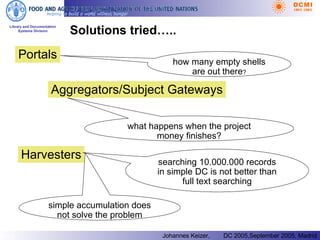
Solutions tried….. Portals Aggregators/Subject Gateways Harvesters how many empty shells are out there ? simple accumulation does not solve the problem what happens when the project money finishes? searching 10.000.000 records in simple DC is not better than full text searching
Wanted! A sustainable way to access, disseminate and re-use decentralized information and knowledge resources
The solution? XML buses, web services….. but this gives only the tools and the technology
The problem is about meaning AQUASTAT AGRIS AGRIPPA new dataset   service 2 common  exchange layer service etc. AQUASTAT AGRIS AGRIPPA new  database   services
Value-added  information  services Shared layer of  interoperability  Distributed Datasets dataset1 dataset2 Common exchange layer (Vocabularies,Ontologies, RDF/XML) … … The concept datasetn Aggregated Database View Subject  specific Portals Information System (n) News feed service
©Berners-Lee … .in a bigger context
Ingredients for Realization Agreed Exchange Schemas Subject Vocabularies Ontologies An Implementation Mechanism Capacity Building Alliance for coherence in Agricultural Information systems AGROVOC And this is the biggest issues with our stakeholders Agricultural Ontology Service (AOS) AgMES Other Schema Projects AGRIS AP
AgMES –  Agricultural Metadata Element Set established namespace for the Agricultural domain implementation independent set of elements that provides elements in addition to DC, DCTerms, ISO19115, etc. to store and exchange metadata without compromising interoperability within and outside the domain.  at the moment limited to the description of textual data but open to register elements to describe other datatypes AgMES
AgMES Specifications for DC Refinements 2.3.8  subjectThesaurus Library of Congress Subject Headings (DC)  LCSH   Medical Subject Headings (DC)  MeSH A controlled vocabulary of terms, especially key words, in agricultural sciences for use in indexing and information retrieval created by National Agricultural Library (NAL) of United States. (AGS)  NALT A controlled vocabulary of terms, especially key words, in fisheries for use in indexing and information retrieval created by ASFA (Aquatic Sciences and Fisheries Abstracts). (AGS)  ASFAT A controlled vocabulary of terms, especially key words, in agricultural sciences for use in indexing and information retrieval created and produced by CAB International. (AGS)  CABT Multilingual agricultural thesaurus produced by FAO, and used for indexing and cataloguing. (AGS)  AGROVOC free-text; it is preferable to have the value from a controlled list. Here are some possible Schemes.  Scheme DC.Subject Element Refined Repeatable Maximum Occurrence Character String Datatype Optional Obligation English Language FAO Registration Authority 1.1 Version Below are some possible schemes that may be used for expressing the values of subject Classification. If you wish to use one that has not been listed here, simply indicate the correct reference URI, in XML one can indicate this using the attribute “scheme” and in RDF by using “rdf:isdefinedby”. Comments A classified list of terms or keywords, in a particular field, for use in indexing and information retrieval. Definition subjectThesaurus Label subjectThesaurus Name
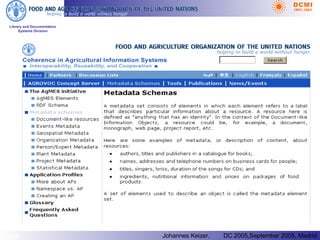
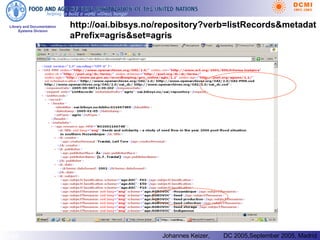
AGRIS AP : an Application Profile for OAI Services in Agriculture It is based on established metadata namespaces  such as DC, AgMES, AGLS therefore making the data OpenURL compliant; It is qualified Dublin Core and makes complex searches on data sets possible Maintains high quality of data by promoting use of controlled vocabulary; The use of XML to exchange makes it compatible with different software and platforms allowing easier management; It is an “exchange layer” that allows users to have their choice of proprietary applications but still exchange information; Enables harvesting of  metadata by service providers for value added services such as the OAI; Handles multilinguality in a consistent way;
http://oai.bibsys.no/repository?verb=listRecords&metadataPrefix=agris&set=agris
Other schema projects already ongoing Event metadata : exploring use of DC and AgMES Project/Person/Organizations : exploring the use of CERIF with local extensions in AgMES Plant Production and Protection : exploring the use of Darwin Core (1.0 and 2.0) (DwC), the ABCD Schema.
Implementation Successes 2004: Wageningen University and Vikki Science Library rejoin the AGRIS network by implementing data exchange with the AGRIS AP (mapping MARC to the AGRIS AP) 2005: GFIS (Global Forestry Information Service) decides to use the AGRIS AP as the Basis for their Data Exchange 2005: The Research Centres of the CGIAR start to map their metadata repositories (all different) to an AGRIS AP based CGIAR –AP to interchange data within and without the network 2005: FAO makes the entire AGRIS respository (3 million records) available in the AGRIS AP Exchange Format 2005: Expert Consultation in October will discuss the possibility of a common standard for Agricultural Open Archives.
Vocabularies: AGROVOC, a starting point
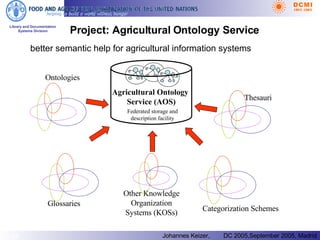
Project: Agricultural Ontology Service better semantic help for agricultural information systems Thesauri Categorization Schemes Glossaries Ontologies Other Knowledge Organization Systems (KOSs) Agricultural Ontology  Service (AOS) Federated storage and description facility
AOS Elements AGROVOC Concept Server KOS registry AGROVOC Concept Server KOS registry Metadata and subject ontologies Domain concepts Other KOS (thesauri, word lists, etc.) ……
Modeling and Changing AGROVOC Conversion to UTF-8 Modified structure to store multiple classification schemes Incorporation of specific vocabularies Revised RDBMS scheme for ontology representation Implementation of further languages (Thai, Indian Languages, Korean, Hungarian…..) Designed OWL models Export to OWL format (v0.8b) Export to SKOS format (v0.8a) AGROVOC web services to be published
Main Issues Getting  a correct and sustainable presentation of the concept/term/string relationship in  a multilingual environment Creating a distributed and decentralized, but coherent maintenance  environment  for vocabularies
Concept Relationships between concepts Lexicalization/ Term String Relationships between strings Relationships between terms designated by manifested as Other information: language/culture subvocabulary/scope audience type, etc. annotation relationship Relationship Relationships between Relationships Note
Conceptual structure of a thesaurus in OWL All terms are created as instances of the class o_terms. All at the same level. Only one language per term. term level string level concept level
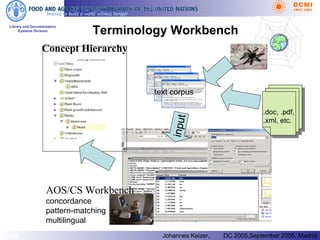
Terminology Workbench .doc, .pdf, .xml, etc. Concept Hierarchy input AOS/CS Workbench concordance  pattern-matching multilingual text corpus
Successes AGROVOC as de facto Standard with many of our partners Many downloads a month for the use in different information systems Language coverage is growing faster A working model for the representation of the thesaurus in OWL and for a workbench for collaborative maintenance
Representation of Application Profiles as Ontologies The ontology layer offers: the possibility of reasoning within the domain through precise specifications of concepts, relations, and rules the possibility of inferring new data from existing data
Implementation Successes not so many, but AGROVOC has become already a link between different information systems in and outside FAO (GIS, Project, Documents) Some demonstrators of semantically enhanced applications
The Vision  - a semantic space in the web Network of Data and Service Providers with agreed procedures and standards – and common ontological layers Data Provider:  exposes institutional open archives of data and information Development Agencies and NGOs Research Institutions Industry Information Centres Service Provider: provides services based on these institutional  open archives Libraries and other traditional Aggregators Thematic or Regional Centres of Excellence
The Vehicle:  an Alliance for Coherence in Agricultural Information Systems Shared Communication  Platform Expert  Meetings Information System Designers/Developers Information System Managers Consultations Donor  Organizations Information System Owners External Actors
Functions of the Alliance Registration and documentation of common standards  Registration and documentation of information systems Facilitation of the coherent use of standards and tools Advocacy for a “Code of Conduct” Establishment of mechanisms to agree on common standards and procedures Collaborative efforts in maintaining standards Facilitation of fund raising Expert meetings to elaborate standards and procedures
Partners Publishers Important Agricultural Libraries Development Agencies Universities IARs (CG-network) Industry Organizations from Related Areas (UNEPS EnOS)
1999:  IDML Initiative 2000:  Contacts to DCMI 2000:  Brussels meeting and AGstandards (AgMES) initiative 2001: Launch of the Agricultural Ontology Service 2002:  AOS Workshops  2003: Fertile Ground meeting for more coherence in Agricultural  Information Systems Release of AgMES 2004:  AGRIS Application Profile 2005: Integration of the AOS workshops with INFITA Strong Collaboration FAO ICT-Program CG network (CGIAR Application Profiles) Sponsor: DFID Partners: FAO, CGIAR, CABI, NAL. CAAS, GFIS Successes
 
 
Credits Stefano Anibaldi Fynvola Le Hunte Ward Gudrun Johannsen Stefka Kaloyanova Boris Lauser Anita Liang Irene Onyancha Gauri Salokhe Margherita Sini Jim Weinheimer and Dagobert Soergel

2005 09 Dc Keynote

  • 1.
    Issues , Experiencesand a Project Coherence and Interoperability in Agricultural Information Systems – Issues, Experiences and a Project Johannes Keizer FAO of the United Nations
  • 2.
    World Food Summit1996 Reducing Hunger and Poverty in the World by 50% in 2015 "The Rome Declaration calls upon us to reduce by half the number of chronically undernourished people on the Earth by the year 2015 .... If each of us gives his or her best I believe that we can meet and even exceed the target we have set for ourselves.""The Rome Declaration calls upon us to reduce by half the number of chronically undernourished people on the Earth by the year 2015 .... If each of us gives his or her best I believe that we can meet and even exceed the target we have set for ourselves.“ "We have the possibility to do it. We have the knowledge. We have the resources. And with the Rome Declaration and the Plan of Action, we've shown that we have the will." Our Division’s Goal: Combating Hunger with Information
  • 3.
    Different Needs forKnowledge…… A library that wants to set up a new portal on sustainable fishery livelihoods let us imagine a researcher in Colombo, who working on the consequences of irrigation for land deterioration The Extension Worker in Tamil Nadu who every week needs to answer different questions of the farmers The Secretary of the Ministry of Agriculture who needs Legal Information on Pesticide Regulations A researcher at IWMI who needs information on Irrigation and Land Deterioriation
  • 4.
    And many sources…….ICAR NAL CABI DLML CAAS Libraries CGIAR Research DBs FAO WHO Websites GeoNW GIS Services USDA Gov.Archives University Resources University Resources University Resources Land Deterioriation Farmer questions Pesticide Regulations new web portal
  • 5.
    And many sources…….There is nothing to resolve this problem at the moment ICAR NAL CABI DLML CAAS Libraries CGIAR Research DBs FAO WHO Websites GeoNW GIS Services USDA Gov.Archives University Resources University Resources University Resources Land Deterioriation Farmer questions Pesticide Regulations new web portal
  • 6.
    The problem hasnot been created by the Internet Revolution But the Internet Revolution has created the expectation that there are easy solutions
  • 7.
    AGRIS: an examplesolution from the 70s FAO program from 1975 More than 200 AGRIS centres all over the world collecting bibliographical references Nearly 3 million bibliographical references Standardized through proprietary protocols and software Executed as a specific task for FAO Crisis with the advent of the Internet and the investment in own information systems of partners
  • 8.
    Solutions tried….. PortalsAggregators/Subject Gateways Harvesters how many empty shells are out there ? simple accumulation does not solve the problem what happens when the project money finishes? searching 10.000.000 records in simple DC is not better than full text searching
  • 9.
    Wanted! A sustainableway to access, disseminate and re-use decentralized information and knowledge resources
  • 10.
    The solution? XMLbuses, web services….. but this gives only the tools and the technology
  • 11.
    The problem isabout meaning AQUASTAT AGRIS AGRIPPA new dataset service 2 common exchange layer service etc. AQUASTAT AGRIS AGRIPPA new database services
  • 12.
    Value-added information services Shared layer of interoperability Distributed Datasets dataset1 dataset2 Common exchange layer (Vocabularies,Ontologies, RDF/XML) … … The concept datasetn Aggregated Database View Subject specific Portals Information System (n) News feed service
  • 13.
    ©Berners-Lee … .ina bigger context
  • 14.
    Ingredients for RealizationAgreed Exchange Schemas Subject Vocabularies Ontologies An Implementation Mechanism Capacity Building Alliance for coherence in Agricultural Information systems AGROVOC And this is the biggest issues with our stakeholders Agricultural Ontology Service (AOS) AgMES Other Schema Projects AGRIS AP
  • 15.
    AgMES – Agricultural Metadata Element Set established namespace for the Agricultural domain implementation independent set of elements that provides elements in addition to DC, DCTerms, ISO19115, etc. to store and exchange metadata without compromising interoperability within and outside the domain. at the moment limited to the description of textual data but open to register elements to describe other datatypes AgMES
  • 16.
    AgMES Specifications forDC Refinements 2.3.8 subjectThesaurus Library of Congress Subject Headings (DC) LCSH Medical Subject Headings (DC) MeSH A controlled vocabulary of terms, especially key words, in agricultural sciences for use in indexing and information retrieval created by National Agricultural Library (NAL) of United States. (AGS) NALT A controlled vocabulary of terms, especially key words, in fisheries for use in indexing and information retrieval created by ASFA (Aquatic Sciences and Fisheries Abstracts). (AGS) ASFAT A controlled vocabulary of terms, especially key words, in agricultural sciences for use in indexing and information retrieval created and produced by CAB International. (AGS) CABT Multilingual agricultural thesaurus produced by FAO, and used for indexing and cataloguing. (AGS) AGROVOC free-text; it is preferable to have the value from a controlled list. Here are some possible Schemes. Scheme DC.Subject Element Refined Repeatable Maximum Occurrence Character String Datatype Optional Obligation English Language FAO Registration Authority 1.1 Version Below are some possible schemes that may be used for expressing the values of subject Classification. If you wish to use one that has not been listed here, simply indicate the correct reference URI, in XML one can indicate this using the attribute “scheme” and in RDF by using “rdf:isdefinedby”. Comments A classified list of terms or keywords, in a particular field, for use in indexing and information retrieval. Definition subjectThesaurus Label subjectThesaurus Name
  • 17.
    AGRIS AP :an Application Profile for OAI Services in Agriculture It is based on established metadata namespaces such as DC, AgMES, AGLS therefore making the data OpenURL compliant; It is qualified Dublin Core and makes complex searches on data sets possible Maintains high quality of data by promoting use of controlled vocabulary; The use of XML to exchange makes it compatible with different software and platforms allowing easier management; It is an “exchange layer” that allows users to have their choice of proprietary applications but still exchange information; Enables harvesting of metadata by service providers for value added services such as the OAI; Handles multilinguality in a consistent way;
  • 18.
  • 19.
    Other schema projectsalready ongoing Event metadata : exploring use of DC and AgMES Project/Person/Organizations : exploring the use of CERIF with local extensions in AgMES Plant Production and Protection : exploring the use of Darwin Core (1.0 and 2.0) (DwC), the ABCD Schema.
  • 20.
    Implementation Successes 2004:Wageningen University and Vikki Science Library rejoin the AGRIS network by implementing data exchange with the AGRIS AP (mapping MARC to the AGRIS AP) 2005: GFIS (Global Forestry Information Service) decides to use the AGRIS AP as the Basis for their Data Exchange 2005: The Research Centres of the CGIAR start to map their metadata repositories (all different) to an AGRIS AP based CGIAR –AP to interchange data within and without the network 2005: FAO makes the entire AGRIS respository (3 million records) available in the AGRIS AP Exchange Format 2005: Expert Consultation in October will discuss the possibility of a common standard for Agricultural Open Archives.
  • 21.
  • 22.
    Project: Agricultural OntologyService better semantic help for agricultural information systems Thesauri Categorization Schemes Glossaries Ontologies Other Knowledge Organization Systems (KOSs) Agricultural Ontology Service (AOS) Federated storage and description facility
  • 23.
    AOS Elements AGROVOCConcept Server KOS registry AGROVOC Concept Server KOS registry Metadata and subject ontologies Domain concepts Other KOS (thesauri, word lists, etc.) ……
  • 24.
    Modeling and ChangingAGROVOC Conversion to UTF-8 Modified structure to store multiple classification schemes Incorporation of specific vocabularies Revised RDBMS scheme for ontology representation Implementation of further languages (Thai, Indian Languages, Korean, Hungarian…..) Designed OWL models Export to OWL format (v0.8b) Export to SKOS format (v0.8a) AGROVOC web services to be published
  • 25.
    Main Issues Getting a correct and sustainable presentation of the concept/term/string relationship in a multilingual environment Creating a distributed and decentralized, but coherent maintenance environment for vocabularies
  • 26.
    Concept Relationships betweenconcepts Lexicalization/ Term String Relationships between strings Relationships between terms designated by manifested as Other information: language/culture subvocabulary/scope audience type, etc. annotation relationship Relationship Relationships between Relationships Note
  • 27.
    Conceptual structure ofa thesaurus in OWL All terms are created as instances of the class o_terms. All at the same level. Only one language per term. term level string level concept level
  • 28.
    Terminology Workbench .doc,.pdf, .xml, etc. Concept Hierarchy input AOS/CS Workbench concordance pattern-matching multilingual text corpus
  • 29.
    Successes AGROVOC asde facto Standard with many of our partners Many downloads a month for the use in different information systems Language coverage is growing faster A working model for the representation of the thesaurus in OWL and for a workbench for collaborative maintenance
  • 30.
    Representation of ApplicationProfiles as Ontologies The ontology layer offers: the possibility of reasoning within the domain through precise specifications of concepts, relations, and rules the possibility of inferring new data from existing data
  • 31.
    Implementation Successes notso many, but AGROVOC has become already a link between different information systems in and outside FAO (GIS, Project, Documents) Some demonstrators of semantically enhanced applications
  • 32.
    The Vision - a semantic space in the web Network of Data and Service Providers with agreed procedures and standards – and common ontological layers Data Provider: exposes institutional open archives of data and information Development Agencies and NGOs Research Institutions Industry Information Centres Service Provider: provides services based on these institutional open archives Libraries and other traditional Aggregators Thematic or Regional Centres of Excellence
  • 33.
    The Vehicle: an Alliance for Coherence in Agricultural Information Systems Shared Communication Platform Expert Meetings Information System Designers/Developers Information System Managers Consultations Donor Organizations Information System Owners External Actors
  • 34.
    Functions of theAlliance Registration and documentation of common standards Registration and documentation of information systems Facilitation of the coherent use of standards and tools Advocacy for a “Code of Conduct” Establishment of mechanisms to agree on common standards and procedures Collaborative efforts in maintaining standards Facilitation of fund raising Expert meetings to elaborate standards and procedures
  • 35.
    Partners Publishers ImportantAgricultural Libraries Development Agencies Universities IARs (CG-network) Industry Organizations from Related Areas (UNEPS EnOS)
  • 36.
    1999: IDMLInitiative 2000: Contacts to DCMI 2000: Brussels meeting and AGstandards (AgMES) initiative 2001: Launch of the Agricultural Ontology Service 2002: AOS Workshops 2003: Fertile Ground meeting for more coherence in Agricultural Information Systems Release of AgMES 2004: AGRIS Application Profile 2005: Integration of the AOS workshops with INFITA Strong Collaboration FAO ICT-Program CG network (CGIAR Application Profiles) Sponsor: DFID Partners: FAO, CGIAR, CABI, NAL. CAAS, GFIS Successes
  • 37.
  • 38.
  • 39.
    Credits Stefano AnibaldiFynvola Le Hunte Ward Gudrun Johannsen Stefka Kaloyanova Boris Lauser Anita Liang Irene Onyancha Gauri Salokhe Margherita Sini Jim Weinheimer and Dagobert Soergel