helping to build a world without hunger FOOD AND AGRICULTURE ORGANIZATION OF THE UNITED NATIONS
World Food Summit 1996 Reducing Hunger and Poverty in the World by 50% in 2015 "The Rome Declaration calls upon us to reduce by half the number of chronically undernourished people on the Earth by the year 2015 .... If each of us gives his or her best I believe that we can meet and even exceed the target we have set for ourselves.""The Rome Declaration calls upon us to reduce by half the number of chronically undernourished people on the Earth by the year 2015 .... If each of us gives his or her best I believe that we can meet and even exceed the target we have set for ourselves.“ "We have the possibility to do it. We have the knowledge. We have the resources. And with the Rome Declaration and the Plan of Action, we've shown that we have the will."
Information and Knowledge Management at FAO The First Article of the FAO Constitution: “ The Organization shall collect, analyse, interpret and disseminate information relating to nutrition, food and agriculture .” A specific objective of FAO’s Strategic Framework In response to the World Food Summit (1996) “ improve decision-making through the provision of information and assessments and fostering of knowledge management for food and agriculture.” A new focus on FAO as a “Knowledge Organization” as approved by the FAO Council
 
AGMES – Application Profiles Building Blocks for a Semantic Web Space in Food and Agriculture Gauri Salokhe [email_address] http://www.salokhe.com Johannes Keizer [email_address] http://www.johanneskeizer.com
Starting Points in 2000 AGRIS  (FAO Documentation) AGROVOC And there was a question : Is there any need to invest in metadata and vocabularies in the age of electronic information ?
…… . we went 2001 to Ottawa to participate the first time in the Dublin Core meetings ...... since then we are knitting the semantic web in our area
Resources we are dealing with..  Document – Like Information Objects (DLIOs)  Learning resources  Organizations Projects News and Events
Document – Like Information Objects - About Starting point was the AGRIS Database, which gathers bibliographic information from over 200+ centres from across the world  It currently contains 2.5 million bibliographic records. Before the year 2000, participating centers were forced to use a proprietary software or complicated format conversions were necessary at the central database
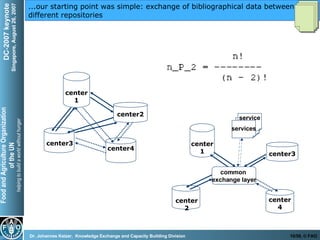
...our starting point was simple: exchange of bibliographical data between different repositories center3 center1 center2 center4 service 2 common  exchange layer service etc. center2 center1 center3 center4 services
Document – Like Information Objects – Our Proposal The AGRIS Application Profile (AGRIS AP) is a metadata standard created specifically to enhance the description, exchange and subsequent retrieval of agricultural Document-Like Information Objects (DLIOs).  It is a metadata schema which draws elements from well known Metadata standards such as  Dublin Core (DC),  Australian Government Locator Service Metadata (AGLS), and  Agricultural Metadata Element Set (AgMES) namespaces.  It allows sharing of information across dispersed bibliographic systems and provides guidelines on recommended best practices for cataloguing and subject indexing.
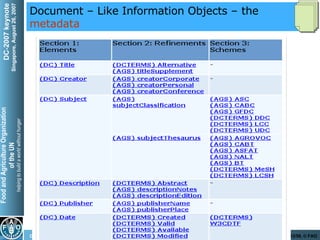
Document – Like Information Objects – the  metadata
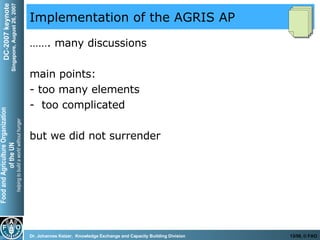
Implementation of the AGRIS AP …… . many discussions main points: - too many elements too complicated but we did not surrender
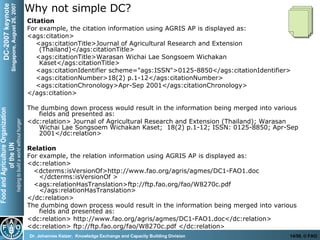
Why not simple DC? Citation For example, the citation information using AGRIS AP is displayed as:  <ags:citation> <ags:citationTitle>Journal of Agricultural Research and Extension (Thailand)</ags:citationTitle> <ags:citationTitle>Warasan Wichai Lae Songsoem Wichakan Kaset</ags:citationTitle> <ags:citationIdentifier scheme=&quot;ags:ISSN&quot;>0125-8850</ags:citationIdentifier> <ags:citationNumber>18(2) p.1-12</ags:citationNumber> <ags:citationChronology>Apr-Sep 2001</ags:citationChronology> </ags:citation> The dumbing down process would result in the information being merged into various fields and presented as:  <dc:relation> Journal of Agricultural Research and Extension (Thailand); Warasan Wichai Lae Songsoem Wichakan Kaset;  18(2) p.1-12; ISSN: 0125-8850; Apr-Sep 2001</dc:relation>  Relation For example, the relation information using AGRIS AP is displayed as:  <dc:relation> <dcterms:isVersionOf>http://www.fao.org/agris/agmes/DC1-FAO1.doc </dcterms:isVersionOf > <ags:relationHasTranslation>ftp://ftp.fao.org/fao/W8270c.pdf </ags:relationHasTranslation> </dc:relation> The dumbing down process would result in the information being merged into various fields and presented as:  <dc:relation> http://www.fao.org/agris/agmes/DC1-FAO1.doc</dc:relation>  <dc:relation> ftp://ftp.fao.org/fao/W8270c.pdf </dc:relation >
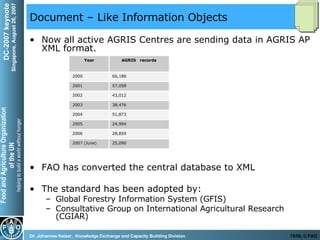
Document – Like Information Objects Now all active AGRIS Centres are sending data in AGRIS AP XML format. FAO has converted the central database to XML The standard has been adopted by:  Global Forestry Information System (GFIS) Consultative Group on International Agricultural Research (CGIAR) 25,090 2007 (June) 28,859 2006 24,994 2005 51,873 2004 38,476 2003 43,012 2002 57,058 2001 66,186 2000 AGRIS  records Year
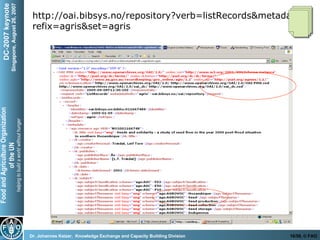
http://oai.bibsys.no/repository?verb=listRecords&metadataPrefix=agris&set=agris
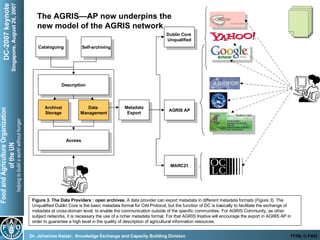
Figure 3.  The Data Providers : open archives .  A data provider can export metadata in different metadata formats ( Figure 3 ). The Unqualified Dublin Core is the basic metadata format for OAI Protocol, but the function of DC is basically to facilitate the exchange of metadata at cross-domain level, to enable the communication outside of the specific communities. For AGRIS Community, as other subject networks, it is necessary the use of a richer metadata format. For that AGRIS Iniative will encourage the export in AGRIS AP in order to guarantee a high level in the quality of description of agricultural information resources.  The AGRIS—AP now underpins the new model of the AGRIS network Data  Management Archival Storage Access Description Cataloguing Metadata Export Dublin Core  Unqualified MARC21 AGRIS AP Self-archiving
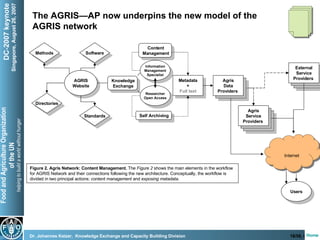
Home The AGRIS—AP now underpins the new model of the AGRIS network Figure 2.  Agris Network: Content Management .  The  Figure 2  shows the main elements in the workflow for AGRIS Network and their connections following the new architecture. Conceptually, the workflow is divided in two principal actions:  content management  and  exposing metadata .  Information Management Specialist Metadata + Full text Software AGRIS Website Agris Service Providers   Standards Users Researcher Open Access External Service Providers   Agris Data Providers   Content Management Self Archiving Knowledge Exchange Directories Methods Internet
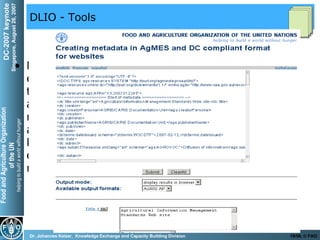
DLIO - Tools Metamaker
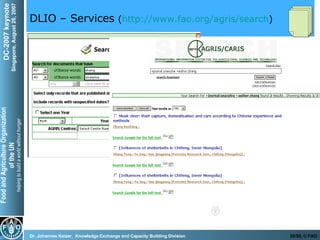
DLIO – Services  ( http://www.fao.org/agris/search )
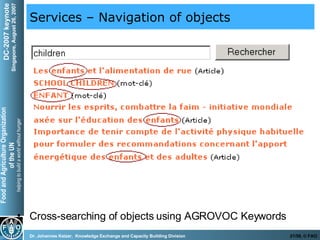
Services – Navigation of objects Cross-searching of objects using AGROVOC Keywords
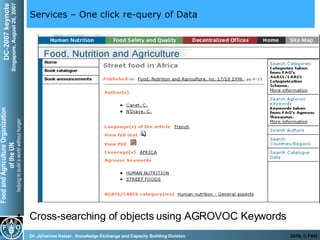
Services – One click re-query of Data Cross-searching of objects using AGROVOC Keywords
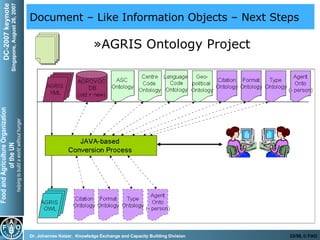
Document – Like Information Objects – Next Steps AGRIS Ontology Project
Learning resources - About The United Nations General Assembly recognizes the crucial role of capacity building for achieving the Millennium Development Goals It has called upon the United Nations organizations to increase their support to developing countries’ own efforts. Capacity and institution building is a core function of the Food and Agriculture Organization (FAO) of the United Nations.
Learning resources – Our Proposal In order to provide structured access to FAO’s agricultural learning resources and capacity and institution building services, the “Capacity and Institution Building Portal” project was started in 2006.  A  metadata  standard was needed to assure that each resource will be described appropriately.
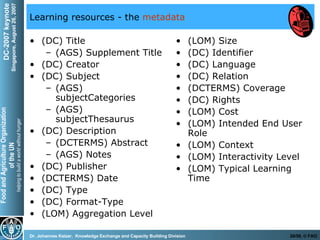
Learning resources - the  metadata (DC) Title (AGS) Supplement Title (DC) Creator (DC) Subject  (AGS) subjectCategories (AGS) subjectThesaurus  (DC) Description (DCTERMS) Abstract (AGS) Notes (DC) Publisher  (DCTERMS) Date (DC) Type (DC) Format-Type (LOM) Aggregation Level (LOM) Size (DC) Identifier (DC) Language (DC) Relation (DCTERMS) Coverage  (DC) Rights (LOM) Cost (LOM) Intended End User Role (LOM) Context (LOM) Interactivity Level (LOM) Typical Learning Time
Learning resources – Next Steps The  “Capacity and Institution Building Portal” will be made available to FAO staff and member countries towards the end of the year Approximately, 300+ records have been identified in FAO as learning resources. Metadata for these resources is being created according to the Learning Resources AP Strong collaboration with the CGIAR Learning Resource Initiative
Organizations - About Information on agricultural organizations is available from many different information services  with independent databases. Very few of these systems share data among themselves and in no case do they coherently integrate data.  This translates into three major difficulties:  maintenance is costly;  similar (but incomprehensive) information is available from several sources;  visibility in all the existing databases requires submitting the same data to multiple databases.
Organizations – Our Proposal Provide a web-based tool that allows everyone to create  metadata  about their organization.  The tool will come with guidelines on &quot;how-to&quot; create the  metadata  file.  The XML file will be stored on institutes’ webserver and the URL will be registered in a central server The central server can be exploited to create other value-added services as desired.  Periodic update requests will be sent out to all the organizations.
Organizations – the  metadata (AGS) organizationName (AGS) fullOrganizationName (AGS) organizationAcronym (AGS) address (AGS) streetAddress (AGS) country (AGS) telephone (AGS) fax (AGS) telex (AGS) email (DC) identifier (scheme “dcterms:URI”) (DC) description (DC) subject (AGS) subjectThesaurus (AGS) organizationType (DC) relation (DCTERMS) isPartOf (sugg: scheme “dcterms:URI”) (DCTERMS) replaces  (sugg: scheme “dcterms:URI”) (DC) date (DCTERMS) created (DCTERMS) modified
Organizations – Next Steps The “metamaker” is under construction The registry is being developed by our partner organization the Global Forum on Agricultural Research (GFAR) Data will be collected by targeting the partner organizations (CGIAR, GFIS etc.)
Projects - About Repositories of Project metadata exist but...  maintenance is costly;  similar (but incomprehensive) information is available from several sources;  visibility in all the existing databases requires submitting the same data to multiple databases. Promote data sharing
Projects – Our Proposal To develop core data standard for enable sharing of project metadata describing projects by evaluating existing standards; Provide user friendly documentation on the list of fields used to describe and share project information and best practices on encoding them; and  To provide machine-readable encoding (such as eXtensible Markup Language) to allow automatic validation of shared information.  Partner organization (WIS International), with FAO, is developing a proposal for the metadata standard.
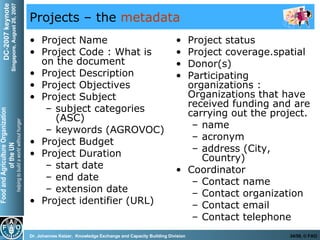
Projects – the  metadata Project Name Project Code : What is on the document Project Description Project Objectives Project Subject subject categories (ASC) keywords (AGROVOC) Project Budget Project Duration start date end date extension date Project identifier (URL) Project status  Project coverage.spatial  Donor(s) Participating organizations : Organizations that have received funding and are carrying out the project. name acronym address (City, Country) Coordinator Contact name Contact organization Contact email Contact telephone
Projects – Next Steps Get an agreement from partners on the elements Provide a XML DTD for validation of the metadata files Promote the standard as a possible “means” for sharing project information without going into too many details .
News and Events - About An event is defined here as “something that happens at a given place and time.”  An event can be broken into different ‘subsets’, for example by day or session. In this document, it will be the larger entity that will be addressed.  For example, some of the events in FAO are:  Eighth AOS Workshop -- 7 years of AOS: Achievements and Next Steps , Rome, Italy. 21-22 September 2007 Special Session on Agricultural Metadata & Semantics : 2nd International Conference on Metadata and Semantics Research (MTSR'07), Greece, October 11-12, 2007
News and Events - About At present, the sharing is done in a ad-hoc manner, leading to specialized formats and incompatible exchange models.  Systems such as NEMS in FAO store and provide possibilities to access this information using RSS feeds. However, the exports are done without using a standard set of elements. Such a standard would facilitate the efficient exchange of news and more importantly event information, and the creation of better tools to support event management.
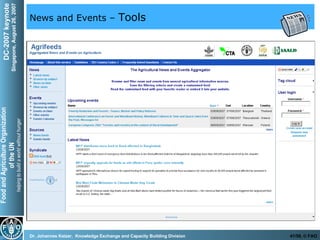
News and Events – Our Proposal In the case of News, we use standard RSS news format. The basic requirements are elements provided by the RSS standard: <link>, <title>, and <description> In the case of Events, an expanded  metadata  set was proposed. RSS feeds that comply with the proposal can be registered at  www.agrifeeds.org
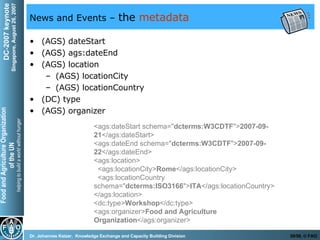
News and Events –  the  metadata (AGS) dateStart (AGS) ags:dateEnd (AGS) location (AGS) locationCity (AGS) locationCountry (DC) type (AGS) organizer <ags:dateStart schema=&quot; dcterms:W3CDTF &quot;> 2007-09-21 </ags:dateStart>  <ags:dateEnd schema=&quot; dcterms:W3CDTF &quot;> 2007-09-22 </ags:dateEnd>  <ags:location>     <ags:locationCity> Rome </ags:locationCity>      <ags:locationCountry schema=&quot; dcterms:ISO3166 &quot;> ITA </ags:locationCountry>  </ags:location> <dc:type> Workshop </dc:type>  <ags:organizer> Food and Agriculture Organization </ags:organizer>
News and Events –  Next Steps Agrifeeds will be launched in September 2007 The “metamaker” is under construction (GFIS) Data will be collected by targeting webmasters (CGIAR, GFIS etc.)
News and Events –  Tools
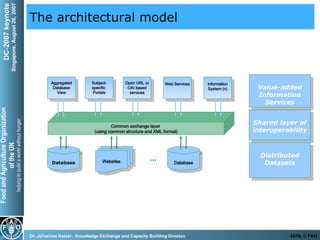
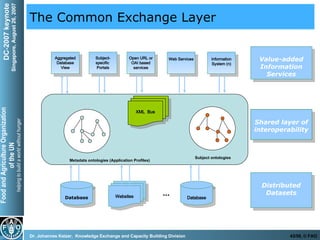
The architectural model  Shared layer of interoperability Common exchange layer  (using common structure and XML format) Value-added Information Services Distributed Datasets Database ... Database Websites Aggregated Database View Subject-specific  Portals Open URL or OAI based services Information System (n) Web Services
The Common Exchange Layer Shared layer of interoperability Value-added Information Services Distributed Datasets Database ... Database Websites XML  Bus Aggregated Database View Subject-specific  Portals Open URL or OAI based services Information System (n) Web Services Metadata ontologies (Application Profiles) Subject ontologies
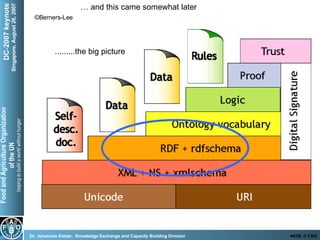
©Berners-Lee .........the big picture …  and this came somewhat later
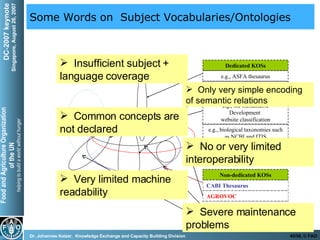
Some Words on  Subject Vocabularies/Ontologies AGROVOC NAL Thesaurus CABI Thesaurus Dedicated KOSs Non-dedicated KOSs e.g., ASFA thesaurus e.g., the Multilingual  Forestry Thesaurus e.g., the Sustainable Development  website classification e.g., biological taxonomies such as NCBI and ITIS GEMET Other thematic thesauri Existing Thesauri and Knowledge Organization Systems (KOSs) Common concepts are not declared No or very limited interoperability Insufficient subject + language coverage Severe maintenance problems Very limited machine readability Only very simple encoding of semantic relations
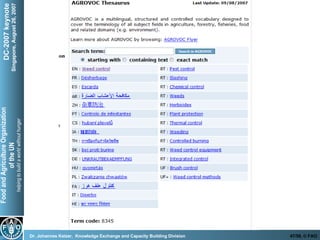
Investing in AGROVOC In 2000 AGROVOC was available in 3 languages and mainly used by AGRIS centres In 2007 AGROVOC is available in 16 languages (and many pipeline projects) AGROVOC is also basis for many projects related to improving semantics in agricultural information The mapping between AGROVOC and NAL was done by an EU project of which existence we only got knowledge in the concluding phase
 
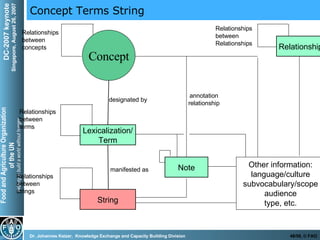
Concept Terms String Concept Relationships between concepts Lexicalization/ Term String Relationships between strings Relationships between terms designated by manifested as Other information: language/culture subvocabulary/scope audience type, etc. annotation relationship Relationship Relationships between Relationships Note
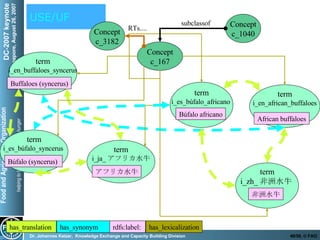
USE/UF Concept c_167 term i_en_ african_buffaloes African buffaloes has_lexicalization Concept c_1040 subclassof Concept c_3182 RTs.... rdfs:label: has_synonym has_translation term i_en_buffaloes_syncerus Buffaloes (syncerus) term i_es_búfalo_africano  Búfalo africano term i_zh_ 非洲水牛  非洲水牛 term i_ja_ アフリカ水牛 アフリカ水牛 term i_es_búfalo_syncerus  Búfalo (syncerus)
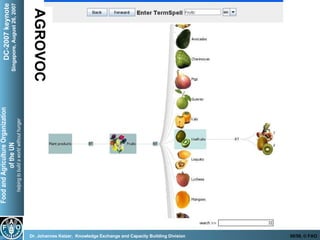
AGROVOC
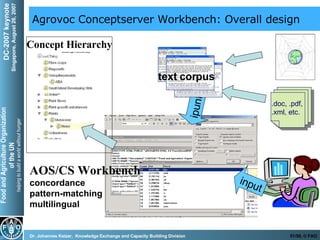
Agrovoc Conceptserver Workbench: Overall design ipunt AOS/CS Workbench concordance  pattern-matching multilingual input .doc, .pdf, .xml, etc. Concept Hierarchy text corpus
SKOS discussions (Our model too complicated) Some weeks ago  Alistair Miles from W3 working group send out a proposal for Label relations  
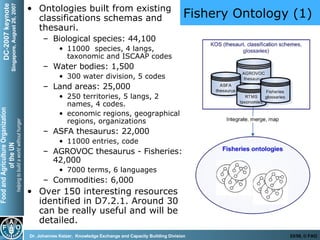
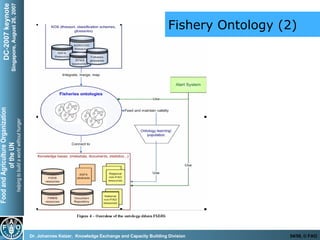
Fishery Ontology (1) Ontologies built from existing classifications schemas and thesauri. Biological species: 44,100  11000  species, 4 langs, taxonomic and ISCAAP codes Water bodies: 1,500 300 water division, 5 codes  Land areas: 25,000  250 territories, 5 langs, 2 names, 4 codes.  economic regions, geographical regions, organizations ASFA thesaurus: 22,000 11000 entries, code AGROVOC thesaurus - Fisheries: 42,000 7000 terms, 6 languages Commodities: 6,000 Over 150 interesting resources identified in D7.2.1. Around 30 can be really useful and will be detailed.
Fishery Ontology (2)
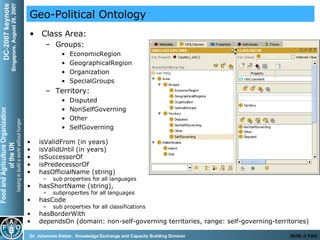
Geo-Political Ontology Class Area: Groups: EconomicRegion GeographicalRegion Organization SpecialGroups Territory:  Disputed NonSelfGoverning Other  SelfGoverning isValidFrom (in years) isValidUntil (in years) isSuccessorOf  isPredecessorOf  hasOfficialName (string) sub properties for all languages  hasShortName (string),  subproperties for all languages hasCode sub properties for all classifications  hasBorderWith dependsOn (domain: non-self-governing territories, range: self-governing-territories)
 
Conclusion The semantic web starts with  existing data applications semantic standards promise to:  be an effective approach to resolving the problems posed by semantic heterogeneity help users find and discover information efficiently and effectively The richer the semantics, the greater the possibilities for developing smart applications.  investment in the enhancement of relations between vocabularies, both metadata and domain-specific, yields a relatively large return on investment not a semantic web, but  semantic webspaces for communities of practice
Thank you Johannes Keizer  {Johannes.Keizer@fao.org} Stefano Anibaldi  { Stefano.Anibaldi @fao.org} Marta Iglesias   { Marta . Iglesias @fao.org} Gudrun Johannsen   { Gudrun . Johannsen @fao.org} Stefka Kaloyanova   { Stefka . Kaloyanova @fao.org} Irene Onyancha  {Irene.Onyancha@fao.org}   Gauri Salokhe  {Gauri.Salokhe@fao.org}   Margherita Sini   { Margherita . Sini @fao.org} Imma Subirats  {Imma.Subirats@fao.org} and credits to our network of collaborators: Dagobert Soergel, Anita Liang, Boris Lauser, Chang Chun, Asanee Kawtrakul, Caterina Caracciolo, Maria Grazia Bovo, Wang Zhong, Ze Li, Jai Haravu, ARD Prasad, Jayanta Chatterjee,  and many others Organizations directly involved: Indian Institute of Technology Kanpur,  Wageningen International, Globa Forum on Agricultural Research , Chinese Academy of Agricultural Science, Hungary Agricultural University,

2007 08 26 Dc Keynote Keizer

  • 1.
    helping to builda world without hunger FOOD AND AGRICULTURE ORGANIZATION OF THE UNITED NATIONS
  • 2.
    World Food Summit1996 Reducing Hunger and Poverty in the World by 50% in 2015 &quot;The Rome Declaration calls upon us to reduce by half the number of chronically undernourished people on the Earth by the year 2015 .... If each of us gives his or her best I believe that we can meet and even exceed the target we have set for ourselves.&quot;&quot;The Rome Declaration calls upon us to reduce by half the number of chronically undernourished people on the Earth by the year 2015 .... If each of us gives his or her best I believe that we can meet and even exceed the target we have set for ourselves.“ &quot;We have the possibility to do it. We have the knowledge. We have the resources. And with the Rome Declaration and the Plan of Action, we've shown that we have the will.&quot;
  • 3.
    Information and KnowledgeManagement at FAO The First Article of the FAO Constitution: “ The Organization shall collect, analyse, interpret and disseminate information relating to nutrition, food and agriculture .” A specific objective of FAO’s Strategic Framework In response to the World Food Summit (1996) “ improve decision-making through the provision of information and assessments and fostering of knowledge management for food and agriculture.” A new focus on FAO as a “Knowledge Organization” as approved by the FAO Council
  • 4.
  • 5.
    AGMES – ApplicationProfiles Building Blocks for a Semantic Web Space in Food and Agriculture Gauri Salokhe [email_address] http://www.salokhe.com Johannes Keizer [email_address] http://www.johanneskeizer.com
  • 6.
    Starting Points in2000 AGRIS (FAO Documentation) AGROVOC And there was a question : Is there any need to invest in metadata and vocabularies in the age of electronic information ?
  • 7.
    …… . wewent 2001 to Ottawa to participate the first time in the Dublin Core meetings ...... since then we are knitting the semantic web in our area
  • 8.
    Resources we aredealing with.. Document – Like Information Objects (DLIOs) Learning resources Organizations Projects News and Events
  • 9.
    Document – LikeInformation Objects - About Starting point was the AGRIS Database, which gathers bibliographic information from over 200+ centres from across the world It currently contains 2.5 million bibliographic records. Before the year 2000, participating centers were forced to use a proprietary software or complicated format conversions were necessary at the central database
  • 10.
    ...our starting pointwas simple: exchange of bibliographical data between different repositories center3 center1 center2 center4 service 2 common exchange layer service etc. center2 center1 center3 center4 services
  • 11.
    Document – LikeInformation Objects – Our Proposal The AGRIS Application Profile (AGRIS AP) is a metadata standard created specifically to enhance the description, exchange and subsequent retrieval of agricultural Document-Like Information Objects (DLIOs). It is a metadata schema which draws elements from well known Metadata standards such as Dublin Core (DC), Australian Government Locator Service Metadata (AGLS), and Agricultural Metadata Element Set (AgMES) namespaces. It allows sharing of information across dispersed bibliographic systems and provides guidelines on recommended best practices for cataloguing and subject indexing.
  • 12.
    Document – LikeInformation Objects – the metadata
  • 13.
    Implementation of theAGRIS AP …… . many discussions main points: - too many elements too complicated but we did not surrender
  • 14.
    Why not simpleDC? Citation For example, the citation information using AGRIS AP is displayed as: <ags:citation> <ags:citationTitle>Journal of Agricultural Research and Extension (Thailand)</ags:citationTitle> <ags:citationTitle>Warasan Wichai Lae Songsoem Wichakan Kaset</ags:citationTitle> <ags:citationIdentifier scheme=&quot;ags:ISSN&quot;>0125-8850</ags:citationIdentifier> <ags:citationNumber>18(2) p.1-12</ags:citationNumber> <ags:citationChronology>Apr-Sep 2001</ags:citationChronology> </ags:citation> The dumbing down process would result in the information being merged into various fields and presented as: <dc:relation> Journal of Agricultural Research and Extension (Thailand); Warasan Wichai Lae Songsoem Wichakan Kaset; 18(2) p.1-12; ISSN: 0125-8850; Apr-Sep 2001</dc:relation> Relation For example, the relation information using AGRIS AP is displayed as: <dc:relation> <dcterms:isVersionOf>http://www.fao.org/agris/agmes/DC1-FAO1.doc </dcterms:isVersionOf > <ags:relationHasTranslation>ftp://ftp.fao.org/fao/W8270c.pdf </ags:relationHasTranslation> </dc:relation> The dumbing down process would result in the information being merged into various fields and presented as: <dc:relation> http://www.fao.org/agris/agmes/DC1-FAO1.doc</dc:relation> <dc:relation> ftp://ftp.fao.org/fao/W8270c.pdf </dc:relation >
  • 15.
    Document – LikeInformation Objects Now all active AGRIS Centres are sending data in AGRIS AP XML format. FAO has converted the central database to XML The standard has been adopted by: Global Forestry Information System (GFIS) Consultative Group on International Agricultural Research (CGIAR) 25,090 2007 (June) 28,859 2006 24,994 2005 51,873 2004 38,476 2003 43,012 2002 57,058 2001 66,186 2000 AGRIS records Year
  • 16.
  • 17.
    Figure 3. The Data Providers : open archives . A data provider can export metadata in different metadata formats ( Figure 3 ). The Unqualified Dublin Core is the basic metadata format for OAI Protocol, but the function of DC is basically to facilitate the exchange of metadata at cross-domain level, to enable the communication outside of the specific communities. For AGRIS Community, as other subject networks, it is necessary the use of a richer metadata format. For that AGRIS Iniative will encourage the export in AGRIS AP in order to guarantee a high level in the quality of description of agricultural information resources. The AGRIS—AP now underpins the new model of the AGRIS network Data Management Archival Storage Access Description Cataloguing Metadata Export Dublin Core Unqualified MARC21 AGRIS AP Self-archiving
  • 18.
    Home The AGRIS—APnow underpins the new model of the AGRIS network Figure 2. Agris Network: Content Management . The Figure 2 shows the main elements in the workflow for AGRIS Network and their connections following the new architecture. Conceptually, the workflow is divided in two principal actions: content management and exposing metadata . Information Management Specialist Metadata + Full text Software AGRIS Website Agris Service Providers Standards Users Researcher Open Access External Service Providers Agris Data Providers Content Management Self Archiving Knowledge Exchange Directories Methods Internet
  • 19.
    DLIO - ToolsMetamaker
  • 20.
    DLIO – Services ( http://www.fao.org/agris/search )
  • 21.
    Services – Navigationof objects Cross-searching of objects using AGROVOC Keywords
  • 22.
    Services – Oneclick re-query of Data Cross-searching of objects using AGROVOC Keywords
  • 23.
    Document – LikeInformation Objects – Next Steps AGRIS Ontology Project
  • 24.
    Learning resources -About The United Nations General Assembly recognizes the crucial role of capacity building for achieving the Millennium Development Goals It has called upon the United Nations organizations to increase their support to developing countries’ own efforts. Capacity and institution building is a core function of the Food and Agriculture Organization (FAO) of the United Nations.
  • 25.
    Learning resources –Our Proposal In order to provide structured access to FAO’s agricultural learning resources and capacity and institution building services, the “Capacity and Institution Building Portal” project was started in 2006. A metadata standard was needed to assure that each resource will be described appropriately.
  • 26.
    Learning resources -the metadata (DC) Title (AGS) Supplement Title (DC) Creator (DC) Subject (AGS) subjectCategories (AGS) subjectThesaurus (DC) Description (DCTERMS) Abstract (AGS) Notes (DC) Publisher (DCTERMS) Date (DC) Type (DC) Format-Type (LOM) Aggregation Level (LOM) Size (DC) Identifier (DC) Language (DC) Relation (DCTERMS) Coverage (DC) Rights (LOM) Cost (LOM) Intended End User Role (LOM) Context (LOM) Interactivity Level (LOM) Typical Learning Time
  • 27.
    Learning resources –Next Steps The “Capacity and Institution Building Portal” will be made available to FAO staff and member countries towards the end of the year Approximately, 300+ records have been identified in FAO as learning resources. Metadata for these resources is being created according to the Learning Resources AP Strong collaboration with the CGIAR Learning Resource Initiative
  • 28.
    Organizations - AboutInformation on agricultural organizations is available from many different information services with independent databases. Very few of these systems share data among themselves and in no case do they coherently integrate data. This translates into three major difficulties: maintenance is costly; similar (but incomprehensive) information is available from several sources; visibility in all the existing databases requires submitting the same data to multiple databases.
  • 29.
    Organizations – OurProposal Provide a web-based tool that allows everyone to create metadata about their organization. The tool will come with guidelines on &quot;how-to&quot; create the metadata file. The XML file will be stored on institutes’ webserver and the URL will be registered in a central server The central server can be exploited to create other value-added services as desired. Periodic update requests will be sent out to all the organizations.
  • 30.
    Organizations – the metadata (AGS) organizationName (AGS) fullOrganizationName (AGS) organizationAcronym (AGS) address (AGS) streetAddress (AGS) country (AGS) telephone (AGS) fax (AGS) telex (AGS) email (DC) identifier (scheme “dcterms:URI”) (DC) description (DC) subject (AGS) subjectThesaurus (AGS) organizationType (DC) relation (DCTERMS) isPartOf (sugg: scheme “dcterms:URI”) (DCTERMS) replaces (sugg: scheme “dcterms:URI”) (DC) date (DCTERMS) created (DCTERMS) modified
  • 31.
    Organizations – NextSteps The “metamaker” is under construction The registry is being developed by our partner organization the Global Forum on Agricultural Research (GFAR) Data will be collected by targeting the partner organizations (CGIAR, GFIS etc.)
  • 32.
    Projects - AboutRepositories of Project metadata exist but... maintenance is costly; similar (but incomprehensive) information is available from several sources; visibility in all the existing databases requires submitting the same data to multiple databases. Promote data sharing
  • 33.
    Projects – OurProposal To develop core data standard for enable sharing of project metadata describing projects by evaluating existing standards; Provide user friendly documentation on the list of fields used to describe and share project information and best practices on encoding them; and To provide machine-readable encoding (such as eXtensible Markup Language) to allow automatic validation of shared information. Partner organization (WIS International), with FAO, is developing a proposal for the metadata standard.
  • 34.
    Projects – the metadata Project Name Project Code : What is on the document Project Description Project Objectives Project Subject subject categories (ASC) keywords (AGROVOC) Project Budget Project Duration start date end date extension date Project identifier (URL) Project status Project coverage.spatial Donor(s) Participating organizations : Organizations that have received funding and are carrying out the project. name acronym address (City, Country) Coordinator Contact name Contact organization Contact email Contact telephone
  • 35.
    Projects – NextSteps Get an agreement from partners on the elements Provide a XML DTD for validation of the metadata files Promote the standard as a possible “means” for sharing project information without going into too many details .
  • 36.
    News and Events- About An event is defined here as “something that happens at a given place and time.” An event can be broken into different ‘subsets’, for example by day or session. In this document, it will be the larger entity that will be addressed. For example, some of the events in FAO are: Eighth AOS Workshop -- 7 years of AOS: Achievements and Next Steps , Rome, Italy. 21-22 September 2007 Special Session on Agricultural Metadata & Semantics : 2nd International Conference on Metadata and Semantics Research (MTSR'07), Greece, October 11-12, 2007
  • 37.
    News and Events- About At present, the sharing is done in a ad-hoc manner, leading to specialized formats and incompatible exchange models. Systems such as NEMS in FAO store and provide possibilities to access this information using RSS feeds. However, the exports are done without using a standard set of elements. Such a standard would facilitate the efficient exchange of news and more importantly event information, and the creation of better tools to support event management.
  • 38.
    News and Events– Our Proposal In the case of News, we use standard RSS news format. The basic requirements are elements provided by the RSS standard: <link>, <title>, and <description> In the case of Events, an expanded metadata set was proposed. RSS feeds that comply with the proposal can be registered at www.agrifeeds.org
  • 39.
    News and Events– the metadata (AGS) dateStart (AGS) ags:dateEnd (AGS) location (AGS) locationCity (AGS) locationCountry (DC) type (AGS) organizer <ags:dateStart schema=&quot; dcterms:W3CDTF &quot;> 2007-09-21 </ags:dateStart> <ags:dateEnd schema=&quot; dcterms:W3CDTF &quot;> 2007-09-22 </ags:dateEnd> <ags:location>   <ags:locationCity> Rome </ags:locationCity>   <ags:locationCountry schema=&quot; dcterms:ISO3166 &quot;> ITA </ags:locationCountry> </ags:location> <dc:type> Workshop </dc:type> <ags:organizer> Food and Agriculture Organization </ags:organizer>
  • 40.
    News and Events– Next Steps Agrifeeds will be launched in September 2007 The “metamaker” is under construction (GFIS) Data will be collected by targeting webmasters (CGIAR, GFIS etc.)
  • 41.
    News and Events– Tools
  • 42.
    The architectural model Shared layer of interoperability Common exchange layer (using common structure and XML format) Value-added Information Services Distributed Datasets Database ... Database Websites Aggregated Database View Subject-specific Portals Open URL or OAI based services Information System (n) Web Services
  • 43.
    The Common ExchangeLayer Shared layer of interoperability Value-added Information Services Distributed Datasets Database ... Database Websites XML Bus Aggregated Database View Subject-specific Portals Open URL or OAI based services Information System (n) Web Services Metadata ontologies (Application Profiles) Subject ontologies
  • 44.
    ©Berners-Lee .........the bigpicture … and this came somewhat later
  • 45.
    Some Words on Subject Vocabularies/Ontologies AGROVOC NAL Thesaurus CABI Thesaurus Dedicated KOSs Non-dedicated KOSs e.g., ASFA thesaurus e.g., the Multilingual Forestry Thesaurus e.g., the Sustainable Development website classification e.g., biological taxonomies such as NCBI and ITIS GEMET Other thematic thesauri Existing Thesauri and Knowledge Organization Systems (KOSs) Common concepts are not declared No or very limited interoperability Insufficient subject + language coverage Severe maintenance problems Very limited machine readability Only very simple encoding of semantic relations
  • 46.
    Investing in AGROVOCIn 2000 AGROVOC was available in 3 languages and mainly used by AGRIS centres In 2007 AGROVOC is available in 16 languages (and many pipeline projects) AGROVOC is also basis for many projects related to improving semantics in agricultural information The mapping between AGROVOC and NAL was done by an EU project of which existence we only got knowledge in the concluding phase
  • 47.
  • 48.
    Concept Terms StringConcept Relationships between concepts Lexicalization/ Term String Relationships between strings Relationships between terms designated by manifested as Other information: language/culture subvocabulary/scope audience type, etc. annotation relationship Relationship Relationships between Relationships Note
  • 49.
    USE/UF Concept c_167term i_en_ african_buffaloes African buffaloes has_lexicalization Concept c_1040 subclassof Concept c_3182 RTs.... rdfs:label: has_synonym has_translation term i_en_buffaloes_syncerus Buffaloes (syncerus) term i_es_búfalo_africano Búfalo africano term i_zh_ 非洲水牛 非洲水牛 term i_ja_ アフリカ水牛 アフリカ水牛 term i_es_búfalo_syncerus Búfalo (syncerus)
  • 50.
  • 51.
    Agrovoc Conceptserver Workbench:Overall design ipunt AOS/CS Workbench concordance pattern-matching multilingual input .doc, .pdf, .xml, etc. Concept Hierarchy text corpus
  • 52.
    SKOS discussions (Ourmodel too complicated) Some weeks ago Alistair Miles from W3 working group send out a proposal for Label relations 
  • 53.
    Fishery Ontology (1)Ontologies built from existing classifications schemas and thesauri. Biological species: 44,100 11000 species, 4 langs, taxonomic and ISCAAP codes Water bodies: 1,500 300 water division, 5 codes Land areas: 25,000 250 territories, 5 langs, 2 names, 4 codes. economic regions, geographical regions, organizations ASFA thesaurus: 22,000 11000 entries, code AGROVOC thesaurus - Fisheries: 42,000 7000 terms, 6 languages Commodities: 6,000 Over 150 interesting resources identified in D7.2.1. Around 30 can be really useful and will be detailed.
  • 54.
  • 55.
    Geo-Political Ontology ClassArea: Groups: EconomicRegion GeographicalRegion Organization SpecialGroups Territory: Disputed NonSelfGoverning Other SelfGoverning isValidFrom (in years) isValidUntil (in years) isSuccessorOf isPredecessorOf hasOfficialName (string) sub properties for all languages hasShortName (string), subproperties for all languages hasCode sub properties for all classifications hasBorderWith dependsOn (domain: non-self-governing territories, range: self-governing-territories)
  • 56.
  • 57.
    Conclusion The semanticweb starts with existing data applications semantic standards promise to: be an effective approach to resolving the problems posed by semantic heterogeneity help users find and discover information efficiently and effectively The richer the semantics, the greater the possibilities for developing smart applications. investment in the enhancement of relations between vocabularies, both metadata and domain-specific, yields a relatively large return on investment not a semantic web, but semantic webspaces for communities of practice
  • 58.
    Thank you JohannesKeizer {Johannes.Keizer@fao.org} Stefano Anibaldi { Stefano.Anibaldi @fao.org} Marta Iglesias { Marta . Iglesias @fao.org} Gudrun Johannsen { Gudrun . Johannsen @fao.org} Stefka Kaloyanova { Stefka . Kaloyanova @fao.org} Irene Onyancha {Irene.Onyancha@fao.org} Gauri Salokhe {Gauri.Salokhe@fao.org} Margherita Sini { Margherita . Sini @fao.org} Imma Subirats {Imma.Subirats@fao.org} and credits to our network of collaborators: Dagobert Soergel, Anita Liang, Boris Lauser, Chang Chun, Asanee Kawtrakul, Caterina Caracciolo, Maria Grazia Bovo, Wang Zhong, Ze Li, Jai Haravu, ARD Prasad, Jayanta Chatterjee, and many others Organizations directly involved: Indian Institute of Technology Kanpur, Wageningen International, Globa Forum on Agricultural Research , Chinese Academy of Agricultural Science, Hungary Agricultural University,