The CIARD (Coherence in Information for Agricultural Research for development) initiative and a global infrastructure for linked open dataDr. Johannes KeizerOffice ofKnowledge Exchange, Research and ExtensionFood andAgricultureOrganizationofthe UNTalk atWorldbank,  2011, May 17
We will promote research for food and agriculture, including research to adapt to, and mitigate climate change, and access to research results and technologies at national, regional and international levels. We will reinvigorate national research systems and will share information and best practices. We will improve access to knowledge.worldfoodsummit  2009
FAO has been engaged for decades in making agricultural development information more easily accessible and sharable among it's stakeholders.  These efforts reach back to the early 70s when FAO set up the AGRIS program.  Since the advent of the Internet the AIMS team at FAO HQ is working to make distributed data and information repositories interoperable. This work has been backed up on the institutional level by the CIARD  (Coherence in Information for Agricultural Research for Development) initiative, in which FAO, GFAR, the CGIAR and many national partners collaborate. Technically FAO has underpinned this with the further development of the Agricultural Thesaurus AGROVOC and with initiatives on shared metadata sets (AGRIS AP) and ontologies. The paradigm and technology of linked open data, proposed by Tim Berners Lee some years ago, now provides a practical possibility to apply standard vocabularies and semantics to link distributed data that is published in a non proprietary format. The presentation will show the CIARD RING,  ("routemap to information nodes and gateways"), demonstrate the AGROVOC LOD, will talk about the use of LOD in federating document repositories and will outline an Infrastructure for Information interoperability in Agricultural research and innovation
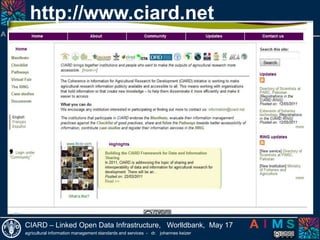
http://www.ciard.net
The Communityand growing…..Founding Partners
 The  Vision and Manifesto“To make public domain agricultural research information and knowledge truly accessible to all”All organizations that create and possess public agricultural research information disseminate and share it more widely
CIARD partners will (a) coordinate their efforts, (b) promote common formats, (c) adopt open systems
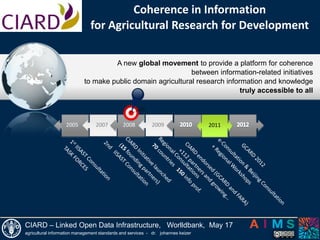
Create a global network of public collections of informationCoherence in InformationforAgriculturalResearchforDevelopmentA new global movement to provide a platform for coherence between information-related initiatives to make public domain agricultural research information and knowledge truly accessible to all 20092007200820052010201220111st IISAST Consultation TASK FORCESCIARD Initiative launched (15 founding partners)Regional Consultations70 countries   150 info prof.2nd   IISAST ConsultationGCARD 2012e-Consultation & Beijing Consultation+ Regional WorkshopsCIARD endorsed (GCARD and FARA)+112 partners and growing…
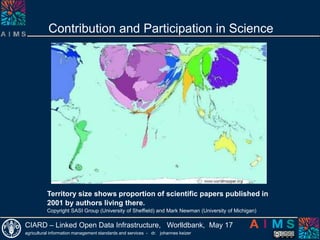
Contribution and Participation in ScienceTerritory size shows proportion of scientific papers published in 2001 by authors living there.  Copyright SASI Group (University of Sheffield) and Mark Newman (University of Michigan)
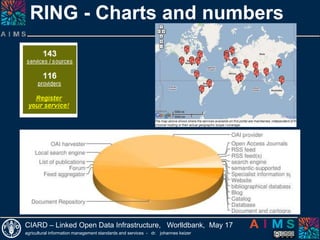
RING - Charts and numbers
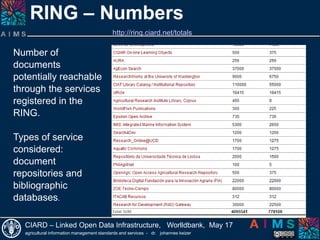
RING – Numbershttp://ring.ciard.net/totalsNumber of documents potentially reachable through the services registered in the RING.Types of service considered: document repositories and bibliographic databases.
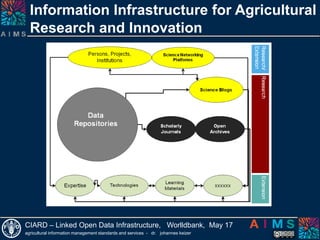
Information InfrastructureforAgriculturalResearch and Innovation
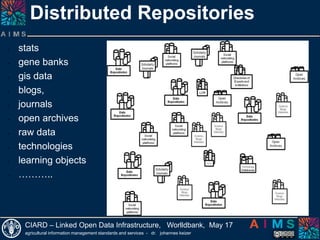
DistributedRepositoriesstats
gene banks
gis data
blogs,
journals
open archives
raw data
technologies
learningobjects
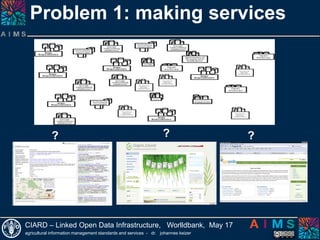
………..Problem 1: makingservices???
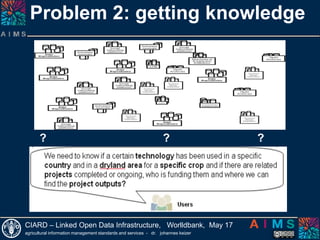
Problem 2: gettingknowledge???
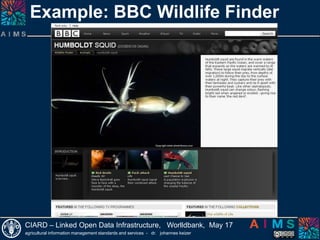
Example: BBC Wildlife Finder
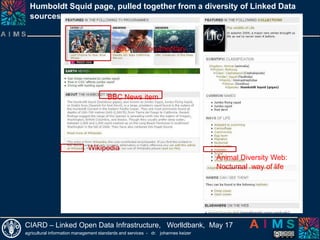
Humboldt Squid page, pulled together from a diversity of Linked Data sourcesBBC TV DocumentaryBBC News itemWikipediaAnimal Diversity Web:Nocturnal  way of life
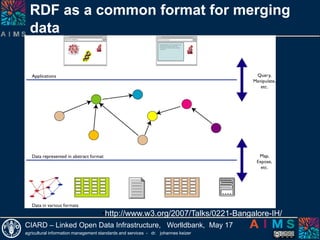
http://www.w3.org/2007/Talks/0221-Bangalore-IH/RDF as a common format for merging data
The role of vocabularies in linking data sets
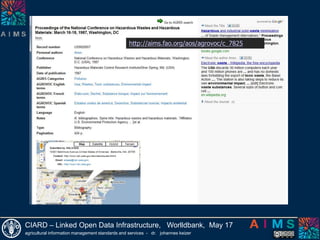
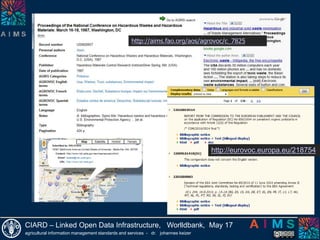
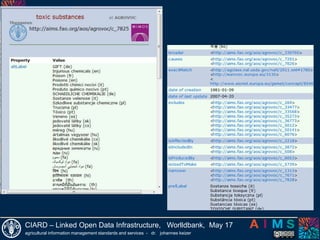
http://aims.fao.org/aos/agrovoc/c_7825
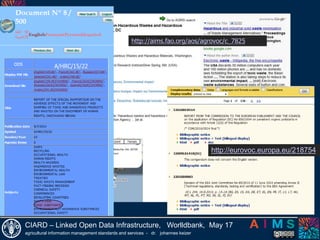
http://eurovoc.europa.eu/218754http://aims.fao.org/aos/agrovoc/c_7825
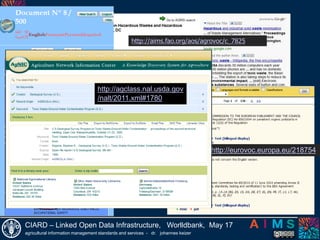
http://eurovoc.europa.eu/218754http://agclass.nal.usda.gov/nalt/2011.xml#1780http://aims.fao.org/aos/agrovoc/c_7825
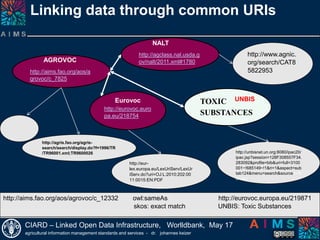
Linking data through common URIsTOXIC SUBSTANCEShttp://www.agnic.org/search/CAT85822953UNBISAGROVOCNALThttp://aims.fao.org/aos/agrovoc/c_7825http://agclass.nal.usda.gov/nalt/2011.xml#1780http://eurovoc.europa.eu/218754Eurovochttp://agris.fao.org/agris-search/search/display.do?f=1996/TR/TR96001.xml;TR9600026http://unbisnet.un.org:8080/ipac20/ipac.jsp?session=128F308557F34.283092&profile=bib&uri=full=3100001~!685149~!1&ri=1&aspect=subtab124&menu=search&source=~!horizonhttp://eur-lex.europa.eu/LexUriServ/LexUriServ.do?uri=OJ:L:2010:202:0011:0015:EN:PDFhttp://aims.fao.org/aos/agrovoc/c_12332        owl:sameAshttp://eurovoc.europa.eu/219871skos: exact match                  UNBIS: Toxic Substances
If all institutions, which publish about toxic wastes would:- Index their publications with URIs from AGROVOC,GEMET, NALT, LCSH or EUROVOC
(many do – low hanging fruit!)
- Publish their metadata as LOD
(quite easy to do, bibData map well to RDFThenEveryone who knows to write SparqlQeries could get all these publications with one shot for a new website on toxic wastes
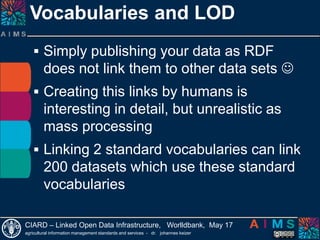
Vocabularies and LODSimply publishing your data as RDF does not link them to other data sets Creating this links by humans is interesting in detail, but unrealistic as mass processingLinking 2 standard vocabularies can link 200 datasets which use these standard vocabularies
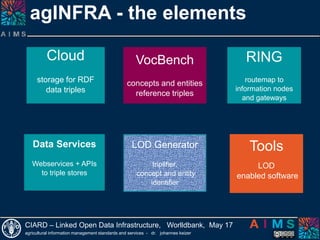
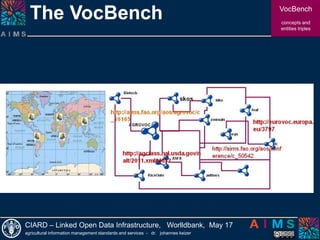
RINGroutemapto  information nodes and gatewaysVocBenchconcepts and entitiesreferencetriplesCloudstoragefor RDF data triplesToolsLODenabled software LOD Generatortriplifier,concept and entityidentifierData ServicesWebservices + APIsto triple storesagINFRA - the elements
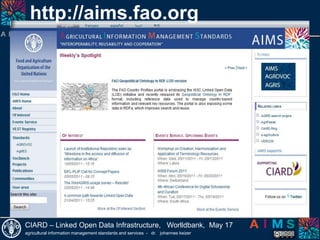
http://aims.fao.org
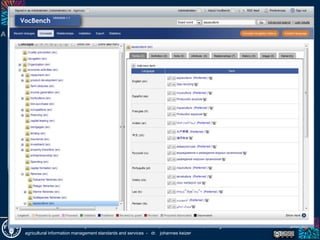
….views into the construction siteVocBenchAGROVOC LOD on VocBench 1.1LOD GeneratorDo you know openCalais?AgroTagger Testing SiteLODE-BDThe RING: http://ring.ciard.netToolsAgriDrupalAgriOceanDspace : http://193.190.8.15/agri3/
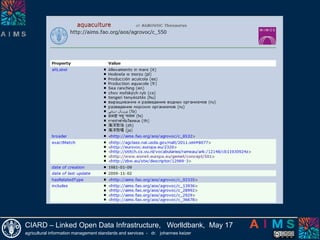
AGROVOC
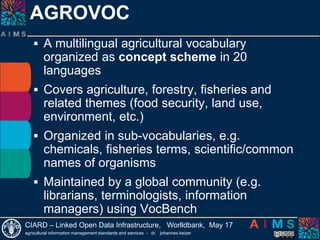
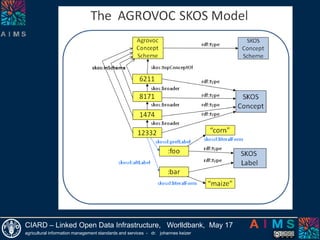
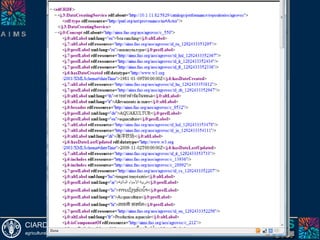
AGROVOCA multilingual agricultural vocabulary organized as concept scheme in 20 languagesCovers agriculture, forestry, fisheries and related themes (food security, land use, environment, etc.)Organized in sub-vocabularies, e.g. chemicals, fisheries terms, scientific/common names of organismsMaintained by a global community (e.g. librarians, terminologists, information managers) using VocBench
AGROVOC - Statistics
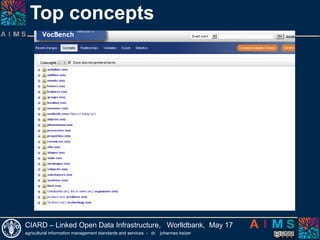
Top concepts
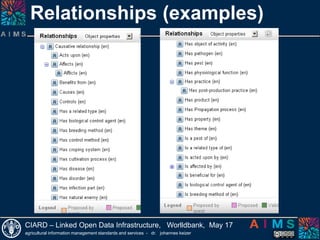
Relationships (examples)
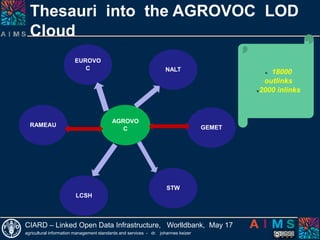
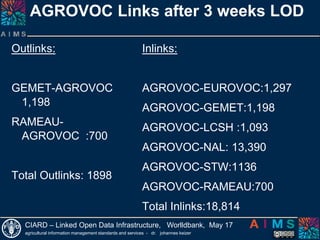
Thesauri  into  the AGROVOC  LOD Cloud    18000 outlinks
2000 inlinksEUROVOCNALT AGROVOCRAMEAUGEMET STW  LCSH

World bank 2011-05

  • 1.
    The CIARD (Coherencein Information for Agricultural Research for development) initiative and a global infrastructure for linked open dataDr. Johannes KeizerOffice ofKnowledge Exchange, Research and ExtensionFood andAgricultureOrganizationofthe UNTalk atWorldbank, 2011, May 17
  • 2.
    We will promoteresearch for food and agriculture, including research to adapt to, and mitigate climate change, and access to research results and technologies at national, regional and international levels. We will reinvigorate national research systems and will share information and best practices. We will improve access to knowledge.worldfoodsummit 2009
  • 3.
    FAO has beenengaged for decades in making agricultural development information more easily accessible and sharable among it's stakeholders.  These efforts reach back to the early 70s when FAO set up the AGRIS program.  Since the advent of the Internet the AIMS team at FAO HQ is working to make distributed data and information repositories interoperable. This work has been backed up on the institutional level by the CIARD  (Coherence in Information for Agricultural Research for Development) initiative, in which FAO, GFAR, the CGIAR and many national partners collaborate. Technically FAO has underpinned this with the further development of the Agricultural Thesaurus AGROVOC and with initiatives on shared metadata sets (AGRIS AP) and ontologies. The paradigm and technology of linked open data, proposed by Tim Berners Lee some years ago, now provides a practical possibility to apply standard vocabularies and semantics to link distributed data that is published in a non proprietary format. The presentation will show the CIARD RING,  ("routemap to information nodes and gateways"), demonstrate the AGROVOC LOD, will talk about the use of LOD in federating document repositories and will outline an Infrastructure for Information interoperability in Agricultural research and innovation
  • 4.
  • 5.
  • 6.
    The Vision and Manifesto“To make public domain agricultural research information and knowledge truly accessible to all”All organizations that create and possess public agricultural research information disseminate and share it more widely
  • 7.
    CIARD partners will(a) coordinate their efforts, (b) promote common formats, (c) adopt open systems
  • 8.
    Create a globalnetwork of public collections of informationCoherence in InformationforAgriculturalResearchforDevelopmentA new global movement to provide a platform for coherence between information-related initiatives to make public domain agricultural research information and knowledge truly accessible to all 20092007200820052010201220111st IISAST Consultation TASK FORCESCIARD Initiative launched (15 founding partners)Regional Consultations70 countries 150 info prof.2nd IISAST ConsultationGCARD 2012e-Consultation & Beijing Consultation+ Regional WorkshopsCIARD endorsed (GCARD and FARA)+112 partners and growing…
  • 9.
    Contribution and Participationin ScienceTerritory size shows proportion of scientific papers published in 2001 by authors living there. Copyright SASI Group (University of Sheffield) and Mark Newman (University of Michigan)
  • 10.
    RING - Chartsand numbers
  • 11.
    RING – Numbershttp://ring.ciard.net/totalsNumberof documents potentially reachable through the services registered in the RING.Types of service considered: document repositories and bibliographic databases.
  • 12.
  • 13.
  • 14.
  • 15.
  • 16.
  • 17.
  • 18.
  • 19.
  • 20.
  • 21.
  • 22.
  • 23.
  • 25.
  • 26.
    Humboldt Squid page,pulled together from a diversity of Linked Data sourcesBBC TV DocumentaryBBC News itemWikipediaAnimal Diversity Web:Nocturnal way of life
  • 27.
  • 28.
    The role ofvocabularies in linking data sets
  • 30.
  • 31.
  • 32.
  • 33.
  • 34.
    Linking data throughcommon URIsTOXIC SUBSTANCEShttp://www.agnic.org/search/CAT85822953UNBISAGROVOCNALThttp://aims.fao.org/aos/agrovoc/c_7825http://agclass.nal.usda.gov/nalt/2011.xml#1780http://eurovoc.europa.eu/218754Eurovochttp://agris.fao.org/agris-search/search/display.do?f=1996/TR/TR96001.xml;TR9600026http://unbisnet.un.org:8080/ipac20/ipac.jsp?session=128F308557F34.283092&profile=bib&uri=full=3100001~!685149~!1&ri=1&aspect=subtab124&menu=search&source=~!horizonhttp://eur-lex.europa.eu/LexUriServ/LexUriServ.do?uri=OJ:L:2010:202:0011:0015:EN:PDFhttp://aims.fao.org/aos/agrovoc/c_12332 owl:sameAshttp://eurovoc.europa.eu/219871skos: exact match UNBIS: Toxic Substances
  • 35.
    If all institutions,which publish about toxic wastes would:- Index their publications with URIs from AGROVOC,GEMET, NALT, LCSH or EUROVOC
  • 36.
    (many do –low hanging fruit!)
  • 37.
    - Publish theirmetadata as LOD
  • 38.
    (quite easy todo, bibData map well to RDFThenEveryone who knows to write SparqlQeries could get all these publications with one shot for a new website on toxic wastes
  • 39.
    Vocabularies and LODSimplypublishing your data as RDF does not link them to other data sets Creating this links by humans is interesting in detail, but unrealistic as mass processingLinking 2 standard vocabularies can link 200 datasets which use these standard vocabularies
  • 40.
    RINGroutemapto informationnodes and gatewaysVocBenchconcepts and entitiesreferencetriplesCloudstoragefor RDF data triplesToolsLODenabled software LOD Generatortriplifier,concept and entityidentifierData ServicesWebservices + APIsto triple storesagINFRA - the elements
  • 41.
  • 42.
    ….views into theconstruction siteVocBenchAGROVOC LOD on VocBench 1.1LOD GeneratorDo you know openCalais?AgroTagger Testing SiteLODE-BDThe RING: http://ring.ciard.netToolsAgriDrupalAgriOceanDspace : http://193.190.8.15/agri3/
  • 43.
  • 44.
    AGROVOCA multilingual agriculturalvocabulary organized as concept scheme in 20 languagesCovers agriculture, forestry, fisheries and related themes (food security, land use, environment, etc.)Organized in sub-vocabularies, e.g. chemicals, fisheries terms, scientific/common names of organismsMaintained by a global community (e.g. librarians, terminologists, information managers) using VocBench
  • 45.
  • 46.
  • 47.
  • 52.
    Thesauri into the AGROVOC LOD Cloud 18000 outlinks
  • 53.

Editor's Notes

  • #10 the chart on the homepage representing the distribution of services across "service types" (http://ring.ciard.net) (implemented with support from John Fereira); the geographic map on the homepage representing the geographic distribution of services;
  • #11 a first attempt to provide some aggregated data on the number of contents / resources potentially reachable through the services registered in the RING: http://ring.ciard.net/totals
  • #17 Whatdoesthismean in practice? I will show thiswithanexamplefrom the BBC. The biggestconsumers (and producers) of LOD are as I know the BBC and the New York times (Butnowalso the US government)
  • #18 During the Web 1.0 phase, Webpageswerecomposedbyhumans. Todaymostwebpages are drivenbydatabasesthat can bedynamicallyqueried. Theycontainthrough RSS feedsalso data fromotherwebsitesThis BBC webpageis a big jumpfurther. I hasnotbeencomposedbyhumans and itisnotfromone database generated. Itisgeneratedfromdifferentdatasourcesthatwerepresentaslinked open data, linkedonlythrough common URIs
  • #22 Ifresources are marked up withsemanticallydefined and machinereadableconcepts, they can belinked and mashed up preciselyaswehaveseen in the examplefrom the BBC.In thisexamplewe start withan AGRIS record on Hazardouswaste, whichisindexedwith AGROVOC. Alreadynowwe can easily link to material indexedwithEurovoc, hereanexamplefromEuroLex. If the UNBIS thesaurus wouldberestructuredto a conceptscheme and publishedas LOD, related UN documentscouldbeattachedautomaticallyby the machine.
  • #23 Ifresources are marked up withsemanticallydefined and machinereadableconcepts, they can belinked and mashed up preciselyaswehaveseen in the examplefrom the BBC.In thisexamplewe start withan AGRIS record on Hazardouswaste, whichisindexedwith AGROVOC. Alreadynowwe can easily link to material indexedwithEurovoc, hereanexamplefromEuroLex. If the UNBIS thesaurus wouldberestructuredto a conceptscheme and publishedas LOD, related UN documentscouldbeattachedautomaticallyby the machine.
  • #24 Ifresources are marked up withsemanticallydefined and machinereadableconcepts, they can belinked and mashed up preciselyaswehaveseen in the examplefrom the BBC.In thisexamplewe start withan AGRIS record on Hazardouswaste, whichisindexedwith AGROVOC. Alreadynowwe can easily link to material indexedwithEurovoc, hereanexamplefromEuroLex. If the UNBIS thesaurus wouldberestructuredto a conceptscheme and publishedas LOD, related UN documentscouldbeattachedautomaticallyby the machine.
  • #25 Ifresources are marked up withsemanticallydefined and machinereadableconcepts, they can belinked and mashed up preciselyaswehaveseen in the examplefrom the BBC.In thisexamplewe start withan AGRIS record on Hazardouswaste, whichisindexedwith AGROVOC. Alreadynowwe can easily link to material indexedwithEurovoc, hereanexamplefromEuroLex. If the UNBIS thesaurus wouldberestructuredto a conceptscheme and publishedas LOD, related UN documentscouldbeattachedautomaticallyby the machine.
  • #26 How does this work: A resource is connected with each concept URI in the web. The concepts between three vocabularies are having same literal which is connected with owl:sameAS/exactMatch relationship. As we are speakingaboutthesauri and notontologieswekept the relation tobechosenpurposelyvague. The conceptscouldbematchedwithowl:sameAS or the termscouldbematcheswith SKOS:exactMatch. A lotofdiscussion on thisisongoing
  • #29 The mainintegrationworksthroughcommonsemanticsCore ofagINFRAtechnologyisaLODstoreofsharedencodedknowledgeorganizationsystemsan automaticmarkupto link structuredandunstructureddatasourcesthroughthissharedKnowledgeOrganizationsystemsSharing withinthe R.I.N.G.Partner registertheirservices, notechnicallimitationLOD – Wrapper for all participatingInstitutionsFor all registered services a „triplificationwrapper“ will besetupThe triplifierworkswith „agConceptsandagIdentities“ tocreatelinkeddataSteadilygrowing LOD ecosystemThe agINFRA LOD ecosystemoffers Webservices forthewww
  • #31 http://193.190.8.15/agri3/user: agri@oceanpassword: agrihttp://aims.fao.org/lode/bd/subjecthttp://202.73.13.50:58301/AgroTagger/
  • #41 Note: we identified outlinks to RAMAEU and GEMET, and they have taken them as inlinks to their own thesaurus.
  • #46 - All links are checked by a domain expert.
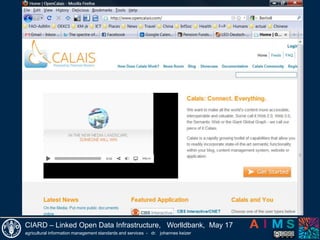
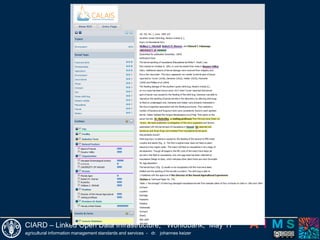
  • #49 Oneof the groundbreakingenterprises in this area isThomsonReuters “Open Calais”. Thisis a webservicethatprovidessemanticmark up foranyunstructured text thatyoufeedintotheir service The service is free ofCharge. Why? I will show youlater.
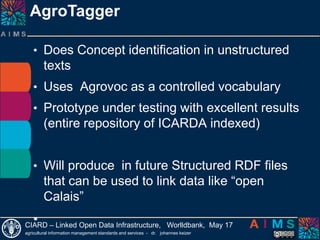
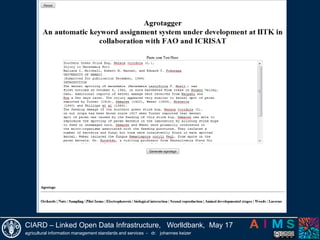
  • #50 My team in collaborationwith the IndianInstituteofTechnology in Kanpur isdeveloping a similar service foroursubject area.
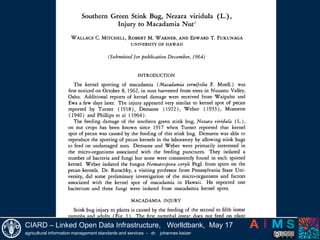
  • #51 Wehavehere a text from 1964 without a bibliographic record at handabout a plantprotectionissue
  • #52 Open Calais isverygood in thoseareas, in whichtheyhavetheirownelaboratedconceptschemeagainstwhich the texts are analyzed: “Places”, “Persons”, “Business Processes” , “IndustryTerms”, butitisweak in the specifictopicanalysis, whattheycall “social tags”
  • #53 AgroTaggerstilllacksmanyof the sophisticated featuresof “Open Calais” ,butismuch, muchbetter in the subjectanalysisof the text