COUNTRY PAPER
ON
AGRICULTURAL EXTENSION SYSTEM
IN BANGLADESH
Presented by
Md. Hamidur Rahman,
Project Director
Second Crop Diversification Project (SCDP)
and Additional Director
Department of Agricultural Extension (DAE)
Dhaka, Bangladesh
Agricultural Extension System - Md. Hamidur Rahman2
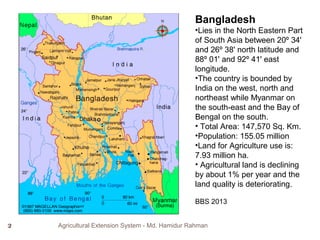
Bangladesh
•Lies in the North Eastern Part
of South Asia between 20º 34'
and 26º 38' north latitude and
88º 01' and 92º 41' east
longitude.
•The country is bounded by
India on the west, north and
northeast while Myanmar on
the south-east and the Bay of
Bengal on the south.
• Total Area: 147,570 Sq. Km.
•Population: 155.05 million
•Land for Agriculture use is:
7.93 million ha.
• Agricultural land is declining
by about 1% per year and the
land quality is deteriorating.
BBS 2013
2
 Agriculture contributes about 19% to the national
economy including fisheries (3.7%) & Livestock(4%)
but contribution to employment about 53%
 Incidence of poverty declined from more than 80%
during 70s to 31.5 % in 2010
 Long history of Agricultural extension service
 Majorcrops are rice, wheat, jute, maize, potato, fruits,
vegetables, pulses, oilseed, spices etc.
 Fisheries and livestockare also productive sector
 Country has 80% flat alluvial soil, 8% hill
 Cropping intensity is about 191 % in 8 million ha
Agriculture At a GlanceAgriculture At a Glance
Agricultural Extension System in Bangladesh - Md. Hamidur Rahman
3
 Dominated by smallholders, Av. farmsize 0.0946 ha. 53% family
having less than .20 ha of land and marked as landless on the other
hand only 1% farmfamily having av.3.3 ha. of land remaining 36%
farmers are small and marginal farmers (av. land size 0.80 ha.)
 Rice covers nearly 75% of cropped area
 Irrigated area covers 7.06 million ha. of the total cultivated land
 75% women and 58% men involved in vegetable crops, 49%
Women & 38% men in poultry, 51% women 62% & men in
livestock,40% women & 58% men in fruit crops, 9% women & 75%
men field crops and 5% women and 24% in Fish/prawns.
 Fairly developed research-extension linkage, having extensive
research and extension network
 Emerging private sectorin tech transferthrough media & private
dealers.
 Agriculture is involved with numberof Ministries:
Min of Aagriculture (Crops), Min. of Fisheries & Livestock, Min. of
Environment & Forest
Agriculture At a GlanceAgriculture At a Glance
Agricultural Extension System in Bangladesh- Md. Hamidur
Rahman
5
 Historically, Research, Extension, Education &
Training were under the same directorate (Dept of
Agriculture)
 With the expansion of large no. of actors and system
diversity, directorate was divided into separate
departments during 1973.
 In 1982, reorganization of extension service as Dept of
Ag Extension (DAE) merging Jute Production, Plant
Protection, Horticulture Dev Board, Tobacco Dev
Board etc.
 Research institutes emerged as autonomous bodies
Agricultural Extension System in Bangladesh- Md. Hamidur
Rahman
The objectives of the Extension Policy are to:
•Improve the productivity and production of
primary food crops to sustain National Food
Security
•Increase farm income and employment
through increased diversification of the sector
with high value crops and farm enterprises
linked with domestic and international markets
•Improve longer term sustainability of the use
and conservation of Natural Resources
including mitigation of climate change induced
vulnerabilities.
•Mobilize, build and develop farmer groups
and organizations for better access to
technologies, information and markets
through aggregation, economies of scale and
building social capital.
• Help alleviate poverty among tiny, small and
marginal farmers including removal of
nutritional imbalances and ensuring food
safety.
The objectives of the Extension Policy are to:
•Improve the productivity and production of
primary food crops to sustain National Food
Security
•Increase farm income and employment
through increased diversification of the sector
with high value crops and farm enterprises
linked with domestic and international markets
•Improve longer term sustainability of the use
and conservation of Natural Resources
including mitigation of climate change induced
vulnerabilities.
•Mobilize, build and develop farmer groups
and organizations for better access to
technologies, information and markets
through aggregation, economies of scale and
building social capital.
• Help alleviate poverty among tiny, small and
marginal farmers including removal of
nutritional imbalances and ensuring food
safety.
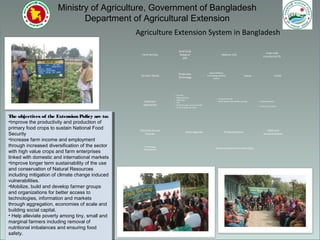
Small Scale
Marginal
34%
Medium 12%
Large scale
Commercial 2%
Farm Families
Production
Technology
Value Addition
Technology,Market
Access
Inputs CreditFarmers’ Needs
Public Agencies Private Extension
NGOs and
Scheduled Banks
Extension Service
Provider
Extension
Approaches
• Training
• Demonstration
• Field Days
• FFS
• Promote Local service provider
• On farm collection Point
• Contract Farming
• Inputs dealers and retailer training • Group Formation
• Provision of Credits
Research System and Universities
Technology
Development
Agriculture Extension System in Bangladesh
Ministry of Agriculture, Government of Bangladesh
Department of Agricultural Extension
The National Agriculture Extension Policy draws from the fore-going
constraint analysis and derives the following strategic approaches
considering the competitive and strategic advantages for Bangladesh.
1.Differentiated Approach to Suit Location Specific
Demands.
2.Targeting the Tiny, Marginal and Small Holders.
3.Recognizing Farmers as Partners in Development.
4.Synergizing Producer Organizations to Address Value
Chain Constraints.
5.Reinventing Integrated Whole Farm Approach.
6.Value Added Facilitation Style of Extension Agents.
7.Pluralistic and De-centralized Approach. Promoting e-
Agriculture.
Strategic Shifts and Guiding Principles
7
Agricultural Extension System in Bangladesh - Md. Hamidur
Rahman
Strategic Shifts and Guiding Principles
8
Agricultural Extension System in Bangladesh - Md. Hamidur
Rahman
8. Enhanced Capacity Building of Extension Personnel
9. Investment in Common Productive Assets to
Augment Information Support.
10.Promoting e-Agriculture
11.Copping with Climate Changes and Balancing
Environmental Issues.
12.Refocus on Social Safeguard Considerations.
13.Alignment, Harmonization and Coordination.
14.Stop use of agriculture land for non-agricultural
purpose
15.Strengthening extension program.
16.Strengthening research –extension coordination
9
Agricultural Extension System in Bangladesh - Md. Hamidur
Rahman
Strategic Shifts and Guiding Principles
17.Importance on crop diversification & crop zoning.
18.Step towards improve soil health.
19.Importance on using agriculture inputs support card.
Thank you
10
Agricultural Extension System - Md. Hamidur Rahman

Agriculture Extension system in Bangladesh

  • 1.
    COUNTRY PAPER ON AGRICULTURAL EXTENSIONSYSTEM IN BANGLADESH Presented by Md. Hamidur Rahman, Project Director Second Crop Diversification Project (SCDP) and Additional Director Department of Agricultural Extension (DAE) Dhaka, Bangladesh
  • 2.
    Agricultural Extension System- Md. Hamidur Rahman2 Bangladesh •Lies in the North Eastern Part of South Asia between 20º 34' and 26º 38' north latitude and 88º 01' and 92º 41' east longitude. •The country is bounded by India on the west, north and northeast while Myanmar on the south-east and the Bay of Bengal on the south. • Total Area: 147,570 Sq. Km. •Population: 155.05 million •Land for Agriculture use is: 7.93 million ha. • Agricultural land is declining by about 1% per year and the land quality is deteriorating. BBS 2013
  • 3.
    2  Agriculture contributesabout 19% to the national economy including fisheries (3.7%) & Livestock(4%) but contribution to employment about 53%  Incidence of poverty declined from more than 80% during 70s to 31.5 % in 2010  Long history of Agricultural extension service  Majorcrops are rice, wheat, jute, maize, potato, fruits, vegetables, pulses, oilseed, spices etc.  Fisheries and livestockare also productive sector  Country has 80% flat alluvial soil, 8% hill  Cropping intensity is about 191 % in 8 million ha Agriculture At a GlanceAgriculture At a Glance Agricultural Extension System in Bangladesh - Md. Hamidur Rahman
  • 4.
    3  Dominated bysmallholders, Av. farmsize 0.0946 ha. 53% family having less than .20 ha of land and marked as landless on the other hand only 1% farmfamily having av.3.3 ha. of land remaining 36% farmers are small and marginal farmers (av. land size 0.80 ha.)  Rice covers nearly 75% of cropped area  Irrigated area covers 7.06 million ha. of the total cultivated land  75% women and 58% men involved in vegetable crops, 49% Women & 38% men in poultry, 51% women 62% & men in livestock,40% women & 58% men in fruit crops, 9% women & 75% men field crops and 5% women and 24% in Fish/prawns.  Fairly developed research-extension linkage, having extensive research and extension network  Emerging private sectorin tech transferthrough media & private dealers.  Agriculture is involved with numberof Ministries: Min of Aagriculture (Crops), Min. of Fisheries & Livestock, Min. of Environment & Forest Agriculture At a GlanceAgriculture At a Glance Agricultural Extension System in Bangladesh- Md. Hamidur Rahman
  • 5.
    5  Historically, Research,Extension, Education & Training were under the same directorate (Dept of Agriculture)  With the expansion of large no. of actors and system diversity, directorate was divided into separate departments during 1973.  In 1982, reorganization of extension service as Dept of Ag Extension (DAE) merging Jute Production, Plant Protection, Horticulture Dev Board, Tobacco Dev Board etc.  Research institutes emerged as autonomous bodies Agricultural Extension System in Bangladesh- Md. Hamidur Rahman
  • 6.
    The objectives ofthe Extension Policy are to: •Improve the productivity and production of primary food crops to sustain National Food Security •Increase farm income and employment through increased diversification of the sector with high value crops and farm enterprises linked with domestic and international markets •Improve longer term sustainability of the use and conservation of Natural Resources including mitigation of climate change induced vulnerabilities. •Mobilize, build and develop farmer groups and organizations for better access to technologies, information and markets through aggregation, economies of scale and building social capital. • Help alleviate poverty among tiny, small and marginal farmers including removal of nutritional imbalances and ensuring food safety. The objectives of the Extension Policy are to: •Improve the productivity and production of primary food crops to sustain National Food Security •Increase farm income and employment through increased diversification of the sector with high value crops and farm enterprises linked with domestic and international markets •Improve longer term sustainability of the use and conservation of Natural Resources including mitigation of climate change induced vulnerabilities. •Mobilize, build and develop farmer groups and organizations for better access to technologies, information and markets through aggregation, economies of scale and building social capital. • Help alleviate poverty among tiny, small and marginal farmers including removal of nutritional imbalances and ensuring food safety. Small Scale Marginal 34% Medium 12% Large scale Commercial 2% Farm Families Production Technology Value Addition Technology,Market Access Inputs CreditFarmers’ Needs Public Agencies Private Extension NGOs and Scheduled Banks Extension Service Provider Extension Approaches • Training • Demonstration • Field Days • FFS • Promote Local service provider • On farm collection Point • Contract Farming • Inputs dealers and retailer training • Group Formation • Provision of Credits Research System and Universities Technology Development Agriculture Extension System in Bangladesh Ministry of Agriculture, Government of Bangladesh Department of Agricultural Extension
  • 7.
    The National AgricultureExtension Policy draws from the fore-going constraint analysis and derives the following strategic approaches considering the competitive and strategic advantages for Bangladesh. 1.Differentiated Approach to Suit Location Specific Demands. 2.Targeting the Tiny, Marginal and Small Holders. 3.Recognizing Farmers as Partners in Development. 4.Synergizing Producer Organizations to Address Value Chain Constraints. 5.Reinventing Integrated Whole Farm Approach. 6.Value Added Facilitation Style of Extension Agents. 7.Pluralistic and De-centralized Approach. Promoting e- Agriculture. Strategic Shifts and Guiding Principles 7 Agricultural Extension System in Bangladesh - Md. Hamidur Rahman
  • 8.
    Strategic Shifts andGuiding Principles 8 Agricultural Extension System in Bangladesh - Md. Hamidur Rahman 8. Enhanced Capacity Building of Extension Personnel 9. Investment in Common Productive Assets to Augment Information Support. 10.Promoting e-Agriculture 11.Copping with Climate Changes and Balancing Environmental Issues. 12.Refocus on Social Safeguard Considerations. 13.Alignment, Harmonization and Coordination. 14.Stop use of agriculture land for non-agricultural purpose 15.Strengthening extension program. 16.Strengthening research –extension coordination
  • 9.
    9 Agricultural Extension Systemin Bangladesh - Md. Hamidur Rahman Strategic Shifts and Guiding Principles 17.Importance on crop diversification & crop zoning. 18.Step towards improve soil health. 19.Importance on using agriculture inputs support card.
  • 10.
    Thank you 10 Agricultural ExtensionSystem - Md. Hamidur Rahman