Presented by
ARUNA T N
Mtech(dept of FMPE)
CTAE, MPUAT Udaipur
TESTING OF MANUAL
AND POWER OPERATED
WEEDER
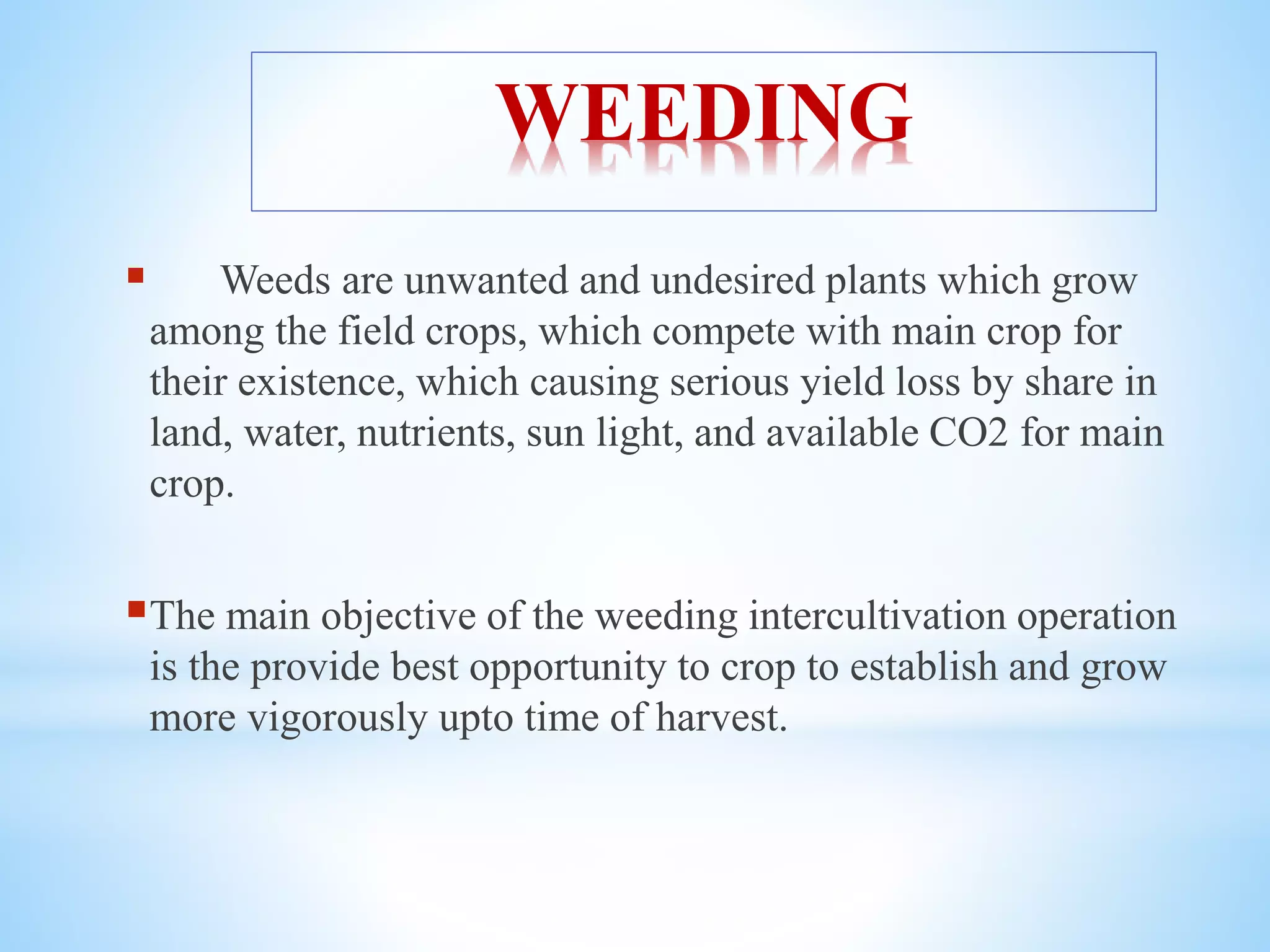
WEEDING
 Weeds are unwanted and undesired plants which grow
among the field crops, which compete with main crop for
their existence, which causing serious yield loss by share in
land, water, nutrients, sun light, and available CO2 for main
crop.
The main objective of the weeding intercultivation operation
is the provide best opportunity to crop to establish and grow
more vigorously upto time of harvest.
 Main objective is to reduce the competation of light, nutrients
and water with the main crops.
 It improves the soil condition by reducing the evaporation
from the soil surface.
 It improves the infilteration of rain or surface water .
 Reduce the runoff to maintain ridges or beds in which the crop
is grown.
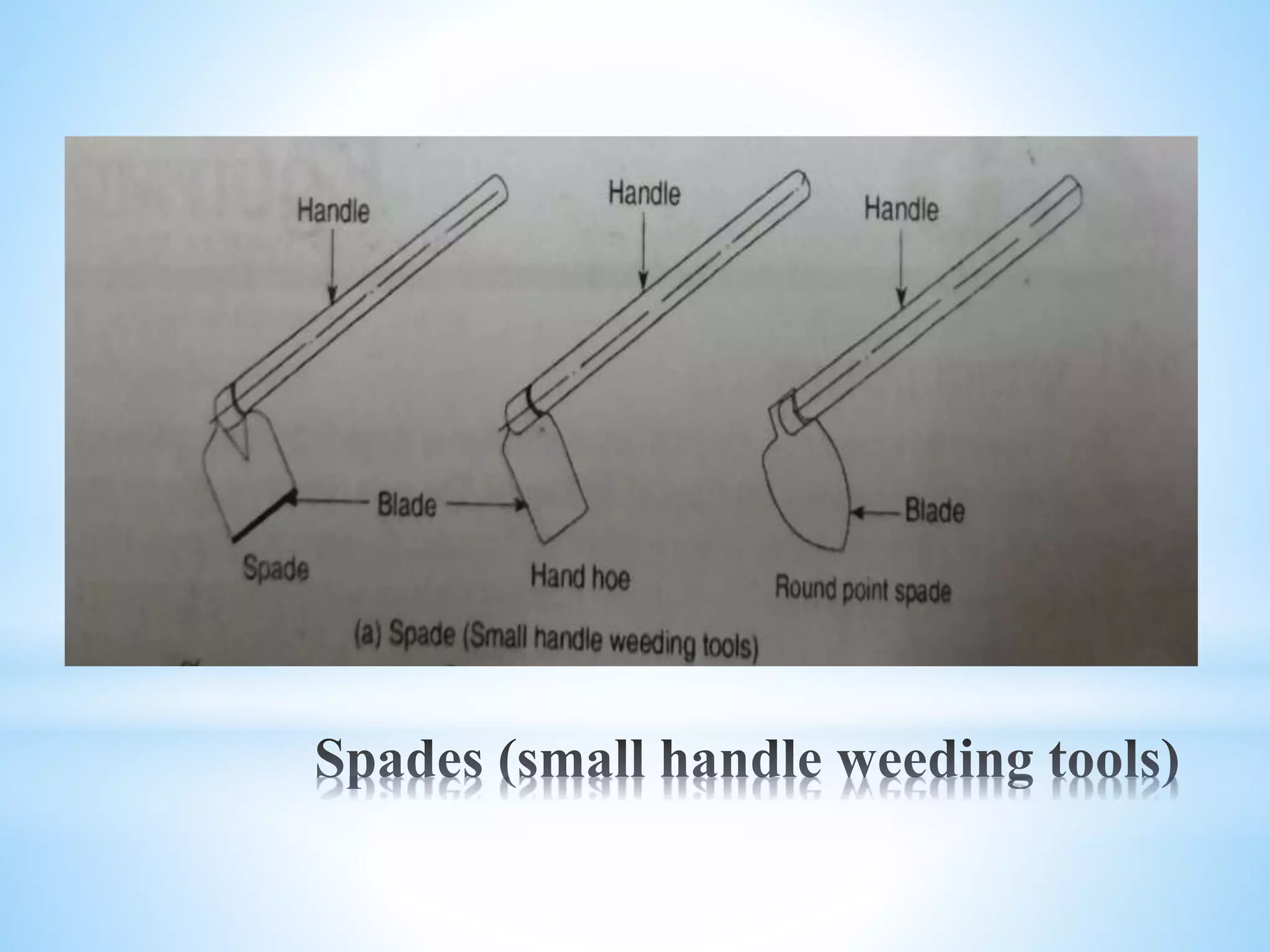
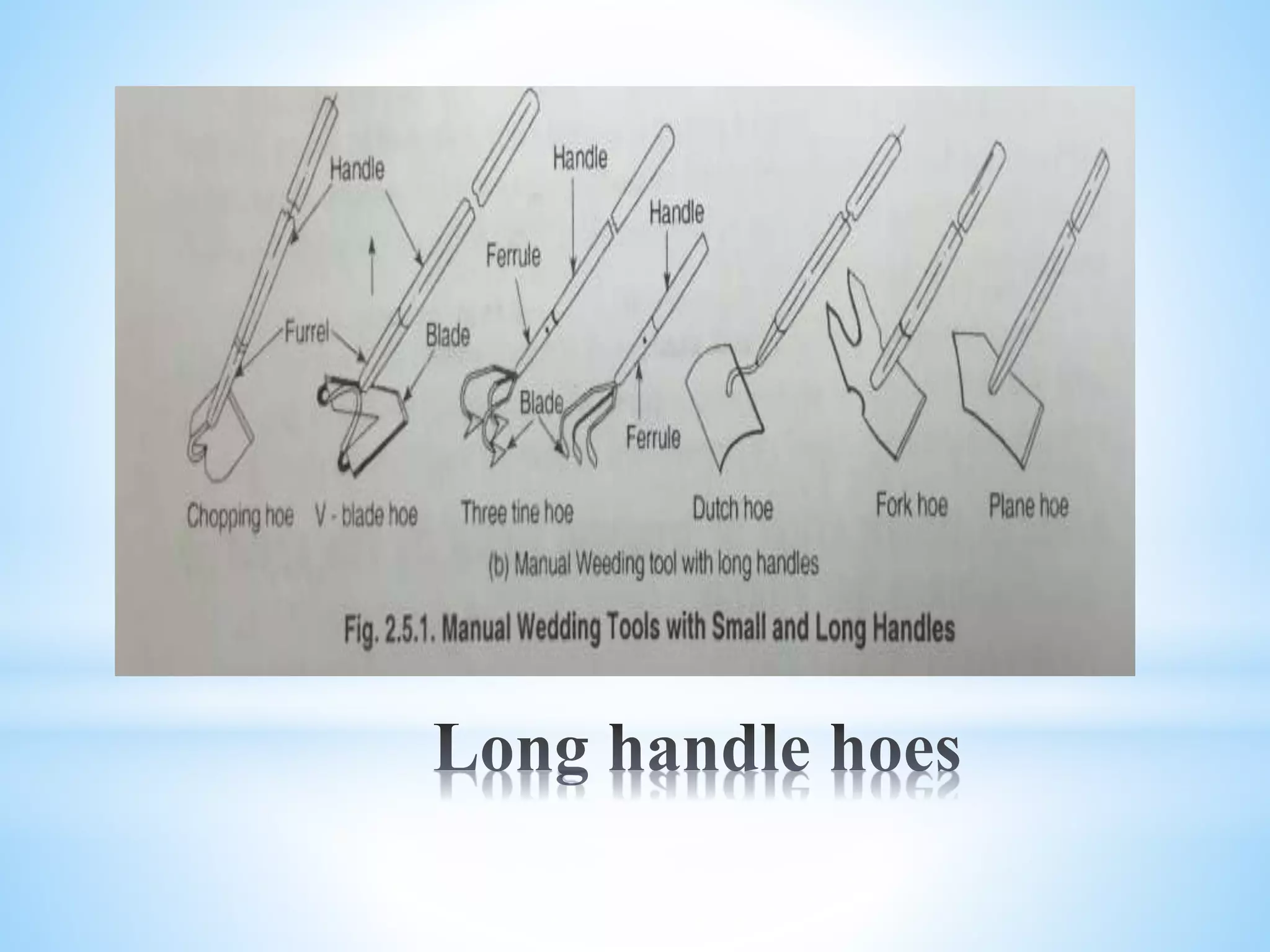
1. Manual weeding tools - Small tools
- Spades or chopping hoes
- Long handle weeders
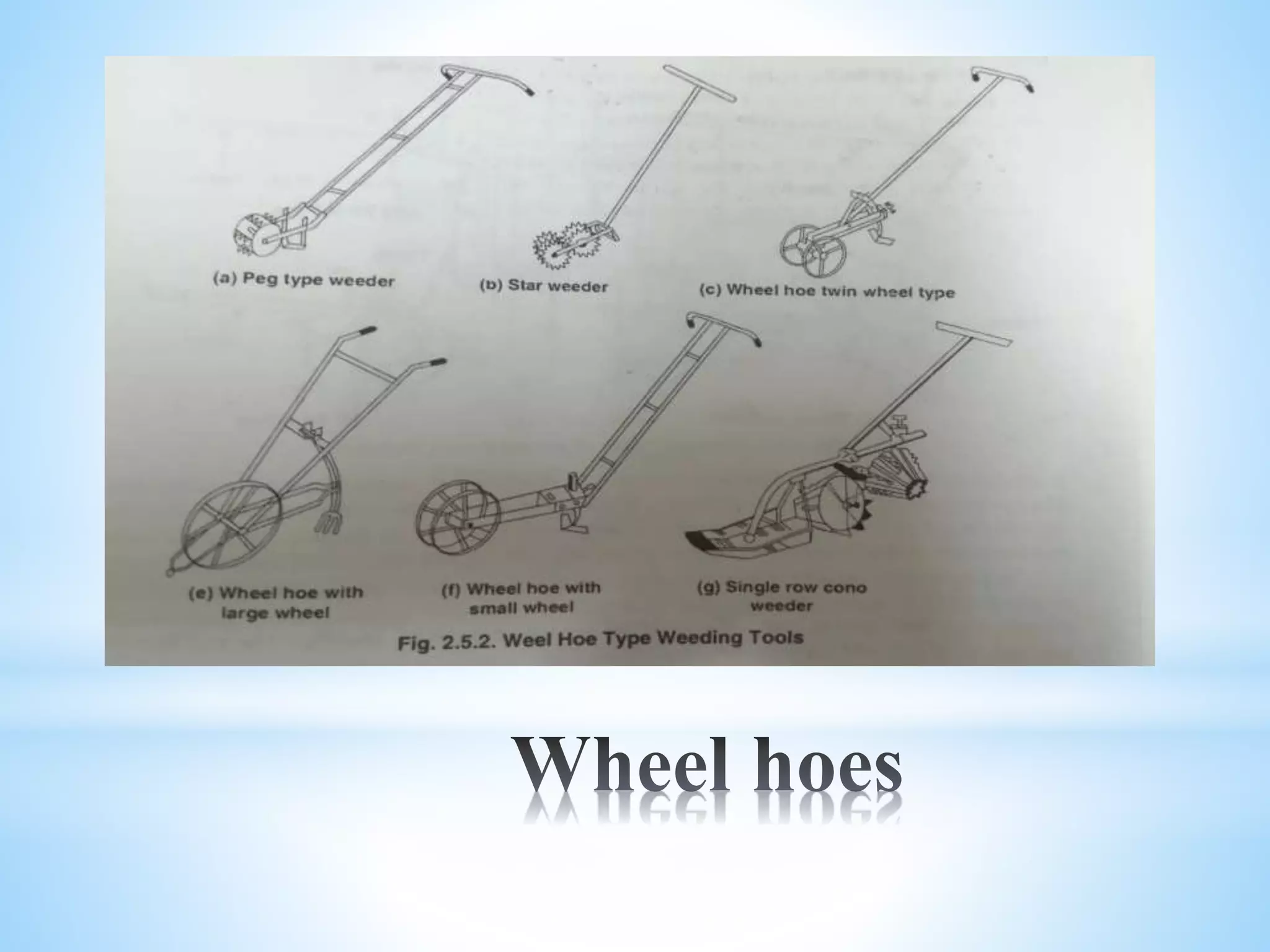
- wheel hoe type weeders.
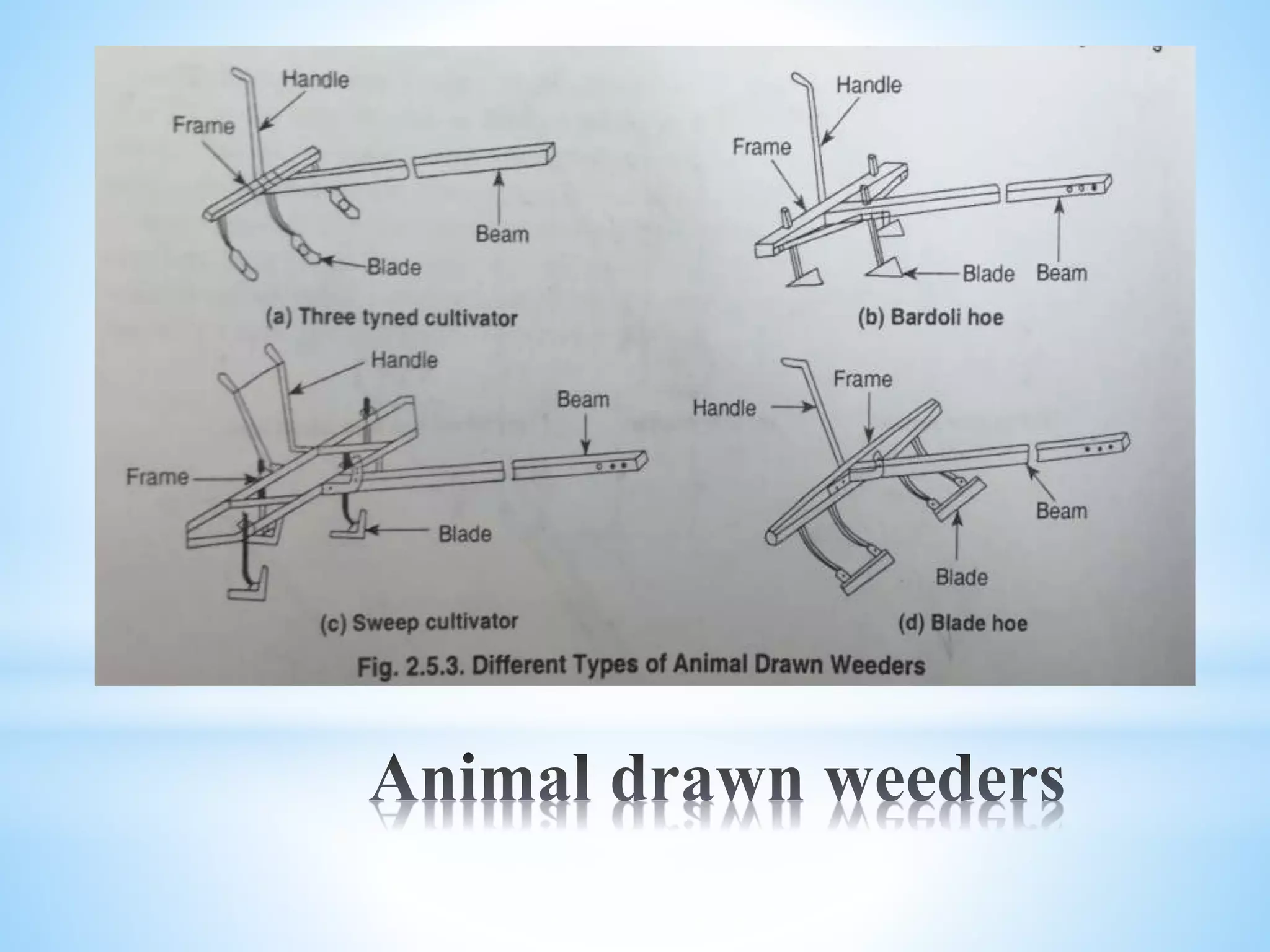
2. Animal drawan weeder - single row hoe
- multi row implements
- multi purpose tool frame with wheels
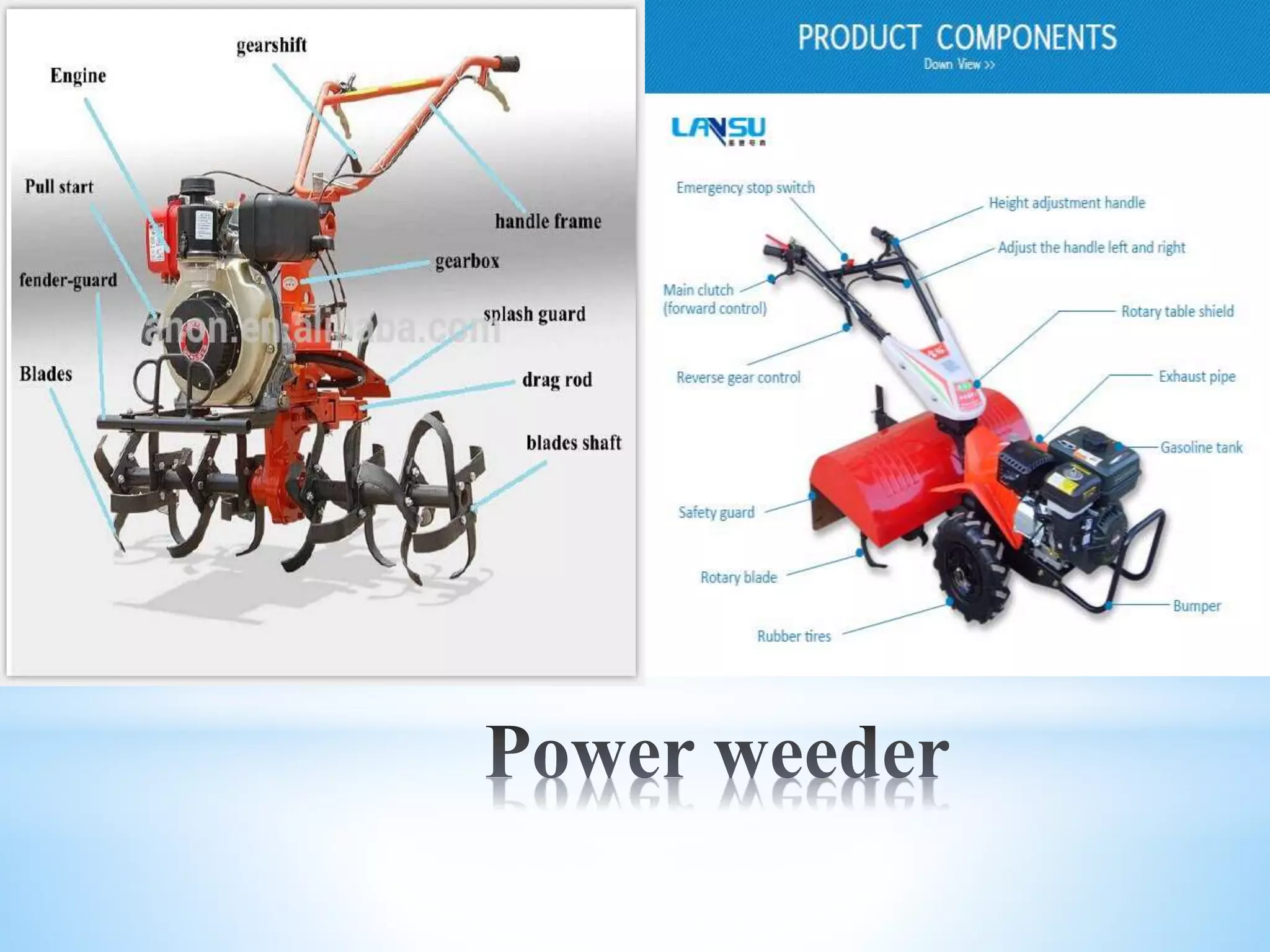
3. Power operated weeder - self propelled power weeder
- tractor operated weeder
- rotary hoe
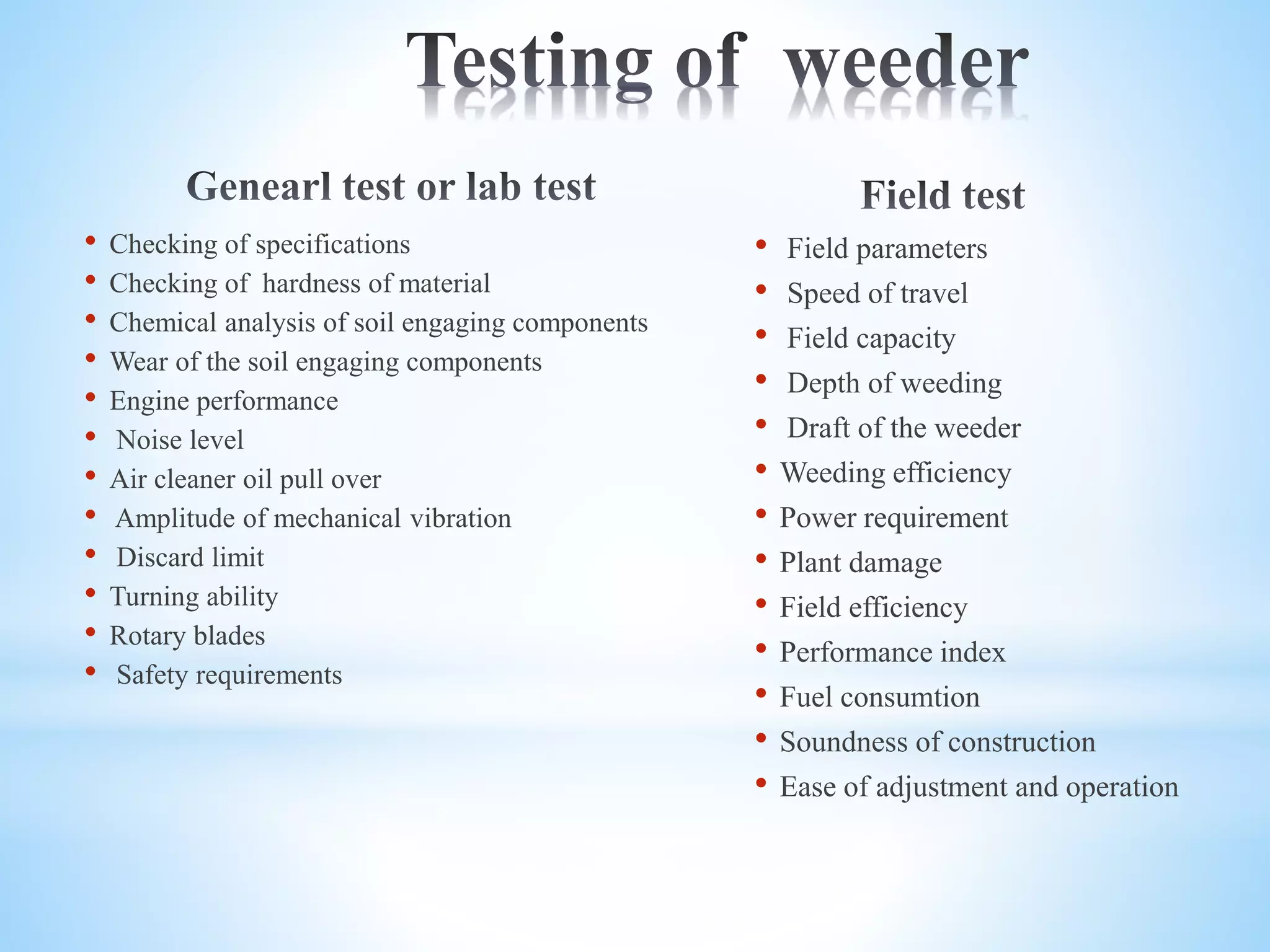
• Checking of specifications
• Checking of hardness of material
• Chemical analysis of soil engaging components
• Wear of the soil engaging components
• Engine performance
• Noise level
• Air cleaner oil pull over
• Amplitude of mechanical vibration
• Discard limit
• Turning ability
• Rotary blades
• Safety requirements
• Field parameters
• Speed of travel
• Field capacity
• Depth of weeding
• Draft of the weeder
• Weeding efficiency
• Power requirement
• Plant damage
• Field efficiency
• Performance index
• Fuel consumtion
• Soundness of construction
• Ease of adjustment and operation
Checking of specifications
The specifications of the machine and of the component should be
checked and verified as against the values furnished by the applicant
given in BIS document.
Hardness
The hardness of the various critical components should be measured and
compared with the relevant Indian Standards.
Chemical analysis
The chemical composition of the critical soil engaging components
should be determined and reported.
Wear test
The mass of the critical soil engaging components should be determined
before and after the field test to assess the wear rate.
Engine performance - power at the rated enginre speed, specific
fuel consumption under maximum power and rated power. Max.
crankshaft torque, Max. temperature of Engine oil, Lubrication oil
consumption [g/kwh).
Noise level
Maximum ambient noise emitted by the power tiller in dB at
by-stander's level & Max. noise at operators ear level in dB.-
max.90dB
Amplitude of mechanical vibration
Test the amplitude of the vibration level on the right and left hand
handle, Forward and reverse motion belt tightening lever,
throttle control lever, top of the fuel tank and the top of the air
cleaner. – max 100 micron.
Turning ability
Test the minimum turning diameter and clearence diameter in
both left side and right hand side .
Rotary blades
Test the shape, dimensions, hardness and the chemical composition of the
blades as per the BIS standards specifications.
Safety requirements
Check and test the Provision of guards on moving parts other than rotavator
location and direction of exhaust emission to be away from the operator and
machine for stationary operations.
Covers on hot parts & Locking of parking stand lever.
Protective shield for rotavator to prevent flying of mud and stones.
 Field parameters
The test condition of the field were considered like type of field,
length and width of the field, area of the field, soil moisture
content and soil type.
The condition of weed is also taken in to consideration in terms
of type of weed, root zone depth of weed, density of weed.
The condition of crop is also considered in terms of variety, row
spacing, age in days, plant population per meter square of area
and height of plant.
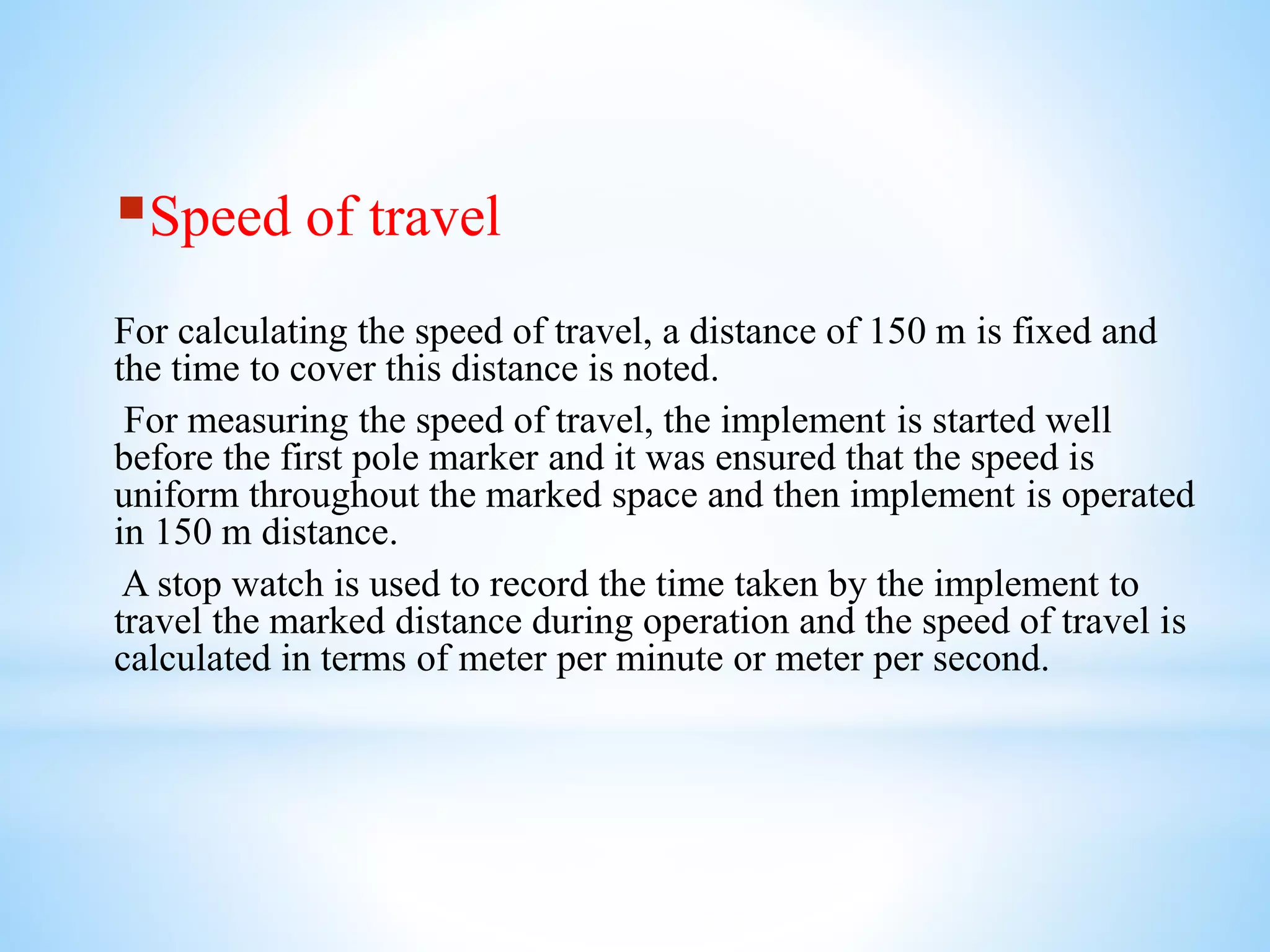
Speed of travel
For calculating the speed of travel, a distance of 150 m is fixed and
the time to cover this distance is noted.
For measuring the speed of travel, the implement is started well
before the first pole marker and it was ensured that the speed is
uniform throughout the marked space and then implement is operated
in 150 m distance.
A stop watch is used to record the time taken by the implement to
travel the marked distance during operation and the speed of travel is
calculated in terms of meter per minute or meter per second.
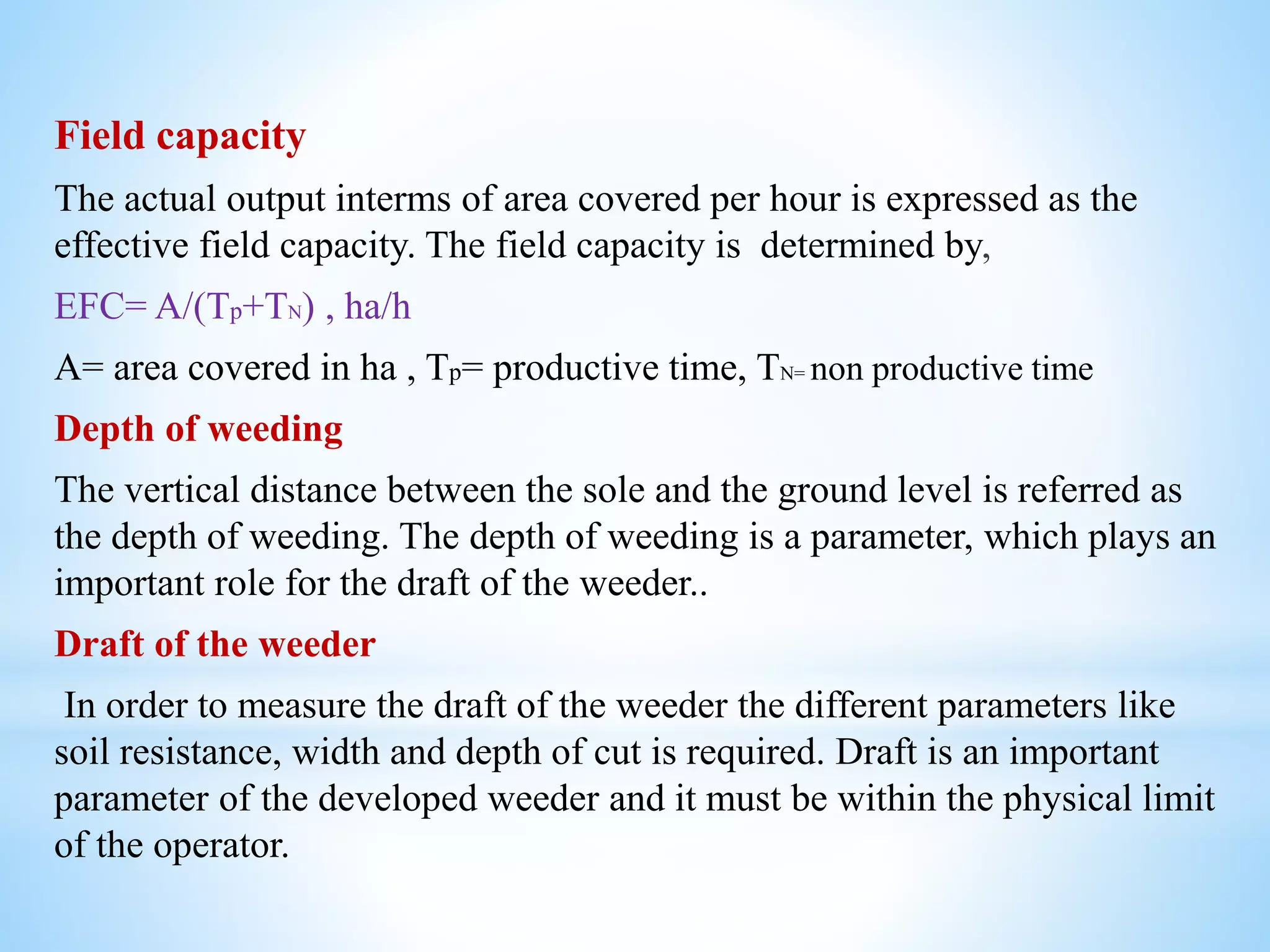
Field capacity
The actual output interms of area covered per hour is expressed as the
effective field capacity. The field capacity is determined by,
EFC= A/(Tp+TN) , ha/h
A= area covered in ha , Tp= productive time, TN= non productive time
Depth of weeding
The vertical distance between the sole and the ground level is referred as
the depth of weeding. The depth of weeding is a parameter, which plays an
important role for the draft of the weeder..
Draft of the weeder
In order to measure the draft of the weeder the different parameters like
soil resistance, width and depth of cut is required. Draft is an important
parameter of the developed weeder and it must be within the physical limit
of the operator.
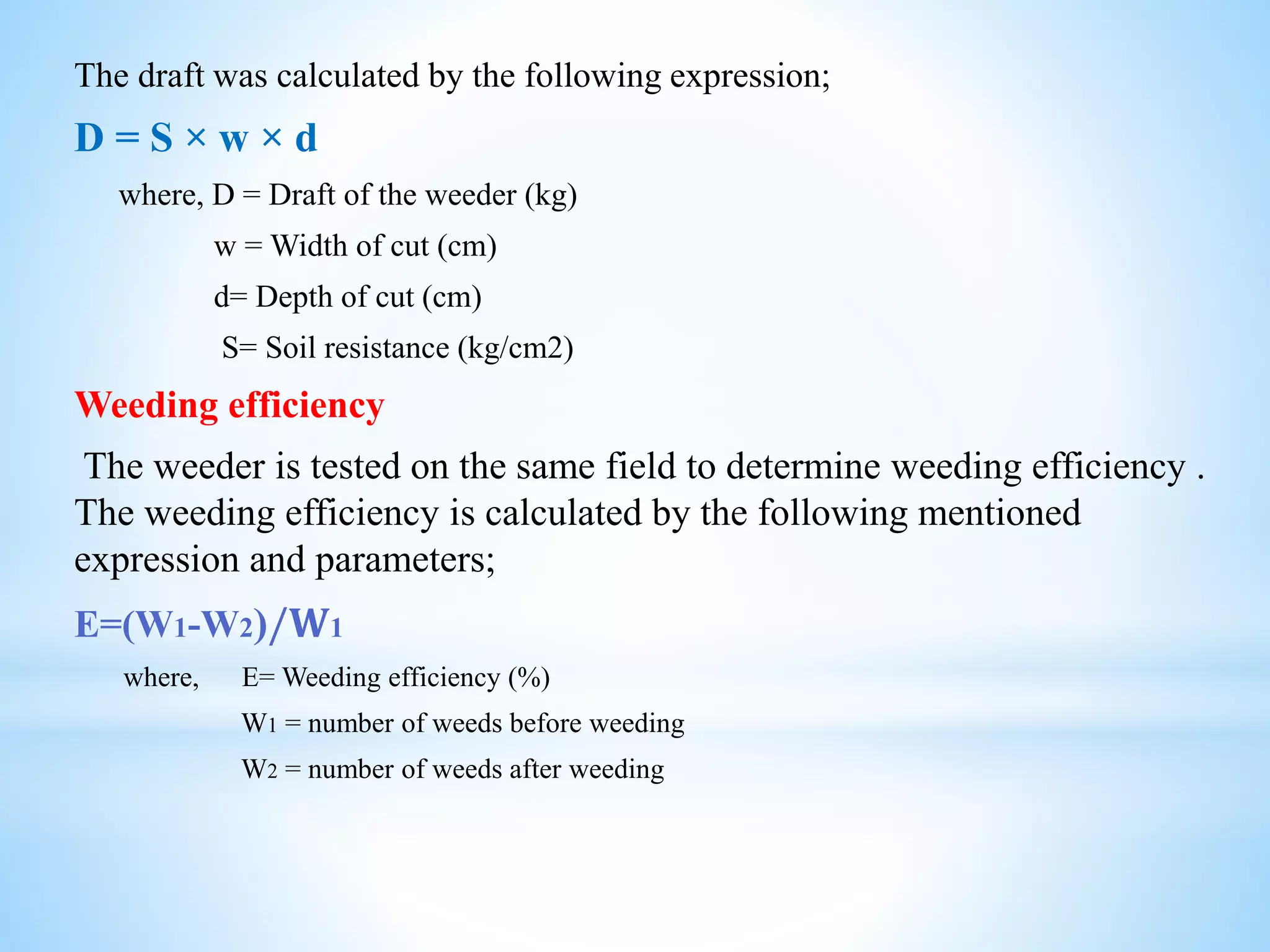
The draft was calculated by the following expression;
D = S × w × d
where, D = Draft of the weeder (kg)
w = Width of cut (cm)
d= Depth of cut (cm)
S= Soil resistance (kg/cm2)
Weeding efficiency
The weeder is tested on the same field to determine weeding efficiency .
The weeding efficiency is calculated by the following mentioned
expression and parameters;
E=(W1-W2)/𝐖1
where, E= Weeding efficiency (%)
W1 = number of weeds before weeding
W2 = number of weeds after weeding
Power requirement
The power input required for weeding operation is calculated by
considering the parameters like draft and traveling speed.
Power input (hp) = [draft(kg) × travelling speed (m/s)]/75
Plant damage
The test is conducted to find out the percent of the plant damage that taken
place during the field operation.
The percent plant damage is calculated by the following expression
Percentage plant damage = q/p × 100
where, q= Number of plant damaged in 10 m row length after weeding
p= Number of plant damaged in 10 m row length before weeding
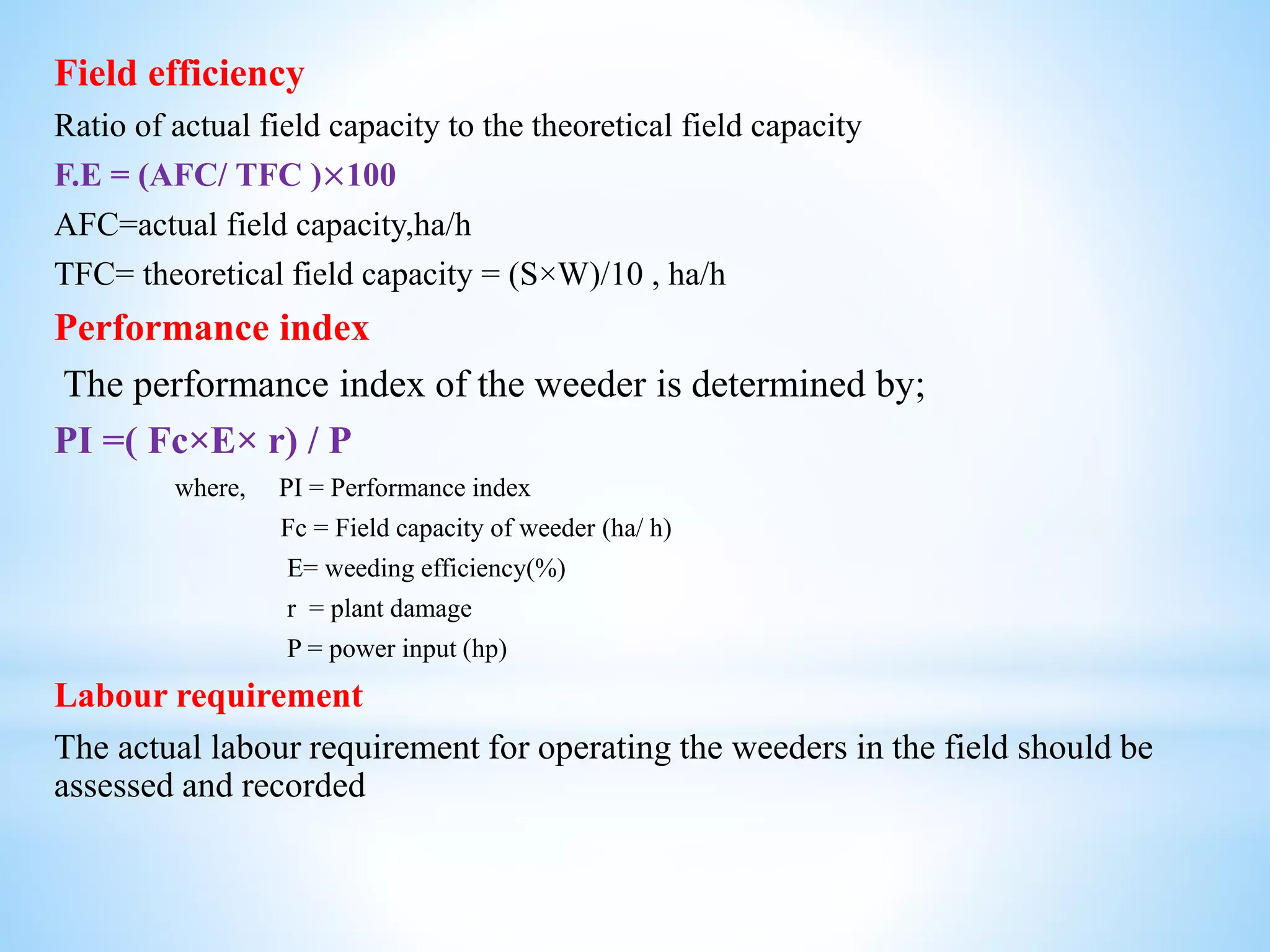
Field efficiency
Ratio of actual field capacity to the theoretical field capacity
F.E = (AFC/ TFC )×100
AFC=actual field capacity,ha/h
TFC= theoretical field capacity = (S×W)/10 , ha/h
Performance index
The performance index of the weeder is determined by;
PI =( Fc×E× r) / P
where, PI = Performance index
Fc = Field capacity of weeder (ha/ h)
E= weeding efficiency(%)
r = plant damage
P = power input (hp)
Labour requirement
The actual labour requirement for operating the weeders in the field should be
assessed and recorded
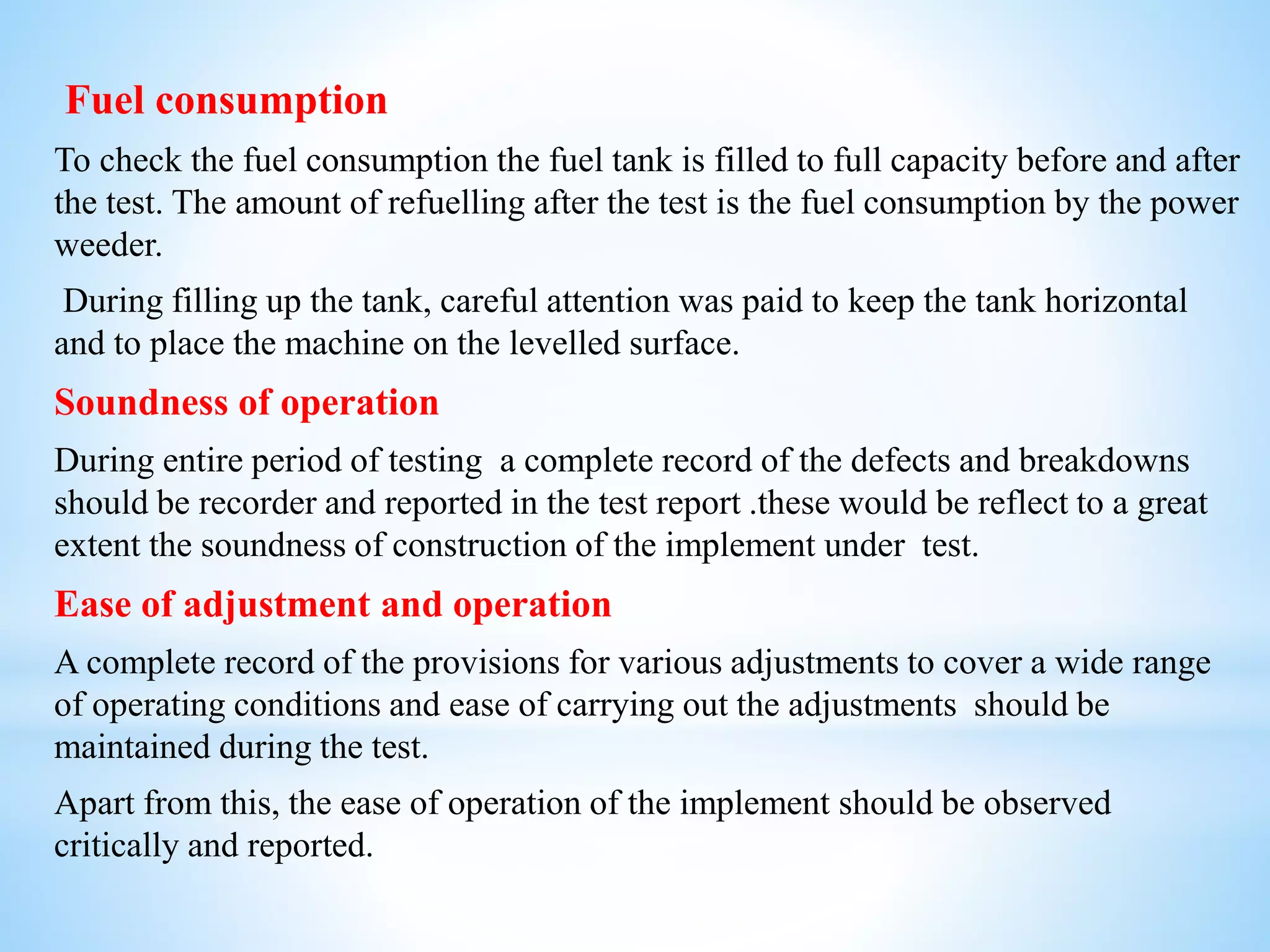
Fuel consumption
To check the fuel consumption the fuel tank is filled to full capacity before and after
the test. The amount of refuelling after the test is the fuel consumption by the power
weeder.
During filling up the tank, careful attention was paid to keep the tank horizontal
and to place the machine on the levelled surface.
Soundness of operation
During entire period of testing a complete record of the defects and breakdowns
should be recorder and reported in the test report .these would be reflect to a great
extent the soundness of construction of the implement under test.
Ease of adjustment and operation
A complete record of the provisions for various adjustments to cover a wide range
of operating conditions and ease of carrying out the adjustments should be
maintained during the test.
Apart from this, the ease of operation of the implement should be observed
critically and reported.
THANK YOU

Testing of manual and power Weeder

  • 2.
    Presented by ARUNA TN Mtech(dept of FMPE) CTAE, MPUAT Udaipur TESTING OF MANUAL AND POWER OPERATED WEEDER
  • 3.
    WEEDING  Weeds areunwanted and undesired plants which grow among the field crops, which compete with main crop for their existence, which causing serious yield loss by share in land, water, nutrients, sun light, and available CO2 for main crop. The main objective of the weeding intercultivation operation is the provide best opportunity to crop to establish and grow more vigorously upto time of harvest.
  • 4.
     Main objectiveis to reduce the competation of light, nutrients and water with the main crops.  It improves the soil condition by reducing the evaporation from the soil surface.  It improves the infilteration of rain or surface water .  Reduce the runoff to maintain ridges or beds in which the crop is grown.
  • 5.
    1. Manual weedingtools - Small tools - Spades or chopping hoes - Long handle weeders - wheel hoe type weeders. 2. Animal drawan weeder - single row hoe - multi row implements - multi purpose tool frame with wheels 3. Power operated weeder - self propelled power weeder - tractor operated weeder - rotary hoe
  • 11.
    • Checking ofspecifications • Checking of hardness of material • Chemical analysis of soil engaging components • Wear of the soil engaging components • Engine performance • Noise level • Air cleaner oil pull over • Amplitude of mechanical vibration • Discard limit • Turning ability • Rotary blades • Safety requirements • Field parameters • Speed of travel • Field capacity • Depth of weeding • Draft of the weeder • Weeding efficiency • Power requirement • Plant damage • Field efficiency • Performance index • Fuel consumtion • Soundness of construction • Ease of adjustment and operation
  • 12.
    Checking of specifications Thespecifications of the machine and of the component should be checked and verified as against the values furnished by the applicant given in BIS document. Hardness The hardness of the various critical components should be measured and compared with the relevant Indian Standards. Chemical analysis The chemical composition of the critical soil engaging components should be determined and reported. Wear test The mass of the critical soil engaging components should be determined before and after the field test to assess the wear rate.
  • 13.
    Engine performance -power at the rated enginre speed, specific fuel consumption under maximum power and rated power. Max. crankshaft torque, Max. temperature of Engine oil, Lubrication oil consumption [g/kwh). Noise level Maximum ambient noise emitted by the power tiller in dB at by-stander's level & Max. noise at operators ear level in dB.- max.90dB Amplitude of mechanical vibration Test the amplitude of the vibration level on the right and left hand handle, Forward and reverse motion belt tightening lever, throttle control lever, top of the fuel tank and the top of the air cleaner. – max 100 micron. Turning ability Test the minimum turning diameter and clearence diameter in both left side and right hand side .
  • 14.
    Rotary blades Test theshape, dimensions, hardness and the chemical composition of the blades as per the BIS standards specifications. Safety requirements Check and test the Provision of guards on moving parts other than rotavator location and direction of exhaust emission to be away from the operator and machine for stationary operations. Covers on hot parts & Locking of parking stand lever. Protective shield for rotavator to prevent flying of mud and stones.
  • 15.
     Field parameters Thetest condition of the field were considered like type of field, length and width of the field, area of the field, soil moisture content and soil type. The condition of weed is also taken in to consideration in terms of type of weed, root zone depth of weed, density of weed. The condition of crop is also considered in terms of variety, row spacing, age in days, plant population per meter square of area and height of plant.
  • 16.
    Speed of travel Forcalculating the speed of travel, a distance of 150 m is fixed and the time to cover this distance is noted. For measuring the speed of travel, the implement is started well before the first pole marker and it was ensured that the speed is uniform throughout the marked space and then implement is operated in 150 m distance. A stop watch is used to record the time taken by the implement to travel the marked distance during operation and the speed of travel is calculated in terms of meter per minute or meter per second.
  • 17.
    Field capacity The actualoutput interms of area covered per hour is expressed as the effective field capacity. The field capacity is determined by, EFC= A/(Tp+TN) , ha/h A= area covered in ha , Tp= productive time, TN= non productive time Depth of weeding The vertical distance between the sole and the ground level is referred as the depth of weeding. The depth of weeding is a parameter, which plays an important role for the draft of the weeder.. Draft of the weeder In order to measure the draft of the weeder the different parameters like soil resistance, width and depth of cut is required. Draft is an important parameter of the developed weeder and it must be within the physical limit of the operator.
  • 18.
    The draft wascalculated by the following expression; D = S × w × d where, D = Draft of the weeder (kg) w = Width of cut (cm) d= Depth of cut (cm) S= Soil resistance (kg/cm2) Weeding efficiency The weeder is tested on the same field to determine weeding efficiency . The weeding efficiency is calculated by the following mentioned expression and parameters; E=(W1-W2)/𝐖1 where, E= Weeding efficiency (%) W1 = number of weeds before weeding W2 = number of weeds after weeding
  • 19.
    Power requirement The powerinput required for weeding operation is calculated by considering the parameters like draft and traveling speed. Power input (hp) = [draft(kg) × travelling speed (m/s)]/75 Plant damage The test is conducted to find out the percent of the plant damage that taken place during the field operation. The percent plant damage is calculated by the following expression Percentage plant damage = q/p × 100 where, q= Number of plant damaged in 10 m row length after weeding p= Number of plant damaged in 10 m row length before weeding
  • 20.
    Field efficiency Ratio ofactual field capacity to the theoretical field capacity F.E = (AFC/ TFC )×100 AFC=actual field capacity,ha/h TFC= theoretical field capacity = (S×W)/10 , ha/h Performance index The performance index of the weeder is determined by; PI =( Fc×E× r) / P where, PI = Performance index Fc = Field capacity of weeder (ha/ h) E= weeding efficiency(%) r = plant damage P = power input (hp) Labour requirement The actual labour requirement for operating the weeders in the field should be assessed and recorded
  • 21.
    Fuel consumption To checkthe fuel consumption the fuel tank is filled to full capacity before and after the test. The amount of refuelling after the test is the fuel consumption by the power weeder. During filling up the tank, careful attention was paid to keep the tank horizontal and to place the machine on the levelled surface. Soundness of operation During entire period of testing a complete record of the defects and breakdowns should be recorder and reported in the test report .these would be reflect to a great extent the soundness of construction of the implement under test. Ease of adjustment and operation A complete record of the provisions for various adjustments to cover a wide range of operating conditions and ease of carrying out the adjustments should be maintained during the test. Apart from this, the ease of operation of the implement should be observed critically and reported.
  • 22.