 Basis of progress in business is experience.
 Accounts preserve experience and for its real significance need to be
analyzed.
 Farm Accountancy, Farm Records and Accounts or Farm Book-
keeping have a same objectives, only differ by treatment or
approaches.
 Farm Accountancy – Art and science of recording in books business
transactions in a regular and systemic manner.
 Farm Bookkeeping – System of records written to furnish the history of
business transactions.
 Farm accounting is thus an application of the accounting principles to
the business of farming.
 We deal about simple types of records and accounts that can be
maintained on an average farm.
 The records need to be kept in a systematic and classified form so
that it could give concise and precise picture of the farm operations
over the year.
Objectives
 To know about the operation of firm at a certain
time.
 Figure out the weaknesses
 Possible improvements needed.
Stages
 Proper recording of accounts and activities.
 Analysis and interpretation of results.
 Presentation of results.
 Means of higher income – It helps farmers to get exact
knowledge about present and potential income & operating
costs.
 Basis of diagonosis & planning – Diagnosis of management
problems is the pre-requisite of sound planning which is
provided by farm records & accounts.
 Ways to improve managerial ability of farmer.
 Basis of credit acquisition and management.
 Guide to better home management.
 Basis of conducting research in Agricultural Economics and
production economics.
 Basis for government policies- Farmers need to feed the facts
for state and national farm policies such as land policies, price
policies and crop insurance etc.
 Subsistence nature of farming.
 Faming is laborious work.
 Triple role of farmer.
 Illiteracy and lack of business awareness.
 Complicated nature of agriculture business.
 Inadequate extension service.
 Non availability of suitable farm record books.
 Fear of taxation.
 Accounting period
 Types of farm accounting
- Farm inventory .
- Farm financial accounting
- Farm cost accounting
a) Full cost accounting.
b) Single Enterprise Accounting.
Levels of farm accountancy
 Financial accounting
 Cost accounting
- Full cost accounting.
- Single enterprise accounting.
Financial accounting
 Records and accounts under this method set
forth income, expenditure, and profit or loss
of the farm business as a whole.
 Presents aggregate effect of all farm
undertakings & expenditure incurred is
shown separately.
 At the end, profit and loss and the balance
sheet are prepared.
 It is simpler than cost accounting.
Cost accounting
A) Full cost accounting
 It shows income and expenditure and profit or loss of the
farm business as a whole as well as of each department,
enterprise or each farm product.
 It involves greater details.
 It is suitable for larger farms that can afford the necessary
labor or money for keeping accounts.
B) Single enterprise accounting
 It is kept for important selected enterprises or a particular
aspect of an enterprise such as production of milk,
sugarcane, wool, eggs, etc
 It is restricted form of cost accounting so is not so
accurate and complete.
There are two systems of book keeping:
(i) Double entry system
 Method of recording each transaction in the
book of accounts in two fold aspects, i.e. two
entries for each transaction one being debited
and other being credited.
 Theory of double entry- Every business transaction involve
two parties – one for receiving the goods or services and the
other for giving them. Therefore, every transactions is
entered at two places , for debit and for credit .
Examples of double entry :
a) Sale of wheat for Rs. 240
Here, involves two accounts cash account and wheat
account. The cash account will be the receiving amount
hence it is debited & the wheat will be the giving
account and hence it is credited.
Advantages of Double Entry System
 Provides complete personal and impersonal records.
 Provides means for checking arithmetical accuracy.
 Provides detailed information regarding the business,
classified records of all transactions.
 This system provides for automatic checks to prevent
mistakes.
 Affords easy and ready reference to details of
accounts.
Single Entry System
 It ignores the double effect of transactions.
 Only personal accounts of debtors and
creditors are kept and impersonal accounts
are ignored altogether.
 All the accounts that falls short of double
entry system may be called single entry
system.
 It is less reliable and accuracy cannot be
tested by means of trial balance.
 Farm records and accounts need to be prepared for a
certain purpose on a particular farm situation.
 There is no certain rules for the preparation of form for
farm records; it may varied with the purpose, system of
farming, level of understanding & capability of farmer.
 Characteristics of good farm record book:
- Simple & easy to understand.
- Classification of all entries.
- Adequate space for itemizing all entries, and
sufficient space for writing without crowding.
- Adequate instructions for recording and analysis of
recorded data.
There are three parts of farm record system: (i) Physical farm records, (ii) Financial
farm records, and
(iii) Supplementary farm records
 Physical farm records:
- Relates to physical aspects of a farm business.
- Records physical efficiency of the farm.
- It include the following records.
1) Farm map, soil map and contour map.
2) Charts on physical efficiency.
3) Land utilization record
4) Crop production and disposal record.
5) Livestock production and disposal record.
6) Machinery records.
7) Feed records.
8) Stock / store register.
9) Poultry records.
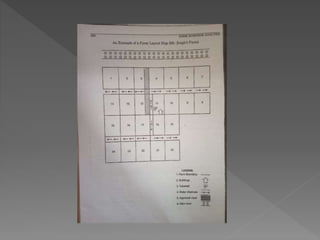
Farm map
- Most simple, and brief record of farm
features. It gives a visual impression or a
bird’s eye view of the whole location of farm
business. It is just supplementary to the
physical spot observation.
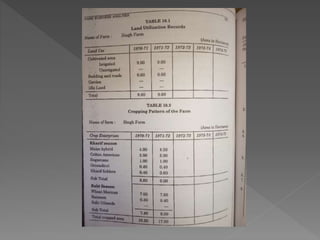
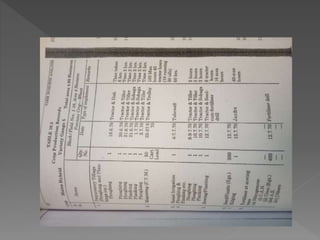
Production records :
- Provides standards of performance in the
use of resources.
- The form and type of physical records
relating to crops or livestock enterprises
will depend upon the degree of
specialization and the type of farming
involved.
-
-
Labour records
Can be categorized as -
1) Simple labour records: It is useful to keep a
record of labour to study efficiency or seasonal
requirements. At the end of each day enter the
number of hours of labour and tractor work for
each operation. To obtain seasonal distribution
of labour on the enterprise , it is necessay to
make sub-total , by months or weeks,within
columns.
2) Complete labour records: In complete record of
farm labour,the amount of time each worker
spent on the farm each day is recorded in each
enterprise. The records must also specify the
implements along with the size of the machine.
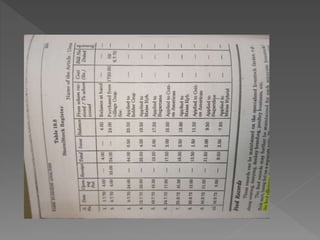
Machinery use records ( Log Book ) :
It is kept to have a full control over machine use
and to study its performance. It is necessary to
economize the heavy cost spent on machines.
For example, a log book can be maintained for
a tractor.
Store/ Stock register:
Store/ Stock register is to be maintained to
watch the store/ stock position at a particular
time of different articles used in the farm.
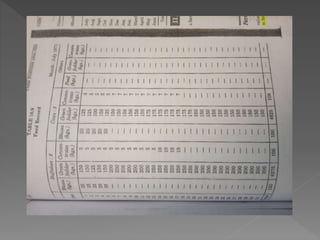
Feed records:
 These records is maintained in specialized
livestock farms , e.g. , sheep rearing, dairying,
donkey breeding, poultry business, etc.
 It can be maintained for each separate
livestock/ flock unit, being fed in a separate
ratio.
 It is maintained to determine the feed
efficiency.
 It is used to show the output per unit of feed.
 It can indicate the profits per bird per animal
and farmer can adjust the feeding method.
Financial records :
Related to the financial aspects of the
operation of a farm business. These records
are on:
 Farm inventory
 Farm Cash Accounts or Farm Financial
Accounts
 Classified Farm Cash Account and farm
Business Analysis.
 Supplementary Financial Records: (1)
Capital assets sale register (2) Cash sale
register (3) Credit sale/purchase register
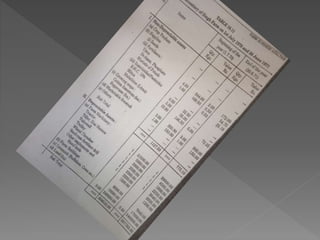
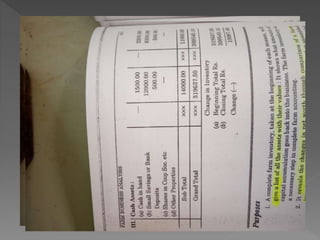
 Farm inventory :
- It is a list of the whole physical property of a
business.
- It is the complete list of farmer’s assets .
- It is the first step in farm accounting.
Purposes:
 To give a list of all assets with their values.
 To reveal the changes in net worth.
 To enable to work out the measure of income.
 To determine the depreciation costs.
 It is the basis of income statement.
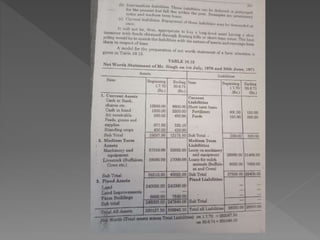
 Net Worth Statement :
- It shows the financial condition and stability of the
business at a particular point of time.
- It is shown excess of assets over liabilities.
- It shows whether the business is expanding or
shrinking.
- The business is said to be in solvent when the net
worth or equity is greater than zero.
- The farmer is more concerned about immediate
solvency than ultimate solvency.
- Assets can be categorized as fixed assets ( land,
building), working assets ( machinery) & current
assets (cash, fertiliers ).
- Liabilities also may be of long duration, intermediate
or current. s
-
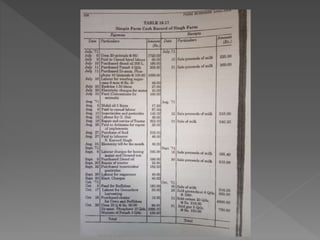
 Farm Finanacial Accounts or Farm Cash
Accounts
- These records refers to the annual operation of
the business and the profit and losses
associated with it.
- It is the result of the operation of the farm over
the period of time.
- It is simply a statement of the payment
(expenses) and receipts and its detail form
includes expenses and receipts on various
enterprises as well as operation involved in
business.
It may be of different types- Farm diary, Farm
Business Cash Record, Personal Cash record
& Complete Cash Record.
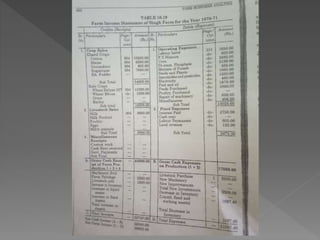
 Income Statement:
- Its objective is to summarize the data on
income and expenses to present the truthful
picture of the year’s performance.
- It is the list of all farm expenses or business
debts on one hand and all receipts or
business credits on the other.
- At the end, expenses are subtracted from
receipts to determine the net income for the
year.
- It helps to point out the strong and weak
pointed in the farm business so that business
operations in the future can be adjusted to
result in higher earning to the producer.
Farm business analysis

Farm business analysis

  • 2.
     Basis ofprogress in business is experience.  Accounts preserve experience and for its real significance need to be analyzed.  Farm Accountancy, Farm Records and Accounts or Farm Book- keeping have a same objectives, only differ by treatment or approaches.  Farm Accountancy – Art and science of recording in books business transactions in a regular and systemic manner.  Farm Bookkeeping – System of records written to furnish the history of business transactions.  Farm accounting is thus an application of the accounting principles to the business of farming.  We deal about simple types of records and accounts that can be maintained on an average farm.  The records need to be kept in a systematic and classified form so that it could give concise and precise picture of the farm operations over the year.
  • 3.
    Objectives  To knowabout the operation of firm at a certain time.  Figure out the weaknesses  Possible improvements needed. Stages  Proper recording of accounts and activities.  Analysis and interpretation of results.  Presentation of results.
  • 4.
     Means ofhigher income – It helps farmers to get exact knowledge about present and potential income & operating costs.  Basis of diagonosis & planning – Diagnosis of management problems is the pre-requisite of sound planning which is provided by farm records & accounts.  Ways to improve managerial ability of farmer.  Basis of credit acquisition and management.  Guide to better home management.  Basis of conducting research in Agricultural Economics and production economics.  Basis for government policies- Farmers need to feed the facts for state and national farm policies such as land policies, price policies and crop insurance etc.
  • 5.
     Subsistence natureof farming.  Faming is laborious work.  Triple role of farmer.  Illiteracy and lack of business awareness.  Complicated nature of agriculture business.  Inadequate extension service.  Non availability of suitable farm record books.  Fear of taxation.
  • 6.
     Accounting period Types of farm accounting - Farm inventory . - Farm financial accounting - Farm cost accounting a) Full cost accounting. b) Single Enterprise Accounting. Levels of farm accountancy  Financial accounting  Cost accounting - Full cost accounting. - Single enterprise accounting.
  • 7.
    Financial accounting  Recordsand accounts under this method set forth income, expenditure, and profit or loss of the farm business as a whole.  Presents aggregate effect of all farm undertakings & expenditure incurred is shown separately.  At the end, profit and loss and the balance sheet are prepared.  It is simpler than cost accounting.
  • 8.
    Cost accounting A) Fullcost accounting  It shows income and expenditure and profit or loss of the farm business as a whole as well as of each department, enterprise or each farm product.  It involves greater details.  It is suitable for larger farms that can afford the necessary labor or money for keeping accounts. B) Single enterprise accounting  It is kept for important selected enterprises or a particular aspect of an enterprise such as production of milk, sugarcane, wool, eggs, etc  It is restricted form of cost accounting so is not so accurate and complete.
  • 9.
    There are twosystems of book keeping: (i) Double entry system  Method of recording each transaction in the book of accounts in two fold aspects, i.e. two entries for each transaction one being debited and other being credited.  Theory of double entry- Every business transaction involve two parties – one for receiving the goods or services and the other for giving them. Therefore, every transactions is entered at two places , for debit and for credit .
  • 10.
    Examples of doubleentry : a) Sale of wheat for Rs. 240 Here, involves two accounts cash account and wheat account. The cash account will be the receiving amount hence it is debited & the wheat will be the giving account and hence it is credited. Advantages of Double Entry System  Provides complete personal and impersonal records.  Provides means for checking arithmetical accuracy.  Provides detailed information regarding the business, classified records of all transactions.  This system provides for automatic checks to prevent mistakes.  Affords easy and ready reference to details of accounts.
  • 11.
    Single Entry System It ignores the double effect of transactions.  Only personal accounts of debtors and creditors are kept and impersonal accounts are ignored altogether.  All the accounts that falls short of double entry system may be called single entry system.  It is less reliable and accuracy cannot be tested by means of trial balance.
  • 12.
     Farm recordsand accounts need to be prepared for a certain purpose on a particular farm situation.  There is no certain rules for the preparation of form for farm records; it may varied with the purpose, system of farming, level of understanding & capability of farmer.  Characteristics of good farm record book: - Simple & easy to understand. - Classification of all entries. - Adequate space for itemizing all entries, and sufficient space for writing without crowding. - Adequate instructions for recording and analysis of recorded data.
  • 13.
    There are threeparts of farm record system: (i) Physical farm records, (ii) Financial farm records, and (iii) Supplementary farm records  Physical farm records: - Relates to physical aspects of a farm business. - Records physical efficiency of the farm. - It include the following records. 1) Farm map, soil map and contour map. 2) Charts on physical efficiency. 3) Land utilization record 4) Crop production and disposal record. 5) Livestock production and disposal record. 6) Machinery records. 7) Feed records. 8) Stock / store register. 9) Poultry records.
  • 14.
    Farm map - Mostsimple, and brief record of farm features. It gives a visual impression or a bird’s eye view of the whole location of farm business. It is just supplementary to the physical spot observation.
  • 16.
    Production records : -Provides standards of performance in the use of resources. - The form and type of physical records relating to crops or livestock enterprises will depend upon the degree of specialization and the type of farming involved. - -
  • 19.
    Labour records Can becategorized as - 1) Simple labour records: It is useful to keep a record of labour to study efficiency or seasonal requirements. At the end of each day enter the number of hours of labour and tractor work for each operation. To obtain seasonal distribution of labour on the enterprise , it is necessay to make sub-total , by months or weeks,within columns. 2) Complete labour records: In complete record of farm labour,the amount of time each worker spent on the farm each day is recorded in each enterprise. The records must also specify the implements along with the size of the machine.
  • 21.
    Machinery use records( Log Book ) : It is kept to have a full control over machine use and to study its performance. It is necessary to economize the heavy cost spent on machines. For example, a log book can be maintained for a tractor. Store/ Stock register: Store/ Stock register is to be maintained to watch the store/ stock position at a particular time of different articles used in the farm.
  • 23.
    Feed records:  Theserecords is maintained in specialized livestock farms , e.g. , sheep rearing, dairying, donkey breeding, poultry business, etc.  It can be maintained for each separate livestock/ flock unit, being fed in a separate ratio.  It is maintained to determine the feed efficiency.  It is used to show the output per unit of feed.  It can indicate the profits per bird per animal and farmer can adjust the feeding method.
  • 25.
    Financial records : Relatedto the financial aspects of the operation of a farm business. These records are on:  Farm inventory  Farm Cash Accounts or Farm Financial Accounts  Classified Farm Cash Account and farm Business Analysis.  Supplementary Financial Records: (1) Capital assets sale register (2) Cash sale register (3) Credit sale/purchase register
  • 26.
     Farm inventory: - It is a list of the whole physical property of a business. - It is the complete list of farmer’s assets . - It is the first step in farm accounting. Purposes:  To give a list of all assets with their values.  To reveal the changes in net worth.  To enable to work out the measure of income.  To determine the depreciation costs.  It is the basis of income statement.
  • 29.
     Net WorthStatement : - It shows the financial condition and stability of the business at a particular point of time. - It is shown excess of assets over liabilities. - It shows whether the business is expanding or shrinking. - The business is said to be in solvent when the net worth or equity is greater than zero. - The farmer is more concerned about immediate solvency than ultimate solvency. - Assets can be categorized as fixed assets ( land, building), working assets ( machinery) & current assets (cash, fertiliers ). - Liabilities also may be of long duration, intermediate or current. s -
  • 31.
     Farm FinanacialAccounts or Farm Cash Accounts - These records refers to the annual operation of the business and the profit and losses associated with it. - It is the result of the operation of the farm over the period of time. - It is simply a statement of the payment (expenses) and receipts and its detail form includes expenses and receipts on various enterprises as well as operation involved in business. It may be of different types- Farm diary, Farm Business Cash Record, Personal Cash record & Complete Cash Record.
  • 33.
     Income Statement: -Its objective is to summarize the data on income and expenses to present the truthful picture of the year’s performance. - It is the list of all farm expenses or business debts on one hand and all receipts or business credits on the other. - At the end, expenses are subtracted from receipts to determine the net income for the year. - It helps to point out the strong and weak pointed in the farm business so that business operations in the future can be adjusted to result in higher earning to the producer.