S21 Working Session
Building Successful Agricultural Value Chain Finance
Calvin Miller, FAO Senior Officer, Agribusiness and Finance
Revolutionising finance for agri-value chains conference
14 – 18 July, 2014
Nairobi, Kenya
2
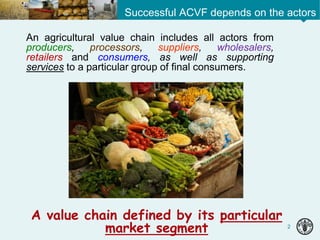
An agricultural value chain includes all actors from
producers, processors, suppliers, wholesalers,
retailers and consumers, as well as supporting
services to a particular group of final consumers.
A value chain defined by its particular
market segment
Successful ACVF depends on the actors
3
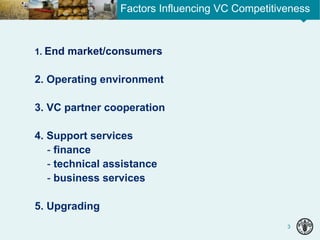
1. End market/consumers
2. Operating environment
3. VC partner cooperation
4. Support services
- finance
- technical assistance
- business services
5. Upgrading
Factors Influencing VC Competitiveness
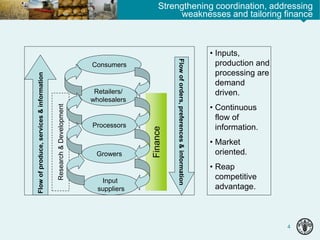
Strengthening coordination, addressing
weaknesses and tailoring finance
4
Flowofproduce,services&information
Consumers
Retailers/
wholesalers
Processors
Growers
Input
suppliers
Finance
Research&Development
Flowoforders,preferences&information
• Inputs,
production and
processing are
demand
driven.
• Continuous
flow of
information.
• Market
oriented.
• Reap
competitive
advantage.
Analytical framework
5
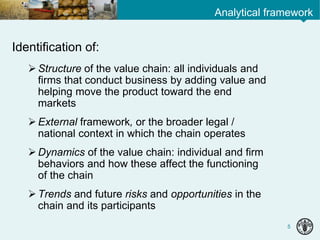
Identification of:
Structure of the value chain: all individuals and
firms that conduct business by adding value and
helping move the product toward the end
markets
External framework, or the broader legal /
national context in which the chain operates
Dynamics of the value chain: individual and firm
behaviors and how these affect the functioning
of the chain
Trends and future risks and opportunities in the
chain and its participants
Agri-finance value chain approach
6
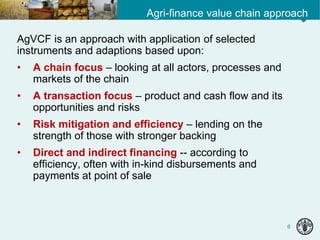
AgVCF is an approach with application of selected
instruments and adaptions based upon:
• A chain focus – looking at all actors, processes and
markets of the chain
• A transaction focus – product and cash flow and its
opportunities and risks
• Risk mitigation and efficiency – lending on the
strength of those with stronger backing
• Direct and indirect financing -- according to
efficiency, often with in-kind disbursements and
payments at point of sale
7
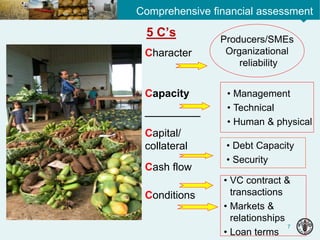
Comprehensive financial assessment
Character
Capacity
________
Capital/
collateral
Cash flow
Conditions
Producers/SMEs
Organizational
reliability
• Management
• Technical
• Human & physical
• VC contract &
transactions
• Markets &
relationships
• Loan terms
• Debt Capacity
• Security
5 C’s
8
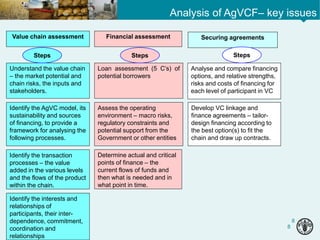
Value chain assessment Financial assessment Securing agreements
Understand the value chain
– the market potential and
chain risks, the inputs and
stakeholders.
Identify the AgVC model, its
sustainability and sources
of financing, to provide a
framework for analysing the
following processes.
Identify the interests and
relationships of
participants, their inter-
dependence, commitment,
coordination and
relationships
Loan assessment (5 C’s) of
potential borrowers
Assess the operating
environment – macro risks,
regulatory constraints and
potential support from the
Government or other entities
Determine actual and critical
points of finance – the
current flows of funds and
then what is needed and in
what point in time.
Analyse and compare financing
options, and relative strengths,
risks and costs of financing for
each level of participant in VC
Develop VC linkage and
finance agreements – tailor-
design financing according to
the best option(s) to fit the
chain and draw up contracts.
Identify the transaction
processes – the value
added in the various levels
and the flows of the product
within the chain.
StepsStepsSteps
Analysis of AgVCF– key issues
8
9
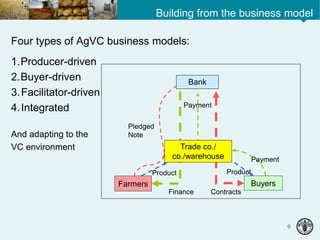
Four types of AgVC business models:
1.Producer-driven
2.Buyer-driven
3.Facilitator-driven
4.Integrated
And adapting to the
VC environment
Building from the business model
Farmers Buyers
Pledged
Note
Finance
Product
Contracts
Payment
Payment
Trade co./
co./warehouse
Bank
Product
10
10
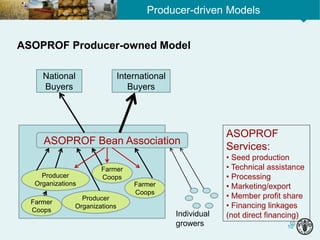
Producer-driven Models
ASOPROF Producer-owned Model
Farmer
Coops
ASOPROF Bean Association
National
Buyers
International
Buyers
Producer
Organizations
Farmer
Coops
Producer
Organizations
Farmer
Coops
ASOPROF
Services:
• Seed production
• Technical assistance
• Processing
• Marketing/export
• Member profit share
• Financing linkages
(not direct financing)Individual
growers
11
11
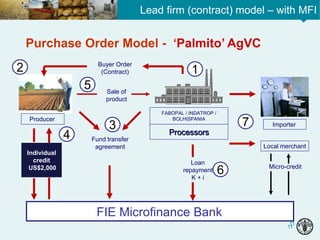
Purchase Order Model - ‘Palmito’ AgVC
Sale of
product
Loan
repayment
K + i
Fund transfer
agreement
Individual
credit
US$2,000
FABOPAL / INDATROP /
BOLHISPANIA
Importer
Buyer Order
(Contract)
Producer
Processors
FIE Microfinance Bank
12
4
3
5
6
7
Local merchant
Micro-credit
Lead firm (contract) model – with MFI
12
12
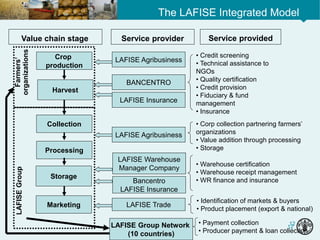
The LAFISE Integrated Model
Crop
production
Farmers’
organizations
Value chain stage Service provider Service provided
Harvest
Collection
Processing
Storage
Marketing
LAFISE Agribusiness
BANCENTRO
LAFISE Insurance
• Credit screening
• Technical assistance to
NGOs
• Quality certification
• Credit provision
• Fiduciary & fund
management
• Insurance
LAFISEGroup
• Corp collection partnering farmers’
organizations
• Value addition through processing
• Storage
LAFISE Agribusiness
LAFISE Warehouse
Manager Company
Bancentro
LAFISE Insurance
• Warehouse certification
• Warehouse receipt management
• WR finance and insurance
LAFISE Trade
LAFISE Group Network
(10 countries)
• Identification of markets & buyers
• Product placement (export & national)
• Payment collection
• Producer payment & loan collection
13
AgVC Financing Instruments
Product-linked finance 1. Supplier and trader finance
2. Marketing / Trade Finance
3. Lead firm contract farming finance
Receivables finance 4. Bill discounting
5. Factoring and reverse factoring
6. Forfaiting
Physical asset
collateralization
7. Warehouse receipts
8. Financial leasing
9. Repurchase agreements
Risk mitigation products 10. Forward Contracts
11. Futures hedging
12. Insurance
Structured financing 13. Credit guarantees
14. Equity finance and joint ventures
15. Islamic finance
Adapting financial instruments to the Ag VC
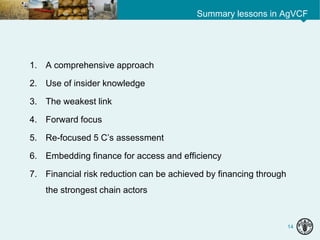
Summary lessons in AgVCF
14
1. A comprehensive approach
2. Use of insider knowledge
3. The weakest link
4. Forward focus
5. Re-focused 5 C’s assessment
6. Embedding finance for access and efficiency
7. Financial risk reduction can be achieved by financing through
the strongest chain actors
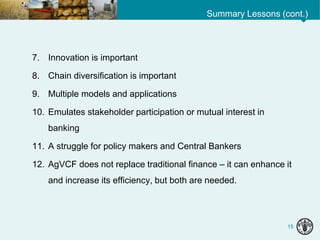
Summary Lessons (cont.)
15
7. Innovation is important
8. Chain diversification is important
9. Multiple models and applications
10. Emulates stakeholder participation or mutual interest in
banking
11. A struggle for policy makers and Central Bankers
12. AgVCF does not replace traditional finance – it can enhance it
and increase its efficiency, but both are needed.

Building Successful Agricultural Value Chain Finance

  • 1.
    S21 Working Session BuildingSuccessful Agricultural Value Chain Finance Calvin Miller, FAO Senior Officer, Agribusiness and Finance Revolutionising finance for agri-value chains conference 14 – 18 July, 2014 Nairobi, Kenya
  • 2.
    2 An agricultural valuechain includes all actors from producers, processors, suppliers, wholesalers, retailers and consumers, as well as supporting services to a particular group of final consumers. A value chain defined by its particular market segment Successful ACVF depends on the actors
  • 3.
    3 1. End market/consumers 2.Operating environment 3. VC partner cooperation 4. Support services - finance - technical assistance - business services 5. Upgrading Factors Influencing VC Competitiveness
  • 4.
    Strengthening coordination, addressing weaknessesand tailoring finance 4 Flowofproduce,services&information Consumers Retailers/ wholesalers Processors Growers Input suppliers Finance Research&Development Flowoforders,preferences&information • Inputs, production and processing are demand driven. • Continuous flow of information. • Market oriented. • Reap competitive advantage.
  • 5.
    Analytical framework 5 Identification of: Structureof the value chain: all individuals and firms that conduct business by adding value and helping move the product toward the end markets External framework, or the broader legal / national context in which the chain operates Dynamics of the value chain: individual and firm behaviors and how these affect the functioning of the chain Trends and future risks and opportunities in the chain and its participants
  • 6.
    Agri-finance value chainapproach 6 AgVCF is an approach with application of selected instruments and adaptions based upon: • A chain focus – looking at all actors, processes and markets of the chain • A transaction focus – product and cash flow and its opportunities and risks • Risk mitigation and efficiency – lending on the strength of those with stronger backing • Direct and indirect financing -- according to efficiency, often with in-kind disbursements and payments at point of sale
  • 7.
    7 Comprehensive financial assessment Character Capacity ________ Capital/ collateral Cashflow Conditions Producers/SMEs Organizational reliability • Management • Technical • Human & physical • VC contract & transactions • Markets & relationships • Loan terms • Debt Capacity • Security 5 C’s
  • 8.
    8 Value chain assessmentFinancial assessment Securing agreements Understand the value chain – the market potential and chain risks, the inputs and stakeholders. Identify the AgVC model, its sustainability and sources of financing, to provide a framework for analysing the following processes. Identify the interests and relationships of participants, their inter- dependence, commitment, coordination and relationships Loan assessment (5 C’s) of potential borrowers Assess the operating environment – macro risks, regulatory constraints and potential support from the Government or other entities Determine actual and critical points of finance – the current flows of funds and then what is needed and in what point in time. Analyse and compare financing options, and relative strengths, risks and costs of financing for each level of participant in VC Develop VC linkage and finance agreements – tailor- design financing according to the best option(s) to fit the chain and draw up contracts. Identify the transaction processes – the value added in the various levels and the flows of the product within the chain. StepsStepsSteps Analysis of AgVCF– key issues 8
  • 9.
    9 Four types ofAgVC business models: 1.Producer-driven 2.Buyer-driven 3.Facilitator-driven 4.Integrated And adapting to the VC environment Building from the business model Farmers Buyers Pledged Note Finance Product Contracts Payment Payment Trade co./ co./warehouse Bank Product
  • 10.
    10 10 Producer-driven Models ASOPROF Producer-ownedModel Farmer Coops ASOPROF Bean Association National Buyers International Buyers Producer Organizations Farmer Coops Producer Organizations Farmer Coops ASOPROF Services: • Seed production • Technical assistance • Processing • Marketing/export • Member profit share • Financing linkages (not direct financing)Individual growers
  • 11.
    11 11 Purchase Order Model- ‘Palmito’ AgVC Sale of product Loan repayment K + i Fund transfer agreement Individual credit US$2,000 FABOPAL / INDATROP / BOLHISPANIA Importer Buyer Order (Contract) Producer Processors FIE Microfinance Bank 12 4 3 5 6 7 Local merchant Micro-credit Lead firm (contract) model – with MFI
  • 12.
    12 12 The LAFISE IntegratedModel Crop production Farmers’ organizations Value chain stage Service provider Service provided Harvest Collection Processing Storage Marketing LAFISE Agribusiness BANCENTRO LAFISE Insurance • Credit screening • Technical assistance to NGOs • Quality certification • Credit provision • Fiduciary & fund management • Insurance LAFISEGroup • Corp collection partnering farmers’ organizations • Value addition through processing • Storage LAFISE Agribusiness LAFISE Warehouse Manager Company Bancentro LAFISE Insurance • Warehouse certification • Warehouse receipt management • WR finance and insurance LAFISE Trade LAFISE Group Network (10 countries) • Identification of markets & buyers • Product placement (export & national) • Payment collection • Producer payment & loan collection
  • 13.
    13 AgVC Financing Instruments Product-linkedfinance 1. Supplier and trader finance 2. Marketing / Trade Finance 3. Lead firm contract farming finance Receivables finance 4. Bill discounting 5. Factoring and reverse factoring 6. Forfaiting Physical asset collateralization 7. Warehouse receipts 8. Financial leasing 9. Repurchase agreements Risk mitigation products 10. Forward Contracts 11. Futures hedging 12. Insurance Structured financing 13. Credit guarantees 14. Equity finance and joint ventures 15. Islamic finance Adapting financial instruments to the Ag VC
  • 14.
    Summary lessons inAgVCF 14 1. A comprehensive approach 2. Use of insider knowledge 3. The weakest link 4. Forward focus 5. Re-focused 5 C’s assessment 6. Embedding finance for access and efficiency 7. Financial risk reduction can be achieved by financing through the strongest chain actors
  • 15.
    Summary Lessons (cont.) 15 7.Innovation is important 8. Chain diversification is important 9. Multiple models and applications 10. Emulates stakeholder participation or mutual interest in banking 11. A struggle for policy makers and Central Bankers 12. AgVCF does not replace traditional finance – it can enhance it and increase its efficiency, but both are needed.

Editor's Notes

  • #4 3
  • #7 A chain focus – looking at all actors, processes and markets of the chain; not individual lender-borrower A transaction focus – product and cash flow and its opportunities and risks; not the credit-worthiness of the individual client and business as the primary criteria. Risk mitigation and efficiency – lending on the strength of those with stronger backing Direct and indirect financing according to efficiency, often with in-kind disbursements and payments at point of sale; not high transaction costs bank lending to each client