A FRAMEWORK PRESENTATION
ENTREPRENEURIAL DEVELOPMENT TRAINING PROGRAM
FOR SOUTH –SOUTH NIGERIA
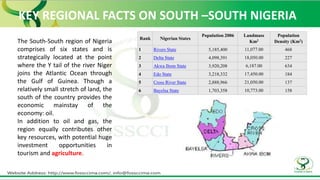
KEY REGIONAL FACTS ON SOUTH –SOUTH NIGERIA
The South-South region of Nigeria
comprises of six states and is
strategically located at the point
where the Y tail of the river Niger
joins the Atlantic Ocean through
the Gulf of Guinea. Though a
relatively small stretch of land, the
south of the country provides the
economic mainstay of the
economy: oil.
In addition to oil and gas, the
region equally contributes other
key resources, with potential huge
investment opportunities in
tourism and agriculture.
Rank Nigerian States
Population 2006 Landmass
Km2
Population
Density (Km2)
1 Rivers State 5,185,400 11,077.00 468
2 Delta State 4,098,391 18,050.00 227
3 Akwa Ibom State 3,920,208 6,187.00 634
4 Edo State 3,218,332 17,450.00 184
5 Cross River State 2,888,966 21,050.00 137
6 Bayelsa State 1,703,358 10,773.00 158
ABOUT FOSSCCIMA
 FOSSCIMA is the umbrella chamber of commerce, industry, mines
and agriculture comprising the coalition of Delta, Bayelsa, Rivers,
Akwaibom, Cross Rivers and Edo States of Nigeria. In addition,
 FOSSCCIMA works with a team of consultants that cuts across
organizations, universities and institutions within Nigeria, United
Kingdom, Malaysia, United States of America, Singapore, Romania,
Israel and the United Nations.
Background
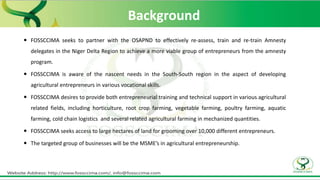
 FOSSCCIMA seeks to partner with the OSAPND to effectively re-assess, train and re-train Amnesty
delegates in the Niger Delta Region to achieve a more viable group of entrepreneurs from the amnesty
program.
 FOSSCCIMA is aware of the nascent needs in the South-South region in the aspect of developing
agricultural entrepreneurs in various vocational skills.
 FOSSCCIMA desires to provide both entrepreneurial training and technical support in various agricultural
related fields, including horticulture, root crop farming, vegetable farming, poultry farming, aquatic
farming, cold chain logistics and several related agricultural farming in mechanized quantities.
 FOSSCCIMA seeks access to large hectares of land for grooming over 10,000 different entrepreneurs.
 The targeted group of businesses will be the MSME’s in agricultural entrepreneurship.
OUR DELIVERABLES
1. Concept and Template Design
2. Inception/Diagnostic Reports
3. Stakeholder's meeting/ Advocacy
4. Evaluation of previous training
5. Biometrics capture and creation of data base/ existing skills
assessment
6. Re-Scaling of Training modules and delivery
7. A value chain approach farming
OUR DELIVERABLES
8. Linkage to cooperative groups and professional bodies for
membership of professional associations.
9. A data base of Amnesty delegates of the South - South
10. Linkage to financial support & local and international
market.
11. A Monitoring & Evaluation Guidelines Template (M&E
System)
12. Final Report / Implementation Strategies and Action Plan
manual.
FOSSCCIMA Project Timeline
• Project is to be completed within 12 months.
• Upscaling of skills for delegates and training/ re-training will be
an ongoing process.
• 11,000 delegates to be trained on different stages of
entrepreneurship development formal training period of eight
weeks (2 months in camp).
• The training is in batches of 250 per stream.
• Each stream will be empowered with start-up funds N2M
• Each stream of 250 shall be deployed at one week interval from
the previous stream.
OUR APPROACH
• FOSSCCIMA intends to integrate the use of a hybrid of models
including “Value Chain” (VC) and “Commercial Village” (CV)
approaches of agricultural entrepreneurial development.
• These approaches will achieve the desired objectives of
Sustainable Entrepreneurial Skills, enhanced productivity and
increase in the overall GDP of the nation’s economy.
Agricultural Production
Value Chain
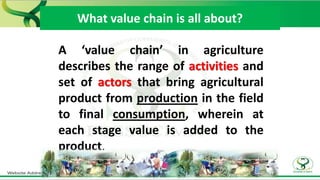
What value chain is all about?
A ‘value chain’ in agriculture
describes the range of activities and
set of actors that bring agricultural
product from production in the field
to final consumption, wherein at
each stage value is added to the
product.
The production stages entail a
combination of physical
transformation and the
participation of various producers
and services up to product’s
disposal after use.
What value chain is all about?
A simple value chain
Pre-production Post
production
Production Industrial
processing
Agro inputs: seeds, fertilizers
Tillage operations
Harvest
Direct sales
Market manufacturers
Food & product preservation
Food & product packaging
Transportation
Value Chain Analysis?
It is an approach that
analyzes a production unit
or process in a market
chain—from input
suppliers to final buyers—
and the relationships
among them.
• It analyzes the factors influencing
performance of produce
• Analyzes access to the end markets
• Analyzes requirements of end
markets; the legal, regulatory and
policy environment;
• Analyzes coordination between
firms in the industry; and the level
and quality of support services.
Why Value Chain Analysis ?
Value chain analysis is a useful
analytical tool that helps
understand overall trends of
industrial reorganization and
identify change agents and leverage
points for policy and technical
interventions.
Usefulness of Value chain analyses
It breaks the value chain into
its constituent parts in order to
better understand its structure
and functioning.
Usefulness of Value chain analyses
It identifies chain actors at
each stage and discerning
their functions and
relationships; determine the
chain governance, or
leadership, to facilitate chain
formation and strengthening
Usefulness of Value chain analyses
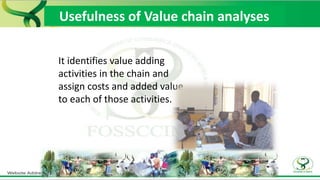
It identifies value adding
activities in the chain and
assign costs and added value
to each of those activities.
Usefulness of Value chain analyses
It identifies the flow of
goods, information and
finance through the
various stages of the chain
Usefulness of Value chain analyses
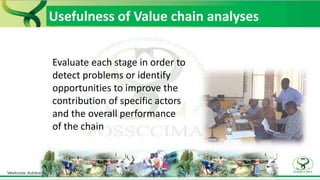
Evaluate each stage in order to
detect problems or identify
opportunities to improve the
contribution of specific actors
and the overall performance
of the chain
Usefulness of Value chain analyses
• There are no fixed rules as to how value chain
analysis should be carried out
• A range of qualitative and/or quantitative
research tools are available
–Participant observation
–Semi-structured interviews
–Focus group meetings
–Structured Questionnaire
–Market Mapping
Tools used in value chain analysis
• Activity Analysis
• Value Analysis
• Evaluation and Planning
Steps to analyze Value chain
• Step 1 – Activity Analysis
–Brainstorm the activities that each VC
actor undertakes that in some way
contribute towards the customer's
experience.
–Identify step-by-step flow of work that
each VC actor will carry out
Steps to analyze Value chain
• Step 2 – Value Analysis
– For each activity we've identified, we list the
"Value Factors" – the things that the
customers' value in the way that each activity
is conducted
– Write down these Value Factors.
– Write down what needs to be done or
changed to provide great value for each Value
Factor.
Steps to analyze Value chain
• Step 3 – Evaluate Changes and Plan for
Action
–Pick out the quick, easy, cheap wins
–Screen the more difficult changes
–Prioritize the remaining tasks and plan
to tackle them in an achievable way
OUR ACTIVITIES: PRE-PRODUCTION
• Set of activities carried out by other
practitioners outside the farmers that
contribute to effective production of
agricultural commodities.
– Research
– Extension
– Land allocation and policies
– Infrastructures
– Etc.
OUR ACTIVITIES: PRODUCTION
• All the activities of the farmers that lead to effective
cultivation of crops, fishery and husbandry of
livestock to yield the different commodities.
– Tillage
– Planting
– Agronomic /husbandry practices
– Harvesting
– Post harvest practices
o Identifying Factors Affecting Production
efficiencies.
o Balancing the value accorded to the primary
producer in the agricultural value chain
OUR ACTIVITIES: TRANSPORTATION
• A facility consisting of the
means and equipment
necessary for the
movement of passengers or
goods.
OUR ACTIVITIES: PROCESSING/ VALUE ADD
• Local and Industrial transformation of raw
agricultural commodities into semi finished or
finished product.
- Identifying how to secure true value addition
from processing and balanced reward among
stakeholders.
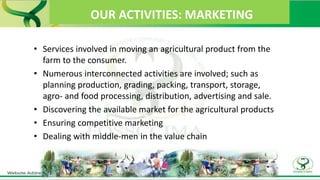
OUR ACTIVITIES: MARKETING
• Services involved in moving an agricultural product from the
farm to the consumer.
• Numerous interconnected activities are involved; such as
planning production, grading, packing, transport, storage,
agro- and food processing, distribution, advertising and sale.
• Discovering the available market for the agricultural products
• Ensuring competitive marketing
• Dealing with middle-men in the value chain
FOSSCCIMA
Agricultural
Entrepreneurship
BUSINESS MODELS
32
1.Producer-driven
2.Buyer-driven
3.Facilitator-driven
4.Integrated
And adapting to the
VC environment
Building from the business model
Farmers Buyers
Pledged
Note
Finance
Product
Contracts
Payment
Payment
Trade co./
co./warehouse
Bank
Product
Four types of AgVC business models:
33
33
PRODUCER-DRIVEN MODELS
ASOPROF Producer-owned Model
Farmer
Coops
ASOPROF Bean Association
National
Buyers
International
Buyers
Producer
Organizations
Farmer
Coops
Producer
Organizations
Farmer
Coops
ASOPROF
Services:
• Seed production
• Technical assistance
• Processing
• Marketing/export
• Member profit share
• Financing linkages
(not direct financing)
Individual
growers
34
34
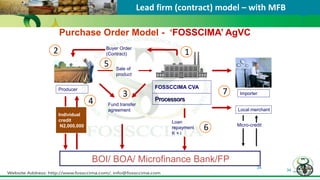
Purchase Order Model - ‘FOSSCIMA’ AgVC
Sale of
product
Loan
repayment
K + i
Fund transfer
agreement
Individual
credit
N2,000,000
FOSSCCIMA CVA
Importer
Buyer Order
(Contract)
Producer
Processors
BOI/ BOA/ Microfinance Bank/FP
12
4
3
5
6
7
Local merchant
Micro-credit
Lead firm (contract) model – with MFB
35
35
The FOSSCCIMA Integrated Model (CVA)
Crop
production
Farmers’
organizations
Value chain stage Service provider Service provided
Harvest
Collection
Processing
Storage
Marketing
FOSSCCIMA Agribusiness
BOA/ BOI
NAIC Insurance
• Credit screening
• Technical assistance to
NGOs
• Quality certification
• Credit provision
• Fiduciary & fund
management
• Insurance
FOSSCCIMAGroup
• Crop collection partnering farmers’
organizations
• Value addition through processing
• Storage
FOSSCCIMA Agribusiness
FOSSCCIMA Warehouse
Manager Company
BOA/ BOI
NAIC Insurance
• Warehouse certification
• Warehouse receipt management
• WR finance and insurance
FOSSCCIMA Trade Partners
FOSSCCIMA Group Network
(10 countries)
• Identification of markets & buyers
• Product placement (export & national)
• Payment collection
• Producer payment & loan collection
VALUE CHAIN LINKAGE
Buyer
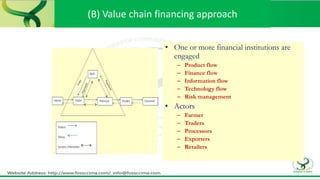
(A) Value chain financing approaches (source: KIT & IIRP 2010)
A. Chain liquidity
B. Agriculture finance
• One or more financial institutions are
engaged
– Product flow
– Finance flow
– Information flow
– Technology flow
– Risk management
• Actors
– Farmer
– Traders
– Processors
– Exporters
– Retailers
(B) Value chain financing approach
Agri-finance value chain approach
39
AgVCF is an approach with application of selected
instruments and adaptions based upon:
• A chain focus – looking at all actors, processes and
markets of the chain
• A transaction focus – product and cash flow and its
opportunities and risks
• Risk mitigation and efficiency – lending on the
strength of those with stronger backing
• Direct and indirect financing -- according to
efficiency, often with in-kind disbursements and
payments at point of sale
Key instruments of Agric value chain financing (AVCF)
• Financing for buying inputs
– Planting material, Chemicals, feed, chicks, packaging material
• Financing for creating assets
– Land development, polyhouse development, machine, irrigation
management (drip, sprinkler, micro-irrigation)
– Cold storage, warehouse, chilling plants, processing plant, animals
• Financing for risk mitigation
– Insurance for production and transportation
– Agricultural commodity futures
• Warehouse receipts
• Commodity futures market
– Price discovery and price risk management
41
An agricultural value chain
includes all actors from
producers, processors, suppliers,
wholesalers, retailers and
consumers, as well as
supporting services to a
particular group of final
consumers.
A value chain defined by its particular market segment
Successful ACVF depends on the actors
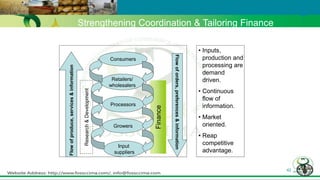
42
Flowofproduce,services&information
Consumers
Retailers/
wholesalers
Processors
Growers
Input
suppliers
Finance
Research&Development
Flowoforders,preferences&information
• Inputs,
production and
processing are
demand
driven.
• Continuous
flow of
information.
• Market
oriented.
• Reap
competitive
advantage.
Strengthening Coordination & Tailoring Finance
Analytical framework
43
Identification of:
Structure of the value chain: all individuals and firms
that conduct business by adding value and helping
move the product toward the end markets
External framework, or the broader legal / national
context in which the chain operates
Dynamics of the value chain: individual and firm
behaviors and how these affect the functioning of
the chain
Trends and future risks and opportunities in the
chain and its participants
44
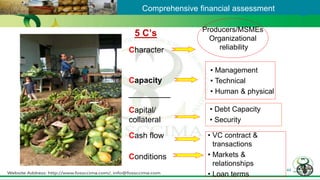
Comprehensive financial assessment
Character
Capacity
________
Capital/
collateral
Cash flow
Conditions
Producers/MSMEs
Organizational
reliability
• Management
• Technical
• Human & physical
• VC contract &
transactions
• Markets &
relationships
• Loan terms
• Debt Capacity
• Security
5 C’s
45
Value chain assessment Financial assessment Securing agreements
Understand the value chain –
the market potential and
chain risks, the inputs and
stakeholders.
Identify the AgVC model, its
sustainability and sources of
financing, to provide a
framework for analysing the
following processes.
Identify the interests and
relationships of participants,
their inter-dependence,
commitment, coordination
and relationships
Loan assessment based on the
(5 C’s) of potential borrowers
Assess the operating
environment – macro risks,
regulatory constraints and
potential support from the
Government or other entities
Determine actual and critical
points of finance – the current
flows of funds and then what is
needed and in what point in
time.
Analyse and compare financing
options, and relative strengths,
risks and costs of financing for
each level of participant in VC
Develop VC linkage and finance
agreements – tailor-design
financing according to the best
option(s) to fit the chain and draw
up contracts.
Identify the transaction
processes – the value added
in the various levels and the
flows of the product within
the chain.
StepsStepsSteps
Analysis of AgVCF– key issues
45
46
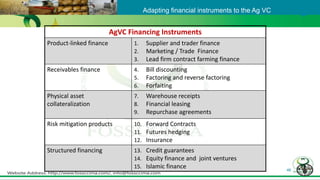
AgVC Financing Instruments
Product-linked finance 1. Supplier and trader finance
2. Marketing / Trade Finance
3. Lead firm contract farming finance
Receivables finance 4. Bill discounting
5. Factoring and reverse factoring
6. Forfaiting
Physical asset
collateralization
7. Warehouse receipts
8. Financial leasing
9. Repurchase agreements
Risk mitigation products 10. Forward Contracts
11. Futures hedging
12. Insurance
Structured financing 13. Credit guarantees
14. Equity finance and joint ventures
15. Islamic finance
Adapting financial instruments to the Ag VC
COMMERCIAL VILLAGE APPROACH
Input suppliers
•Commercial improved
Seeds and seedlings suppliers
•Chemical and fertilizer suppliers
Embedded BDS
•Training on safe chemical use
•Training on crop production
And post-harvest handling
•Community commercial empowerment
•Extension services (e.g.demo plots)
Village centre services
•Grading, sorting and primary Packaging
•Bulking and local transporters
•Purchasing by local and external
Intermediaries
Market intermediaries
Embedded services
•Market research transportation
•Quality assurance and market
Penetration services
Private sector embedded services
•Market research and market
Penetration services
•Extension services
•Transportation
Embedded services
•Quality assurance and export
Certification Authorities
Market
Support
Unit 1
Formal markets Informal markets
Market
Support
Unit 2
Market
Support
Unit 3
Commercial Villages’ Member
Commercial village coordination unit
–At MSU level and CVA level
Business development
Services providers
Commercial village collection centres
Private sector buyers
Farmers’ Producers’ organization (FPO)
Aquatic/Marine Vegetable Growers Root & Tuber growers
Farmers Interest
Group (FIG)
Farmers Interest
Group (FIG)
Farmers Interest
Group (FIG)
Cluster Committee Cluster Committee
B
L
O
C
K
FPO
D
I
S
T
R
I
C
T
• One FIG = 50-80 Farmers.
• One village = 1- 4 FIG (50 to 320 Farmers)
• One FPO = 15-20 Villages (45-60 FIG with 2500 to 4800
farmers).
H
A
L
L
FOSSCCIMA
Agric. Entrepreneurship
VALUE CHAIN
BUSINESS AREAS
Livelihood
Financial
Services
Cotton crop
technical
Services
Institutional
Development
Services
Farmers
Ginning
FOSSCCIMA – Cotton Value Chain
Lint Pressing unit-
Conversion to
Bales
Farmers
Farmers
National Commodity Derivatives Exchange
(NCDEX )
Trading Platform
Formed into cotton
Producer Group
FOSSCCIMA
Warehouse
Receipt
BANK
Loan
Assured
PriceSeeds,
Fertilizers,
Pesticides
NCMSL
Godowns
Supper Spinning Mill
Dairy Value Chain:
FOSSCCIMA - Reliance Dairy Company Collaboration
DAIRY
FARMERS
INPUTSUPPLY
FOSSCCIMA
OUTPUTMARKET
RELIANCE
Milk supplied to
Bulk Milk Coolers
Financial &
Dairy Extn
Services
Potato Value Chain
Frito Lays India Limited
Potato Growers
FOSSCCIMA
Credit Ext. services
Group
formation
Potato
Seed
Buy back
arrangement
Some Illustrations of Improved
Value Chains
Cooperative model: AMUL milk model
Private sector initiative: tomato & potato by PepsiCo
In potato, CPRI, Shimla is
providing technical support
Field Fresh Model for domestic and export
market (Bharati and Del Monte Pacific) India
Land Use and Other Inputs such as plant
materials, facilities are provided by Tanflora
Corporation
Global Value Chain Export of Cut flowers
Growers’ facilities
SBI Financing
(Agriculture
Development
Branch)
Small Growers/Farmers employed by Tanflora
Corporation Growing Units
Growing of cut flowers by private companies
(e.g. Tanflora Company)
Grading and Packing
Pre-Cooling and Cold Storage
Refrigerated Van /Transportation
Export to international markets (Europe,
Middle and Far East, Australia, Japan and CIS
countries)
Value chain & financing cut flowers by Tanflora Corporation
Flowers exported
to Europe, Middle
& Far East,
Australia, Japan
25:75 sharing of
profit
Value chain & financing in poultry: Saguna
Value Chain & Value System of TATA motors (India)
Inbound
Logistics
Operations Marketing Service
Outbound
Logistics
Suppliers , Contractors
SAP , VCM
SAP , CRM - DMS
Strategic Alliances
Transporters, Convoy Drivers
Association
Dealer Network, Marketing
Research Firms, Vehicle
Financing
Regional Warehouses, Dealer
Workshops, Distributors, TASS
Some other Value Chain Interventions (India example)
1. Dairy Value Chain Intervention – Reliance Dairy Foods
– 1000 farmers; 30 villages
– 50 Producer Groups formed
– Credit, Vet. Services, Market linkages
2. Vegetables Intervention – ITC
– Push carts were provided by ITC
– Credit, Crop extension services
– Market Linkages
3. Sweet Orange Market Linkages – Reliance Fresh
– Credit
– Extension services
– Market Linkages
4. Mango Market Linkages – Jain and Other players
– Mango cluster developed
– Credit
– Extension services
– Market linkages
Package of Services to Crop customers
• Productivity Enhancement
through Package of Practices
– Soil testing, Vermicompost and
Integrated Nutrient Management
• Risk Mitigation
– Seed treatment, Stem application,
Integrated Pest Management
• Local Value Addition
– Semi-processing (e.g. ginning of
cotton, shelling of groundnut pods)
• Alternate Market Linkages for
better prices (Super Spinning Mills,
NCDEX)
• Establishing/strengthening farmers’
cooperatives for input/output marketing
Enhanced Production in Cotton
Linked with Market
FOSSCCIMA
Agric. Entrepreneurship
VALUE CHAIN
SUPPORT SERVICES
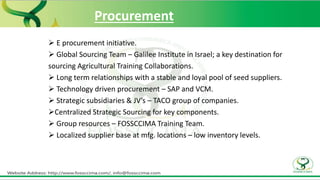
Procurement
 E procurement initiative.
 Global Sourcing Team – Galilee Institute in Israel; a key destination for
sourcing Agricultural Training Collaborations.
 Long term relationships with a stable and loyal pool of seed suppliers.
 Technology driven procurement – SAP and VCM.
 Strategic subsidiaries & JV’s – TACO group of companies.
Centralized Strategic Sourcing for key components.
 Group resources – FOSSCCIMA Training Team.
 Localized supplier base at mfg. locations – low inventory levels.
Technology Development
 Approximately 2% of the annual profits of the Commercial Village
invested in research and development.
 Knowledge portal – helps artisans keep abreast with the latest
technologies.
 Extensive prototype building and testing facilities inside the CV.
 Strategic partnerships – GIMI (Israel),
Formal benchmarking process.
 “Technology Day” organized across all FIG locations etc.
Human Resource
 Vast pool of technically competent consultants and managers.
 Focus on development of technical capabilities – Technical
Training Center’s, Alliance with technical Institutes (GIMI, Israel)
 Focus on development of managerial capabilities – MTC’s , TMTC,
executive training programs at premier business schools
 Entrepreneurial Development Training – EDT, (FOSSCCIMA)
Financial Management Training - FMT (FOSSCCIMA)
Firm Infrastructure (CV & FPO CENTRE)
 Multi – Location facilities
 Strong leadership – under the aegis
of FOSSCCIMA
 Best in class prototype building
facilities (1000 Capacity Training
Centre, located inside the Commercial
Village - CV).
 Technology – SAP
 Large product portfolio
JUSTIFICATION TO OUR APPROACH
• Conventional thinking - agricultural sector is too costly and risky for
lending. Yet, major banks in the sector such as Rabobank and Banorte,
in the Netherlands and Mexico respectively, both express the view that
agricultural credit is profitable if producers are well integrated into a
viable value chain (Shwedel, 2007; Martínez, 2006).
• VALUE CHAIN approach; proven and tested in India, Netherlands
Mexico, South America, and other Asian and African countries.
• VALUE CHAIN will make the entrepreneurial training more revenue
generating for the delegates as against previous handouts being doled
out to the delegates without a comprehensive business development
plan.
Thank you

Entrepreneurial Value Chain Presentation

  • 1.
    A FRAMEWORK PRESENTATION ENTREPRENEURIALDEVELOPMENT TRAINING PROGRAM FOR SOUTH –SOUTH NIGERIA
  • 2.
    KEY REGIONAL FACTSON SOUTH –SOUTH NIGERIA The South-South region of Nigeria comprises of six states and is strategically located at the point where the Y tail of the river Niger joins the Atlantic Ocean through the Gulf of Guinea. Though a relatively small stretch of land, the south of the country provides the economic mainstay of the economy: oil. In addition to oil and gas, the region equally contributes other key resources, with potential huge investment opportunities in tourism and agriculture. Rank Nigerian States Population 2006 Landmass Km2 Population Density (Km2) 1 Rivers State 5,185,400 11,077.00 468 2 Delta State 4,098,391 18,050.00 227 3 Akwa Ibom State 3,920,208 6,187.00 634 4 Edo State 3,218,332 17,450.00 184 5 Cross River State 2,888,966 21,050.00 137 6 Bayelsa State 1,703,358 10,773.00 158
  • 3.
    ABOUT FOSSCCIMA  FOSSCIMAis the umbrella chamber of commerce, industry, mines and agriculture comprising the coalition of Delta, Bayelsa, Rivers, Akwaibom, Cross Rivers and Edo States of Nigeria. In addition,  FOSSCCIMA works with a team of consultants that cuts across organizations, universities and institutions within Nigeria, United Kingdom, Malaysia, United States of America, Singapore, Romania, Israel and the United Nations.
  • 4.
    Background  FOSSCCIMA seeksto partner with the OSAPND to effectively re-assess, train and re-train Amnesty delegates in the Niger Delta Region to achieve a more viable group of entrepreneurs from the amnesty program.  FOSSCCIMA is aware of the nascent needs in the South-South region in the aspect of developing agricultural entrepreneurs in various vocational skills.  FOSSCCIMA desires to provide both entrepreneurial training and technical support in various agricultural related fields, including horticulture, root crop farming, vegetable farming, poultry farming, aquatic farming, cold chain logistics and several related agricultural farming in mechanized quantities.  FOSSCCIMA seeks access to large hectares of land for grooming over 10,000 different entrepreneurs.  The targeted group of businesses will be the MSME’s in agricultural entrepreneurship.
  • 5.
    OUR DELIVERABLES 1. Conceptand Template Design 2. Inception/Diagnostic Reports 3. Stakeholder's meeting/ Advocacy 4. Evaluation of previous training 5. Biometrics capture and creation of data base/ existing skills assessment 6. Re-Scaling of Training modules and delivery 7. A value chain approach farming
  • 6.
    OUR DELIVERABLES 8. Linkageto cooperative groups and professional bodies for membership of professional associations. 9. A data base of Amnesty delegates of the South - South 10. Linkage to financial support & local and international market. 11. A Monitoring & Evaluation Guidelines Template (M&E System) 12. Final Report / Implementation Strategies and Action Plan manual.
  • 7.
    FOSSCCIMA Project Timeline •Project is to be completed within 12 months. • Upscaling of skills for delegates and training/ re-training will be an ongoing process. • 11,000 delegates to be trained on different stages of entrepreneurship development formal training period of eight weeks (2 months in camp). • The training is in batches of 250 per stream. • Each stream will be empowered with start-up funds N2M • Each stream of 250 shall be deployed at one week interval from the previous stream.
  • 8.
    OUR APPROACH • FOSSCCIMAintends to integrate the use of a hybrid of models including “Value Chain” (VC) and “Commercial Village” (CV) approaches of agricultural entrepreneurial development. • These approaches will achieve the desired objectives of Sustainable Entrepreneurial Skills, enhanced productivity and increase in the overall GDP of the nation’s economy.
  • 9.
  • 10.
    What value chainis all about? A ‘value chain’ in agriculture describes the range of activities and set of actors that bring agricultural product from production in the field to final consumption, wherein at each stage value is added to the product.
  • 11.
    The production stagesentail a combination of physical transformation and the participation of various producers and services up to product’s disposal after use. What value chain is all about?
  • 12.
    A simple valuechain Pre-production Post production Production Industrial processing Agro inputs: seeds, fertilizers Tillage operations Harvest Direct sales Market manufacturers Food & product preservation Food & product packaging Transportation
  • 13.
    Value Chain Analysis? Itis an approach that analyzes a production unit or process in a market chain—from input suppliers to final buyers— and the relationships among them.
  • 14.
    • It analyzesthe factors influencing performance of produce • Analyzes access to the end markets • Analyzes requirements of end markets; the legal, regulatory and policy environment; • Analyzes coordination between firms in the industry; and the level and quality of support services. Why Value Chain Analysis ?
  • 15.
    Value chain analysisis a useful analytical tool that helps understand overall trends of industrial reorganization and identify change agents and leverage points for policy and technical interventions. Usefulness of Value chain analyses
  • 16.
    It breaks thevalue chain into its constituent parts in order to better understand its structure and functioning. Usefulness of Value chain analyses
  • 17.
    It identifies chainactors at each stage and discerning their functions and relationships; determine the chain governance, or leadership, to facilitate chain formation and strengthening Usefulness of Value chain analyses
  • 18.
    It identifies valueadding activities in the chain and assign costs and added value to each of those activities. Usefulness of Value chain analyses
  • 19.
    It identifies theflow of goods, information and finance through the various stages of the chain Usefulness of Value chain analyses
  • 20.
    Evaluate each stagein order to detect problems or identify opportunities to improve the contribution of specific actors and the overall performance of the chain Usefulness of Value chain analyses
  • 21.
    • There areno fixed rules as to how value chain analysis should be carried out • A range of qualitative and/or quantitative research tools are available –Participant observation –Semi-structured interviews –Focus group meetings –Structured Questionnaire –Market Mapping Tools used in value chain analysis
  • 22.
    • Activity Analysis •Value Analysis • Evaluation and Planning Steps to analyze Value chain
  • 23.
    Steps to analyzeValue chain • Step 1 – Activity Analysis –Brainstorm the activities that each VC actor undertakes that in some way contribute towards the customer's experience. –Identify step-by-step flow of work that each VC actor will carry out
  • 24.
    Steps to analyzeValue chain • Step 2 – Value Analysis – For each activity we've identified, we list the "Value Factors" – the things that the customers' value in the way that each activity is conducted – Write down these Value Factors. – Write down what needs to be done or changed to provide great value for each Value Factor.
  • 25.
    Steps to analyzeValue chain • Step 3 – Evaluate Changes and Plan for Action –Pick out the quick, easy, cheap wins –Screen the more difficult changes –Prioritize the remaining tasks and plan to tackle them in an achievable way
  • 26.
    OUR ACTIVITIES: PRE-PRODUCTION •Set of activities carried out by other practitioners outside the farmers that contribute to effective production of agricultural commodities. – Research – Extension – Land allocation and policies – Infrastructures – Etc.
  • 27.
    OUR ACTIVITIES: PRODUCTION •All the activities of the farmers that lead to effective cultivation of crops, fishery and husbandry of livestock to yield the different commodities. – Tillage – Planting – Agronomic /husbandry practices – Harvesting – Post harvest practices o Identifying Factors Affecting Production efficiencies. o Balancing the value accorded to the primary producer in the agricultural value chain
  • 28.
    OUR ACTIVITIES: TRANSPORTATION •A facility consisting of the means and equipment necessary for the movement of passengers or goods.
  • 29.
    OUR ACTIVITIES: PROCESSING/VALUE ADD • Local and Industrial transformation of raw agricultural commodities into semi finished or finished product. - Identifying how to secure true value addition from processing and balanced reward among stakeholders.
  • 30.
    OUR ACTIVITIES: MARKETING •Services involved in moving an agricultural product from the farm to the consumer. • Numerous interconnected activities are involved; such as planning production, grading, packing, transport, storage, agro- and food processing, distribution, advertising and sale. • Discovering the available market for the agricultural products • Ensuring competitive marketing • Dealing with middle-men in the value chain
  • 31.
  • 32.
    32 1.Producer-driven 2.Buyer-driven 3.Facilitator-driven 4.Integrated And adapting tothe VC environment Building from the business model Farmers Buyers Pledged Note Finance Product Contracts Payment Payment Trade co./ co./warehouse Bank Product Four types of AgVC business models:
  • 33.
    33 33 PRODUCER-DRIVEN MODELS ASOPROF Producer-ownedModel Farmer Coops ASOPROF Bean Association National Buyers International Buyers Producer Organizations Farmer Coops Producer Organizations Farmer Coops ASOPROF Services: • Seed production • Technical assistance • Processing • Marketing/export • Member profit share • Financing linkages (not direct financing) Individual growers
  • 34.
    34 34 Purchase Order Model- ‘FOSSCIMA’ AgVC Sale of product Loan repayment K + i Fund transfer agreement Individual credit N2,000,000 FOSSCCIMA CVA Importer Buyer Order (Contract) Producer Processors BOI/ BOA/ Microfinance Bank/FP 12 4 3 5 6 7 Local merchant Micro-credit Lead firm (contract) model – with MFB
  • 35.
    35 35 The FOSSCCIMA IntegratedModel (CVA) Crop production Farmers’ organizations Value chain stage Service provider Service provided Harvest Collection Processing Storage Marketing FOSSCCIMA Agribusiness BOA/ BOI NAIC Insurance • Credit screening • Technical assistance to NGOs • Quality certification • Credit provision • Fiduciary & fund management • Insurance FOSSCCIMAGroup • Crop collection partnering farmers’ organizations • Value addition through processing • Storage FOSSCCIMA Agribusiness FOSSCCIMA Warehouse Manager Company BOA/ BOI NAIC Insurance • Warehouse certification • Warehouse receipt management • WR finance and insurance FOSSCCIMA Trade Partners FOSSCCIMA Group Network (10 countries) • Identification of markets & buyers • Product placement (export & national) • Payment collection • Producer payment & loan collection
  • 36.
  • 37.
    (A) Value chainfinancing approaches (source: KIT & IIRP 2010) A. Chain liquidity B. Agriculture finance
  • 38.
    • One ormore financial institutions are engaged – Product flow – Finance flow – Information flow – Technology flow – Risk management • Actors – Farmer – Traders – Processors – Exporters – Retailers (B) Value chain financing approach
  • 39.
    Agri-finance value chainapproach 39 AgVCF is an approach with application of selected instruments and adaptions based upon: • A chain focus – looking at all actors, processes and markets of the chain • A transaction focus – product and cash flow and its opportunities and risks • Risk mitigation and efficiency – lending on the strength of those with stronger backing • Direct and indirect financing -- according to efficiency, often with in-kind disbursements and payments at point of sale
  • 40.
    Key instruments ofAgric value chain financing (AVCF) • Financing for buying inputs – Planting material, Chemicals, feed, chicks, packaging material • Financing for creating assets – Land development, polyhouse development, machine, irrigation management (drip, sprinkler, micro-irrigation) – Cold storage, warehouse, chilling plants, processing plant, animals • Financing for risk mitigation – Insurance for production and transportation – Agricultural commodity futures • Warehouse receipts • Commodity futures market – Price discovery and price risk management
  • 41.
    41 An agricultural valuechain includes all actors from producers, processors, suppliers, wholesalers, retailers and consumers, as well as supporting services to a particular group of final consumers. A value chain defined by its particular market segment Successful ACVF depends on the actors
  • 42.
    42 Flowofproduce,services&information Consumers Retailers/ wholesalers Processors Growers Input suppliers Finance Research&Development Flowoforders,preferences&information • Inputs, production and processingare demand driven. • Continuous flow of information. • Market oriented. • Reap competitive advantage. Strengthening Coordination & Tailoring Finance
  • 43.
    Analytical framework 43 Identification of: Structureof the value chain: all individuals and firms that conduct business by adding value and helping move the product toward the end markets External framework, or the broader legal / national context in which the chain operates Dynamics of the value chain: individual and firm behaviors and how these affect the functioning of the chain Trends and future risks and opportunities in the chain and its participants
  • 44.
    44 Comprehensive financial assessment Character Capacity ________ Capital/ collateral Cashflow Conditions Producers/MSMEs Organizational reliability • Management • Technical • Human & physical • VC contract & transactions • Markets & relationships • Loan terms • Debt Capacity • Security 5 C’s
  • 45.
    45 Value chain assessmentFinancial assessment Securing agreements Understand the value chain – the market potential and chain risks, the inputs and stakeholders. Identify the AgVC model, its sustainability and sources of financing, to provide a framework for analysing the following processes. Identify the interests and relationships of participants, their inter-dependence, commitment, coordination and relationships Loan assessment based on the (5 C’s) of potential borrowers Assess the operating environment – macro risks, regulatory constraints and potential support from the Government or other entities Determine actual and critical points of finance – the current flows of funds and then what is needed and in what point in time. Analyse and compare financing options, and relative strengths, risks and costs of financing for each level of participant in VC Develop VC linkage and finance agreements – tailor-design financing according to the best option(s) to fit the chain and draw up contracts. Identify the transaction processes – the value added in the various levels and the flows of the product within the chain. StepsStepsSteps Analysis of AgVCF– key issues 45
  • 46.
    46 AgVC Financing Instruments Product-linkedfinance 1. Supplier and trader finance 2. Marketing / Trade Finance 3. Lead firm contract farming finance Receivables finance 4. Bill discounting 5. Factoring and reverse factoring 6. Forfaiting Physical asset collateralization 7. Warehouse receipts 8. Financial leasing 9. Repurchase agreements Risk mitigation products 10. Forward Contracts 11. Futures hedging 12. Insurance Structured financing 13. Credit guarantees 14. Equity finance and joint ventures 15. Islamic finance Adapting financial instruments to the Ag VC
  • 47.
    COMMERCIAL VILLAGE APPROACH Inputsuppliers •Commercial improved Seeds and seedlings suppliers •Chemical and fertilizer suppliers Embedded BDS •Training on safe chemical use •Training on crop production And post-harvest handling •Community commercial empowerment •Extension services (e.g.demo plots) Village centre services •Grading, sorting and primary Packaging •Bulking and local transporters •Purchasing by local and external Intermediaries Market intermediaries Embedded services •Market research transportation •Quality assurance and market Penetration services Private sector embedded services •Market research and market Penetration services •Extension services •Transportation Embedded services •Quality assurance and export Certification Authorities Market Support Unit 1 Formal markets Informal markets Market Support Unit 2 Market Support Unit 3 Commercial Villages’ Member Commercial village coordination unit –At MSU level and CVA level Business development Services providers Commercial village collection centres Private sector buyers
  • 48.
    Farmers’ Producers’ organization(FPO) Aquatic/Marine Vegetable Growers Root & Tuber growers Farmers Interest Group (FIG) Farmers Interest Group (FIG) Farmers Interest Group (FIG) Cluster Committee Cluster Committee B L O C K FPO D I S T R I C T • One FIG = 50-80 Farmers. • One village = 1- 4 FIG (50 to 320 Farmers) • One FPO = 15-20 Villages (45-60 FIG with 2500 to 4800 farmers). H A L L
  • 49.
  • 50.
    Livelihood Financial Services Cotton crop technical Services Institutional Development Services Farmers Ginning FOSSCCIMA –Cotton Value Chain Lint Pressing unit- Conversion to Bales Farmers Farmers National Commodity Derivatives Exchange (NCDEX ) Trading Platform Formed into cotton Producer Group FOSSCCIMA Warehouse Receipt BANK Loan Assured PriceSeeds, Fertilizers, Pesticides NCMSL Godowns Supper Spinning Mill
  • 51.
    Dairy Value Chain: FOSSCCIMA- Reliance Dairy Company Collaboration DAIRY FARMERS INPUTSUPPLY FOSSCCIMA OUTPUTMARKET RELIANCE Milk supplied to Bulk Milk Coolers Financial & Dairy Extn Services
  • 52.
    Potato Value Chain FritoLays India Limited Potato Growers FOSSCCIMA Credit Ext. services Group formation Potato Seed Buy back arrangement
  • 53.
    Some Illustrations ofImproved Value Chains
  • 54.
  • 55.
    Private sector initiative:tomato & potato by PepsiCo In potato, CPRI, Shimla is providing technical support
  • 56.
    Field Fresh Modelfor domestic and export market (Bharati and Del Monte Pacific) India
  • 57.
    Land Use andOther Inputs such as plant materials, facilities are provided by Tanflora Corporation Global Value Chain Export of Cut flowers Growers’ facilities SBI Financing (Agriculture Development Branch) Small Growers/Farmers employed by Tanflora Corporation Growing Units Growing of cut flowers by private companies (e.g. Tanflora Company) Grading and Packing Pre-Cooling and Cold Storage Refrigerated Van /Transportation Export to international markets (Europe, Middle and Far East, Australia, Japan and CIS countries) Value chain & financing cut flowers by Tanflora Corporation Flowers exported to Europe, Middle & Far East, Australia, Japan 25:75 sharing of profit
  • 58.
    Value chain &financing in poultry: Saguna
  • 59.
    Value Chain &Value System of TATA motors (India) Inbound Logistics Operations Marketing Service Outbound Logistics Suppliers , Contractors SAP , VCM SAP , CRM - DMS Strategic Alliances Transporters, Convoy Drivers Association Dealer Network, Marketing Research Firms, Vehicle Financing Regional Warehouses, Dealer Workshops, Distributors, TASS
  • 60.
    Some other ValueChain Interventions (India example) 1. Dairy Value Chain Intervention – Reliance Dairy Foods – 1000 farmers; 30 villages – 50 Producer Groups formed – Credit, Vet. Services, Market linkages 2. Vegetables Intervention – ITC – Push carts were provided by ITC – Credit, Crop extension services – Market Linkages 3. Sweet Orange Market Linkages – Reliance Fresh – Credit – Extension services – Market Linkages 4. Mango Market Linkages – Jain and Other players – Mango cluster developed – Credit – Extension services – Market linkages
  • 61.
    Package of Servicesto Crop customers • Productivity Enhancement through Package of Practices – Soil testing, Vermicompost and Integrated Nutrient Management • Risk Mitigation – Seed treatment, Stem application, Integrated Pest Management • Local Value Addition – Semi-processing (e.g. ginning of cotton, shelling of groundnut pods) • Alternate Market Linkages for better prices (Super Spinning Mills, NCDEX) • Establishing/strengthening farmers’ cooperatives for input/output marketing Enhanced Production in Cotton Linked with Market
  • 62.
  • 63.
    Procurement  E procurementinitiative.  Global Sourcing Team – Galilee Institute in Israel; a key destination for sourcing Agricultural Training Collaborations.  Long term relationships with a stable and loyal pool of seed suppliers.  Technology driven procurement – SAP and VCM.  Strategic subsidiaries & JV’s – TACO group of companies. Centralized Strategic Sourcing for key components.  Group resources – FOSSCCIMA Training Team.  Localized supplier base at mfg. locations – low inventory levels.
  • 64.
    Technology Development  Approximately2% of the annual profits of the Commercial Village invested in research and development.  Knowledge portal – helps artisans keep abreast with the latest technologies.  Extensive prototype building and testing facilities inside the CV.  Strategic partnerships – GIMI (Israel), Formal benchmarking process.  “Technology Day” organized across all FIG locations etc.
  • 65.
    Human Resource  Vastpool of technically competent consultants and managers.  Focus on development of technical capabilities – Technical Training Center’s, Alliance with technical Institutes (GIMI, Israel)  Focus on development of managerial capabilities – MTC’s , TMTC, executive training programs at premier business schools  Entrepreneurial Development Training – EDT, (FOSSCCIMA) Financial Management Training - FMT (FOSSCCIMA)
  • 66.
    Firm Infrastructure (CV& FPO CENTRE)  Multi – Location facilities  Strong leadership – under the aegis of FOSSCCIMA  Best in class prototype building facilities (1000 Capacity Training Centre, located inside the Commercial Village - CV).  Technology – SAP  Large product portfolio
  • 67.
    JUSTIFICATION TO OURAPPROACH • Conventional thinking - agricultural sector is too costly and risky for lending. Yet, major banks in the sector such as Rabobank and Banorte, in the Netherlands and Mexico respectively, both express the view that agricultural credit is profitable if producers are well integrated into a viable value chain (Shwedel, 2007; Martínez, 2006). • VALUE CHAIN approach; proven and tested in India, Netherlands Mexico, South America, and other Asian and African countries. • VALUE CHAIN will make the entrepreneurial training more revenue generating for the delegates as against previous handouts being doled out to the delegates without a comprehensive business development plan.
  • 68.

Editor's Notes

  • #40 A chain focus – looking at all actors, processes and markets of the chain; not individual lender-borrower A transaction focus – product and cash flow and its opportunities and risks; not the credit-worthiness of the individual client and business as the primary criteria. Risk mitigation and efficiency – lending on the strength of those with stronger backing Direct and indirect financing according to efficiency, often with in-kind disbursements and payments at point of sale; not high transaction costs bank lending to each client