SNV Ethiopia’s
Value Chain Development Approach


   Pro Poor Development through
     Value Chain Development

     LVC/PPD National Project
       Inception Workshop


                 Addis Ababa, January 21, 2011
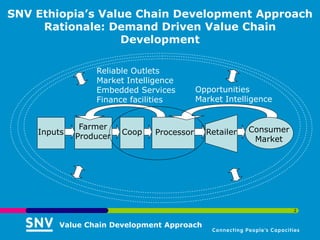
SNV Ethiopia’s Value Chain Development Approach
     Rationale: Demand Driven Value Chain
                  Development

                 Reliable Outlets
                 Market Intelligence
                 Embedded Services         Opportunities
                 Finance facilities        Market Intelligence


              Farmer                                    Consumer
    Inputs              Coop   Processor     Retailer
             Producer                                    Market


                                                                   2


        Value Chain Development Approach
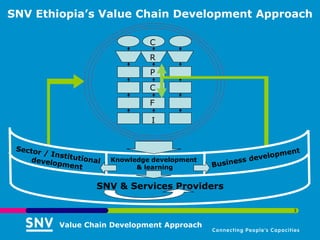
SNV Ethiopia’s Value Chain Development Approach

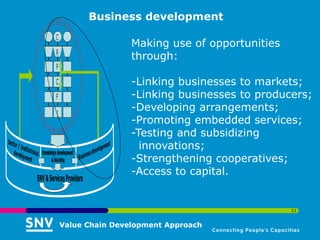
                            C
                            R
                            P
                            C
                            F

                            I


                   Knowledge development
                         & learning


                SNV & Services Providers

                                            3


        Value Chain Development Approach
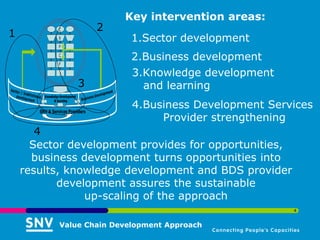
Key intervention areas:
                  2
1                         1.Sector development
                          2.Business development
                          3.Knowledge development
              3             and learning
                          4.Business Development Services
                               Provider strengthening
       4
      Sector development provides for opportunities,
      business development turns opportunities into
    results, knowledge development and BDS provider
           development assures the sustainable
                up-scaling of the approach
                                                       4


          Value Chain Development Approach
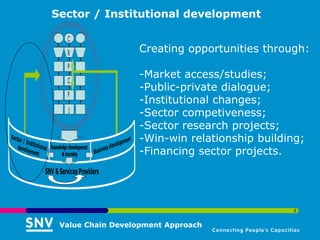
Sector / Institutional development


                  Creating opportunities through:

                  -Market access/studies;
                  -Public-private dialogue;
                  -Institutional changes;
                  -Sector competiveness;
                  -Sector research projects;
                  -Win-win relationship building;
                  -Financing sector projects.


                                              5


 Value Chain Development Approach
Sector / Institutional development: products
MSP:   Multi Stakeholder Platforms (Coordination Groups)

- Bottleneck definition and priority setting (ownership)

- Project implementers report to the CG on project
  status/fund use (accountability)

- From the interaction from CG meetings producers and
  processors have agreed to form EMPPA, EHBPEA

- Starting point for apiculture and dairy board
  establishment (public-private dialogue forums)

- Research agenda setting


                                                       6


        Value Chain Development Approach
Sector / Institutional development: products

MSP:   Multi Stakeholder Platforms (Coordination Groups

- Input suppliers , producers and processors create B2B
  linkages

- Linking public institutions to private sector actors
  (EMDTI, HBRC, Regional Marketing Agencies)

- Public-Private dialogue resulting in policy/regulatory
  changes (Feed export ban, honey proclamation,
  collection centers)

- Input suppliers , producers and processors create B2B
  linkages


                                                           7
Sector / Institutional development: products
MI:   Market Intelligence

- Exchange visit to Kenya that resulted to the idea of
  Dairy Business Hub
- Researches on various issues (new product
  development, quality, EU market access, shoats rearing
  vs. fattening)
- Advise for packaging materials, technical advise on
  processing technology (set up and equipments)
- Trade fair participation leading to exports (2008 - 30t
  Europe, 10t Yemen; 2010 - 400t)
- Publications on bee flora and apiculture resources
- With ECOPA awareness creation on hygienic milk
  production and consumption


                                                       8
Sector / Institutional development: products
SAS:   Sector Association Strengthening
- EMPPA, EBA and EHBPEA: support the
establishment, strategic planning, business planning


EPPM: Effective Public Policy Management
- Support associations to lobby at government level
- Commitment to the establishment of the dairy and
  apiculture board
- EU third country listing: MoARD in the lead
- Honey proclamation
- Introduction of transitional beehives besides
  modern beehives


                                                       9


        Value Chain Development Approach
Sector / Institutional development: products


VCF:   Value Chain Financing (100%)
- CGs, trade fairs, research
- Sector projects for sector associations and public sector
- Upgrading of EMDTI laboratory


ATP: Appropriate Technology Promotion
- Improved aluminum milk cans
- Simple quality control equipment
- Transitional beehive: Women having access to honey
  production


                                                        10


         Value Chain Development Approach
Business development

                Making use of opportunities
                through:

                -Linking businesses to markets;
                -Linking businesses to producers;
                -Developing arrangements;
                -Promoting embedded services;
                -Testing and subsidizing
                  innovations;
                -Strengthening cooperatives;
                -Access to capital.


                                              11


Value Chain Development Approach
Business development: products
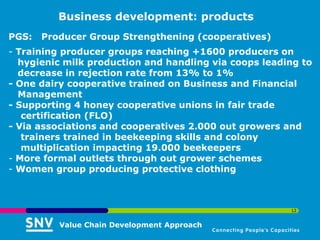
PGS:   Producer Group Strengthening (cooperatives)
- Training producer groups reaching +1600 producers on
  hygienic milk production and handling via coops leading to
  decrease in rejection rate from 13% to 1%
- One dairy cooperative trained on Business and Financial
  Management
- Supporting 4 honey cooperative unions in fair trade
   certification (FLO)
- Via associations and cooperatives 2.000 out growers and
   trainers trained in beekeeping skills and colony
   multiplication impacting 19.000 beekeepers
- More formal outlets through out grower schemes
- Women group producing protective clothing


                                                       12


          Value Chain Development Approach
Business development: products
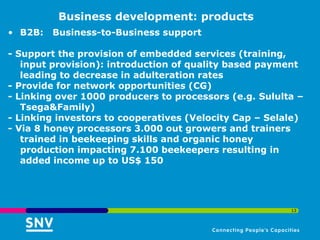
• B2B:   Business-to-Business support

- Support the provision of embedded services (training,
   input provision): introduction of quality based payment
   leading to decrease in adulteration rates
- Provide for network opportunities (CG)
- Linking over 1000 producers to processors (e.g. Sululta –
   Tsega&Family)
- Linking investors to cooperatives (Velocity Cap – Selale)
- Via 8 honey processors 3.000 out growers and trainers
   trained in beekeeping skills and organic honey
   production impacting 7.100 beekeepers resulting in
   added income up to US$ 150


                                                        13
Business development: products

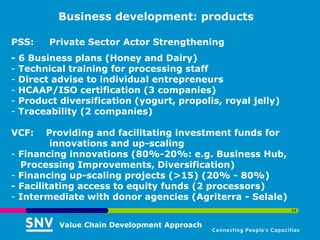
PSS:      Private Sector Actor Strengthening
-   6 Business plans (Honey and Dairy)
-   Technical training for processing staff
-   Direct advise to individual entrepreneurs
-   HCAAP/ISO certification (3 companies)
-   Product diversification (yogurt, propolis, royal jelly)
-   Traceability (2 companies)

VCF:      Providing and facilitating investment funds for
           innovations and up-scaling
-   Financing innovations (80%-20%: e.g. Business Hub,
    Processing Improvements, Diversification)
-   Financing up-scaling projects (>15) (20% - 80%)
-   Facilitating access to equity funds (2 processors)
-   Intermediate with donor agencies (Agriterra - Selale)
                                                              14


            Value Chain Development Approach
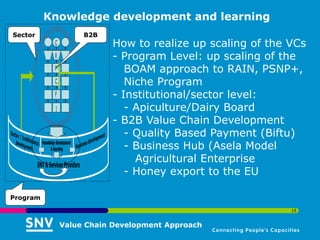
Knowledge development and learning
Sector           B2B
                       How to realize up scaling of the VCs
                       - Program Level: up scaling of the
                          BOAM approach to RAIN, PSNP+,
                          Niche Program
                       - Institutional/sector level:
                          - Apiculture/Dairy Board
                       - B2B Value Chain Development
                          - Quality Based Payment (Biftu)
                          - Business Hub (Asela Model
                            Agricultural Enterprise
                          - Honey export to the EU

Program
                                                        15


            Value Chain Development Approach
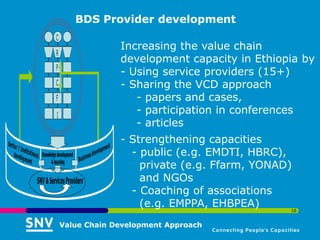
BDS Provider development

             Increasing the value chain
             development capacity in Ethiopia by
             - Using service providers (15+)
             - Sharing the VCD approach
                - papers and cases,
                - participation in conferences
                - articles
             - Strengthening capacities
               - public (e.g. EMDTI, HBRC),
                 private (e.g. Ffarm, YONAD)
                 and NGOs
               - Coaching of associations
                 (e.g. EMPPA, EHBPEA)      16


Value Chain Development Approach
SNV Ethiopia’s Value Chain Development Approach
               Key Success Factors
• First assure markets, then increase production
• Focus on private sector as the engine for growth
• Combination of sector wide and B2B support
• Involvement of all key stakeholders (via MSP)
• Ownership: defining intervention priorities
• Build on private sector leaders
• Public sector focused on sector identified
  priorities
• Combine capacity building with access to funds
• Quick wins (short term vs long term)


                                                     17


        Value Chain Development Approach
Recap:
   Pro – Poor development through
       value chain development

 Demand/market driven value chain development
Supporting the private sector as engine for growth

 Sector development provides for opportunities,
  business development turns opportunities into
   results, knowledge development and service
  provider development assures the sustainable
             up-scaling of the approach


                                                  18


      Value Chain Development Approach

Snv value chain

  • 1.
    SNV Ethiopia’s Value ChainDevelopment Approach Pro Poor Development through Value Chain Development LVC/PPD National Project Inception Workshop Addis Ababa, January 21, 2011
  • 2.
    SNV Ethiopia’s ValueChain Development Approach Rationale: Demand Driven Value Chain Development Reliable Outlets Market Intelligence Embedded Services Opportunities Finance facilities Market Intelligence Farmer Consumer Inputs Coop Processor Retailer Producer Market 2 Value Chain Development Approach
  • 3.
    SNV Ethiopia’s ValueChain Development Approach C R P C F I Knowledge development & learning SNV & Services Providers 3 Value Chain Development Approach
  • 4.
    Key intervention areas: 2 1 1.Sector development 2.Business development 3.Knowledge development 3 and learning 4.Business Development Services Provider strengthening 4 Sector development provides for opportunities, business development turns opportunities into results, knowledge development and BDS provider development assures the sustainable up-scaling of the approach 4 Value Chain Development Approach
  • 5.
    Sector / Institutionaldevelopment Creating opportunities through: -Market access/studies; -Public-private dialogue; -Institutional changes; -Sector competiveness; -Sector research projects; -Win-win relationship building; -Financing sector projects. 5 Value Chain Development Approach
  • 6.
    Sector / Institutionaldevelopment: products MSP: Multi Stakeholder Platforms (Coordination Groups) - Bottleneck definition and priority setting (ownership) - Project implementers report to the CG on project status/fund use (accountability) - From the interaction from CG meetings producers and processors have agreed to form EMPPA, EHBPEA - Starting point for apiculture and dairy board establishment (public-private dialogue forums) - Research agenda setting 6 Value Chain Development Approach
  • 7.
    Sector / Institutionaldevelopment: products MSP: Multi Stakeholder Platforms (Coordination Groups - Input suppliers , producers and processors create B2B linkages - Linking public institutions to private sector actors (EMDTI, HBRC, Regional Marketing Agencies) - Public-Private dialogue resulting in policy/regulatory changes (Feed export ban, honey proclamation, collection centers) - Input suppliers , producers and processors create B2B linkages 7
  • 8.
    Sector / Institutionaldevelopment: products MI: Market Intelligence - Exchange visit to Kenya that resulted to the idea of Dairy Business Hub - Researches on various issues (new product development, quality, EU market access, shoats rearing vs. fattening) - Advise for packaging materials, technical advise on processing technology (set up and equipments) - Trade fair participation leading to exports (2008 - 30t Europe, 10t Yemen; 2010 - 400t) - Publications on bee flora and apiculture resources - With ECOPA awareness creation on hygienic milk production and consumption 8
  • 9.
    Sector / Institutionaldevelopment: products SAS: Sector Association Strengthening - EMPPA, EBA and EHBPEA: support the establishment, strategic planning, business planning EPPM: Effective Public Policy Management - Support associations to lobby at government level - Commitment to the establishment of the dairy and apiculture board - EU third country listing: MoARD in the lead - Honey proclamation - Introduction of transitional beehives besides modern beehives 9 Value Chain Development Approach
  • 10.
    Sector / Institutionaldevelopment: products VCF: Value Chain Financing (100%) - CGs, trade fairs, research - Sector projects for sector associations and public sector - Upgrading of EMDTI laboratory ATP: Appropriate Technology Promotion - Improved aluminum milk cans - Simple quality control equipment - Transitional beehive: Women having access to honey production 10 Value Chain Development Approach
  • 11.
    Business development Making use of opportunities through: -Linking businesses to markets; -Linking businesses to producers; -Developing arrangements; -Promoting embedded services; -Testing and subsidizing innovations; -Strengthening cooperatives; -Access to capital. 11 Value Chain Development Approach
  • 12.
    Business development: products PGS: Producer Group Strengthening (cooperatives) - Training producer groups reaching +1600 producers on hygienic milk production and handling via coops leading to decrease in rejection rate from 13% to 1% - One dairy cooperative trained on Business and Financial Management - Supporting 4 honey cooperative unions in fair trade certification (FLO) - Via associations and cooperatives 2.000 out growers and trainers trained in beekeeping skills and colony multiplication impacting 19.000 beekeepers - More formal outlets through out grower schemes - Women group producing protective clothing 12 Value Chain Development Approach
  • 13.
    Business development: products •B2B: Business-to-Business support - Support the provision of embedded services (training, input provision): introduction of quality based payment leading to decrease in adulteration rates - Provide for network opportunities (CG) - Linking over 1000 producers to processors (e.g. Sululta – Tsega&Family) - Linking investors to cooperatives (Velocity Cap – Selale) - Via 8 honey processors 3.000 out growers and trainers trained in beekeeping skills and organic honey production impacting 7.100 beekeepers resulting in added income up to US$ 150 13
  • 14.
    Business development: products PSS: Private Sector Actor Strengthening - 6 Business plans (Honey and Dairy) - Technical training for processing staff - Direct advise to individual entrepreneurs - HCAAP/ISO certification (3 companies) - Product diversification (yogurt, propolis, royal jelly) - Traceability (2 companies) VCF: Providing and facilitating investment funds for innovations and up-scaling - Financing innovations (80%-20%: e.g. Business Hub, Processing Improvements, Diversification) - Financing up-scaling projects (>15) (20% - 80%) - Facilitating access to equity funds (2 processors) - Intermediate with donor agencies (Agriterra - Selale) 14 Value Chain Development Approach
  • 15.
    Knowledge development andlearning Sector B2B How to realize up scaling of the VCs - Program Level: up scaling of the BOAM approach to RAIN, PSNP+, Niche Program - Institutional/sector level: - Apiculture/Dairy Board - B2B Value Chain Development - Quality Based Payment (Biftu) - Business Hub (Asela Model Agricultural Enterprise - Honey export to the EU Program 15 Value Chain Development Approach
  • 16.
    BDS Provider development Increasing the value chain development capacity in Ethiopia by - Using service providers (15+) - Sharing the VCD approach - papers and cases, - participation in conferences - articles - Strengthening capacities - public (e.g. EMDTI, HBRC), private (e.g. Ffarm, YONAD) and NGOs - Coaching of associations (e.g. EMPPA, EHBPEA) 16 Value Chain Development Approach
  • 17.
    SNV Ethiopia’s ValueChain Development Approach Key Success Factors • First assure markets, then increase production • Focus on private sector as the engine for growth • Combination of sector wide and B2B support • Involvement of all key stakeholders (via MSP) • Ownership: defining intervention priorities • Build on private sector leaders • Public sector focused on sector identified priorities • Combine capacity building with access to funds • Quick wins (short term vs long term) 17 Value Chain Development Approach
  • 18.
    Recap: Pro – Poor development through value chain development Demand/market driven value chain development Supporting the private sector as engine for growth Sector development provides for opportunities, business development turns opportunities into results, knowledge development and service provider development assures the sustainable up-scaling of the approach 18 Value Chain Development Approach