Value chain development processes
By:
MAKTUNU BENARD
TENYWA DERICK KAWANGUZI
Group 5
Meaning of the value chain
Range of activities that brings a product from conception to
its end use.
Producing
Buying
Transportation
Processing
Selling
consumption of a specific goods/commodity.
Meaning of value chain development
• Achieving “upgrades” in the activities entailed in the
value chain of a given agricultural product.
• It is done by taking a product/commodity as the basis
for analysis of the entire value chain for that product,
from inputs through farming, harvesting, processing
and transport, to sale to the consumer.
The process of value chain development
Basic steps taken
Sector selection
Market system analysis
Intervention design
Implementation
Monitoring and result measurement
Sector selection
• Priority sectors are often selected according to
objectives and target group to achieve the
highest impact.
Steps to select the sector
• Define the objectives and target group
• Criteria selection
• Rapid assessment of the economic sector
• Consultative meetings with stakeholders
Market system analysis
Components
Value chain mapping
Value chain analysis
Value chain mapping
• Drawing a visual representation of the value chain
systems which identifies business functions, chain
operators and linkages together with the chain
supporters.
• Gain a basic overview of the VC
• Identify constraints and possible solutions
• Understanding network connections between actors
Steps taken in mapping
• Mapping the core processes in VC
• Identifying and mapping main VC actors
• Mapping the product flow
• Mapping the knowledge and information flow
• Mapping volume of products and number of actors & jobs
• Mapping value at different levels of VC
• Mapping relationships and linkages between VC actors
• Mapping services that feeds into the VC
• Mapping constraints and potential solutions
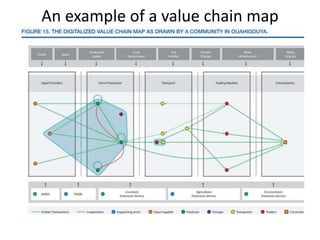
An example of a value chain map
Value chain analysis
• All stakeholders/activities are involved to
probe the root causes of the challenge(s) in
question- rather than being a solution in
search of a problem
• The result is to identify interventions that help
producers and traders to meet market
demand or address market malfunctions in
more pro-poor ways, while maximising profits
Value chain analysis…
The outcome of value chain analysis
A clear vision on how to bring a sustainable
and systematic change
Develop an intervention framework outlining
possible upgrades and interventions
Value chain analysis…
 Analyzing major constraints identified during value chain
mapping
 Link the constraints to specific supporting functions and rules
within the market system
 Identify market players performing the functions or have
incentives to perform the functions
 Formulate sustainable solutions for value chain upgrading
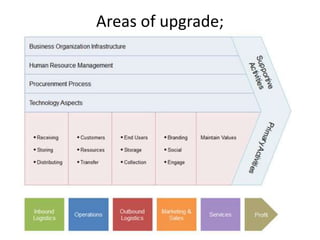
Areas of upgrade;
Categories of upgrades obtained
Process upgrading
Product upgrading
Functional upgrading
Channel upgrading
Intersectoral upgrading
Process upgrading
Process upgrading increases the efficiency of
production either through better organization of
the production process or the use of improved
technology.
The need to cut costs and/or increase output in
response to intra- or inter-chain competition drives
process upgrading, reducing the per-unit cost of
production.
Product upgrading
• Improving product quality and increasing value for
consumers.
• May be stimulated by changes in end markets, usually
stemming from changes in customer preferences, or the
desire for higher value added, higher quality, and
consequently more profitable products on the part of
agribusiness.
Functional upgrading
Increasing value added by changing the mix of
activities conducted within the firm or moving
the locus of activities to different links in the
value chain;
I.e. the entry of a firm into a new, higher value-
added function or level in the value chain
Channel upgrading
• Is when agribusinesses enter one or more new end
markets in the same basic product—domestic, regional
or global.
• Participation in a range of markets provides
agribusinesses with more effective risk management
options through market diversification and allows them
to sell a higher proportion of their total output.
Intersectoral upgrading
• Is the entry of a firm into a completely new value chain
or industry using knowledge acquired through
production of another product or a specialized service.
• Example: when shea nut producers in Sudan moved
from selling nuts in local markets, to exporting
cosmetic-grade butter to a formulating and packing
facility in Kenya
Implementation of VCD
The implementation should result into sustainable
business models which can grow in the market
system and easily driven and replicates by the actors.
The project should think about exiting strategies and
who will replace them to continue running the
market.
Methods of implementing the
upgrades
After analysis you can decide which method to
use
the pull approach of VCD
the push approach of VCD.
The pull approach of VCD
In the pull up methods the key actors include
Leaders/owners of industries
Policy makers
Relevant development agencies
Government officials
Opinion leaders etc
The push approach of VCD.
• In push up VCD Processes, people are
organized on consultation at or near the
bottom levels and negotiation is done upward.
This negotiation is made possible through the
help of researchers and planners to form a
strong advocacy system.
Monitoring and result measurement
• Measuring the progress of development against the
targets. Done in 4 areas.
Input used for the development intervention
Output, products or services from an intervention
outcome, achieved short and medium term effects of an
intervention output
Impact, overall long term achievements
An example of an approach used in
value chain development
The inclusive Value Chain Development
approach
The inclusive Value Chain Development approach
looks at market dynamics and relationships between
the different actors in the chain with the objective of
strengthening the whole market system - enterprises,
business relationships, financial networks, supporting
functions, rules and norms, and the business
environment – in a way that ensures greater benefits
for the poor from economic growth and
development.
Rationale for value chain development
Adapting to new market trends
Coping with changes in consumer preferences
Improved profitability of agribusiness ventures
Increased participation (inclusiveness) in(of)
agribusinesses
To achieve sustainable value chains
Constraints to value chain development
Production constraints e.g. high prices of inputs
Poor quality inputs i.e. counterfeits, rudimentary tools, poor
access to credits and extension services, soil exhaustion and pest
and diseases
Processing constraints e.g. lack of simple processing equipment,
shortage of post harvest handling equipment, limited access to
processing machines.
Marketing constraints e.g. lack of storage facilities, low market
opportunities, poor market information and high marketing cost.
Solutions to the constraints
 Provision of credit facilities
 Provision of incentives
 Strengthening the extension system
 provision of subsidies
 Improving research
 provision of storage facilities
 Enhancing the flow of market information
 Infrastructural development

AGRI-VALUE CHAIN DEVELOPMENT PROCESSES

  • 1.
    Value chain developmentprocesses By: MAKTUNU BENARD TENYWA DERICK KAWANGUZI Group 5
  • 2.
    Meaning of thevalue chain Range of activities that brings a product from conception to its end use. Producing Buying Transportation Processing Selling consumption of a specific goods/commodity.
  • 3.
    Meaning of valuechain development • Achieving “upgrades” in the activities entailed in the value chain of a given agricultural product. • It is done by taking a product/commodity as the basis for analysis of the entire value chain for that product, from inputs through farming, harvesting, processing and transport, to sale to the consumer.
  • 4.
    The process ofvalue chain development Basic steps taken Sector selection Market system analysis Intervention design Implementation Monitoring and result measurement
  • 5.
    Sector selection • Prioritysectors are often selected according to objectives and target group to achieve the highest impact.
  • 6.
    Steps to selectthe sector • Define the objectives and target group • Criteria selection • Rapid assessment of the economic sector • Consultative meetings with stakeholders
  • 7.
    Market system analysis Components Valuechain mapping Value chain analysis
  • 8.
    Value chain mapping •Drawing a visual representation of the value chain systems which identifies business functions, chain operators and linkages together with the chain supporters. • Gain a basic overview of the VC • Identify constraints and possible solutions • Understanding network connections between actors
  • 9.
    Steps taken inmapping • Mapping the core processes in VC • Identifying and mapping main VC actors • Mapping the product flow • Mapping the knowledge and information flow • Mapping volume of products and number of actors & jobs • Mapping value at different levels of VC • Mapping relationships and linkages between VC actors • Mapping services that feeds into the VC • Mapping constraints and potential solutions
  • 10.
    An example ofa value chain map
  • 11.
    Value chain analysis •All stakeholders/activities are involved to probe the root causes of the challenge(s) in question- rather than being a solution in search of a problem • The result is to identify interventions that help producers and traders to meet market demand or address market malfunctions in more pro-poor ways, while maximising profits
  • 12.
    Value chain analysis… Theoutcome of value chain analysis A clear vision on how to bring a sustainable and systematic change Develop an intervention framework outlining possible upgrades and interventions
  • 13.
    Value chain analysis… Analyzing major constraints identified during value chain mapping  Link the constraints to specific supporting functions and rules within the market system  Identify market players performing the functions or have incentives to perform the functions  Formulate sustainable solutions for value chain upgrading
  • 14.
  • 15.
    Categories of upgradesobtained Process upgrading Product upgrading Functional upgrading Channel upgrading Intersectoral upgrading
  • 16.
    Process upgrading Process upgradingincreases the efficiency of production either through better organization of the production process or the use of improved technology. The need to cut costs and/or increase output in response to intra- or inter-chain competition drives process upgrading, reducing the per-unit cost of production.
  • 17.
    Product upgrading • Improvingproduct quality and increasing value for consumers. • May be stimulated by changes in end markets, usually stemming from changes in customer preferences, or the desire for higher value added, higher quality, and consequently more profitable products on the part of agribusiness.
  • 18.
    Functional upgrading Increasing valueadded by changing the mix of activities conducted within the firm or moving the locus of activities to different links in the value chain; I.e. the entry of a firm into a new, higher value- added function or level in the value chain
  • 19.
    Channel upgrading • Iswhen agribusinesses enter one or more new end markets in the same basic product—domestic, regional or global. • Participation in a range of markets provides agribusinesses with more effective risk management options through market diversification and allows them to sell a higher proportion of their total output.
  • 20.
    Intersectoral upgrading • Isthe entry of a firm into a completely new value chain or industry using knowledge acquired through production of another product or a specialized service. • Example: when shea nut producers in Sudan moved from selling nuts in local markets, to exporting cosmetic-grade butter to a formulating and packing facility in Kenya
  • 21.
    Implementation of VCD Theimplementation should result into sustainable business models which can grow in the market system and easily driven and replicates by the actors. The project should think about exiting strategies and who will replace them to continue running the market.
  • 22.
    Methods of implementingthe upgrades After analysis you can decide which method to use the pull approach of VCD the push approach of VCD.
  • 23.
    The pull approachof VCD In the pull up methods the key actors include Leaders/owners of industries Policy makers Relevant development agencies Government officials Opinion leaders etc
  • 24.
    The push approachof VCD. • In push up VCD Processes, people are organized on consultation at or near the bottom levels and negotiation is done upward. This negotiation is made possible through the help of researchers and planners to form a strong advocacy system.
  • 25.
    Monitoring and resultmeasurement • Measuring the progress of development against the targets. Done in 4 areas. Input used for the development intervention Output, products or services from an intervention outcome, achieved short and medium term effects of an intervention output Impact, overall long term achievements
  • 26.
    An example ofan approach used in value chain development The inclusive Value Chain Development approach
  • 27.
    The inclusive ValueChain Development approach looks at market dynamics and relationships between the different actors in the chain with the objective of strengthening the whole market system - enterprises, business relationships, financial networks, supporting functions, rules and norms, and the business environment – in a way that ensures greater benefits for the poor from economic growth and development.
  • 28.
    Rationale for valuechain development Adapting to new market trends Coping with changes in consumer preferences Improved profitability of agribusiness ventures Increased participation (inclusiveness) in(of) agribusinesses To achieve sustainable value chains
  • 29.
    Constraints to valuechain development Production constraints e.g. high prices of inputs Poor quality inputs i.e. counterfeits, rudimentary tools, poor access to credits and extension services, soil exhaustion and pest and diseases Processing constraints e.g. lack of simple processing equipment, shortage of post harvest handling equipment, limited access to processing machines. Marketing constraints e.g. lack of storage facilities, low market opportunities, poor market information and high marketing cost.
  • 30.
    Solutions to theconstraints  Provision of credit facilities  Provision of incentives  Strengthening the extension system  provision of subsidies  Improving research  provision of storage facilities  Enhancing the flow of market information  Infrastructural development