HPLC Vs GC
S.No. Parameter HPLC GC
Methods
1 Mobile Phase Liquid Inert Gas
Separation
Techniques
Based On Polarity Based on volatality
Compound
Properties
Soluble (Volatile or non
volatile)
Volatile
Working
Temperature
RT (20-25°C) High Temp. (150-300°C)
Speed Slower Faster
Resolution
Low Resolution for
polarity
Low Resolution for molecular
Weight
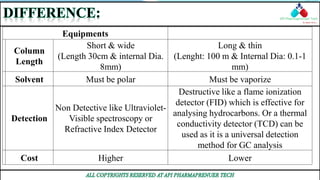
Equipments
Column
Length
Short & wide
(Length 30cm & internal Dia.
8mm)
Long & thin
(Lenght: 100 m & Internal Dia: 0.1-1
mm)
Solvent Must be polar Must be vaporize
Detection
Non Detective like Ultraviolet-
Visible spectroscopy or
Refractive Index Detector
Destructive like a flame ionization
detector (FID) which is effective for
analysing hydrocarbons. Or a thermal
conductivity detector (TCD) can be
used as it is a universal detection
method for GC analysis
Cost Higher Lower
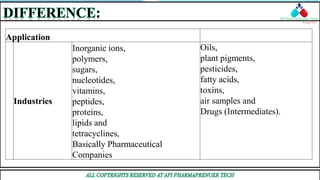
Application
Industries
Inorganic ions,
polymers,
sugars,
nucleotides,
vitamins,
peptides,
proteins,
lipids and
tetracyclines,
Basically Pharmaceutical
Companies
Oils,
plant pigments,
pesticides,
fatty acids,
toxins,
air samples and
Drugs (Intermediates).
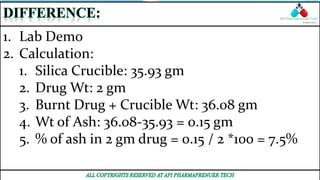
1. Lab Demo
2. Calculation:
1. Silica Crucible: 35.93 gm
2. Drug Wt: 2 gm
3. Burnt Drug + Crucible Wt: 36.08 gm
4. Wt of Ash: 36.08-35.93 = 0.15 gm
5. % of ash in 2 gm drug = 0.15 / 2 *100 = 7.5%
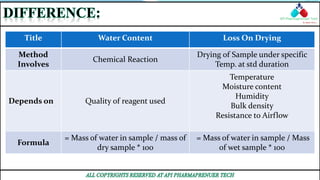
Title Water Content Loss On Drying
Method
Involves
Chemical Reaction
Drying of Sample under specific
Temp. at std duration
Depends on Quality of reagent used
Temperature
Moisture content
Humidity
Bulk density
Resistance to Airflow
Formula
= Mass of water in sample / mass of
dry sample * 100
= Mass of water in sample / Mass
of wet sample * 100
Basic Difference Between HPLC Vs GC Used In API Pharma Companies

Basic Difference Between HPLC Vs GC Used In API Pharma Companies

  • 1.
  • 2.
    S.No. Parameter HPLCGC Methods 1 Mobile Phase Liquid Inert Gas Separation Techniques Based On Polarity Based on volatality Compound Properties Soluble (Volatile or non volatile) Volatile Working Temperature RT (20-25°C) High Temp. (150-300°C) Speed Slower Faster Resolution Low Resolution for polarity Low Resolution for molecular Weight
  • 3.
    Equipments Column Length Short & wide (Length30cm & internal Dia. 8mm) Long & thin (Lenght: 100 m & Internal Dia: 0.1-1 mm) Solvent Must be polar Must be vaporize Detection Non Detective like Ultraviolet- Visible spectroscopy or Refractive Index Detector Destructive like a flame ionization detector (FID) which is effective for analysing hydrocarbons. Or a thermal conductivity detector (TCD) can be used as it is a universal detection method for GC analysis Cost Higher Lower
  • 4.
    Application Industries Inorganic ions, polymers, sugars, nucleotides, vitamins, peptides, proteins, lipids and tetracyclines, BasicallyPharmaceutical Companies Oils, plant pigments, pesticides, fatty acids, toxins, air samples and Drugs (Intermediates).
  • 5.
    1. Lab Demo 2.Calculation: 1. Silica Crucible: 35.93 gm 2. Drug Wt: 2 gm 3. Burnt Drug + Crucible Wt: 36.08 gm 4. Wt of Ash: 36.08-35.93 = 0.15 gm 5. % of ash in 2 gm drug = 0.15 / 2 *100 = 7.5%
  • 6.
    Title Water ContentLoss On Drying Method Involves Chemical Reaction Drying of Sample under specific Temp. at std duration Depends on Quality of reagent used Temperature Moisture content Humidity Bulk density Resistance to Airflow Formula = Mass of water in sample / mass of dry sample * 100 = Mass of water in sample / Mass of wet sample * 100