How to Improve Business Processes with Agile
We manage learning.
“Building an Innovative Learning Organization. A Framework to Build a Smarter
Workforce, Adapt to Change, and Drive Growth”. Download now!
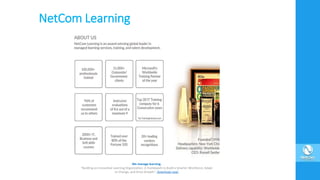
NetCom Learning
We manage learning.
“Building an Innovative Learning Organization. A Framework to Build a Smarter Workforce, Adapt
to Change, and Drive Growth”. Download now!
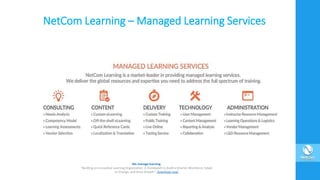
NetCom Learning – Managed Learning Services
We manage learning.
“Building an Innovative Learning Organization. A Framework to Build a Smarter Workforce, Adapt
to Change, and Drive Growth”. Download now!
We manage learning.
“Building an Innovative Learning Organization. A Framework to Build a Smarter Workforce, Adapt
to Change, and Drive Growth”. Download now!
What is “Agile”?
• In 2001, 17 agile advocates came together
• Drafted document with organizing principles for Agile
• High-level concepts
• Addressed commonality of different methodologies
History of Modern Agile
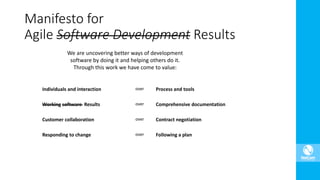
Manifesto for
Agile Software Development Results
Individuals and interaction over Process and tools
Working software Results over Comprehensive documentation
Customer collaboration over Contract negotiation
Responding to change over Following a plan
We are uncovering better ways of development
software by doing it and helping others do it.
Through this work we have come to value:
• Primary driving factor from moving from traditional
methods to agile methods
• Agile concentrates on the process which adds value to
the stakeholders
• Cumulative value
• Customer
• End-user
• Team
• Sponsor
• Organization
Value-Driven
• Small steps
• Focus on important stuff first
• What is delivered “works”
• Seek and incorporate feedback
• Make course corrections when needed
• Everyone is accountable and empowered
Agile Key Concepts
Adaptation
Agile Frameworks
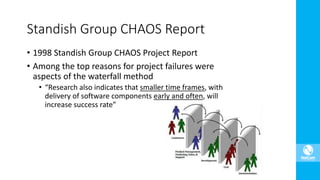
Standish Group CHAOS Report
• 1998 Standish Group CHAOS Project Report
• Among the top reasons for project failures were
aspects of the waterfall method
• “Research also indicates that smaller time frames, with
delivery of software components early and often, will
increase success rate”
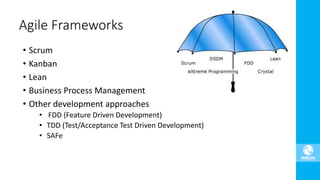
• Scrum
• Kanban
• Lean
• Business Process Management
• Other development approaches
• FDD (Feature Driven Development)
• TDD (Test/Acceptance Test Driven Development)
• SAFe
Agile Frameworks
• Predictive
• Waterfall
• Iterative
• Adaptive
• Time-boxed
• Continuous
• Combined/Blended
Comparison of Methodologies
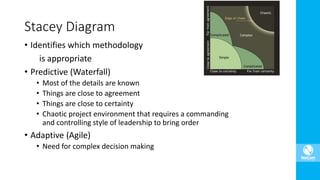
• Identifies which methodology
is appropriate
• Predictive (Waterfall)
• Most of the details are known
• Things are close to agreement
• Things are close to certainty
• Chaotic project environment that requires a commanding
and controlling style of leadership to bring order
• Adaptive (Agile)
• Need for complex decision making
Stacey Diagram
• Strong points
• Heavy up-front analysis
• Plan formulated, results compared to plan and corrective actions taken as
needed
• Strong change control after requirements agreed upon
• Weaknesses
• Resistance to change
• Often more about process than result
• Extensive time and expense producing documentation
• Long delay between requirements and results
Predictive Methodologies
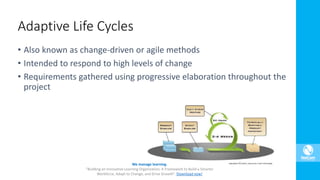
Adaptive Life Cycles
• Also known as change-driven or agile methods
• Intended to respond to high levels of change
• Requirements gathered using progressive elaboration throughout the
project
We manage learning.
“Building an Innovative Learning Organization. A Framework to Build a Smarter
Workforce, Adapt to Change, and Drive Growth”. Download now!
• Pros
• Frequent delivery of results
• Able to adapt to changes to provide business competitive advantages
• Cons
• Requires change to existing processes and organizational structures
Pros and Cons of Adaptive Approach
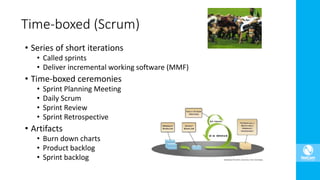
Time-boxed (Scrum)
• Series of short iterations
• Called sprints
• Deliver incremental working software (MMF)
• Time-boxed ceremonies
• Sprint Planning Meeting
• Daily Scrum
• Sprint Review
• Sprint Retrospective
• Artifacts
• Burn down charts
• Product backlog
• Sprint backlog
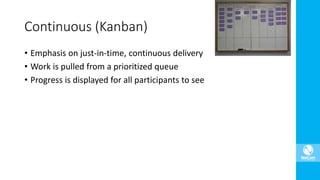
Continuous (Kanban)
• Emphasis on just-in-time, continuous delivery
• Work is pulled from a prioritized queue
• Progress is displayed for all participants to see
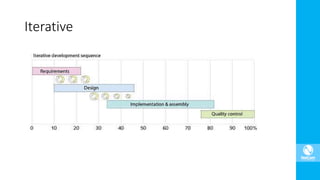
Iterative
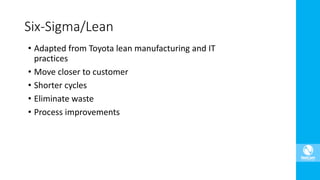
Six-Sigma/Lean
• Adapted from Toyota lean manufacturing and IT
practices
• Move closer to customer
• Shorter cycles
• Eliminate waste
• Process improvements
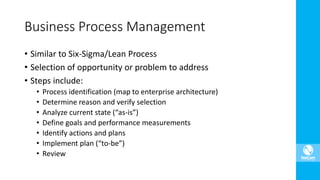
Business Process Management
• Similar to Six-Sigma/Lean Process
• Selection of opportunity or problem to address
• Steps include:
• Process identification (map to enterprise architecture)
• Determine reason and verify selection
• Analyze current state (“as-is”)
• Define goals and performance measurements
• Identify actions and plans
• Implement plan (“to-be”)
• Review
Agile Impacts
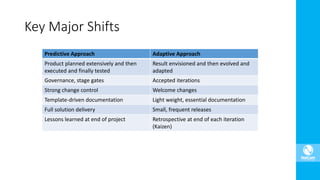
Key Major Shifts
Predictive Approach Adaptive Approach
Product planned extensively and then
executed and finally tested
Result envisioned and then evolved and
adapted
Governance, stage gates Accepted iterations
Strong change control Welcome changes
Template-driven documentation Light weight, essential documentation
Full solution delivery Small, frequent releases
Lessons learned at end of project Retrospective at end of each iteration
(Kaizen)
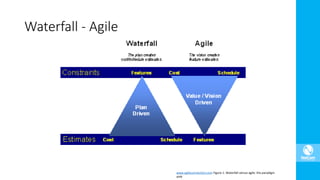
Waterfall - Agile
www.agileconnection.com Figure 1: Waterfall versus agile: the paradigm
shift
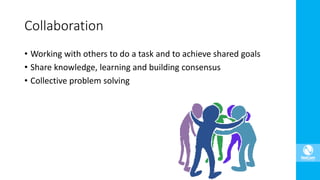
• Working with others to do a task and to achieve shared goals
• Share knowledge, learning and building consensus
• Collective problem solving
Collaboration
Commitment
• Team members are committed
• Project
• Outcomes
• Stakeholders are involved
• Feedback
• Communication
• Product
• Process
• People
• Feedback Methods
Continuous Improvement
• Based on measurable data
• Two areas
• Reinforcement of positive
• Corrective actions
Feedback Methods
Business Process Improvement
• Value-based emphasis based on strategic alignment
• Enterprise Architecture structure
• Portfolio management - unchanged
• Project charter – slight modification
Initiating Concepts
• Supports integration and optimization of fragmented
processes into integrated environment
• High-level view of organization
• Current Baseline
• Target Baseline
• Baseline architectures
• Business
• Data
• Application
• Technology
Enterprise Architecture
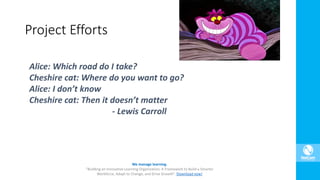
Project Efforts
Alice: Which road do I take?
Cheshire cat: Where do you want to go?
Alice: I don’t know
Cheshire cat: Then it doesn’t matter
- Lewis Carroll
We manage learning.
“Building an Innovative Learning Organization. A Framework to Build a Smarter
Workforce, Adapt to Change, and Drive Growth”. Download now!
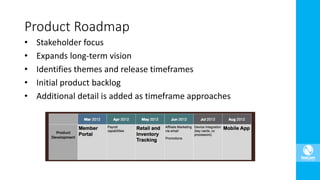
• Stakeholder focus
• Expands long-term vision
• Identifies themes and release timeframes
• Initial product backlog
• Additional detail is added as timeframe approaches
Product Roadmap
• Includes:
• Who - Stakeholders
• Why – Vision, Mission, Goals
• What – Objectives, Project Boundaries
• Where – Work sites, Deployment requirements
• When – Start and end target dates
• How - Approach
• Success Criteria
• May involve multiple stakeholders to build
consensus – Shared vision
Project Chartering
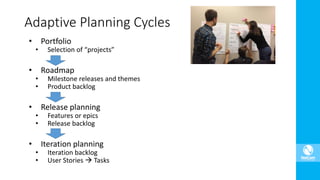
• Portfolio
• Selection of “projects”
• Roadmap
• Milestone releases and themes
• Product backlog
• Release planning
• Features or epics
• Release backlog
• Iteration planning
• Iteration backlog
• User Stories  Tasks
Adaptive Planning Cycles
• Value of including features
• Cost of implementing features
• Amount of risk removed by including features
• Prioritization Schemes
Prioritization
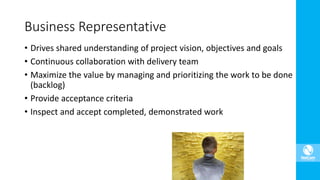
• Drives shared understanding of project vision, objectives and goals
• Continuous collaboration with delivery team
• Maximize the value by managing and prioritizing the work to be done
(backlog)
• Provide acceptance criteria
• Inspect and accept completed, demonstrated work
Business Representative
Summary
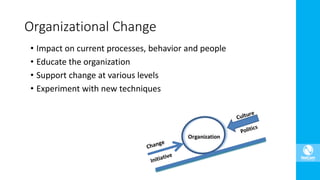
• Impact on current processes, behavior and people
• Educate the organization
• Support change at various levels
• Experiment with new techniques
Organizational Change
• Allows teams to work “agile”
• Other teams utilize a predictive approach with a
project manager and specialized team roles
• Need to adapt to changing requirements
• Collaboration and communication
Blended Approach
• Change is always challenging but the value is worth the effort
• It is impossible to gather all requirements at beginning of project
• Whatever requirements available to be gathered are guaranteed to
change
• There will always be more to do than time and money will allow
Four Simple Truths
“ A well-functioning team of adequate people will complete a project
almost regardless of the process or technology they are asked to use
(although the process and technology may help or hinder them along
the way) .”
- Alistair Cockburn
Agile is Not a Silver Bullet
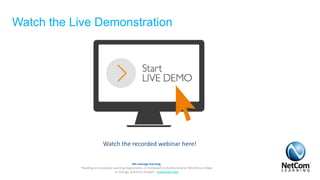
Watch the Live Demonstration
Watch the recorded webinar here!
We manage learning.
“Building an Innovative Learning Organization. A Framework to Build a Smarter Workforce, Adapt
to Change, and Drive Growth”. Download now!
NetCom Learning offers a comprehensive portfolio for Agile training options.
Enroll for any of the recommended courses below:
Leading a Scaled Agile Framework (SAFe Agilist Certification)- Class scheduled for Feb 1
Implementing Agile Test-Driven Development for Non-Programmers -Class scheduled for
March 5
PMI Agile Certified Practitioner (PMI-ACP)®– Class scheduled for March 12
Recommended Courses:
We manage learning.
“Building an Innovative Learning Organization. A Framework to Build a Smarter Workforce, Adapt
to Change, and Drive Growth”. Download now!
Our live webinars will help you to touch base a wide variety of IT, soft skills and
business productivity topics; and keep you up to date on the latest IT industry trends.
Register now for our upcoming webinars:
Introduction to Revit and firewalls
Cracking Careers in Data Science
5 Most In-Demand Cyber Security Jobs
How to Design and Implement a Successful Cloud Strategy for your Business
The Ultimate Key to Project Managers Success - PMBOK Guide
We manage learning.
“Building an Innovative Learning Organization. A Framework to Build a Smarter Workforce, Adapt
to Change, and Drive Growth”. Download now!
Special Promotion
Trial Version & 10% First Time User discount on Soft Skills
E-Learning Courses
(Limited Period Offer, Register NOW)
Log onto www.sarderlearning.com
Coupon Code: SARDER10
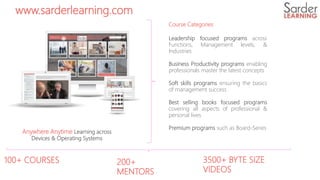
3500+ BYTE SIZE
VIDEOS
200+
MENTORS
100+ COURSES
Leadership focused programs across
Functions, Management levels, &
Industries
Business Productivity programs enabling
professionals master the latest concepts
Soft skills programs ensuring the basics
of management success
Best selling books focused programs
covering all aspects of professional &
personal lives
Premium programs such as Board-Series
www.sarderlearning.com
Course Categories
Anywhere Anytime Learning across
Devices & Operating Systems
Media Platform with a blend of Charlie
Rose & TED
Headquartered in New York, the platform
publishes Exclusive High Quality Video
Content from Fortune 1000 Corporate
Leaders, Best Selling Authors & Ivy League
Professors
With a purpose to "Promote Learning", the
Platform is based on the Core values of
Continuous Learning, Innovation &
Performance.
Get the latest insights on Management,
Strategy, Marketing, Sales, Innovation and
Entrepreneurship.
www.sardertv.com
To get the latest insights on the Business World
To get latest technology updates, please follow our social media pages!
We manage learning.
“Building an Innovative Learning Organization. A Framework to Build a Smarter Workforce, Adapt
to Change, and Drive Growth”. Download now!
We manage learning.
“Building an Innovative Learning Organization. A Framework to Build a Smarter Workforce, Adapt
to Change, and Drive Growth”. Download now!
THANK YOU !!!

NetCom Learning : How to Improve Business Processes using Agile

  • 1.
    How to ImproveBusiness Processes with Agile We manage learning. “Building an Innovative Learning Organization. A Framework to Build a Smarter Workforce, Adapt to Change, and Drive Growth”. Download now!
  • 2.
    NetCom Learning We managelearning. “Building an Innovative Learning Organization. A Framework to Build a Smarter Workforce, Adapt to Change, and Drive Growth”. Download now!
  • 3.
    NetCom Learning –Managed Learning Services We manage learning. “Building an Innovative Learning Organization. A Framework to Build a Smarter Workforce, Adapt to Change, and Drive Growth”. Download now!
  • 4.
    We manage learning. “Buildingan Innovative Learning Organization. A Framework to Build a Smarter Workforce, Adapt to Change, and Drive Growth”. Download now!
  • 5.
  • 6.
    • In 2001,17 agile advocates came together • Drafted document with organizing principles for Agile • High-level concepts • Addressed commonality of different methodologies History of Modern Agile
  • 7.
    Manifesto for Agile SoftwareDevelopment Results Individuals and interaction over Process and tools Working software Results over Comprehensive documentation Customer collaboration over Contract negotiation Responding to change over Following a plan We are uncovering better ways of development software by doing it and helping others do it. Through this work we have come to value:
  • 8.
    • Primary drivingfactor from moving from traditional methods to agile methods • Agile concentrates on the process which adds value to the stakeholders • Cumulative value • Customer • End-user • Team • Sponsor • Organization Value-Driven
  • 9.
    • Small steps •Focus on important stuff first • What is delivered “works” • Seek and incorporate feedback • Make course corrections when needed • Everyone is accountable and empowered Agile Key Concepts Adaptation
  • 10.
  • 11.
    Standish Group CHAOSReport • 1998 Standish Group CHAOS Project Report • Among the top reasons for project failures were aspects of the waterfall method • “Research also indicates that smaller time frames, with delivery of software components early and often, will increase success rate”
  • 12.
    • Scrum • Kanban •Lean • Business Process Management • Other development approaches • FDD (Feature Driven Development) • TDD (Test/Acceptance Test Driven Development) • SAFe Agile Frameworks
  • 13.
    • Predictive • Waterfall •Iterative • Adaptive • Time-boxed • Continuous • Combined/Blended Comparison of Methodologies
  • 14.
    • Identifies whichmethodology is appropriate • Predictive (Waterfall) • Most of the details are known • Things are close to agreement • Things are close to certainty • Chaotic project environment that requires a commanding and controlling style of leadership to bring order • Adaptive (Agile) • Need for complex decision making Stacey Diagram
  • 15.
    • Strong points •Heavy up-front analysis • Plan formulated, results compared to plan and corrective actions taken as needed • Strong change control after requirements agreed upon • Weaknesses • Resistance to change • Often more about process than result • Extensive time and expense producing documentation • Long delay between requirements and results Predictive Methodologies
  • 16.
    Adaptive Life Cycles •Also known as change-driven or agile methods • Intended to respond to high levels of change • Requirements gathered using progressive elaboration throughout the project We manage learning. “Building an Innovative Learning Organization. A Framework to Build a Smarter Workforce, Adapt to Change, and Drive Growth”. Download now!
  • 17.
    • Pros • Frequentdelivery of results • Able to adapt to changes to provide business competitive advantages • Cons • Requires change to existing processes and organizational structures Pros and Cons of Adaptive Approach
  • 18.
    Time-boxed (Scrum) • Seriesof short iterations • Called sprints • Deliver incremental working software (MMF) • Time-boxed ceremonies • Sprint Planning Meeting • Daily Scrum • Sprint Review • Sprint Retrospective • Artifacts • Burn down charts • Product backlog • Sprint backlog
  • 19.
    Continuous (Kanban) • Emphasison just-in-time, continuous delivery • Work is pulled from a prioritized queue • Progress is displayed for all participants to see
  • 20.
  • 21.
    Six-Sigma/Lean • Adapted fromToyota lean manufacturing and IT practices • Move closer to customer • Shorter cycles • Eliminate waste • Process improvements
  • 22.
    Business Process Management •Similar to Six-Sigma/Lean Process • Selection of opportunity or problem to address • Steps include: • Process identification (map to enterprise architecture) • Determine reason and verify selection • Analyze current state (“as-is”) • Define goals and performance measurements • Identify actions and plans • Implement plan (“to-be”) • Review
  • 23.
  • 24.
    Key Major Shifts PredictiveApproach Adaptive Approach Product planned extensively and then executed and finally tested Result envisioned and then evolved and adapted Governance, stage gates Accepted iterations Strong change control Welcome changes Template-driven documentation Light weight, essential documentation Full solution delivery Small, frequent releases Lessons learned at end of project Retrospective at end of each iteration (Kaizen)
  • 25.
    Waterfall - Agile www.agileconnection.comFigure 1: Waterfall versus agile: the paradigm shift
  • 26.
    • Working withothers to do a task and to achieve shared goals • Share knowledge, learning and building consensus • Collective problem solving Collaboration
  • 27.
    Commitment • Team membersare committed • Project • Outcomes • Stakeholders are involved • Feedback • Communication
  • 28.
    • Product • Process •People • Feedback Methods Continuous Improvement
  • 29.
    • Based onmeasurable data • Two areas • Reinforcement of positive • Corrective actions Feedback Methods
  • 30.
  • 31.
    • Value-based emphasisbased on strategic alignment • Enterprise Architecture structure • Portfolio management - unchanged • Project charter – slight modification Initiating Concepts
  • 32.
    • Supports integrationand optimization of fragmented processes into integrated environment • High-level view of organization • Current Baseline • Target Baseline • Baseline architectures • Business • Data • Application • Technology Enterprise Architecture
  • 33.
    Project Efforts Alice: Whichroad do I take? Cheshire cat: Where do you want to go? Alice: I don’t know Cheshire cat: Then it doesn’t matter - Lewis Carroll We manage learning. “Building an Innovative Learning Organization. A Framework to Build a Smarter Workforce, Adapt to Change, and Drive Growth”. Download now!
  • 34.
    • Stakeholder focus •Expands long-term vision • Identifies themes and release timeframes • Initial product backlog • Additional detail is added as timeframe approaches Product Roadmap
  • 35.
    • Includes: • Who- Stakeholders • Why – Vision, Mission, Goals • What – Objectives, Project Boundaries • Where – Work sites, Deployment requirements • When – Start and end target dates • How - Approach • Success Criteria • May involve multiple stakeholders to build consensus – Shared vision Project Chartering
  • 36.
    • Portfolio • Selectionof “projects” • Roadmap • Milestone releases and themes • Product backlog • Release planning • Features or epics • Release backlog • Iteration planning • Iteration backlog • User Stories  Tasks Adaptive Planning Cycles
  • 37.
    • Value ofincluding features • Cost of implementing features • Amount of risk removed by including features • Prioritization Schemes Prioritization
  • 38.
    • Drives sharedunderstanding of project vision, objectives and goals • Continuous collaboration with delivery team • Maximize the value by managing and prioritizing the work to be done (backlog) • Provide acceptance criteria • Inspect and accept completed, demonstrated work Business Representative
  • 39.
  • 40.
    • Impact oncurrent processes, behavior and people • Educate the organization • Support change at various levels • Experiment with new techniques Organizational Change
  • 41.
    • Allows teamsto work “agile” • Other teams utilize a predictive approach with a project manager and specialized team roles • Need to adapt to changing requirements • Collaboration and communication Blended Approach
  • 42.
    • Change isalways challenging but the value is worth the effort • It is impossible to gather all requirements at beginning of project • Whatever requirements available to be gathered are guaranteed to change • There will always be more to do than time and money will allow Four Simple Truths
  • 43.
    “ A well-functioningteam of adequate people will complete a project almost regardless of the process or technology they are asked to use (although the process and technology may help or hinder them along the way) .” - Alistair Cockburn Agile is Not a Silver Bullet
  • 44.
    Watch the LiveDemonstration Watch the recorded webinar here! We manage learning. “Building an Innovative Learning Organization. A Framework to Build a Smarter Workforce, Adapt to Change, and Drive Growth”. Download now!
  • 45.
    NetCom Learning offersa comprehensive portfolio for Agile training options. Enroll for any of the recommended courses below: Leading a Scaled Agile Framework (SAFe Agilist Certification)- Class scheduled for Feb 1 Implementing Agile Test-Driven Development for Non-Programmers -Class scheduled for March 5 PMI Agile Certified Practitioner (PMI-ACP)®– Class scheduled for March 12 Recommended Courses: We manage learning. “Building an Innovative Learning Organization. A Framework to Build a Smarter Workforce, Adapt to Change, and Drive Growth”. Download now!
  • 46.
    Our live webinarswill help you to touch base a wide variety of IT, soft skills and business productivity topics; and keep you up to date on the latest IT industry trends. Register now for our upcoming webinars: Introduction to Revit and firewalls Cracking Careers in Data Science 5 Most In-Demand Cyber Security Jobs How to Design and Implement a Successful Cloud Strategy for your Business The Ultimate Key to Project Managers Success - PMBOK Guide We manage learning. “Building an Innovative Learning Organization. A Framework to Build a Smarter Workforce, Adapt to Change, and Drive Growth”. Download now!
  • 47.
    Special Promotion Trial Version& 10% First Time User discount on Soft Skills E-Learning Courses (Limited Period Offer, Register NOW) Log onto www.sarderlearning.com Coupon Code: SARDER10
  • 48.
    3500+ BYTE SIZE VIDEOS 200+ MENTORS 100+COURSES Leadership focused programs across Functions, Management levels, & Industries Business Productivity programs enabling professionals master the latest concepts Soft skills programs ensuring the basics of management success Best selling books focused programs covering all aspects of professional & personal lives Premium programs such as Board-Series www.sarderlearning.com Course Categories Anywhere Anytime Learning across Devices & Operating Systems
  • 49.
    Media Platform witha blend of Charlie Rose & TED Headquartered in New York, the platform publishes Exclusive High Quality Video Content from Fortune 1000 Corporate Leaders, Best Selling Authors & Ivy League Professors With a purpose to "Promote Learning", the Platform is based on the Core values of Continuous Learning, Innovation & Performance. Get the latest insights on Management, Strategy, Marketing, Sales, Innovation and Entrepreneurship. www.sardertv.com To get the latest insights on the Business World
  • 50.
    To get latesttechnology updates, please follow our social media pages! We manage learning. “Building an Innovative Learning Organization. A Framework to Build a Smarter Workforce, Adapt to Change, and Drive Growth”. Download now!
  • 51.
    We manage learning. “Buildingan Innovative Learning Organization. A Framework to Build a Smarter Workforce, Adapt to Change, and Drive Growth”. Download now!
  • 52.

Editor's Notes

  • #17 Adaptive life cycles are also know as change-driven, agile or iterative methods and are intended to respond to high levels of change as the project progresses to meet the changing needs of the organization. Requirements are gathered using progressive elaboration in small increments know as iterations or sprints throughout the life of the entire project. They have the distinct advantage of delivering working results earlier than tradition projects, as well as adapting to the changing requirements of the organization. This is compared to Predictive life cycles where all the requirements are able to be gathered and understood up front.
  • #34 Here is an interesting quote from the book: Alice in Wonderland: “Alice: Which road do I take? Cheshire cat: Where do you want to go? Alice: I don’t know Cheshire cat: Then it doesn’t matter” - Lewis Carroll The basic premise of this quote is that the planning does greatly matter. .
  • #37 A scrum theme is the highest level of the story hierarchy and describes a view of a tangible product (such as a trading application) or an abstract goal (such as performance tuning). A product owner breaks down a theme into one or more epics. An epic groups related user stories together or describes a block of requirements that have not yet been rationalized into stories. A story is a brief statement of a product requirement or a business case. Typically, stories are expressed in plain language to help the reader understand what the software should accomplish. Product owners create stories. A scrum user then divides the stories into one or more scrum tasks. Scrum tasks are the discreet pieces of work required to complete a story
  • #48 Further, if your interested in “Learning from the Top American Leaders”, please logon to the e-learning platform - www.sarderlearning.com. Avail the special promotion meant for FIRST TIME USERS. Use your coupon code – SARDER10 and begin your leadership journey. Now!!
  • #49 Sarder Learning is a micro-learning knowledge platform that brings the world’s best Fortune 500 companies CXOs, Ivy League professors and best selling authors together to share industry –wide best practices related to leadership & management. Sarder Learning under 13 different categories has a rapidly growing course library relevant across multiple domains with well defined specific learning paths and scenario –based learning. An intuitive and responsive learning management system environment makes it easy to track one’s learning journey take courses at convinence
  • #50 To get your dose of Latest Business Insights FROM Corporate America, logonto Sardertv.com. Don’t forget to register for our newsletter.