Experiment Name: Aggregate Impact Value
Prepared By
Nurmohammad
Department of Civil Engineering
Dhaka International University
Experiment Name: Aggregate Impact Value
IS 2386 (PART-IV)
The impact test is a type of quality control test for highway pavements that
is used to determine the suitability of aggregates for use in highway
pavement construction. Aggregates used in road construction should be
strong enough to resist abrasion, crushing, and impact load.
Objective
Based on the impact value, we can decide whether the coarse aggregate is
suitable for construction or not. This test is performed to ensure the
aggregate toughness, which is used in road construction to work as a base
layer, and sub-base layer.
Significance and use
Apparatus
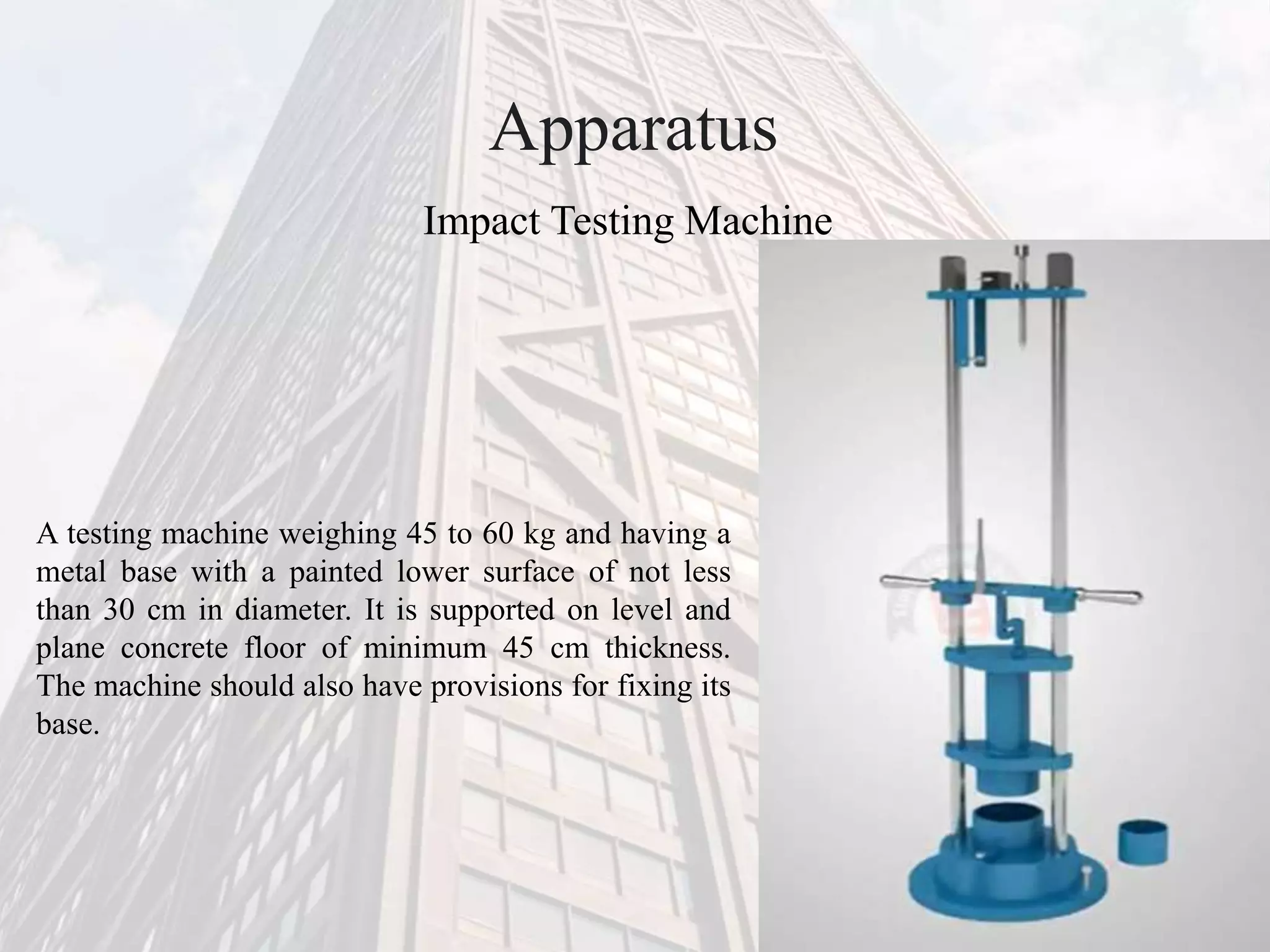
A testing machine weighing 45 to 60 kg and having a
metal base with a painted lower surface of not less
than 30 cm in diameter. It is supported on level and
plane concrete floor of minimum 45 cm thickness.
The machine should also have provisions for fixing its
base.
Impact Testing Machine
Apparatus
A cylindrical steel cup of internal
diameter 102 mm, depth 50 mm
and minimum thickness 6.3 mm.
102 mm
50 mm
Cylindrical Steel Cup
Apparatus
75 mm
50 mm
Cylindrical Metal Measure
A cylindrical metal measure having
internal diameter 75 mm and depth 50
mm for measuring aggregates.
Apparatus
A metal hammer or tup weighing 13.5 to
14.0 kg the lower end being cylindrical in
shape, 50 mm long, 100.0 mm in
diameter, with a 2 mm chamfer at the
lower edge and case hardened. The
hammer should slide freely between
vertical guides and be concentric with the
cup. Free fall of hammer should be within
380±5 mm.
Hammer
Apparatus
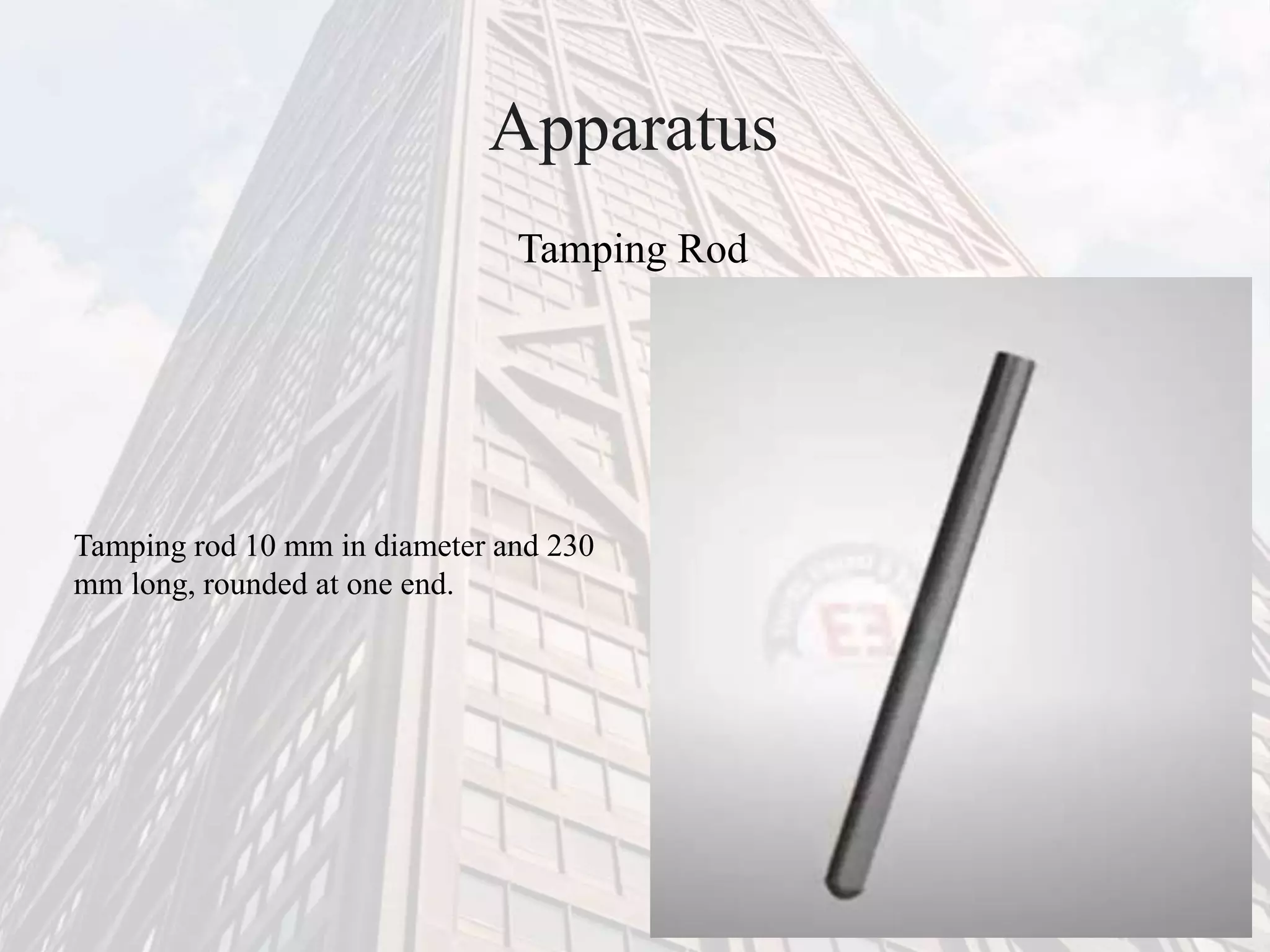
Tamping rod 10 mm in diameter and 230
mm long, rounded at one end.
Tamping Rod
Apparatus
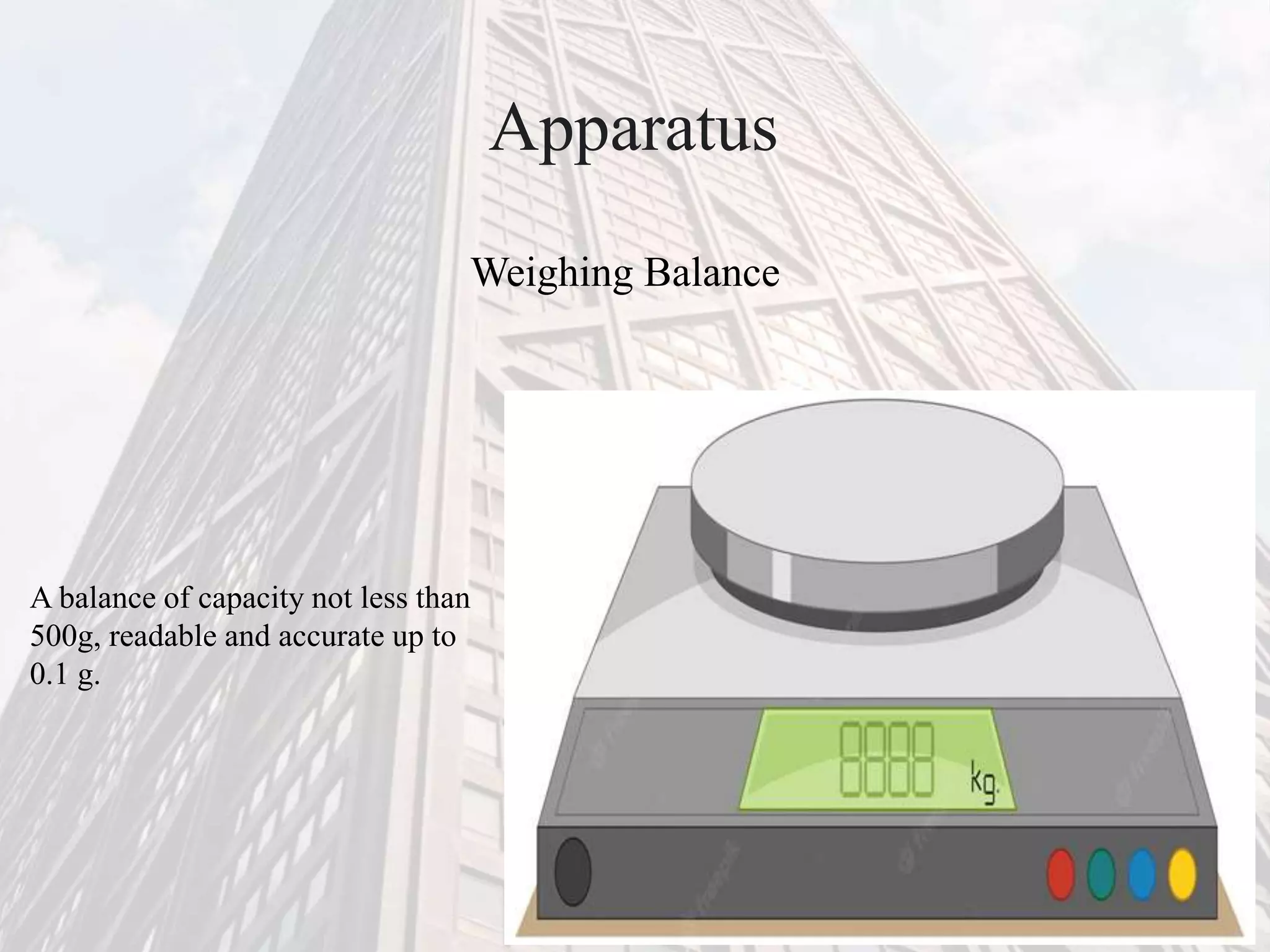
Weighing Balance
A balance of capacity not less than
500g, readable and accurate up to
0.1 g.
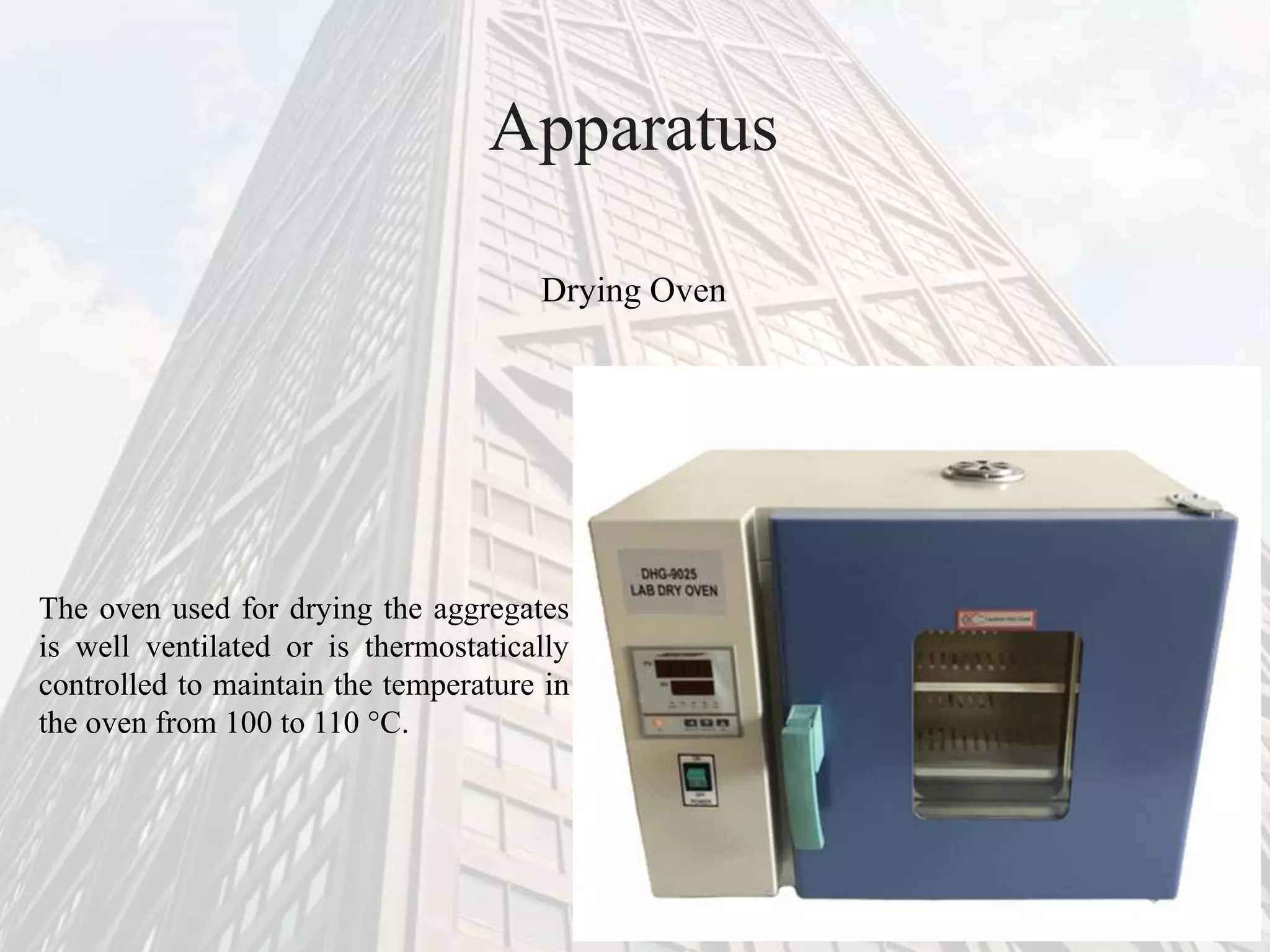
The oven used for drying the aggregates
is well ventilated or is thermostatically
controlled to maintain the temperature in
the oven from 100 to 110 °C.
Drying Oven
Apparatus
Apparatus
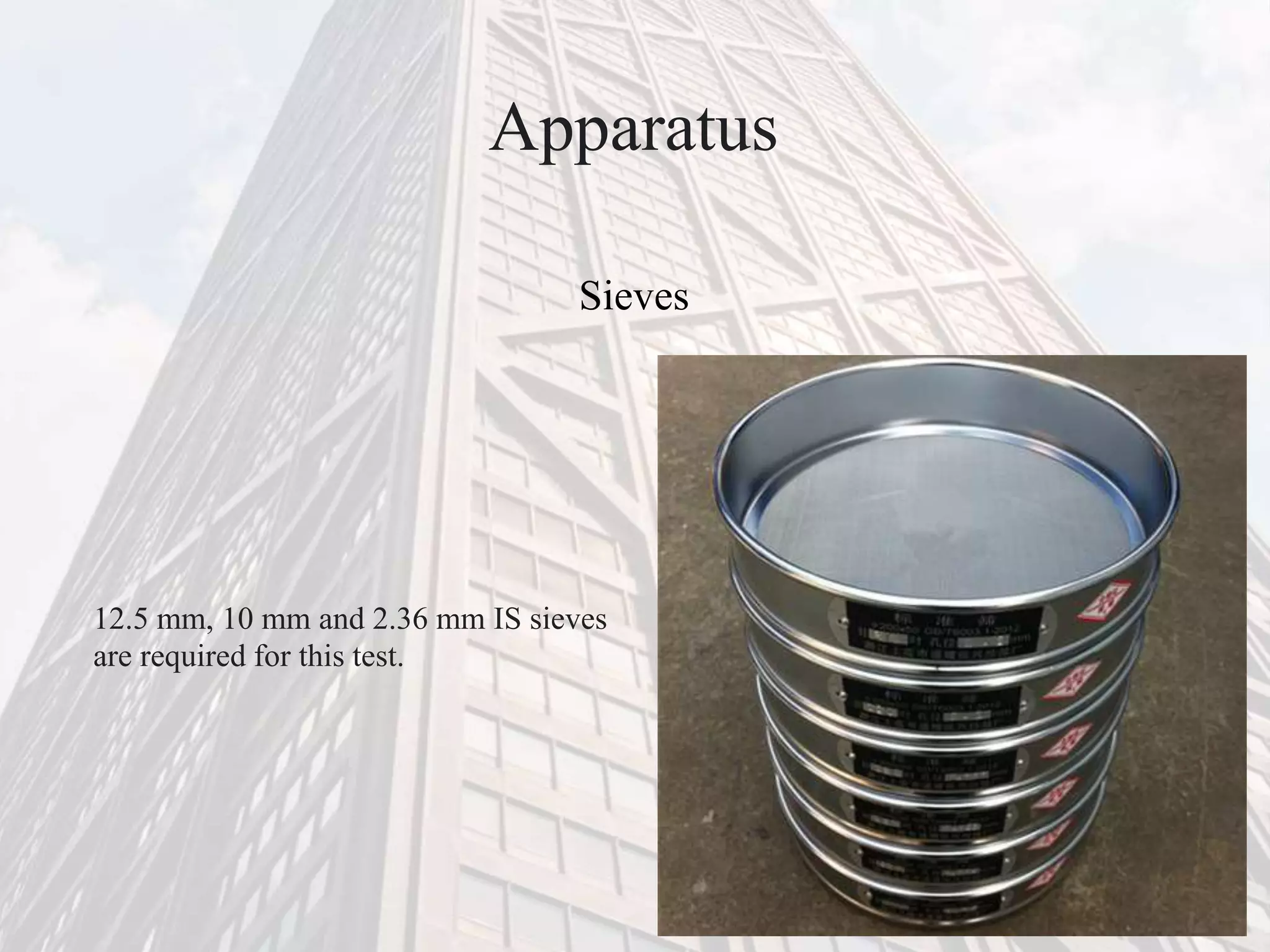
Sieves
12.5 mm, 10 mm and 2.36 mm IS sieves
are required for this test.
Apparatus
Tray
Preparation Of Test Specimen
1. Take test samples of aggregates passing through 12.5 mm IS sieve and retained
on 10 mm IS sieve.
2. Dry theme in an oven for 4 hours at a temperature of 100 °C to 110 °C and then
cool at room temperature.
Preparation Of Test Specimen
3. Fill the aggregates up to about 1/3 full in the cylindrical measure and tamp for
25 times with rounded end of the tamping rod.
4. Fill the rest portion of the cylindrical measure by two layers (1/3 + 1/3) and
tamp each layer for 25 times.
5. Cut off the overflow of aggregates in cylindrically measure by tamping rod
using its straight edge or by a knife.
Preparation Of Test Specimen
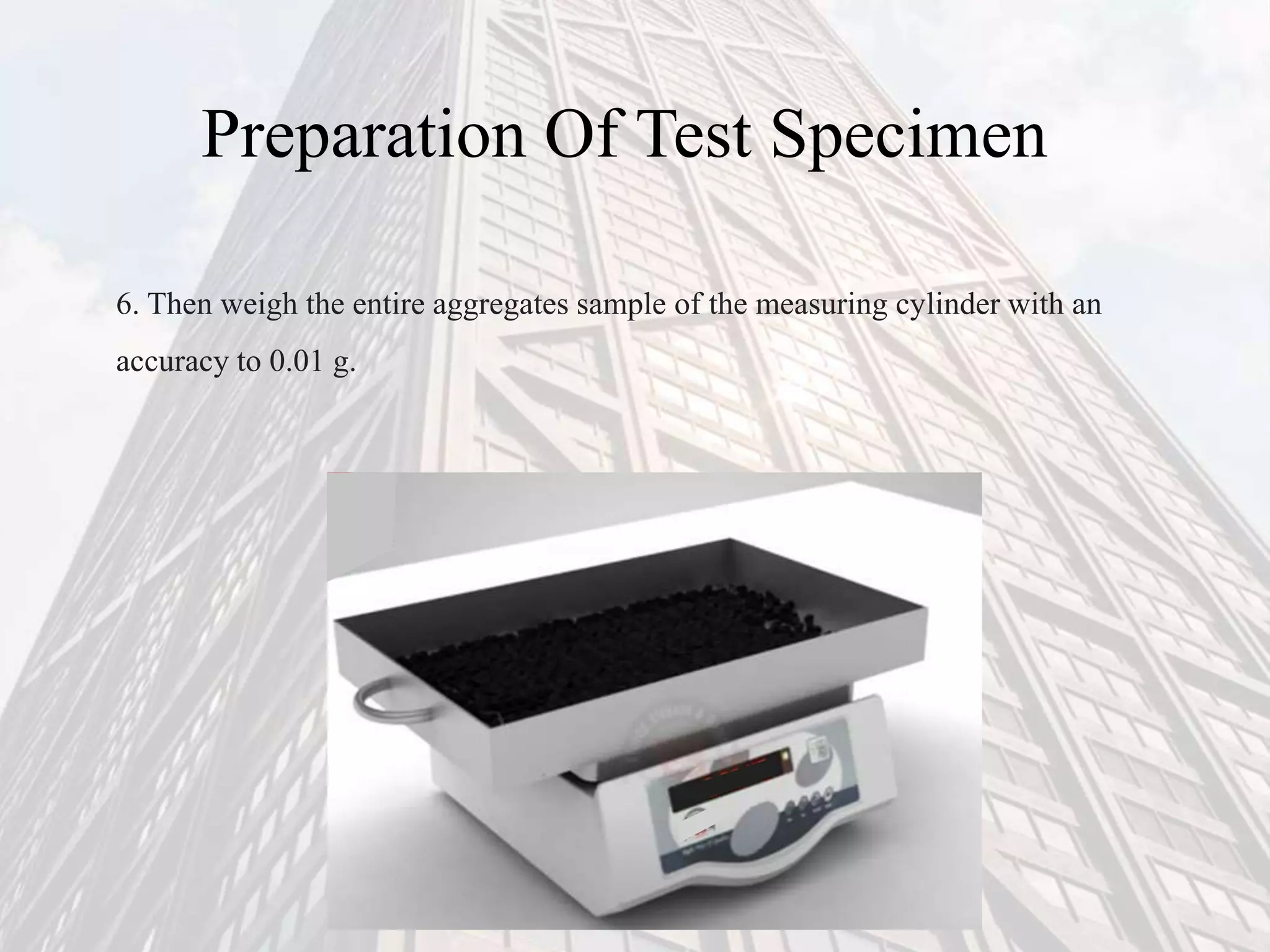
6. Then weigh the entire aggregates sample of the measuring cylinder with an
accuracy to 0.01 g.
Preparation Of Test Specimen
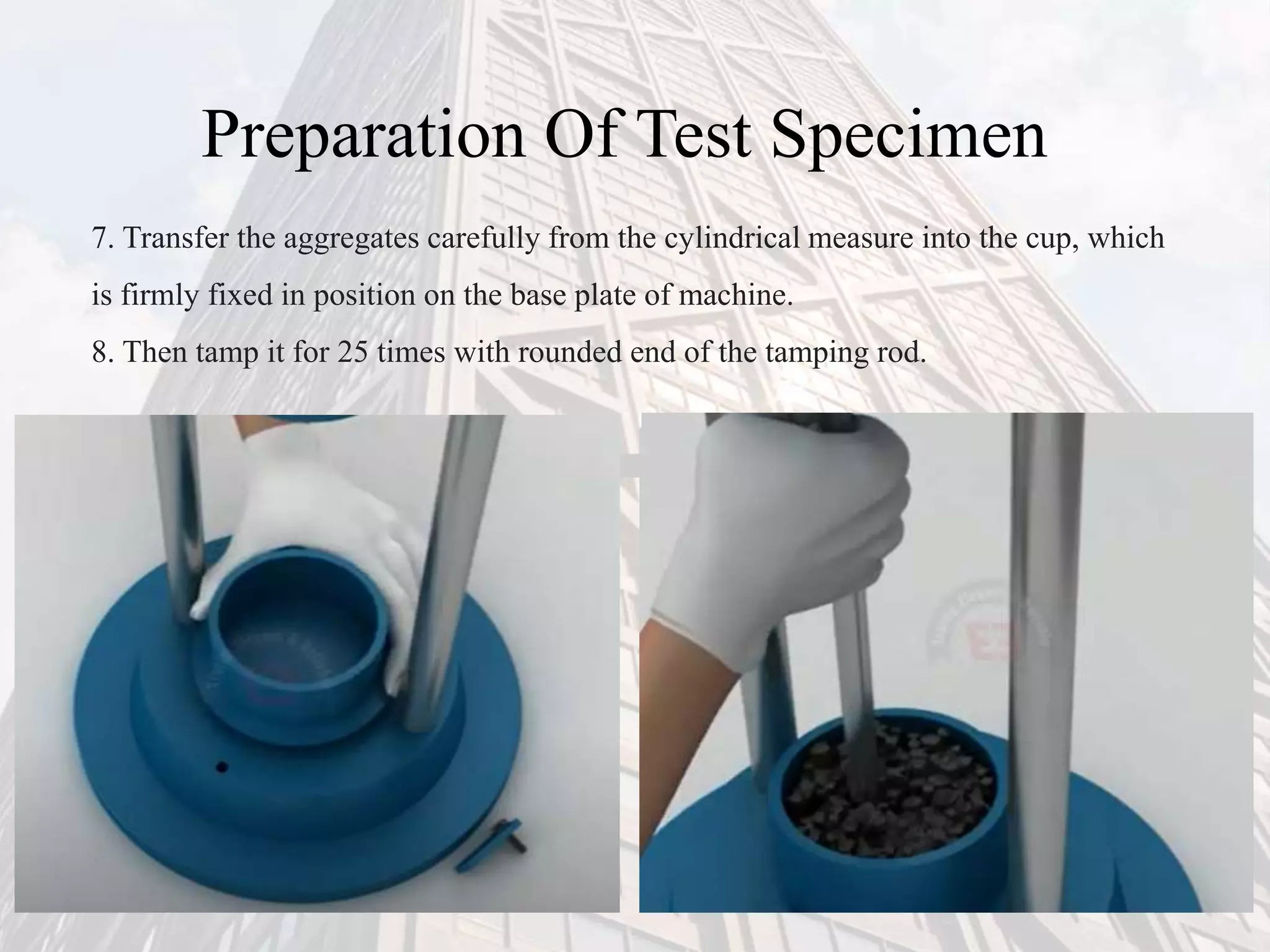
7. Transfer the aggregates carefully from the cylindrical measure into the cup, which
is firmly fixed in position on the base plate of machine.
8. Then tamp it for 25 times with rounded end of the tamping rod.
Procedure
9. The hammer is raised until its lower face be 380 mm above the upper surface of
aggregate in the cup and allow it to fall freely on the aggregates.
10. The test sample (aggregate) is subjected to a total of 15 such blows each being
delivered at an interval of not less than 1 second.
Procedure
11. Then remove the crushed aggregate from the cup and sieve the whole of it on 2.36
mm IS sieve until no significant amount passes through the sieve.
12. Weigh the fraction (aggregates) passing through the 2.36 mm IS sieve with an
accuracy to 0.1 g.
13. Repeat the above steps with other fresh sample.
2.36mm IS
Sieve
14. Let the original weight of the oven dry sample of aggregates be W₁ g and the
weight of fraction (aggregates) passing 2.36 mm IS sieve be W₂ g.
15. Then aggregate impact value is expressed as the percentage of fines formed
in terms of the total weight of the sample.
Procedure
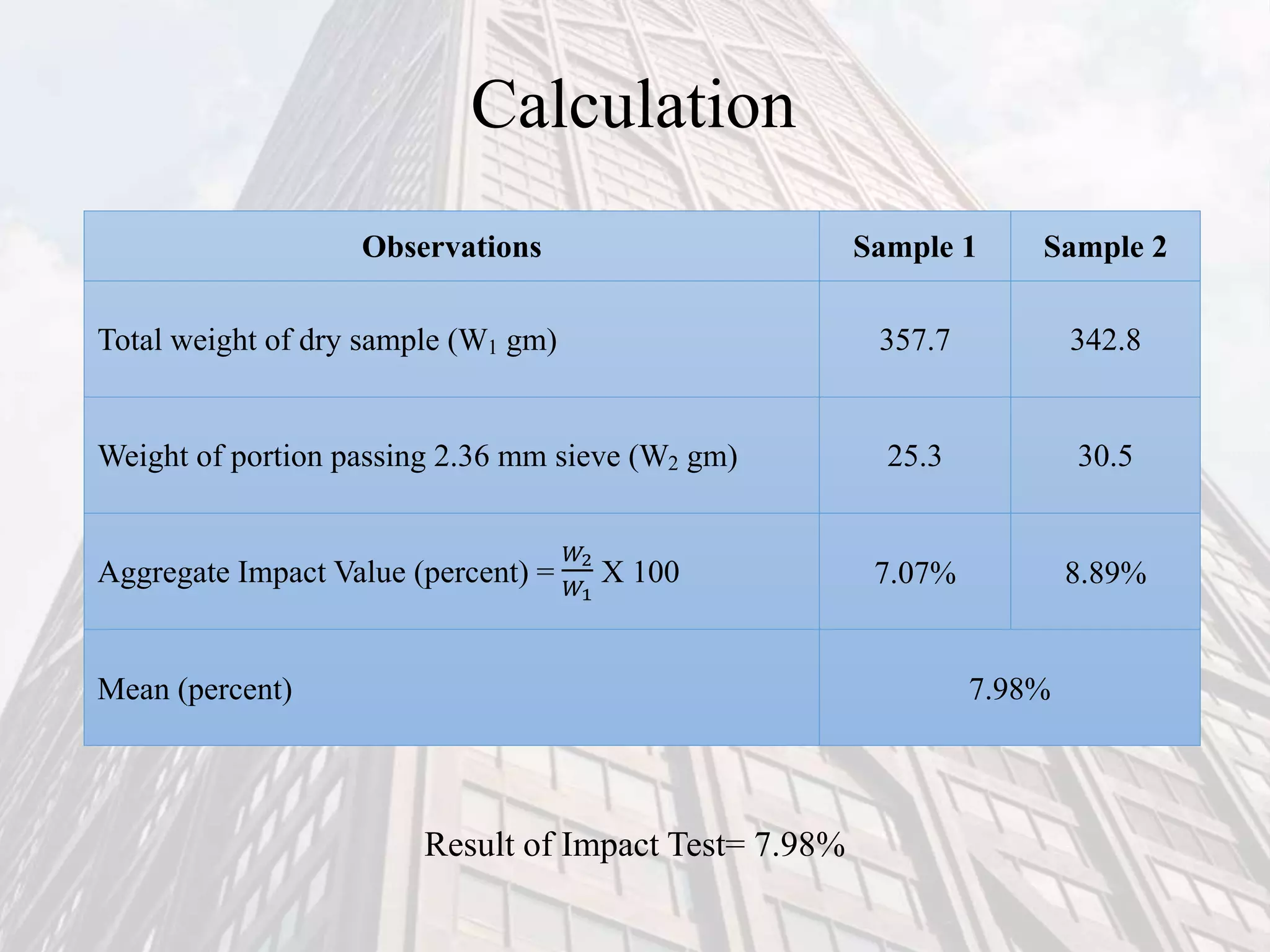
Observations Sample 1 Sample 2
Total weight of dry sample (W1 gm) 357.7 342.8
Weight of portion passing 2.36 mm sieve (W2 gm) 25.3 30.5
Aggregate Impact Value (percent) =
𝑊2
𝑊1
X 100 7.07% 8.89%
Mean (percent) 7.98%
Calculation
Result of Impact Test= 7.98%
Recommended Aggregate Impact Test Values
Aggregate Impact Value Classification
<20% Exceptionally Strong
10 – 20% Strong
20-30% Satisfactory for road surfacing
>35% Weak for road surfacing
Thank You

Aggregate Impact Value Test.pptx

  • 1.
    Experiment Name: AggregateImpact Value Prepared By Nurmohammad Department of Civil Engineering Dhaka International University
  • 2.
    Experiment Name: AggregateImpact Value IS 2386 (PART-IV)
  • 3.
    The impact testis a type of quality control test for highway pavements that is used to determine the suitability of aggregates for use in highway pavement construction. Aggregates used in road construction should be strong enough to resist abrasion, crushing, and impact load. Objective Based on the impact value, we can decide whether the coarse aggregate is suitable for construction or not. This test is performed to ensure the aggregate toughness, which is used in road construction to work as a base layer, and sub-base layer. Significance and use
  • 4.
    Apparatus A testing machineweighing 45 to 60 kg and having a metal base with a painted lower surface of not less than 30 cm in diameter. It is supported on level and plane concrete floor of minimum 45 cm thickness. The machine should also have provisions for fixing its base. Impact Testing Machine
  • 5.
    Apparatus A cylindrical steelcup of internal diameter 102 mm, depth 50 mm and minimum thickness 6.3 mm. 102 mm 50 mm Cylindrical Steel Cup
  • 6.
    Apparatus 75 mm 50 mm CylindricalMetal Measure A cylindrical metal measure having internal diameter 75 mm and depth 50 mm for measuring aggregates.
  • 7.
    Apparatus A metal hammeror tup weighing 13.5 to 14.0 kg the lower end being cylindrical in shape, 50 mm long, 100.0 mm in diameter, with a 2 mm chamfer at the lower edge and case hardened. The hammer should slide freely between vertical guides and be concentric with the cup. Free fall of hammer should be within 380±5 mm. Hammer
  • 8.
    Apparatus Tamping rod 10mm in diameter and 230 mm long, rounded at one end. Tamping Rod
  • 9.
    Apparatus Weighing Balance A balanceof capacity not less than 500g, readable and accurate up to 0.1 g.
  • 10.
    The oven usedfor drying the aggregates is well ventilated or is thermostatically controlled to maintain the temperature in the oven from 100 to 110 °C. Drying Oven Apparatus
  • 11.
    Apparatus Sieves 12.5 mm, 10mm and 2.36 mm IS sieves are required for this test.
  • 12.
  • 13.
    Preparation Of TestSpecimen 1. Take test samples of aggregates passing through 12.5 mm IS sieve and retained on 10 mm IS sieve. 2. Dry theme in an oven for 4 hours at a temperature of 100 °C to 110 °C and then cool at room temperature.
  • 14.
    Preparation Of TestSpecimen 3. Fill the aggregates up to about 1/3 full in the cylindrical measure and tamp for 25 times with rounded end of the tamping rod. 4. Fill the rest portion of the cylindrical measure by two layers (1/3 + 1/3) and tamp each layer for 25 times. 5. Cut off the overflow of aggregates in cylindrically measure by tamping rod using its straight edge or by a knife.
  • 15.
    Preparation Of TestSpecimen 6. Then weigh the entire aggregates sample of the measuring cylinder with an accuracy to 0.01 g.
  • 16.
    Preparation Of TestSpecimen 7. Transfer the aggregates carefully from the cylindrical measure into the cup, which is firmly fixed in position on the base plate of machine. 8. Then tamp it for 25 times with rounded end of the tamping rod.
  • 17.
    Procedure 9. The hammeris raised until its lower face be 380 mm above the upper surface of aggregate in the cup and allow it to fall freely on the aggregates. 10. The test sample (aggregate) is subjected to a total of 15 such blows each being delivered at an interval of not less than 1 second.
  • 18.
    Procedure 11. Then removethe crushed aggregate from the cup and sieve the whole of it on 2.36 mm IS sieve until no significant amount passes through the sieve. 12. Weigh the fraction (aggregates) passing through the 2.36 mm IS sieve with an accuracy to 0.1 g. 13. Repeat the above steps with other fresh sample. 2.36mm IS Sieve
  • 19.
    14. Let theoriginal weight of the oven dry sample of aggregates be W₁ g and the weight of fraction (aggregates) passing 2.36 mm IS sieve be W₂ g. 15. Then aggregate impact value is expressed as the percentage of fines formed in terms of the total weight of the sample. Procedure
  • 20.
    Observations Sample 1Sample 2 Total weight of dry sample (W1 gm) 357.7 342.8 Weight of portion passing 2.36 mm sieve (W2 gm) 25.3 30.5 Aggregate Impact Value (percent) = 𝑊2 𝑊1 X 100 7.07% 8.89% Mean (percent) 7.98% Calculation Result of Impact Test= 7.98%
  • 21.
    Recommended Aggregate ImpactTest Values Aggregate Impact Value Classification <20% Exceptionally Strong 10 – 20% Strong 20-30% Satisfactory for road surfacing >35% Weak for road surfacing
  • 22.