Aggregate Impact Value
TenPercent Fines Value
Aggregate Crushing Value
Aggregate Abrasion Value
Edwin . A
M.Tech –Structural Engg.
2.
Aggregate Impact Value
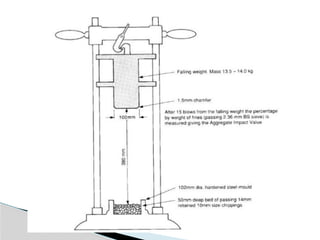
Theapparatus consists of a steel test mould with a falling hammer
as shown in figure. The hammer slides freely between vertical guides
so arranged that the lower part of the hammer is above and concentric
with the mould.
The material used is aggregate passing a 12.7 mm sieve and retained
on a 9.52mm sieve. It shall be clean and dry (washed if necessary) but
it must not be dried for longer than 4 hours nor at a temperature higher
than 110 otherwise certain aggregates may be damaged.
℃
The whole of the test sample (mass A) is placed in the steel mould
and compacted by a single tamping of 25 strokes of the tamping rod.
3.
The test sampleis subjected to 15 blows of the hammer
dropping 381mm, each being delivered at an interval not less than
1 second.
The crushed aggregate is sieved over a 2.36mm sieve. The
fraction passing 2.36mm is weighed to the nearest 0.1g (mass B).
The reaction retained on the sieve is also weighed (mass C).
If [A-(B+C)]>1g, the result shall be discarded and a fresh test is
made. The aggregate Impact value (AIV) is
(B/A) x (100%).
4.
Result:
An avg.is taken of the two tests and the results is recorded to the
nearest whole no. As the Aggregate Impact value.
The AIV is normally about 105 % of the aggregate crushing value
and it can be used for the same purpose. For week aggregate, the
required load for the first 10% fines test can be estimated by means of
the formula:
Required load (kN) = 4000/AIV.
6.
TEN PERCENT FINESVALUE:
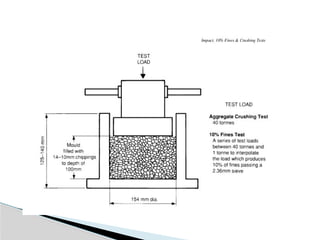
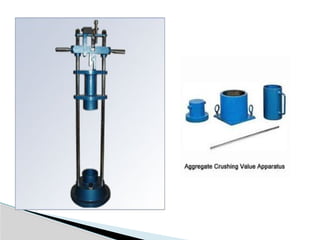
The apparatus (as in fig) consist of a case hardened steel cylinder
154mm dia and 125mm high together with a plunger which just fits
inside the cylinder and a base plate.
Other items are a steel tamping bar 16mm diameter by 450-
600mm long and a metal measuring cylinder 115mm diameter
by180mm deep. Also required is a compression testing machine
capable of applying a force of up to 500 kN and which can be
operated to give a uniform rate of loading so that this force is
reached in 10 minutes.
The material used is aggregate passing a 12.7mm sieve and
retained on 9.52mm sieve. It shall be clean and dry(washed if
necessary) but it must not be dried for longer than 4 hrs nor at a
temp. Higher than 110 otherwise certain aggregates may be
℃
damaged.
7.
The required volumeis obtained by filling the measuring
cylinder in 3 layers, each tamped 25 times with the rod and top
struck level. This volume is then weighed to the nearest 0.1g
(mass A)
The material from the measuring cylinder is placed in the test
cylinder in 3 layers, each tamped 25 times with rod. The depth of
the sample will then be about 100mm. The Plunger is lowered
onto the sample and rotated gently to seat it and level it.
The cylinder, plunger and sample are placed in the
compressing testing machine. Force is applied at a uniform
rate so that the total penetration in 10 minutes is about:
• 15mm for uncrushed gravel
• 20mm for normal, crushed aggregate,
• 24mm for honeycombed aggregate.
(eg: some slag and volcanic rocks).
8.
The sampleis then sieved over a 2.36mm sieve. As this is a fairly
fine sieve, it is preferable to pass the whole sample over a larger
sieve.(say 4.75mm) first. The material passing 2.36mm is then
weighed (mass B) and expressed as a %age of original mass
[y= 100% x B/A].
If the %age fines lies between 7.5% and 12.5%, the following
calculation for ten percent values is made:
TFV = Force to produce 10% fines = (14x/ y+4)
Where,
x= max. Forced used (kN).
y= %age fines from the test(%).
10.
Aggregate Crushing Value:
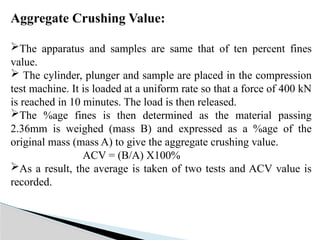
Theapparatus and samples are same that of ten percent fines
value.
The cylinder, plunger and sample are placed in the compression
test machine. It is loaded at a uniform rate so that a force of 400 kN
is reached in 10 minutes. The load is then released.
The %age fines is then determined as the material passing
2.36mm is weighed (mass B) and expressed as a %age of the
original mass (mass A) to give the aggregate crushing value.
ACV = (B/A) X100%
As a result, the average is taken of two tests and ACV value is
recorded.
12.
Aggregate Abrasion Value:
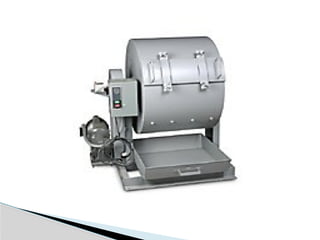
Theapparatus used in this test are Los Angles abrasion testing
machine,
IS Sieve of size – 1.7mm,
Abrasive charge – 12 nos. cast iron or steel spheres approximately
48mm dia. and each weighing between 390 and 445g ensuring that the
total weight of charge is 5000 g.
Oven.
14.
Procedure:
The test sampleand the abrasive charge should be placed in the Los
Angles abrasion testing machine.
The machine is rotated at a speed of 20 to 33 revolutions/minute for
1000 revolutions. At the completion of the test, the material should be
discharged and sieved through 1.70mm IS Sieve.
![The test sample is subjected to 15 blows of the hammer
dropping 381mm, each being delivered at an interval not less than
1 second.
The crushed aggregate is sieved over a 2.36mm sieve. The
fraction passing 2.36mm is weighed to the nearest 0.1g (mass B).
The reaction retained on the sieve is also weighed (mass C).
If [A-(B+C)]>1g, the result shall be discarded and a fresh test is
made. The aggregate Impact value (AIV) is
(B/A) x (100%).](https://image.slidesharecdn.com/edwina-250304232807-aa19f802/85/Tests-on-aggregates-civil-engineering-pptx-3-320.jpg)
![ The sample is then sieved over a 2.36mm sieve. As this is a fairly
fine sieve, it is preferable to pass the whole sample over a larger
sieve.(say 4.75mm) first. The material passing 2.36mm is then
weighed (mass B) and expressed as a %age of original mass
[y= 100% x B/A].
If the %age fines lies between 7.5% and 12.5%, the following
calculation for ten percent values is made:
TFV = Force to produce 10% fines = (14x/ y+4)
Where,
x= max. Forced used (kN).
y= %age fines from the test(%).](https://image.slidesharecdn.com/edwina-250304232807-aa19f802/85/Tests-on-aggregates-civil-engineering-pptx-8-320.jpg)