OBJECTIVE
To assess the resistance of an aggregate to mechanical degradation by the Aggregate Impact
Value.
BACKGROUND
When a road aggregate has been manufactured to a specified grading it is stockpiled, loaded
into trucks, transported, tipped, spread and compacted. If the aggregates is weak, some
degradation may take place and result in a change ingrading and/or the production of
excessive and undesirable fines. Thus, an aggregate complying with a specification at the
quarry may fail to do so when it is in the pavement.
Granular base layers and surfacings are subjected to repeated loadings from truck tyres and
the stress at the contact points of aggregate particles can be quite high. These crushing tests
can reveal aggregate properties subject to mechanical degradation of this form. The table
below indicates some requirements.
Country Material Requirements
UK
Structural PC Concrete
Other PC Concrete
Road Bases
Bituminous Surfacing
10% Fines Force > 100kN
10% Fines Force > 50kN
BSI Abrasion Test
NZ
PC Concrete
Road Bases
Sealing Chips
Asphalt Concrete
10% Fines Force > 130kN
Los Angelas Abrasion Test
US All road materials Los Angelas Abrasion Test
EQUIPMENTS
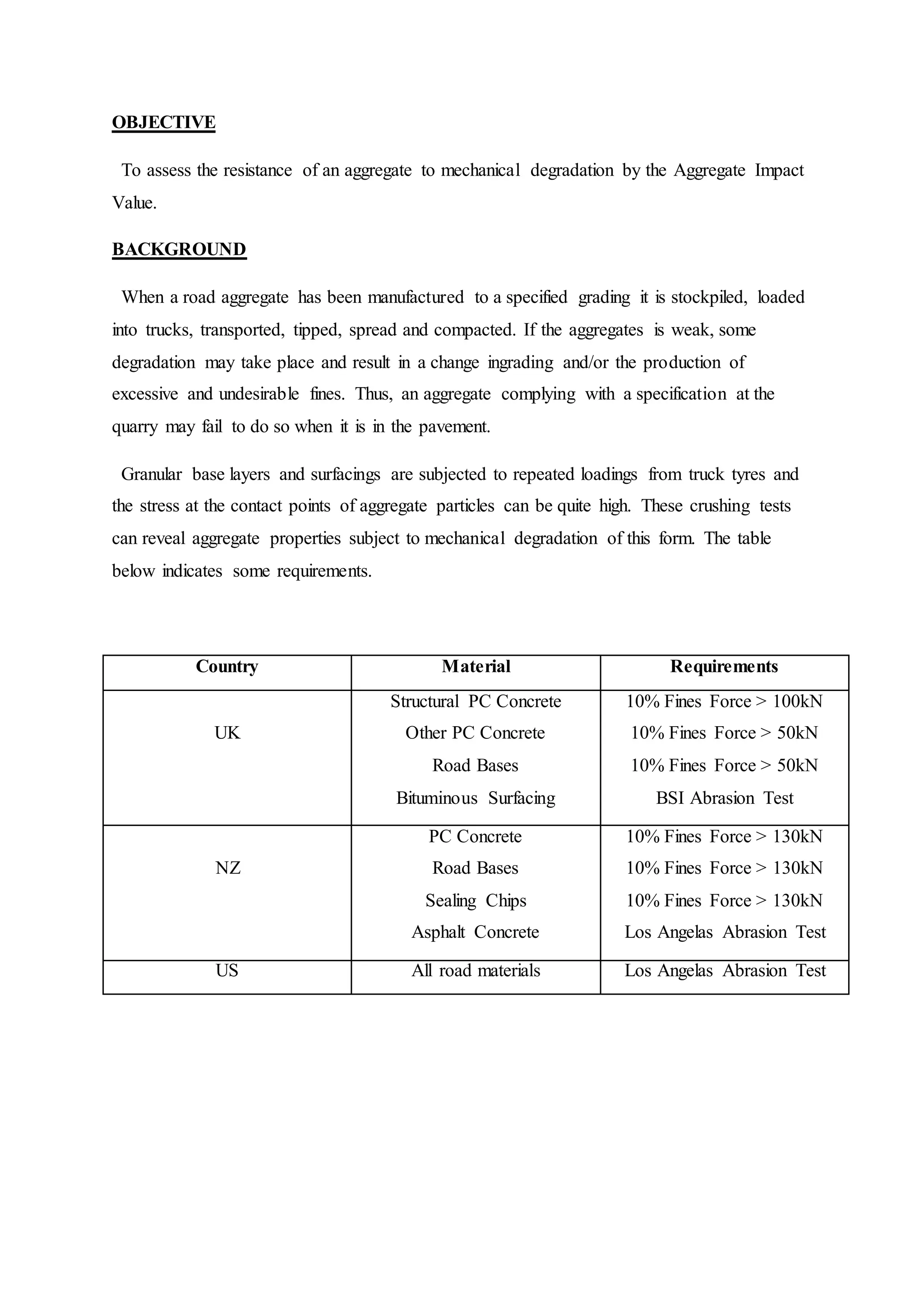
Figure 1 : Sieve Set
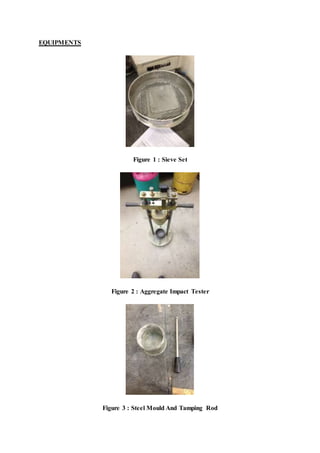
Figure 2 : Aggregate Impact Tester
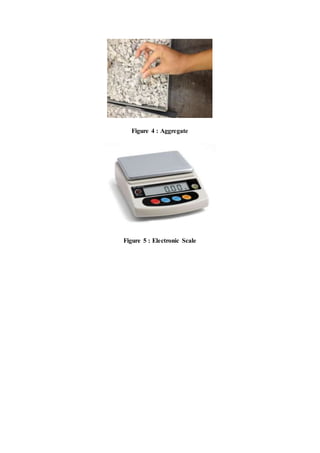
Figure 3 : Steel Mould And Tamping Rod
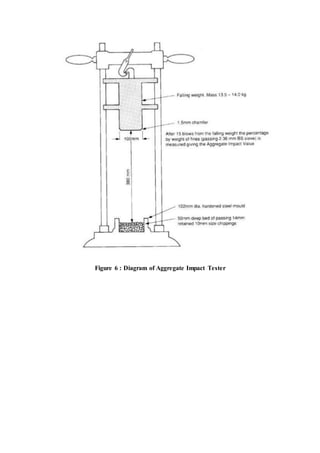
Figure 4 : Aggregate
Figure 5 : Electronic Scale
Figure 6 : Diagram of Aggregate Impact Tester
PROCEDURE
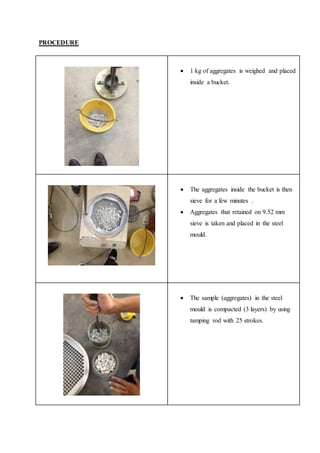
 1 kg of aggregates is weighed and placed
inside a bucket.
 The aggregates inside the bucket is then
sieve for a few minutes .
 Aggregates that retained on 9.52 mm
sieve is taken and placed in the steel
mould.
 The sample (aggregates) in the steel
mould is compacted (3 layers) by using
tamping rod with 25 strokes.
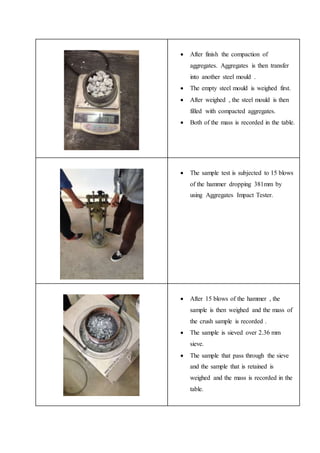
 After finish the compaction of
aggregates. Aggregates is then transfer
into another steel mould .
 The empty steel mould is weighed first.
 After weighed , the steel mould is then
filled with compacted aggregates.
 Both of the mass is recorded in the table.
 The sample test is subjected to 15 blows
of the hammer dropping 381mm by
using Aggregates Impact Tester.
 After 15 blows of the hammer , the
sample is then weighed and the mass of
the crush sample is recorded .
 The sample is sieved over 2.36 mm
sieve.
 The sample that pass through the sieve
and the sample that is retained is
weighed and the mass is recorded in the
table.
DATA AND CALCULATION
TEST SAMPLE (gram)
Sample mould weight (W1) 2539.4 g
Sample mould weight and sample weight (W2) 3057.3 g
Sample weight before blows (W3) 3057.3 – 2539.4
= 517.8 g
Crush sample weight (M1) 517.2 g
Sample weight passing sieve 2.36 mm (M2) 81.8 g
Sample weight retained in sieve 2.36 mm (M3) 435.2 g
The aggregate impact value (AIV)
AIV =
𝑀2
𝑀1
× 100%
AIV =
81.8
517.2
× 100
= 15.82%
DISCUSSION
a) Give the good value for the AIV test in highway engineering. Compare the standard
result and the experiments result of AIV value.
- A good value of AIV test in highway engineering is < 10% which is exceptionally
strong , 10%-20% Strong , 10-30% Satisfactory for road surfacing and > 35% is weak
for road surfacing . In this experiment that we have carried out , our aggregate impact
value (AIV) is 15.82% which is in the range of 10%-20% and it is strong enough for
road surfacing.
b) Give two experiments for aggregate degradation other than AIV test.
- Aggregates Crushing Value (ACV)
- Aggregates Abrasion Value (AAV)
c) How is aggregate impact value expressed ?
- The aggregate impact value is a strength value of an aggregate that is determined by
performing the Aggregates Impact Test on a sample of the aggregates.
d) Aggregate impact value material A is 20 and that of B is 45. Which one is better for
surface course ? Why ?
- Material A is beter than Material B . It is because the AIV for material A is lower than
material B . According to the good value for AIV test in highway engineering , 45%
of AIV is normally be regarded as too weak for use in the road surface compare to
20% is stronger . Thus , material A is better than material B.
CONCLUSION
From the experiment that we have conducted , we managed to obtain the AIV of our sample.
The AIV of our sample is 15.82 % which is strong enough for road surface . If the AIV of the
sample is < 10% , then the sample is exceptionally strong . If the AIV is > 35% , it is weak
for road surfacing . Hence , we can concluded that our aggregates sample is acceptable for
use in road surfaces .
REFERENCES
i. http://www.engineeringcivil.com/aggregate-impact-value.html
ii. http://www.slideshare.net/sudeepmahapatro/aggregate-impact-and
iii. http://www.highwaysmaintenance.com/Aggtext.htm
iv. http://www.scribd.com/doc/86556593/Aggregate-Impact-Value#scribd
v. http://theconstructor.org/building/building-material/determination-of-aggregate-
impact-value/1355/

Objective

  • 1.
    OBJECTIVE To assess theresistance of an aggregate to mechanical degradation by the Aggregate Impact Value. BACKGROUND When a road aggregate has been manufactured to a specified grading it is stockpiled, loaded into trucks, transported, tipped, spread and compacted. If the aggregates is weak, some degradation may take place and result in a change ingrading and/or the production of excessive and undesirable fines. Thus, an aggregate complying with a specification at the quarry may fail to do so when it is in the pavement. Granular base layers and surfacings are subjected to repeated loadings from truck tyres and the stress at the contact points of aggregate particles can be quite high. These crushing tests can reveal aggregate properties subject to mechanical degradation of this form. The table below indicates some requirements. Country Material Requirements UK Structural PC Concrete Other PC Concrete Road Bases Bituminous Surfacing 10% Fines Force > 100kN 10% Fines Force > 50kN 10% Fines Force > 50kN BSI Abrasion Test NZ PC Concrete Road Bases Sealing Chips Asphalt Concrete 10% Fines Force > 130kN 10% Fines Force > 130kN 10% Fines Force > 130kN Los Angelas Abrasion Test US All road materials Los Angelas Abrasion Test
  • 2.
    EQUIPMENTS Figure 1 :Sieve Set Figure 2 : Aggregate Impact Tester Figure 3 : Steel Mould And Tamping Rod
  • 3.
    Figure 4 :Aggregate Figure 5 : Electronic Scale
  • 4.
    Figure 6 :Diagram of Aggregate Impact Tester
  • 5.
    PROCEDURE  1 kgof aggregates is weighed and placed inside a bucket.  The aggregates inside the bucket is then sieve for a few minutes .  Aggregates that retained on 9.52 mm sieve is taken and placed in the steel mould.  The sample (aggregates) in the steel mould is compacted (3 layers) by using tamping rod with 25 strokes.
  • 6.
     After finishthe compaction of aggregates. Aggregates is then transfer into another steel mould .  The empty steel mould is weighed first.  After weighed , the steel mould is then filled with compacted aggregates.  Both of the mass is recorded in the table.  The sample test is subjected to 15 blows of the hammer dropping 381mm by using Aggregates Impact Tester.  After 15 blows of the hammer , the sample is then weighed and the mass of the crush sample is recorded .  The sample is sieved over 2.36 mm sieve.  The sample that pass through the sieve and the sample that is retained is weighed and the mass is recorded in the table.
  • 7.
    DATA AND CALCULATION TESTSAMPLE (gram) Sample mould weight (W1) 2539.4 g Sample mould weight and sample weight (W2) 3057.3 g Sample weight before blows (W3) 3057.3 – 2539.4 = 517.8 g Crush sample weight (M1) 517.2 g Sample weight passing sieve 2.36 mm (M2) 81.8 g Sample weight retained in sieve 2.36 mm (M3) 435.2 g The aggregate impact value (AIV) AIV = 𝑀2 𝑀1 × 100% AIV = 81.8 517.2 × 100 = 15.82% DISCUSSION a) Give the good value for the AIV test in highway engineering. Compare the standard result and the experiments result of AIV value. - A good value of AIV test in highway engineering is < 10% which is exceptionally strong , 10%-20% Strong , 10-30% Satisfactory for road surfacing and > 35% is weak for road surfacing . In this experiment that we have carried out , our aggregate impact value (AIV) is 15.82% which is in the range of 10%-20% and it is strong enough for road surfacing. b) Give two experiments for aggregate degradation other than AIV test. - Aggregates Crushing Value (ACV) - Aggregates Abrasion Value (AAV) c) How is aggregate impact value expressed ? - The aggregate impact value is a strength value of an aggregate that is determined by performing the Aggregates Impact Test on a sample of the aggregates.
  • 8.
    d) Aggregate impactvalue material A is 20 and that of B is 45. Which one is better for surface course ? Why ? - Material A is beter than Material B . It is because the AIV for material A is lower than material B . According to the good value for AIV test in highway engineering , 45% of AIV is normally be regarded as too weak for use in the road surface compare to 20% is stronger . Thus , material A is better than material B. CONCLUSION From the experiment that we have conducted , we managed to obtain the AIV of our sample. The AIV of our sample is 15.82 % which is strong enough for road surface . If the AIV of the sample is < 10% , then the sample is exceptionally strong . If the AIV is > 35% , it is weak for road surfacing . Hence , we can concluded that our aggregates sample is acceptable for use in road surfaces . REFERENCES i. http://www.engineeringcivil.com/aggregate-impact-value.html ii. http://www.slideshare.net/sudeepmahapatro/aggregate-impact-and iii. http://www.highwaysmaintenance.com/Aggtext.htm iv. http://www.scribd.com/doc/86556593/Aggregate-Impact-Value#scribd v. http://theconstructor.org/building/building-material/determination-of-aggregate- impact-value/1355/