Assessment of Aflatoxin B1 contamination in maize and
awareness of Aflatoxins in Son La province, in Vietnam
Hu Suk Lee, Xuan Nguyen Thi Thanh, Thuy Nguyen Thi Thanh, Hung Nguyen-Viet,
Johanna Lindahl and Delia Grace
Ecohealth 2018 Conference, Cali, Columbia, 15-18 August 2018
Outline
• Introduction of Aflatoxins
• Objectives
• Materials & Methods
• Results
• Discussion & Conclusion
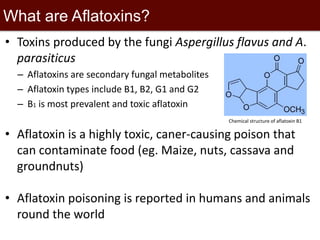
• Toxins produced by the fungi Aspergillus flavus and A.
parasiticus
– Aflatoxins are secondary fungal metabolites
– Aflatoxin types include B1, B2, G1 and G2
– B1 is most prevalent and toxic aflatoxin
• Aflatoxin is a highly toxic, caner-causing poison that
can contaminate food (eg. Maize, nuts, cassava and
groundnuts)
• Aflatoxin poisoning is reported in humans and animals
round the world
What are Aflatoxins?
Chemical structure of aflatoxin B1
4
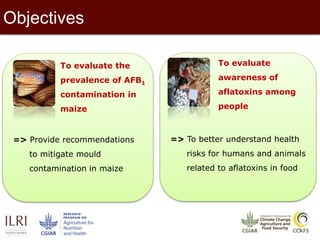
=> Provide recommendations
to mitigate mould
contamination in maize
=> To better understand health
risks for humans and animals
related to aflatoxins in food
To evaluate
awareness of
aflatoxins among
people
To evaluate the
prevalence of AFB1
contamination in
maize
Objectives
Materials & Methods
6
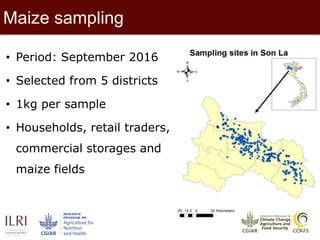
• Period: September 2016
• Selected from 5 districts
• 1kg per sample
• Households, retail traders,
commercial storages and
maize fields
Maize sampling
7
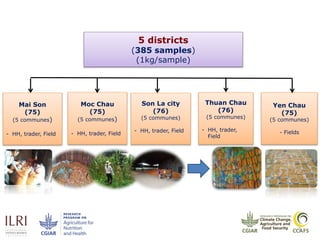
5 districts
(385 samples)
(1kg/sample)
Moc Chau
(75)
(5 communes)
- HH, trader, Field
Son La city
(76)
(5 communes)
- HH, trader, Field
Thuan Chau
(76)
(5 communes)
- HH, trader,
Field
Yen Chau
(75)
(5 communes)
- Fields
Mai Son
(75)
(5 communes)
- HH, trader, Field
8
• Knowledge, attitudes and practices (KAP)
about aflatoxins
• Term “mold”, not “Aflatoxins”
• Selected from 5 districts
• Using face-to-face interviews (107)
• Socio-demographic information
Awareness survey
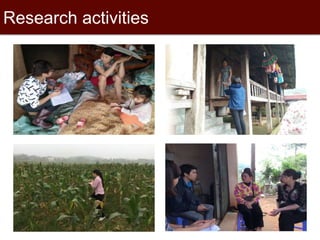
Research activities
10
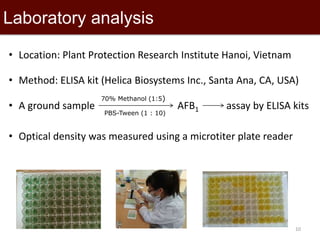
• Location: Plant Protection Research Institute Hanoi, Vietnam
• Method: ELISA kit (Helica Biosystems Inc., Santa Ana, CA, USA)
• A ground sample AFB1 assay by ELISA kits
• Optical density was measured using a microtiter plate reader
70% Methanol (1:5)
PBS-Tween (1 : 10)
METHODSLaboratory analysis
11
Data analysis
• To calculate the prevalence of AFB1 in maize
 Cut-off levels: 5µg/kg and 20µg/kg [above: limit of detection (LOD)-> 1 µg/kg]
 Human consumption in Vietnam (AFB1< 5µg/kg)
 No guideline for animal feed in Vietnam
• To assess awareness of aflatoxins
 A multi-variable logistic regression models with cluster
effect (district): Odds ratio (OR) and 95% CI
 P-value < 0.05: statistical significance
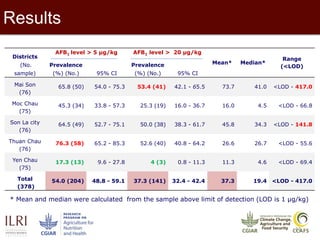
* Mean and median were calculated from the sample above limit of detection (LOD is 1 µg/kg)
12
Districts
(No.
sample)
AFB1 level > 5 µg/kg AFB1 level > 20 µg/kg
Mean* Median*
Range
(<LOD)Prevalence
(%) (No.) 95% CI
Prevalence
(%) (No.) 95% CI
Mai Son
(76)
65.8 (50) 54.0 - 75.3 53.4 (41) 42.1 - 65.5 73.7 41.0 <LOD - 417.0
Moc Chau
(75)
45.3 (34) 33.8 - 57.3 25.3 (19) 16.0 - 36.7 16.0 4.5 <LOD - 66.8
Son La city
(76)
64.5 (49) 52.7 - 75.1 50.0 (38) 38.3 - 61.7 45.8 34.3 <LOD - 141.8
Thuan Chau
(76)
76.3 (58) 65.2 - 85.3 52.6 (40) 40.8 - 64.2 26.6 26.7 <LOD - 55.6
Yen Chau
(75)
17.3 (13) 9.6 - 27.8 4 (3) 0.8 - 11.3 11.3 4.6 <LOD - 69.4
Total
(378)
54.0 (204) 48.8 - 59.1 37.3 (141) 32.4 - 42.4 37.3 19.4 <LOD - 417.0
Results
13
Category
Characteristic
(n)
Are molds
harmful to
human & animal
health?
Do you think that
consumption of
moldy maize can
cause a disease?
Is it safe to eat
meat from animals
which were fed
with moldy feed?
Do you consume the
meat of the animals
which were fed with
moldy maize/cereal?
Proportion (%) (Number of respondent)
Age (years)
< 20 (n= 3) 33.0 (1) 100.0 (3) 0.0 (0) 100.0 (3)
20-29 (n= 12) 100.0 (12) 75.0 (9) 25.0 (3) 91.7 (11)
30-39 (n=30) 76.7 (23) 60.0 (18) 50.0 (15) 86.7 (26)
40-49 (n= 34) 58.8 (20) 50.0 (17) 32.4 (11) 73.5 (25)
50-59 (n= 25) 68.0 (17) 40.0 (10) 40.0 (10) 88.0 (22)
≥ 60 (n= 3) 67.7 (2) 66.7 (2) 33.3 (1) 100.0 (3)
Sex Male (n= 63) 68.3 (43) 50.8 (32) 31.8 (20) 82.5 (52)
Female (n= 44) 72.7 (32) 61.4 (27) 45.5 (20) 86.4 (38)
Education None (n= 10) 70.0 (7) 60.0 (6) 40.0 (4) 100.0 (10)
I (n= 52) 65.4 (34) 55.8 (29) 42.3 (22) 84.6 (44)
II (n= 38) 71.1 (27) 52.6 (20) 34.2 (13) 81.6 (31)
III (n= 7) 100.0 (7) 57.1 (4) 14.3 (1) 71.4 (5)
Ethenic Kinh (n = 5) 60.0 (3) 80.0 (4) 20.0 (1) 20.0 (1)
Thái (n = 96) 70.8 (68) 51.0 (49) 39.6 (38) 88.5 (85)
Mong (n = 6) 66.7 (4) 100.0 (6) 16.7 (1) 66.7 (4)
Occupation Retailer (n= 6) 83.3 (5) 50.0 (3) 50.0 (3) 100.0 (6)
Farmer (n=93) 67.7 (63) 54.8 (51) 38.7 (36) 85.0 (79)
FM (n= 1) 100.0 (1) 100.0 (1) 0.0 (0) 0.0 (0)
Others (n= 7) 85.7 (6) 57.1 (4) 14.3 (1) 71.4 (5)
Income ($) ≤ 150 (n= 63) 76.2 (48) 55.6 (35) 39.7 (25) 84.1 (53)
> 150 - 300
(n=30) 60.0 (18) 66.7 (20) 36.7 (11) 80.0 (24)
≥ 300 (n= 14) 64.3 (9) 28.6 (4) 28.6 (4) 92.9 (13)
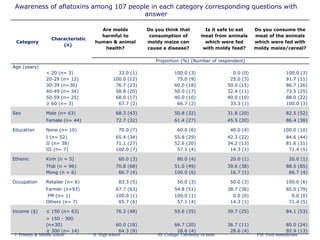
Awareness of aflatoxins among 107 people in each category corresponding questions with
answer
I: Primary & Middle school II: High school III: College/ University or more FM: Feed manufacture
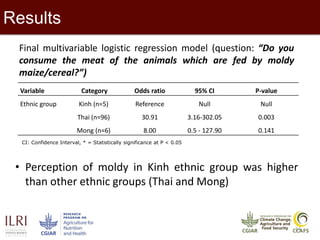
Final multivariable logistic regression model (question: “Do you
consume the meat of the animals which are fed by moldy
maize/cereal?”)
CI: Confidence Interval, * = Statistically significance at P < 0.05
14
• Perception of moldy in Kinh ethnic group was higher
than other ethnic groups (Thai and Mong)
Variable Category Odds ratio 95% CI P-value
Ethnic group Kinh (n=5) Reference Null Null
Thai (n=96) 30.91 3.16-302.05 0.003
Mong (n=6) 8.00 0.5 - 127.90 0.141
Results
15
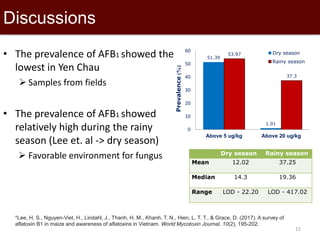
51.39
1.01
53.97
37.3
0
10
20
30
40
50
60
Above 5 ug/kg Above 20 ug/kg
Dry season
Rainy season
Prevalence(%)
• The prevalence of AFB1 showed the
lowest in Yen Chau
 Samples from fields
• The prevalence of AFB1 showed
relatively high during the rainy
season (Lee et. al -> dry season)
 Favorable environment for fungus
Discussions
Dry season Rainy season
Mean 12.02 37.25
Median 14.3 19.36
Range LOD - 22.20 LOD - 417.02
*Lee, H. S., Nguyen-Viet, H., Lindahl, J., Thanh, H. M., Khanh, T. N., Hien, L. T. T., & Grace, D. (2017). A survey of
aflatoxin B1 in maize and awareness of aflatoxins in Vietnam. World Mycotoxin Journal, 10(2), 195-202.
16
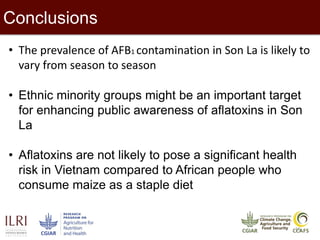
• The prevalence of AFB1 contamination in Son La is likely to
vary from season to season
• Ethnic minority groups might be an important target
for enhancing public awareness of aflatoxins in Son
La
• Aflatoxins are not likely to pose a significant health
risk in Vietnam compared to African people who
consume maize as a staple diet
Conclusions
This presentation is licensed for use under the Creative Commons Attribution 4.0 International Licence.
better lives through livestock
ilri.org
ILRI thanks all donors and organizations who globally supported its work through their contributions
to the CGIAR system

Assessment of aflatoxin B1 contamination in maize and awareness of aflatoxins in Son La province, Vietnam

  • 1.
    Assessment of AflatoxinB1 contamination in maize and awareness of Aflatoxins in Son La province, in Vietnam Hu Suk Lee, Xuan Nguyen Thi Thanh, Thuy Nguyen Thi Thanh, Hung Nguyen-Viet, Johanna Lindahl and Delia Grace Ecohealth 2018 Conference, Cali, Columbia, 15-18 August 2018
  • 2.
    Outline • Introduction ofAflatoxins • Objectives • Materials & Methods • Results • Discussion & Conclusion
  • 3.
    • Toxins producedby the fungi Aspergillus flavus and A. parasiticus – Aflatoxins are secondary fungal metabolites – Aflatoxin types include B1, B2, G1 and G2 – B1 is most prevalent and toxic aflatoxin • Aflatoxin is a highly toxic, caner-causing poison that can contaminate food (eg. Maize, nuts, cassava and groundnuts) • Aflatoxin poisoning is reported in humans and animals round the world What are Aflatoxins? Chemical structure of aflatoxin B1
  • 4.
    4 => Provide recommendations tomitigate mould contamination in maize => To better understand health risks for humans and animals related to aflatoxins in food To evaluate awareness of aflatoxins among people To evaluate the prevalence of AFB1 contamination in maize Objectives
  • 5.
  • 6.
    6 • Period: September2016 • Selected from 5 districts • 1kg per sample • Households, retail traders, commercial storages and maize fields Maize sampling
  • 7.
    7 5 districts (385 samples) (1kg/sample) MocChau (75) (5 communes) - HH, trader, Field Son La city (76) (5 communes) - HH, trader, Field Thuan Chau (76) (5 communes) - HH, trader, Field Yen Chau (75) (5 communes) - Fields Mai Son (75) (5 communes) - HH, trader, Field
  • 8.
    8 • Knowledge, attitudesand practices (KAP) about aflatoxins • Term “mold”, not “Aflatoxins” • Selected from 5 districts • Using face-to-face interviews (107) • Socio-demographic information Awareness survey
  • 9.
  • 10.
    10 • Location: PlantProtection Research Institute Hanoi, Vietnam • Method: ELISA kit (Helica Biosystems Inc., Santa Ana, CA, USA) • A ground sample AFB1 assay by ELISA kits • Optical density was measured using a microtiter plate reader 70% Methanol (1:5) PBS-Tween (1 : 10) METHODSLaboratory analysis
  • 11.
    11 Data analysis • Tocalculate the prevalence of AFB1 in maize  Cut-off levels: 5µg/kg and 20µg/kg [above: limit of detection (LOD)-> 1 µg/kg]  Human consumption in Vietnam (AFB1< 5µg/kg)  No guideline for animal feed in Vietnam • To assess awareness of aflatoxins  A multi-variable logistic regression models with cluster effect (district): Odds ratio (OR) and 95% CI  P-value < 0.05: statistical significance
  • 12.
    * Mean andmedian were calculated from the sample above limit of detection (LOD is 1 µg/kg) 12 Districts (No. sample) AFB1 level > 5 µg/kg AFB1 level > 20 µg/kg Mean* Median* Range (<LOD)Prevalence (%) (No.) 95% CI Prevalence (%) (No.) 95% CI Mai Son (76) 65.8 (50) 54.0 - 75.3 53.4 (41) 42.1 - 65.5 73.7 41.0 <LOD - 417.0 Moc Chau (75) 45.3 (34) 33.8 - 57.3 25.3 (19) 16.0 - 36.7 16.0 4.5 <LOD - 66.8 Son La city (76) 64.5 (49) 52.7 - 75.1 50.0 (38) 38.3 - 61.7 45.8 34.3 <LOD - 141.8 Thuan Chau (76) 76.3 (58) 65.2 - 85.3 52.6 (40) 40.8 - 64.2 26.6 26.7 <LOD - 55.6 Yen Chau (75) 17.3 (13) 9.6 - 27.8 4 (3) 0.8 - 11.3 11.3 4.6 <LOD - 69.4 Total (378) 54.0 (204) 48.8 - 59.1 37.3 (141) 32.4 - 42.4 37.3 19.4 <LOD - 417.0 Results
  • 13.
    13 Category Characteristic (n) Are molds harmful to human& animal health? Do you think that consumption of moldy maize can cause a disease? Is it safe to eat meat from animals which were fed with moldy feed? Do you consume the meat of the animals which were fed with moldy maize/cereal? Proportion (%) (Number of respondent) Age (years) < 20 (n= 3) 33.0 (1) 100.0 (3) 0.0 (0) 100.0 (3) 20-29 (n= 12) 100.0 (12) 75.0 (9) 25.0 (3) 91.7 (11) 30-39 (n=30) 76.7 (23) 60.0 (18) 50.0 (15) 86.7 (26) 40-49 (n= 34) 58.8 (20) 50.0 (17) 32.4 (11) 73.5 (25) 50-59 (n= 25) 68.0 (17) 40.0 (10) 40.0 (10) 88.0 (22) ≥ 60 (n= 3) 67.7 (2) 66.7 (2) 33.3 (1) 100.0 (3) Sex Male (n= 63) 68.3 (43) 50.8 (32) 31.8 (20) 82.5 (52) Female (n= 44) 72.7 (32) 61.4 (27) 45.5 (20) 86.4 (38) Education None (n= 10) 70.0 (7) 60.0 (6) 40.0 (4) 100.0 (10) I (n= 52) 65.4 (34) 55.8 (29) 42.3 (22) 84.6 (44) II (n= 38) 71.1 (27) 52.6 (20) 34.2 (13) 81.6 (31) III (n= 7) 100.0 (7) 57.1 (4) 14.3 (1) 71.4 (5) Ethenic Kinh (n = 5) 60.0 (3) 80.0 (4) 20.0 (1) 20.0 (1) Thái (n = 96) 70.8 (68) 51.0 (49) 39.6 (38) 88.5 (85) Mong (n = 6) 66.7 (4) 100.0 (6) 16.7 (1) 66.7 (4) Occupation Retailer (n= 6) 83.3 (5) 50.0 (3) 50.0 (3) 100.0 (6) Farmer (n=93) 67.7 (63) 54.8 (51) 38.7 (36) 85.0 (79) FM (n= 1) 100.0 (1) 100.0 (1) 0.0 (0) 0.0 (0) Others (n= 7) 85.7 (6) 57.1 (4) 14.3 (1) 71.4 (5) Income ($) ≤ 150 (n= 63) 76.2 (48) 55.6 (35) 39.7 (25) 84.1 (53) > 150 - 300 (n=30) 60.0 (18) 66.7 (20) 36.7 (11) 80.0 (24) ≥ 300 (n= 14) 64.3 (9) 28.6 (4) 28.6 (4) 92.9 (13) Awareness of aflatoxins among 107 people in each category corresponding questions with answer I: Primary & Middle school II: High school III: College/ University or more FM: Feed manufacture
  • 14.
    Final multivariable logisticregression model (question: “Do you consume the meat of the animals which are fed by moldy maize/cereal?”) CI: Confidence Interval, * = Statistically significance at P < 0.05 14 • Perception of moldy in Kinh ethnic group was higher than other ethnic groups (Thai and Mong) Variable Category Odds ratio 95% CI P-value Ethnic group Kinh (n=5) Reference Null Null Thai (n=96) 30.91 3.16-302.05 0.003 Mong (n=6) 8.00 0.5 - 127.90 0.141 Results
  • 15.
    15 51.39 1.01 53.97 37.3 0 10 20 30 40 50 60 Above 5 ug/kgAbove 20 ug/kg Dry season Rainy season Prevalence(%) • The prevalence of AFB1 showed the lowest in Yen Chau  Samples from fields • The prevalence of AFB1 showed relatively high during the rainy season (Lee et. al -> dry season)  Favorable environment for fungus Discussions Dry season Rainy season Mean 12.02 37.25 Median 14.3 19.36 Range LOD - 22.20 LOD - 417.02 *Lee, H. S., Nguyen-Viet, H., Lindahl, J., Thanh, H. M., Khanh, T. N., Hien, L. T. T., & Grace, D. (2017). A survey of aflatoxin B1 in maize and awareness of aflatoxins in Vietnam. World Mycotoxin Journal, 10(2), 195-202.
  • 16.
    16 • The prevalenceof AFB1 contamination in Son La is likely to vary from season to season • Ethnic minority groups might be an important target for enhancing public awareness of aflatoxins in Son La • Aflatoxins are not likely to pose a significant health risk in Vietnam compared to African people who consume maize as a staple diet Conclusions
  • 17.
    This presentation islicensed for use under the Creative Commons Attribution 4.0 International Licence. better lives through livestock ilri.org ILRI thanks all donors and organizations who globally supported its work through their contributions to the CGIAR system