MASTER SEMINAR
ON
WATER MANAGEMENT IN FRUIT CROPS
Submitted To :
Professor and Head
Department of
Horticulture
Presented By:
Suraj Kumar
Roll no. 200143011
Department of Horticulture
JNKVV, Jabalpur (M.P.) 482 004
TABLE OF CONTENT
1. INTRODUCTION
2. TERMINOLOGIES
3. SOIL PLANT ATMOSPHERE CONTINUUM
4. IRRIGATION SCHEDULING
5. CROP WATER REQUIRMENT
6. IRRIGATION AND METHODS
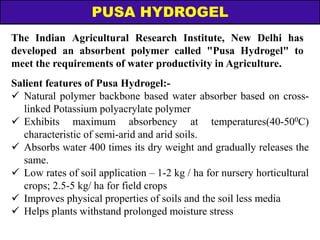
7. PUSA HYDROGEL
8. CONCLUSION
 Water is most essential requisite to sustain life for
plants, animals and humans.
 Approximately 70 per cent of global freshwater
consumption is used in the agricultural sector, yet
water use efficiency in many countries is below 50
per cent. (Source: International atomic energy agency)
 Water is used for carrier of nutrient from the soil to
green plant tissues. Water forms 90% of the plant
body by fresh weight basis.
 India is endowed with vast water resources which are
not distributed uniformly.
INTRODUCTION
 PMKSY is a Centrally Sponsored Scheme (Core Scheme)
 launched in 2015.
Pradhan Mantri Krishi Sinchayee Yojana
Its objectives are:-
 To expand the cultivable area under assured irrigation
(Har Khet ko pani).
 To improve on-farm water use efficiency to reduce
wastage of water.
 To enhance the adoption of precision-irrigation and
other water saving technologies (More crop per drop).
 To enhance recharge of aquifers and introduce
sustainable water conservation practices.
WATER MANAGEMENT
 Water management refers to artificial ways and
means to provide a specific quantity of water at
an appropriate time to the effective root zone of
crops deriving maximum water for higher
application efficiency and water use efficiency
(WUE).
 Water management is the activity of planning,
developing, distribution and managing the
optimum use of water.
TERMINOLOGIES
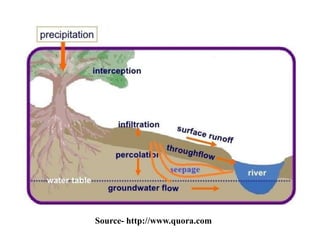
• INFILTRATION
• PERCOLATION
• LEACHING
• SEEPAGE
• WATER USE EFFICIENCY (WUE)
• EVAPOTRANSPIRATION (ET)
Source- http://www.quora.com
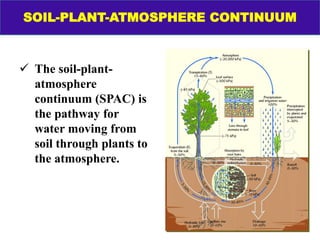
 The soil-plant-
atmosphere
continuum (SPAC) is
the pathway for
water moving from
soil through plants to
the atmosphere.
SOIL-PLANT-ATMOSPHERE CONTINUUM
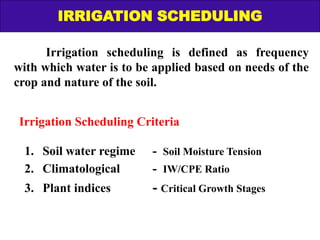
Irrigation scheduling is defined as frequency
with which water is to be applied based on needs of the
crop and nature of the soil.
Irrigation Scheduling Criteria
1. Soil water regime - Soil Moisture Tension
2. Climatological - IW/CPE Ratio
3. Plant indices - Critical Growth Stages
IRRIGATION SCHEDULING
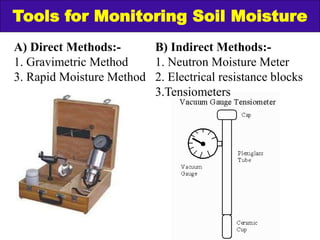
A) Direct Methods:-
1. Gravimetric Method
3. Rapid Moisture Method
Tools for Monitoring Soil Moisture
B) Indirect Methods:-
1. Neutron Moisture Meter
2. Electrical resistance blocks
3.Tensiometers
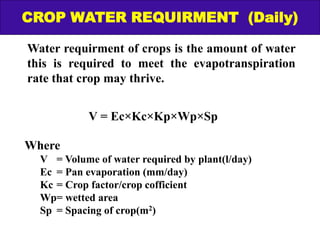
Water requirment of crops is the amount of water
this is required to meet the evapotranspiration
rate that crop may thrive.
Where
V = Volume of water required by plant(l/day)
Ec = Pan evaporation (mm/day)
Kc = Crop factor/crop cofficient
Wp= wetted area
Sp = Spacing of crop(m2)
V = Ec×Kc×Kp×Wp×Sp
CROP WATER REQUIRMENT (Daily)
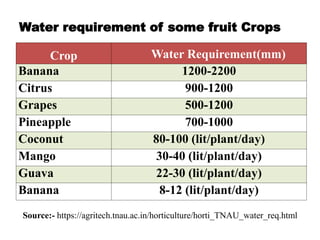
Water requirement of some fruit Crops
Crop Water Requirement(mm)
Banana 1200-2200
Citrus 900-1200
Grapes 500-1200
Pineapple 700-1000
Coconut 80-100 (lit/plant/day)
Mango 30-40 (lit/plant/day)
Guava 22-30 (lit/plant/day)
Banana 8-12 (lit/plant/day)
Source:- https://agritech.tnau.ac.in/horticulture/horti_TNAU_water_req.html
1.Traditional Method
• Flood system, basin, Furrow method etc.
2.Modern Method/Micro irrigation
• Drip irrigation
• Sprinkler irrigation
It is defined as the artificial supply of water to
support plant growth and production in absence of
adequate supply of water through rainfall is known as
irrigation.
System of irrigation:-
IRRIGATION
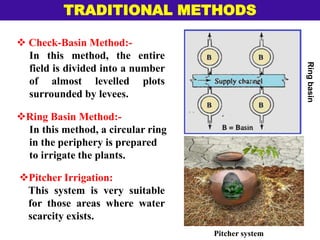
 Check-Basin Method:-
In this method, the entire
field is divided into a number
of almost levelled plots
surrounded by levees.
TRADITIONAL METHODS
Ring Basin Method:-
In this method, a circular ring
in the periphery is prepared
to irrigate the plants.
Pitcher Irrigation:
This system is very suitable
for those areas where water
scarcity exists.
Pitcher system
Ring
basin
MODERN/MICRO-
IRRIGATION
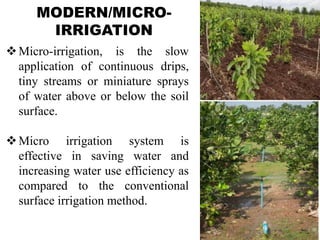
Micro-irrigation, is the slow
application of continuous drips,
tiny streams or miniature sprays
of water above or below the soil
surface.
Micro irrigation system is
effective in saving water and
increasing water use efficiency as
compared to the conventional
surface irrigation method.
PRINCIPLES OF MICRO-IRRIGATION
 Water is applied directly to the root zone of the
plants.
 Water is applied at frequent intervals at precise
quantities
 Water is applied through a low-pressure pipe
network comprising Mains, Sub mains, Laterals and
Emitting Devices
1. SPRINKLER IRRIGATION
 The water is applied with pressure to the surface of
any crop or soil in the form of a thin spray,
somewhat resembling rainfall.
 It discharges rate at 1000 L/h at 2.5-4.5 kg/cm².
 Suitable for undulating topography
 The rate of spray can be regulated
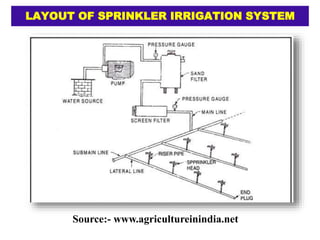
LAYOUT OF SPRINKLER IRRIGATION SYSTEM
Source:- www.agricultureinindia.net
Merits Of Sprinkler
 Highly suitable for sandy, shallow and steep soils.
 25-50 percent saving in irrigation water.
 Prevent the frost damage.
 More uniform water application than surface
irrigation.
 Water use efficiency can be as high as 60%.
 Protect crops against high temperatures.
 High winds cause improper distribution of water.
 Evaporation losses are high especially under high
temperature and low relative humidity conditions.
 High initial investment.
 Higher energy is required for operating the
sprinkler system.
Demerits Of Sprinkler
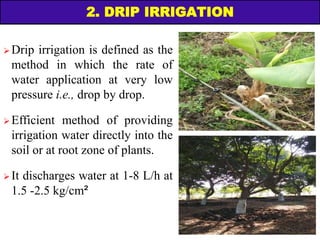
2. DRIP IRRIGATION
 Drip irrigation is defined as the
method in which the rate of
water application at very low
pressure i.e., drop by drop.
 Efficient method of providing
irrigation water directly into the
soil or at root zone of plants.
 It discharges water at 1-8 L/h at
1.5 -2.5 kg/cm²
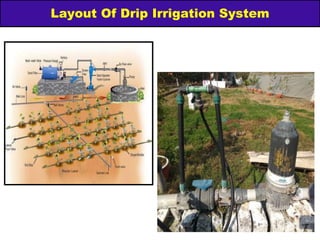
Layout Of Drip Irrigation System
Merits Of Drip System
 50-70 per cent water saving
 40-60 per cent savings in fertilizer and chemicals
 Less evaporation losses of water as compared to
surface irrigation.
 Most suitable for widely spaced crop, orchard
trees and in green houses.
 Fertigation and herbigation also possible to apply
with drip
Demerits Of Drip System
 Expensive:
 Waste:
 Clogging:
 Drip tape causes extra cleanup costs after harvest.
The Indian Agricultural Research Institute, New Delhi has
developed an absorbent polymer called "Pusa Hydrogel" to
meet the requirements of water productivity in Agriculture.
PUSA HYDROGEL
Salient features of Pusa Hydrogel:-
 Natural polymer backbone based water absorber based on cross-
linked Potassium polyacrylate polymer
 Exhibits maximum absorbency at temperatures(40-500C)
characteristic of semi-arid and arid soils.
 Absorbs water 400 times its dry weight and gradually releases the
same.
 Low rates of soil application – 1-2 kg / ha for nursery horticultural
crops; 2.5-5 kg/ ha for field crops
 Improves physical properties of soils and the soil less media
 Helps plants withstand prolonged moisture stress
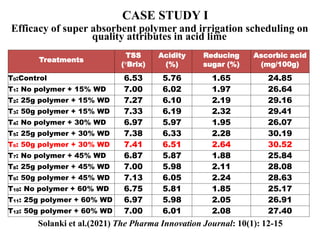
Treatments
TSS
(°Brix)
Acidity
(%)
Reducing
sugar (%)
Ascorbic acid
(mg/100g)
T0:Control 6.53 5.76 1.65 24.85
T1: No polymer + 15% WD 7.00 6.02 1.97 26.64
T2: 25g polymer + 15% WD 7.27 6.10 2.19 29.16
T3: 50g polymer + 15% WD 7.33 6.19 2.32 29.41
T4: No polymer + 30% WD 6.97 5.97 1.95 26.07
T5: 25g polymer + 30% WD 7.38 6.33 2.28 30.19
T6: 50g polymer + 30% WD 7.41 6.51 2.64 30.52
T7: No polymer + 45% WD 6.87 5.87 1.88 25.84
T8: 25g polymer + 45% WD 7.00 5.98 2.11 28.08
T9: 50g polymer + 45% WD 7.13 6.05 2.24 28.63
T10: No polymer + 60% WD 6.75 5.81 1.85 25.17
T11: 25g polymer + 60% WD 6.97 5.98 2.05 26.91
T12: 50g polymer + 60% WD 7.00 6.01 2.08 27.40
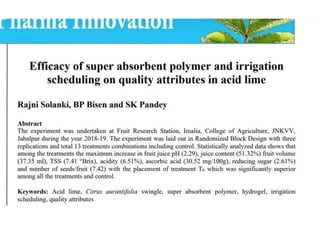
Efficacy of super absorbent polymer and irrigation scheduling on
quality attributes in acid lime
Solanki et al.(2021) The Pharma Innovation Journal: 10(1): 12-15
CASE STUDY I
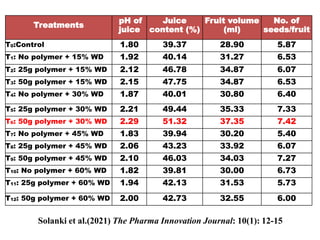
Treatments
pH of
juice
Juice
content (%)
Fruit volume
(ml)
No. of
seeds/fruit
T0:Control 1.80 39.37 28.90 5.87
T1: No polymer + 15% WD 1.92 40.14 31.27 6.53
T2: 25g polymer + 15% WD 2.12 46.78 34.87 6.07
T3: 50g polymer + 15% WD 2.15 47.75 34.87 6.53
T4: No polymer + 30% WD 1.87 40.01 30.80 6.40
T5: 25g polymer + 30% WD 2.21 49.44 35.33 7.33
T6: 50g polymer + 30% WD 2.29 51.32 37.35 7.42
T7: No polymer + 45% WD 1.83 39.94 30.20 5.40
T8: 25g polymer + 45% WD 2.06 43.23 33.92 6.07
T9: 50g polymer + 45% WD 2.10 46.03 34.03 7.27
T10: No polymer + 60% WD 1.82 39.81 30.00 6.73
T11: 25g polymer + 60% WD 1.94 42.13 31.53 5.73
T12: 50g polymer + 60% WD 2.00 42.73 32.55 6.00
Solanki et al.(2021) The Pharma Innovation Journal: 10(1): 12-15
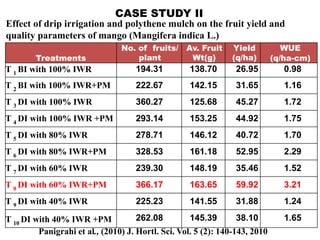
Treatments
No. of fruits/
plant
Av. Fruit
Wt(g)
Yield
(q/ha)
WUE
(q/ha-cm)
T 1 BI with 100% IWR 194.31 138.70 26.95 0.98
T 2 BI with 100% IWR+PM 222.67 142.15 31.65 1.16
T 3 DI with 100% IWR 360.27 125.68 45.27 1.72
T 4 DI with 100% IWR +PM 293.14 153.25 44.92 1.75
T 5 DI with 80% IWR 278.71 146.12 40.72 1.70
T 6 DI with 80% IWR+PM 328.53 161.18 52.95 2.29
T 7 DI with 60% IWR 239.30 148.19 35.46 1.52
T 8 DI with 60% IWR+PM 366.17 163.65 59.92 3.21
T 9 DI with 40% IWR 225.23 141.55 31.88 1.24
T 10 DI with 40% IWR +PM 262.08 145.39 38.10 1.65
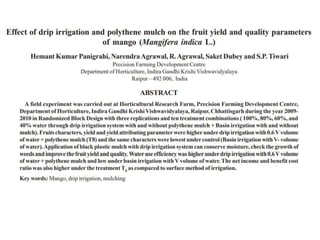
Effect of drip irrigation and polythene mulch on the fruit yield and
quality parameters of mango (Mangifera indica L.)
Panigrahi et al., (2010) J. Hortl. Sci. Vol. 5 (2): 140-143, 2010
CASE STUDY II
CONCLUSION
 Water management is the activity of planning, developing,
distribution and managing the optimum use of water.
 Scientific and judicious water use through advanced
irrigation system need to implement in different part of
country to offset the water shortage.
THANK YOU
Water Management in Fruit Crops

Water Management in Fruit Crops

  • 1.
    MASTER SEMINAR ON WATER MANAGEMENTIN FRUIT CROPS Submitted To : Professor and Head Department of Horticulture Presented By: Suraj Kumar Roll no. 200143011 Department of Horticulture JNKVV, Jabalpur (M.P.) 482 004
  • 2.
    TABLE OF CONTENT 1.INTRODUCTION 2. TERMINOLOGIES 3. SOIL PLANT ATMOSPHERE CONTINUUM 4. IRRIGATION SCHEDULING 5. CROP WATER REQUIRMENT 6. IRRIGATION AND METHODS 7. PUSA HYDROGEL 8. CONCLUSION
  • 3.
     Water ismost essential requisite to sustain life for plants, animals and humans.  Approximately 70 per cent of global freshwater consumption is used in the agricultural sector, yet water use efficiency in many countries is below 50 per cent. (Source: International atomic energy agency)  Water is used for carrier of nutrient from the soil to green plant tissues. Water forms 90% of the plant body by fresh weight basis.  India is endowed with vast water resources which are not distributed uniformly. INTRODUCTION
  • 4.
     PMKSY isa Centrally Sponsored Scheme (Core Scheme)  launched in 2015. Pradhan Mantri Krishi Sinchayee Yojana Its objectives are:-  To expand the cultivable area under assured irrigation (Har Khet ko pani).  To improve on-farm water use efficiency to reduce wastage of water.  To enhance the adoption of precision-irrigation and other water saving technologies (More crop per drop).  To enhance recharge of aquifers and introduce sustainable water conservation practices.
  • 5.
    WATER MANAGEMENT  Watermanagement refers to artificial ways and means to provide a specific quantity of water at an appropriate time to the effective root zone of crops deriving maximum water for higher application efficiency and water use efficiency (WUE).  Water management is the activity of planning, developing, distribution and managing the optimum use of water.
  • 6.
    TERMINOLOGIES • INFILTRATION • PERCOLATION •LEACHING • SEEPAGE • WATER USE EFFICIENCY (WUE) • EVAPOTRANSPIRATION (ET)
  • 7.
  • 8.
     The soil-plant- atmosphere continuum(SPAC) is the pathway for water moving from soil through plants to the atmosphere. SOIL-PLANT-ATMOSPHERE CONTINUUM
  • 9.
    Irrigation scheduling isdefined as frequency with which water is to be applied based on needs of the crop and nature of the soil. Irrigation Scheduling Criteria 1. Soil water regime - Soil Moisture Tension 2. Climatological - IW/CPE Ratio 3. Plant indices - Critical Growth Stages IRRIGATION SCHEDULING
  • 10.
    A) Direct Methods:- 1.Gravimetric Method 3. Rapid Moisture Method Tools for Monitoring Soil Moisture B) Indirect Methods:- 1. Neutron Moisture Meter 2. Electrical resistance blocks 3.Tensiometers
  • 11.
    Water requirment ofcrops is the amount of water this is required to meet the evapotranspiration rate that crop may thrive. Where V = Volume of water required by plant(l/day) Ec = Pan evaporation (mm/day) Kc = Crop factor/crop cofficient Wp= wetted area Sp = Spacing of crop(m2) V = Ec×Kc×Kp×Wp×Sp CROP WATER REQUIRMENT (Daily)
  • 12.
    Water requirement ofsome fruit Crops Crop Water Requirement(mm) Banana 1200-2200 Citrus 900-1200 Grapes 500-1200 Pineapple 700-1000 Coconut 80-100 (lit/plant/day) Mango 30-40 (lit/plant/day) Guava 22-30 (lit/plant/day) Banana 8-12 (lit/plant/day) Source:- https://agritech.tnau.ac.in/horticulture/horti_TNAU_water_req.html
  • 13.
    1.Traditional Method • Floodsystem, basin, Furrow method etc. 2.Modern Method/Micro irrigation • Drip irrigation • Sprinkler irrigation It is defined as the artificial supply of water to support plant growth and production in absence of adequate supply of water through rainfall is known as irrigation. System of irrigation:- IRRIGATION
  • 14.
     Check-Basin Method:- Inthis method, the entire field is divided into a number of almost levelled plots surrounded by levees. TRADITIONAL METHODS Ring Basin Method:- In this method, a circular ring in the periphery is prepared to irrigate the plants. Pitcher Irrigation: This system is very suitable for those areas where water scarcity exists. Pitcher system Ring basin
  • 15.
    MODERN/MICRO- IRRIGATION Micro-irrigation, is theslow application of continuous drips, tiny streams or miniature sprays of water above or below the soil surface. Micro irrigation system is effective in saving water and increasing water use efficiency as compared to the conventional surface irrigation method.
  • 16.
    PRINCIPLES OF MICRO-IRRIGATION Water is applied directly to the root zone of the plants.  Water is applied at frequent intervals at precise quantities  Water is applied through a low-pressure pipe network comprising Mains, Sub mains, Laterals and Emitting Devices
  • 17.
    1. SPRINKLER IRRIGATION The water is applied with pressure to the surface of any crop or soil in the form of a thin spray, somewhat resembling rainfall.  It discharges rate at 1000 L/h at 2.5-4.5 kg/cm².  Suitable for undulating topography  The rate of spray can be regulated
  • 18.
    LAYOUT OF SPRINKLERIRRIGATION SYSTEM Source:- www.agricultureinindia.net
  • 19.
    Merits Of Sprinkler Highly suitable for sandy, shallow and steep soils.  25-50 percent saving in irrigation water.  Prevent the frost damage.  More uniform water application than surface irrigation.  Water use efficiency can be as high as 60%.  Protect crops against high temperatures.
  • 20.
     High windscause improper distribution of water.  Evaporation losses are high especially under high temperature and low relative humidity conditions.  High initial investment.  Higher energy is required for operating the sprinkler system. Demerits Of Sprinkler
  • 21.
    2. DRIP IRRIGATION Drip irrigation is defined as the method in which the rate of water application at very low pressure i.e., drop by drop.  Efficient method of providing irrigation water directly into the soil or at root zone of plants.  It discharges water at 1-8 L/h at 1.5 -2.5 kg/cm²
  • 22.
    Layout Of DripIrrigation System
  • 23.
    Merits Of DripSystem  50-70 per cent water saving  40-60 per cent savings in fertilizer and chemicals  Less evaporation losses of water as compared to surface irrigation.  Most suitable for widely spaced crop, orchard trees and in green houses.  Fertigation and herbigation also possible to apply with drip
  • 24.
    Demerits Of DripSystem  Expensive:  Waste:  Clogging:  Drip tape causes extra cleanup costs after harvest.
  • 25.
    The Indian AgriculturalResearch Institute, New Delhi has developed an absorbent polymer called "Pusa Hydrogel" to meet the requirements of water productivity in Agriculture. PUSA HYDROGEL Salient features of Pusa Hydrogel:-  Natural polymer backbone based water absorber based on cross- linked Potassium polyacrylate polymer  Exhibits maximum absorbency at temperatures(40-500C) characteristic of semi-arid and arid soils.  Absorbs water 400 times its dry weight and gradually releases the same.  Low rates of soil application – 1-2 kg / ha for nursery horticultural crops; 2.5-5 kg/ ha for field crops  Improves physical properties of soils and the soil less media  Helps plants withstand prolonged moisture stress
  • 26.
    Treatments TSS (°Brix) Acidity (%) Reducing sugar (%) Ascorbic acid (mg/100g) T0:Control6.53 5.76 1.65 24.85 T1: No polymer + 15% WD 7.00 6.02 1.97 26.64 T2: 25g polymer + 15% WD 7.27 6.10 2.19 29.16 T3: 50g polymer + 15% WD 7.33 6.19 2.32 29.41 T4: No polymer + 30% WD 6.97 5.97 1.95 26.07 T5: 25g polymer + 30% WD 7.38 6.33 2.28 30.19 T6: 50g polymer + 30% WD 7.41 6.51 2.64 30.52 T7: No polymer + 45% WD 6.87 5.87 1.88 25.84 T8: 25g polymer + 45% WD 7.00 5.98 2.11 28.08 T9: 50g polymer + 45% WD 7.13 6.05 2.24 28.63 T10: No polymer + 60% WD 6.75 5.81 1.85 25.17 T11: 25g polymer + 60% WD 6.97 5.98 2.05 26.91 T12: 50g polymer + 60% WD 7.00 6.01 2.08 27.40 Efficacy of super absorbent polymer and irrigation scheduling on quality attributes in acid lime Solanki et al.(2021) The Pharma Innovation Journal: 10(1): 12-15 CASE STUDY I
  • 27.
    Treatments pH of juice Juice content (%) Fruitvolume (ml) No. of seeds/fruit T0:Control 1.80 39.37 28.90 5.87 T1: No polymer + 15% WD 1.92 40.14 31.27 6.53 T2: 25g polymer + 15% WD 2.12 46.78 34.87 6.07 T3: 50g polymer + 15% WD 2.15 47.75 34.87 6.53 T4: No polymer + 30% WD 1.87 40.01 30.80 6.40 T5: 25g polymer + 30% WD 2.21 49.44 35.33 7.33 T6: 50g polymer + 30% WD 2.29 51.32 37.35 7.42 T7: No polymer + 45% WD 1.83 39.94 30.20 5.40 T8: 25g polymer + 45% WD 2.06 43.23 33.92 6.07 T9: 50g polymer + 45% WD 2.10 46.03 34.03 7.27 T10: No polymer + 60% WD 1.82 39.81 30.00 6.73 T11: 25g polymer + 60% WD 1.94 42.13 31.53 5.73 T12: 50g polymer + 60% WD 2.00 42.73 32.55 6.00 Solanki et al.(2021) The Pharma Innovation Journal: 10(1): 12-15
  • 28.
    Treatments No. of fruits/ plant Av.Fruit Wt(g) Yield (q/ha) WUE (q/ha-cm) T 1 BI with 100% IWR 194.31 138.70 26.95 0.98 T 2 BI with 100% IWR+PM 222.67 142.15 31.65 1.16 T 3 DI with 100% IWR 360.27 125.68 45.27 1.72 T 4 DI with 100% IWR +PM 293.14 153.25 44.92 1.75 T 5 DI with 80% IWR 278.71 146.12 40.72 1.70 T 6 DI with 80% IWR+PM 328.53 161.18 52.95 2.29 T 7 DI with 60% IWR 239.30 148.19 35.46 1.52 T 8 DI with 60% IWR+PM 366.17 163.65 59.92 3.21 T 9 DI with 40% IWR 225.23 141.55 31.88 1.24 T 10 DI with 40% IWR +PM 262.08 145.39 38.10 1.65 Effect of drip irrigation and polythene mulch on the fruit yield and quality parameters of mango (Mangifera indica L.) Panigrahi et al., (2010) J. Hortl. Sci. Vol. 5 (2): 140-143, 2010 CASE STUDY II
  • 29.
    CONCLUSION  Water managementis the activity of planning, developing, distribution and managing the optimum use of water.  Scientific and judicious water use through advanced irrigation system need to implement in different part of country to offset the water shortage.
  • 30.