AEROSPACE ENGINEERING
BY DENNIS PAULRAJ
WHAT IS AEROSPACE
ENGINEERING?
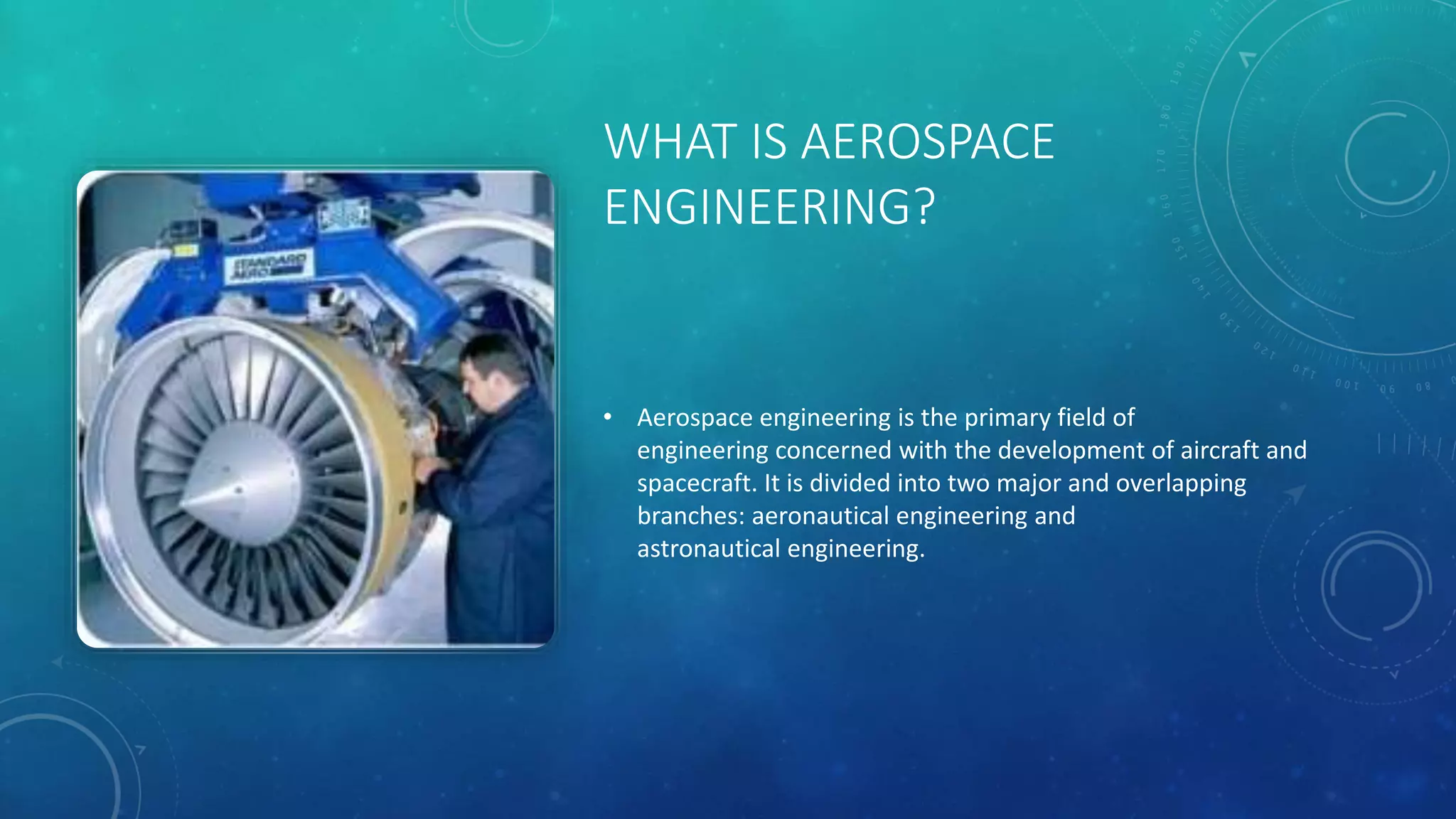
• Aerospace engineering is the primary field of
engineering concerned with the development of aircraft and
spacecraft. It is divided into two major and overlapping
branches: aeronautical engineering and
astronautical engineering.
WHAT IS AN AIRPLANE?
• Aircraft
• More general term
• Refers to any heavier-than-air object that is
• Supported by its own buoyancy
• Supported by the action of air on it’s structures
• Airplane
• Heavier-than-air craft propelled by an engine
• Uses aerodynamic surfaces (wings) to generate lift
WHY SO MANY
TYPES?
• Every modern aircraft is built for a
specific purpose
• Different altitudes
• Different speeds
• Different weight-carrying capacities
• Different performances
TYPES OF AIRCRAFTS
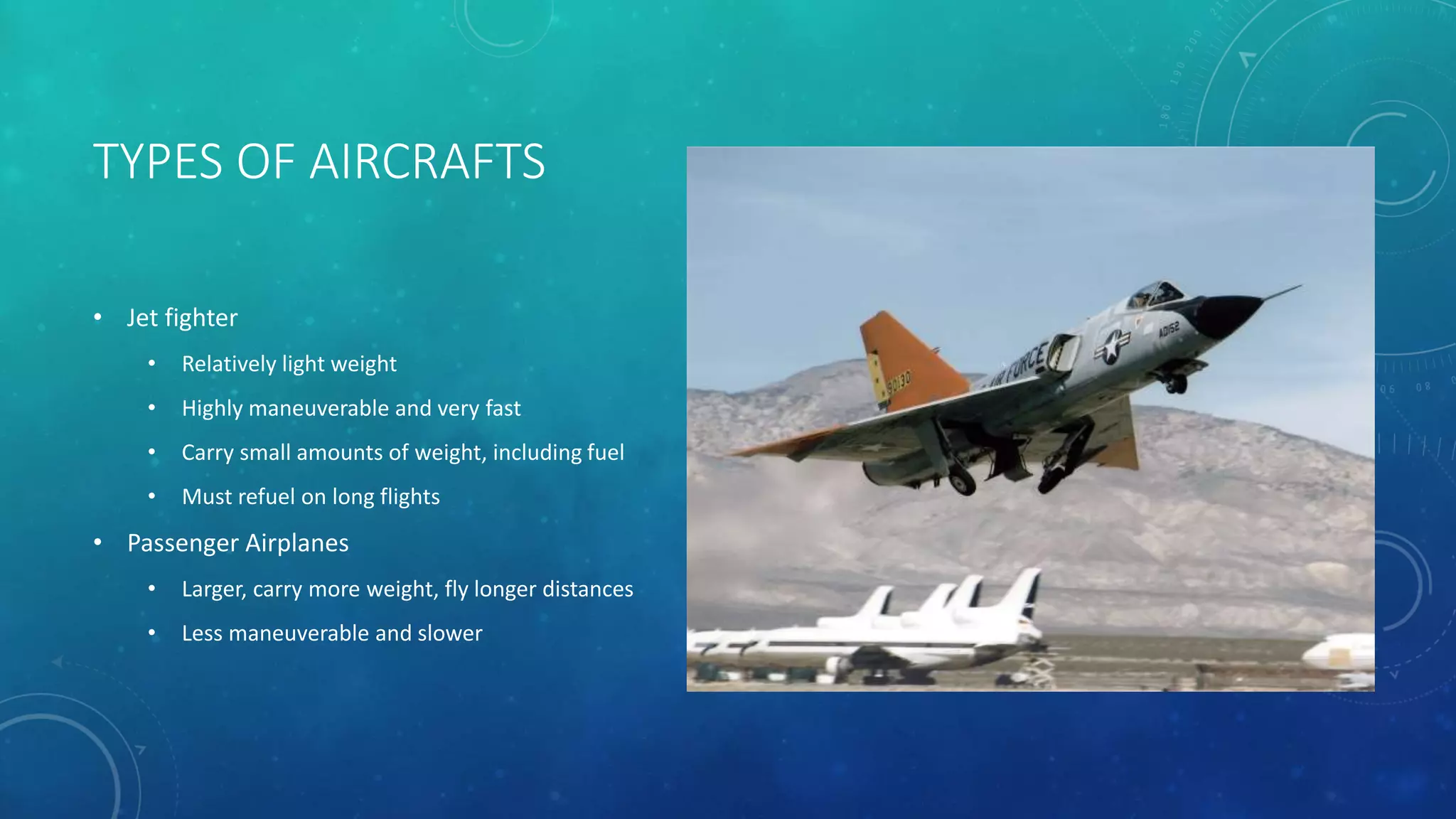
• Jet fighter
• Relatively light weight
• Highly maneuverable and very fast
• Carry small amounts of weight, including fuel
• Must refuel on long flights
• Passenger Airplanes
• Larger, carry more weight, fly longer distances
• Less maneuverable and slower
FIVE BASIC
STRUCTURAL
COMPONENTS
• Fuselage
• Main body structure
• All other components are
attached to it
• Contains
• Cockpit or flight deck
• Passenger Compartment
• Cargo Compartment
• Produces lift but can also
produce a lot of drag
FIVE BASIC
STRUCTURAL
COMPONENTS
• Wings
• Most important lift- producing
part of the aircraft
• Also carries fuel
• Designed so that the outer tips of
the wings are higher than where
the wings are attached to the
fuselage.
• Called the Dihedral
• Helps keep the airplane from
rolling unexpectedly
• High wing
• Mid wing
• Low wing
WING DESIGNS
• Straight Wing (Small Planes)
• Rectangular
• Tapered
• Rounded or Elliptical
• Sweepback Wing (Fast Planes)
• Moderate
• Great
• Forward
• Delta Wings (Supersonic Planes)
• Simple
• Complex
• Swing Wing
• Takeoff and Landig –Straight
• Cruise mode- sweep back
• Inter-Changeable
WING
COMPONENTS
• Trailing edge equipped with flaps
• Move backwards and forward
• Increase the area of the wing and the
camber of the airfoil
• Different from the ailerons, also located
on the trailing edge of the wing
• Spoilers
• Located on the top of the wing
• Opposite direction from the flaps and the
slats
• Reduce lift by disrupting the airflow over
the top of the wing
• Deployed after the airplane has landed
and lift is no longer needed
• Increase drag
WING
COMPONENTS
• Slats
• Located on the leading side
• Slide forward and increase the area o
the wing and the camber of the
airfoil
• Flaps and Slats
• Used during takeoff and landing
• Increase lift at slower speeds
FIVE BASIC STRUCTURAL COMPONENTS
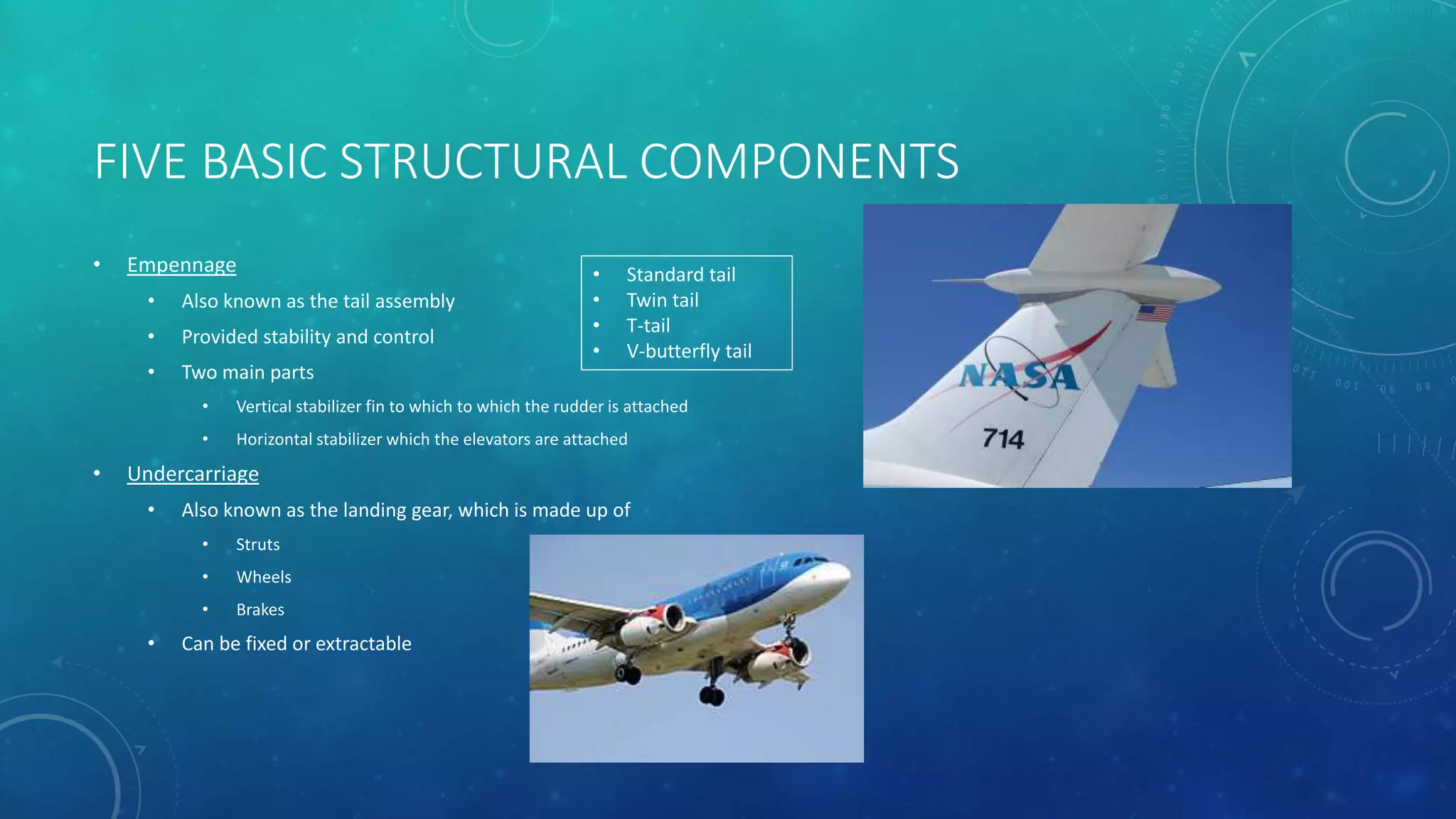
• Empennage
• Also known as the tail assembly
• Provided stability and control
• Two main parts
• Vertical stabilizer fin to which to which the rudder is attached
• Horizontal stabilizer which the elevators are attached
• Undercarriage
• Also known as the landing gear, which is made up of
• Struts
• Wheels
• Brakes
• Can be fixed or extractable
• Standard tail
• Twin tail
• T-tail
• V-butterfly tail
FIVE BASIC STRUCTURAL COMPONENTS
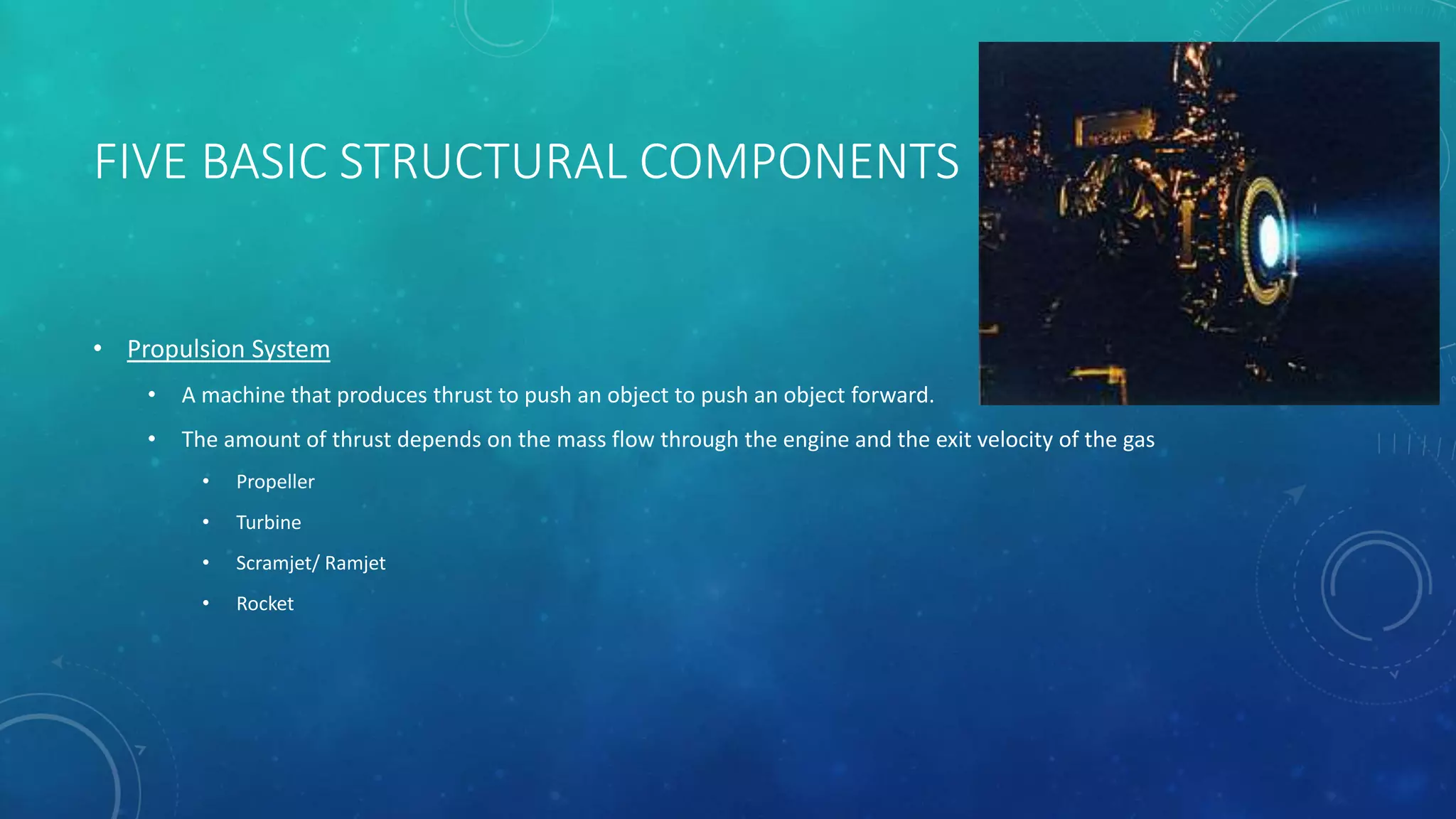
• Propulsion System
• A machine that produces thrust to push an object to push an object forward.
• The amount of thrust depends on the mass flow through the engine and the exit velocity of the gas
• Propeller
• Turbine
• Scramjet/ Ramjet
• Rocket
TYPES OF PROPULSION
• Liquid Fuel
• Carries fuel and oxidizer in separate tanks
• Fuel circulates through cooling jacket before entering combustion chamber
• Circulation preheats the fuel for combustion and helps cool the rocket
• Ion
• Coils are heated to change the fuel, such as xenon into a vapor
• Hot platinum or tungsten ionization grid vapor changes the flowing vapor into a stream of electrically
changed particles called ions.
• Nuclear
• Uses heat from a nuclear reactor to change a liquid fuel into gas
• Some of the fuel heated by the rocket flows through the turbine
• Turbine drives the fuel pump
TRAVELING IN
SPACE
• Rockets provide high sped, high
power transportation, both within
the Earth’s atmosphere and in
space.
• Military use
• Atmospheric Research
• Launching probes and satellites
• Space travel
MILESTONES IN AEROSPACE ENGINEERING
• First Human Flight, Pilâtre de Rozier and the Marquis d'Alandes, Montgolfier balloon, 21 November
1783
• First Manned Powered Flight, Orville Wright, Wright Flyer I, 17 December, 1903
• First Satellite in Orbit, Sputnik, 4 October, 1957
• First Manned Moon Landing, Neil Armstrong and Edwin ‘Buzz’ Aldrin, Apollo 11, 20 July, 1969
• First Human Space flight, Yuri Gagarin, Vostok I, 12 April, 1961
• First Manmade Object to leave the Solar System, Pioneer 10, 13 June, 1983
• First Commercial Airline Flight, Tony Jannus, Benoist Type XIV airboat, 1 January, 1914
IN NO PARTICULAR ORDER
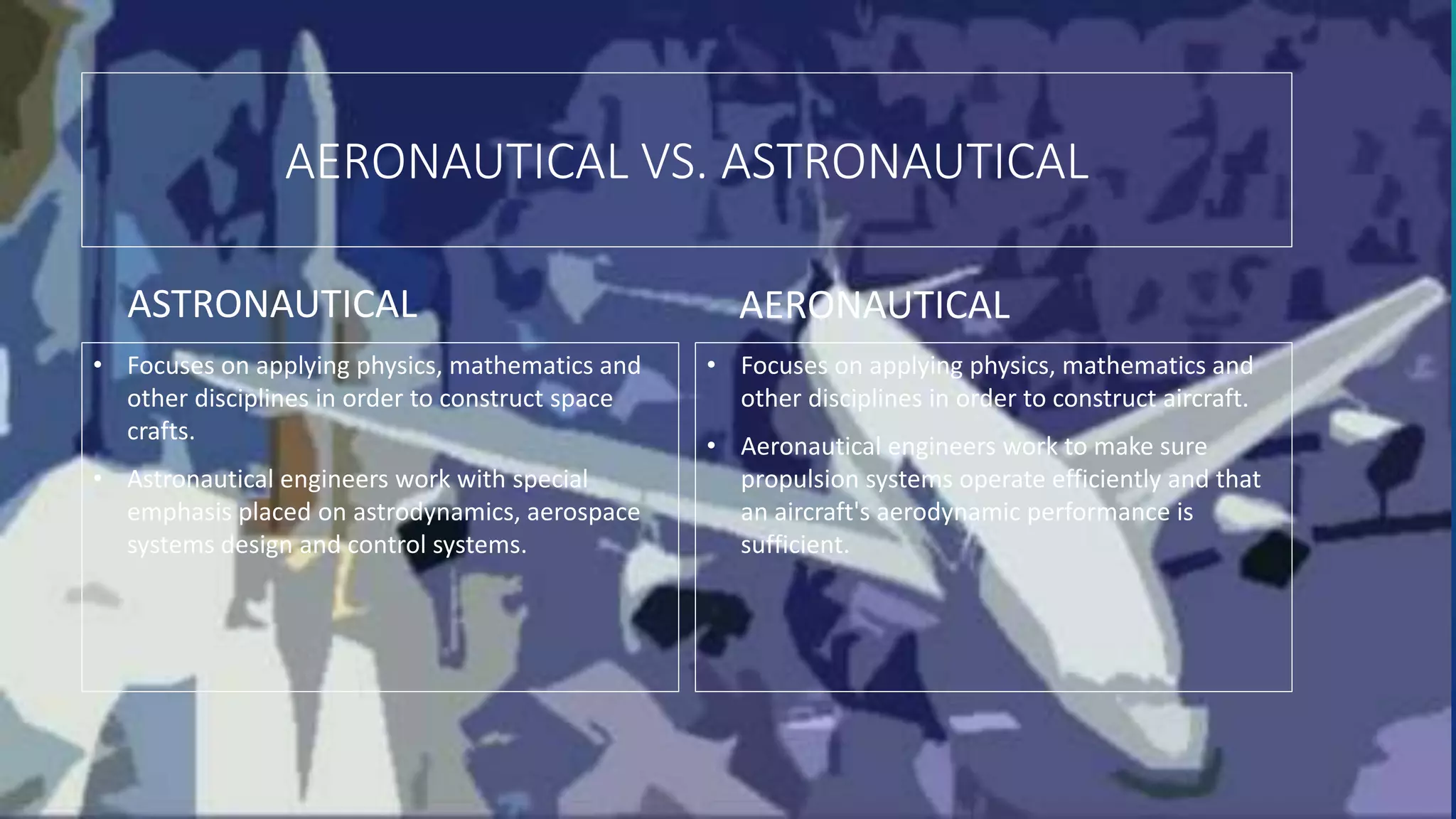
AERONAUTICAL VS. ASTRONAUTICAL
ASTRONAUTICAL
• Focuses on applying physics, mathematics and
other disciplines in order to construct space
crafts.
• Astronautical engineers work with special
emphasis placed on astrodynamics, aerospace
systems design and control systems.
AERONAUTICAL
• Focuses on applying physics, mathematics and
other disciplines in order to construct aircraft.
• Aeronautical engineers work to make sure
propulsion systems operate efficiently and that
an aircraft's aerodynamic performance is
sufficient.
KEY SKILLS FOR AEROSPACE ENGINEERING
• strong mathematical, analytical and problem solving skills
• technical expertise
• creativity and innovative thinking
• attention to detail
• a strong awareness of safety issues
• communication skills, both verbal and written
• project and time management skills
• commitment to keeping up to date with technical developments
TOP UPCOMING AND CURRENT AEROSPACE PROJECTS
• Juno
• The JUpiter Near-polar Orbiter was launched from Cape Canaveral Air Force Station on August 5, 2011 and will arrive
on July 4, 2016.
• Chang’E Lunar Mission
• A multi-stage lunar mission with a unmanned rover being sent in 2012 and a manned mission being sent in 2017 to
collect lunar samples.
• Ion Thrusters
Create small thrust levels in comparison to conventional chemical rockets, but achieve high specific impulse. They could be
practical in the vacuum of space.
• Dextre Space Robot
• Will assist astronauts on ISS in repairing the station. There are four main tools to use for repairs, and the robot runs on
1,400 watts of power, weighs about 3,300 pounds, and stands almost 13 feet tall.
• Orion Spacecraft
• Perhaps the most interesting of all missions, 750000 pound behemoth can withstand 1.35 times gravitational force.
IN NO PARTICULAR ORDER
TOP UPCOMING AND CURRENT AEROSPACE PROJECTS
CONT.
• Virgin Galactic SpaceShip Two
• An air-launched suborbital spaceplane type designed for space tourism, launched in 2011 with a top speed of
4000 km/h.
• Mars Space Laboratory
• Launched in 2011, it is a major upgrade from the current rovers, the MSL has 10 times the instrumentation and
will be able to examine mineral deposits in greater detail.
• Aquarius Mission
• Launched in 2010, it is a satellite that will scan oceans for “salinity” (or saltiness) in order to understand climate
change on a global scale.
• Mars Reconnaissance Orbiter
• Launched in 2005, MRO is a multipurpose spacecraft designed to conduct reconnaissance and exploration of
Mars from orbit.
IN NO PARTICULAR ORDER
TOP 10 SPACE RESEARCH
ORGANIZATIONS
1. NASA Goddard Institute of Space Studies
2. Russian Federal Space Agency
3. European Space Agency
4. Japan Aerospace Exploration Agency
5. Indian Space Research Organization
6. China National Space Administration
7. Space Studies Institute (California)
8. Space Science and Engineering Center (Wisconsin)
9. International Space University (France)
10. International Space Science Institute (Switzerland)
MILESTONES IN ISRO
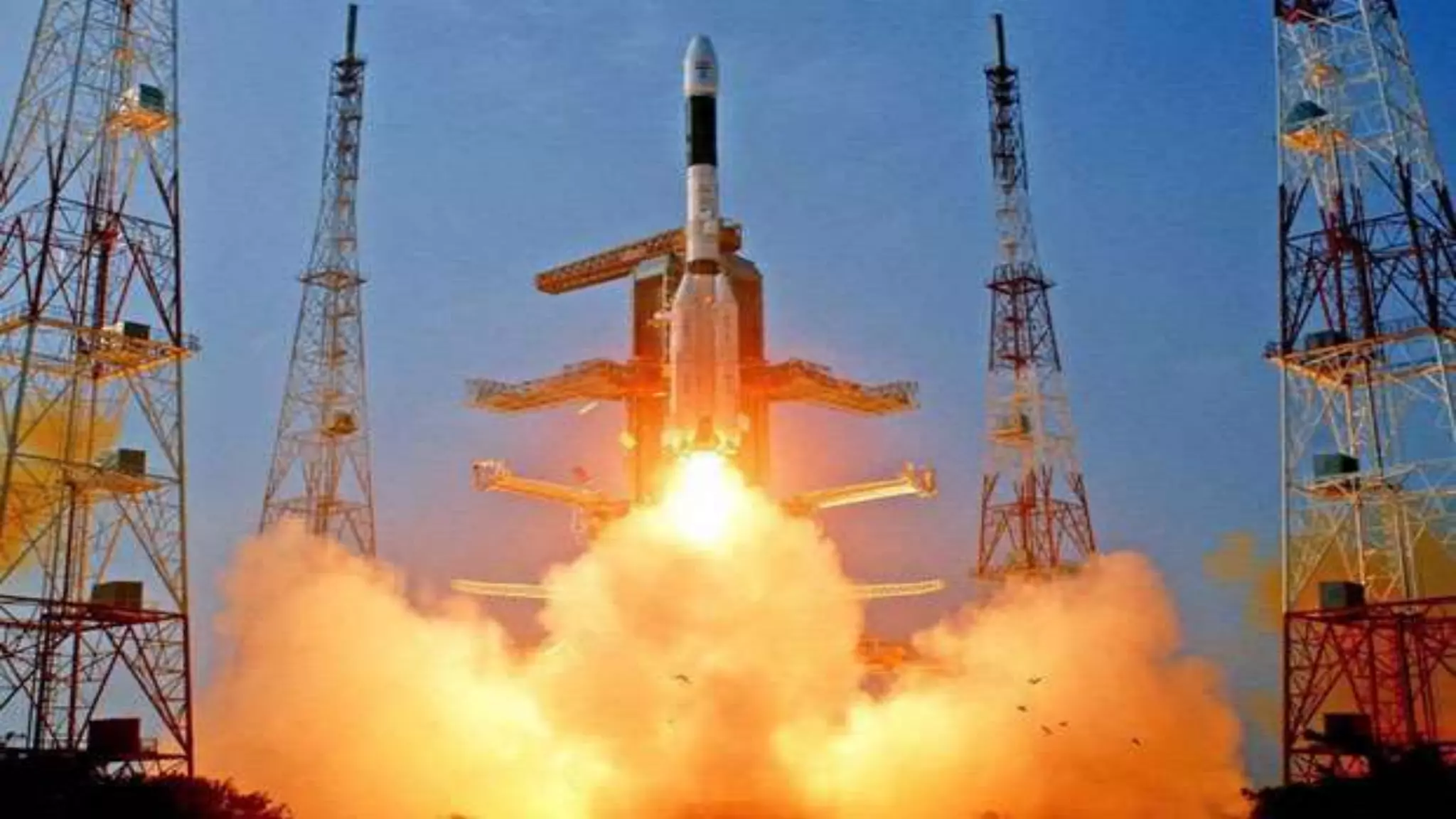
• First country to reach Mars in its maiden flights in September 24, 2014 with a budget of just $70 million
USD and just one of four space agencies to reach Mars.
• On April 4, 2014, made history with 25 consecutive successful launches with the Polar Satellite Launch
Vehicle or PSLV.
• On December 18, 2014, ISRO first launched its Geosynchronous Satellite Launch Vehicle (GSLV) along
with the first prototype of a crew module aimed at carrying the first ever Indian human mission to
space in future.
FUTURE PROJECTS FOR ISRO
• Reusable Launch Vehicle- Technology Demonstrator
• Unified Launch Vehicle: objective is to design a modular architecture that will enable the replacement
of the PSLV, GSLV Mk I/II and GSLV Mk III with a single family of launchers.
• Chandrayaan 2: India’s first mission to Moon will include an orbiter and lander-rover module
• Venus exploration: An orbiter mission that will study its atmosphere
• Solar Exploration Program: A mission to study solar Corona in visible and near IR bands.
• Space Capsule Recovery Experiment II: A project to create a fully recoverable capsule and provide a
platform to conduct microgravity experiments on Micro-biology, Agriculture, Powder Metallurgy, etc.
SOURCES
• https://targetjobs.co.uk/careers-advice/job-descriptions/277079-aeronautical-engineer-job-description
• http://www.aerospaceweb.org/question/history/q0154.shtml
• http://www.digitaltrends.com/features/ten-amazing-space-projects-from-nasa-and-beyond/4/
• http://www.rankred.com/top-10-space-research-organisations-world/
• http://www.mea.gov.in/in-focus-article.htm?23198/Important+milestones+crossed+by+India+in+space
• https://en.wikipedia.org/wiki/Indian_Space_Research_Organisation#Future_projects

Aerospace engineering

  • 1.
  • 2.
    WHAT IS AEROSPACE ENGINEERING? •Aerospace engineering is the primary field of engineering concerned with the development of aircraft and spacecraft. It is divided into two major and overlapping branches: aeronautical engineering and astronautical engineering.
  • 3.
    WHAT IS ANAIRPLANE? • Aircraft • More general term • Refers to any heavier-than-air object that is • Supported by its own buoyancy • Supported by the action of air on it’s structures • Airplane • Heavier-than-air craft propelled by an engine • Uses aerodynamic surfaces (wings) to generate lift
  • 4.
    WHY SO MANY TYPES? •Every modern aircraft is built for a specific purpose • Different altitudes • Different speeds • Different weight-carrying capacities • Different performances
  • 5.
    TYPES OF AIRCRAFTS •Jet fighter • Relatively light weight • Highly maneuverable and very fast • Carry small amounts of weight, including fuel • Must refuel on long flights • Passenger Airplanes • Larger, carry more weight, fly longer distances • Less maneuverable and slower
  • 6.
    FIVE BASIC STRUCTURAL COMPONENTS • Fuselage •Main body structure • All other components are attached to it • Contains • Cockpit or flight deck • Passenger Compartment • Cargo Compartment • Produces lift but can also produce a lot of drag
  • 7.
    FIVE BASIC STRUCTURAL COMPONENTS • Wings •Most important lift- producing part of the aircraft • Also carries fuel • Designed so that the outer tips of the wings are higher than where the wings are attached to the fuselage. • Called the Dihedral • Helps keep the airplane from rolling unexpectedly • High wing • Mid wing • Low wing
  • 8.
    WING DESIGNS • StraightWing (Small Planes) • Rectangular • Tapered • Rounded or Elliptical • Sweepback Wing (Fast Planes) • Moderate • Great • Forward • Delta Wings (Supersonic Planes) • Simple • Complex • Swing Wing • Takeoff and Landig –Straight • Cruise mode- sweep back • Inter-Changeable
  • 9.
    WING COMPONENTS • Trailing edgeequipped with flaps • Move backwards and forward • Increase the area of the wing and the camber of the airfoil • Different from the ailerons, also located on the trailing edge of the wing • Spoilers • Located on the top of the wing • Opposite direction from the flaps and the slats • Reduce lift by disrupting the airflow over the top of the wing • Deployed after the airplane has landed and lift is no longer needed • Increase drag
  • 10.
    WING COMPONENTS • Slats • Locatedon the leading side • Slide forward and increase the area o the wing and the camber of the airfoil • Flaps and Slats • Used during takeoff and landing • Increase lift at slower speeds
  • 11.
    FIVE BASIC STRUCTURALCOMPONENTS • Empennage • Also known as the tail assembly • Provided stability and control • Two main parts • Vertical stabilizer fin to which to which the rudder is attached • Horizontal stabilizer which the elevators are attached • Undercarriage • Also known as the landing gear, which is made up of • Struts • Wheels • Brakes • Can be fixed or extractable • Standard tail • Twin tail • T-tail • V-butterfly tail
  • 12.
    FIVE BASIC STRUCTURALCOMPONENTS • Propulsion System • A machine that produces thrust to push an object to push an object forward. • The amount of thrust depends on the mass flow through the engine and the exit velocity of the gas • Propeller • Turbine • Scramjet/ Ramjet • Rocket
  • 13.
    TYPES OF PROPULSION •Liquid Fuel • Carries fuel and oxidizer in separate tanks • Fuel circulates through cooling jacket before entering combustion chamber • Circulation preheats the fuel for combustion and helps cool the rocket • Ion • Coils are heated to change the fuel, such as xenon into a vapor • Hot platinum or tungsten ionization grid vapor changes the flowing vapor into a stream of electrically changed particles called ions. • Nuclear • Uses heat from a nuclear reactor to change a liquid fuel into gas • Some of the fuel heated by the rocket flows through the turbine • Turbine drives the fuel pump
  • 14.
    TRAVELING IN SPACE • Rocketsprovide high sped, high power transportation, both within the Earth’s atmosphere and in space. • Military use • Atmospheric Research • Launching probes and satellites • Space travel
  • 15.
    MILESTONES IN AEROSPACEENGINEERING • First Human Flight, Pilâtre de Rozier and the Marquis d'Alandes, Montgolfier balloon, 21 November 1783 • First Manned Powered Flight, Orville Wright, Wright Flyer I, 17 December, 1903 • First Satellite in Orbit, Sputnik, 4 October, 1957 • First Manned Moon Landing, Neil Armstrong and Edwin ‘Buzz’ Aldrin, Apollo 11, 20 July, 1969 • First Human Space flight, Yuri Gagarin, Vostok I, 12 April, 1961 • First Manmade Object to leave the Solar System, Pioneer 10, 13 June, 1983 • First Commercial Airline Flight, Tony Jannus, Benoist Type XIV airboat, 1 January, 1914 IN NO PARTICULAR ORDER
  • 16.
    AERONAUTICAL VS. ASTRONAUTICAL ASTRONAUTICAL •Focuses on applying physics, mathematics and other disciplines in order to construct space crafts. • Astronautical engineers work with special emphasis placed on astrodynamics, aerospace systems design and control systems. AERONAUTICAL • Focuses on applying physics, mathematics and other disciplines in order to construct aircraft. • Aeronautical engineers work to make sure propulsion systems operate efficiently and that an aircraft's aerodynamic performance is sufficient.
  • 17.
    KEY SKILLS FORAEROSPACE ENGINEERING • strong mathematical, analytical and problem solving skills • technical expertise • creativity and innovative thinking • attention to detail • a strong awareness of safety issues • communication skills, both verbal and written • project and time management skills • commitment to keeping up to date with technical developments
  • 18.
    TOP UPCOMING ANDCURRENT AEROSPACE PROJECTS • Juno • The JUpiter Near-polar Orbiter was launched from Cape Canaveral Air Force Station on August 5, 2011 and will arrive on July 4, 2016. • Chang’E Lunar Mission • A multi-stage lunar mission with a unmanned rover being sent in 2012 and a manned mission being sent in 2017 to collect lunar samples. • Ion Thrusters Create small thrust levels in comparison to conventional chemical rockets, but achieve high specific impulse. They could be practical in the vacuum of space. • Dextre Space Robot • Will assist astronauts on ISS in repairing the station. There are four main tools to use for repairs, and the robot runs on 1,400 watts of power, weighs about 3,300 pounds, and stands almost 13 feet tall. • Orion Spacecraft • Perhaps the most interesting of all missions, 750000 pound behemoth can withstand 1.35 times gravitational force. IN NO PARTICULAR ORDER
  • 19.
    TOP UPCOMING ANDCURRENT AEROSPACE PROJECTS CONT. • Virgin Galactic SpaceShip Two • An air-launched suborbital spaceplane type designed for space tourism, launched in 2011 with a top speed of 4000 km/h. • Mars Space Laboratory • Launched in 2011, it is a major upgrade from the current rovers, the MSL has 10 times the instrumentation and will be able to examine mineral deposits in greater detail. • Aquarius Mission • Launched in 2010, it is a satellite that will scan oceans for “salinity” (or saltiness) in order to understand climate change on a global scale. • Mars Reconnaissance Orbiter • Launched in 2005, MRO is a multipurpose spacecraft designed to conduct reconnaissance and exploration of Mars from orbit. IN NO PARTICULAR ORDER
  • 20.
    TOP 10 SPACERESEARCH ORGANIZATIONS 1. NASA Goddard Institute of Space Studies 2. Russian Federal Space Agency 3. European Space Agency 4. Japan Aerospace Exploration Agency 5. Indian Space Research Organization 6. China National Space Administration 7. Space Studies Institute (California) 8. Space Science and Engineering Center (Wisconsin) 9. International Space University (France) 10. International Space Science Institute (Switzerland)
  • 21.
    MILESTONES IN ISRO •First country to reach Mars in its maiden flights in September 24, 2014 with a budget of just $70 million USD and just one of four space agencies to reach Mars. • On April 4, 2014, made history with 25 consecutive successful launches with the Polar Satellite Launch Vehicle or PSLV. • On December 18, 2014, ISRO first launched its Geosynchronous Satellite Launch Vehicle (GSLV) along with the first prototype of a crew module aimed at carrying the first ever Indian human mission to space in future.
  • 23.
    FUTURE PROJECTS FORISRO • Reusable Launch Vehicle- Technology Demonstrator • Unified Launch Vehicle: objective is to design a modular architecture that will enable the replacement of the PSLV, GSLV Mk I/II and GSLV Mk III with a single family of launchers. • Chandrayaan 2: India’s first mission to Moon will include an orbiter and lander-rover module • Venus exploration: An orbiter mission that will study its atmosphere • Solar Exploration Program: A mission to study solar Corona in visible and near IR bands. • Space Capsule Recovery Experiment II: A project to create a fully recoverable capsule and provide a platform to conduct microgravity experiments on Micro-biology, Agriculture, Powder Metallurgy, etc.
  • 24.
    SOURCES • https://targetjobs.co.uk/careers-advice/job-descriptions/277079-aeronautical-engineer-job-description • http://www.aerospaceweb.org/question/history/q0154.shtml •http://www.digitaltrends.com/features/ten-amazing-space-projects-from-nasa-and-beyond/4/ • http://www.rankred.com/top-10-space-research-organisations-world/ • http://www.mea.gov.in/in-focus-article.htm?23198/Important+milestones+crossed+by+India+in+space • https://en.wikipedia.org/wiki/Indian_Space_Research_Organisation#Future_projects